Home

Cast of Characters : The Witnesses

1 Comment

The Portsmouth Community Theater is rehearsing for a performance of “The Ghostly Witness” Sunday (Sept. 8) , at 4 PM at the Portsmouth Historical Society Museum.  The actors appreciate knowing more about he characters they portray.

Henry Strait

Henry Strait might have been about 21 at the time of the trial. He boarded with the Cornells, but he was the apprentice of  Greshom Woddell and was learning to be a wheelwright. He was from Wales and when he was 15 he came to Rhode Island under contract to Woddell. That was how he paid his way to America. He was obligated to Woddell for six years work.   He could not write, but he did seem to have the ability to speak with the Native Americans in the area.  Strait was one of the first to come into Rebecca’s room after the fire and his testimony contradicted Thomas Cornell Jr. about Rebecca not eating with them when they had salted mackerel.

Sarah Cornell

Denise Betz as Sarah Cornell rehearses with Ron Marsh who portrays Thomas Cornell

Sarah Earle Cornell grew up in a affluent family in the household of her father, Ralph Earle.  That household would have had servants to help the women with their work at home and in the garden.  After her marriage to Thomas Cornell, Jr, she was the only able bodied woman in the household and would have milked cows, picked berries and fruit, tended the garden as well as tended to the indoor chores of cooking, cleaning and washing.  Her testimony alone put a potential murder weapon in Thomas’ hand. 

Sarah was the second wife of Thomas, so she entered marriage with a full household, Thomas, his four sons and Rebecca.  Sarah had two daughters  with Thomas and was pregnant with the third daughter at the time of the trial. She named that child “Innocent” and this daughter was an ancestor of Lizzie Borden.

Thomas’ younger brother William advocated for Sarah to stand trial in 1675 even though Thomas had already been tried, found guilty and hanged. Some thought that Sarah was a co-conspirator because another person said they overheard a conversation between Thomas and his wife.  The couple promised that “If you will keep my Council, I will keep yours.”   Sarah was indicted and stayed in prison while awaiting trial.  She was found “not guilty”.  

She was remarried to a man named David Lake and had more children with him.  

Mary Cornell

Mary was the daughter in law of Rebecca Cornell, the wife of John Cornell.  Her father was John Russell.  His testimony, along with that of John Briggs, helped re-open the Cornell case.  John Russel said that a friend reported a conversation in which Rebecca showed fear of her son Thomas and wanted to leave his home.  Mary lived in the Dartmouth area and her testimony centered around how Rebecca believed that her son Thomas neglected her.

Rebecca Woolsey

Rebecca was one of the older children of Thomas Cornell, Sr and Rebecca.  After the rest of the family came home from the Bronx after the massacre of the Hutchinson family, Rebecca stayed in New York.  Her testimony was given by deposition in Flushing, New York.  Rebecca Woolsey’s testimony added another possibility – that her mother had some suicidal thoughts.
Cast of Characters: John Briggs and his vision

Leave a comment

Although his sister Rebecca Cornell was buried and the coroner’s inquest labeled her death an accident, John Briggs re-opens the case with a “ghost story” – he claimed he had seen his sister.  With Briggs’ story and the testimony from a Dartmouth resident that Rebecca feared her son, the case was re-opened.  Who was John Briggs and why would his story lead to the exhumation of the body and ultimately a trial?

Born in 1609, John Briggs was one of the youngest of the signers of the compact of 1638 that led to the settlement of Aquidneck. He played a prominent part in the government of the town, serving as juryman, constable, town councilor, surveyor of lands, special commissioner, and Deputy to the General Assembly.  John Briggs married Sarah Cornell – sister of Thomas Cornell Senior.  A brother and sister Briggs (John and Rebecca)  married a brother and sister Cornell (Thomas and Sarah).

John came to Boston in 1635 on the ship, the Blessing.  This was a few years before his sister and her family came over.   He was a follower of Anne Hutchinson, and when when she ran into trouble with the leaders of the Massachusetts Colony it became unsafe for her supporters to stay there.  They banded together to found a new settlement in Portsmouth.

John Briggs is documented as having a license to operate an ordinary (tavern)  in Portsmouth RI, and in Dartmouth.  It was customary for town meetings to be held at taverns and it is clear from the records that many town meetings were frequently held at the house of Mr. John Briggs, Sr.   Although Briggs was unable to write – he was a long standing town leader. He was a credible man with a good reputation.

Ghosts were taken seriously even among the Protestant reformers.   The view at the time was that ghosts were spirits of the dead who always had a reason for their appearance – usually to correct an injustice that would not be detected by other means. Antinomians and Quakers believed that God could speak to them in their dreams.  John Briggs dream or vision of his Sister Cornell would not be easily dismissed.

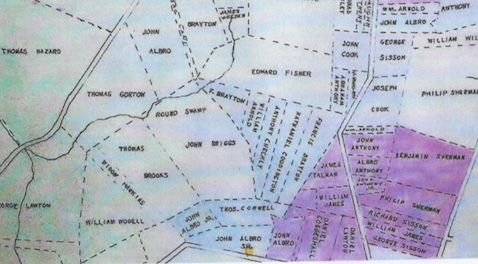
Briggs landgrant

Cast of Characters: The Accused – Thomas Cornell, Jr.

2 Comments

Thomas Cornell, Jr was accused of murdering his mother, Rebecca Cornell. Who was he? By most accounts Thomas was an integral part of the Portsmouth community. He was born in 1627 in Saffron Walden, Essex, England. He may have attended school there because he was able to read and write – a very valuable skill in early Portsmouth. He was eleven years old when his family emigrated from England to Boston. The Cornells were coming to Boston just at the time that Anne Hutchinson’s and her followers were leaving to begin a community in Portsmouth.  The Cornells bought William Baulston’s tavern in Boston, but they ran into trouble with the authorities there.  Thomas’ uncle, John Briggs, was in the group of Portsmouth founders and the Cornells followed him to Portsmouth in 1643. They were friends of Anne Hutchinson and went with her group to a new settlement in the Bronx.  The Cornells escaped the fate of the Hutchinson family and they returned to Portsmouth.

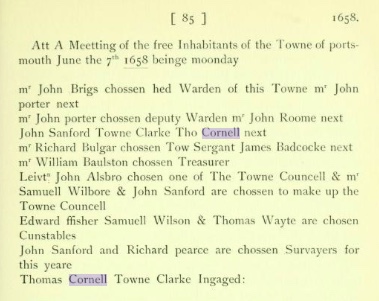
Thomas Cornell, Jr serving as Town Clerk 1658

Thomas played many roles in the Portsmouth community.  In 1658 he was chosen as town clerk.  He was a juror and even oversaw the construction of the prison he would eventually inhabit. He was a constable, deputy to the high court, set tax rates and was a town councilman.    Thomas seems to have left Portsmouth in 1661 after some quarrels with the town over his late father’s failure to construct a brew house.  The town wanted the return of the land that was granted.  Thomas may have been in the Dartmouth area since we know he had property there. He held offices in Dartmouth at the same time he held offices in Portsmouth.   In July of 1663 Rebecca Cornell deeded the family homestead to her son Thomas effective at her death.

Thomas Jr. had been married to Elizabeth Fiscock and they had four sons, Thomas, Stephen, Edward and John. There are indications that mother Rebecca and Elizabeth had a good relationship.   The speculation is that Thomas came back to the family homestead and his mother Rebecca when he was left a widower.  Thomas married Sarah Earle in 1668 and they had three daughters (one of whom was born after Thomas’ death).  The friction between Sarah and her mother-in-law was brought to light in the testimony of witnesses at Thomas’ trial.

Meanwhile Thomas worked the family homestead well.  They kept a good dairy, and used the wool from their sheep to spin valuable “trading cloth.”  A native American called Wickhopash (or Harry) was convicted of stealing Thomas Cornell’s rapier and a valuable length of this trading cloth.    Thomas was raising horses on his Dartmouth property for the West Indian market.  Thomas Cornell, Jr was not a poor man, but he wanted the resources to join in the Narragansett purchases and other financial deals that the Portsmouth men around him were capable of making.

Thomas’ last request was to be buried in the family plot next to his mother, Rebecca.  That request was denied, but he was buried at the homestead far away from his mother.

Cast of Characters: “Ghostly Witness”: Rebecca Cornell

1 Comment

This blog will give you a bit of background to the characters you will meet when the Portsmouth Community Theater presents their play – “The Ghostly Witness” – at 4 PM at the Portsmouth Historical Society.

Rebecca Cornell’s mysterious death in 1673 has been the subject of stories, books and even a play.  Rebecca Cornell, however, had another claim to fame.  Rebecca was a friend of Anne Hutchinson and she was one of Portsmouth’s founding mothers. Back in 1630s Thomas and Rebecca Briggs Cornell were respectable members of the Saffron Walden community in Essex, England. He was 45 and she was 38 when they sailed for Boston in 1638 with their eight children. Thomas and Rebecca came to Boston in 1638, just as Anne and her followers were leaving.  They bought the house of William Baulston (who also is part of the Ghostly Witness story) and received his license for innkeeping.  Thomas soon ran into trouble in the Massachusetts Bay Colony.  Thomas received fines for selling wine without license. Neither Thomas nor Rebecca were literate, but Rebecca was considered an accomplished spinster (spinner).  Thomas was in trouble for his religious beliefs and they government refused to renew his license.

In 1640 the couple departed for Portsmouth. Thomas was made a freeman in Portsmouth and became a constable. By 1642 the Cornells, the Hutchinson and the Throckmortons and others had settled in large tracts of what is now the Bronx. The Hutchinson and the Cornells had adjoining land. When the Hutchinson family was massacred in August of 1643, the Cornells lost property, but their family was preserved. A boat brought the Cornells to safety and away from the hatchets and flames that killed their neighbors. The Cornells lost cattle and their home was burned.

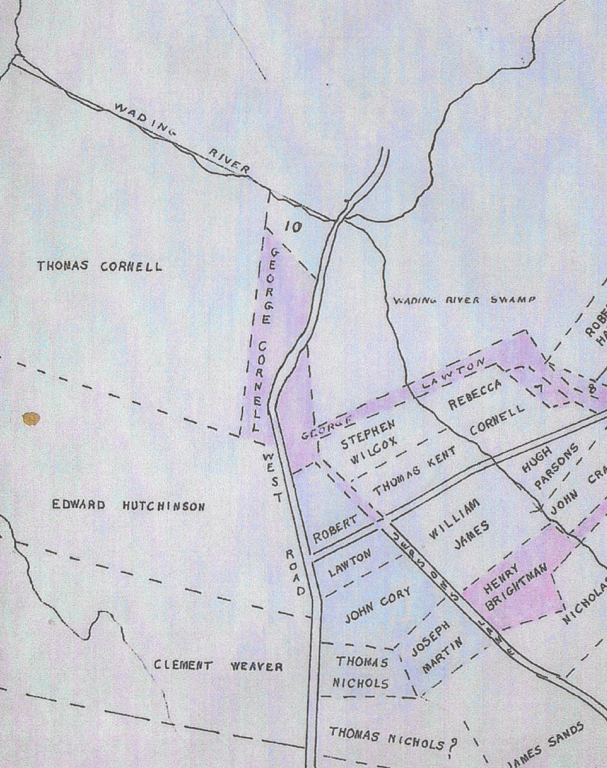
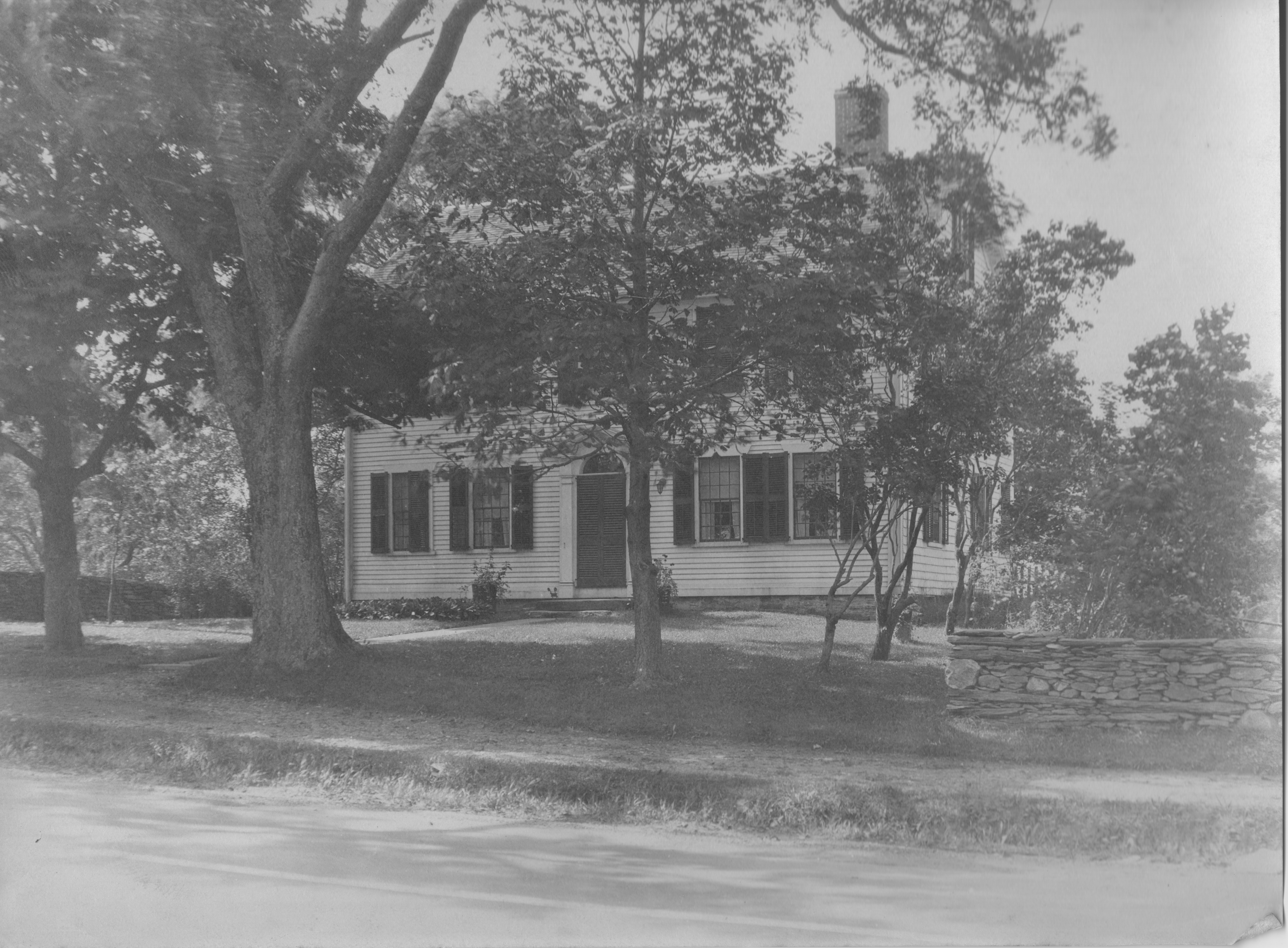
The Cornells headed back to Portsmouth. Thomas Cornell was given ten acres of land by November of 1643. Their older daughters remained in New York as new brides.   Thomas accumulated land grants in both New York and Portsmouth. In July 1646 Thomas was granted a 100 acre homestead that would be the location of Rebecca’s mysterious death in 1673. This grant is the land around the Valley Inn property today.  Rebecca is left with the property when her husband dies.  Part of the tension between Rebecca and her son Thomas is that the junior Thomas Cornell and his family of six children are living with Rebecca on this family homestead.

West land grant map showing Cornell property

Source:  Killed Strangely: The Death of Rebecca Cornell by Elaine Crane.  Cornell University Press, 2002.

SaveSave

Found in Our Collection: Antique Mail Sorting Table

1 Comment

In 2017 the curator’s committee of the Portsmouth Historical Society had to pack up and store every item in our museum because the building was getting a necessary painting. Most things were put back in place last year, but it took until now for us to find what was stored in our permanent storage shed at the back of our property. Coming out of the shed was a treasure – an antique mail sorting table.

Mail Sorting “Table”

Where did it come from originally? Who used it? How old was it? A newspaper clipping from 1930 provided some of the answers.  The article is about an antiques exhibit for the benefit of St. Paul’s Church that was held at the home of Miss Hicks.  Among the featured items was a sorting table used by Miss Hick’s grandfather, Oliver D. Greene, who was Portsmouth postmaster from 1822 to 1845.  His son, Oliver E. Greene, was postmaster from 1845 to 1851.  Then Oliver D.’s widow, Phebe, later became postmistress from 1851 to 1854.    Like most items and homes in Portsmouth, this “mail sorting table” was used by many generations.  The sorting table was taken out to the stagecoach which brought in the mail.  The mail was put on the sorter and then the postmaster (or postmistress) would sort the mail for delivery.  Miss Hicks said the sorting table was used in the old Greene house and then moved to an historic home at the foot of Quaker Hill that had once been Lay’s Tavern.

When we look at the mail sorting table more closely, we find some labels penciled into the wood.  The labels are items such as “marriage certificates,” “town meeting warrants” and “treasurer’s reports.”  What are these labels doing on a mail sorting table?  The answer is that the table was passed down in the Greene family to grandson George B Hicks – Portsmouth Town Clerk from 1909 to 1933.

The mail sorting table is now on display in an appropriate place.  It is located near the “last mail wagon” in our Old Town Hall on the Portsmouth Historical Society grounds.

Touring Around Early Portsmouth with Edward West: Union St. and Wapping Road

1 Comment

Edward West’s article “The Lands of Portsmouth” provides a quick tour around early Portsmouth’s landowners. Heading from the West Path across to the East Path, he mentions a bridge to cross the stream. It was built in 1713 and called the New Bridge. It seems that the west part of Union Street did not cut across to the West side until that bridge was built. Old postcards show a bridge just to the east of Julia Ward Howe’s home and across from Thurston’s tree farm. To the north of the bridge was Wading River Swamp and north of that Round Swamp. Thomas Cornell had more land in this area and it was called Circuit Farm. On the south side of Union were the grants of William James, Hugh Parsons and Thomas Lawton’s “Hunting Swamp Farm.”

At the corner of Union and East Path was the Southermost School. It was across the street from where it is now at the Portsmouth Historical Society grounds. One story West tells concerns the widow Sarah Strange. She took up residence at the schoolhouse when her husband died. At a town meeting in 1746 she was ordered out so that the school might be improved and used as a schoolhouse once again. We know from other records that the widow of the first schoolmaster moved in when her husband died as well.

West now takes us down “the Newport Path” through Brayman’s Lane (laid out in 1713) to Wapping Road. Wapping was laid out as early as 1661 and ran between many of the larger farm grants. Descriptions of Wapping include the “Great Rock” which today is still located on Wapping near the Middletown line. The land grants belonged to Bartholomew West, Samuel Hutchinson and John Sanford. On the west side was the “Long Swamp Farm” of Thomas Lawton. On the east side was the farm of Thomas Burton and old records mention his ferry which probably went to Fogland. Turning east you could go to Sandy Point Farm that was first given to William Aspinwall and after he left, to Edward Hutchinson.

Touring Early Portsmouth: Edward West’s West Shore Continued

1 Comment

This blog series is based on Portsmouth historian Edward West’s article “The Lands of Portsmouth, RI.” that was published in 1932.  West continues his tour down the West Shore by giving us a glimpse of neighborly friction. We start south of Cory’s Lane with land that had been granted to John Porter.  In 1675 John had given Thomas Shrieve permission to build on a house lot on his property.  Mrs. Shrieve must have had a reputation as a troublemaker because the Town Meeting got involved. “It is consented unto by vote that Thomas Shrieve hath liberty to sett down for the present, upon his wife’s peaceable and good behavior towards her neighbors: until he can more conveniently provide for himself or the town take further orders. Mr. William Baulston, Philip Sherman and Mr. John Briggs are appointed to speak with Shrieve’s wife and William Charles and George Lawton’s wife to give them the best advice and warning for their own peace and the peace of the place.”

In West’s tour we come to the Wading River where George Lawton had been granted 40 acres to build a mill for Mr. Baulston.  George Lawton’s land was mainly on the East side of West Main Road.  Apparently Lawton built a dam on the river, but in 1672 there was concern that it made the bridge there unsafe.  Since Lawton created the dam, the town ordered that George Lawton should make the bridge “sufficient” and that the West Main highway should be restored to the way it was before the damn was built.  Robert Dennis and Jacob Mott were to deal with Lawton on this matter.  Apparently Lawton did not make the repairs because they sent more representatives to him because it “was so dangerous.”

The last property before the Newport (now Middletown) border belonged to Thomas Cornell (100 acres), Edward Hutchinson (100 acres) and Joshua Coggeshall had land that was partly in Portsmouth and partly across the town line.

Touring Early Portsmouth: Along the West Shore to Cory’s Lane

2 Comments

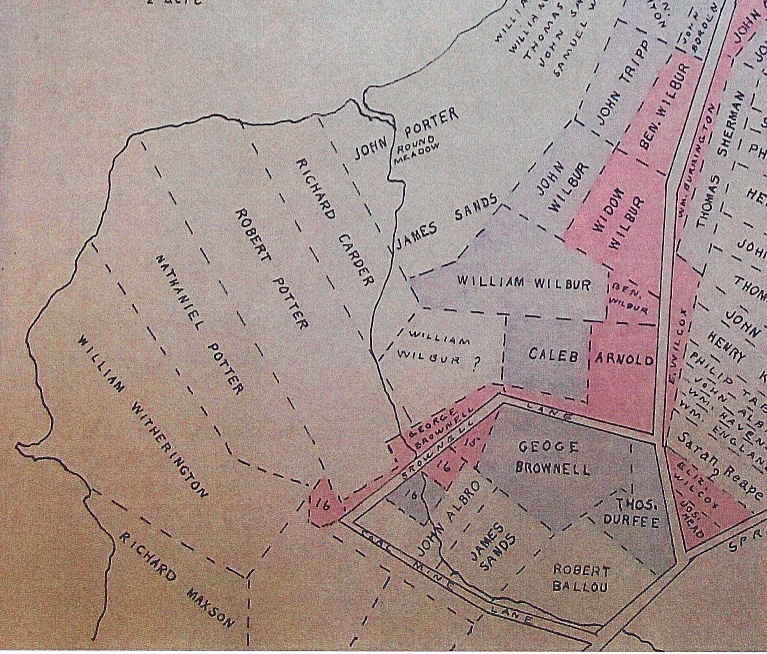
Portsmouth historian Edward West, in his article “The Lands of Portsmouth, R. I., and a Glimpse of Its People,” continues to take his readers from Bristol Ferry south to the West Shore. There was active buying and selling of these land grants.  For example, Samuel Wilbur acquired “Long Meadow” from several grantees.  At the mouth of the brook was another meadow – “Round Meadow” which was the property of John Porter.  The brook was called “First Brook” by the early settlers in 1643, but it became “Little Silver Brook” when it was the property of Robert Ballou.  We know it as Willow Brook and this property was sold to artist Sarah Eddy by the Ballou family.

West Shore South of Bristol Ferry

Going down the highway (known as the “King’s High Road” (we know it as West Main Road), was the property of William Baulston.  This was a large tract of 240 acres and there was a small stream through it.  West thinks it might have been larger in colonial days because it was called Mill River or sometimes Two Mill River.  George Lawton had a mill on this property in 1648.  Also on this river, located nearly down to Freeborn’s Creek, was the mill of James Sands and Samuel Wilbur.  They received a grant for this mill in 1642.  William Freeborn bought the mill in 1655 and the land remained in his family until 1800.  John Tyler also had a mill on this same river.

West Shore to Cory Lane

What we know as Cory’s Lane was laid out in 1683 as “highway 2 rods wide beginning at the sea side on the west side of the Island at the head of William Freeborn’s lot and so to run that breadth to the Common at the head of the land laid out to Ralph Earl, dec.”  In 1717 it was declared a “driftway” down to the water “for the benefit of His Majesties subjects to Pass and repass through, both for cattle, horses, carts, wagons or any carriage or creature whatsoe’er.”

Touring Early Portsmouth: Bristol Ferry area

3 Comments

West Land Grant Map of Bristol Ferry Area

In the 1930s, Portsmouth historian Edward West did some remarkable work with land evidence that benefits us all. Among his works are the Land Grant Maps that tell us where the early settlers were given land. How he worked through all the locations with rods as measurements, I will never know. West tells us that upon founding the town “they immediately made laws governing the size and location of the house lots.” They began recording property in a book. There were times when land transferred without records, so the accuracy of the land evidence may be questionable in some cases. West found some of these properties as he worked with other deeds.  He also wrote an article that appeared in the Rhode Island Historical Society Journal in July of 1932 (The Lands of Portsmouth, R. I., and
a Glimpse of Its People) that gives us a commentary to go with the maps. This series of blogs will be a tour of early Portsmouth using his article and his maps.

The Bristol Ferry Area: Some of the first grants given were in the Bristol Ferry area.  As the town was laid out, Sprague Street was the southernmost border.  West tells us an interesting story.  Just above the Bristol Ferry is the 3 acre lot that Richard Searl sold to Mary Paine.  Mary was a bar-maid at Baulston’s public house.  Searl exchanged his lot for a pint of wine.  He didn’t give Mary a deed, but the town council ratified the sale on the testimony of a witness in 1666.  Mary later married John Tripp and that piece of land became the site of his ferry house.

In 1719 the land to the south of the ferry was ordered to be kept open “for the convenience of the public in importing and transporting horses, cattle, sheep, wood etc.”

The first street to the right was “Stoney Lane.”  It was a short “driftway” (a path used to drive cattle or sheep) between Richard Borden’s property and that of Mistress Harts.  South of that was a lane that led to a “watering place.”  On the map it is called Hawkins Lane for Richard Hawkins and his wife Jane who was a friend of Anne Hutchinson. (Check the reference below to learn more about Jane.) This “watering place” was laid out in 1713 as a public place for the washing of sheep and general water uses.  Also in 1713 Thomas Burton received a piece of land that was known as the “Training Place” before that.  That ground may be where the militia had trained.

Land grants were given out in 1657, 1693 and the last lands were given out in 1713.  By 1713 the commons were laid out, highways were straightened and the town was considered finished as laid out from Sprague Street northward.

Jane Hawkins:  https://portsmouthhistorynotes.com/2017/07/18/founding-mothers-jane-hawkins-accused-of-witchcraft/

West map on Portsmouth Digital Archives:  http://www.portsmouthhistorycenterarchive.org/items/show/144

Preserving Our Walls

Leave a comment

“Why should we care about stone walls?” This question was asked by a Portsmouth elementary student after I had given a presentation on stone walls to a class.  I answered that stone walls are part of our heritage as a farming community and that they are history we can touch.  I am haunted by the question because I hope Portsmouth children and other residents will appreciate the walls and work to preserve or protect our walls.  It may just be that we have so many beautiful walls that our families just don’t appreciate how special our walls are.  Sadly stone walls at Glen Park were among town property vandalized recently.  Thieves have stolen some of the critical capstones on the walls leading to Glen Manor House.  Everyday wear from people sitting or walking on the walls can dislodge stones as well.

There are efforts to preserve our walls.

Our town has an ordinance that seeks to protect the walls that border the town roads.  The Stone Wall Preservation Ordinance of the Town of Portsmouth aims “to protect one of the Town’s important cultural resources, historic stone walls, saving one of the beautiful features of the Town for the people of tomorrow and preserving the rural character of the Town.”

The Aquidneck Island Stone Wall Initiative is a joint project of the Newport County Preservation Society and Preserve Rhode Island. Their vision statement states: ” It is intended to protect and improve Aquidneck Island’s scenic quality by preserving its historic stone walls. Stone walls are visible reminders of the Island’s rural agricultural history and contribute to its sense of place and scenic character.”  With funding from the vanBuren Charitable Trust, the Initiative has restored a wall by the Simmons Farm and it is now working on a wall by the Norman Bird Sanctuary.  It is an effort to call attention to the need to preserve and protect the walls as part of our cultural heritage.

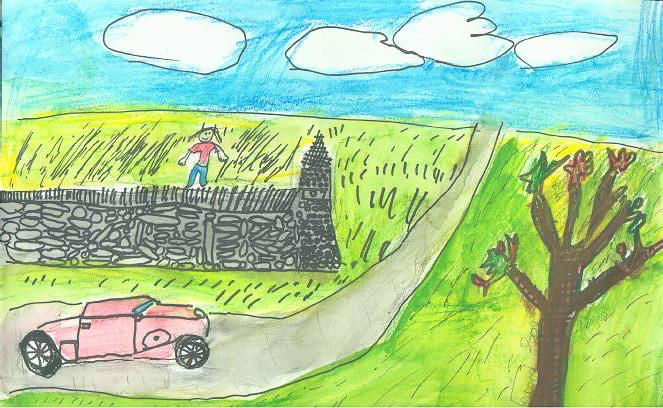
I’m not sure posting “Do not walk on the walls” signs around the athletic fields would work.  Years ago my students were researching the Leonard Brown House and the Camara Sisters (Mary Lou and Gerry) told us a story about the walls.  Mr. Nicholson, the husband of the owner of Glen Farm (Edith Taylor Nicholson) appreciated the walls and wanted the Glen Farm children to stay off of them.  He would pay them a quarter to get down off the wall.  Well, whenever the children saw Mr. Nicholson’s Cadillac coming they would get on the walls just to get their quarters!

Illustration of Children on Glen Walls

All I can do is call attention to the walls with blogs, books and talks.  Perhaps a child (or adult) might appreciate the work involved in building the walls, the beauty of the walls themselves and the farming history the walls represent.

Older Entries Newer Entries