Home

Portsmouth Place Names: Common Fence Point

1 Comment

Edward West map of original settlers.

Some places in Portsmouth have changed names over the years, but Common Fence Point was the name used in 1638 and it is the name used today.  A Borden family genealogy gives us the root cause for the name: “To the northeast of the spring a neck of land extends about two miles, which was nearly separated by creeks, marshes and the town pond from the rest of the island.  This strip of land, called by the natives Pocasset Neck, was set off by the settlers as a common by running a fence from the south end of the pond to a cove on the east side of the island. This common was called the fence common, to distinguish it from the lands outside to the south and west of it, which were all common; and the north point then received the name of common fence point. “(1)

The original settlement of Portsmouth took a pattern that was familiar to the English – homes were in a central village location and their animals grazed on common land around the homesteads.  Recording how each family branded their animals was very important with their stock intermingled in the commons.   While this may have been a good pattern the first year when they needed to be close together for safety, this land use soon gave way to larger scattered farm lots which included their homes.

Edward West’s land grant maps show William Brenton as being the owner of much of Common Fence Point. Common Fence Point shifted to the Durfee Family a short while later.  Thomas Durfee Junior was a Portsmouth Deputy to the colonial Assembly and records show he got an Act passed in 1717 to benefit himself.   “On June 18, 1717, Thomas and his wife Ann petitioned the Assembly … for a good and sufficient highway to be laid out to his farm at Common Fence Point, he having already applied to the committee of the town of Portsmouth, but did not obtain it.  The Assembly ordered the committee to lay out, within one month’s time a good lawful and passable highway fit for horses and carts to pass and repass … “(2)

In 1728 Thomas Durfee Junior deeded 60 acres of Common Fence Point Farm to his son Gideon, but he was to pass it down to his brother Job when he was old enough.  What was farming Common Fence Point like?  Thomas Durfee Jr.’s death inventory gives us some insights.  Among his belongings were spectacles, books, money scales, tailor shears, iron heaters, steelyards, and spinning wheels.  His animals included geese, cattle, horses, sheep and swine.  Among his possessions was a slave.  His home included an “outward room, bedroom, kitchen, bedchamber, “outward room chamber,”  garret and cellar.”  (3)

The 1849 Hammett Map shows Abner Chace holding Common Fence Point and the Chace (or Chase) family seemed to own pieces of the Point for many years.  In 1865  a charter was granted to several men to build and operate the Rhode Island Oil and Guano Company on Common Fence Point.

Pogy boats

By 1900 part of Common Fence Point held the largest fish factory in the country.  The Tiverton based Church Brothers – Daniel, Nathaniel, Joe, Jim, Isaac, Fisher and George went into business together in 1870.  They commissioned the Herreshoff boatyard in Bristol to build the first fishing steamer – the Seven Brothers.  At first they were fishing for food, but they realized that fish oil and fertilizer from the pogy fish (menhaden)  had potential for profit.  They brought a menhaden processing factory in Maine, dismantled it and rebuilt it on Common Fence Point. The complex cookhouse was 35 ft square and there were two large dinning rooms to feed three hundred workers.  A large building held sleeping quarters and a net mending area.  A cooper made barrels for transporting the oil and there were boat shops.  The Church Brothers Fisheries barn burned in 1928 and that was the last of the Church facilities on Common Fence Point.

Common Fence Point gradually developed into a community.  At first many of the houses served as summer homes, but they gradually became occupied year round.  The Common Fence Point Improvement Association has been active in the community since he 1950s and continues to serve the residents of Common Fence Point with music programs, classes, activities for children and as an Arts Center.

(1) Historical and Genealogical Record of the Descendants as Far as Known of Richard and Joan Borden, who Settled in Portsmouth, Rhode Island, May, 1638: With Historical and Biographical Sketches of Some of Their Descendants H.B. Weld, 1899

(2) The Descendants of Thomas Durfee of Portsmouth RI-Vol. 1, by Wm. Reed.  1902.

(3) Genealogical Records of the Descendants of Thomas Brownell compiled by George Brownell, New York, 1910.

Portsmouth Grove, Bradford, Melville — What’s in a Name?

3 Comments

We know the area as Melville today, but if you look at some of the maps from before the Civil War it was called “Portsmouth Grove.”  It was the site of a recreational park with games (ten pin bowling) and rides (like a merry go round). There was a dock for the steam ships to bring customers for a day of fun and recreation. During the Civil War it was the location of Lovell Hospital.  After the war all signs of the hospital vanished after an auction was held to move buildings and equipment off the ground.  Many old homes in the Portsmouth area have additions or woodwork from the old hospital.  The land became private again.

Bradford Coaling Station

In 1901 the Bradford Coaling Station was constructed in the area in order to supply coal to steamers and military transports navigating Narragansett Bay.   Coal was stored until it was loaded onto ships.  Bradford was named for Rear Admiral Royal Bird Bradford whose job was to supply coal to American warships throughout the world.  Vintage postcards from “Bradford, Rhode Island” show images of the coaling station and a coaling towers the background. By 1910 the Post Office became known by the name “Bradford.”

By 1914 the Post Office began to be called “Melville.”  At that time the

Admiral Melville

coaling station was converted to the Melville Oil Depot.  It was named for Admiral George Wallace Melville.  He had been in the Navy during the Civil War and made heroic Arctic expeditions.  He administered the Bureau of Steam Engineering, but he did pioneering work that opened the way for the Navy to power its ships with oil.

The Melville area played a vital role in the war effort during World War II. The Patrol Torpedo Boat training base at Melville was commissioned in the spring of 1942.  In November of 1945 the PT base at Melville was de-commissioned, but by then it had trained approximately 2,500 officers and 20,000 men for duty on PT boats. The base was known as the Motor Torpedo Boat Squadron Training Center at Melville. The small but fast PT boats saw duty in the Pacific against the Japanese and were used in the Atlantic and Mediterranean as well.

Approximately 45 different squadrons of PT boats were trained at Melville which was the only training facility for these boats. Captain William C. Speech was the commanding officer of Melville. The training period consisted of a three month course with one of those months onboard a PT Boat.  John F. Kennedy was one of those trained at Melville.  On September 27, 1942, Kennedy entered the Training Center. He was promoted to lieutenant (junior grade) during the training.  He completed his training there on December 2 and he took over command of a torpedo boat in early 1943. He ended up in the Pacific and the story of the sinking of PT 109 and Kennedy’s rescue of a crew member became famous when Kennedy ran for President.  The PT crews received a number of commendations for heroism and the small but swift PT boat was recognized for its value in the war effort.

Today Melville is known as a recreational and boating area.

Portsmouth Place Names: Turnpike Avenue

Leave a comment

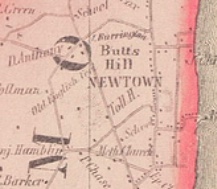
1855 Map showing Toll House

Today Turnpike Avenue is a town road, but it didn’t start out that way. As its name implies, it once was a toll road. In 1804 the “Rhode Island Turnpike Company,” – with business partners Artemus Fish, Abraham Barker, Peleg Fish, Isaac Fish and others, petitioned the State Assembly to make a shortcut to Bristol Ferry and charge people to use the road.  The Assembly granted this request a year later, but added some rules.  The company had two years to create the road or the charter would be void and they could not make the road on any land they had not paid for already.  The capital stock was set at sixty shares at $50 for each share.

According to the charter, the route was “beginning at the fork of the east and west roads near Mr. Job Durfey’s and from thence on a southwesterly course, until it shall meet with the east road near the corner of the orchard late belonging to Mrs. Bathsheba Fish.”  A “turnpike” (a pike or pole on a swivel that was turned to let the travelers through after they paid their toll) was set up in a toll house by the Methodist meeting house near Dexter Street.  The Turnpike ran a mile and three quarters.  By 1853 there was a suit filed against the turnpike company, but it existed until 1864 when the owner, Gardner Thomas, donated the turnpike road to the town.

Portsmouth Place Names: Island Park

Leave a comment

1848 map

What we call “Island Park” today had other names in the past.  In early days it was called Ferry Neck and the main street was called “Ferry Neck Road.”  It was the first highway to an important ferry between Tiverton and Portsmouth.  The land around it was mainly grazing ground for cattle.  In 1848 the Hammett map calls it “Road to the Stone Bridge.”  Later it was called Greene’s Farm for the family that owned the land.  The main street was called Buffum’s Lane.

The name evolved to “Island Park” because electric cars came to the area in June of 1897.   “Island Park”  first appears in town records when the town council allowed a shooting gallery to be erected in Island Park on “Green’s Estate” by Joseph Lunan and Sons on August 12, 1901.

The trolley car companies developed a place at the end of their lines for people from the Fall River area and Aquidneck Island to go during weekends for the beach and some fun.  The Barker family purchased the park and set up first merry-go-round in Island Park in 1898. A variety of amusements and concessions began to bring in the crowds and the area became residential as well. Families built summer cottages there to be close to the activity. In 1924, Park Avenue was made wider and had a layer of tar and stone on the surface.

Glider swings, rental row-boats, and a dancehall were all added through the years. There was even a horse diving attraction.   By early 1920’s tea rooms, fortune tellers, speak-easies were there as well.  The amusement park  had the 2nd largest rollercoaster in New England.   Built in 1926, it was called the Bullet.

The park changed hands through the years.  Hyman Swartz of Swartz Lumber in Fall River owned it and later it was sold to the Cashman Family in 1925. The park operated up to Hurricane of 1938.  Hurricane Carol hit the area hard as well. The “summer homes” have become more full time residences and Island Park is a community on its own.

“The Bullet” at Island Park

We remember the days of the amusement park as we call it “Island Park” today.

Portsmouth Place Names: Linden Lane

Leave a comment

Linden Lane

One of the most beautiful drives in Portsmouth is up Linden Lane toward the Leonard Brown House and then the Polo Field.   It is named “Linden Lane” for the stately old linden trees that line the drive.

Older Portsmouth maps do not show a driveway or path there.  When the property was owned by Cook Wilcox his house was close to East Main Road.  The property was passed down to Sarah Wilcox Brown after she married Leonard Brown.  They tore down the Wilcox home and built their home further up – the restored home we know as the Leonard Brown House.  The diary of a local carpenter, George Manchester, dates the building of the house to around 1850.  When Leonard Brown died the property was sold to H.A.C. Taylor and added to Glen Farm.  It was Taylor that added the linden trees.  A 1904 gardening journal reports:

“The walls have been curved at the entrance to give the driveway a better effect, and on both sides of the drive, from the road to the Taylor mansion, young linden trees have been put out to make the way ornamental as well as shady. V.A. Vanicek, of the Rhode Island nurseries, furnished the trees and also six car loads of hardy rhododendrons for Mr. Vanderbilt’s Oakland Farm.”

Hurricanes have damaged the trees and there are gaps in the stately rows of lindens, but Linden Lane is still beautiful to behold.

Portsmouth Farmer: Mervin Briggs and Fairholm Dairy

1 Comment

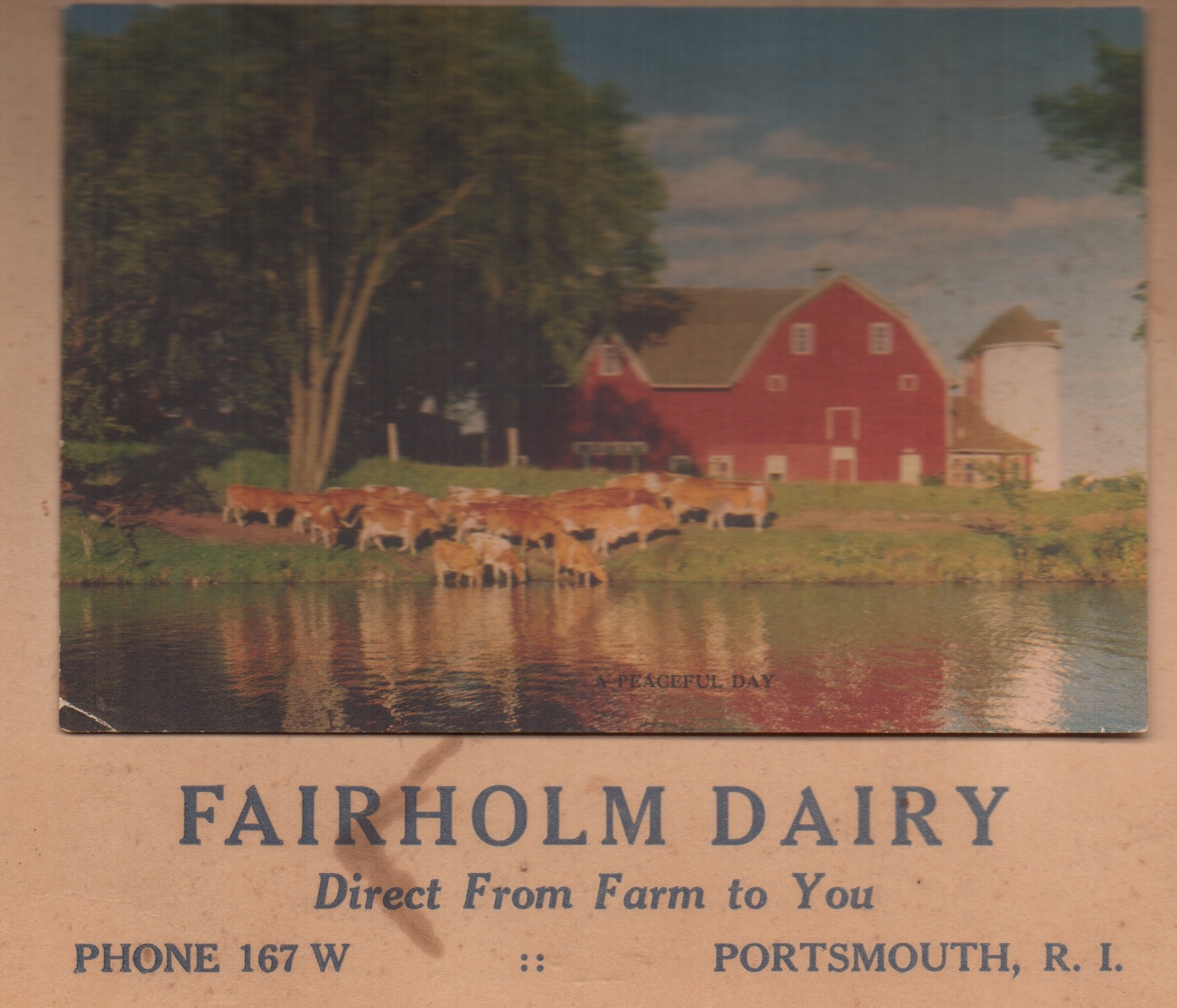
Are you old enough to remember the days when milk was delivered to your home in glass bottles? In the collection of the Portsmouth Historical Society is a calendar advertising the Fairholm Dairy. Located on West Main Road by Hedly Street, it was started by Mervin Briggs and later was run by family members. The dairy developed into a wholesale and retail establishment.  As a family business, Mervin’s sons Barclay, Frederick II and Ernest Briggs all had roles to play. By 1970 it was operated by Mrs. Frederick Briggs and sons Frederick, David and Richard.

Newspaper accounts in 1953 show that the Briggs family had a championship Guernsey cow named Fairholm Senator’s Coronet – that produced 10,423 pounds of milk and 483 pounds of butterfat.  In 1949 when the Glen Guernseys was sold at auction, Mervin Briggs bought one of the Glen Farm prize cows.

Mervin was a dedicated member of the Friends Church in Portsmouth and he played an active role in agricultural interests in the town.  One account lists him as a “Extension Minuteman” who would help to survey Portsmouth farms for food supply in 1943.

Portsmouth Farmers: Frank Chase and Mary Chase Hanks

1 Comment

Frank Chase

Many of the farm tools in the Old Town Hall exhibit were used on Frank Chase’s farm at the bottom of Quaker Hill. Frank was a farmer for 80 years. He was a local pioneer in raising turkeys, eggplant and late growing cauliflower.  Frank’s daughter, Mary Chase Hanks, donated the farm equipment in her father’s name.

A number of years ago my students at Elmhurst School were studying Portsmouth’s farm heritage.  I was able to bring the third grade students to various farms in Portsmouth to interview farmers about their work.  I brought one class to the Chase Farm at the bottom of Quaker Hill.  The students were delighted to talk to two women farmers.  One was an organic farmer who was renting the Chase land.  The other was Mary Chase Hanks whose family had been farming the land for generations.  In many ways their farming techniques were similar.

It is difficult to find information about many of our Portsmouth farmers, but a 1994 Newport Daily News article by R.E. Reimer on Mary Chase Hanks give us more information on both farmers.  At the time Mary was growing peaches, pears, tomatoes, peppers, berries, flowers and corn and selling them at her “Stonewall Stand” on East Main Road.  Mary was using organic techniques and was quoted as saying, “I like natural things, the natural way of preserving life and doing things that’s going to help the other fellow.”  She didn’t use herbicides or insecticides.  That was the Chase farm way since before the Civil War.

Mary stated that the farm was once part of her great-great-grandfather Samuel Chases much larger farm.  Frank Chase inherited part of that farm – around 18 acres of it from Quaker Hill to Bloody Run Brook.

Mary said her father Frank worked long, hard hours and expected the same of everyone who worked with him.  “Remember he started out when you delivered milk in the horse and buggy at 4 o’clock in the morning.”

Mary related that her father liked to plant cauliflower because he loved to watch it grow.  He teased that he had the sweetest melons because he put sugar on the land.

Mary Chase Hanks was dedicated to farming on her father’s side, but she was also artistic like her mother.  She earned a degree in commercial art, but didn’t use her training for a while.  She married and went on to raising four children in California.  She became a portrait painter with children as her subjects.

Mary Chase Hanks – part of Daily News photo – Kathryn Whitney

Mary returned to the Chase Farm in 1954 in order to help her father and she brought her children with her.  As her father aged she would farm in Portsmouth from April to October and then return to her California life over the winter.  Farming was an essential part of Mary’s life.  She died at age 88.

Portsmouth Women: Librarian Ruth Lunan

3 Comments

Ruth Lunan at age 17. Image from Ancestry.

The Portsmouth Free Public Library is a central gathering spot for our community.  The librarian and staff have an important role in encouraging our children to read, providing resources for education and enabling lifelong learning for adults.  One of the librarians that filled that role for twenty-three years was Ruth Coggeshall Lunan.

Ruth was born in 1895 and was the daughter of Leander and Jennie Brownell Coggeshall.  In 1913, at the age of eighteen, Ruth married Clarence Lunan of Fall River.  They had three daughters, Elaine, Madeline and Ethel.  In 1934 Clarence died suddenly while driving a firetruck from a fire at Montaup Golf Club.  Ruth was left a widow and it was about that time that she began to serve the community as librarian of the Portsmouth Free Public Library.

During her twenty-three years of service, Ruth presided over many changes at the library.  The library lacked funds for many of the years Ruth served, but she was credited with providing the services and improvements needed to get by.  The yearly librarian report for 1954 shows that Ruth served 875 adult patrons and 390 children.  Total book circulation was 24,581 volumes.  Edith Taylor Nicholson became aware of the needs of the library and donated a gift to improve the library.  Ruth worked to use that gift wisely for the library and its patrons.  The schedule for library services in 1957 included hours Tuesday, Thursday and Saturday afternoons from 2 to 5PM.  Evening hours were Thursday and Saturday nights from 6 to 8PM.

Ruth resigned from her duties in July of 1958, but she continued to serve as a Friend of the Library.  In 1966 when a new wing was dedicated in the name of longtime benefactor Edith Bishop Taylor Nicholson, Ruth was on hand assisting staff during the open house and dedication.

Newspaper clippings show Ruth as an avid Contract Bridge player and she was active in the Methodist Church.  She and Fred Harper were granted a victualler’s license for Sherman Spa on Quaker Hill.

Sometime later Ruth moved to Florida and she died there in 1980,

Alice Anthony Webb and the Ladies of St. Paul’s Church

Leave a comment

Do you remember going to Cherry & Webb department stores?  A Portsmouth woman, Alice Anthony, provided a local connection to the stores.  When Alice, the daughter of prominent seed farmer Henry C. Anthony and Eldora Wilcox Anthony, married department store owner Frederick Webb in 1910 it was one of the highlights of Portsmouth’s social year. The Webbs were married at the residence of the groom on East Main Road.  Many of you may remember the house as the location of the Seafare Inn restaurant.  After a wedding breakfast the bride and groom took a honeymoon tour of the South and West.  According to the newspaper account, “The bride was the recipient of many beautiful and costly presents.”

Alice Anthony Webb

Alice ( 1886-1960) was active in Portsmouth life.  She was a delegate for the Republican party and she served on the board of St. Michael’s School in Newport.  She was especially active at St. Paul’s Church in the Guild and the Ladies Association.  She was president of the Girl’s Friendly Society which was an Episcopalian society that sought to help girls – especially working girls.  Alice and the women of St. Pauls held fundraisers like whist parties which helped them donate to homes for these young girls.  One newspaper clipping in 1927 records that they were donating to “St. Virgin’s Home” in Chattanooga, Tennessee.

Alice was part of a dedicated group of women who worked to make St. Paul’s an active church.  Alice hosted the annual meeting of the Ladies Association in 1914 and the list of names of officers and committee members helps us recognize some of the “worker bees.”  You will note the number of  Anthony family women who were active.

President:  Miss Hattie G Anthony; Vice President, Mrs. William B. Anthony; Secretary, Miss Abbie Anthony: Treasurer, Miss Fannie Hicks; Collector, Miss Grace Hicks; Work committee, Mrs. Benjamin C. Sherman and Miss Grace Hicks; Fancy work, Mrs. John Eldredge, Mrs. George Anthony, and Mrs. Frank Chase; Other workers included – Mrs. Benjamin S. Anthony, Mrs. John Borden, Mrs. David B. Anthony, Mrs. William Grinnell, Mrs. Berton Storrs and Mrs. Clara Manchester.

The Portsmouth Temperance Ladies: Eunice Greene and Lillian Borden

Leave a comment

Photo includes some of the WCTU women – Josephine Sweet, Etta Sherman and Lillian Borden

What is your image of people who were active in the temperance movement? Do you think of them as radicals like Carrie Nation swinging their axes around saloons?  As I read through vintage newspaper articles about the Portsmouth chapter of the Women’s Christian Temperance Union (WCTU), I’ve formed quite a different image.  These women fought for their cause by organizing, petitioning the Town Council and General Assembly, praying, educating the young, reaching out to soldiers and sailors and working for Women’s Suffrage.  They were the “church ladies” like Lillian Borden and community leaders like Eunice Greene.

The Rhode Island chapter of the WCTU formed in 1875 just two years after the national chapter began.  Phebe Hathaway of Portsmouth was one of the state leaders.  By 1888 the organization had experienced great growth and great failure.  Every town in Rhode Island had a chapter.  In 1886 a statewide prohibition referendum had passed, but there was a vote for repeal in 1889.  In the 1890s the organization regrouped to work on a national prohibition.  The Portsmouth group honored National president, Frances E. Willard, who led the organization for 19 years (1879-1898).  Willard promoted other causes that impacted women such as suffrage, equal pay for equal work, and the eight hour work day.  Local newspaper articles reveal that the Portsmouth chapter would read Willard’s writings at meetings and celebrated her long after her death.

Once National Prohibition passed, the cause faded away in many areas, but the Portsmouth group kept meeting. Sarah Eddy, a noted artist and reformer, hosted a meeting in 1929 at her home on Bristol Ferry Road.  Fifty WCTU members gathered to hear National leaders from many states.  Rhode Island did not ratify the 18th Amendment for Prohibition and our coastland was a well known area for bootlegging.  Even with national Prohibition laws, the “evils of alcohol” still impacted local men and their families.

Vintage newspaper articles give us some clues to the activities of our local WCTU chapter.

  1.  Meetings were religious and ecumenical.  Hymns, devotions, and scripture readings were always part of the gathering.  All the local Protestant churches and ministers seemed to participate.  These included the Trouts of the Friends Church, Kathryn Cooper (Pastor of the Methodist Church), Pastors Macy and Loucks (Christian Church)  and Episcopal Rev. Dennis who held services in Portsmouth over the summer.  I have not seen any mention of the Catholic pastors.  The Temperance movement arose from Protestant revival roots urging that society be reformed.
  2. Activities were varied and there was a Supervisor for each of these areas.  Among these committees in 1914 were “Evangelistic Work”;  “Sunday School Work”;  “Literature”; “Work Among Foreigners” ; “Peace”; “Social Purity”; “Medical Temperance”; and “Scientific Temperance Instruction.”  This instruction involved going into the town classrooms to teach temperance to the school children.
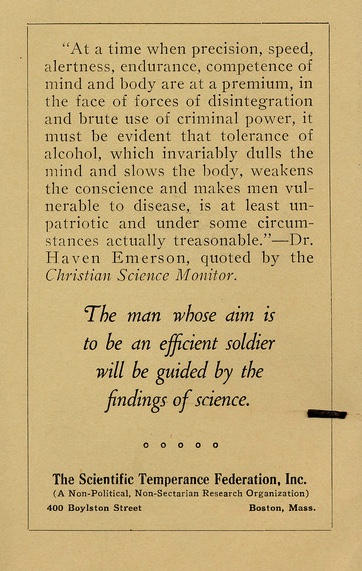
  3. Do you want to be Efficient? pamphlet for military

    In other articles I found outreach to Soldiers and Sailors.  Special pamphlets aimed at young military recruits were included in “comfort bags” that were given out in a war relief effort.  One such booklet was called “Do You Want to be Efficient?”  You can read this pamphlet online from the collection of Brown University.  It typifies the “scientific” bent of the Temperance movement.  Men were urged to make choices based on the science and with all the facts rather than purely moralistic.   https://library.brown.edu/cds/catalog/catalog.php?verb=render&id=1096893563508500&colid=7&view=pageturner

Eunice Chase Greene (1842-1921) was the President of the Portsmouth group for 40 years.  She was married to Dr. Benjamin Greene and she had a house at the foot of Quaker Hill.  For many years she was an Elder in the Friends Church.  In her younger days she taught music – both vocal and instrumental.

Lillian Collins Borden (1869-1933) became President of the Portsmouth WCTU when Eunice Greene became ill.  She was the wife of Alonzo Borden and the couple were very active in the Christian Union Church. This church (now the home of the Portsmouth Historical Society) hosted many temperance meetings throughout the years.   Lillian was active in the community and served on the Portsmouth School Board.

Older Entries Newer Entries