An Introduction to my project
As a researcher for the Battle of Rhode Island Association, I was asked to investigate Lafayette’s role in the Rhode Island Campaign. I looked at the usual “Lafayette stayed here” locations and I wrote about them, but the more I researched the more I realized the very special role Lafayette played in the Rhode Island Campaign. My current project is to trace Lafayette’s movements throughout Rhode Island. It is both a timeline and an attempt to follow him on a map made by his cartographer at the time. What I am sharing now are my approximations. I have used his letters, Orderly Reports, diaries, and trusted secondary sources. Accounts do not always agree, so I have tried to make sure I had confirmations before I listed places and times. This is a work in progress and I would welcome corrections that give me more factual information.
On the Road: The Gathering of the Troops
The Marquis de Lafayette was hopeful about the Rhode Island Campaign as he marched toward Rhode Island. He wrote to General John Sullivan from Saybrook on 28 July, 1778: “I hope a pretty decent set of laurels may be collected upon that island, and we will terminate the whole by joining English country dances to French cotillions in company with the fine and reputed ladies of the charming place.” (1) (Idzerda)
The Rhode Island Campaign was the first joint effort of the American and French forces during the American Revolution. In July of 1778 the French fleet under d’Estaing sailed to America. One idea was for the French to help American forces to free New York from British control, but the fleet had problems sailing in that direction. As d’Estaing steered his fleet toward Rhode Island, General Washington wrote to General Sullivan ordering him to raise 5,000 New England troops. He was to gather provisions and flatboats in preparation to work with the French fleet in releasing the British hold on Aquidneck Island (Rhode Island). Washington put twenty year old Lafayette in charge of General James Varnum’s four regiments as well as Glover’s and Jackson’s regiments. The troops had already started on the road to Rhode Island, and Lafayette had to catch up with them. By July 28th, 1778, Washington divided the forces into two divisions – one under General Nathanael Greene and the other under the leadership of Lafayette. The divisions would include both militia and the more experienced Continental troops. Lafayette caught up with his troops in Lyme, Connecticut. He took a route through Guilford, Saybrook, Norwich and Plainfield, Connecticut before he moved into Rhode Island.
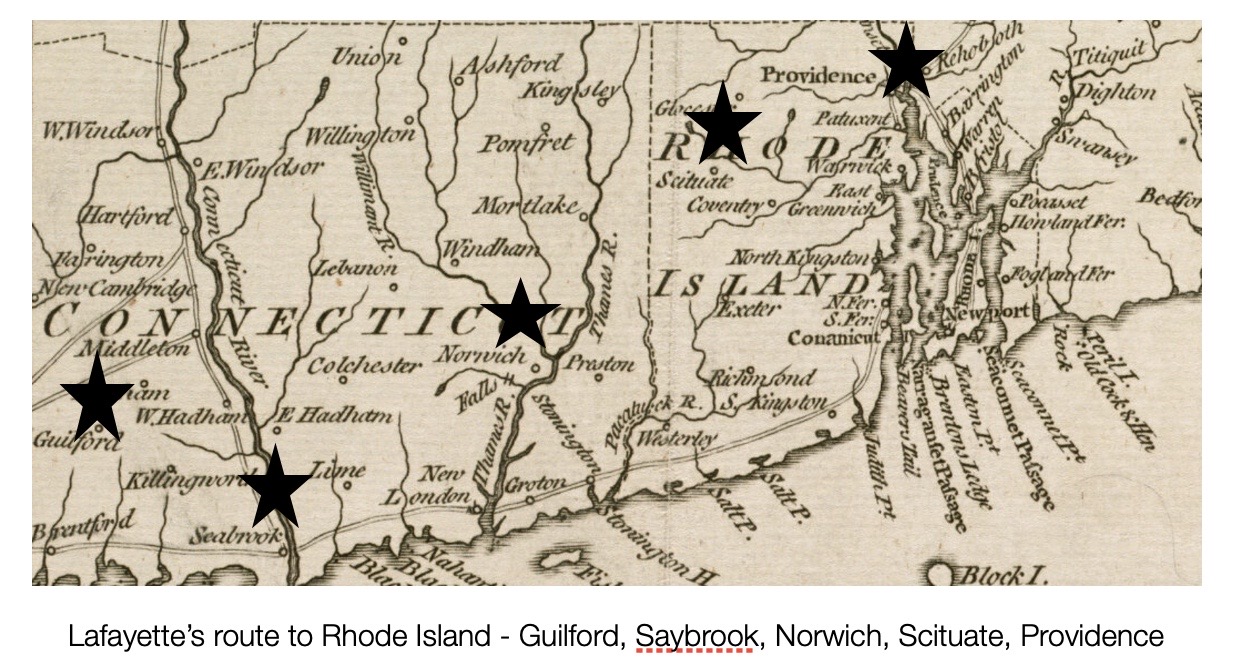
Lafayette had a major role in the Rhode Island Campaign. To his dismay, he would miss being in the action at the Battle of Rhode Island, but he was active in every other phase of the Campaign. This timeline of his movements actually serves to illustrate the various stages of the Campaign. Lafayette was intimately involved in most segments of the action from August 1, 1778 to the end of September.
- George Washington gave him joint command of the American troops.
- He often served as “Major General of the Day” during the Siege of Newport. That meant he had the responsibility of reviewing the troops, checking supplies, attending the hospital, and carrying out discipline. He would assess the lines and entrenchments to place fortifications. He was the eyes and ears of the commander.
- He was an American representative in talks with d’Estaing. He was sent to Boston in a last ditch effort to bring the French Fleet back to Newport.
- On his return from Boston he led the last of the American forces off of Aquidneck Island.
- He commanded the American troops guarding the East side of Narragansett Bay.

August 1,1778. Lafayette’s first stop is Angell’s Tavern (the GREEN SQUARE) in South Scituate, Rhode Island. The 2 divisions which had headed for Rhode Island met there. This was about 12 miles from Providence, so it was an opportunity for the troops to rest.
August 2-5 1778. Lafayette goes to Providence (located at the Green Circle) ahead of his troops. He stays with Governor Bowen. He accepts Washington’s orders that he shares command with General Greene.
August 4,1778. Lafayette was aboard the French flagship Le Languedoc (Brown Square) to meet with French commander d’Estaing. The French fleet was waiting off of Point Judith and d’Estaing provided Lafayette with the ship Provence to bring him back to Providence. Lafayette writes to d”Estaing on August 5th summarizing their discussions and he also relays the hesitance of Sullivan and Greene to a plan where Lafayette would head a joint effort with French soldiers.
August 6th through the 8th, 1778. Lafayette and his men march toward Tiverton through Rehoboth, Swansea and Fall River to the Howland Ferry., marked by the BLUE STAR. Lafayette is at Sullivan’s Headquarters at Tiverton by August 8th.
- Idzerda, Stanley. Lafayette in the Age of the American Revolution, Selected Letters and Papers, 3 Volumes , 1776-1790. Cornell University : Ithaca,N.J. 1979.
 portsmouthhistorynotes
Leave a comment