Home

Celebrating the First Rhode Island’s (Black) Regiment): The Story of Patriot’s Park

2 Comments

For over sixty years the Newport Chapter of the National Associate of Colored People (NAACP) has been calling attention to the valor of the soldiers of the First Rhode Island Regiment (called the Black Regiment).  I heard the story of their efforts at last year’s commemoration of the Black Regiment’s efforts in the Battle of Rhode Island.  Mrs. Fern Lima recounted all the milestones in the NAACP’s  efforts to create a memorial to these soldiers and to continue to tell their story.  Mrs. Lema’s presentation is from the notes of her father, Lyle Matthews, a past NAACP president and one of the earlier workers in the effort.  I recently had the opportunity to talk to longtime Newport County NAACP members, Mrs. Lema and Mrs. Victoria Johnson.  I had gathered a timeline from newspaper articles, but they had been participants and could give me their personal perspectives.  

One of the key information sources Mrs. Lema provided was a copy of the program for an earlier monument dedicated in 1976.  In the booklet for the Dedication, May 2, 1976, NAACP President William Trezvant quoted from historian Charles A. Battle’s booklet “Negroes on the Island of Rhode Island”.

“In August 1928 the one-hundred and fiftieth Anniversary of the Battle of Rhode Island was fittingly celebrated by the citizens of Rhode Island.  At that time the suggestion was made that the State of Rhode Island honor in bronze or stone the memory of Colonel Greene’s regiment.”  

The dedication of the Black Patriot’s Monument in 1976 was just one milestone in a larger effort to bring the story of the Black Regiment to the attention of Rhode Island and the nation.  In an earlier letter (Nov. 12, 1975) Trezvant wrote: “The Goal is to have the Black Regiment take its rightful place in Rhode Island History and in the Nation’s fight for freedom.”   Early steps toward that goal were made by historian Charles Battle and those who researched the role of the First Rhode Island Regiment.  NAACP members Lyle Mathews, John Benson and State Senator Erich O’D. Taylor did the spade work in determining where the redoubt was located that the Black Regiment defended so valiantly.  Mathews was President of the NAACP at the time and Fern, his daughter, remembers field trips out to the Bloody Run Brook area where the men scouted a location that would be an appropriate site for a monument. One of the men, John Howard Benson, was a noted carver and created a woodcut map of the Battle with the redoubt’s position marked with a star.  This beautiful map was included in the program.

Mrs. Lima and Mrs. Johnson helped me with a timeline of the events in the completion of Patriot’s Park.  

In 1967 the NAACP began an annual celebration of the valor of the Black Regiment and to call attention to their role in history.  In July of that year a boulder on the property was dedicated to the Black Regiment.  State Senator Taylor was master of ceremonies and he introduced Oliver Burton who knew Charles Battles and was an early advocate for recognition of the Black Regiment’s role in history.  

In 1969 the remembrance was held in August and a flagpole was added to the site.   Children who had learned about the regiment from Battle’s book attended and Oliver Burton spoke.  Both Mrs. Johnson and Mrs. Lima have their own copies of Battle’s book and having a good history of the story of the First Regiment in the battle was helpful in making the community aware of the special role they played.

In 1972 over 150 gathered at the memorial area on the anniversary of battle. Newspaper accounts state that this was the 9th annual commemoration organized by the NAACP. 

In 1973 a large portion of the battleground was named a national historic site. This portion of the battlefield was called “Patriot’s Park.” At this time the site contained a small monument designating the historical site, a flagpole and simple boulder. Ceremonies celebrating the role of the Black Regiment continued to be held there.

In November of 1975 a fund drive was started to erect a monument to Rhode Island’s black patriots of Bloody Brook in Portsmouth. The Newport NAACP raised funds through the sale of commemorative pins. The plans for the monument were that it would be six feet high by 4 inches wide. The insignia of the 1st Rhode Island Regiment would be carved into the granite. The State Department of Natural Resources would  prepare the landscape.  

May 6, 1976 was the unveiling of a monument at Patriot’s Park. The monument was unveiled by Mrs. Oliver Burton, widow of a man who knew Charles Battle and had dreamed of erecting the memorial Battle had wanted. Plaques were presented to State Senator Erich O.D. Taylor and Dennis J. Murphy of the RI Dept. of Natural Resources for their efforts in the project.

In 1994 funding from the Federal Highway Administration for projects to improve or preserve historic sites associated with the federal highways became available. The Black Patriots Committee of the Newport NAACP and the RI Black Heritage society proposed improving the site.

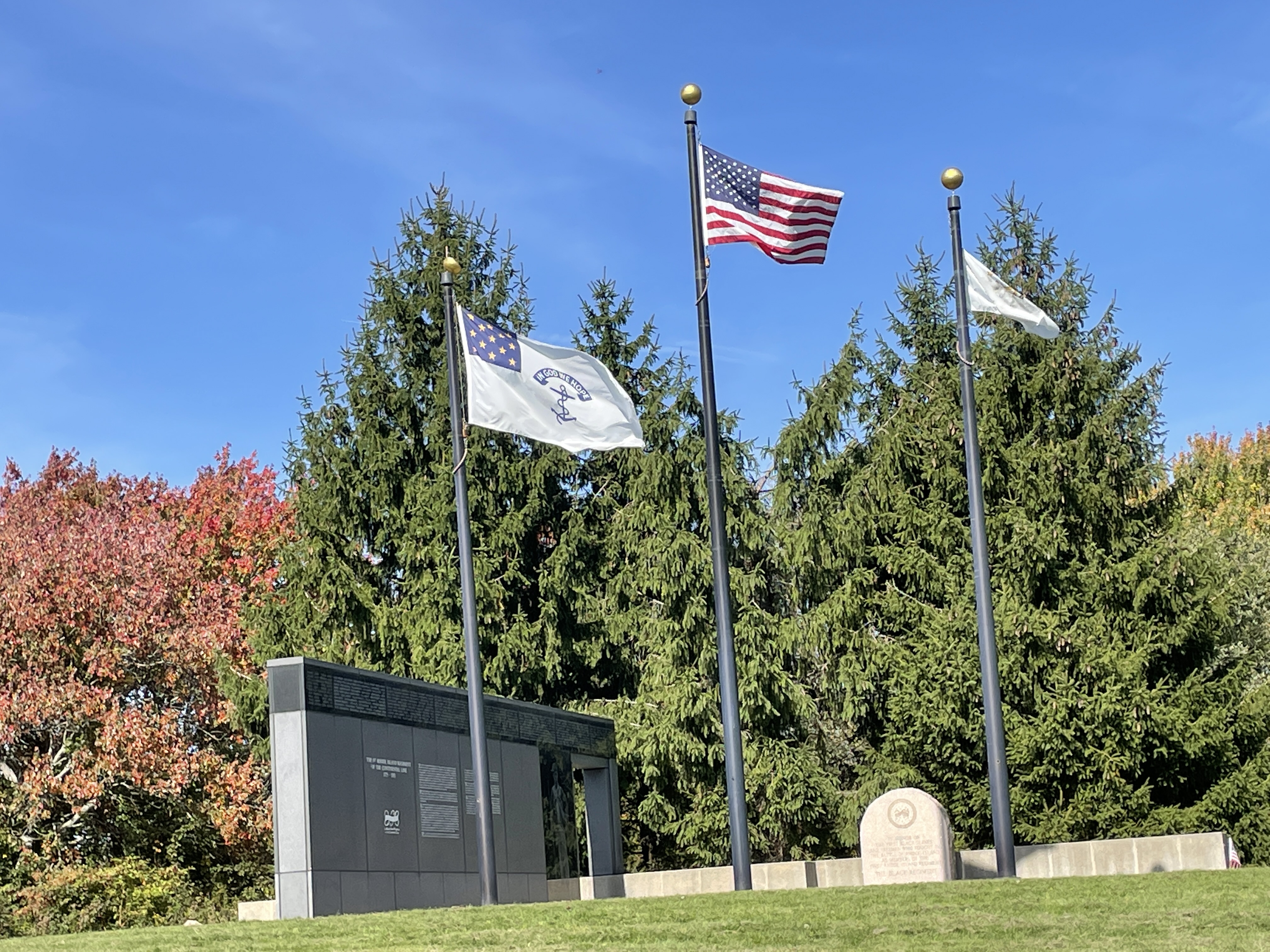
In 1996 the head of the Rhode Island Department of Transportation (RIDOT),  William F. Bundy, selected the Patriot’s Park Landscape Project as the state’s first enhancement project.  Paul Gaines was chosen to coordinate the creation of the memorial and he was working with designer Derek Bradford. Gaines and his committee spent 10 years on the project that created a 36-foot-long, 10-foot-high black granite memorial to the First Rhode Island Regiment. 

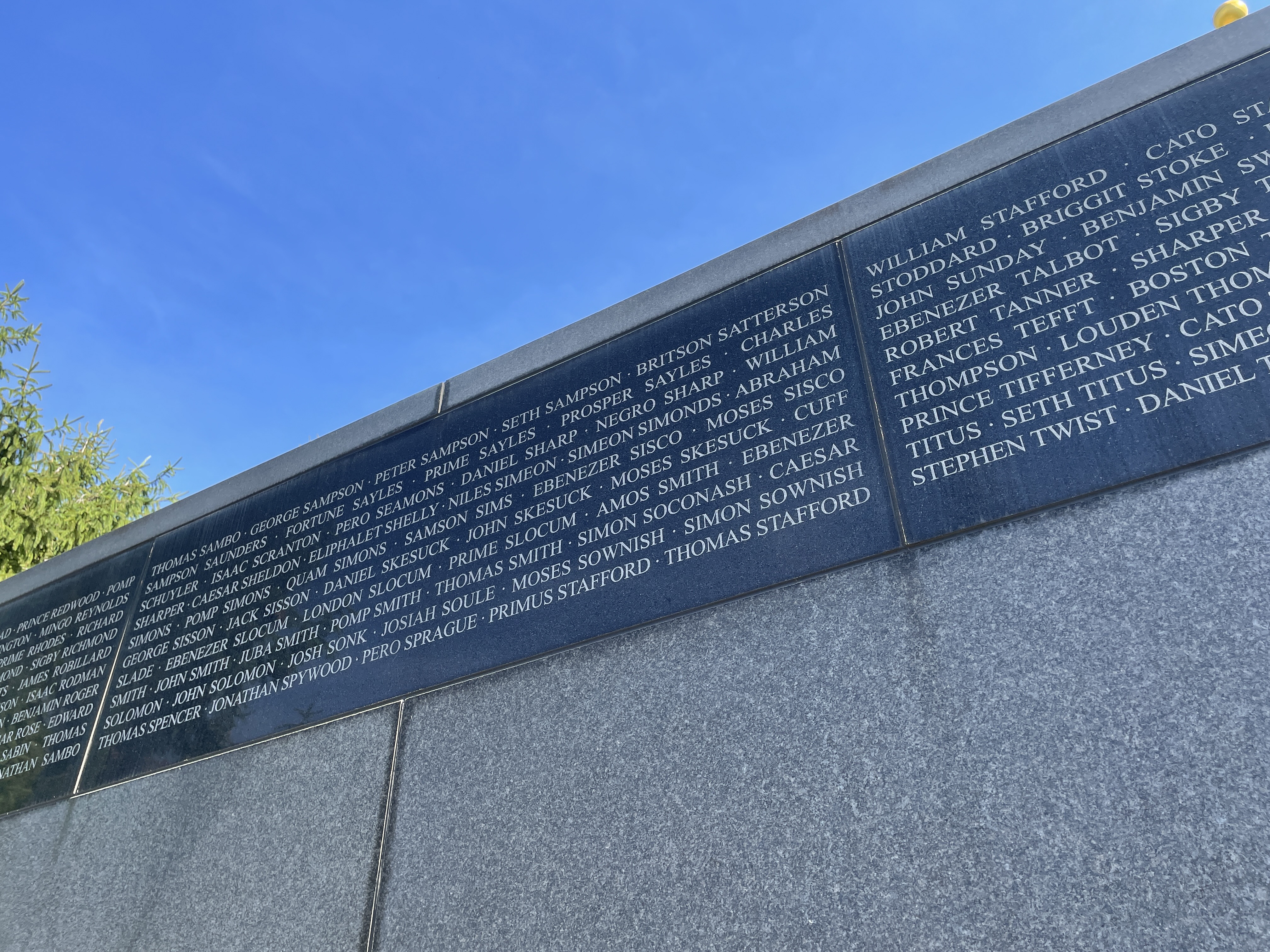
By 1999 Bradford submitted plan for the larger monument.  The design was a simple: platform with a wall that has two doorways and names of First Regiment soldiers engraved on the wall. Since no muster rolls were available for those just involved in the Battle of Rhode Island, Bradford agreed to engrave the names of all known members of the regiment. 

Federally funded projects require an Environmental Impact Assessment in which groups with direct interest are given opportunity to comment. RIDOT invited 12 groups – Black organizations, Native tribes, local institutions like Rhode Island Historic Preservation and Heritage to comment on the plans.  The basic list was the known black soldiers, but the list for inclusion was open to the families of indigenous soldiers and many of those names were added at their family’s request.

By February of 2000, two narratives had been written explaining the creation of the regiment. The battle narrative (written by Carl Becker and Louis Wilson) was agreed upon with corrections.  It took 4 years to reach agreement on the following text:3 “And to the soldiers of the Narragansett Indian Nation who fought alongside them.”

In 2006 the Memorial to Black Regiment was dedicated. The story of the valiant efforts of the 1st Rhode Island Regiment (the Black Regiment) is engraved for all to see and the names of these soldiers are remembered. 

The efforts to tell the story of the Black Regiment are not over.  The cause continues because the Memorial is in need of repairs and funds must be raised to do the required work.  

Through the efforts of the NAACP the story of the Black Regiment is being told and there is a dedicated spot on the battlefield to honor their valor at Bloody Run Brook.
The Many Lives of the HMS Flora

Leave a comment

I am working on a tour of sites in Portsmouth that saw action in the Battle of Rhode Island. The top of Quaker Hill is one such site. Some historians even use the term “Battle of Quaker Hill” because of the heavy action at this place. British soldiers converged on this crossroads from East Main, Middle Road and Hedly Street. Americans were holding their line at that position.

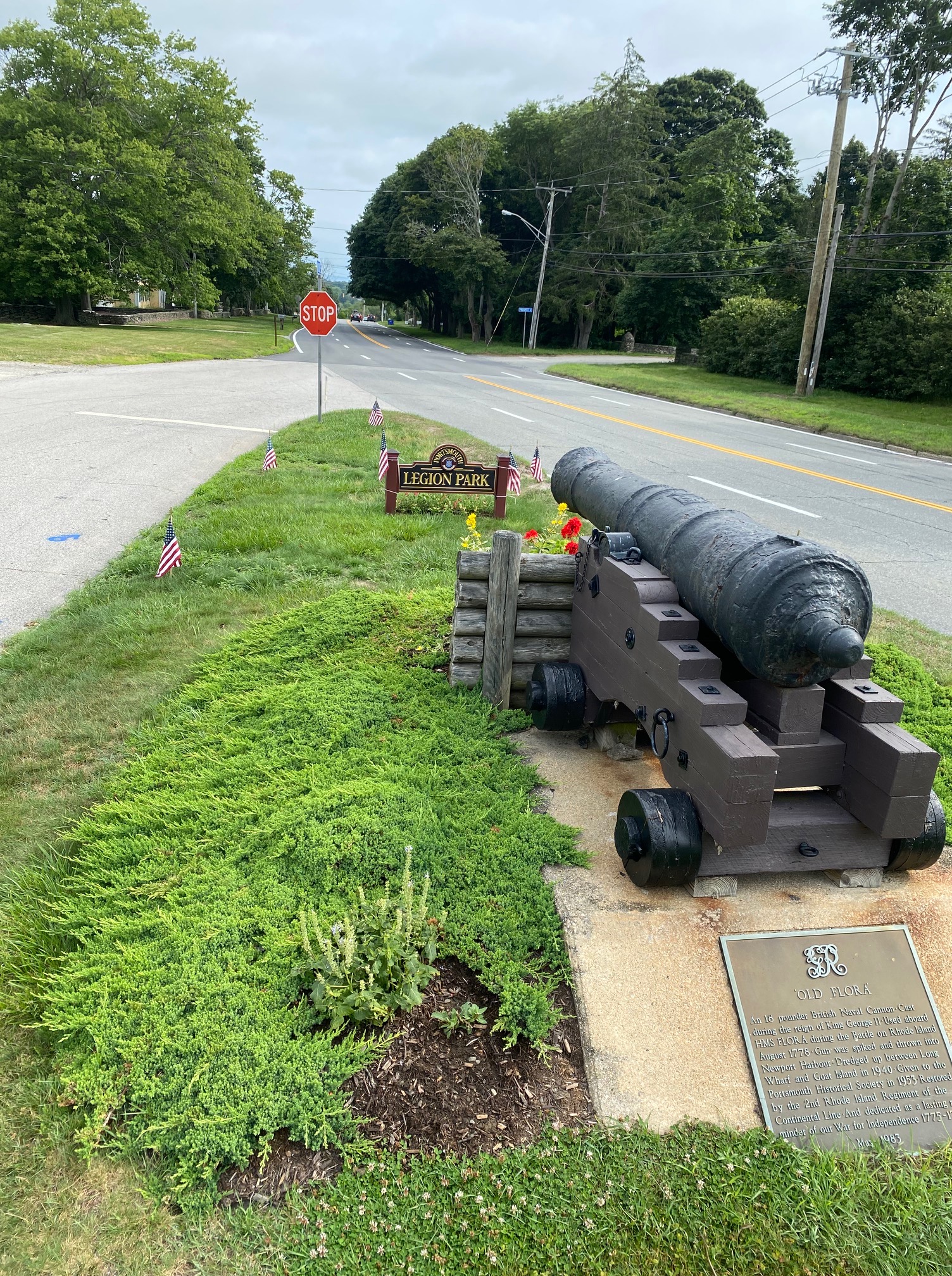
What Revolutionary Era sites can you still see today? The Friends Meeting House is an important landmark that was used by the British and Hessians as a hospital, barracks, and ammunition storehouse. The stonewalls are there to remind us of the American style of warfare in which the Patriots hid behind the walls in what we would call guerilla warfare aimed at harassing and delaying the British. In Legion Park across from the meetinghouse there is a cannon from the British ship Flora.

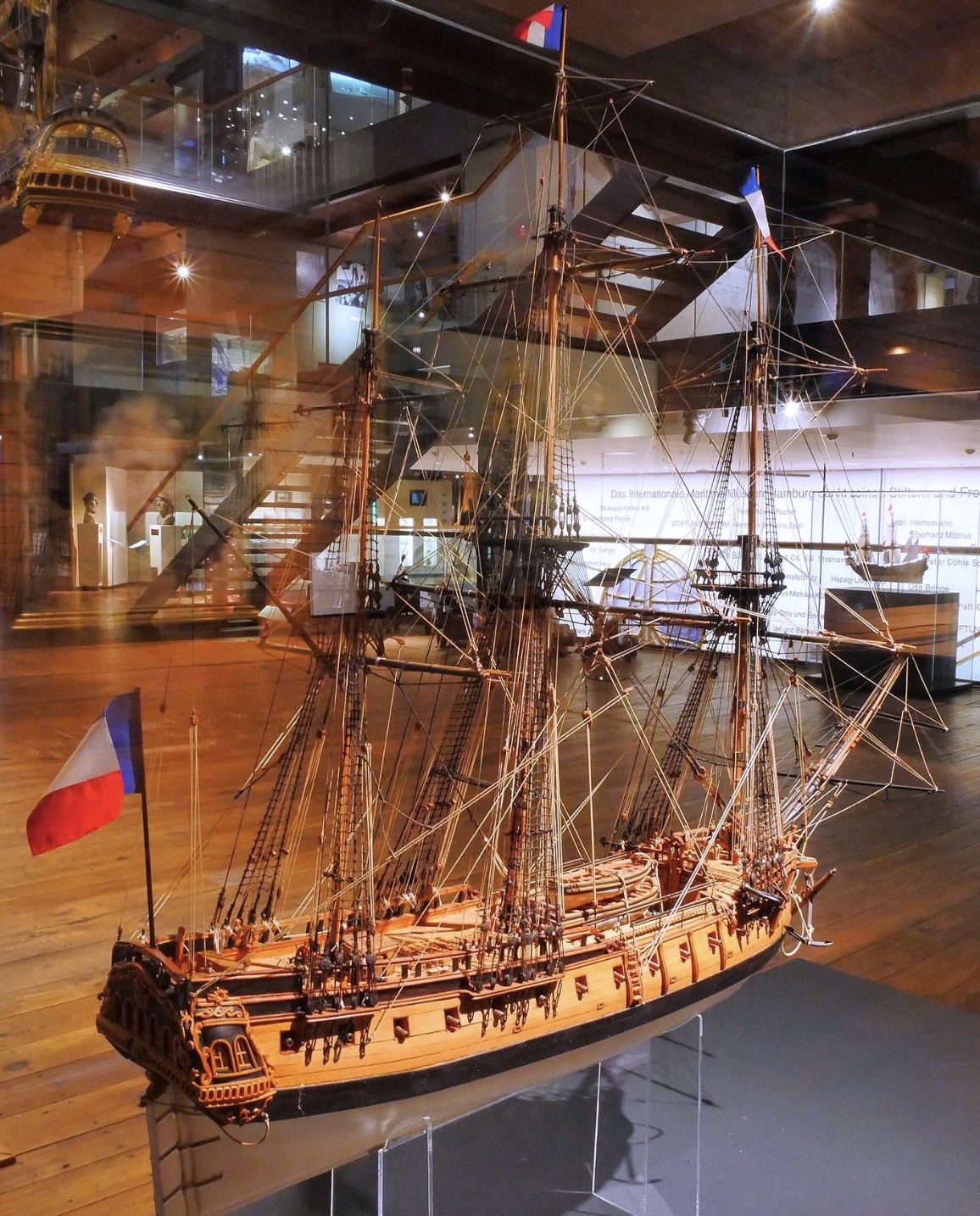
What is the story of the Flora? In researching why we have a ship’s cannon at Quaker Hill, I encountered the tale of a ship of many names and nationalities. According to an article by noted marine archaeologist D.K. Abbass, the Flora was a 698 ton, 32-gun Royal Navy frigate. Its original name was LaVestale and it was built by the French Navy in 1757. Once a ship was captured in those days, it was common practice for the vessel to be used in the navy of its captor. In 1761 the ship was captured by the British and was renamed the Flora. By 1776 the Flora was being used as a troop transport.

When the French fleet arrived in Newport in July of 1778, the British did not want the French to capture their ships. The British scuttled seven of their vessels and 13 of their transports were scuttled in the outer harbor. In Washington’s Wolfpack, the Navy before there was a Navy, author Edgar Maclay wrote that the Flora was heaved over on its side and beached for cleaning. It lay between Goat Island and Long Wharf in Newport until April of 1779 when she was raised again. The British used eight 12 pounders from the Flora on the newly outfitted HMS Pigot. The story of how American Silas Talbot outwitted the British on the Pigot is yet another story to tell. The British sank (and burned) the Flora again when they left Rhode Island in December of 1779. She was passed back and forth. 1784 – named “Reconaissance” (French), 1787 back to “Flora” (French), “Citoyenne Francaise” (a French pirate). By 1798 she was captured by HMS Phaeton and sent to the scrap heap.

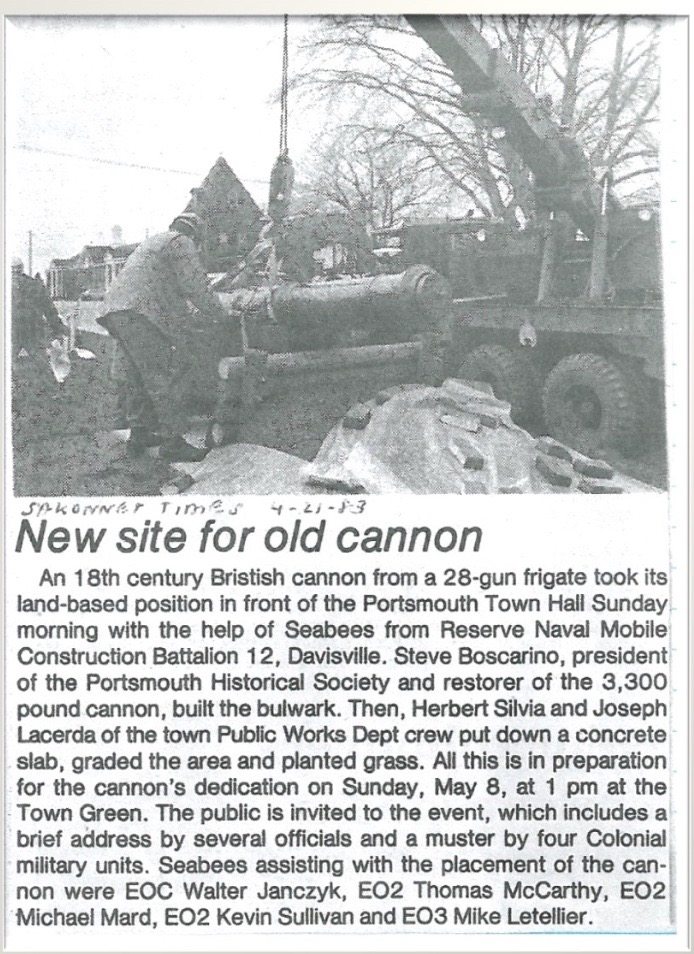
Flora was not down at the bottom of the harbor, but at least one of her cannons was. In 1940 workmen repairing Long Wharf came across the cannon and the cannon is now displayed at Legion Park in Portsmouth.

A note about privateers: they are privately owned armed vessels, commissioned by a state to attack enemy ships, usually merchant ships. The privateers and their crews usually got the ship and a large percentage of the cargo they captured. Without a real Navy, Americans relied upon these privateers in maritime warfare.

Sick at Butts Hill: the Fort as Hospital

Leave a comment

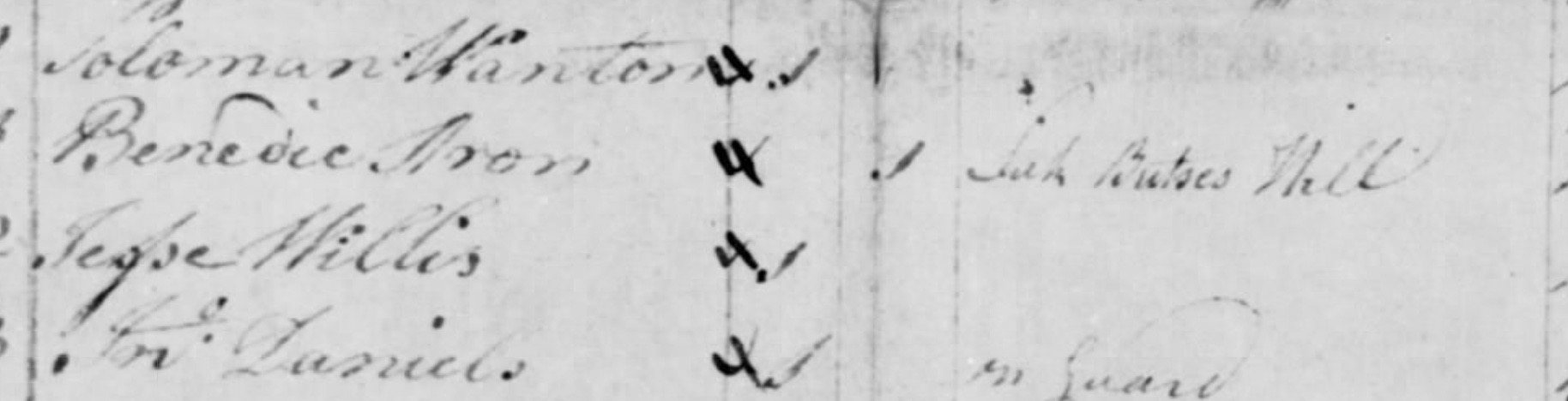
I have been trying to document the Black Regiment at Butts Hill, and Rhode Island historian Christian McBurney sent me a record of two soldiers who were listed as “sick, Butts Hill” in an August 22, 1778 muster roll. That led me to look into the role the fort played as a field hospital during the Siege of Newport and Battle of Rhode Island. I had come across a reference to this medical use in a orderly book for John Jacob’s Regiment of Massachusetts Militia. In this blog I will piece together what I have found so far on the Fort as a field hospital and what these field hospitals would have been like during Revolutionary War times.

Benedic Aron – Sick Butses Hill

A hospital was needed long before the Battle of Rhode Island and provisions had been made for it. The Hospital Department was created by Congress in 1775. There is a letter from Washington that made these provisions for Sullivan’s troops for the Rhode Island campaign.

From George Washington to Thomas Tillotson, 26 July 1778
To Thomas Tillotson
[White Plains, 26 July 1778]Sir,
You are to proceed, immediately, with two assistants to Doctor Isaac Foster Director in the Eastern department, and take his instructions for the procuring of hospital furniture, medicines instruments, and such things as may be thought necessary in the formation of a military & flying hospital for the use and benefit of the troops under the command of Major General Sullivan, at Providence, Rhode Island, in case or provided a proper hospital arrangement has not already taken place in that quarter either by the orders of Major General Sullivan or Doctor Foster. But should there be as yet no establishment of this kind you will repair to and continue with Major General Sulliva[n] in the faithful exercise of the several functions of your profession till dismissed by General Sullivan, the commander in that quarter, or the commander in chief of the army of the United States. Given at Head Quarters this 26th day of July 1778.
G. W——n

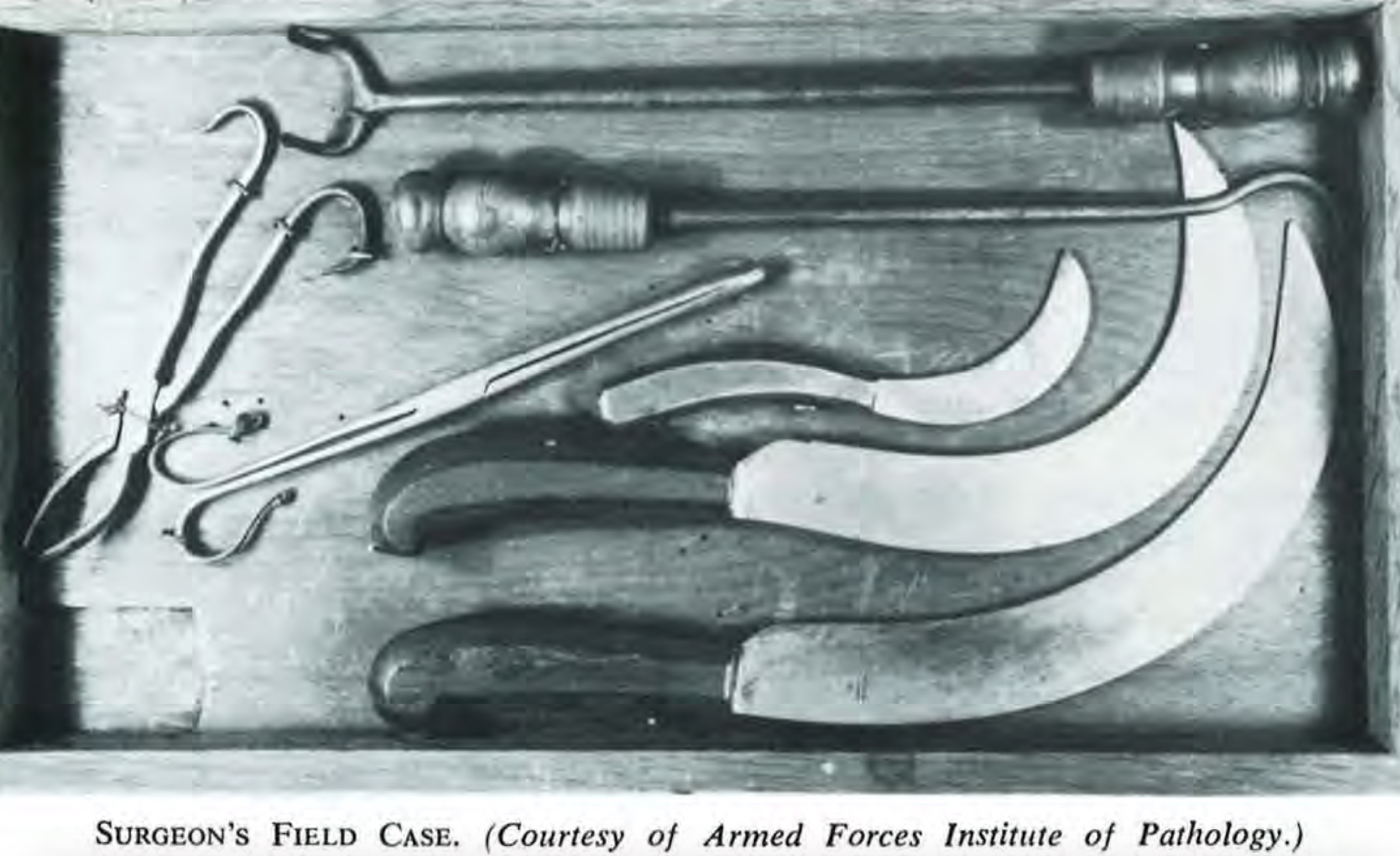
There were three main types of hospitals to care for Revolutionary troops: 

1. The general hospital housed in buildings and run by the Continental military.

2. The mobile “flying hospital” also manned by Continental personnel in a hut or tent (with a few emergency beds and a surgeons table. These were like the later M.A.S.H. units.

3. The regimental hospital run by the regimental surgeon for larger numbers of soldiers. From the Orderly records it seems that the General Hospital was in Providence and Butts Hill would have been a “flying hospital.” Regimental surgeons and surgeon mates may have been closer to the battle doing triage and directing the wounded to Butts Hill.

Even before the Battle of Rhode Island there was a need for care of the “invalids.” The troops suffered through a major storm and there was little protection from the elements. During the Siege of Newport there were exchanges of fire and troops were wounded. 

Orders of August 12 included “A Return of all the Invalids and persons unfit for marching to be made at Headquarters Immediately that they may be properly Officered and left to man the Fort on the North End of the Island.” The “walking wounded” and sick were guarding the Butts Hill Fort area. The orders included asking the Regimental Surgeons to return their sick daily to the director general of the hospital. They also were to make an accounting of bandages and medicines “that they might be supplied.” 

On August 14th the orders included a statement that “a permit from the director General of the hospital will be a sufficient warrant for any Surgeon or sick person to pass to the main(land).” August 24th the orders read that Corporal Tilson is to grant papers to the mainland “as he thinks proper he will give only to the sick and those that attend them and the surgeon.” 

August 30, 1778 was a day of caring for the wounded and burying the dead. The orderly report expresses General Sullivan’s expectation the wounded and those who have care of them will not want for comfort. ”A party of 100 men from the front line are to collect and bury the dead of this Army who fell in action.” The orders from Tiverton on August 31st are ” All the sick and wounded of the Army are to be removed to Providence as soon as it may be done without endangering them.” 

There were more than 100 wounded in the Battle of Rhode Island. Others would have been injured in the storm and siege warfare. Accidents and illnesses would arise among the soldiers. There was a barracks at the Fort that might have served as a hospital caring for the wounded to stabilize them and send them on to more care in Providence. Regimental surgeons and their mates would have been providing the most immediate care, but the Battle of Rhode Island was an orderly retreat and all efforts would have been made to get the wounded to care at Butts Hill. 

Links to information about Revolutionary War Hospitals:

purposehttp://npshistory.com/publications/morr/medicine-surgery.pdf

Tredyffrin Easton Historical Society History Quarterly Digital archiveshttps://www.tehistory.org/hqda/html/v41/v41n1p025.html