Benjamin Cowell collected the stories of Rhode Islanders who applied for pensions many years after the war. He published his stories in a book called “Spirit of 76” and he started his book with the stories of women who had to step up and take extra responsibilities with their husbands at war. Cowell commented: “The women also of Rhode Island, with all the sympathies peculiar to their sex, took an active part in sustaining the “great cause,” and a more noble race of women never existed.”
Here are a of few of the ways women contributed to the war effort in what we might think of as ordinary tasks.
DORCAS MATTESON
Dorcas Matteson, of Coventry was the mother of nineteen children. She was married in 1770 to David Matteson. In the pension application she made made years after the war, she listed some of the difficulties she endured for the “glorious cause.” When her husband went to fight in General Sullivan’s Rhode Island Campaign in 1778, it was hay time. She had to cradle her baby on some hay in a shady spot in the meadow while a young lad helped her load hay and put it in a barn. She was close enough to hear the “roar of the cannon” during the Battle of Rhode Island and she imagined the danger her husband was in. He returned a few days later when his militia duty had expired. He was safe and sound, but he did have a “bullet hole about him” that was made as they retreated from the Island. The bullet was stopped from injuring her husband by a cheese that Dorcas had sent and David had placed in his backpack.
ABIGAL SALISBURY
Abigail’s husband, George, was Sergeant of the guard that was stationed nearby at Rumstick Point. She used her knitting skills to knit stockings for the whole guard. She continued to knit stockings until she was a hundred years of age.
SARAH DYER
Like Dorcas Matteson, Sarah Dyer’s husband was away. Sarah and her husband lived in Glocester. Anthony Dyer was with the “Captain General’s Cavaliers” who were chartered in 1775 to fight the British. Sarah raked and loaded lay, hoed and gathered in potatoes, and harvested corn, and she said she did it “cheerfully.” She was doing all the women’s work and the men’s work on the same day.
ANNA ALDRICH
Anna, the wife of Israel Aldrich, was from Smithfield and was another of our typical Revolutionary mothers. She carried her baby into the field and cradled him in the boughs of a tree to keep him away from reptiles. During the summer of 1777 she hoed corn and potatoes, raked hay, pulled flax, milked cows, mended fences and raised pigs. Whatever her husband would have done at home, Anna did.
Benjamin Cowell ends his chapter of Revolutionary Women by saying that “all the ladies, married and unmarried, were engaged, in one way or another, in sustaining the great cause of liberty. While some workedsp on farms, others were engaged in making clothes for the army, or administering to the wants of the sick and wounded.” Rhode Island women braved the hardships of the Revolution in ordinary ways. Women who went to war as soldiers or acted as spies are exciting, but Cowell was right to elevate the contributions of Rhode Island women who did the work of their husband as well as their own responsibilities. Down through the years and wars, Rhode Island women have been shouldering those responsibilities.
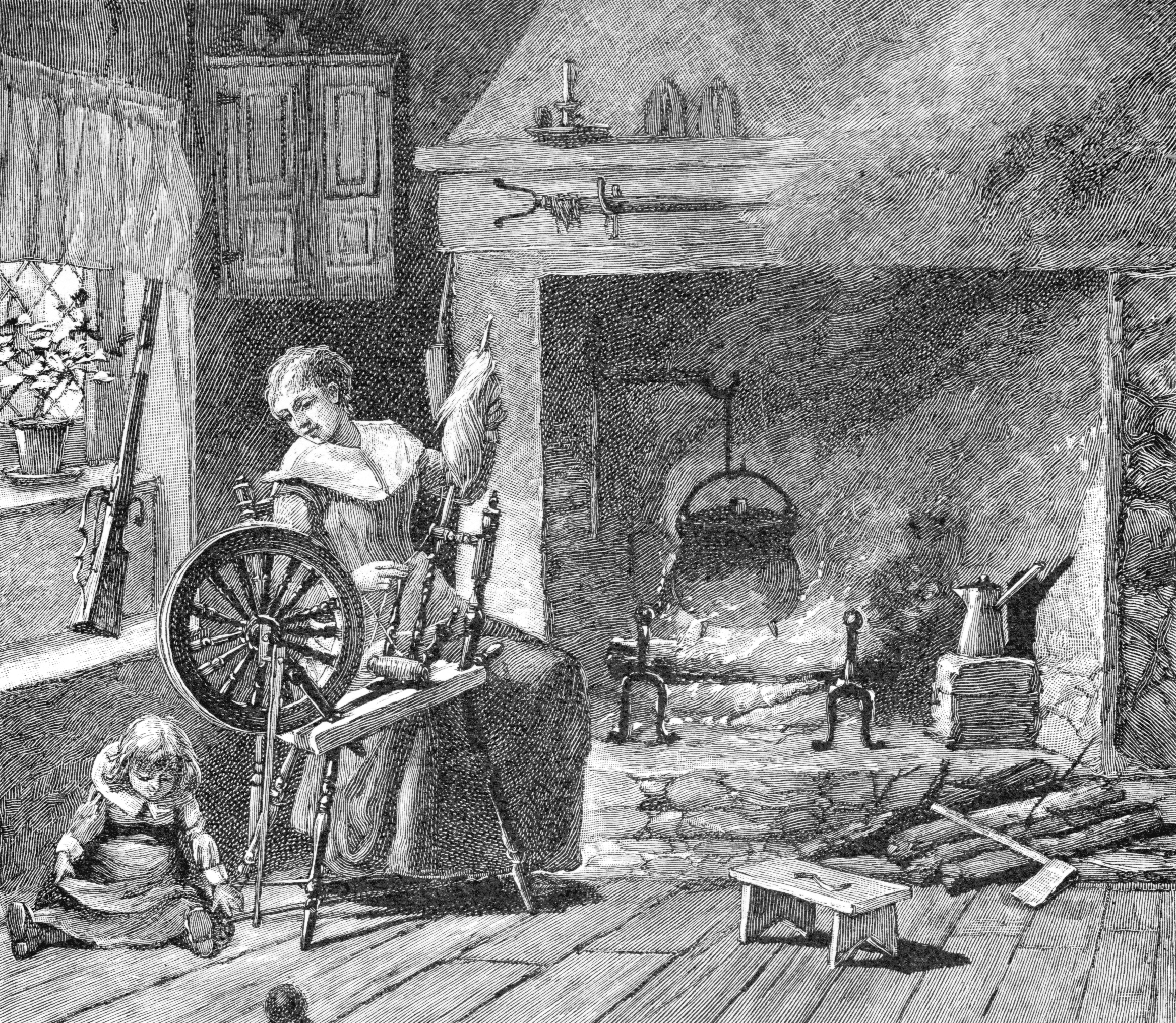
Colonial kitchen with woman spinning, an engraving
Cowell, Benjamin. Spirit of ’76 in Rhode Island, Boston 1850.
 portsmouthhistorynotes
Leave a comment