I recognized the names of a number of those listed on the 1730 census. Some of them I have already researched, so I can give some information about them. So many of these families are inter-related.
John Butts
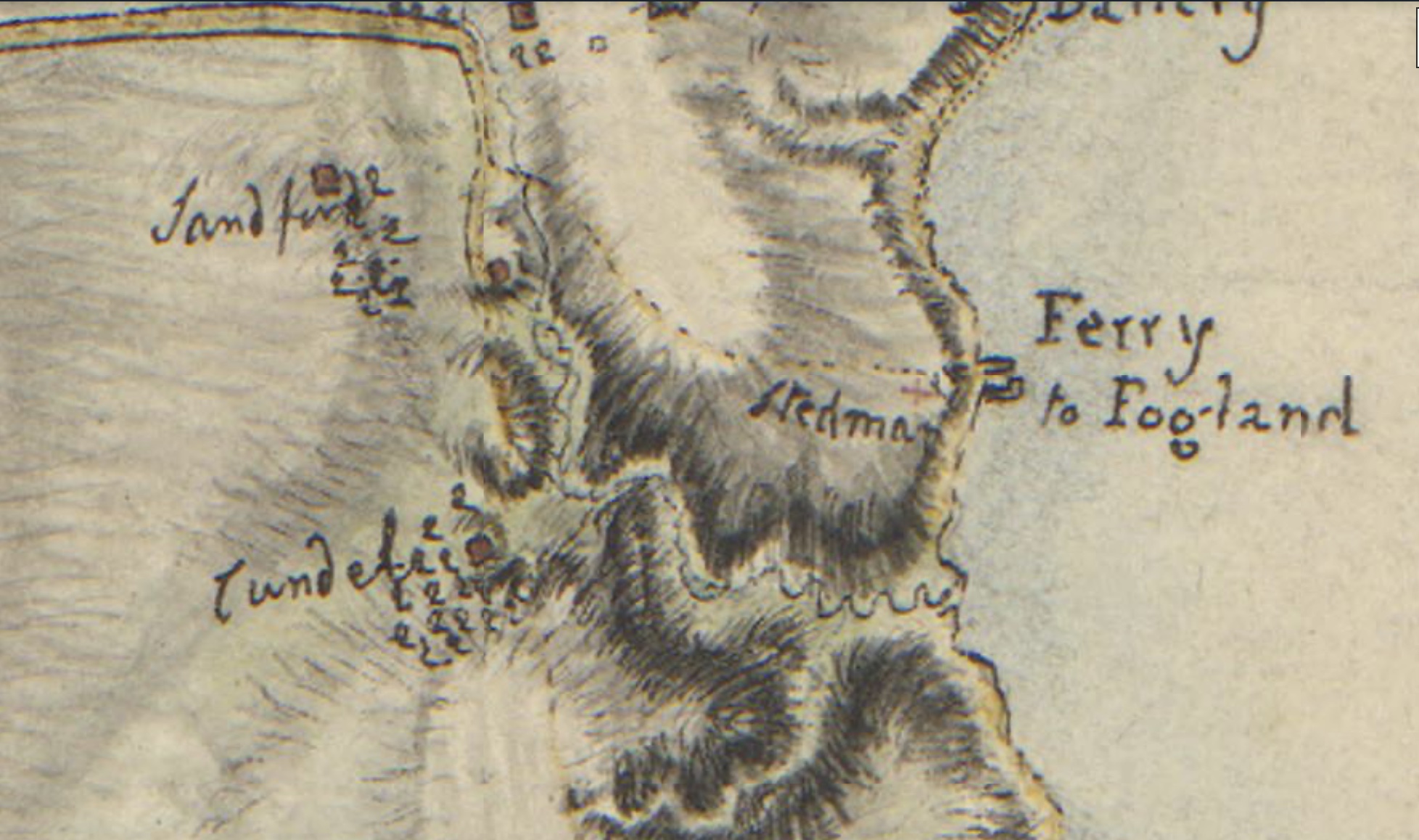
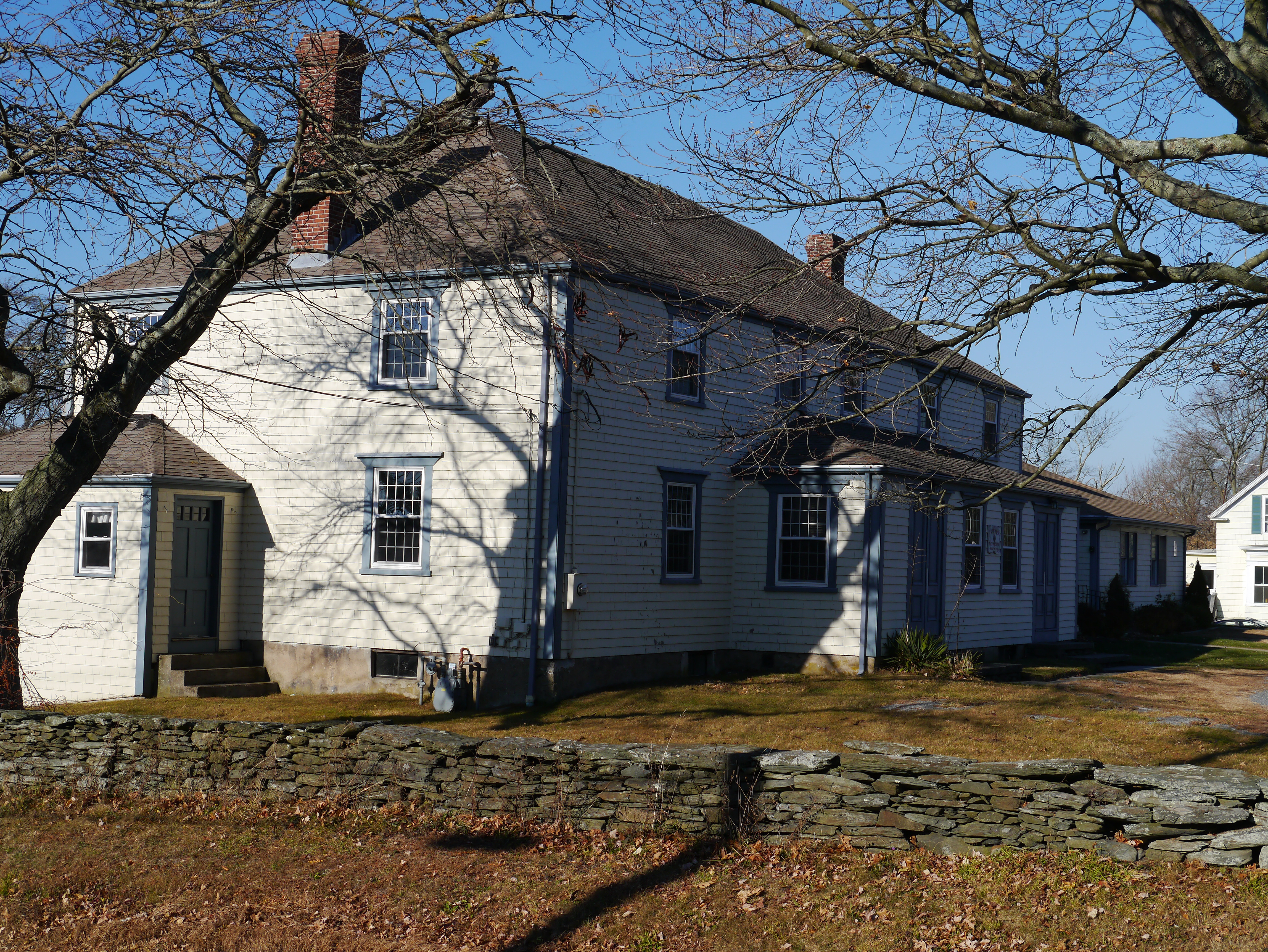
A son, John, was born to Zaccheus and Sarah in Little Compton in 1691. The family history is complicated, but John would have had his grandfather (Thomas Cornell, Jr.) hung for murder and his great grandmother (Alice Lake) hung for witchcraft. He moved to Portsmouth and is recorded to have had two wives. One of his wives was from the Wordell family and the other, Abigail, was from the Briggs Family. This Briggs connection is interesting because what we call Butts Hill was once called Briggs Hill. On January 15, 1725 John bought from Caleb Bennett a windmill and about one rood (about a quarter of an acre) of land on Windmill Hill (now called Butts Hill). He erected a house by the windmill. He must have owned other land in Portsmouth since he had been considered a freeman for some time. A 1726 map of the Newtown area of Portsmouth shows him having a small parcel of land on what would be the East Path (East Main Road today). John is recorded as being a tavern keeper. He was accused in 1747 of allowing card playing at his tavern and his future son-in-law Thomas Cook was called as a witness against him. John’s daughter Sarah married Cook in 1763. When John died in 1768 he left his daughter, Sarah Butts Cook, “my dwelling house and land, bounded southerly on land from my father-in-law Enoch Briggs, next to David Lake.” This is as far as I can trace the Butts presence on this Windmill Hill (Butts Hill). Some of Butts land was passed down through the Cook family. One Butts family genealogist wrote that the War for Independence had ruined the family fortunes. They lost their land and their business interests.
Joseph Cundall
In 1706 Joseph Cundall had left his native England to become an indentured servant in America. Becoming an indentured servant was a way a young person could learn a trade and get an education in exchange for working for seven years or more. Cundall seems to have learned his trade well and was in a good position to buy land as an adult. James Sisson sold his grist mill and 46 acres around the brook to Joseph Cundall. What we call “the Glen” becames commonly known as Cundall’s Mills. Water from the stream powered the carding and fulling mills to wash and pull woolen fibers. Joseph Cundall added almost a hundred more acres to his land around the Glen before he died in 1760.
A note: Joseph Cundall married Elizabeth Butts
“Plan of Rhode-Island / Surveyed and drawn by Edw: Fage, captn. Royal Artillery, in the years 1777, 78 & 79.”. https://quod.lib.umich.edu/w/wcl1ic/x-828/wcl000922. In the digital collection William L. Clements Library Image Bank. William L. Clements Library, University of Michigan Library Digital Collections. March 10, 2025.
What kinds of information does a census give us about Portsmouth? I have worked with other census documents and within the names and numbers there is a great deal that can be learned from them. An article by Christian McBurney in his blog Small State Big History encouraged me to find the 1730 census for Portsmouth. McBurney’s article, “South Kingstown’s Partial Census for 1730, Whites, Indians and Blacks” noted that the Portsmouth census had been posted in Rhode Island Roots magazine by Ruth Sherman. DAR genealogist Laurie Greaney was kind enough to find it for me.
Quaker Meeting House – dating from 1700.
The census is headed with the note: “The number of Inhabitants, whites, etc. belonging to ye town of Portsmouth 1730.” It goes on to say ” A true Account of the number of the Inhabentantans [sic] of the Town of Portsmouth Taken by me John Freeborn, Sargant –. whites 643, blacks etc 170. Unlike the South Kingston census, Freeborn did not list “Indians” separately but counted them with the “blacks, etc.” That makes the total inhabitants to be 813.
Many of the names remind us of the founding families. They are familiar to us in the street names of Portsmouth. Freeborn, Burden (Borden), Durfee, Shearman (Sherman), Anthony, Lawton, Hall, Earl, Cornell, Slocum, Coggeshall, are just a few of those familiar names.
Working with the census, you can get an idea of life in Portsmouth households. Rhode Island legally abolished slavery in 1652, but the Gradual Emancipation Act of 1784 did more to abolish slavery. Children born after March 1, 1784 could not be enslaved, but children born of an enslaved mother would be supported by the master until they reached adulthood. The census records help us understand who the people of Portsmouth were as a whole. Whites made up to 90.5% of the town residents in 1774 and 93.5% in 1782. In 2020 the white population is about 95%. According to the census of 1730, whites accounted for 79% of inhabitants. After the War for Independence the Quakers (Society of Friends) in Portsmouth began to free their slaves. Among Portsmouth citizens who freed their slaves for religious reasons were William Anthony (1 slave 1775), Thomas Brownell (1 slave 1775), James Coggeshall (3 slaves 1775), Cornell Walter (2 slaves, 1775). Weston Hicks (1 slave 1775), Isaac Lawton (1 slave 1775), James Sisson (3 slaves, 1775). I recognized the family names of several whose ancestors are listed as having blacks in 1730. The idea of “all” being created equal had an effect. In 1730 the situation was different. Out of the 123 households, more than half (68) had blacks in their household. Thomas Hix (Hicks) with 8 had the largest number of blacks. Joseph Martin had 7 and George Cornell had 6.
The average number of people (white and black) in a Portsmouth household was 6.6. Daniel Pears had the largest household with 12 whites and 4 blacks. Others with large households were Abral (Able) Tripp, John Alen, Gideon Freeborn, William and Nathanael Hall, William, Benjamin and Job Lawton, Jacob Mott Jr. and Abraham Anthony.
There were a few women listed as head of household. Abigail Shearman, Mary Hefland, Marah Lawton, Joan Taylor, Patience Durfie, Hanah Tallman, and Mary Burden (Borden). Only two – Marah Lawton and Hanah Tallman – had blacks in their household.
Below is a list copied from the census. Some figures had been crossed out and those are marked with XX. These were not included in Freeborn’s totals.
W = WHITES, B= BLACKS, (ETC)
Pears, John W-09 B-03 Pears, Daniel W-12. B-04 Hill, Jothan W-05, B-06 Sweet, James W-08, B-00 Alen, John W-10, B-02 Alen, Willim W-05 B-03 Rementon, Josias W-0X, B-00 Smith, Ebnezer W-10, B-04 Alen, Mathew W-0x B-XX Remington, William W-0X, B-XX Freeborn, Gideon W-10, B-04 Freeborn, Gideon, Jr. W-03, B-02 Denis, Joseph W-06, B-03 Earl, William W-06, B-01 Thomas, Joseph W-08, B-00 Corey, Thomas W-06, B-00 Shref, William W-02, B-00 Almory, Daniel W-07 B-02 Manchester, Nathaniel W-07, B-00 Bennett, Caleb W-02 B-00 Tallman, Peter W-04, B-00 Buts, John W-07, B-00 Durfie, Gideon W-06, B-01 Buranton, John W-03, B-01 Arnold, William W-07, B-00 Wing, John W-04, B-02 Burden, Thomas W-04, B-03 Bengman, Tallman W-08, B-01 Durfie, Thomas W-04, B-01 Tripp, Abial W-10, B-01 Earl, John W-06, B-01 Hall, William W-11, B-01 Tallman, Hanah W-06, B-01 Shearman, Ebnzer W-02, B-01 Fish, Thomas W-05, B-00 Anthony, Abraham W-10, B-00 Durfie, Patience W-08, B-00 Shearman, Pelick W-08, B-05 Shearman, Thomas W-03, B-02 Lawton, William W-10, B-04 Shearman, Joseph W-08, B-00 Sisel, Richard W-09, B-00 Sisel, George W-06, B-00 Fish, Prasuared W-06, B-00 Cook, Joseph W-01, B-02 Cook, Willam W-05, B-01 Sisel, James W-07, B-01 Cook, John W-05, B-03 Cornell, Gideon W-01, B-02 Hall, Pashans W-06, B-00 Taylor, Joan W-05, B-00 Thomas, George W-05 B-00 Hix, Thomas W-10 B-08 Sanford, Wm. W-06 B-01 Shearman, Abigail W- 05, B-00 Slocumb, John W-08, B-01 Cornell, George W-03, B-01 Lawton, Thomas W-06. B-00 Cornell, Willam W-06, B-02 Allen, Ralph w-06 Brown, William W-05, B-02 Freeborn, John W-04. B-02 Sanford, John W-06, B-01 Hunt, Adam W-02, B-03 Ward, Joseph W-05, B-02 Lawton, Adam W-05 – B-03 Earl, Joseph W-03, B-01 Lawton, Jeremiah W-04, B-00 Lawton, JeremiahJR W-09, B-00 Strang, James W-07, B-00 Albrow, John W-06, B-00 Shearman, John W-05, B-03 Lawton, Bengeman W-12, B-00 Wilbour, William W-8, B-00 Counsel, Joseph W-06. B-00 Tyler, William W-07, B-00 Lawton, George W-06, B-00 Brghtmon, William w-08, B-00 Lawton, Robert W-06, B-06 Cornell, Wator W-03, B-01 Cogshel, Joshey W-03, B-02 Martin, Joseph W-07, B-07 Lawton, John W-02, B-04 Sisel, John W-08. B-00 Anthony, John W-04, B-00 Andros, John W-03, B-00 Sodrick, Solomon W-05, B-00 Peteface, Samuel W-07, B-00 Shref, Caleb W-06, B-00 Lawton, Isaacs W-08, B-04 Braeton, Francis W-06, B-01 Hefland, Mary W-04, B-00 Cook, Thomas W-03, B-02 Springer, Bengeman W-XX B-00 Presen, Rabecker W-03, B-00 Mott, Jacpb W-03. B-00 Dexter, John W-08, B-02 Lawton, Job W-12, B-04 Albrow, Samuel W-06, B-00 Hall, Nathaniel W-10, B-03 Lawton, Marah W-06, B-02 Mott, Jacob Jr W-10, B-00 Cornell, George W-09, B-06 Fish, Daniel W-05, B-03 Tallman, Stephen w-06, B-03 Brownell, Stephen W-04, B-02 Brownell, Joseph W-02, B-03 Brigs, Eneck W-04, B-02 Lake, David W-08, B-00 Howland, Daniel W-04, B-03 Corey, Mikel W-05, B-00 Burenton, William W-02, B-01 Burenton, Roger W-06, B-01 Anthony, William W-09, B-01 Slocomb, Gils W-07, B-02 Arnald, Jesias W-04, B-01 Burden, Mary W-01. B-00 Anthony, Jacob W-09. B-00 Fish, Jothan W-05, B-00 Sref, John W-07, B-00 Coggeshel, William W-08, B-02 Wilcox, Joseph W-07, B-00
As twenty-first century residents of Portsmouth, it is hard for us to imagine how common slavery was in Colonial Portsmouth.
Sources:
This is a link to Christian McBurney’s blog which focuses on Rhode Island history.
The 1730 Portsmouth census can be found in an article by Ruth W. Sherman, “1730 Census, Portsmouth, R.I.,” Rhode Island Roots, vol 7, no. 2 (June 1981), p.16.
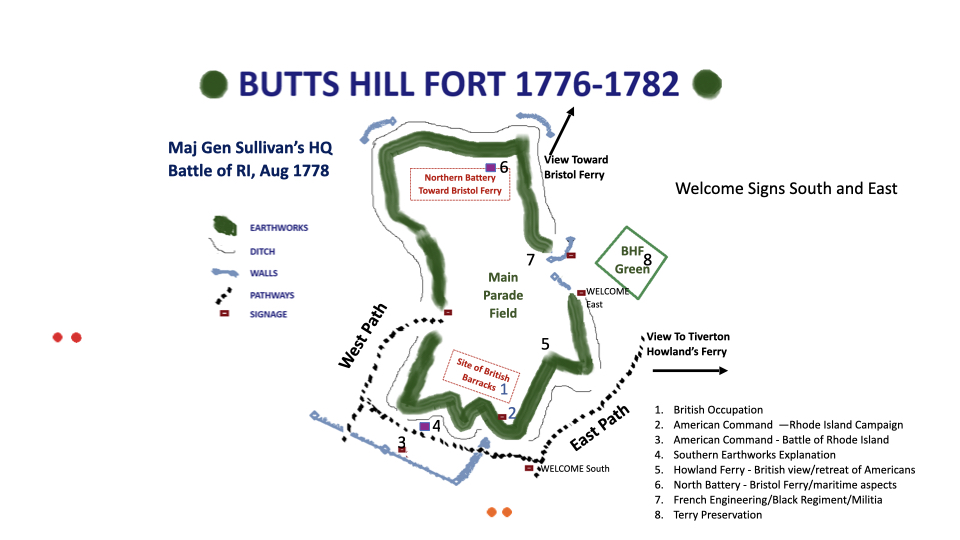
It is time for a new walking guide to Butts Hill Fort. I wrote one two years ago. However thanks to the scholarship of historians sponsored by the Battle of Rhode Island Association, we have added information. I am working on a grant for QR markers for a trail and I started by working with Butts Hill Fort Restoration Committee’s Paul Murphy about where information stations should be and what the topic of each site should be. As I was writing scripts for my husband to do audio clips, it seemed to me that those drafts would work into a book. I am a retired librarian and I have a soft spot for “hard copies.”
The self-publishing company I deal with offers downloadable pdfs and that is what I am posting here.
I hope readers will understand:
That although my husband and I have proofed this there are probably many corrections needed. I appreciate feedback to make corrections. I have only ordered a few copies and there is opportunity for changes.
That this is not a comprehensive tour. Each of the sites has a short introduction to the fort and phases of the Rhode Island Campaign.
That this was written for a tour with short audio clips. Some pages – timeline, glossary, etc. are in the booklet but will not be in the tour.
With grant funding tenuous these days, I have to think of other ways to finance signage for a walk.
 portsmouthhistorynotes