Judge Benjamin Cowell collected the stories of Rhode Islanders who applied for pensions many years after the war. He published his stories in a book called “Spirit of 76” and he started his book with the stories of women who had to step up and take extra responsibilities with their husbands at war. Cowell commented: “The women also of Rhode Island, with all the sympathies peculiar to their sex, took an active part in sustaining the “great cause,” and a more noble race of women never existed.”
Today is July 4, 2025 and I am thinking of what I have learned about what Rhode Island women endured during Aquidneck Island’s Occupation by the British (1776-1779). Would we have the bravery to face the hardships that women of that era faced?

Even before the fighting began the women of this island began to spin yarn to make homespun cloth as a protest to British taxes. Newspaper accounts confirm that “Daughters of Liberty” were active in local protest spins. The Stamp Tax required Americans to pay tax on everyday items like newspapers, marriage licenses, business papers and even playing cards. The act was named for the official “Stamp” on the paper that proved the tax had been payed. The money from the taxes were to pay for the presence of British troops in America. Some of the colonists saw this as “taxation without representation” because they had no representatives in the British Parliament.
In Newport this tax was met with some violence, but the women took more peaceful strategies. Colonists still imported a great deal of goods from Britain. The women hoped that if Americans boycotted English goods that British merchants would pressure Parliament to repeal the Act. Colonial women had the responsibility of purchasing and making goods their families needed. They were willing to make the sacrifices needed to make a political statement. It gave women a voice at a time when they couldn’t hold public office. Benjamin Franklin appeared before the British House of Commons to argue against the Stamp Act. He noted that while Americans used to take pride in wearing fine imported garments, it was now their pride “to wear their old clothes over again, til they can make new ones.” (see blog on “Revolutionary Women: the Daughters of Liberty” for more information on these protest spins.
Aquidneck Island women faced unimaginable hardships during the Occupation by British forces.
They faced homelessness when their homes were commandeered to house British forces.
They lost their orchards, wagons, fences and any other wood for the heating of the British forces.
They lost the ability to move about the island or move off the island. Travel was greatly restricted.
If their husbands were serving in the army or militia, women had to run their farms or their businesses on their own. They had to plant, tend and harvest the crops without their husband’s help.
Looking at records of those petitioning for compensation for war losses, many lost all their animals, furniture, everything they had owned. The Binney Household Manifest in the collection of the Portsmouth Historical Society is an example of what Portsmouth families lost during the Occupation.
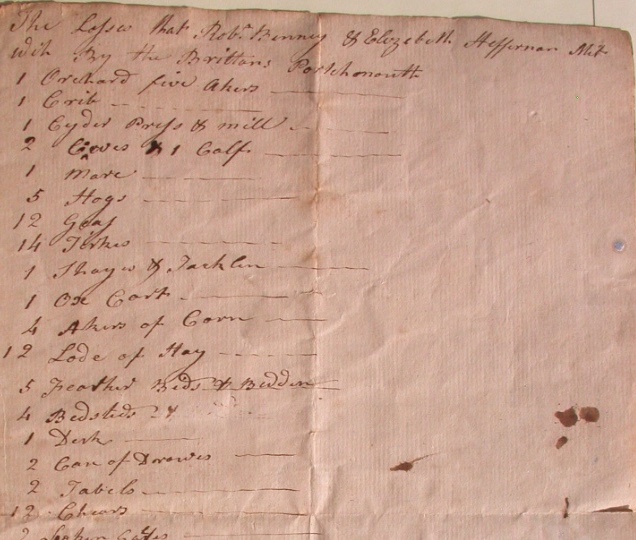
I orchard five acres. 1 crib
I cider press and mill 2 cows and one calf 1 mare
5 hogs
12 goats
14 forks
1 –jackass
1 ox cart
4 acres of corn
12 loads of hay
Aquidneck Island families suffered the most because of the Occupation. We need to remember their sacrifices towards the liberty gained in the Revolutionary War. It is certainly a time for us to ponder what we would sacrifice to keep our freedoms – our time, our voices, our money?
 portsmouthhistorynotes
Leave a comment