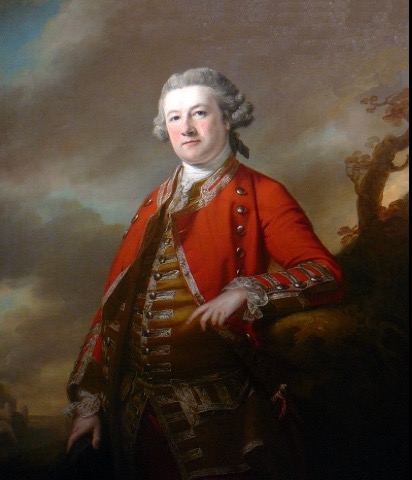
Robert Pigott- 1720-1796
Sir Robert Pigot was from a prominent Huguenot family in London. His brother Hugh was an admiral in the Navy. Pigot joined the British Army before the Revolutionary War and in 1758 was a major in Seventieth Regiment. Although he continued in the army, he was elected as a Member of Parliament. He commanded the Fifty-Fifth Regiment in Ireland as colonel in 1775. After this assignment he moved to America. During the Battle of Bunker Hill, Pigot commanded the left flank of Howe’s army. He led the second assault on the colonists’ position but he failed to break the Americans. In 1776, he was promoted to Major General and was placed in command of the British forces occupying Rhode Island. In 1778 he was in command of British forces during the Rhode Island Campaign. This was a joint effort of French and American forces, but the French pulled out unexpectedly when a storm damaged their ships. When the French ships had arrived near Newport, Pigot ordered his forces to evacuate Portsmouth. The Americans progressed close to Newport, but they began a retreat off the island when it was clear that the French would not come back to help them. Pigot’s forces hoped to catch the Americans in their retreat and his men chased the Americans as they prepared to leave via Howland’s Ferry. This action was known as the Battle of Rhode Island. The British were not able to prevent the Americans from retreating off the island. Rhode Island remained in British hands, but Pigot faced criticism for failing to capture the retreating army. He soon moved back to England.
Eyewitness Account – Pigot gives his orders on August 29th: “As soon as the day broke this Morning and we could see as far as the Enemys Encampment it was observed that their tents were struck; I went immediately on top of Dudleys house, and when it grew lighter, I could plainly perceive that the Rebels had struck their whole Camp, and had marched off; hardly a man was to be seen in their Batteries or Trenches. I rode as fast as possible to General Pigot’s quarters in Newport and informed him of it, and returned to the Camp with his orders for all the troops to get under arms with the utmost expedition. The General came to Irishes Redoubt by the time the Troops were assembled, and being satisfied that the Rebels had quitted their position, he gave orders for a part of the Army to march out, in three Columns, to pursue them, but to advance with caution, and not bring on an Action with a part of our force.” Frederick Mackenzie’s Diary – August 29, 1778.
 portsmouthhistorynotes
Leave a comment