Home

Portsmouth Farm Heritage:

Leave a comment

Wampanoag Gardening

Portsmouth history is farm history and we will be exploring that history in blog posts to come.  Our farm history starts with the fact that Aquidneck Island was a summer campground and hunting field for both Wampanoag and Narragansett tribes.  We know something about how the island’s first residents grew their crops through the heritage of Wampanoag Three Sisters Gardening.  URI Master Gardeners working at Prescott Farm created a Three Sisters Garden in back of the Sherman Windmill.  Just a week ago I saw the corn stalks, squash and green beans there.

How did our native residents feed their families?  They hand planted seeds in a mound pattern about 18 inches at the base and 10 inches at a flat top where the corn would be planted.  The mounds are about 4 inches high with a shallow ring around it to hold water.  When the corn reaches about 4 inches high, beans are planted in four holes around the corn mound.  Squash (summer, winter, pumpkin) is planted with the beans.   The beans, corn and squash all help each other grow.  The beans grow up the corn stalks and the squash spread out and help prevent weeds.

We associate the Wampanoags with our Thanksgiving, but in their calendar they have five thanksgivings.  Strawberry Thanksgiving greets summer when the first wild berries ripen.  Green bean thanksgiving  and green corn thanksgiving are held in mid summer.  Cranberry Thanksgiving celebrates the ripening of that berry in the Fall.  After all the work is done there is yet another thanksgiving. wampanoag-calendar Wampanoag Calendar

Stories from St. Mary’s Churchyard: Harold Stirling Vanderbilt’s Story

Leave a comment

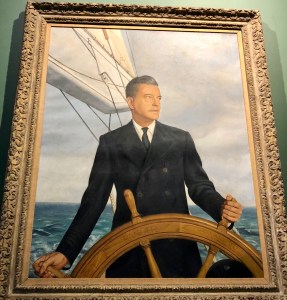
Harold Painting

Portrait of Vanderbilt at MarbleHouse

A very simple, flat gravestone in St. Mary’s Churchyard marks the final resting of place of Harold Stirling Vanderbilt.  Vanderbilt (known as Mike) was a railroad financier and great grandson of Cornelius Vanderbilt. Despite his family background and business, Harold was best known for two passions in his life – The game of Bridge and Sailing.
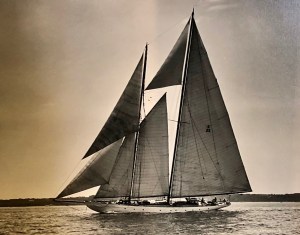
Vanderbilt was a three time defender of the America’s Cup – sailing’s great race.  He nearly lost his yacht, the Vagrant, in a twist of fate in 1914 during the beginning days of the First World War.  As the Commodore of the New York Yacht Club, Vanderbilt sent his yacht from Rhode Island to Bermuda to meet the British competitor – Shamrock IV and escort it to Newport.  When Britain declared war on Germany on August 5, 1914, the British crew received word by radio.  The Vagrant had no radio and was unaware of the declaration of war.  One of the first things done in Bermuda to prepare for war was to remove all navigational aids.  The crew of the Vagrant did their best to work through the narrow channel and barrier reef without the aid of the buoys and markers.  They found themselves directly in front of St. David’s Battery where the gunners were prepared for war and opened fire.  Luckily it was a warning shot!  The America’s Cup was cancelled for that year.

Vagrant (1)

Photo of the Vagrant (Marble House)

Harold Vanderbilt saw active duty when the United States entered World War I.  He was the commanding officer for the scout patrol out of Newport and later was in command at Block Island.  He was then placed in command of an anti-submarine force in New London.  He was reassigned later to command the Block Island, Rhode Island, anti-submarine sector and then the New London, Connecticut sector. In 1918 he was reassigned to a Submarine Chaser Detachment in Ireland and served there until after the Armistice was signed.

When World War II began, Vanderbilt’s yachts Vagrant and Vara were appropriated by the US Navy.  Vanderbilt received a check for their value, but he signed it over to the USO so the money would benefit servicemen.

Harold Vanderbilt is known as the originator of contract bridge.  In 1925 he was on a slow boat to Havana and was bored by the card games that were dependent on luck instead of wits.  He retired to his stateroom to work on a game that would rely more on intellect.  A few hours later he devised a game based on whist and auction bridge.  He had players bid games and slams.   He worked on a scoring system that rewarded good judgment and penalized players who failed to make bids.   He tried it out on his fellow travelers and the game caught on.

If you want to know more about Harold Stirling Vanderbilt, you can view items from his military service and yachting career at the Marble House.  In 1963 Vanderbilt bought back the Marble House which his mother had sold thirty years before.  He turned the building over to the Preservation Society of Newport County.

Sources:  “Vanderbilt’s Card Game:  A mirror of modern society”  An article in the Washington Post, March 1, 1981.

Wikipedia article on Harold Stirling Vanderbilt :https://en.wikipedia.org/wiki/Harold_Stirling_Vanderbilt


Hurricane of ’38: The Story of the Reynolds and Jackson Families

Leave a comment

Destruction at Island Park

As we try to find stories about what happened in Portsmouth during the Hurricane of 1938, one of the best sources comes from “A Wind to Shake the World” by Everett S. Allen (Little Brown, 1976). The author interviewed survivors and one of the interviews was of Ann Reynolds who was ten years old at the time.

Ann relates when she and her brother came home from school at 3PM, no one was home. Mrs. Joseph Jackson, a neighbor, invited them to come to her home as the storm intensified. As they came to the Jackson cottage, they noticed that the water had already started to come into the cellar. Two women and a baby from Common Fence Point asked to come into the Jackson house to get out of the storm. By 5 PM waves were crashing against the house and the water was beginning to reach the second floor. The Jacksons decided to leave the house and the Jacksons made an improvised raft.

Ann related: “The two women with the baby refused to leave the house, believing they were safer in the building than outside. Just as we floated off, we saw the house swept away by the tidal wave, with the women and the baby still in it.”

“Mr. Jackson had Johnny (Reynolds, age 8) on his back, but when his weight took him under water several times, he passed my brother to Earl (Jackson, aged 22). Earl and my brother floated away in another direction and we lost sight of them. Just before we reached high land, Mr. Jackson slipped off the board which we used for a raft, leaving me on high land, where the water reached only to my knees. Mr. Jackson rushed back and caught Mrs. Jackson just as she was going down for the third time.” (pg 225)

The Jacksons and the Reynold’s family lost their homes, but John Reynolds and Earl Jackson were found the next morning by Mr. Reynolds. They had landed safely two miles away.

The Hurricane of ’38 in Portsmouth: Crop Damage

Leave a comment

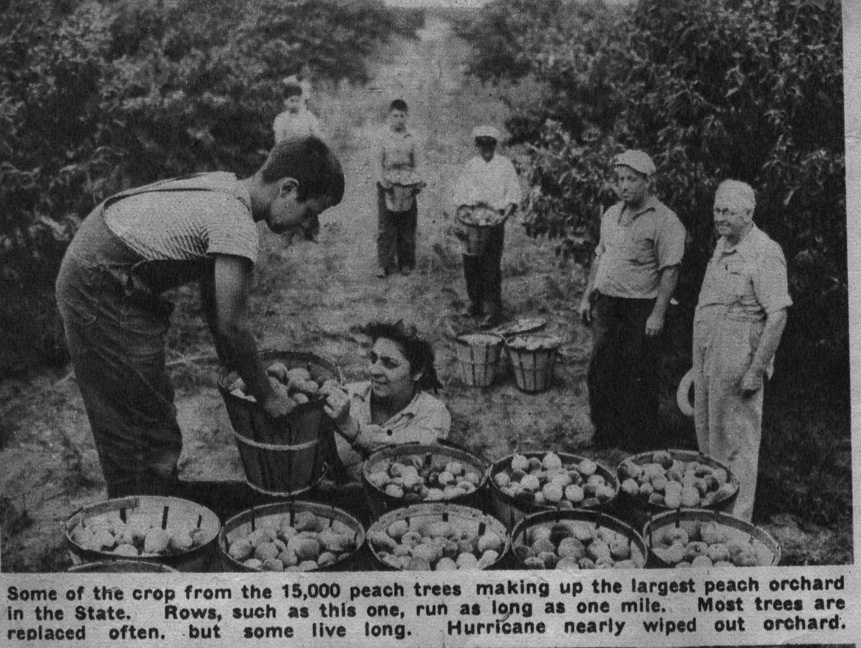
Hathaway Orchard after hurricanePortsmouth farmers had little warning to prepare their crops for a big storm. All Hathaway Orchard owner Howard Hathaway had was that his barometer hit a low. The hurricane damaged both orchards the Hathaways kept and it took years – until 1944 – for a new crop to come in. The orchards on the island were stripped of all their fruit. Peppers, beans and other crops low to the ground had partial losses. Corn and other high growing vegetables suffered severe losses. Poultry houses were demolished and many birds perished in the might of the storm. Only the tubers and root crops survived well.

Read about the hurricane of ’38 in the book “Sudden Sea” and come to the Portsmouth Free Public Library the evening of September 19 for a book discussion. The library will have many copies of the book on hand by the end of the week.

Portsmouth Hurricane Stories: Dorothy Chase’s Account

1 Comment

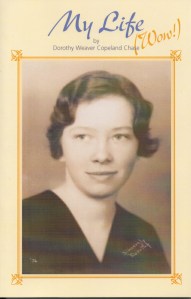
Chase

Dorothy Chase, from the cover of her biography.

This account of the Hurricane of 1938 comes from Dorothy Chase’s biography – “My Life” which was written as a gift for her family in 2004.

Dorothy was tending to Herbert and Stanwood Chase’s “Old Homestead Orchard” roadside stand on East Main Road when the hurricane hit.

“I was at the stand the day of the ’38 hurricane and the rain was coming down in sheets.  The wind blew down the billboard across the street and branches from the large maples over the stand were coming down on the building.  At this point I was afraid to stay inside, so I went out into the gardens in the rear.  Finally Herb came in the Model A truck and we closed up and wove our way through the debris on East Main Road and Glen Road to his house.  There was no power but the Chase men were hungry.  We had corn, potatoes, and onions, so I made a corn chowder on the kerosene stove.  … After supper Al Bryan came and he and Herb drove me home zigzagging over lawns on East Main Road via the Two Mile Corner, out the West Main Road, the only way to get to our house.  My mother broke down in tears, when we arrived, she was so glad to see us all alive and well. It was several days before we knew of all the tidal wave deaths and other destruction and weeks until utilities were restored.  …Herb and Stan’s farming was done for the season.

The next year Dorothy married her beloved Herb at St. Mary’s Episcopal church.


Sarah Gibbs and Oakland Farm: Hospitality and Heartache

3 Comments

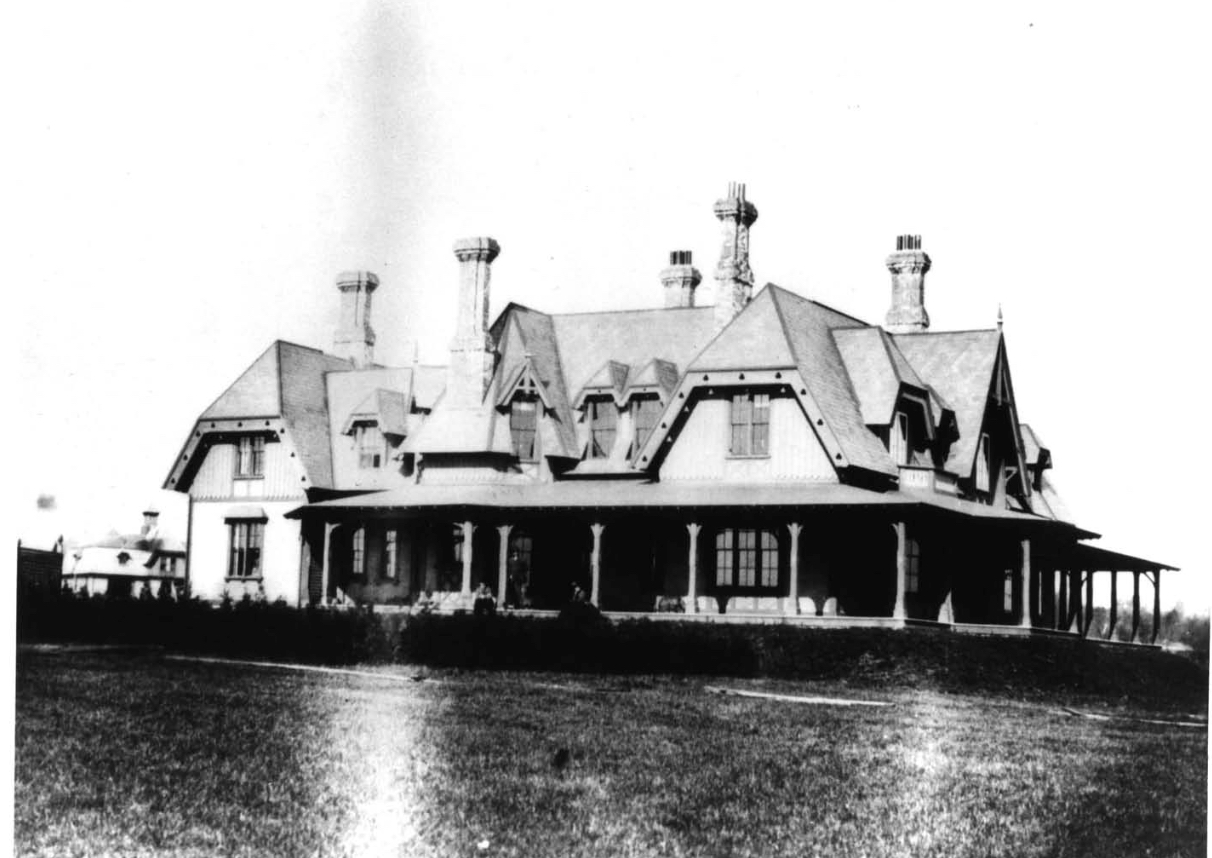
Oakland Farm at Sarah Gibbs time.

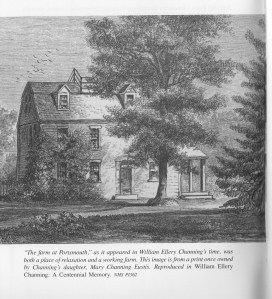
Today “Oakland Farm” is best known as a condominium community or it is remembered as the country estate of a branch of the Vanderbilt family.  Before the land was sold to the Vanderbilts, Oakland Farm was the summer home of Sarah Gibbs and her sister Ruth Gibbs Channing.  Ruth was the wife of William Ellery Channing, a famous Unitarian minister, and Oakland Farm was Channing’s treasured summer retreat.

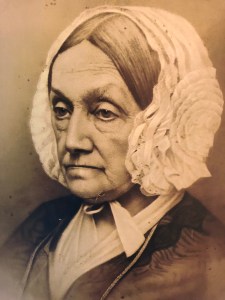
Sarah Gibbs is best known for her founding of St. Mary’s Episcopal Church in Portsmouth.  Known as “Aunt Sarah” by her family, she was famous for her hospitality.  Sarah never married, but at Oakland Farm she was surrounded by loved ones. Sarah was an integral part of the Channing family and wrote about the Channing girls as “my children.”

The reminiscences of family friend Miss Mary Powel, give us a glimpse of Sarah’s Oakland Farm.

“Here she kept not only a good farm but a charming and really beautiful old house…not far from the highroad.  The garden, carefully planted and containing several curious foreign trees (one brought back from England in a flower pot by Miss Gibbs herself), was separated from the road and from the farm driveway by old stone walls and well-kept arbor vitae hedges……The house, a good specimen of colonial architecture, was filled with fine old furniture and many curios.  Owing to the large hospitality of its owner, there were many rambling additions built from time to time and the exterior of the house was adorned here and there by little balconies of open rails….”  (From the Gibbs Family of Rhode Island and some related families.  By George Gibbs privately printed in New York in 1933).

Miss Powel goes on to describe an apple orchard and tree sheltered grass road to the woods where Channing loved to stroll.  To the west of the house were fields of Indian corn and pumpkins with pastures close by.  The farm had the usual outbuildings, barns, corn cribs, stables and sheds.  There was even an outdoor shower!  Approaching Oakland’s door, guests would be surrounded by chickens and turkeys.  Guests would be ushered into a broad beamed drawing room with a fire place.  Sarah would greet her guests there.

Miss Powel describes her  as a “little lady” dressed in fabrics from India and China and draped in white cashmere or camel hair shawls.  “Her features were strong and pronounced, her eyes extremely blue, her complexion rather bright, but much wrinkled and her voice and manner were most kind and gracious…I think that all children thought she was a sort of venerable fairy godmother” – (Gibbs Family, pg 101).  Sarah always sent her guests off with handfuls of ginger cookies.  Miss Powel remembers her as “the genial dignity and gracious cheerfulness of the lady of the manor, with her many rural dependents, her liberal charities, her fond but humble love of the Church; the evening prayer, the kindly chat, the fond welcome and the sweetness and serenity of the scene and the visit.”  (The Gibbs Family, pg 106.)
Sarah Gibbs

While the descriptions of Miss Gibbs’ life at Oakland Farm seem idyllic, there were family tensions that disturbed the peace of both Sarah and her sister Ruth Channing.  The eighty acre Oakland Farm was purchased from John Faxon in 1796 by the merchant firm of Gibbs and Channing.  In 1807 the firm ended and George Gibbs had the property.   When George Gibbs died in 1813, his wife, Mary Gibbs, was granted the farm for her lifetime use.  Mary was concerned about what would happen to the family estates at her death, so she established a trust for the benefit of her children.  It was her intention that Ruth and Sarah would have use of the property for their lifetimes, but after their mother’s death the brothers (George and William) tried to challenge that.  They refused to sign the “life tenancy” agreement for their sisters and explored ways of breaking the trust.

The strain in the relationship between the Gibbs sisters and their brothers weighed heavily on Sarah.  Sarah wrote to her Uncle Walter in 1825:

“The stillness of Oakland is increased in the solitariness of my feelings, – it is a desolation I can never lose – but in the quiet here I strive to interest myself in the garden, to forget that I have a Brother so near to me who has never called or sent to us to offer to give us any assistance.”

A month later she wrote again to her uncle:

“I have not heard from W(William) or what (he) has been doing – this silence forebodes a storm I very much fear – In the sense of the correctness of our feeling and actions- I hope we shall meet all the difficulties with composure and firmness – to me it has been a hard struggle to be cast off where I ought to expect so much tenderness & kindness.”

The rift with her brothers was particularly painful because Sarah was known as a congenial and non-judgmental person.  She was an intimate part of William Ellery Channing’s family. Although she disagreed with Channing on theology, it appears there were no conflicts over this.  Although Channing frequently preached at the Union Church just down the road, Sarah never attended a Channing service.   Sarah was devout in her Episcopal faith, both on Sundays and in her home life.  A bell in the Oakland house called the family to daily morning and evening prayer.  She gathered an orthodox Episcopal community around her and erected St. Mary’s Church at her own expense.

In the end there was a compromise between the siblings.  William and George did sign the life tenancy of Oakland Farm to their sisters and the sisters agreed to sacrifice some of their shares in other portions of the estate.  Sarah lived on there until her death in  1866.   Ruth Gibbs Channing lived until 1870.

Sources:

“William Ellery Channing and the Legacy of Oakland,” by Rev. Dr. Frank Carpenter.  Bulletin of the Newport Historical Society, Vol. 65, Part 3, Number 224.

The Gibbs Family of Rhode Island and Some Related Families, by George Gibbs.  Privately printed, 1933.  Copy in the archives of St. Mary’s Church, Portsmouth.

“The Funeral Sermon of the late Miss Sarah Gibbs” by Rev. F. Marion McAllister.  New York, John F. Trow and Co.,1866. Copy in the archives of St. Mary’s Church, Portsmouth.


Hurricane of ’38 Portsmouth Stories: Nan Howell Waters

Leave a comment

Elmhurst student illustration of hurricane damage at Linden Lane

Our next book club selection – Sudden Sea – has great stories about the Hurricane of 1938, but it doesn’t have many Portsmouth stories. As I prepare for the book club, I am looking for local hurricane stories. Over ten years ago I interviewed Nan Howell Waters about growing up on Glen Farm. She remembered the hurricane. She was at Anthony school and she was frightened by the stones hiting the windows at school. For a while they wouldn’t let them go home because they had to wait for the bus. She remembered her father, Arthur Howell, meeting her at the head of driveway (Linden Lane). The Howell family and the Camara family lived at the Brown House. The Howells lived on the first floor, but they went upstairs and rode out the hurricane with the Camara family. She remembered looking out of the windows and seeing some of the beautiful Linden Trees falling down.

Nan Howell Waters

Stopping by Brown’s Tea House

Leave a comment

1849 Map showing Brown’s and Durfee Tea Houses

Today we might think of “tea houses” as a place to have a quiet cup of tea and sweet snack.  Tea houses were quite different in 19th century Portsmouth.  They served as hotels, party venues and places for the community to gather for events.  I have known about the Durfee Tea House off of Glen Road, but I didn’t know very much about other tea houses in Portsmouth.  This week I came across the name “Brown’s Tea House” as I was doing other research, so I dug deeper to find out something more about this tea house.

Researching local history is like piecing a puzzle together.  You get one clue from one source and that leads you to bits and pieces of information through other sources. Piecing the information together, you come to understand small windows of Portsmouth life.  I’m always searching for old maps and I came across a 1849 Hammett Road Map of Aquidneck Island on the Library of Congress website.  The purpose of the map was to show the roads, but it did mark some sites of interest like churches and windmills. Marked by “East Road” were both the Durfee Tea House (off of Glen Road) and Brown’s Tea House.

Through a newspaper database I found an advertisement for a new tea house in Portsmouth in 1847 – “Fashionable Tea House – Five miles from Newport, on the Post Road leading to the Stone Bridge”.   Benjamin Brown is the proprietor.  They welcome “transient and permanent Boarders” and offer “Tea Parties and Pic Nice furnished at short notice.”  Next to the house are two bowling alleys “where those who take pleasure in this invigorating exercise can indulge.”  They even had a 20 by 45 foot ballroom.

What happened to the Brown’s Tea House?  A later advertisement in 1857 announces a Tea House owned by Charles Russell, Jr.  It seems to be in the same location as the Brown Tea House.  The ad boasts that Russell has enlarged the house and put it in excellent order.  “The location is delightful, and persons visiting the House, for a long or short time, will find every convenience and luxury…there is fine bathing half a mile from the house.  Families desiring to spend the summer in the country will find this one of the most delightful locations on the island.” (Newport Daily News 08/06/1857.)

Yet another source, David Durfee Shearman’s diary, adds to the story.

Entry from 12/17/1858 “The Tea House owned by Charles Russell and occupied by him as a tavern was burned to the ground last night… It is supposed to have caught fire from the stove pipe or rather from the carelessness of an Irish Servant…”

Then on March 14, 1860 “I went to the Half Way Place with Levi Cory.  William B. Sisson has lately purchased the farm of Chas. Russell and will put up a public house this summer on the site of the one that burned down the on the night of Dec. 16, 1858.”

A Newport Mercury article from May 25, 1888 lets us know that the Sisson Tea House must have been built because “The Ell of the “Tea House” has been bought by Mr. Jonathan A. Sisson and moved to its new site on the east side of the road…”  An 1877 Newport Daily News article reports that a “republican caucus for the nomination of candidates for members of the General Assembly and for town officers will be held in the Tea House in South Portsmouth, on Monday, April 23.”

The “Brown – Russell – Sisson” Tea  House never seemed to reach the fame of the Durfee Tea House.  It is interesting that two such tea houses existed so close to each other.  Portsmouth is still looking for community gathering spots for large groups like we had in the days of the tea houses.


Portsmouth People: Greenvale’s James Parker (1854-1934)

Leave a comment

We are truly fortunate that Greenvale Vineyards carries on the tradition of Portsmouth farming.  Established as a model “Gentleman’s Farm” by China Merchant John Barstow, the farm and stick style house went into neglect after Barstow’s death.   Major General James Parker’s wife, Charlotte Condit Parker, was among the various heirs to the property. The Parkers took a real interest in Greenvale and brought it back to life. When James Parker retired in 1918, he and his wife resolved to make Greenvale their home and restore the property as a working farm. They began to work on the stick style Barstow house to make it livable and bright for the family. They hired a farmer and re-established a working farm with fields, chickens, pigs, geese, turkeys and a dairy herd.

While living in retirement on Aquidneck Island, Parker continued to be forward thinking, even if some of his ideas met with opposition.  An April 26, 1929 article in the Newport Mercury contains a letter Parker wrote in support of using Kings Park in Newport as a station for Curtis Flying Services seaplanes.  Parker believed it was the best site with passengers embarking and disembarking from the city pier.  He believed seaplanes were safer than airplanes.  “Air travel is sure to come.”  Seaplanes could make a two hour run from New York to Newport and that would enhance the value of Newport as a summer residence.  Mrs. J. Nicholas Brown and her son opposed that use for the park.

Before his retirement to Portsmouth, James Parker had a brilliant forty-two year career in the military. A graduate of West Point, Parker served in the Indian Wars (including chasing Geronimo), the Spanish American War, the Philippine-American War and World War I.  He received the Congressional Medal of Honor for combat at close quarters during an attack by an overwhelming number of enemy soldiers  in the Philippines in 1899.  He rose to the rank of Major General.

In 1934, Major General James Parker was buried with full military honors at St. Mary’s Episcopal Church in Portsmouth.  James Parker’s son, Major General Cortlandt Parker, whose grave in close to his father’s also retired to Greenvale and continued the farm.  His grandson, Cortlandt Parker, went on to establish the vineyard that makes Greenvale a going farm today.  Family members, including Nancy Parker Wilson, continue to keep Greenvale a beautiful part of Portsmouth’s farming heritage.

Vintage image of the Barstow house at Greenvale

Julia in Portsmouth: First Home at Lawton’s Valley

Leave a comment

1860 Aquidneck map showing Howe property.

We know that Julia Ward Howe’s second Portsmouth home was Oak Glen on Union Street. Where was her first home? She started coming for her Portsmouth summers in the 1850s. The 1860 map that hangs on the wall at the Portsmouth Historical Society provides the answer.  It was on West Main Road, north of the Cornell property and in Lawton’s Valley.  In fact it was not very far from the Town Poor Farm.

Writing in her memoir, Reminiscences, and quoted in her daughter’s book – This Was My Newport – we know how the Howe’s came to own the home. She was writing about a notorious real estate agent named Alfred Smith.  Smith would entrap strangers in his gig (a light two-wheeled open carriage), drive them out to one of his properties and pressure them to purchase the property.  Julia says that “This lovely little estate (Lawton’s Valley) had come to us almost fortuitously.”  “In the summer of 1852 my husband became one of his victims… I say this because Dr. Howe made the purchase without much deliberation.”

Julia’s money was used to buy the property, but it was put in Samuel Gridley Howe’s name.  Later he would sell it just as abruptly as he bought it – and without Julia’s knowledge or agreement.  Thankfully, they later bought the Oak Glen property that we know today and Julia spent her last years there.

Note:  page 171 – This Was My Newport by Maud Howe Elliott, 1944.

Older Entries Newer Entries