Home

History Detective’s Guide: Picturing the Past

1 Comment

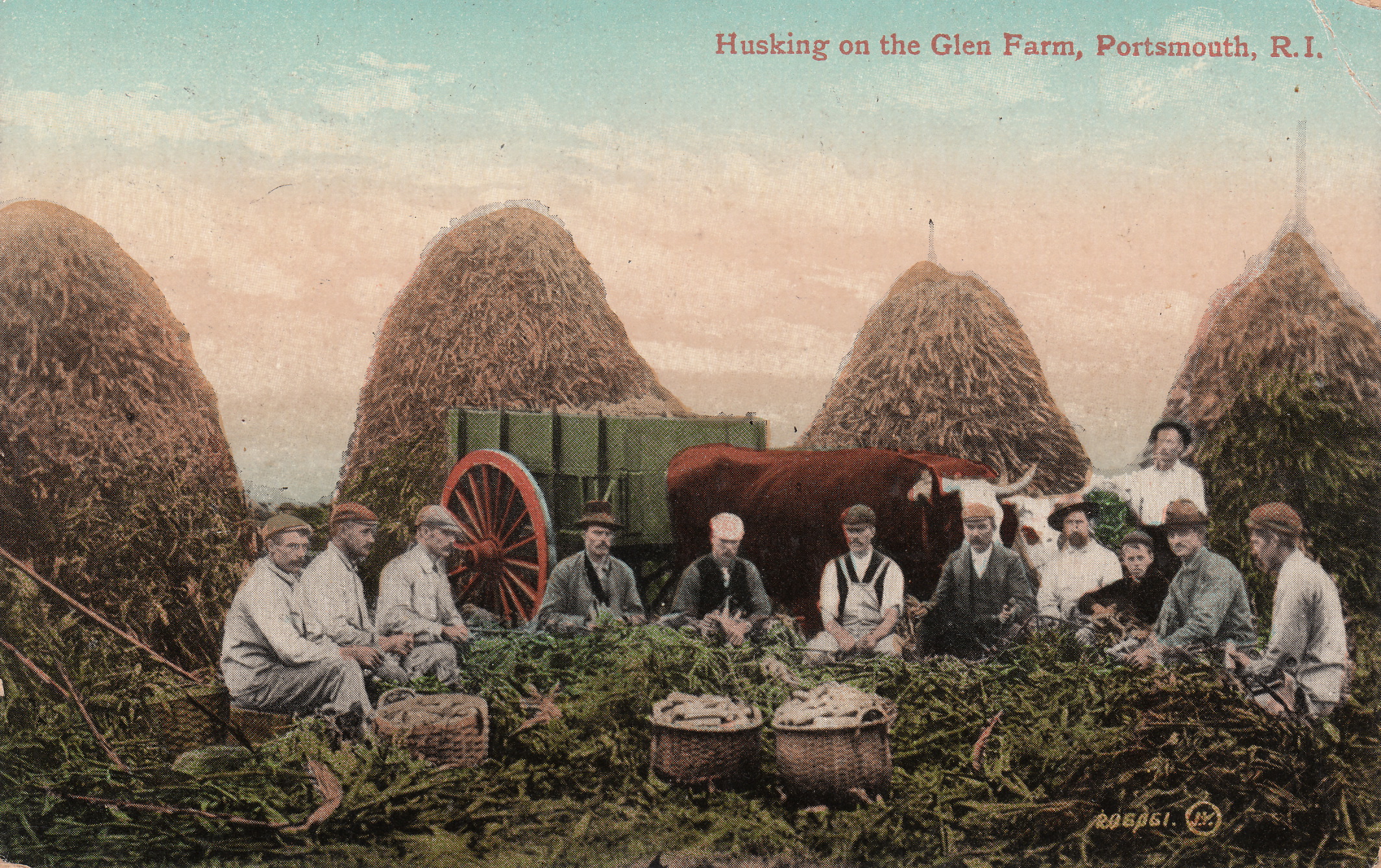
Corn husking on Glen Farm

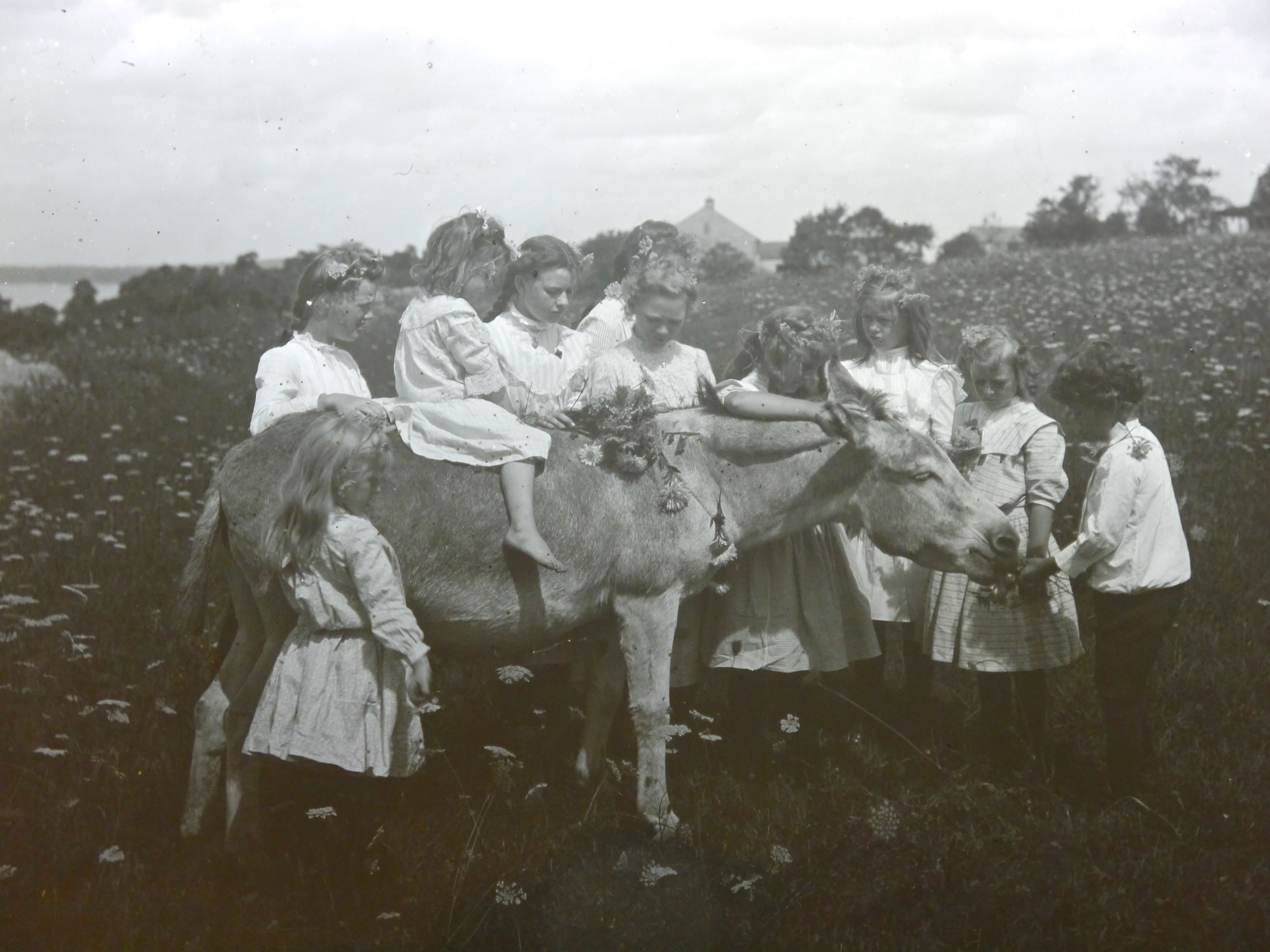
Sarah Eddy photograph of Portsmouth children.

A vintage photograph is an excellent primary source. It is a snapshot of a moment in past time. How do you get the most information from a photograph?  You have to spend time with the photo and carefully look at the details.

Steps in Analyzing a Historical Photograph

  1.  Study the photograph for at least two minutes to get an overall view. Think about why the photographer took this image. Does it record an event? Is it a professional portrait? Is it a postcard meant to show off interesting landscapes and buildings in town?
    In your mind, divide the photo into four quarters.
  2. Look at each quarter separately. Use a magnifying glass if it helps you to enlarge and note the details of the picture.
  3. If there are people in the photo? What can you tell about them. How old are they? What can you tell from the clothes they are wearing?
  4. If this is a photo of an event, what is happening?
  5. When and where was the photo taken?
    a. Are there clues about the location? Does the landscape or buildings look familiar? What do you see in the background?
    b. What year or decade was it taken? Can you tell from the signs, vehicles or even the presence of electric wires.
    c. What season is it? Is there snow on the ground, leaves on the trees?  Are people dressed for warm or cold weather?
    d. What time of day is it? Can you tell by shadows or lighting?
  6. Use a magnifying glass to find the objects that are in the photo. Are there tools, signs, buildings, vehicles?
  7. What questions does the photograph raise? Can you think of other sources that could help answer those questions.  Would a map help? How about a city directory?

SaveSave

SaveSave

History Detective’s Guide: Basic Transcription

Leave a comment

Transcribing Revolutionary War era documents was one of my first volunteer activities for the Portsmouth Historical Society. At that time I was working with the original documents in my hands. Today I usually work from a digital image of the document and that makes it easier. On my computer I can enlarge the image of the document and that helps me to decipher what the text is. Because we can make digital images, transcribing documents is something people can do on there own at home. One of our best transcribers works from Georgia! She enjoys this work because she is a genealogist and she sometimes comes across the names of her Portsmouth ancestors as she works. We have hundreds documents from the 1600s and 1700s digitized (we have jpgs of them) and we are working at preparing more documents from the 1700s and 1800s ready to be photographed.

The more I transcribe, the better I get at deciphering the script. It is a skill that comes with practice. Here are a few tips that may help you if you work with transcription.

Glance over the whole document before you try to transcribe. Is it a will, a bill, a court case, a death inventory or another type of written work? The type of document gives us clues to what kind of words you will encounter. If it is a property inventory you are going to see household goods. The bill for construction of Southermost School is going to have building supplies. Legal documents may have special phrases used in the law. Some of the questions we ask are who wrote this, when did they write it, and why did they write it? Thinking of these questions ahead of time actually helps me to transcribe more easily.

Lines should break in the exact same place as on the original. That will make it much easier to move from original to transcription because they will literally “line up” the same.

Type the words exactly as you see them. Keep the original spelling, even if you would consider it wrong. Punctuation, capitalizations (or lack of them) should be like the original. Include everything – cross outs, words added, what is in the margins.

Take your time. Transcribing is puzzle solving and you won’t get all of it at one time. Keep coming back to it. It is often helpful if at least two people are working together on a transcription.

Write down what you can easily decipher first. If you find something you can’t read, leave a space for it and continue on. Go ahead, make a guess. If you are making a guess, put it in brackets with a [?] . Keep saving your work as you go along. You can go back to it and fill in words you missed earlier. Maybe someone later can determine what word belongs in that spot. I look at the words I can decipher as examples of how letters are written by this author.

Sound out the words that are puzzling. Sometimes the odd spellings can confuse us, but trying to sound out the syllables aloud gives us more of an idea of what the word is. Once I have a letter for letter copy, I often try to write it again in modern English.

A cautionary story about dating documents
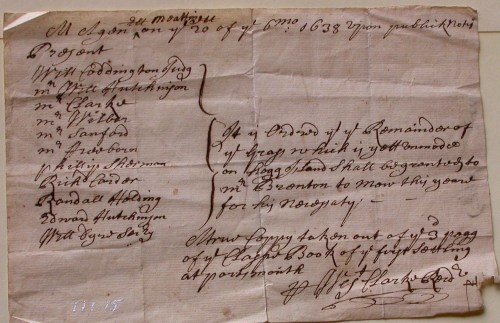
At the Portsmouth Historical Society we have an early copy of one of the first Portsmouth documents. It is about rights to the hay on Hog Island and transcribing it sent me on quite a journey. When I transcribe I usually find myself using secondary sources to look up people and items mentioned in the document. A list of the signers of the Portsmouth Compact provided me with candidates for signers of this document because both documents originated within a few months of each other.
One of the first puzzles concerned the date of the document – the 20th of the 6th month of 1638. At first it sounds like it would be June of 1638. But the right to the hay was given to William Brenton and he wasn’t in Portsmouth in June of 1638. Until 1752, Americans used the Julian Calendar (named after Julius Caesar). The year began in March, so the first month was March and the sixth month would be August. Using numbers instead of names like March, April, May etc. was especially common in Quaker records. There are records of William Brenton being in Portsmouth by August of 1630. There are still mysteries about this document. I know that it is a “true copy” of the original document, but I am not sure if the “Clarke” signing it just means “clerk” or if an actual “Clarke” had made the copy.

transcriptions – hog island – 111.15

DSCN3606

Hog Island Hay Document

! meatting myse
met again ^ on the 20 of the 6th mo:1638 upon publick notice
Present
Will Coddington Judg Mr. Will Hutchinson Mr. Clarke
Mr. Wilbor
Mr. Sanford
Mr. Freeborn
Phillip Shearman Rich Carder
Randall Holden Edward Hutchinson, Will Dyer —–
It is ordered yt ye remainder of the hay which is yet —-on Hogg Island shall be granted to Mr. Brenton to mow this year for he neiey aty —— a trew coppy taken out of the 2/3 page of the Chapp Book of the first sotkmg at Portsmouth.
___ ___ ___ ye Clarke —re —-ro

_________________________________________________

My attempt at modern English
! meeting house
Met again v on the 20th of the 6th month; 1638 upon public notice
Will Coddington, Judge
Mr. Will Hutchinson
Mr. Clarke
Mr. Wilbore
Mr. Sanford
Mr. Freeborn
Phillip Shearman
Rich Carder
Randall Holden
Edward Hutchinson
Will Dyer
William Coddington, William Hutchinson, Jr. [husband of Anne Hutchinson], John Clarke, Samuel Wilbore, John Sanford, William Freeborne, Phillip Shearman, Richard Carder, Randall Holden, Edward Hutchinson,William Dyer.
It is ordered that the remainder of the hay which is yet — on Hog Island shall be granted to Mr. Brenton to mow this year his—–
This is a true Copy ———- taken out of the 2/3 pages of the Chapp Book of the first — at Portsmouth
The Clerk _________________________________________


A History Detective’s Guide: Primary Sources

Leave a comment

SJE glass Br Fer004

A vintage photo gives us an eyewitness view of Bristol Ferry circa 1900.

Historians divide the resources they use into “primary” and “secondary” sources.   To put it briefly, primary sources were created at the time of an event by people who had first hand knowledge.    Secondary sources contain second hand information created after the event by people who were not there.  Most secondary sources are written by people who have used primary sources and then woven them into a book or report.  The books by Edward West, Jim Garman and John Pierce that I mentioned in the previous blog are examples of secondary sources.  I often use secondary sources to help me understand the primary sources I am investigating.

Primary sources are at the heart of new historical research.  There are skills involved in using these sources, but they are skills that are developed from practice.  I am an amateur history detective, but I can share some tips I have learned from my own journey to understand Portsmouth history.  This is the overall object of this series of blogs.

Here are some examples of some of the primary sources that are important to discovering new information about life in Portsmouth.  We need volunteers to explore these primary sources and record the information they give us.

  • Objects: Tools, military items, household goods, clothing, vehicles (like the Willowbrook hearse or the mail wagon in our Old Town Hall).  At the Portsmouth Historical Society we need help in identifying and researching the hundred of items in our collection.
  • Places that remain much the same: like Glen Farm barns, the Glen itself, historical buildings like the Quaker Meeting House.  Landscapes and buildings have a story to tell us.  Students visiting the Southermost School get a unique feeling for what it was like to go to school during colonial times.
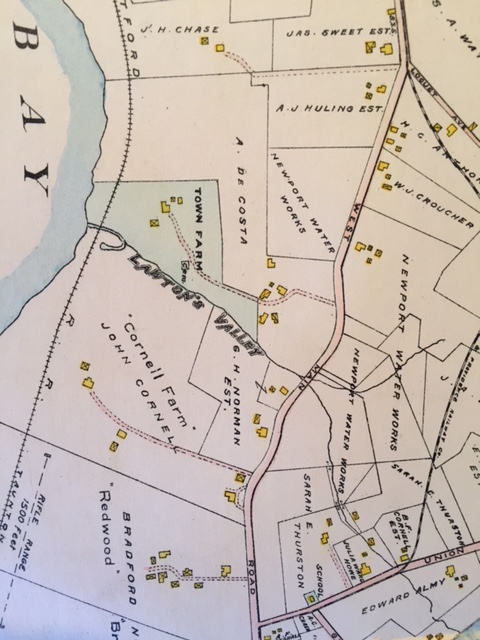
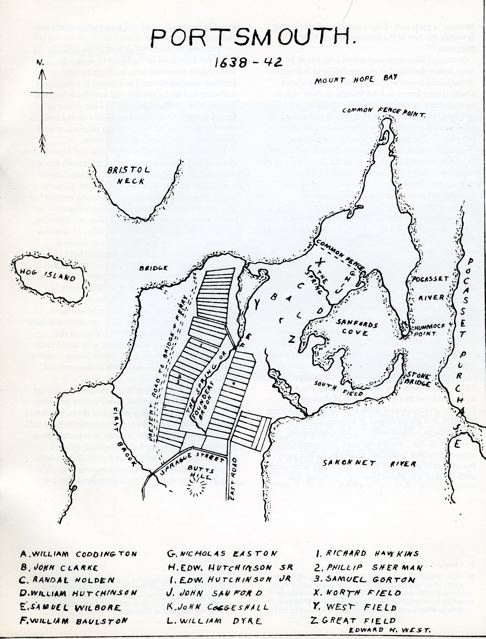
  • Geographic records: vintage maps, school district maps, charts, even place names Common Fence Point or Freeborn Street tell us who lived where and how the land was utilized.
  • Visual records: drawings/paintings, photographs, blue prints.  We have hundreds of vintage photographs in our collection.  These are “snapshots” of a moment in time in Portsmouth.
  • Written records: letters, diaries, laws, vintage books, trial records, public meetings (Early Records of the Town of Portsmouth), newspaper accounts from the time, inscriptions on gravestones, ads.   We have a trove of scraps of documents that need sorting and transcription.
  • People: Oral history and interviews of people who are sharing their experience of an event of time.  We need to interview native Portsmouth residents who have a wealth of knowledge about our town.  My students at Elmhurst interviewed the Camara sisters about growing up on Glen Farm and the videos of these interviews has been a goldmine of information for us.

I love using primary sources because I am finding my own clues and not dealing with someone’s opinions of what happened.  You are discovering your own answers as you look at a picture, examine a map, read a newspaper article or handle an object from the past.  The primary sources often lead to questions that secondary sources can help me resolve.


A History Detective’s Guide to Portsmouth Research

Leave a comment

JIm Garman

Town Historian Jim Garman

One of the Portsmouth Historical Society docents asked me how I go about researching Portsmouth history.  I’m a retired librarian who has come to love researching local history.  It is in my nature to share my sources. This series of blog posts will be a reflection of my journey in becoming a Portsmouth history detective.  Portsmouth has a fascinating history and our community (especially through the collection of the Portsmouth Historical Society) is blessed with a wealth of resources that need to be studied to give us all a fuller understanding of how our town has evolved.

I think of Portsmouth history as a gigantic jigsaw puzzle.  In framing the picture we have benefitted from the works of historians past and present. Edward H. West gave us a general book, History of Portsmouth 1638 to 1936, but he also gave us the West Land Grant Maps and numerous articles that were published in the journal of the Rhode Island Historical Society.  John T. Pierce’s book  Historical Tracts of the Town of Portsmouth Rhode Island provides interesting photos and articles on topics ranging from the Cornell murders to hurricanes.  Where Pierce covers a great many topic briefly, Jim Garman provides us with in-depth information. Some of his books, such as A History of Portsmouth, Rhode Island 1638-1978, are out of print.  Two of his more recent books, A History of the Gentlemen’s Farms of Portsmouth, RI, and Looking Back:  Historic Tales of Newport County  may still be available for sale.  All these works would be available at the Portsmouth Free Public Library.

There are many other books on topics in Portsmouth history and I will mention them later.  I suggest starting with West, Pierce and Garman because they have tackled a variety of events and people in our history.  If you want to learn about Portsmouth history as a general topic, start with the research these men have shared with us.  They give us a frame to the puzzle so that we can place our own puzzle pieces of information into the broader picture of the history of Portsmouth.


Founding Mothers: Rebecca Cornell – Friend of Anne

12 Comments

IMG_1520Rebecca Cornell’s mysterious death in 1673 has been the subject of stories, books and even a play.  We know the story of how her brother, John Briggs, described a dream which called into question the cause of her fiery death.  Her son, the junior Thomas Cornell, was ultimately hung for what was judged a murder.  Rebecca Cornell, however, had another claim to fame.  Rebecca was a friend of Anne Hutchinson and she was one of Portsmouth’s founding mothers.

In 1630s Thomas and Rebecca Briggs Cornell were respectable members of the Saffron Walden community in Essex, England. He was 45 and she was 38 when they sailed for Boston in 1638 with their eight children. Rebecca Cornell’s brother, John Briggs, was one of the earliest and perhaps youngest followers of Anne Hutchinson at age twenty-nine. Thomas and Rebecca came to Boston in 1638, just as Anne and her followers were leaving.  They bought the house of William Baulston and received his license for innkeeping.  Thomas soon ran into trouble in the Massachusetts Bay Colony.  Thomas received fines for selling wine without license. Neither Thomas nor Rebecca were literate, but Rebecca was considered an accomplished spinster (spinner).  Thomas was in trouble for his religious beliefs and they government refused to renew his license.

In 1640 the couple departed for Portsmouth. Thomas was made a freeman in Portsmouth and became a constable. By 1642 the Cornells, the Hutchinson and the Throckmortons and others had settled in large tracts of what is now the Bronx. The Hutchinson and the Cornells had adjoining land. When the Hutchinson family was massacred in August of 1643, the Cornells lost property, but their family was preserved. A boat brought the Cornells to safety and away from the hatchets and flames that killed their neighbors. The Cornells lost cattle and their home was burned.

The Cornells headed back to Portsmouth. Thomas Cornell was given ten acres of land by November of 1643. Their eldest daughter Sarah remained in New York as a new bride. Thomas accumulated land grants in both New York and Portsmouth. In July 1646 Thomas was granted a 100 acre homestead that would be the location of Rebecca’s mysterious death in 1673. This grant is the land around the Valley Inn property today.

Source:  Killed Strangely: The Death of Rebecca Cornell by Elaine Crane.  Cornell University Press, 2002.

SaveSave

Founding Mothers: Jane Hawkins – Accused of Witchcraft

5 Comments

Early settlement planIn the Massachusetts Bay Colony, the role of midwife came with its own perils.  In 1637 Jane Hawkins, the wife of Richard Hawkins, found herself in trouble after helping Mary Dyer deliver a “monster” stillborn child.  The deformed baby was considered a sign of God’s punishment for the way Anne Hutchinson and her followers were criticizing the ministers.   According to Massachusetts Governor John Winthrop, “the midwife, presently after this discovery (of the deformed fetus) went out of the jurisdiction; and indeed it was time for her to be gone, for it was know, that she used to give young women oil of mandrakes and other stuff to cause conception; and she grew into great suspicion to be a witch, for it was credibly reported, that, when she gave any medicines (for she practiced physic), if she did believe, she could help her.  (Winthrop’s Journal April 1638).

Like Anne Hutchinson, Jane was expelled from the Bay Colony spring of 1638.  “Jane Hawkins, the wife of Richard Hawkins, had liberty till the beginning of the third month, called May, and the magistrates (if she did not depart before) to dispose of her; and in the meantime she is not to meddle in surgery, or physic, drinks, plasters, or oils nor to question matters of religion, except with the elders’ satisfaction.  (Massachusetts Bay Records p.224).

Bay colony records show that Jane had to be expelled again in 1641, so she must have tried to go back to Boston.  We do know that her son Job Hawkins continued to live in Portsmouth.

SaveSave

Founding Mothers: A List of Brave Women

Leave a comment

P1040406The founding mothers of Portsmouth and Aquidneck Island were a brave lot.  What conditions did they face when they came to settle here?

It was primitive living.  These women came from well established England to a Boston that just beginning to take shape as a major town. That must have been sobering change.  When they left the buildings, ferries, roads and businesses of Boston to step foot on Aquidneck, they were indeed coming to nothing. Unlike Boston or even Providence, there were no docks or ships bringing in goods.

Shelter was a problem.  They had to live like the Native Americans for a while before their homes were built, crops established and businesses started.  Mary and William Dyer, for example,  followed the Native American example by bending birches into house frames, using mud for walls and weaving twigs to make thatched roof.  Others sought shelter in shallow caves and dug out mud floors until trees could be felled and homes constructed.  Sixty to seventy people lived in pits dug in the ground with floors of planks and dirt walls covered with tree bark.

They needed protection from wild animals. Howling wolves greeted the settlers and they had to rely on Native Americans (through the efforts of Roger Williams) to dig out traps in the Common Fence Point area to eliminate some of the wolves.  One of the first decisions they made was to construct a “common fence” to protect their livestock.  Mosquitoes made living around marshes a miserable existence.  Native Americans again came to the rescue by filling in marsh lands near Newport harbor.

Women became isolated.   The founding mothers were used to the company and support of other women.  This was possible when they settled in small house lots clustered around the springs.   The settlers would abandon this village like setting for homes on their larger farm lots.  This was practical for working their farms.  Women were separated by the move of some of their friends to Newport.  When the Dyers chose to uproot and settle in the Newport area, Mary Dyer was separated from Anne Hutchinson and other friends from Boston were no longer at a neighborly distance.

Here is a partial list of some of the women who were in Portsmouth/Aquidneck Island while Anne Hutchinson lives here (1638-1642).

Mary Moseley Coddington 1603-1647
Elizabeth Harris Clarke 1610-1670
Anne Marbury Hutchinson
Mary Gould Coggeshall 1604-1684)
Elizabeth Goodyear Aspinwall- 1606-1650
Ann Bradford Wilbore – 1597-1645
Margaret Odding Porter- 1596-1665
Bridget Hutchinson Sanford – 1618-1698
Katherine Hamby Hutchinson. 1615-1651
Faith Hutchinson Savage 1617-1652
Mary Barrett Dyer 1611-1660.
Mary Wilson Freeborn – 1600-1670
Sarah Odding Shearman – 1610-1681
Katherine Hutchinson Walker 1609-1654
Elizabeth Baulston – 1597-1683
Sarah Hutchinson
Elizabeth Bull
Frances Dungan Holden
Susanna Ring Clarke- 1611-1664
Margery Johnson
Mary Hall 1619-1680
Lucy Brightman
Sarah Lott Mott 1604-1647
Martha Tomson 1610
Susanna Thompson Wilcox 1607
Mary Paine Tripp
Sarah Cornell 1627-1661
Frances Latham Clarke 1609-1677
Martha Clarke 1621-1694
Elizabeth Hazar Layton (Lawton)
Joan Savage Earle – 1609-1699
Elizabeth Leads Browne
Rebecca Marbury Maxson
Martha Potter Hazard

Jane Hawkin

Herodias Long Hicks Gardner Porter
Mary Mayplet Gorton 1607-1677

Susanna Potter Anthony (1619-1674

Joan Fowle Borden – 1604-1688

Eleanor Wait

SaveSave

SaveSave

Founding Mothers: Anne Hutchinson and Portsmouth

Leave a comment

P1040411

Town Pond: Area of early settlement.

Anne Hutchinson only lived in Portsmouth for four years, but her story is pivotal to understanding the founding of our town. Anne was a bold and intelligent woman that the ministers of Boston viewed as a threat to their power and to the community as a whole. Boston was a theocracy where the church and the state were so connected that you had to be a church member to be able to vote. Anne was a critic of the ministers and to stop her influence she was put on trial twice.  Her civil trial was in Fall of 1637 and her church trial was in March of 1638.  Anne’s greatest crime was leading weekly public meetings to discuss scripture, theology and the ministers’ sermons. In 1635  she started with just women, but by 1636 men began to accompany wives. Anne had stepped out of place.

Among her followers were some of our prominent town founders. Many of them were solid citizens in Boston.   William Aspinwall was a notary, court recorder, and surveyor.  William Coddington was the richest man in Boston.  John Coggeshall was a silk merchant.  William Baulston  was an innkeeper.  William Dyer was a milliner.  As Anne was tried in court, her followers were removed from positions in town government, deprived of their weapons and expelled from Boston as well.  John Clarke had not been part of Hutchinson’s followers, but he joined the group leaving with Anne because he was interested in a society where freedom of religion was possible.  The men in Hutchinson’s group wanted to create a settlement with freedom of conscience. Roger Williams, who had been expelled from Boston earlier,  urged them to try Aquidneck Island.  Men packed building supplies in a ship they had hired to sail them around Cape cod.

About March 7,  while in Boston, a group of men signed what is now known as the Portsmouth Compact.  It was an agreement to join together as a “Bodie Politik.” Will and Edward Hutchinson (Anne’s son) traveled to Providence to Roger Williams who arranged a meeting with Narragansett Sachems Miantonomo and Canonicus. On March 24th they gave the sachems “a gratuity” of forty fathoms of white wampum beads, ten coats, and  twenty hoes. Randall Holden represented the Hutchinson group. The men continued south on ships to a new home  Aquidneck Island in Narragansett Bay.  They agreed to make the first settlement on the flat northeastern end which had a natural spring saltwater cove.  Their first homes resembled what the Native Americans used.  They pitched tents and built huts to live in while they cleared land.  The men chose two to three acre house lots between the cove and spring and began framing simple houses.

Anne walked from Boston to Portsmouth.  On April 1, 1638 she began a six day walk. With her were son Edward (24), Bridget (19),  Francis (17), Anne (12), Mary (10), Katherine (8), William (6), Susan (4 and  a half), Zuriel (2).  Anne’s daughter Bridget carried month old son Eliphal. They walked from Wollaston to Quincy, through Braintreee, Brockton, Tauton, Pawtucket.  They slept in wigwams and makeshift shelter along the way to Providence.  Providence had about a hundred settlers at the time and was a maritime center.  The group with Anne traveled  the last sixteen miles by ship to Aquidneck.

Portsmouth was so much more primitive than the Boston they ha left. The first settlement was about sixty to seventy people. They lived in pits dug in the ground with floors of planks and dirt walls covered with tree bark. They had two or three acre house lots between great cove and mount hope bay. The Hutchinson lot was on the western beach of the cove.

A short while after they settled there was an earthquake that shook the community.  Governor Winthrop said was “God’s continued disquietude against the existence of Anne Hutchinson”.

Anne had been pregnant during the trials and journey.  She was delivered of what we know today was a hydatidiform mole or abnormal growth.   Anne bled profusely and was attended to by John Clarke who was a physician.  Somehow word got back to Governor John Winthrop in Boston.  He asked Clarke for details and Clarke provided all the gory details.  Abnormal births were considered judgements from God and women were accused of evil when such a birth occurred.  Anne herself had helped Mary Dyer at the birth of a deformed baby before her trial.

Very little is know about Anne’s life here in Portsmouth.  Did Anne continue to lead her meetings in Portsmouth?  No formal churches were formed on the island at this early settlement time.   John Clarke preached in Portsmouth but no church founded or built.  Settlers were split over whether to gather on Lord’s day so religious services were disorganized at best. With all the problems they had with the Boston theocracy, this loose faith community might have been purposeful.  Anne probably preached and gathered women at meetings.  There was rapidgrowth in the community due to Anne’s influence and Boston’s strict theocracy.

When Anne’s husband William died, the Boston leaders were prepared to intimidate Anne again.  Ministers from Boston came and suggested they would take over Rhode Island.  Without William, Anne was vulnerable.   In the summer of 1642, the fifty one year old widow was packing to move away from Portsmouth to New York.   Her furniture and heavy belongings were sent over land along with horses, cattle, hogs. She hired boats to transport her group of family and friends (sixteen in all)  to a new home. In August of 1643, Anne and most of her family were butchered in an attack.  Only daughter Susan (Susanna) survived and she spent eight or nine years with the Siwanoy tribe.

Although Anne’s stay in Portsmouth was only four years, Portsmouth remains part of her legacy.  We were founded by Anne and her followers and they brought a tradition of religious toleration with them.

Sources include: American Jezebel:  The Uncommon Life of Anne Hutchinson, the Woman who defied the Puritans –  by Eve LaPlante – Harper Collins, 2004

SaveSave
Founding Mothers: Mary Dyer, Faithful til Death

2 Comments

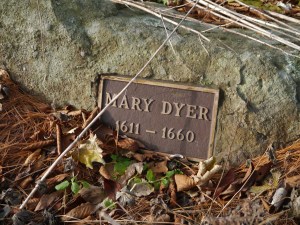
Mary Dyer is known as a martyr for the the Quaker faith, but we should know her story as a founding mother of Aquidneck Island.   Born Marie Barrett in 1611, in 1633 Mary married William Dyer.  Dyer was a milliner, but in the 17th century milliners imported and sold such items as broaches, daggers, swords, gloves and capes.  In 1635 the Dyers made their way to Boston.  Mary became a friend and follower of Anne Hutchinson.  Anne tended Mary when she delivered a badly deformed child in 1637.  Such a birth would be considered punishment for challenging the views of the Governor Endicott, so Anne and minister John Cotton buried the baby in secrecy.  When Anne and some of her followers were tried by the Massachusetts Court and church for opposing the ruling ministers and governor, Mary stood by Anne.  They walked hand in hand out of the church.

Mary’s husband had signed documents supporting Anne’s views, so he was banished as well.  What did Mary find when she came to Aquidneck Island?  The Dyers accompanied the Hutchinson family by land, stopping at Mount Wollaston before going on to Providence.  They followed an Indian trail around Mount Hope.  Aquidneck Island was a wilderness.  Shelter was a big concern.  They crawled into caves around the banks of the cove where they landed.  Mary and William followed Native American example by bending birches into house frames, using mud for walls and weaving twigs to make a thatched roof.  These first settlers were frightened by the sound of the wolves roaming around their camp.  This was a bigger threat because they had unprotected livestocks.  The Dyers had sent their horses, cows, sheep and hogs via ship around Cape Cod.  Through the aid of Roger Williams, Native Americans came and laid traps to kill the wolves.  The settlers decided to make a Common Fence.  Five rails with no more than three inches between each rail was judged sufficient to keep out predators.  The first fence was built around the common pasture for the whole town and we know that today as Common Fence Point.

William Dyer was one of those who surveyed the lands and helped mark out the six acre house lots for all the settlers.  They were given land on the provision that they  must built homes within a year. Dyer drew up property deeds and kept the deeds.  An earthquake in August 1638 generated fear.

Mary and William Dyer were among those who left the northern end of the island to found Newport to the south.  William took the land deeds with him – concealing them in his personal goods. Mary and William Dyer had a farm opposite Coaster’s Island.  It was near a swamp and mosquitos were a problem. The settlers exchanged coats with brass buttons for Native Americans help draining and filling the swamp for house lots.  Mary had women friends but she missed Anne Hutchinson.   The women were separated from each other on big farms instead of clustered in a smaller village.

Mary was mother to Samuel, Mary, Will, Maher (Mahershallaber), Henry, and Charles. When her children were between fifteen years old to infant, Mary left for England.  William was the “single father.” In 1651 Will went to England to bring Mary back.  He was secretary to John Clarke who went with Roger Williams to get a charter for Rhode Island.  Mary would stay there for seven years and she became a Quaker – a follower of George Fox.

When Mary did return she landed in Boston and was jailed.  She was not aware of anti-quaker laws.  Governor Endicott believed that if he permitted Quakers to express their views in the Massachusetts Bay Colony – the whole structure of Church-state partnership might collapse and England would take over.  Mary was finally able to slip a letter out to her husband.  William Dyer demanded his wife’s release and signed a document saying she would not return to Boston.  When she returned to Newport, she found her family had completely changed and Mary felt out of touch.

In October 1658 Boston ruled that banishment upon pain of death was the penalty for Quakers.  Mary went back to Boston to support her quaker friends. Her husband wrote to try to save wife.  Her son, Will, came to her rescue another time.  Mary had the rope around her head before the reprieve was given. The thought was that the near death experience would scare Mary, but it didn’t deter her.

When she got back to Newport, she longed for a quaker community. She left to spend time with friends on Shelter Island in New York.  In April 1660 Mary was incensed that the Boston rulers had spread lies about her.  She was intent on going back to Boston to challenge what the authorities said about her. This time she did not escape the gallows.  She was faithful to her Quaker faith – even to death.

Source:  Mary Dyer:  Biography of a Rebel Quaker by Ruth Plimpton.  1994, Branden Publishing Company, Boston.


Founding Mothers: Herodias Long Hicks Gardiner Porter: “So scandalous a life.”

6 Comments

P1040392

Founder’s Brook

We started our research into our founding mothers with a list compiled by the Friends of Anne Hutchinson.  Last on their list was a “Herodias Long Gardiner” and that name led us to the story of a very interesting woman.  Divorce, domestic abuse, common law marriage, a lashing for expressing religious views – her story has much drama to it.  Life wasn’t always easy for some of these founding mothers.

Herodias was “married” to three of our early Aquidneck settlers – John Hicks, George Gardiner and John Porter.  In researching her story we found her name listed as Horod, Harwood, Harrud, and even Horad.  You wonder why her parents would name her after a biblical queen who was noted as responsible for the beheading of John the Baptist.

What we know about her early life comes from a petition she wrote in 1665.  She was probably born in England around 1623/24.  She married John Hicks in London when she was a young teenager.  They first settled in Weymouth, MA in 1637 and came to Aquidneck Island 1638.  By 1644/45 Herodias accused John of “many grievances & extreme violence” when she petitioned for divorce.  John left for the Dutch colony on Long Island and according to Herodias, he took her inheritance with him.  John had another story when he wrote John Coggeshall.  He believed her unfaithful and sought his own divorce in New Amsterdam.

Left with no money and searching for someone to “maintain” her, Herodias came to live with George Gardiner as his common law wife.  She seemed to have three children by John Hicks and yet another nine with George Gardiner.  Like Mary Dyer, she became a follower of George Fox and the Quaker faith.  In 1658 she walked for sixty miles from Aquidneck Island to Weymouth to protest the treatment of Quakers.  With babe at the breast and another child by her side, Herodias received ten lashes by order of Governor Endicott.  She was then imprisoned for fourteen days for supporting the Quaker faith.  She was never listed as a member of the Quaker faith and didn’t continue her protests after this incident.

By 1664 Herodias petitioned for a separation from Gardiner.  She admitted that they had never been married according to the law.  She asked for some money to keep her in her own house on her land and she wanted the authorities to restrain him from meddling with her.  The authorities judged that both had been “living in a horrible sin of uncleanness … which was a reproach and scandal.”  Both Gardiner and Herodias were fined and told not to lead such a scandalous life.

By 1666 Herodias was married to John Porter after he had settled a court case with his former wife.  After a good long life, Herodias had died by 1705.

Sources:  “Herodias (Long) Hicks-Gardiner-Porter, a Tale of Old Newport by G. Andrews Moriaty – RI History, July 1952, pp 84-92.

rebelpuritan.com – has an extensive section on the historical sources for Herodias’ life story.


SaveSave

Older Entries Newer Entries