Home

Rhode Islanders in the Wider War

Leave a comment

The Rhode Island Continental units began with an “Army of Observation” in 1775. In December of that year they were reenlisted under the Continental Congress. Militias were in the fight, too, but the Continental lines did most of the fighting throughout the war. The 1st and 2nd Regiments were merged into the Rhode Island Regiment in 1781.

Rhode Island Continental Line units

     The list below is from the Rhode Island Historical Society


May 1775 Commissioned as Army of Observation by R.I. General Assembly, under the leadership of Brig. Gen. Nathanael Greene.
May 1775 Served in march to Prospect Hill in Boston
June 1775 Enlistments expired; reformed under continental service.
Dec. 1775 Church’s Third Regiment disbanded.
April 1776 Marched to Long Island
August 1776 Greene promoted to Major General; went to serve mostly in southern campaigns. Replaced by Brig. Gen. James M. Varnum.
Sept. 1776 Brigaded with the other two R.I. regiments under Richmond and Lippitt
Winter 1776-7 At Morristown, N.J.
Sept. 1777 Fought at Brandywine
Oct. 1777 Fought at Germantown and Fort Mercer / Red Bank
Nov. 1777 Fought at Fort Mifflin
12/77-6/78 At Valley Forge
6/78 Fought at Monmouth
1778 Varnum’s brigade under command of Maj. Gen. John Sullivan, in Rhode Island campaign.
Winter 1778-9 Camped for winter at Warren, R.I.
1779 Both regiments were in Rhode Island, in camp at Barber’s Heights, North Kingstown. after the retirement of Varnum, brigade under command of Brig. Gen. John Stark, with Maj. Gen. Horatio Gates
Oct. 1779 Transferred to Morristown, N.J.
Sept. 1780 Transfered to West Point, N.Y.
January 1781 Two regiments merged.
August 1781 Rhode Island continental regiment participated in crucial victory at Yorktown, Va. Capt. Stephen Olney’s company distinguished itself. After surrender of British Gen Cornwallis, fighting was virtually over.

Rhode Island Historical Society. https://www.rihs.org/mssinv/Mss673sg2.htm

Flags of the 1st and 2nd Rhode Island Regiments

Leave a comment

As I was attending the Annual Commemoration Service of the 1st Rhode Island Regiment, I noticed the insignia on buttons some of the guests were wearing. That insignia is also carved in stone on one of the early monuments at Patriots Park. I am gathering materials for a lesson plan on the Black Regiment, and I would like to have students work with the correct flag. I often see two similar flag designs depicted with images of the Black Regiment. It is certainly possible that they would have fought under different flags. In February of 1781 the 1st and 2nd Regiments were combined into the Rhode Island Regiment. The insignia at Patriots Park resembles one of the flags and it is logical that the monument designers would want to reflect the flag used by the 1st Rhode Island Regiment while they were a separate unit.

Emblem at Patriot’s Park

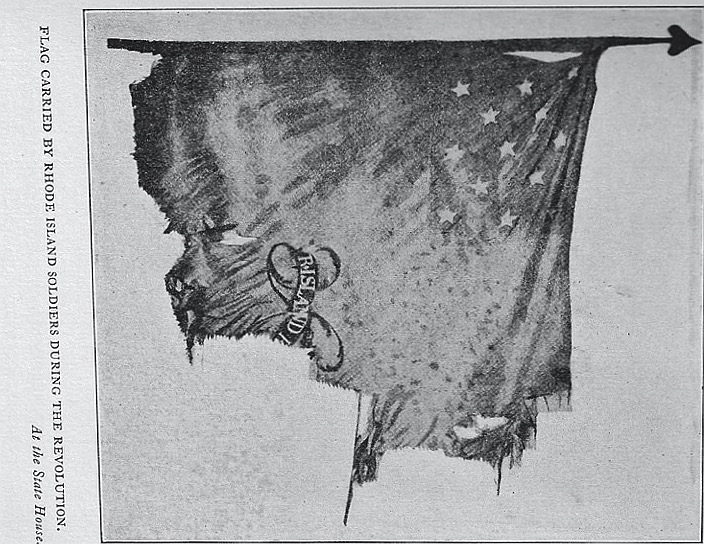
An online search was confusing, but I remembered a 1930 book on Rhode Island flags and symbols by Howard Chapin. There was a depiction of the regimental flag of the 1st Rhode Island Regiment that is kept at the State House. It is described as:

“The field was white, charged with a blue scroll being the inscription “R. Island Regt.” In the upper corner there is a blue canton charged with thirteen white stars.”

The Regimental flag of the 2nd Rhode Island Regiment is pictured as well. This flag is also listed as being at the State House. The description reads:

“The Second Rhode Island Regiment carried a somewhat similar flag, having a white field, charged with a blue foul anchor and the motto, “HOPE,” and having in the corner a blue canton charged with thirteen gold stars…After the passage of the regulation of February 23, 1780, the flag bearing the blue anchor doubtless qualified in a sense partially as a State flag.”

The anchor design is an ancient emblem in Rhode Island. Rhode Island was a seafaring colony. The seal of the colony drawn by William Dyer in 1647 has an anchor. The “foul anchor” described is the robes entwined in the anchor. One description notes that the white is the color of their uniforms and a symbol of the commonwealth. The 13 stars reflect the colonies and may be a reflection of the seals of Portsmouth and Providence.

In May of 1664, the General Assembly “Ordered, That the Seal, with the mottoe Rhod Iland and providence plantations, with the work Hope over the head of the Anker, is the present Seale of the Colony.”

Resources:

Chapin, Howard. Illustrations of the Seals, Arms and Flags of Rhode Island. Providence, RI, Rhode Island Historical Society, 1930.