December 8, 1776: British Army arrives to occupy Aquidneck Island.
British General Prescott landed his troops on Aquidneck Island in December of 1776. They landed on the Western shore near the border of Middletown and Portsmouth at Weaver’s Cove. This was the beginning of the Occupation of Rhode Island (Aquidneck Island). The American militiamen were unable to mount a defense and they escaped by using the ferries to Bristol and Tiverton.
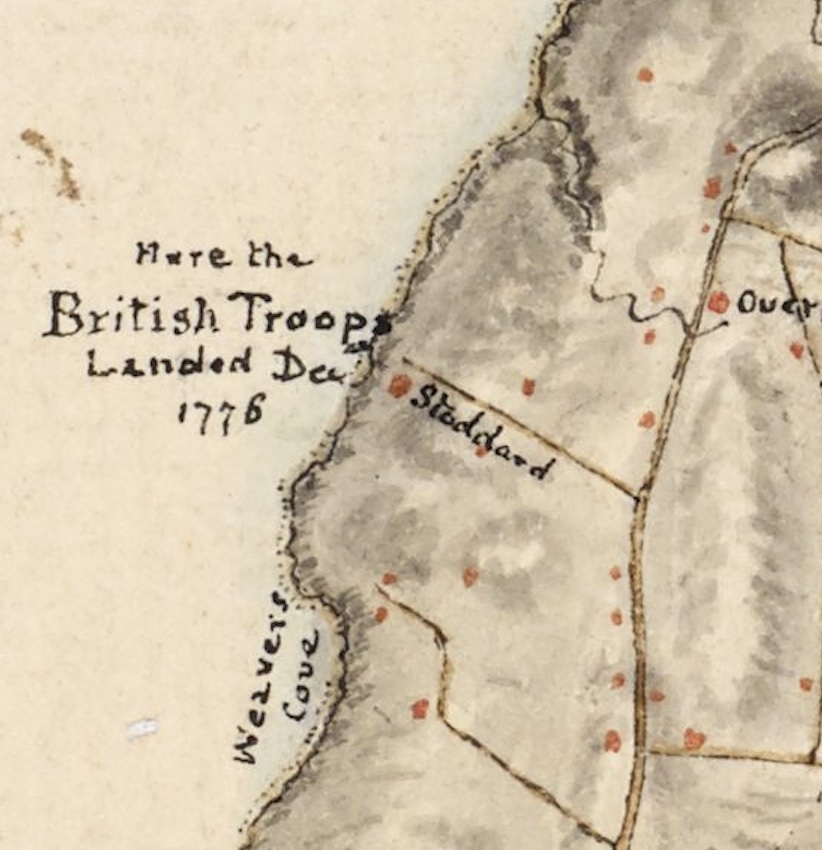
The British had ample reason to invade and occupy Aquidneck Island (called Rhode Island at that time). Newport had a fine harbor from which the British fleet could raid up and down the coast. It would enable them to blockade ships carrying supplies from abroad that were needed by the Americans. The Occupation would last almost three years and brought misery to Aquidneck Islanders.
July 9 – 10, 1777: British General Prescott captured by Col. Barton at Overing Farm in Portsmouth.
In July 1777, while Aquidneck Island was under the control of thousands of British soldiers, American Major William Barton (who was in Tiverton) received word through a runaway slave that the British Commander in Chief, General Prescott was staying at Mr. Overing’s house on West Main Road close to the Portsmouth/Middletown border. When Prescott was at his headquarters in Newport he was well protected. Visiting friends in the countryside, Prescott was less well defended. Barton planned to get Prescott so he could be exchanged for American Major General Charles Lee who had been captured in New Jersey.
Barton asked for volunteers for a dangerous and secret plan. Out of the many who stepped forward he picked out the best rowers and four who had lived on Aquidneck Island and could serve as guides. Barton had five whaleboats and each boat had eight soldiers and one officer. The river crossing between Tiverton and Portsmouth was closely watched, so Barton and his men rowed to Bristol and then all the way over to Warwick to begin their secret mission. The mission was so secret that even the volunteers did not know where they were going until after their journey had begun.
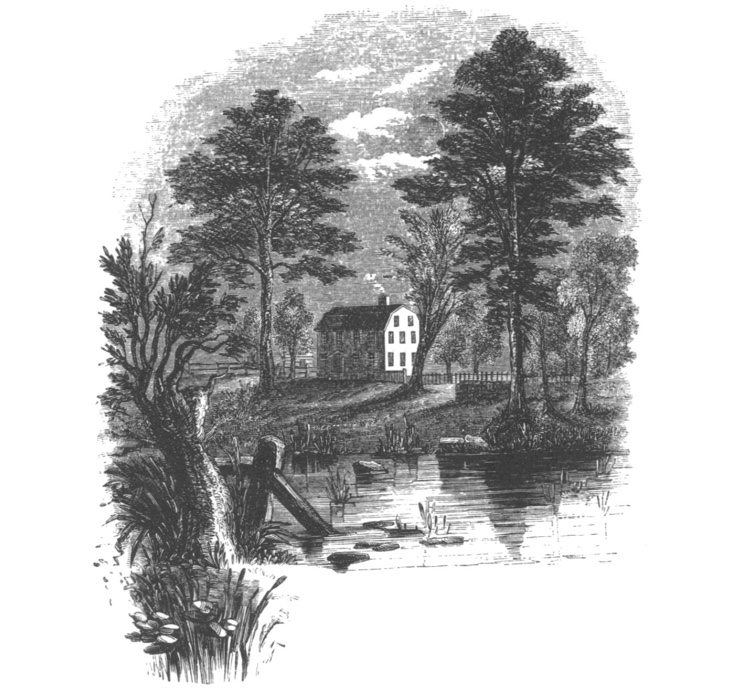
The night of July 10th was perfect – it was very dark and the weather was good. Barton and his volunteers left Warwick Neck, rowed across the Bay with oars that were covered in wool to keep them quiet. They had to row around British ships that were stationed on the west side of the island. The Americans landed on the west shore of Portsmouth and followed a gully up to the Overing Farm on the Portmouth/Middletown border. Barton divided his troops and they approached the house quietly. There was only one sentry on guard at the guardhouse. Hearing noise, the guard asked: “Who comes there.” Barton responded: “Friends.” The guard asked for a countersign and Barton said he did not have one but asked the guard “Have you seen any deserters tonight.” With that the guard allowed Barton to pass and the American grabbed his musket.
They found Prescott in his nightclothes. Barton asked if he was Prescott and he responded. “I am”. Barton said: “You are my prisoner.” and Prescott said “I acknowledge it, sir. The men worked quickly and within seven minutes took Prescott, the sentry and Prescott’s aide-de camp with them. No shot was fired.
They again had to row through British ships on their way back. This capture gave the colonial troops some needed encouragement. There was a prisoner swap in which General Prescott was exchanged for American General Charles Lee, but Prescott made it back to Aquidneck Island.
February 1778: RI Legislature authorizes raising a regiment of Black and Indigenous troops.
Rhode Island had trouble meeting its recruitment quotas with just white men, so General Varnum wrote to George Washington with the idea of allowing the ranks to be filled with Black and Native Americans. He asked Washington to send soldiers from Valley Forge to recruit these men. In the pre-amble to the letter, Varnum wrote that “History affords us frequent precedents of the wisest, freest, and bravest nations having liberated their slaves and enlisted them as soldiers to fight in defense of their country.” (RI Colonial Records VII, 640, 641.) Washington did not comment on the letter, but he sent it on to the Governor of Rhode Island, Nicholas Cooke.
On February 14, 1778, the Rhode Island Assembly voted to allow “every able-bodied Negro, mulatto, or Indian slave in this state to enlist into either of the Continental Battalions being raised.” The Assembly specified that: “every slave so enlightening shall, upon the passing muster before Colonel Greene, be immediately discharged from the service of his master or mistress and be absolutely free.” Owners of the slaves enlisted were to be compensated by the Assembly for the market value of the slave.
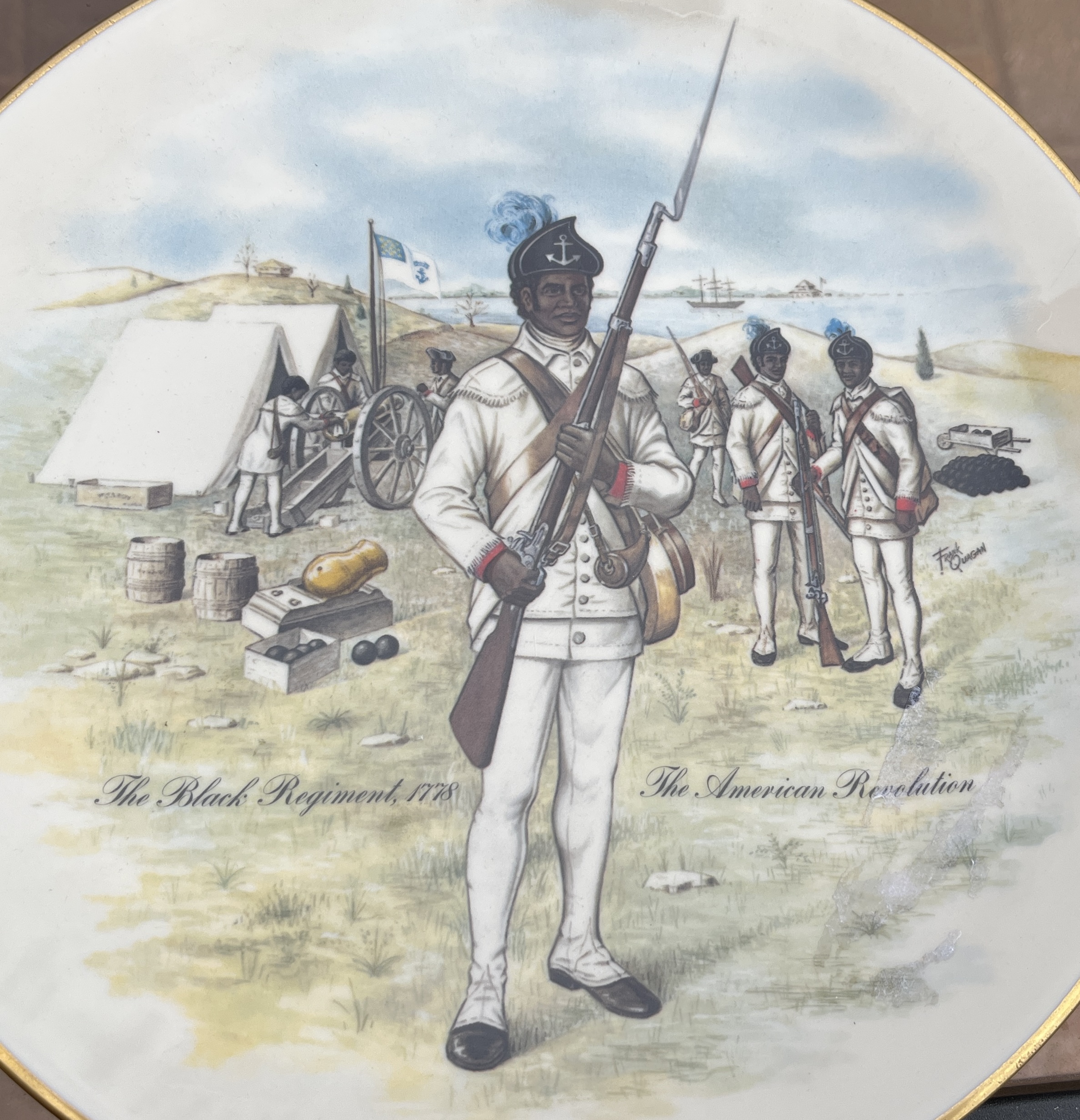
Rhode Island slave owners opposed the idea of the new regiment. In June of 1778 the Rhode Island Assembly repealed the decree, but during those four months that it was in effect, 100 free and formerly enslaved African Americans enlisted. Forty-four slaves enlisted even after this repeal. The First Rhode Island Regiment had 225 men, 140 of them were African Americans. At first the African Americans comprised a separate company, but slowly the regiment was integrated.
May 25, 1778: British forces raid Bristol – Warren
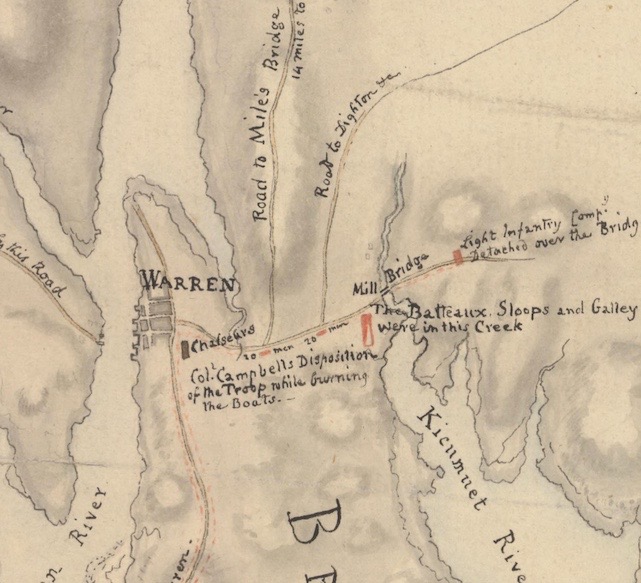
As the American forces were preparing for an attack on Aquidneck Island in Spring of 1778, the British forces were active in trying to crush the Rebel capability to transport troops across the river from Tiverton. The Rebels would need to reach Rhode Island (Aquidneck) by boat and the British planned to attack shipyards, lumber mills and military stores. On May 25, 1778, British soldier Frederick Mackenzie records that the 22nd Regiment, Companies of the 54th, Notenius’s Company of Hessian Chasseurs, ..etc. (500 men in total) moved to Arnold’s Point in Portsmouth. They embarked in flatboats and landed at the mouth of the Warren River. Campbell’s men were divided into two columns. In the town of Warren itself they burned down the Baptist meeting house and other buildings and ransacked homes and property. The other group of Campbell’s men headed to the Kickemuit River. By the Kikemuit Bridge they found and burned 125 boats, large batteaux capable of carrying 40 soldiers. They found a sloop loaded with military stores, a store house, and a corn mill and they burned them. They also burned houses, a bridge and gun carriages. They spiked cannons and set fire to a new Privateer Sloop as well as magazines of gun powder. Campbells troops returned by way of Bristol. They burned houses, a church, ammunition magazines and twenty of the principal houses. The British boats came round from Papasquash Point to the Bristol Ferry. The British ships Flora and Pigot covered the British troops as they crossed over from Bristol Ferry. Having raided Warren and Bristol and destroying American flatboats, Campbell’s forces made their way back to Newport on their own flatboats. The raids certainly delayed the American troops as they prepared for the Rhode Island Campaign.
Other Raids
- August 24, 1775 British Captain Wallace landed around 100 men on Prudence Island. They sacked the farm of John Allin seizing sheep, turkeys, corn and hay. In November of 1775 they raided again and took clothing, geese, kettles and even a desk.
- August 30, 1775 – Frigate Rose conducts raids on Block Island and Stonington, Conn.
- Dec. 10, 1775 – Frigate Rose raids Jamestown
- August 5, 1777 – British raid Narragansett
- May 31, 1778 – British forces raid Tiverton and Fall River
- May 21, 1779 – British raid North Kingston
- June 6, 1779 – British raid Point Judith
- October 16, 1779 – British burn Beavertail Lighthouse before leaving Rhode Island
 portsmouthhistorynotes