Home

Portsmouth Census of 1730: Some stories about John Butts and Joseph Cundall

Leave a comment

I recognized the names of a number of those listed on the 1730 census. Some of them I have already researched, so I can give some information about them. So many of these families are inter-related.

John Butts

A son, John, was born to Zaccheus and Sarah in Little Compton in 1691. The family history is complicated, but John would have had his grandfather (Thomas Cornell, Jr.) hung for murder and his great grandmother (Alice Lake) hung for witchcraft. He moved to Portsmouth and is recorded to have had two wives. One of his wives was from the Wordell family and the other, Abigail, was from the Briggs Family. This Briggs connection is interesting because what we call Butts Hill was once called Briggs Hill. On January 15, 1725 John bought from Caleb Bennett a windmill and about one rood (about a quarter of an acre) of land on Windmill Hill (now called Butts Hill). He erected a house by the windmill. He must have owned other land in Portsmouth since he had been considered a freeman for some time. A 1726 map of the Newtown area of Portsmouth shows him having a small parcel of land on what would be the East Path (East Main Road today). John is recorded as being a tavern keeper. He was accused in 1747 of allowing card playing at his tavern and his future son-in-law Thomas Cook was called as a witness against him. John’s daughter Sarah married Cook in 1763. When John died in 1768 he left his daughter, Sarah Butts Cook, “my dwelling house and land, bounded southerly on land from my father-in-law Enoch Briggs, next to David Lake.” This is as far as I can trace the Butts presence on this Windmill Hill (Butts Hill). Some of Butts land was passed down through the Cook family. One Butts family genealogist wrote that the War for Independence had ruined the family fortunes. They lost their land and their business interests.

Joseph Cundall

In 1706 Joseph Cundall had left his native England to become an indentured servant in America. Becoming an indentured servant was a way a young person could learn a trade and get an education in exchange for working for seven years or more. Cundall seems to have learned his trade well and was in a good position to buy land as an adult. James Sisson sold his grist mill and 46 acres around the brook to Joseph Cundall. What we call “the Glen” becames commonly known as Cundall’s Mills. Water from the stream powered the carding and fulling mills to wash and pull woolen fibers. Joseph Cundall added almost a hundred more acres to his land around the Glen before he died in 1760.
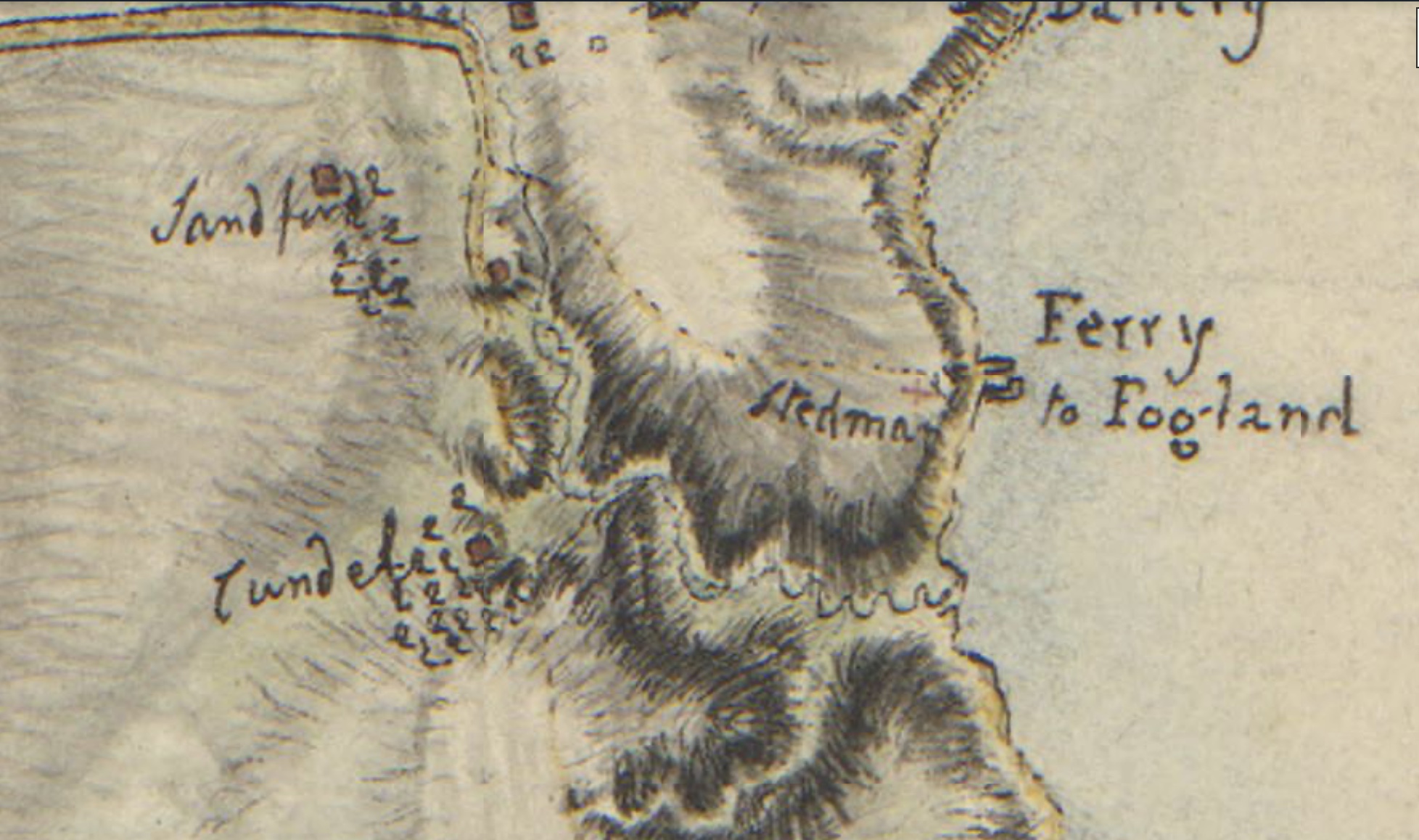
A note: Joseph Cundall married Elizabeth Butts

“Plan of Rhode-Island / Surveyed and drawn by Edw: Fage, captn. Royal Artillery, in the years 1777, 78 & 79.”. https://quod.lib.umich.edu/w/wcl1ic/x-828/wcl000922. In the digital collection William L. Clements Library Image Bank. William L. Clements Library, University of Michigan Library Digital Collections. March 10, 2025.

On the Road with Lafayette in Rhode Island 1778 – Part 2 – A gathering storm

Leave a comment

August 9th, 1778.    

  • Red Triangle: Americans learn the British have left northern Aquidneck Island known as Rhode Island.  Sullivan orders his troops to cross over to Portsmouth at Howland Ferry.   
  • Brown Square: At 4 PM Lafayette goes onboard D’Estaing’s ship Languedoc out to sea by Newport. The ship is out to sea by Newport.   The French decide to do battle with the British fleet that has appeared outside Newport.  They are also unhappy that the Americans have moved onto Aquidneck Island before them.

August 10 – 13th, 1778 

Red Diamond: Butts Hill area

August 10th, Lafayette and the Americans are camped around Butts Hill fortifications in Portsmouth.

August 11th, the Americans are still by Butts Hill with Lafayette as Major General of the Day.  American troops parade at 4 PM.  Lafayette’s  troops paraded on the left and Greene’s troops on the right.  A storm like a hurricane hits the island.

August 12th and 13th,  the Storm is at its most fierce.  Soldiers have no tents or shelter.  Lafayette and Col. Wade inspect the water-logged American camp around Butts Hill. 

British and French ships are returning damaged by the storm.

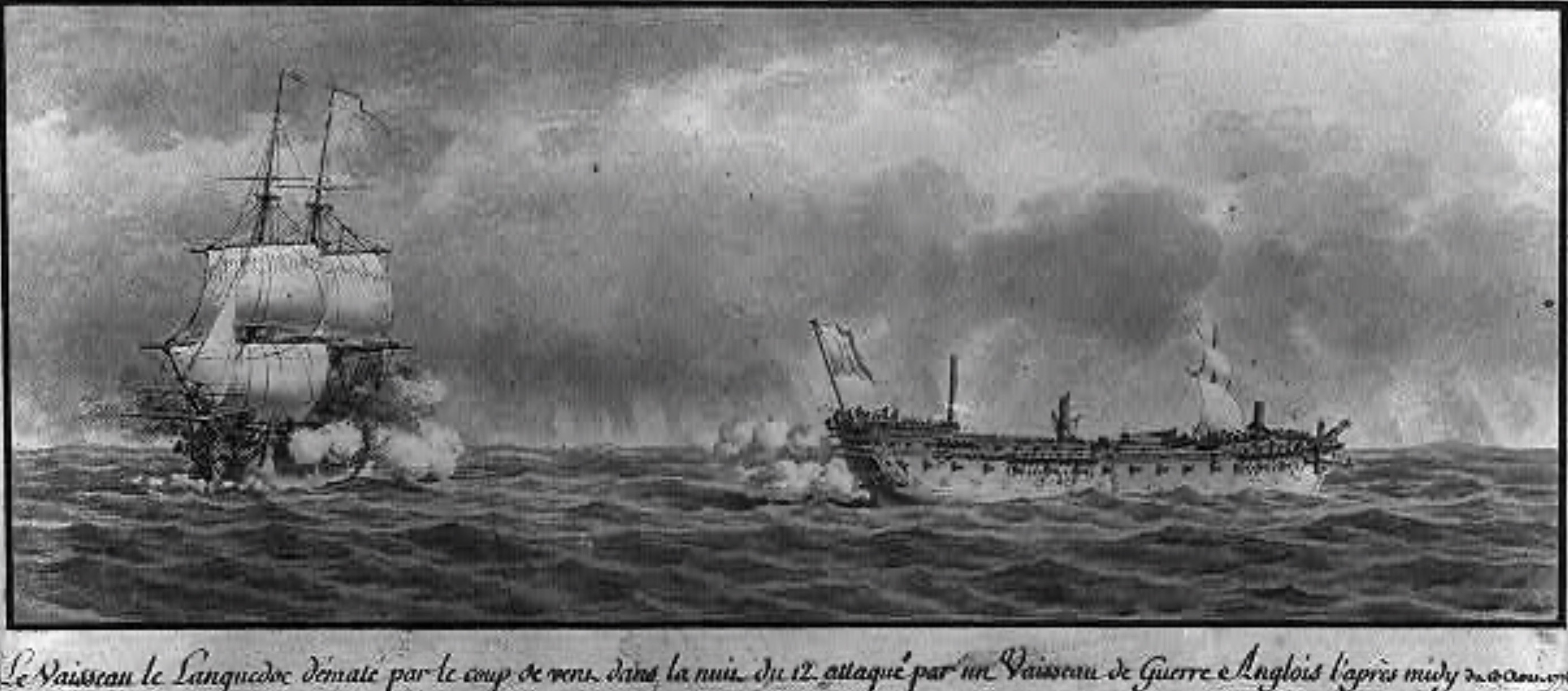
Languedoc returning without masts from Storm and Battle with British fleet.

Ozanne, Pierre, Artist. Le vaisseau le Languedoc dématé par le coup de vent dans le nuit du 12′ attaqué par un vaisseau de guerre Anglois l’après midy du 13 Aoust. [194] Photograph. Retrieved from the Library of Congress, <www.loc.gov/item/2004670063/>.

German Families at Home on Butts Hill

Leave a comment

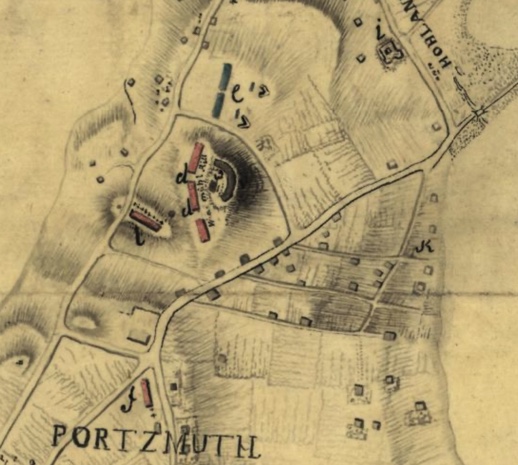
I knew that families came with the British and German soldiers who occupied Aquidneck Island. What I didn’t realize was that there would be families living at the Butts Hill fortifications. Walter Schroder’s book “The Hessian Occupation of Newport and Rhode Island 1776-1779” provides an interesting glimpse of this family life. Most of the German troops were Protestants and they brought their chaplains with the army. Schroder cites records of the Rev. G.C. Coster who was chaplain of two Hessian regiments. Coster lists several births, baptisms and infant deaths recorded at the Windmill Hill encampment (Butts Hill). That is proof that the families of the soldiers came and stayed with them even on their field assignments to North Portsmouth.

Schiffer, J. C. Plan von Rhode Island, und deren dem comando des Herrn General Majors Presgott inf dies-malig befundlichen campements. [1777] Map. Retrieved from the Library of Congress, www.loc.gov/item/75690704/.

Schroder, Walter. The Hessian Occupation of Newport and Rhode Island 1776-1779. Westminster, Maryland, Heritage Books, 2005.

Coster, G.C. Hessian Soldiers in the American Revolution: Records of their marriages and baptisms of their children in American, performed by the Rev. G.C. Coster, 1776-1783, Chaplain of two Hessian Regiments. Edited and translated by Marie Dicktore. Cincinnati: C.J. Krehbiel Co. 1959.