The one and two room schools and the eight districts worked while Portsmouth was more agricultural. As farms turned into housing developments and the Navy had more housing at Melville, Portsmouth schools were crowded. The school committee had to find ways to create more classrooms and the answer was to open new schools. The ten room Anthony School for upper grades opened in February of 1938, but classrooms were needed for the primary students.
Hathaway School
Howard W. Hathaway School opened in November of 1955. Hathaway was a noted orchard owner in the area and he held a number of local government positions including on the school committee for 12 years. At the school dedication local officials spoke of education of youth as the soundest investment for a “Portsmouth of tomorrow.” Hathaway was built on 5 acres of land bought from the Farias family for $15,000 and federal funds helped with the building costs. Principal Mary Shea was the principal of the eight room school.
Neel School and Melville
In 1953 Portsmouth students and Navy Housing students in the Melville area began to use a converted barracks building on the Navy Base as a school. It was named the Charles H. Neel School after a Naval Station Public Works officer. It was a 4 room school with 40 (other accounts say 51) students in grades one to three.
In 1965 Portsmouth schools were still overcrowded. Neel School had its problems and more classrooms were needed. To take care of the students in the Navy Housing, Melville School was planned. Melville School was named after the Melville area of Portsmouth on the West Side of Aquidneck Island. Melville was the center of Naval activities in the area including the training base for the PT Boats used during World War II. It was named after George Wallace Melville (January 10, 1841 – March 17, 1912) who was a United States Navy officer, engineer and Arctic explorer.
The new school would provide 18 teaching stations and serve 500. It was designed as a one story building with different wings for primary and intermediate students. There were doors between classrooms to accommodate the team teaching style that would be at the heart of the school. There was an emphasis on flexibility so that students could be taught according to their ability level. A glass enclosed area would facilitate small group instruction. The library would house 3,000 books appropriate for children. An auditorium with stage would be used by physical education. Two rooms would be outfitted with supporting equipment for social education students.
Hope School
With the development of the Redwood Farms neighborhood, more classrooms were needed. The Mother of Hope Novitiate has was consecrated in 1962, but by 1968 it was shutting down. The town rented part of the building for the Hope School around 1970. There were four classrooms covering first to fourth grade. Robert Crudup was the principal and teachers were Mary Barabe, Sally Kilmer, Janet Deuel, Nancy Phillips and Pamela White. Hope School ended as Elmhurst School was purchased and opened in 1972.
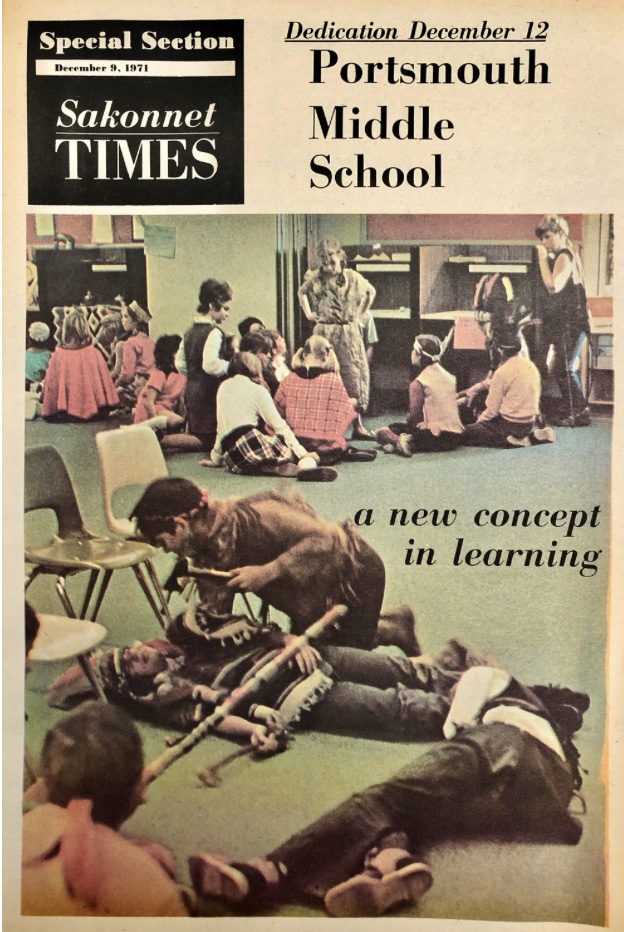
Portsmouth Middle School
Portsmouth was building elementary schools, but there was a need for a middle school. Fort Butts School had started out taking grades from Anthony School, but gradually it was expanded into Portsmouth High School. A new middle school opened in Portsmouth Fall of 1971. It had a new design. The library had a sunken reading area that some joked was meant to be a swimming pool. Instead of separate classrooms, learning centers had moveable walls that could be divided into four separate classrooms. Trends in education come and go and at this time learning centers, stations and adjustable classroom structures were the newest trend. It was meant to give teachers and students great flexibility. As the Portsmouth Middle School was constructed to fit this model, school systems came to view how it was working.
 portsmouthhistorynotes