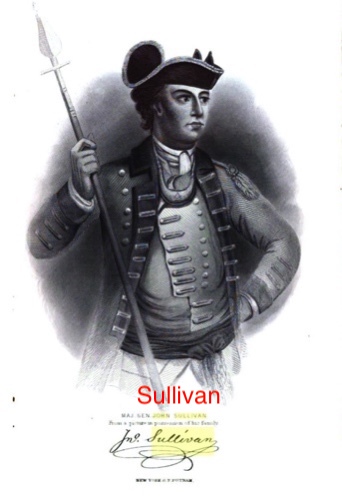
Major General John Sullivan : Commander in Chief.
1740-1795
Sullivan was the son of Irish immigrants who settled in New Hampshire. He served as a Delegate to the Continental congress, Governor of New Hampshire, and United States district judge. The was trained as a lawyer. In 1772 the Royal governor of New Hampshire appointed him as major in The New Hampshire militia. Sullivan began to have rebel leanings. Sullivan was sent as delegate to first continental congress in 1774 and in 1775 he was sent to the Second Continental Congress. Congress appointed George Washington commander in chief and John Sullivan as brigadier general. Sullivan joined the American Army at the siege of Boston. Later he took command of a force in Quebec which ended as a failed invasion. Sullivan had to withdraw the survivors. He was captured in defeat at Battle of Long Island. British General Howe released him on parole to deliver a message to Congress. He was later released in a prisoner exchange for captured British general Prescott. He had some success in battle but had continued difficulties as well. In Early 1778 he was transferred to the post of Rhode Island where he led the continental troops and militia.
His eyewitness account:
General Sullivan writes in a letter to Congress:
“To make a retreat in the face of an enemy, equal, if not superior in number, and cross a river without loss, I knew was an arduous task, and seldom accomplished, if attempted. As our sentries were within 200 yards of other, I knew it would require the greatest care and attention. To cover my design from the enemy, I ordered a number of tents to be brought forward and pitched in sight of the enemy, and almost the whole army employed themselves in fortifying the camp. The heavy baggage and stores were falling back and crossing through the day; at dark, the tents were struck, the light baggage and troops passed dawn, and before twelve o’clock the main army had crossed with the stores and baggage. The Marquis de la Fayette arrived about 11 in the evening from Boston, where he had been by request of the general officers, to solicit the speedy return of the fleet. He was sensibly mortified that he was out of action; and that he might not be out of the way in case of action, he had rode from hence to Boston in seven hours , and returned in six and a half, the distance near seventy miles — he returned time enough to bring off the pickets, and other parties, which converted the retreat of the army, which he did in excellent order; not a man was left behind, nor the smallest article left. I hope my conduct through this expedition may merit the approbation of Congress. Major Morris, one of my aids will have the honor of delivering this to your Excellency; I must beg leave to recommend him to Congress as an officer who is in the last, as well as several other actions, has behaved with great spirit and good conduct, and doubt not Congress will take such notice of him, as his long service and spirited conduct deserves. I have the honor to be, dear Sir, Your very humble servant – John Sullivan.”
 portsmouthhistorynotes