According to the pension application testimony of Daniel Bowen, Sullivan’s body guard was recognized by Congress as a part of the Continental Army. (War Department Communication dated December 1, 1819). This was a company of volunteers called a “Life Guard” to Major General Sullivan who was appointed commander of the state of Rhode Island. He remembers Aaron Mann, Levi Hoppen, George Potter and John Prescott (may be John Wescott) as officers of the group.
Sullivan sent in his Life Guard to reinforce the American troops at Quaker Hill and there was intense fighting there.
From his testimony
“Our circumstance however, I recollect , —service between Butts and Tominy Hills, the Sullivan guards did not arrive at the commencement of the action and as we neared __ up to meet the British, we could but meet by some carrying off The wounded, who said to us, “that’s right my boys, go and give it to them’ as the were borne off, upon the shoulders of their comrades. And we did go on, until we were overpowered by numbers.”
Bowen would go on to serve with Silas Talbot on the Sloop Argo and then aboard the Privateer Washington (a ship of 20 guns) which was also commanded by Talbot. The Americans were taken prisoner and ultimately exchanged for British prisoners.
Bowen called his Revolutionary War experience “days of danger and fatigue and repeated misfortunes.”
Resources: Case Files of Pension and Bounty-Land Warrant Applications Based on Revolutionary War Service, compiled ca. 1800 – ca. 1912, documenting the period ca. 1775 – ca. 1900. I accessed this through Fold3 military records online.
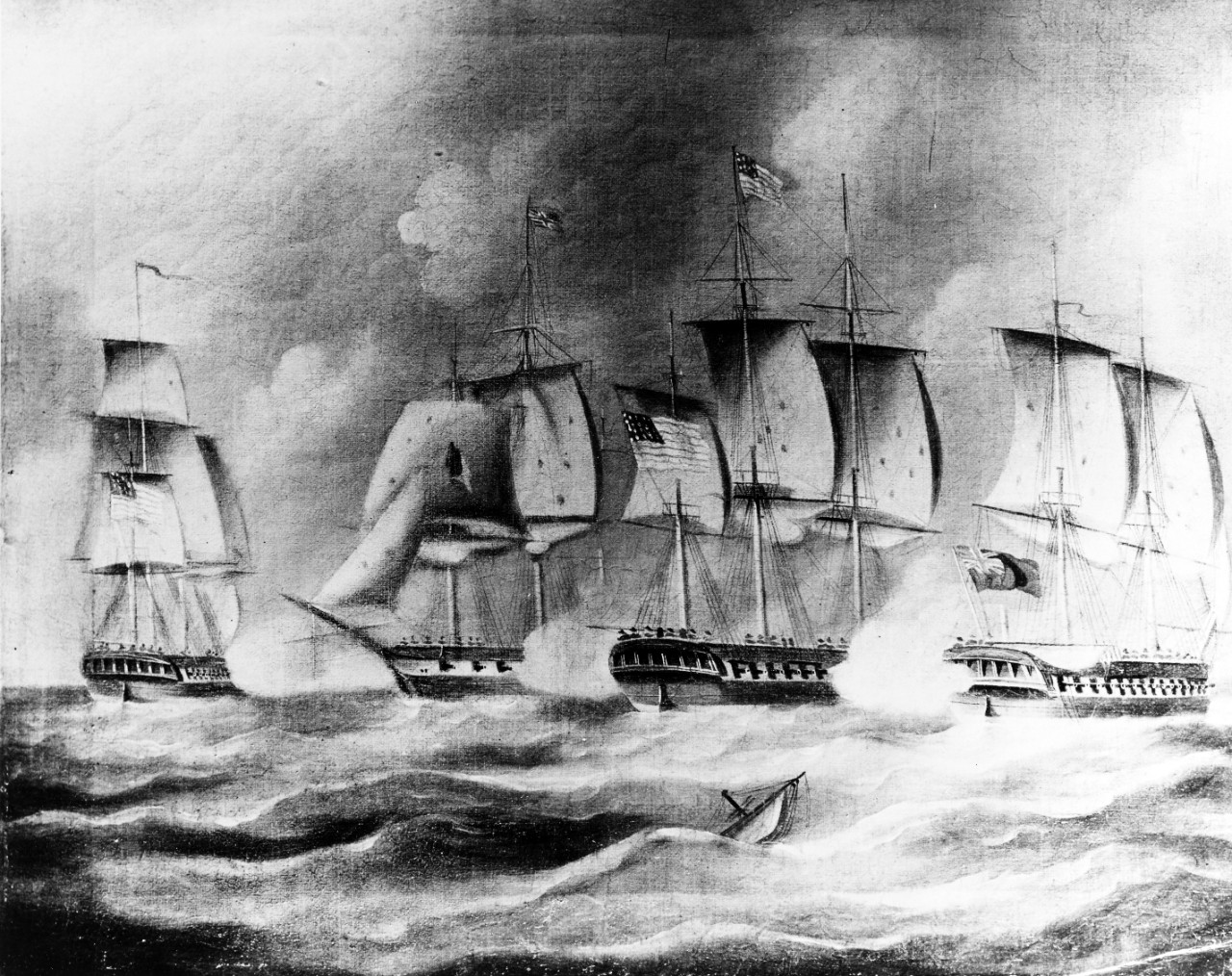
Image: PIGOT and ARGO capture British schooner LIVELY and two privateers, off the coast of Providence. Naval History and Heritage Command.
In 1776 the navy of Great Britain was the most powerful in the world. How could Americans compete on the seas? States outfitted some vessels of War and Congress established a navy, but it was woefully inadequate to meet the needs of the Americans. The Patriots turned to a long established practice of issuing commissions to ship owners to authorize them to attack and seize merchant ships and warships of the British. If the privateers were successful they got to keep profits from the cargo and possible sale of the vessels they seized. The proceeds would be shared by the owners and the crew. Sometimes the state or national government received a small share as well. The primary objective was to disrupt trade and encourage British ship owners to call for an end to the war.
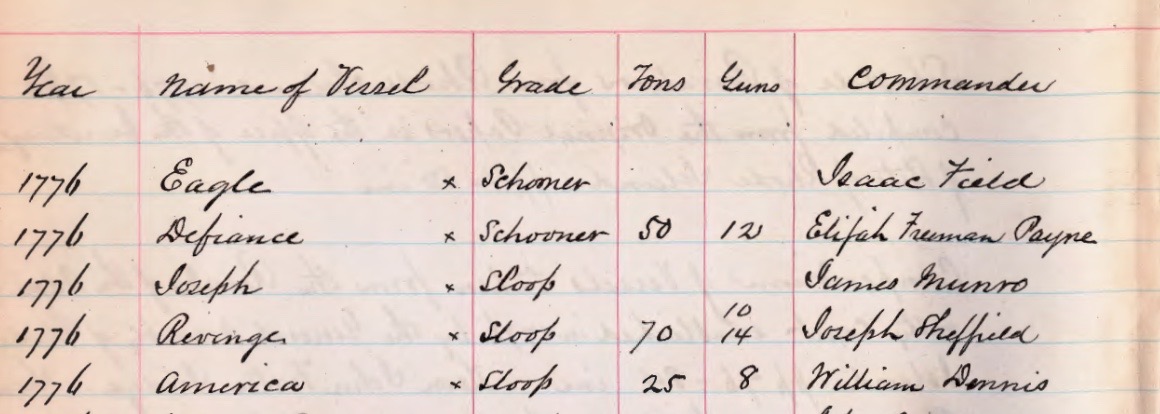
In the archives of the State of Rhode Island is a copy of the 1776 privateer commission of Isaac Field and his ship the Eagle. We have tried to transcribe the document.
Form of a Privateering Commission 1776
That we have granted and by these points do grant and authority to Isaac Field, mariner, commander of the schooner called the Eagle of the (_) of sixty tons or there about(s) belonging to John Matthewson and others of Providence in the colony of Rhode Island and mounting ten carriage guns and (-) by sixty-five men to fit out and set forth the said schooner in a warlike manner and by and with the said schooner and the crew thereof by force of arms to attack ships and take the ships and other vessels belonging to the inhabitants of Great Britain or any of them with their tackle, apparel, furniture and loadings on the high seas in between high water and low water marks and to bring the same to some convenient ports in the said colony in order that the courts which are, or shall be there appointed to hear and determine cases civil and maritime, may process in due form to condemn the said captures if they be judged lawful prizes, the said Isaac Field having given and with sufficient sureties that nothing be done by the said schooner or any of the officers, mariners or company thereof, contrary to or inconsistent with the —-? and customs of nations, and the instructions a copy of which is herewith delivered to him and we will and require all our officers whatsoever to give succor and assistance to the said Isaac Field in the promissary this commission shall continue in force until the Congress shall issue orders to the contrary.
By order of the Congress – John Hancock, President Dated at Providence in the state of Rhode Island and opened under my hand and the seal of the said state the twenty-seventh day of September in the year of our lord one thousand seven hundred and seventy-six Nicholas Cooke, Governor.
By his honor (_). William Mumford, Secretary
Thomas Fleming Day wrote in a Naval Journal in 1911.
“More than two hundred privateer commissions were issued by Rhode Island in the revolution, and not less than one hundred and ninety-three privateer cruises were successfully begun from Narragansett Bay. In November, 1776, John Paul Jones, when in command of the sloop of war Alfred, tried to enlist men at Newport but could get none, as they preferred privateering. The privateer Eagle, Captain Isaac Field, had sailed the day before and anchored at Tarpon Cove. Jones, sailing down Vineyard Sound, saw her, laid alongside and took twenty-four men out of her to force to make up the Alfred’s complement.”
Isaac had a short career. He later became captain of the Industry. He died in June of 1778 and is buried at Swan Point Cemetery.
In a previous post I set the stage for the story of Talbot’s capture of the British ship Pigot. Right after the Battle of Rhode Island, Lafayette suggested a plan to remove a British schooner that had been blocking Narragansett Bay. He reached out to Silas Talbot because Talbot was a seaman who knew the Rhode Island waters. Talbot agreed to the plan, but he had profit in mind as well as serving the American cause.
As he was preparing for the attack, Talbot met with Nicholas Cooke, the Governor of Rhode Island. Cooke owned a ship called “Hawke” and with the help of local Providence merchants, the Hawke was fitted out and armed for the mission. General Sullivan gave Talbot permission to recruit Continental soldiers. Talbot was acting as a privateer. The Battlefield Trust definition of privateer is: “the term privateer refers to a privately-owned ship or sailor commissioned by a government to raid an enemy’s military and merchant shipping. Although controversial, there is a long history of privateering that dates back to the seventeenth century. The main difference between pirates and privateers is that privateers are commissioned by a specific government and can only attack ships that fly under an enemy flag, while pirates are not sanctioned by any government and can attack whomever they choose.”
Talbot had made a deal. Talbot and his men, fifty percent / Cooke and his associations, fifty-percent.
October 25, 1778, the Hawke made its way from Providence to a remote anchorage off of Bristol. The next day the Hawke sailed passed the Bristol Ferry area to Mount Hope in Bristol. Two days later she quietly made her way down the Sakonnet River. They moved toward the Pigot, but a sentry saw it and began firing from a battery on Aquidneck Island (perhaps by Fogland Ferry). Talbot took the Hawke to safety up the Taunton River and he took a small boat down to the Sakonnet River to spy on his quarry (he may have gone on horseback). He saw that the Pigot had netting to defend it from an invading party, so when he returned to the Hawke he ordered a kedge anchor lashed to the jib boom. Talbot was finding a way for the Americans to get through the defensive netting by ramming through it with their spare anchor as a point.
On the night of October 28, 1778, the Hawke sailed from the Taunton River to the Sakonnet River. The sentries at the Fogland Batteries did not see her. When the Hawke got within sight of the Pigot, Talbot positioned his craft so he could ram his jib boom and kedge anchor through the netting to shred it. The crew of the Hawke swarmed over the deck of the enemy skip. The Pigot crew stayed below deck, but the captain was the only one to resist. The prisoners were locked below while members of the Hawke crew sailed the Pigot to Stonington, Connecticut.
British Lieutenant Frederick Mackenzie recorded the event in his diary – 29 October, 1778:
“The galley off Black Point in the Sakonnet with eight twelve pounders and two eighteen pounders plus swivels was surprised this morning about 02:00 by rebels, who boarded and took her with little or no resistance. They cut her cable and stood out to sea. We sent the King George privateer to chase them but they got clear off toward New London.”
This was a profitable venture for Talbot. The Rhode Island General Assembly voted him a silver sword and the Continental Congress promoted him to Lieutenant Colonel. His share of the sale of the Pigot was 500 pounds.
Silas Talbot would go on to further adventures with the Pigot. The website of Naval History and Heritage Command reports: “In the spring of 1779, the Navy Board at Boston purchased prize Pigot, and she operated under Talbot as the Argo guarding Narragansett Bay. During Argo’s cruises she alone kept these important waters open to vital American coastal shipping. Legend holds that she was subsequently burnt.”
Sketch of Pigot from Heritage of Courage.
Resources:
Fowler, William. Silas Talbot Captain of Old Ironshides. Mystic Seaport, Mystic Connecticut, 1995.
” Silas Talbot and the British warship Pigot, 29, October 1778″. Heritage of Courage. John Peck Rathbun Chapter Rhode Island Society, Sons of the American Revolution, 1992.
Diary of Frederick Mackenzie. Harvard University, Cambridge: 1930.

 portsmouthhistorynotes