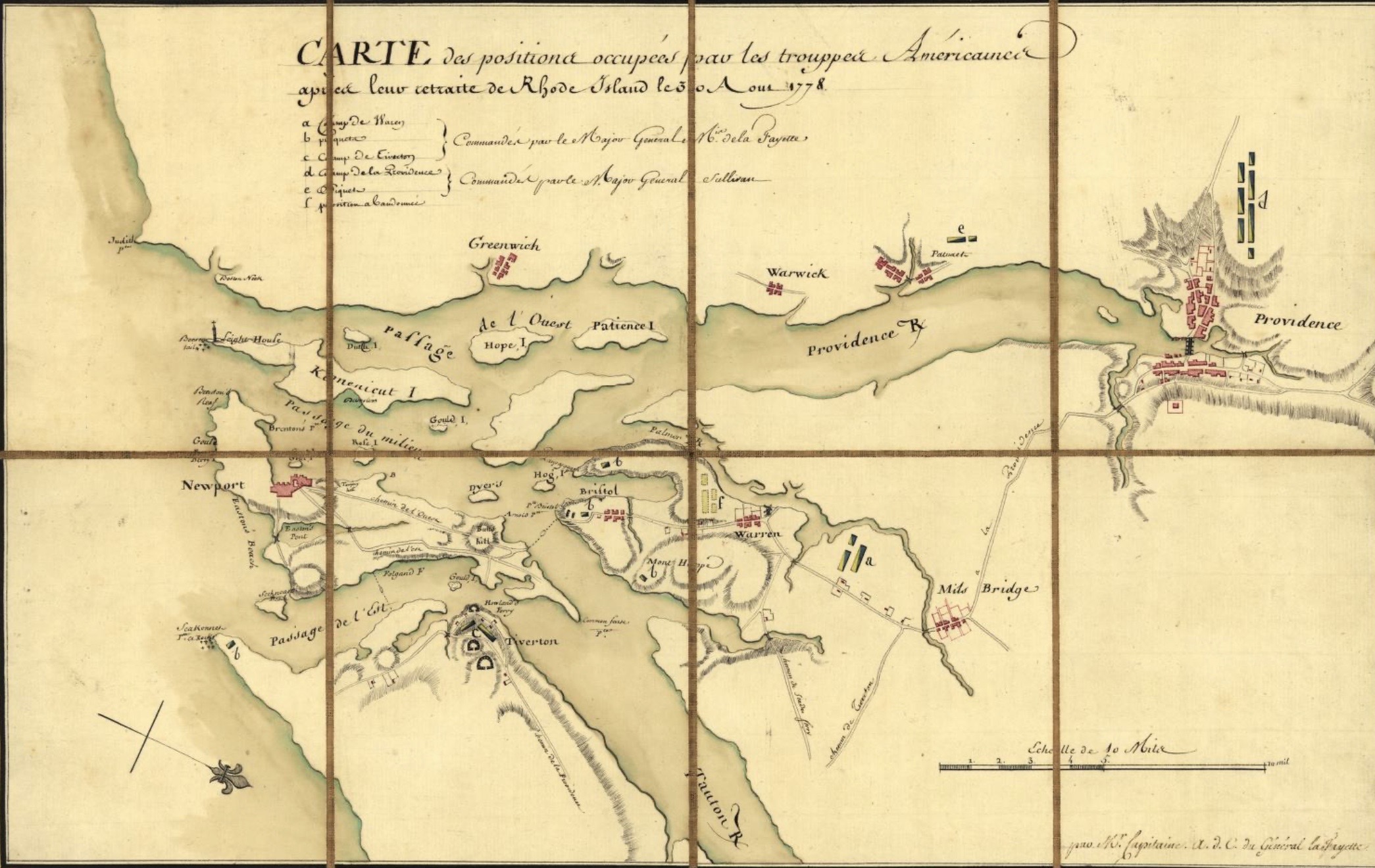
I have been searching for a way to illustrate the Marquis de Lafayette’s movements in Rhode Island and I came across a map that will be very helpful. It is a map of the positions of American troops in August of 1778. Rhode Island shorelines are prominent and the American camps are laid out so I can mark Lafayette’s positions throughout the Campaign.
I have seen (and used) this map before, but as I read Lafayette’s letters just before the Rhode Island Campaign, I came to appreciate this map and the French mapmaker, even more. The mapmaker was Michel Capitaine du Chesnoy. Chesnoy arrived in Charlestown, South Carolina with the teenage Lafayette. He was struck by an illness and it was only in the Spring of 1778 that he was well enough to help Lafayette. In his recovery he made maps of battles that he did not witness personally. He did a survey of the British positions at Ticonderoga, (Plan of Carillon or Ticonderoga). The map of Ticonderoga is unique, as mapmaker Chesnoy created the battlefield map through a combination of scouting accounts and secondary maps without visiting the area.
Chart of the positions occupied by American troops in Rhode Island August 1778 – Chesnoy
When Chesnoy came to America he was thirty-one years old and had been a lieutenant in the French army. He was made a Captain in the engineer corps of the Continental Army. Lafayette was unhappy with that because he considered Du Chesnoy his personal aide. The Marquis wrote to Henry Laurens in a letter dated July 23 from White Plains, New York.
“Mr. Capitaine one of my family has got the commission of a captain of engineers. ..Mr. Capitaine was in the Marshal of Broglios family, they made me a present of him and I attached him to serve me not only in America and in war but also to stay in the family in peaceable times. Such an officer I can’t spare, and I will employ him to make plans of our positions and battled for Gal. Washington, for me and for the king…The only way of getting him out of the engineer is to have for him a commission of Major in the line, he is now in my family but I want to have him entirely my supern-aide-de camp.” Note: A supernumerary aide had no regular duties and is held in reserve by the commander.
In January of 1779, Chesnoy followed Lafayette back to France. Chesnoy’s maps were used to persuade the French to continue to support the American forces. He presented a collection of his maps to the King of France. When he joined Lafayette in returning to America in 1780 he received a promotion to Captain in the French Army. He continued to serve as Lafayette’s mapmaker and aide-de-camp. His maps record the victories of the Virginia Campaign.
Chesnoy returned to France with Lafayette in 1781 but he kept his commission in the American army until it disbanded in 1783. He died in France in 1804, but his maps are still a valuable resource as we study the Rhode Island Campaign.
Resources:
Map: Capitaine Du Chesnoy, Michel, and Marie Joseph Paul Yves Roch Gilbert Du Motier Lafayette. Carte des positions occupeés par les trouppes Américaines apres leur retraite de Rhode Island le 30 Aout. [1778] Map. https://www.loc.gov/item/00555648/.
Did Paul Revere fight in the Battle of Rhode Island? No, but he participated in the Siege of Newport commanding his artillery company. A letter he wrote to his wife in August of 1778 gives us a glimpse of the experience of the American soldiers during the Siege.
We know the story of Revere’s “Midnight Ride,” but he was involved in more of the war effort than that. George Washington came to Boston in the Spring of 1776 days after the British had evacuated. Tradition has it that Washington asked Paul Revere (a craftsman) to repair the damage the British had done to the cannons on Castle Island. Revere was able to make the repairs and worked on a new type of gun-carriage as well. When Washington left Boston he took the majority of the Massachusetts troops with him. Boston was left to defend itself and on April 10th Revere was commissioned a major in the militia raised to defend Boston. Revere was sent to the Bridgewater area to learn from a French foundry man the method of casting of brass and iron to make cannons as well as the forges to make 18 pound shot. Revere would again meet this French foundry man, Louis de Maresquelle (a.k.a Lewis Ansart), when the Frenchman was an aide de camp to General Sullivan during the Rhode Island Campaign.
Newport Artillery Company fires a Paul Revere Cannon
Paul Revere took part in two efforts to remove the British from Aquidneck Island. The presence of the British in Rhode Island was a threat to Massachusetts. In the fall of 1777 Revere’s troops marched to Rhode Island and then back again. Boston printer John Boyle commented: “Nov 1 the 9000 Men lately raised to go upon a Secret Expedition returned home without effecting any Thing.”
Encouraged by the new French alliance, a second expedition was mounted in the summer of 1778. Col. Revere commanded the Boston artillery train and John Hancock was major general of the 3000 member Massachusetts militia. Revere’s heavy artillery headed for Rhode Island. At first Revere was encouraged about their chances of dislodging the British. While on Aquidneck Island Paul Revere wrote to his wife Rachel. (Annotations are added to make the references clearer to our modern readers.)
“My dear Girl, …Pray take care of yourself & my little ones. I hoped ere this too have been in Newport, my next hope will be dated there. We have had the most severe N. East Storms I ever knew, but thank Heaven, after 48 hours it is over.”
The storm was devastating to all sides. The French and the English warships were severely damaged. American troops had little shelter from the storm.
“I am in high health and spirits, & (so is) our Army. The Enemy dare not show their heads. We have had about 50 who have deserted to us; Hessians and others. They say more will desert & only wait for opportunity. I am told by the inhabitants that before we came on, they burned 6 of their Frigates; they have destroyed many houses between them & us. I hope we shall make them pay for all.”
When the French fleet entered Narragansett Bay on August 5, HMS Orpheus a 32 gun frigate was run aground at Almy’s Point and set on fire a few miles north of Newport on the west side of Aquidneck Island. The Juno, Lark and Cerberus were also scuttled and burned so that the French and Americans would not capture them. The were positioned so that the wrecks would block shipping lanes.
British maps recording the Siege of Newport show where houses were leveled in order to give British cannons a better line of fire.
“The French Fleet are not returned but I just heard they were off Point Judith with 3 frigates, prizes, this, I am told, comes from Head Quarters. I do not assert it for fact, but hope it is true”
When he wrote this letter, Revere was not aware of the damage to the French fleet.
“You have heard this Island is the Garden of America indeed it used to appeal so, but those British Savages have so abused and destroyed the Trees (the greater part of which was Fruit Trees) that it does not look like the same Island; some of the inhabitants who left it hardly know where to find their homes.”
After almost two years of occupation, Aquidneck Islanders lost almost all their trees and anything made of wood – docks, farm tools, wagons.
“Col. Crafts is obliged to act under Col. Crane which is a severe Mortification to him. I have but little to do with him having a separate command.”
Col. Crafts had turned down a military appointment because it was not high enough for someone of his stature. In the Rhode Island Campaign he was under the command of someone he had criticized as not being worthy of his position.
“It is very irksome to be separated from her whom I so tenderly love, and from my little lambs, but were I at home I should want to be here. It seems as if half Boston was here. I hope the affair will soon be settled. I think it will not be long first.”
The phrase, “It seems as if half Boston was here” is often quoted. The Boston militia was there.
“I trust that Allwise Being who has protected me will still protect me, and send me safely to the Arms of her whom it is my greatest happiness to call my own. Paul is well; send Duty and love to all. …Col. Matescall, (Lewis Ansart) who is one of General Sullivans Adi Camps, tell me this minute that the French have took a Transport with British Grenadiers, but could not tell particulars. Your own, Paul Revere”
Paul is Revere’s 18 year old son. He had been his father’s lieutenant and served with him.
When Paul Revere wrote this letter he did not know of the damage to the French fleet. When it was clear that the fleet would not return, the Massachusetts troops under John Hancock began to leave Aquidneck Island. Hancock complained of the length and tiresomeness of the campaign. He had heard that his child was sick and dying and he thought that if the the fleet had gone to Boston, he could facilitate the re-fitting of the ships. Hancock did his best to smooth over the testy relationship between D’Estaing who commanded the French fleet and the Americans.
Back in Boston Revere was losing men to service on three types of ships: privateers, Continental and Massachusetts. Some of his men had lost their blankets on the retreat from Rhode Island and lacked clothing, pay and ways to feed their families. Revere entered the action in Rhode Island with high spirits, but found discouragement in the aftermath.
Resources
Forbes, Esther. Paul Revere and the World He Lived In. Boston: Houghton, Mifflin, 1942. This source provided the background to Revere’s story and the letter from the Siege.
Boyle, John. Journal of Occurrences in Boston, 1759-1778 in N.E. Historical General Register. Quoted in Forbe’s book on Revere.

 portsmouthhistorynotes