As the Portsmouth founders moved away from the settlements around the Town Pond, Common Fence and Founder’s Brook, the Bristol Ferry community to the northwest began to develop. In the 1930s, Portsmouth historian Edward West did some remarkable work with land evidence. Among his works are the Land Grant Maps that tell us where the early settlers were given land. How he worked through all the locations with rods as measurements, we will never know. West tells us that upon founding the town “they immediately made laws governing the size and location of the house lots.” They began recording property in a book. There were times when land transferred without records, so the accuracy of the land evidence may be questionable in some cases. West illustrates the grants and town plan with his maps. Some of the first grants given were in the Bristol Ferry area. As the town was laid out, Sprague Street was the southernmost border. Land grants were given out in 1657, 1693 and the last lands were given out in 1713. By 1713 the commons were laid out, highways were straightened and the town was considered finished as laid out from Sprague Street northward. As the Portsmouth population spread to the north and west of Town Pond, the town fathers and surveyors thought they had finished laying out the town.
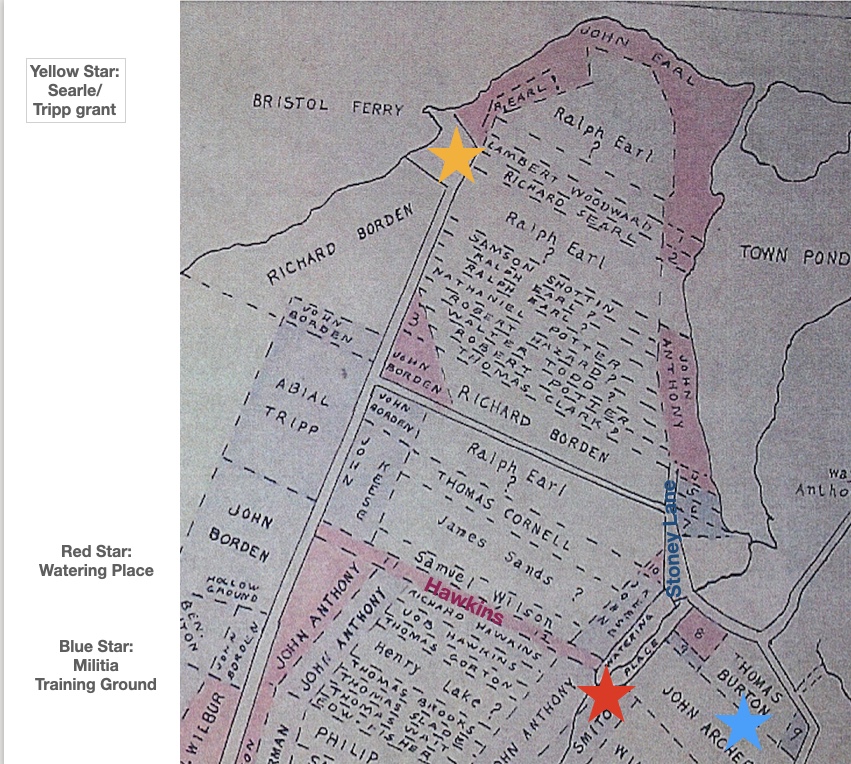
The first street to the right was “Stoney Lane.” It was a short “driftway” (a path used to drive cattle or sheep) between Richard Borden’s property and that of Mistress Harts. South of that was a lane that led to a “watering place” now called Founder’s Brook. On the map it is called Hawkins Lane for Richard Hawkins and his wife Jane who was a friend of Anne Hutchinson. This “watering place” was laid out in 1713 as a public place for the washing of sheep and general water uses. Also in 1713 Thomas Burton received a piece of land that was known as the “Training Place” before that. That ground may be where the militia had trained.
Waiting for the Ferry
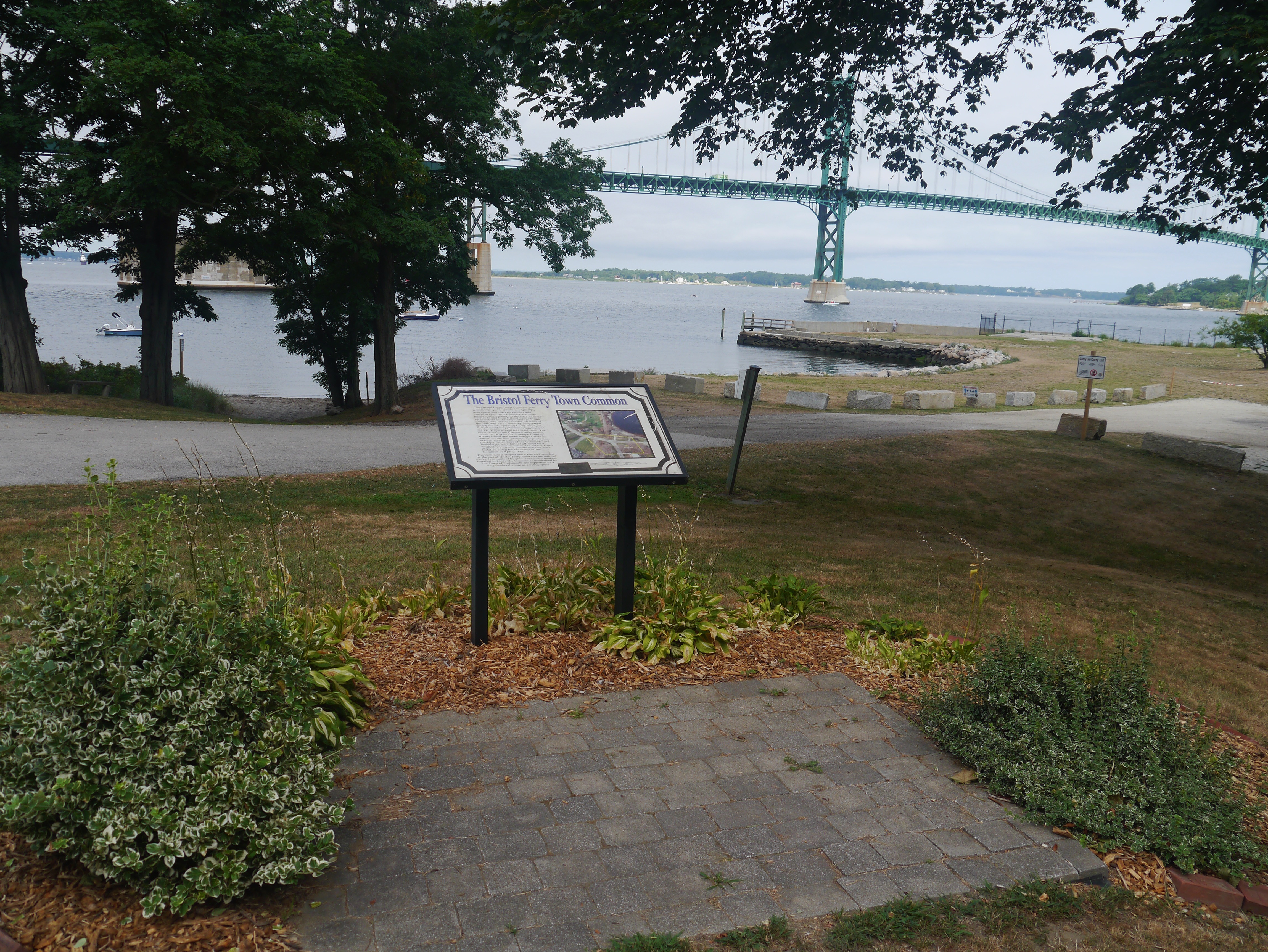
The tip of the Bristol Ferry area developed commercial businesses like taverns and shops that catered to those using the ferry. Ferries were more informal at the beginning. Those with boats provided a service to passengers and goods that needed to be transported to the mainline at Bristol. This is the site of a town common dating back to 1714. Ferry service started here in 1640. This 1.5 acre space was originally used by farmers and others to keep their livestock and other goods while waiting for the ferry to Bristol. The Bristol Ferry area had a British fort during the occupation. This area was the transportation hub for Aquidneck Island (Rhode Island) and there are records of George Washington passing through here after visiting with General Rochambeau in 1781. The French and Americans would make the start of their long journey to victory at Yorktown through Bristol Ferry.
A Bristol Ferry story
Just above the Bristol Ferry is the 3 acre lot that Richard Searle sold to Mary Paine. Mary was a bar-maid at Baulston’s public house. Searl exchanged his lot for a pint of wine. He didn’t give Mary a deed, but the town council ratified the sale on the testimony of a witness in 1666. Mary later married John Tripp and that piece of land became the site of his ferry house.
Recommended Reading
West, Edward. Rhode Island Historical Society Journal in July of 1932 (The Lands of Portsmouth, R. I., and a Glimpse of Its People).
 portsmouthhistorynotes
Leave a comment