Home

Out of the Attic: Do we have a Civil War Cavalry Sword?

Leave a comment

P1080090

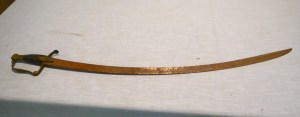
Possible Civil War Cavalry Sword belonging to a lighthouse keeper.

The sword in this picture has been laying on the top of a display case in the Portsmouth Historical Museum.  It has been somewhat out of sight, so it is a good candidate for our Out of the Attic theme this year.  It had an acquisition number written on it which refers to some old museum records. According to the record. It was a:

“Civil War sword (that) belonged to Sheridan Smith, Calvary man. His horse was shot out from under him and for recognition he was made keeper of the Mussel Bed Shoal lighthouse. This is how they came to this section from Norton MA.”

Is this true? How can we determine that?

An on-line search revealed that historical records for the Mussel Bed Shoal lighthouse list a Thomas and Andrew Smith as lighthouse keepers – Not Sheridan Smith. Was Sheridan a middle name?

P1020333

Mussel Shoal Light – near Mt. Hope Bridge area.

The 1880 Federal census lists ”Thomas S. Smith” as a resident of Portsmouth and a “Lighthouse Keeper”.  We learned that his wife’s name was “Roseanne.” Does the “S” stand for Sheridan? We noted that the census lists one of his sons as “Andrew.”

Thomas Smith died in 1881 and it appears that his son Andrew took over the role as lighthouse keeper.

A Veterans Schedule from 1890 lists Roseanne as the wife of Thos. S. Smith (Alias) “Thomas Sheridan.” It also says he was in the Cavalry.

Is this a cavalry sword? It is similar to images we have seen of a typical Civil War Cavalry Sword found online.

It appears that may indeed be a Civil War Calvary Sword that belonged to Thomas Sheridan Smith. Was his horse shot out from under him? That is more difficult to prove.  Maybe someone in Smith’s family has more of the story.

Research by Richard L. Schmidt of the Curator’s Committee
Oscar Miller: Bristol Ferry Artist

Leave a comment

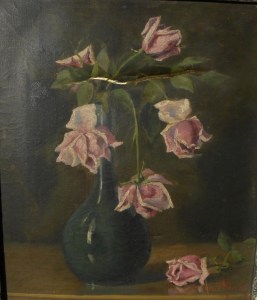
Oscar Miller roses

Oscar Miller painting on sale at Ruby Lane website.

Much due to Sarah J. Eddy’s influence, Bristol Ferry was a cultural and intellectual center. It was also a transportation center that made it easy to take the Fall River Line to New York, ferry to Bristol, take a train to Fall River and north or farmers to ship their produce from the freight dock. It was a perfect place for Oscar Miller and other artists to call home.
Oscar Miller was an artist with a national reputation. He created over 1500 works. Miller exhibited at most of the great American art institutions: The National Academy, painting titled “Girl Reading” at the 1904 World’s Fair. He painted marine seascapes, salon paintings, genre studies, and figure studies. Miller had many studios – New York and Paris as well as Portsmouth. His first Portsmouth studio was in the living room of the cottage he built in 1897-8 for his wife to be and then a purpose built 1904 Gambrel or “Dutch” style studio structure with a huge North window on Bristol Ferry Road which still exists today. A shop shed was added when Oscar returned from Europe just before the First World War.
Sarah Eddy liked Oscar’s paintings in a New Your City exhibition and first invited him up to Bristol Ferry in 1896 to “paint the spring.” In Bristol Ferry, Oscar would dress his subjects in costumes – as did Sarah Eddy and other artists of their day. Eddy taught him photography and his photography was just as good as his painting. His grandson, Gus, has glass plates of his grandfather’s photography work.
While in Portsmouth, Sarah Eddy introduced him to the woman who would become his wife – Clara Brownell May – daughter of Floride Mitchel. When their house was finished and furnished in 1898, they married. Clara believed that if she was to marry an artist, it should be one who could put a roof over her head.
Oscar Miller had married into a Bristol Ferry family. Clara’s aunts were part of the Bristol Ferry Art Colony – Sophie Mitchel (artist) and Cora Mitchel (poet and musician). Miller’s home and studio were built on Mitchel land that had been an asparagus farm. The Family raised and traded cotton in Florida. Mrs. Miller’s uncle Colby Mitchel had even been impressed into the Confederate Army and had to be rescued after he contracted malaria and smuggled back North. The family spent their time between Florida and Bristol Ferry.
Oscar Miller was a great organizer with a business mind. His Family had an art gallery on New York’s Fifth Avenue so he would also buy art as well as produce it. He always painted in a spotless suit because much of his work was painting portraits and he never knew when a client might drop by unannounced and he wanted to be able to shake their hand. Miller painted the portraits of many important New York, Providence and Fall River businessmen and matrons.
During the Spring, Summer and Fall, he would make the rounds of European locales – Holland, Northeast France, Brittany, St. Ives in England, Italy, Austria, Switzerland and Belgium. In the winter he would go back to work in his winter studio in Paris to paint works for the great Paris Salon exhibition. Every other year he would return to Bristol Ferry for a few months to visit family and to paint and exhibit locally.
He exhibited at many American and European institutions including: American Federation of Arts, American Water Color Society, Art Club of Philadelphia, Art Institute of Chicago, Le Salon de la Societe des Artistes Français, Memorial Art Gallery Rochester, Milwaukee Art Museum, Museum of Fine Arts Ghent, National Academy of Design, National Arts Club, Newport Art Association, Pennsylvania Academy of Fine Arts, Providence Art Club, Salmagundi Club, and the Society of American Artists in New York. A posthumous retrospective was held at the Rhode Island School of Design.
When he was in Bristol Ferry he loved to go out to paint at dawn or sunset. He thought the light in Bristol Ferry was like that of Holland or Venice because it was surrounded by water that reflected sunlight upward. More than that, Oscar Bristol Ferry among the most beautiful places in the world.
Bristol Ferry was unique. It had the warmest climate on the island and the surrounding water kept the growing fields moist even in drought. People would come to Bristol Ferry farms as a vacation destination. It was a wonderful area for artists to come for the summer season.
Most of my information on Oscar Miller was from an interview with August “Gus” Miller – Oscar Miller’s grandson. Sept. 12, 2014
The image of Oscar Miller’s painting is from this website:  https://www.rubylane.com/item/230729-JB04415/OSCAR-MILLER-1867-1921-still-life


Out of the Attic: Bristol Ferry Artist Box

Leave a comment

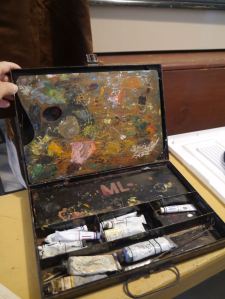
P1060744We received this artist box a number of years ago.  It had belonged to Claire Fay, a longtime board member of the Portsmouth Historical Society.  The paints are relatively new, but the box itself dates from a hundred years ago.  A note said it originally belonged to Bristol Ferry Art Colony member Mariette Letourneau – the great aunt of Claire Fay.  This item raised some questions.  Who was Mariette Letourneau?  Was there an “art colony” at the Bristol Ferry neighborhood of Portsmouth.
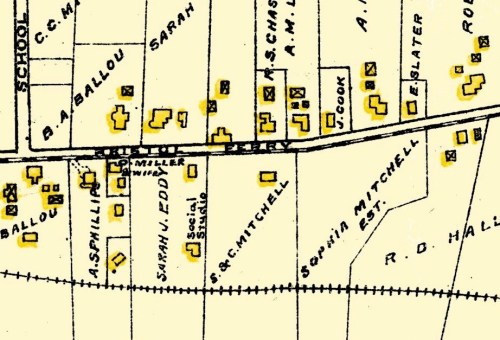
Finding Mariette Letourneau was not so easy. Genealogical resources show an aunt for Claire that was named Mariette Letourneau, but the birth date doesn’t match the date given on the card that was left with the box.  Was she an artist at Bristol Ferry?  Perhaps she stayed with the Fay family and they did live on Bristol Ferry Road.

Was there an artist colony?  There were certainly a number of artists that lived in the Bristol Ferry neighborhood.  Many of them were drawn there by Sarah J. Eddy. Sarah was a noted photographer, sculptor and painter.  Her most famous works are portraits of Frederick Douglass and Susan B. Anthony.  Sarah would invite artists to come visit and stay at her home (if they were female) or at Willowbrook,  her guest house.

Among the most famous artists in the neighborhood was Oscar Miller who had international fame.  He married into a family with Bristol Ferry roots and kept a studio there. Miller’s studio is still there under the care of his grandson.

Sophia Mitchell was another artist who had a national following.  She traveled extensively and had studios in Brooklyn as well as Bristol Ferry.  There were as many as six studios along Bristol Ferry Road.

Bristol Ferry had a reputation for having the quality of light that artists love – beautiful morning light and gorgeous sunsets.fullsizeoutput_167


Bristol Ferry Artists

Leave a comment

sunset-at-bf-glassplate

This image is from a glass plate negative.  Captured in 1910, this was titled “Sunset at Bristol Ferry”.  I don’t know that this image is by Sarah Eddy, but she was a marvelous photographer working around the Bristol Ferry area at that time.  The Bristol Ferry area attracted many artists and photographers.  The quality of the light there was special.  Artists and photographers especially came during the summer season, but many had permanent studios in the area.  I found this small glass plate on Ebay, but I know that other glass plates may be found in Portsmouth attics.  Hopefully we can uncover more about the Bristol Ferry artist colony.

The Social Studio – Lost to Time

1 Comment

Social Studio postcard - GSchmidt collection

Social Studio postcard – GSchmidt collection

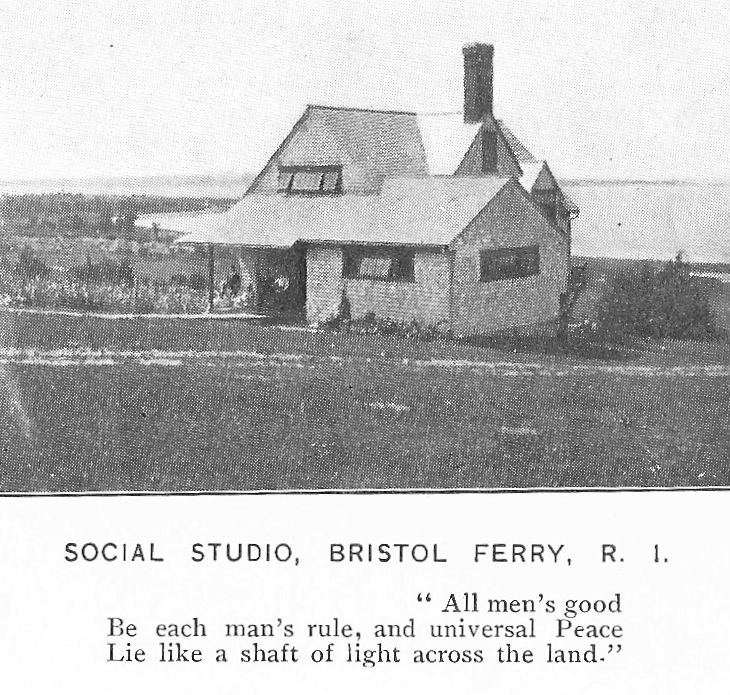
Wouldn’t it be nice if Portsmouth had a place where young and old could gather for social, artistic and cultural events?  There could be drawing and painting classes as well as craft and sewing lessons.  There would be stage where musicals and plays could be performed.  It would be a space for art exhibits, lectures and writing and reading.

Portsmouth residents have been looking for such a space in the past few years, but we used to have it.  The Social Studio on Bristol Ferry Road was such a spot a hundred years ago.

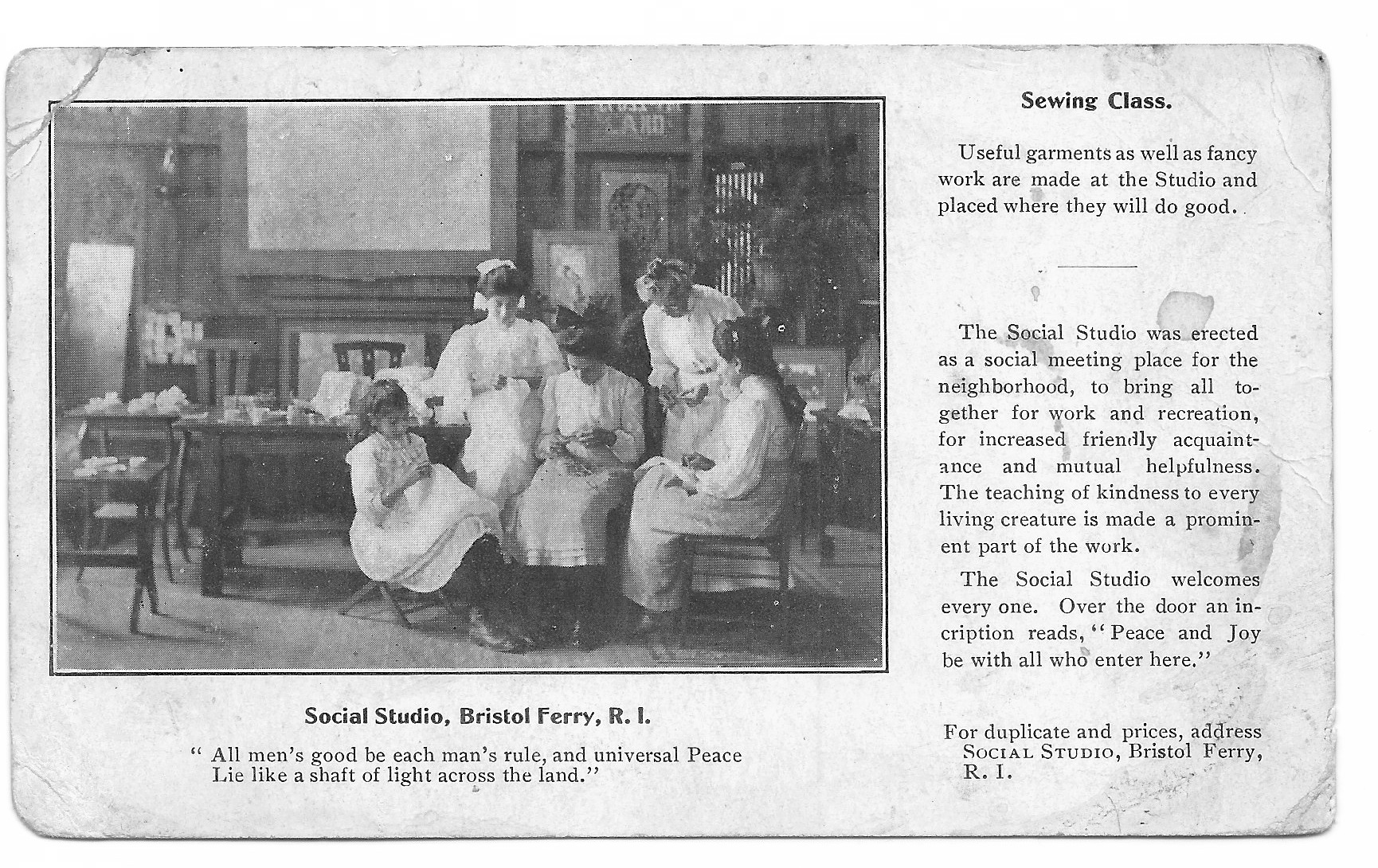
Magazines at the time describe the studio as “a large room for assemblies, one end of which is occupied by a small stage, is furnished simply and artistically.  Potted plants, a pianola, a huge open fireplace, oil painting on the wall and a good library-all lend great charm to the big room which is a delightful retreat for the young people who flock there from adjoining farms.  Lectures, readings, musicals and social gatherings are frequently held.  Classes in pyrography, drawing, water color painting and raffia are conducted by competent teachers, a nominal fee being charged for instruction.” (The Common, Vol. 10 – 1905)

The Social Studio was founded by Sarah J. Eddy.  This remarkable lady was a talented photographer, author, painter and sculptor.  She came to Portsmouth in the early 1890’s and lived in Portsmouth until her death at age ninety-three in 1945.  Sarah had a passion for the humane treatment of animals and was among the founders of the Rhode Island Humane Educational Society.

You can find out more about the Social Studio when you come to the Portsmouth Historical Society Museum for the “Lost to Time” Exhibit for 2014.  The Exhibit will be up and running at the museum (on the corner of East Main and Union St.) from Memorial Day weekend to Columbus Day Weekend.  On display will be s a large painting of a cook preparing vegetables for Thanksgiving dinner which was painted by Mrs. Eddy.  You will also be able to see animal books for children written and illustrated by Mrs. Eddy.  A Good Housekeeping Magazine article on the Social Studio and a series of postcards of events at the studio help us to understand the activities that took place there.  Newspaper clippings alert us to the various sales and lectures held at the site.  Even Julia Ward Howe came to speak and socialize. The Social Studio building still exists today as a private home.

Our research into Sarah Eddy in Portsmouth continues.  Look for future blogs on Sarah as artist and photographer

Classes at Social Studio:  collection of GSchmidt

Classes at Social Studio: collection of GSchmidt

and Sarah’s many causes (abolition, women’s suffrage, humane treatment of animal).

Leave a comment

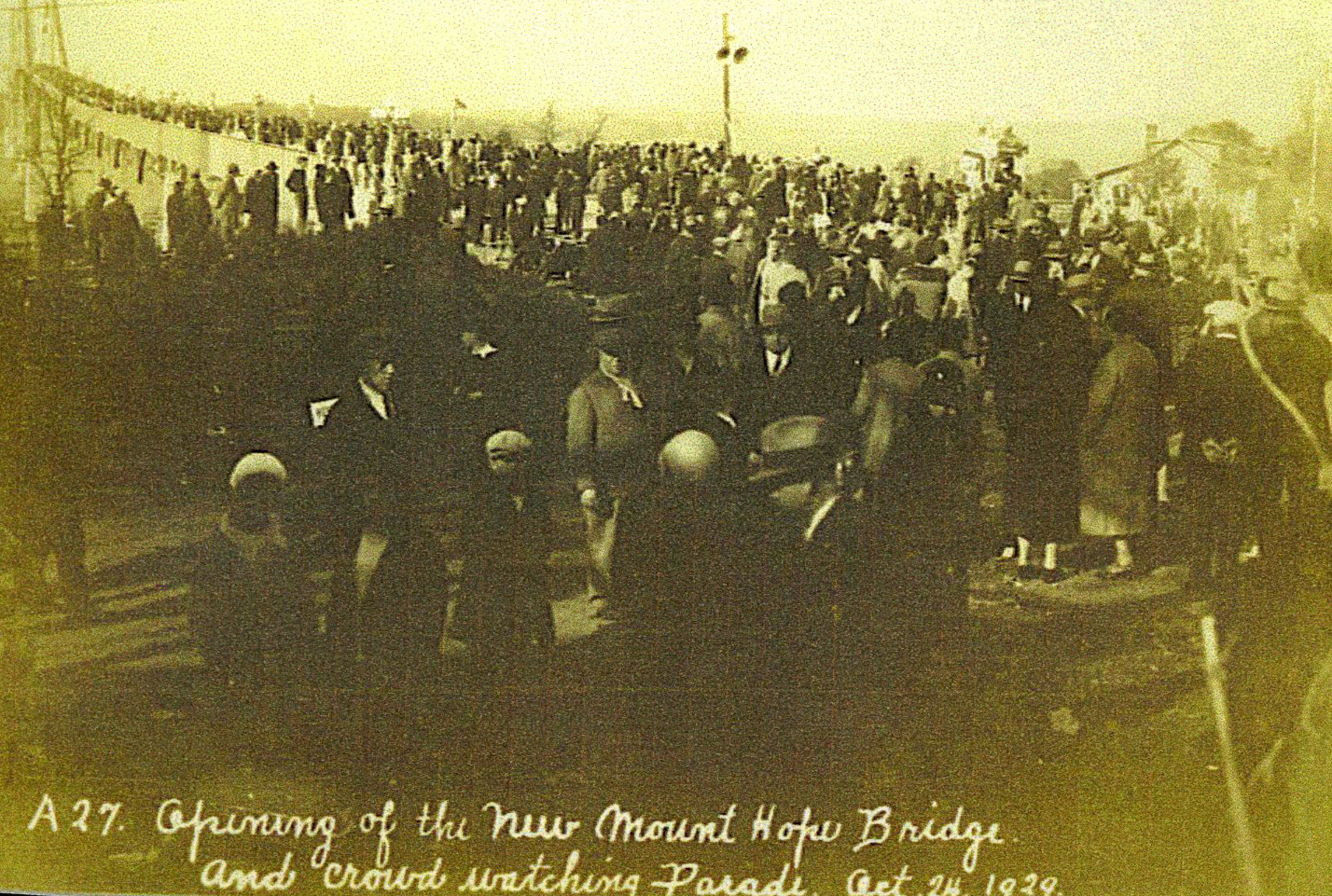
The Portsmouth Historical Society has items from the opening festivities of the Mt. Hope Bridge in 1929.  Those items include an invitation, guest badge and photographs of the construction and ribbon cutting.  A front page newspaper article from the time helped us to understand how elaborate the ceremonies were.  Senator William H. Vanderbilt presided over the pageant.  Beginning at 10 in the morning a parade began in Bristol – a “tableau”  depicting Roger Williams organized by the Rhode Island Historical Society.  The Newport Historical Society organized a tableau and parade depicting John Clarke and they marched from the Aquidneck Island side.  At 11 AM “Roger Williams” met “John Clarke”  and unfurled flags at the center of the bridge and exchanged greetings. There was an Indian ceremony in which Governor Case and Senator Vanderbilt became members of the Algonquin Council.  Vice President Charles Curtis signaled from Washington, D.C. at noon to begin the dedication of the bridge.  The program lists events such as a christening of the bridge, ribbon cuttings and acceptance of bridge certification.  The ceremony was even broadcast on WEAN at the old Outlet Building in Providence.

Part of the elaborate ceremonies at the Opening of the Mt.Hope Bridge in 1929.

Catboat Bristol Ferries

Leave a comment

Captain Hicks used a catboat to ferry bicycles and their riders.

Even in the late 1800’s sailboats were used as ferries.  Captain Oliver G. Hicks bought a large wide catboat for bicycle traffic.  The boat could carry up to 16 bikes.

(image from a book in the collection of the Portsmouth Historical Society)

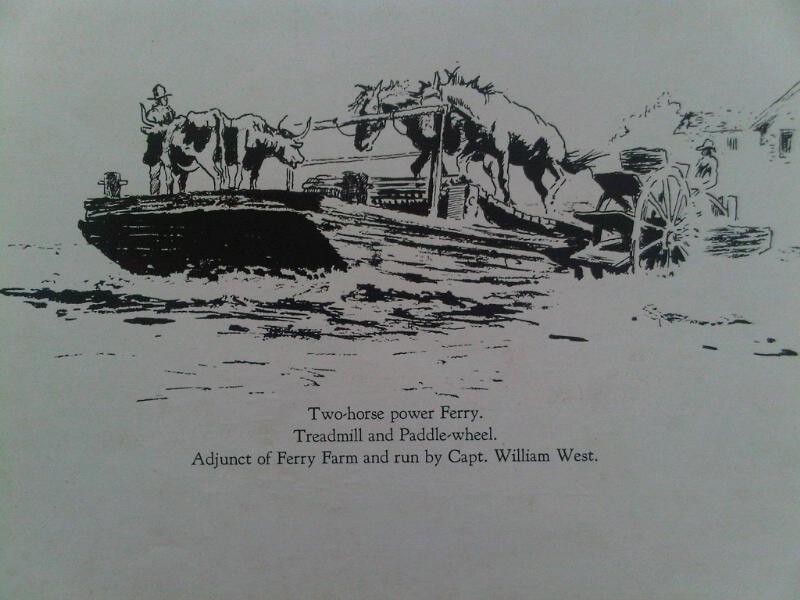
Horse Powered Bristol Ferry

Leave a comment

Horses powered Bristol Ferries in the mid 1800's.

In 1824 the Rhode Island Steam & Team Boat Company was chartered  to use either steam or horsepower to ferry from Portsmouth to Bristol.  The boat was like a square paddlewheel boat with rounded ends.  Two pairs of horses on both sides of the ferry provided the power as they moved on a large round disk.  This was hard work and horses had to be replaced frequently. Ferry Farm was home to the horses.  The horses proved to be an expensive way to power a boat and by 1845 the horse powered ferries were replaced by the steamboats or even sailboats when people were in a hurry.

(Image from book in PHS collection)

Hog Island Shoal Lighthouse

Leave a comment

Treacherous shoals are marked by this 1901 lighthouse near Hog Island.  There was a small light boat on the spot that the Old Colony Steamship Company used to aid their vessels.  A larger boat, the Eel Grass Shoal Lightship, LV 12, was used beginning in 1886.

This 1901 Lighthouse replaced a light boat on the Hog Island Shoals. (Image G. Schmidt collection)

Light Keeper’s Quarters

Leave a comment

Plans in the PHS collections.

The plans of the Musselbed Shoal Light show the quarters for the lighthouse keeper.  The keeper led an isolated life.  Most keepers held the post for only a short time.  A few of them lasted as long as ten years.

Older Entries Newer Entries