Tomorrow we honor those who participated in the Battle of Rhode Island with a Sunset Salute at Butts Hill Fort. Why did we have a battle? What was the spark? Over the past week I have heard an historian and a US Senator tell us that it was initiated by the British. I have been working on a role playing activity to let students and adults experience the decision making that principals in the Battle of Rhode Island had to make in the heat of the action. I like to draw from primary sources as I provide background material to the decisions that had to be made. Drawing from the diary of British soldier Frederick Mackenzie, I believe that the British were reacting to the retreat that they discovered that the Americans had already started overnight on August 28th.
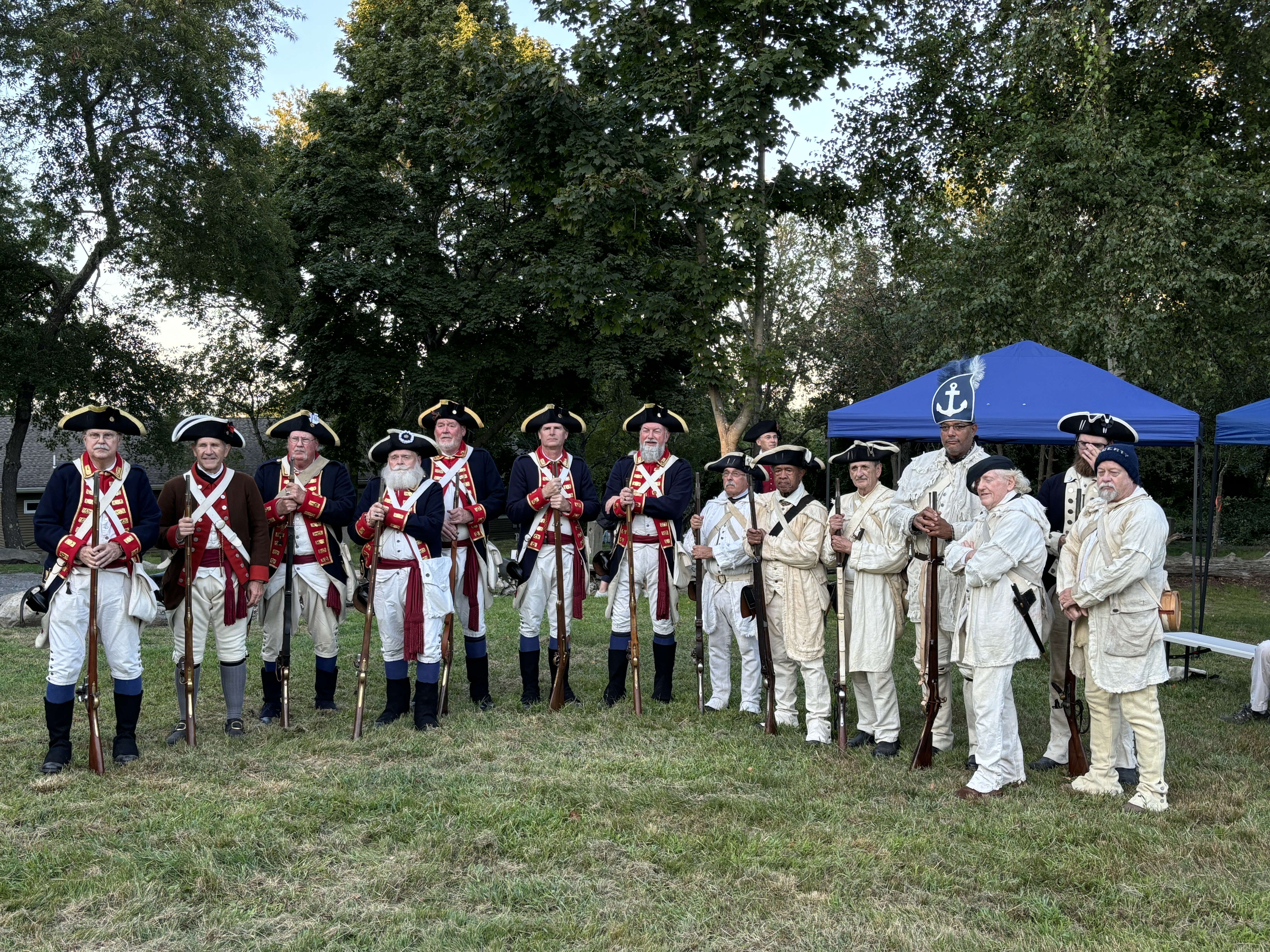
Sunset Salute 2024
“As soon as the day broke this Morning and we could see as far as the Enemys Encampment it was observed that their tents were struck; I went immediately on top of Dudleys house, and when it grew lighter, I could plainly perceive that the Rebels had struck their whole Camp, and had marched off; hardly a man was to be seen in their Batteries or Trenches. I rode as fast as possible to General Pigot’s quarters in Newport and informed him of it, and returned to the Camp with his orders for all the troops to get under arms with the utmost expedition. The General came to Irishes Redoubt by the time the Troops were assembled, and being satisfied that the Rebels had quitted their position, he gave orders for a part of the Army to march out, in three Columns, to pursue them, but to advance with caution, and not bring on an Action with a part of our force.” Mackenzie’s diary August 29, 1778
The British didn’t decide to go on the attack against the American Siege of Newport. Mackenzie notes that the British were “to advance with caution, and not bring on an Action with a part of our force.” The British found that Americans had left their positions and General Pigot decided to go after them to capture the American Army before it could retreat off Aquidneck Island. The goal of the Americans was to get their soldiers and equipment safely to Tiverton so they could fight another day. The American aim in the battle was to push the British and German (Hessian) troops back so that a successful retreat could be made. They were in an untenable position once it was clear that the French were not coming back to aide in the plans of the Rhode Island Campaign. The Americans were not trying for a full engagement either.
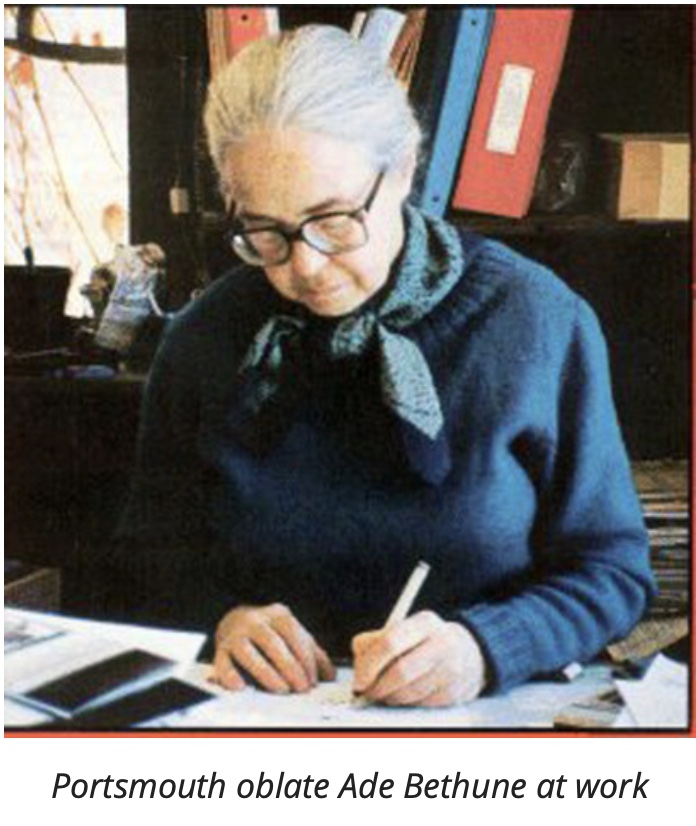
The new housing development being built by the old Anne Hutchinson school is being named after Ade Bethune. I remember Ade as a liturgical artist. She had the St. Leo’s shop out of her home on Washington Street in Newport. I went there to buy some things and what sticks out in my memory is that her coffee table was her wooden coffin! She designed jewelry and liturgical objects under the name of the Terra Sancta Guild. I still have some of those pieces.
Why would you name senior housing after Ade? Ade founded The Church Community Housing Corporation (CCHC), in 1969. The CCHC has the lease from the Town of Portsmouth to build a senior housing development.
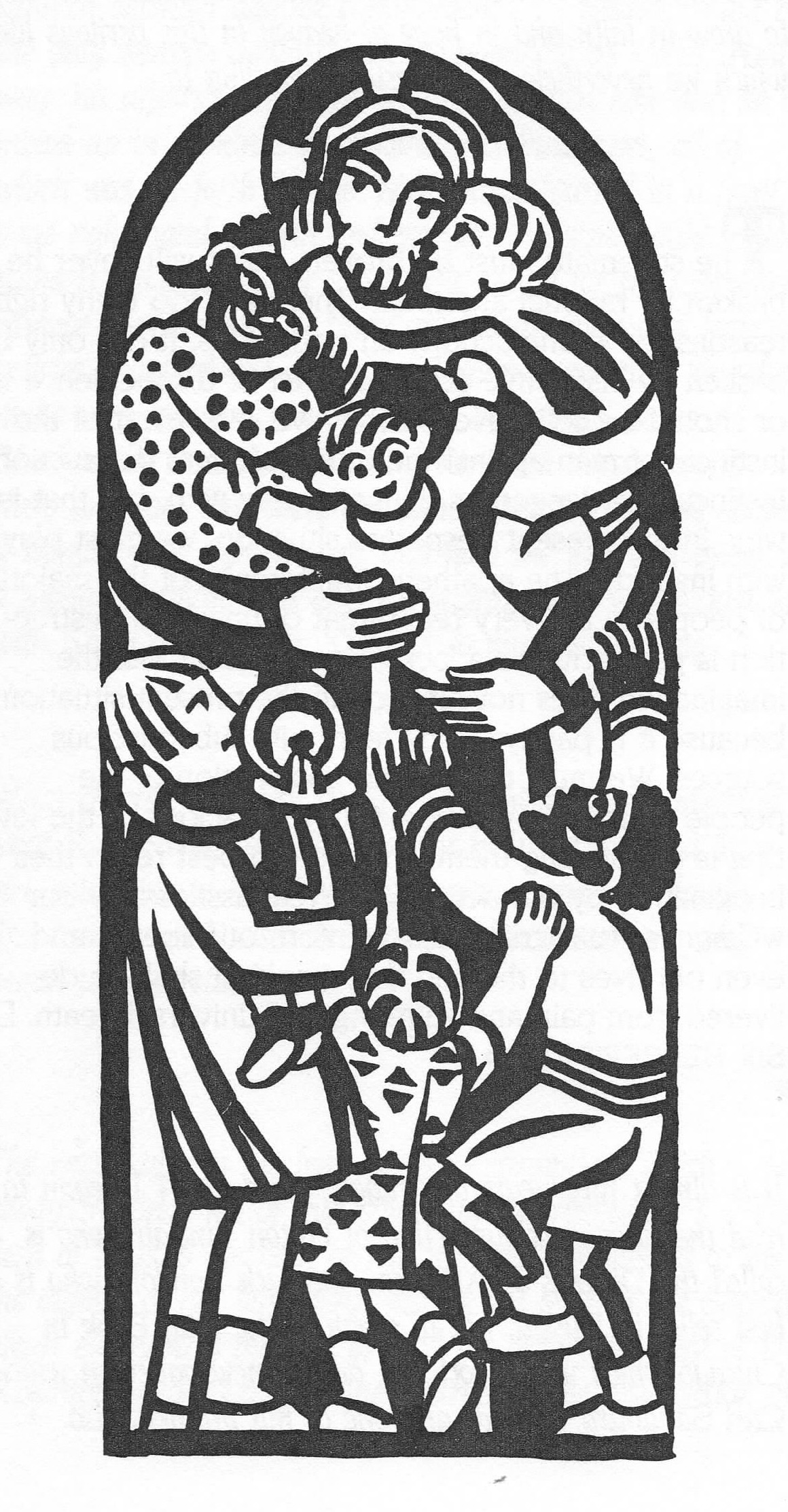
Ade (Adelaide De Bethune) was born in Brussels, Belgium, in 1914. Ade and her family emigrated to New York City in 1928. In 1933 she met Dorothy Day at a place were the poor were being fed. Ade thought the illustrations in Dorothy’s newspaper The Catholic Worker, could use some help and she volunteered to do it. In my library I own a book on Dorothy Day and Ade was the illustrator. This early experience led Ade to focus on liturgical art and architecture which were rooted in the Catholic faith. Ade Bethune wanted her artistic gifts to be of service to others.
In 1938 Bethune moved to Newport, Rhode Island. Ade thought that home ownership was important to giving people a sense of belonging to a community. Throughout the years Ade was a vocal critic of efforts to tear down existing housing in Newport. She and a group of concerned citizens created the Church Community Corporation in 1969 (later the Church Community Housing Corporation or CCHC). This organization worked through renovation and new construction to enable low-income residents to find a home. In the 1980s Ade worked to develop Harbor House on Washington Street for elder housing. She was one of the first residents in 2002, but died shortly after. She is buried at Portsmouth Abbey in the monastery’s burial grounds.
Illustration from the Dorothy Day Book
To learn more about Ade – I would recommend these sites:
I’m not a military historian. I am working on a role playing activity to give students and interested adults a sense of the decisions that had to be made on both sides in the Battle of Rhode Island. So I am learning about military tactics. If I ask role players to make decisions about what they would do when faced with certain situations during the Battle of Rhode Island, I need to inform the players about what their choices might be. What follows is a gathering of military tactics and an attempt to define them in a way players might understand. I appreciate feedback from readers that have more military experience.
Tactics 1. Linear formations: Both British and American forces often fought in close-order formations, relying on mass volleys because musket fire was not very accurate.
2. Open formations: Instead of close formation in line, skirmishers are more spread out and use the terrain to take cover.
3. Scouts: Used ahead of the main forces to gather information and to protect the flanks (sides) and rear of the army.
4. Fabian Strategy: General Washington employed this tactic, which involved avoiding major battles while harassing the enemy and gathering intelligence, according to the American Battlefield Trust.
5. Guerilla Tactics:
A. Surprise Attack: Element of surprise used to gain an advantage. Soldiers used the American landscape to their advantage – using forests and hills ( especially stone walls and corn stalks in Portsmouth) to hide and then surprise the enemy.
B. Ambush: A type of surprise attack where the attackers conceal themselves and then launch a sudden attack inflicting damage before the enemy can defend themselves.
C. Hit-and-run attacks: Using short surprise attacks and withdrawing before the enemy can respond in force. This inflicts damage on the enemy without a full-scale battle.
D. Harassing Tactics: Firing from a distance, disrupting formations, tactics that delay the enemy.
Edward Wigglesworth was born and raided up in Newburyport, Massachusetts. He graduated from Harvard and worked for merchants in Newburyport. That gave him experience as a ship’s captain in the Caribbean. In 1776 he was commissioned a Colonel and he took command of the 6th Massachusetts Continental Battalion. His battalion was ordered to Fort Ticonderoga as the Americans were quickly building a fleet to counter the British on Lake Champlain. As an experienced mariner, General Gates appointed Wigglesworth as third in command of the American fleet. Wigglesworth joined the fleet and took part in the Battle of Valcour Island in October of 1776. With the destruction of the American fleet, Wigglesworth escaped back to Fort Ticonderoga and took command of his battalion again. When his battalion disbanded, he was took command of the 13th Massachusetts Regiment. He was at Valley Forge and took part in many battles.
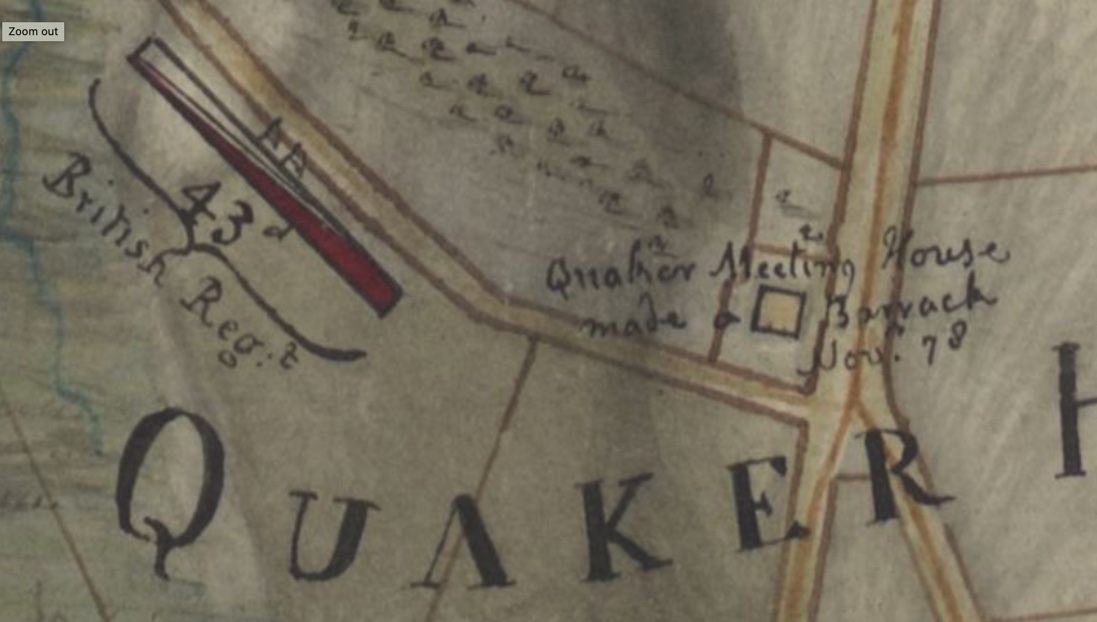
During the Battle of Rhode Island, Wigglesworth was positioned at Quaker Hill. American units (Wiggleworth’s Regiment, Livingston’s advanced guard and Wade’s pickets) were waiting at the junction of Middle Road, East Road and Hedley Street near where the Quaker Meeting House was located. Wigglesworth mistook the uniform of the Hessians troops advancing for American soldiers. Sullivan sent John Trumbull up Quaker Hill to set Wigglesworth straight. American General Sullivan saw his troops retreating, so he sent in Shepard’s Regiment of Massachusetts Continentals. General Sullivan’s “Life Guards” were sent in as well. For a while the Americans had an advantage.
A private from Jackson’s attachment described the action:
Detail of Quaker Hill from Huntington Map.
“We began to attack. The action began to be warm when we were reinforced by Col. Shepard’s Regiment under the command of Lieutenant Colonel Sprout. The action then commenced hot. We plied them so briskly that they began to give way. Our troops seeing this, gave three cheers and advanced. The enemy then gave way and left one piece of cannon but poorly supported. A party of our men then advanced, drove the artillerymen and took possession of the cannon. The enemy then rallied and being reinforced, advanced and gave our men so heavy a fire that they obliged them to quit their prize, the cannon.” (From: Diary of a soldier in the RI Expedition (Massachusetts Historical Society. Quoted in McBurney.)
Like many other officers he exhausted his financial reserves and resigned from the army in 1779. He returned to Newburyport and ultimately was appointed tax collector for the port. He held this post for many years prior to his death on December 8, 1826.
Christian McBurney’s book on the Battle Rhode Island Campaign provides me with a step by step breakdown of the action, but I still need to digest it slowly. While I work on a tabletop role playing activity centered around the Battle of Rhode Island, I am trying to draw out the points in the battle where decisions had to be made. These are some of the decision points I may include in the role playing.
August 28
Once the Americans knew the French would not be returning, Sullivan’s council of war had to make a decision on whether to continue their Siege or Retreat.
Once the decision was made to retreat – Sullivan had to devise a strategy for that retreat.
August 29
In making a decision to retreat, how did the geography of Portsmouth affect the strategy for the retreat?
How would Sullivan decide to distribute the seasoned soldiers and raw militia?
How would Sullivan decide where to place the advanced guards to hinder the enemy?
The British had been on the defensive with the Siege. What decisions does Pigot make to go on the offensive?
What is Pigot’s strategy?
On Turkey Hill, Lauren asks Sullivan for more men. What decisions does Sullivan make?
When Malsburg is out of ammunition past Turkey Hill, what decision does he make?
What were Malsburg’s decisions on attacking the redoubt.
What decisions did the British Navy make?
Greene urged Sullivan to Fully Engage when the British got beyond Quaker Hill. What decision did Sullivan make?
How did the American actions change the Navy’s decisions?
What decisions did Nathanael Greene make in flanking the Hessians?
What decisions did Smith make when he had orders not to make a general engagement?
Later in the afternoon, when Sullivan was faced with the choice of counter attack or stay put – what decision did he make?
Questions:
How did both armies communicate?
What were some of the tactics used by the Americans?
What were some of the tactics used by the British?
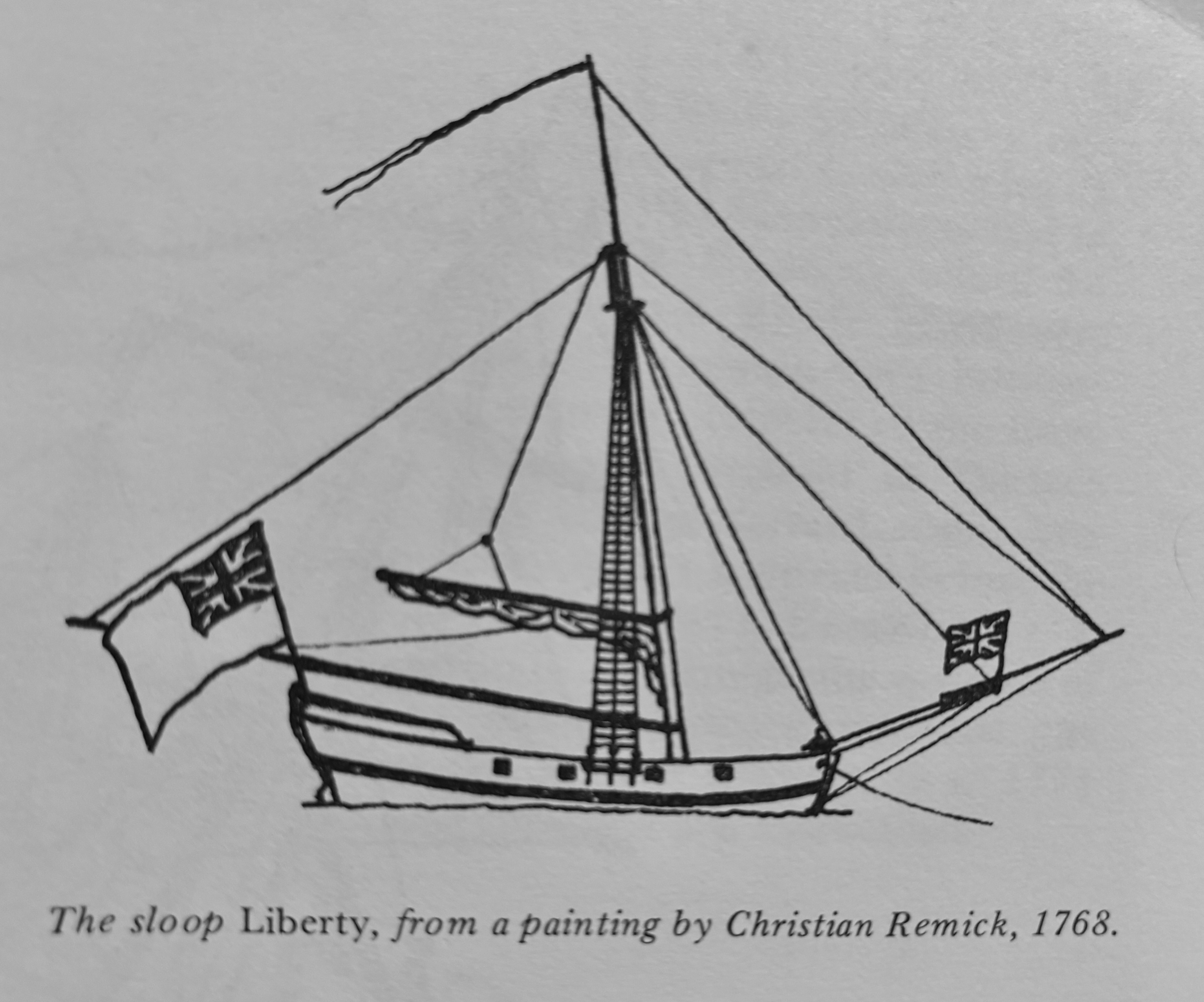
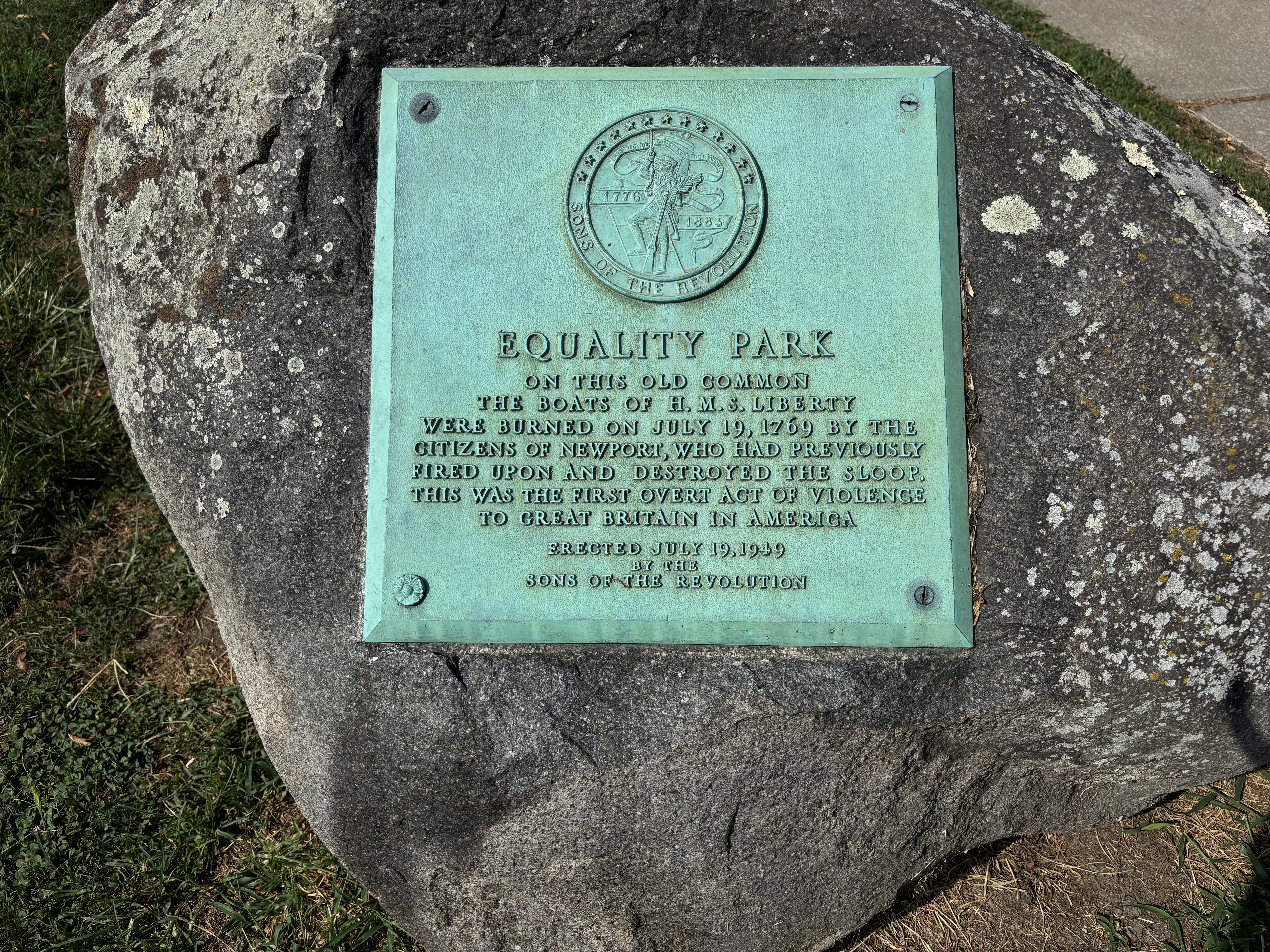
On the 19th of July in 1769 a Newport mob was so exasperated with the captain of a sloop owned by Royal Commissioners that they “went on board the Liberty as she lay at Anchor in the Harbour, and cut her cables, and let her drift ashore, they then set her on fire…” (Boston Chronicles, 24, July 1769). This incident was almost three years before the burning of the Gaspee. The Liberty burning has some aspects in common with the Gaspee Affair. Both were protests to the increase in taxation on the colonists. But the roots of the burning of the sloop Liberty have some interesting origins that start with charges brought against John Hancock, the original owner of the Liberty. Liberty’s story begins in Boston.
The Seizure of the Sloop Liberty
The Revenue Act of 1767, part of the Townshend Acts, placed heavy taxes on goods imported to the colony. The American Board of Customs Commissioners was put in place so that royal officials could inspect incoming merchant vessels and charge the appropriate taxes, but Hancock had refused to allow the officials to inspect one of his vessels – the Lydia. When the customs official was sent to inspect the Liberty, he accused Hancock’s men of offering him a bribe to look the other way while they were unloading. He refused the bribe and he claimed they locked him in the hold of the ship. When news of the incident spread, an angry crowd assaulted the officials involved, broke the windows of their homes and set the officials personal boats on fire on the Commons. The sloop was seized at Boston Harbor on June 10, 1768. John Adams defended Hancock against the smuggling charges. The case dragged on and the charges were later dropped due to lack of evidence. The sloop Liberty, however, had been seized and Hancock could not get it back. It was condemned in August of 1768 and sold in September.
Illustration from John Fitzhugh Millar’s book – Rhode Island: Forgotten Leader of the Revolutionary Era
The Burning of the Sloop Liberty
Parliament’s taxation laws hit the New England economy hard, and some turned to smuggling to avoid the taxes. In 1769 the sloop Liberty came into Newport Harbor. It was the same sloop that had been seized from John Hancock. The captain, William Reid, was authorized to capture smugglers and in return he and his crew would receive a bounty. The Liberty was a private vessel hired by the Commissioners of Customs. Reid had the reputation for being overly zealous in carrying out his order. He frequently boarded and searched legitimate merchant ships and delayed their sailing.
On 17 July 1769 the Liberty took a Connecticut-owned brig into custody on Long Island Sound and brought her to Newport. But Reid could not prove the brig had violated any laws. Captain Packwood, the ship’s master, had declared his cargo at the customs house before sailing. Reid’s crew continued to hold the ship in the hopes something else would be discovered to justify their bounty for the capture. Captain Packwood visited the Liberty to take control of his vessel, but shots were fired towards him. Local Newporters became outraged and a crowd gathered. Tempers flared when local officials would not help the Captain get his vessel back. A group of men attacked the Liberty, cutting the sloop’s mooring lines and drifting her down toward Long Wharf. One report is that they cut down her masts and threw her guns overboard. The hulk drifted out of the harbor on the tide and came to rest on Goat Island, where another mob set her ablaze.
This is the account of the burning in the Boston Gazette – July 24, 1769.
“We hear from Newport, Rhode-Island, that last Monday the Sloop Liberty, Capt. Reid, said to be owned by the Commissioners, brought in there a Brig and a Sloop belong to Connecticut, that they had for some pretext seized in the Sound, which, together with the impudent behavior of the Captain and some of his People, so exasperated a number of persons there, that on Wednesday afternoon they went on board the Liberty as she lay at Anchor in the Harbour, and cut her cables, and let her drift ashore, they then set her on fire but being informed a considerable Quantity of Powder was on board, for fear of endangering the Town, they extinguished it again; they then cut away her mast, threw her guns and stores overboard, entered the Cabin and destroyed the Captains and his wife’s cloaths, bedding, broke the tables, chairs, china and other things therein, and did not quit her til 3 oclock the next morning, when after scuttling the vessel, they left her a meer Wreck, and now remains sunk near one of the wharfs there. They also seized her barge and boat and burnt them – The Brig that was seized we hear was legally discharged on Thursday, but that the Sloop made her escape in the confusion the evening before.”
An 1835 edition of the The Rhode-Island Republican (Newport, R.I.), November 1, 1837 has an in-depth story about the burning. The article starts with an account “related to us by one of the old inhabitants of the town, Mr. Benjamin Hadwin”. Hadwin adds some details of how the crowd was able to get on board the Liberty. The reporter found articles to substantiate. the story. One was from the Providence Gazette of July 22nd, 1769 and it adds more details to what incensed the crowd. The Captain of the brig went on board the vessel to retrieve his sword and other items. When he found a crew member of the Liberty in possession of it, he seized it and made for the shore. Musket fire came from the Liberty directed at the Captain of the brig. Witnesses on the shore saw the attack and Captain Reid had to bring his men on shore to answer for their actions and “a number of men, chiefly from Connecticut, went on board and rendered her unfit for service. ”
Governor Wanton issued a proclamation that officers of justice should bring the persons guilty of the crime of destroying the Liberty, but nothing became of it.
An article dated August 28th, 1769 contains the Order of the Commissioners. It names the sloop Reid brought in as the Sally whose master was Edward Finker of New London. “A reward of one hundred pounds sterling is offered to any person or persons who shall inform against any of the offenders (except Nathanial Shaw, Joseph Packwood and ________ Angell;) to be paid on his or their convictions.” Nathanial Shaw’s family were noted New London merchants and later privateers working for the Americans. The Shaws may have been the owners of the Sally.
An article in the Newport Mercury (July 22, 1769) adds a few more details. Captain Packwood of the brig had “to draw his sword to force his way into his boat whereupon the officer called upon the Liberty’s people to fire on Captain Packwood…” Captain Reid was made to send his men to shore to discover who fired on Packwood and the crowd took that opportunity to board the Liberty.
The burning of the barge and the boat the accompanied the Liberty are commemorated with a plaque in Newport today. According to the Rhode Island Republican 1835 article “The Boats were burned on the Common, opposite the Pound. They were run up the Long Wharf, then up the Parade, and through Broad Street by the populace…”
Background – His military life began in 1746 as an ensign. He had a long line of service with the 22nd Regiment of Foot. In 1775 he was promoted to Lieutenant Colonel. He retired on October 11th, 1778 but later served as Captain of the Plymouth Invalid Company. His service extended to a total of almost 48 years.
In Rhode Island Lt. Col. John Campbell served as commanding officer of the 22nd Regiment and saw action during the British Occupation and the Battle of Rhode Island. He and his regiment raided towns around Rhode Island.
The Rebels would need to reach Rhode Island (Aquidneck) by boat and the British planned to attack shipyards, lumber mills and military stores. On May 25, 1778, British soldier Mackenzie records that the 22nd Regiment, Companies of the 54th, Notenius’s Company of Hessian Chasseurs, ..etc. (500 men in total) moved to Arnold’s Point in Portsmouth. They embarked in flatboats and landed at the mouth of the Warren River. Campbell’s men were divided into two columns. In the town of Warren itself they burned down the Baptist meeting house and other buildings, ransacked homes and property. The other group of Campbell’s men headed to the Kickemuit River. By the Kickemuit Bridge they found and burned 125 boats, large batteaux capable of carrying 40 soldiers. They found a sloop loaded with military stores, a store house, and a corn mill and they burned them. They also burned houses, a bridge and gun carriages. They spiked cannons and set fire to new Privateer Sloop as well as magazines of gun powder.
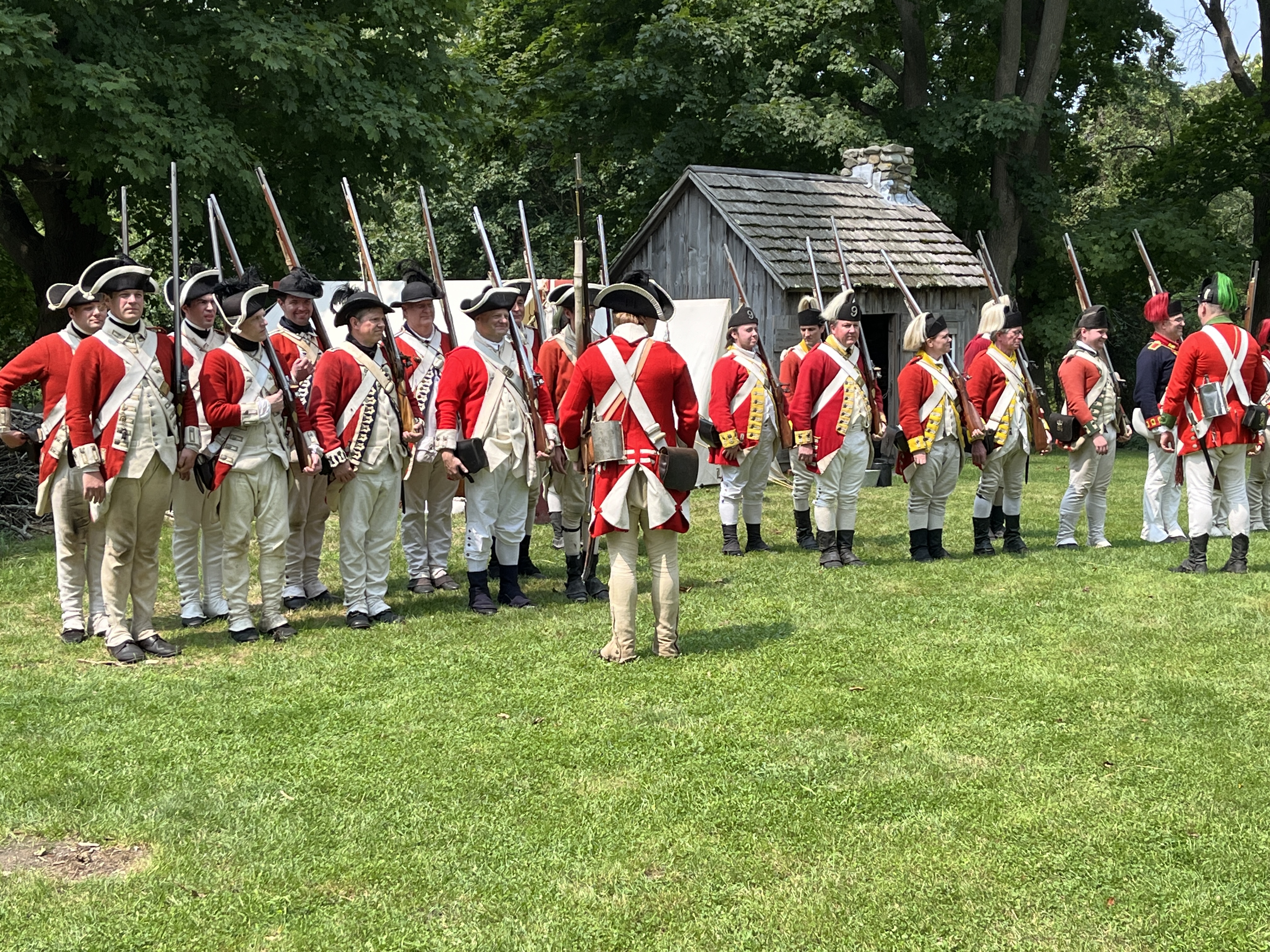
2024 Bristol Re-enactment of Campbell’s raids.
Campbells troops returned by way of Bristol. About 300 Rebels were assembled behind walls, trees and houses. They burned houses, a church, ammunition magazines and twenty of the principal houses. The British boats came round from Papasquash Point to the Bristol Ferry. The British ships Flora and Pigot covered the British troops as they crossed over from Bristol Ferry.
During the Battle of Rhode Island, Campbell was in charge of the 22nd Regiment as they proceeded down East Road.
Eyewitness Account
“The twenty-second, Forty-third, and flank companies of the Thirty-eighth and Fifty-fourth regiments, marched under Brigadier-General Smith, by the east road, to intercept the retreating enemy. A stand was made by the Americans, and some sharp fighting occurred, in which the twenty-second, under Lieut.-Colonel Campbell, highly distinguished themselves. The Americans were driven from Quakers’ Hill, when they fell back to their works at the north end of the island, from which they afterwards withdrew. Major-General Pigot stated in his public despatch,—”To these particulars I am, in justice, obliged to add Brigadier-General Smith’s report, who, amidst the general tribute due to the good conduct of every individual under his command, has particularly distinguished Lieut.-Colonel Campbell and the twenty-second regiment, on whom, by their position, the greatest weight of the action fell.” The regiment had eleven rank and file killed; Lieutenant Cleghorn, Ensigns Bareland, Proctor, and Adam, two serjeants, and forty-eight rank and file wounded; one man missing”. (source: Historical Record of the 22nd or Cheshire Regiment of Foot. This is a quote from Major General Pigot letter to Sir Henry Clinton dated Newport, Rhode Island, August 31, 1778)
Resources: Good biographical material can be found in John Hattendorf’s book: The Battle of Rhode Island in 1778: The official British View as Reported in the London Gazette.
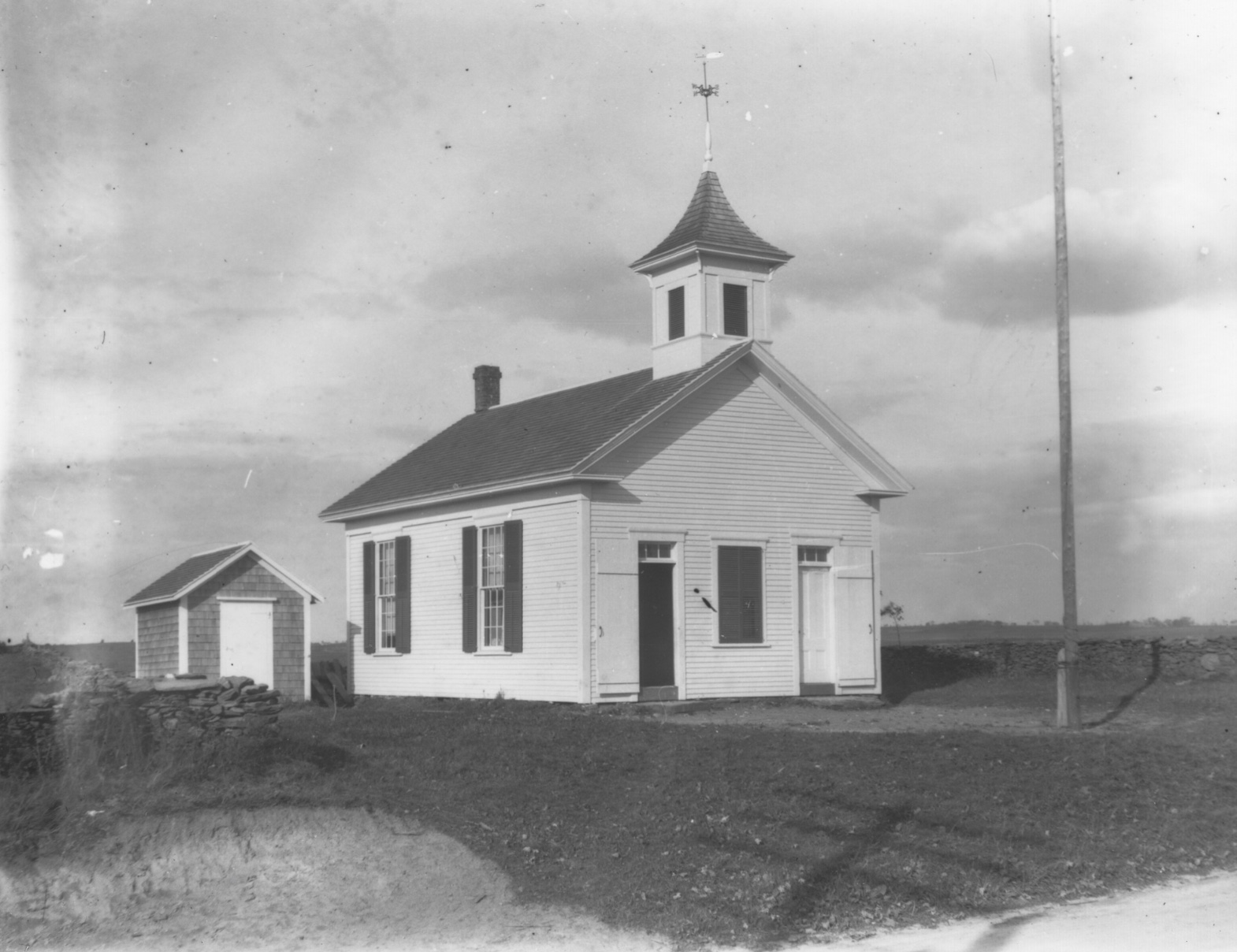
“If it wasn’t here, it was near.” That was the repeated phrase of our guide when we toured the Holy Land. I find myself saying the same thing when it comes to the second location of the Southermost School. I always thought that location was the same lot that was the home of the Gibbs School. The timing worked out perfectly. The schoolhouse went to Lakeside Farm when the Almy family bought it at auction in 1863. The building date of the Gibbs School was 1864. I imagined that the Southermost School had to be moved away for the construction of the newer school. When I went to research the Gibbs School, I began to have my doubts. There was much debate about what to do with the Gibbs School when it was no longer needed in the 1940s, because the original donor of the land (Listed as Parker Lawton in one newspaper article and Edward Lawton in another) stipulated that the property is “to be used and improved by School District No. 3 for school purposes only, forever.” (Note – at that time each of the one room schools functioned independently as is own district.). This was written in a deed in 1845. Parker sold the lot to the town for $60, but family members claimed that the land should go back to the Lawton family if it is not needed for a school.
Gibbs School from Collection of Jim Garman
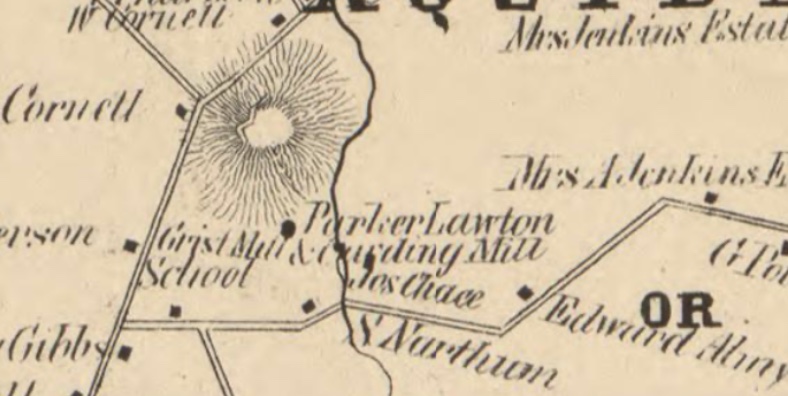
Some histories of the Southermost School said it was moved around 1800 to a location on Union Street closer to West Main Road. If the Gibbs School lot wasn’t available, Southermost School could not have been in its location unless it was not on town property. A newspaper account from 1970 reports that “Southermost School was moved from its first location to the west end of Union Street – the Fred Sherman land now owned by Mrs. Robert Young.” The article states that the Gibbs School was built across Union Street from the land where the Southermost school had been. What is further confusing is that the 1850 Ward map of Newport County shows the schoolhouse to the North of Union Street close to West Main Road. Confusing!
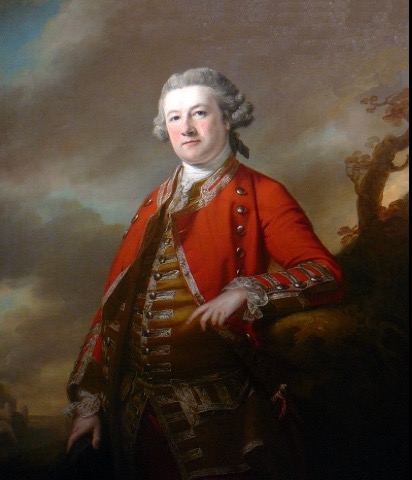
Robert Pigott- 1720-1796 Sir Robert Pigot was from a prominent Huguenot family in London. His brother Hugh was an admiral in the Navy. Pigot joined the British Army before the Revolutionary War and in 1758 was a major in Seventieth Regiment. Although he continued in the army, he was elected as a Member of Parliament. He commanded the Fifty-Fifth Regiment in Ireland as colonel in 1775. After this assignment he moved to America. During the Battle of Bunker Hill, Pigot commanded the left flank of Howe’s army. He led the second assault on the colonists’ position but he failed to break the Americans. In 1776, he was promoted to Major General and was placed in command of the British forces occupying Rhode Island. In 1778 he was in command of British forces during the Rhode Island Campaign. This was a joint effort of French and American forces, but the French pulled out unexpectedly when a storm damaged their ships. When the French ships had arrived near Newport, Pigot ordered his forces to evacuate Portsmouth. The Americans progressed close to Newport, but they began a retreat off the island when it was clear that the French would not come back to help them. Pigot’s forces hoped to catch the Americans in their retreat and his men chased the Americans as they prepared to leave via Howland’s Ferry. This action was known as the Battle of Rhode Island. The British were not able to prevent the Americans from retreating off the island. Rhode Island remained in British hands, but Pigot faced criticism for failing to capture the retreating army. He soon moved back to England.
Eyewitness Account – Pigot gives his orders on August 29th: “As soon as the day broke this Morning and we could see as far as the Enemys Encampment it was observed that their tents were struck; I went immediately on top of Dudleys house, and when it grew lighter, I could plainly perceive that the Rebels had struck their whole Camp, and had marched off; hardly a man was to be seen in their Batteries or Trenches. I rode as fast as possible to General Pigot’s quarters in Newport and informed him of it, and returned to the Camp with his orders for all the troops to get under arms with the utmost expedition. The General came to Irishes Redoubt by the time the Troops were assembled, and being satisfied that the Rebels had quitted their position, he gave orders for a part of the Army to march out, in three Columns, to pursue them, but to advance with caution, and not bring on an Action with a part of our force.” Frederick Mackenzie’s Diary – August 29, 1778.
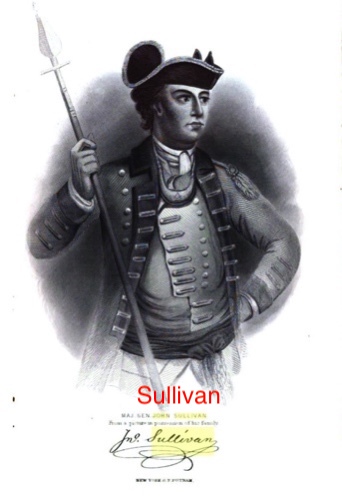
Sullivan was the son of Irish immigrants who settled in New Hampshire. He served as a Delegate to the Continental congress, Governor of New Hampshire, and United States district judge. The was trained as a lawyer. In 1772 the Royal governor of New Hampshire appointed him as major in The New Hampshire militia. Sullivan began to have rebel leanings. Sullivan was sent as delegate to first continental congress in 1774 and in 1775 he was sent to the Second Continental Congress. Congress appointed George Washington commander in chief and John Sullivan as brigadier general. Sullivan joined the American Army at the siege of Boston. Later he took command of a force in Quebec which ended as a failed invasion. Sullivan had to withdraw the survivors. He was captured in defeat at Battle of Long Island. British General Howe released him on parole to deliver a message to Congress. He was later released in a prisoner exchange for captured British general Prescott. He had some success in battle but had continued difficulties as well. In Early 1778 he was transferred to the post of Rhode Island where he led the continental troops and militia.
His eyewitness account:
General Sullivan writes in a letter to Congress:
“To make a retreat in the face of an enemy, equal, if not superior in number, and cross a river without loss, I knew was an arduous task, and seldom accomplished, if attempted. As our sentries were within 200 yards of other, I knew it would require the greatest care and attention. To cover my design from the enemy, I ordered a number of tents to be brought forward and pitched in sight of the enemy, and almost the whole army employed themselves in fortifying the camp. The heavy baggage and stores were falling back and crossing through the day; at dark, the tents were struck, the light baggage and troops passed dawn, and before twelve o’clock the main army had crossed with the stores and baggage. The Marquis de la Fayette arrived about 11 in the evening from Boston, where he had been by request of the general officers, to solicit the speedy return of the fleet. He was sensibly mortified that he was out of action; and that he might not be out of the way in case of action, he had rode from hence to Boston in seven hours , and returned in six and a half, the distance near seventy miles — he returned time enough to bring off the pickets, and other parties, which converted the retreat of the army, which he did in excellent order; not a man was left behind, nor the smallest article left. I hope my conduct through this expedition may merit the approbation of Congress. Major Morris, one of my aids will have the honor of delivering this to your Excellency; I must beg leave to recommend him to Congress as an officer who is in the last, as well as several other actions, has behaved with great spirit and good conduct, and doubt not Congress will take such notice of him, as his long service and spirited conduct deserves. I have the honor to be, dear Sir, Your very humble servant – John Sullivan.”


 portsmouthhistorynotes