Home

Portsmouth Farm Heritage: Windmills

1 Comment

Wind grist mills were important to Portsmouth farmers during the 19th century. In 1942 the Fall River Herald ran an essay by Benjamin Boyd whose family ran the Boyd’s Mill. Boyd wrote about “Wind Grist Mills of Rhode Island.”  He provides a first hand account of the history of his family’s mill, the Sherman Mill and the vital role the mills played for local agriculture.

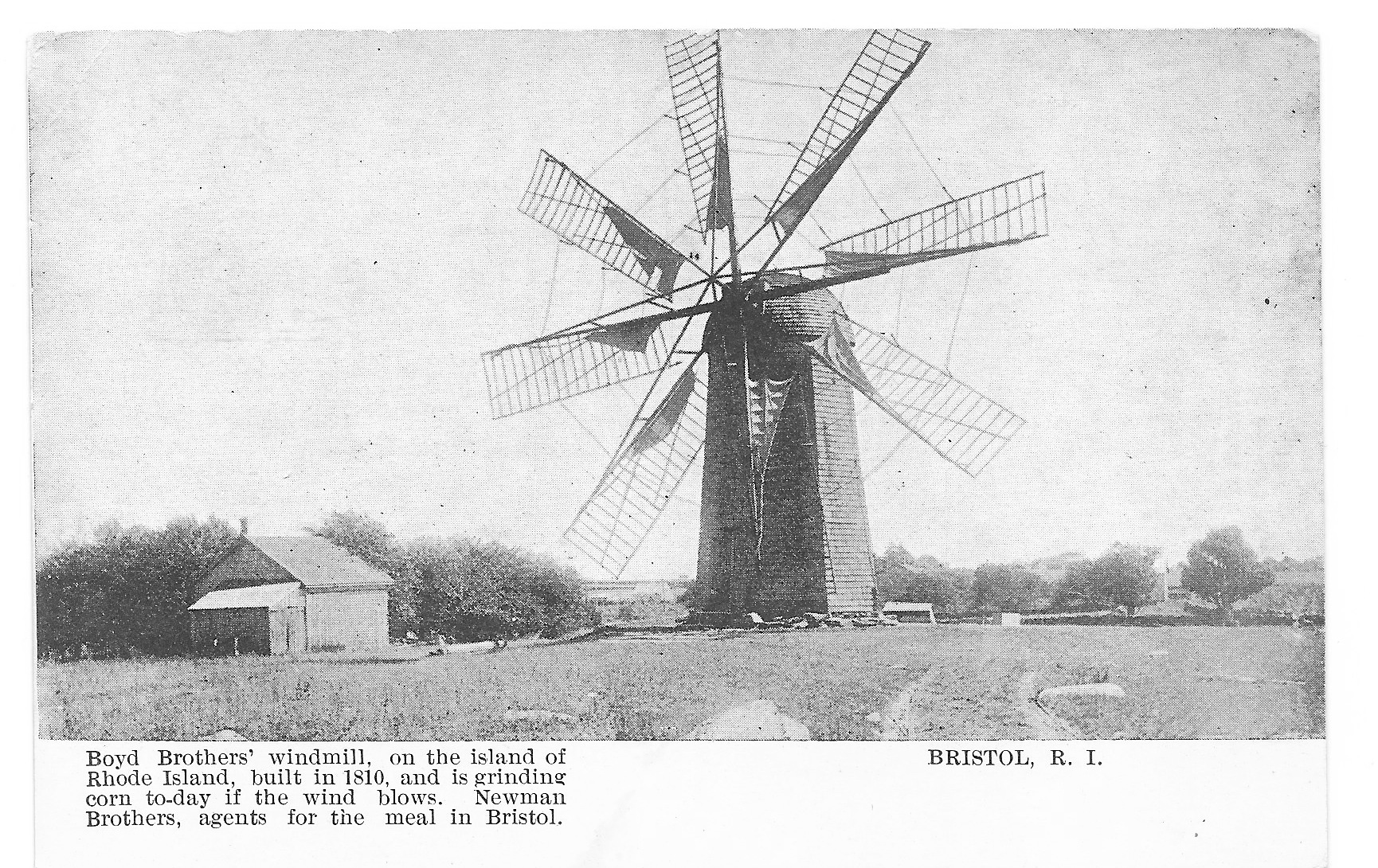
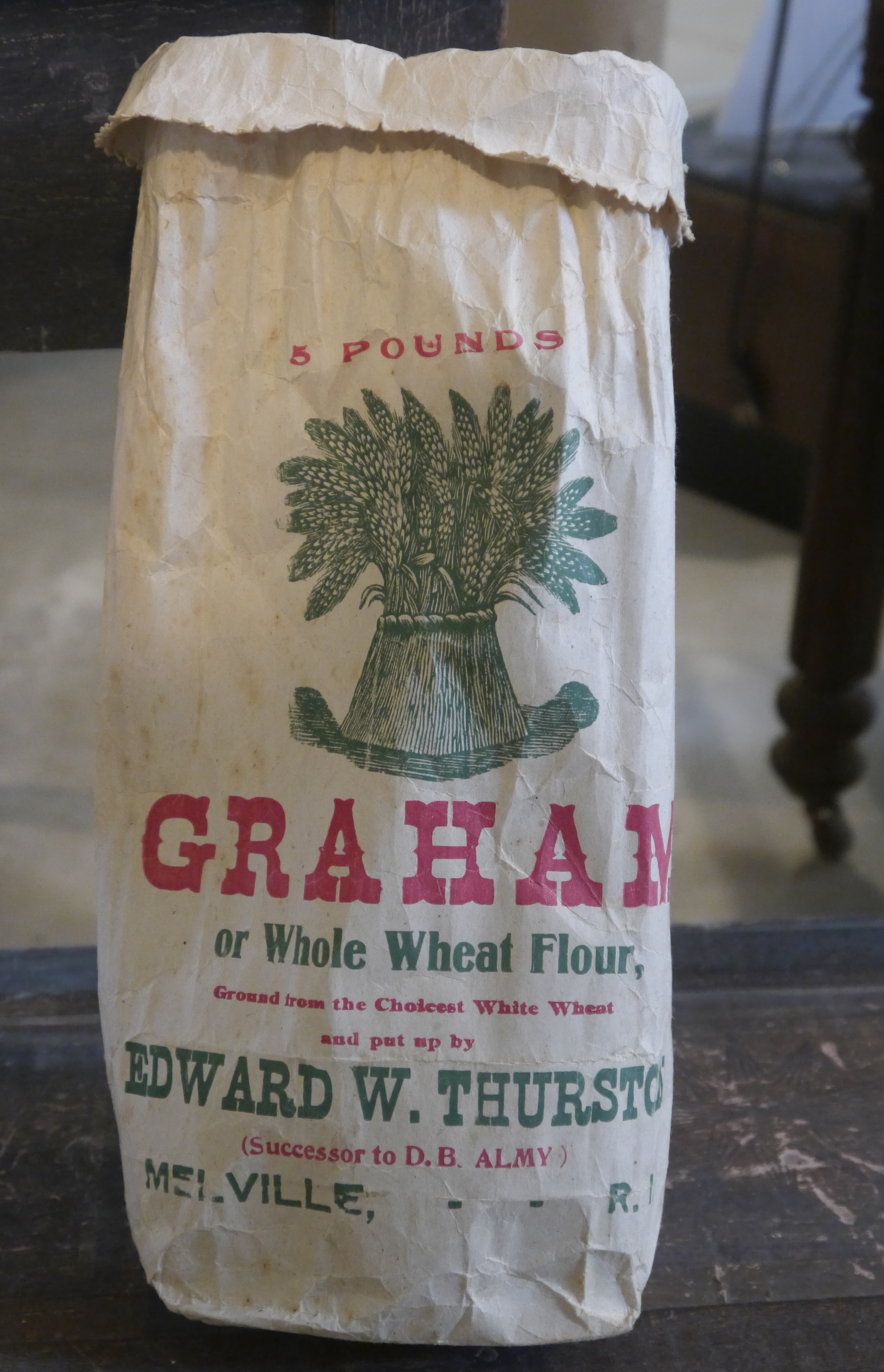
“For some reason,” Boyd wrote, “Rhode Island seems to have been the only place where these wind mills were used to any extent.” When Boyd was a boy he remembered 10 mills in Portsmouth.  In 1942 there were three mills left in Portsmouth.  Almy’s Mill (later called Thurston’s Mill) was on East Main Road.  The Sherman Mill was built in Warren to grind grain for whiskey production.  It was moved to Fall River and then to LeHigh Hill on West Main Road.  Boyd’s Mill was the third.  The first mill the Boyd family ran stood by Bristol Ferry.  The Great Gale of 1815 destroyed that one.  The family bought the Peterson Mill.  It was located by Mill Lane near West Main Road.  This mill was built in 1810 to grind grain to feed livestock.  Boyd said that in 1901 he converted the Boyd Mill into a eight vaned windmill.

Boyd wrote that cheap grain and meat from the western US made these old methods of farming unprofitable for Rhode Island farmers so they went more into truck farming.
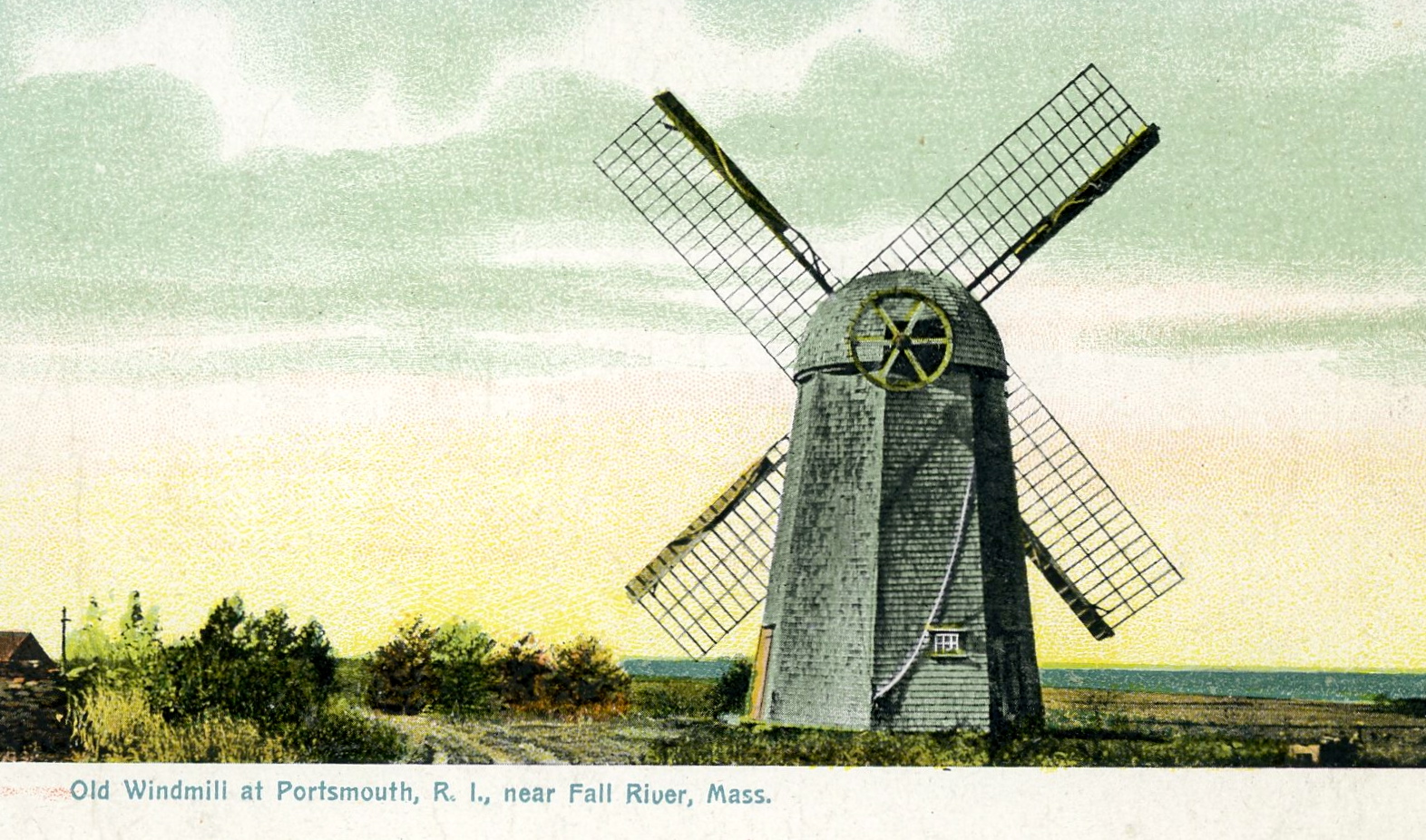
Sherman Mill – Now at Prescott Farm

“But there were many people who appreciated the fact that Rhode Island corn, which is of a different shape and color from any other, possessed merits for making meal for family use superior to any other cornmeal.”  Boyd was referring to the famous Rhode Island Johnny Cake meal.

Boyd commented that all meal up to 1895 was unsifted so that the cook had to sift it.  Boyd invented a “power sifter” run by the mill.

By the end of the 19th century there were 6,000 sheep kept on the island and many hogs.  November was slaughter time for the hogs that had been grown and fattened by the wind mill ground grain.  As the miller, the Boyds received a portion of the ground grain as payment and they fed their hogs with it.   Benjamin Boyd said his father took up to 6,000 pounds of pork to sell in New Bedford.  The gristmill grain and hay fed cows, oxen, sheep, pigs and poultry.

Most Portsmouth farmers had at least a pair of oxen that could be put to work.  Boyd said that local farmers looked to “pay off” their taxes.  “Money was scarce, so the town was divided into seven road districts with a supervisor for each district, and on a certain day after planting, when there was a slack time before cultivating and hoeing, the supervisor warned each taxpayer that he could come out and work out his tax if he so desired, bring oxen and carts, crowbars, shovels, forks, hoes, chains, plows, and as many of his hired help as he desired.”  Boyd states that the seven “road districts” corresponded to the “school districts.”

Boyd remembers “cattle drivers” and “horse traders” who drove their livestock down the main roads to sell their animals to the farmers.  One such driver stopped to talk to a potential buyer but his animals continued down the road and found a poor farmer’s cabbage patch.

For Boyd, windmills were part of his heritage.  He was a descendent of Nicholas Easton who built the first wind grist mill.  “I have farmed all my life and have turned the black dirt of Old Mother Earth into wheat, rye, oats and barley to be ground into feed for livestock, and as I have baked many Johnny Cakes.  I have literally turned the black dirt of Old Mother Earth into one of the finest food products known to man, the Famous Rhode Island Johnny Cake; ground by the power of the free air, which is the only thing that is free today.”
This article is available online at this link:
Click to access Scrapbook-Part-2-p-13-20-18-blank.pdf

Portsmouth Farm Heritage: After the Occupation

Leave a comment

What happened to Portsmouth farms and farmers after the British occupation? A line from town hall meeting records states the post Revolutionary War situation succinctly:

“On Sunday ye 8th Day of December A.D. 1776 about Eight Thousand of British Troops took possession of this island and Remained on until Monday the 25 Day of October A.D. 1779, for which time the inhabitants were greatly oppressed.”

“The inhabitants were greatly oppressed.” Farmers were left without their livestock, without their hunting guns, without their farm tools, without their carts and wagons, without their fencing, and in many cases without their homes. Firewood was scarce since the British had chopped down just about every tree on the island, so the farmers felt the cold winter without fuel for heating or cooking.

Farmers may have had their land, but many had not been able work their land.  During the occupation they had been impressed by the British to labor on fortifications, etc. The occupation had taken its toll and right after the Revolution, Portsmouth farmers needed to focus on their own interests.

Household Inventory

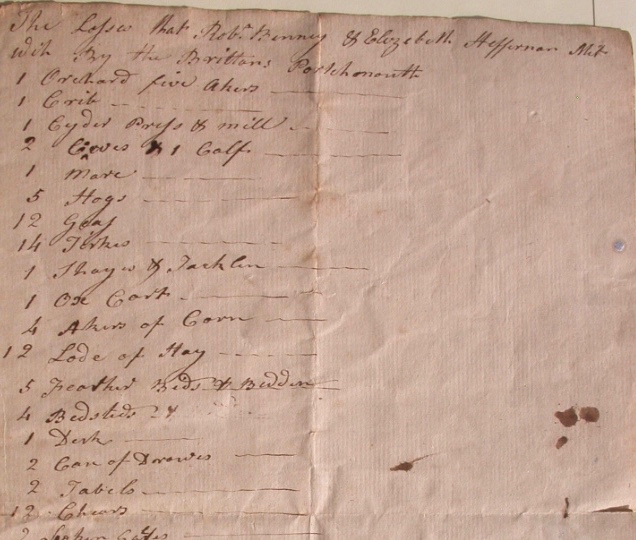
To make good their losses, Portsmouth families petitioned the state for compensation for the damages suffered during the War. Among the documents in the collection of the Portsmouth Historical Society is such an inventory of losses dated around 1780. Robert Binney (Benney) and Elizabeth Heffernan were “in laws” who shared a home and a 26-acre farm just north of the Quaker Meeting House.  The household inventory that they prepared can give an idea of what Portsmouth residents lost in the War. Among the items destroyed were five acres of orchards, a mare and 5 hogs. They lost their corn crib, four acres of corn, 12 loads of hay, twelve goats, two cows and one calf, a jackass and a ox cart among other household items.

In 1779, when the town meetings began again, Portsmouth citizens sent a message to the Rhode Island General Assembly asking that their taxes should be lowered because the town was in a “Distressed Situation.” Unfortunately the state still wanted its taxes and in May of 1781 threatened to confiscate the property of those who did not pay even though they had supported the war and suffered from the hardships of occupation. Portsmouth people were so concerned about their local issues, that it was hard for them to sacrifice anything more for the state or national government.  The citizens preferred the more decentralized Articles of Confederation to the new Constitution that was proposed.  Portsmouth Freemen voted twelve to sixty to not adopt the Constitution in a vote held May 24th, 1788.  Portsmouth military leaders Cook Wilcox, David Gifford and Burrington Anthony were among those who voted against adoption of the Constitution.  As an agricultural community, Portsmouth people were concerned about war debt repayment and “paper money” issues as well as waiting for the adoption of the Bill Of Rights.  Portsmouth townspeople began to favor the new constitution when it seemed that the national government would start putting heavy fines on Rhode Island trade with other states.  That would not be in the best interest of the Portsmouth farmers.  Portsmouth voted for the Constitution and Rhode Island finally became the thirteenth state in 1790.

The 1790 census showed a thousand, five hundred and sixty residents – 243 families and 19 slaves. By the early 1800s dairy and grain farms were more important.  Sheep raising became less important than it had been in early years.  The occupation and post war concerns had changed the lot of the Portsmouth farmer.

Resources:  Localism in Portsmouth and Foster during the Revolutionary and Founding Periods  by WILLIAM M. FERRARO.  Rhode Island Historical Society, August 1996.

Metcalf Bowler: Farmer, Merchant and British Spy

1 Comment

bowler002
Vintage image of Bowler’s Home on Wapping Road

Hidden among the papers of Sir Henry Clinton, the British Commander during the American Revolutionary War, was the story of a well known Portsmouth farmer and Newport merchant who played the role of spy.  The spy was none other than Metcalfe Bowler whose farm was on Wapping Road.  Metcalf Bowler did an excellent job of hiding his spy activities.  He was an important man in the Rhode Island Colonial government.  When Rhode Island decided to become independent from Great Britain, Bowler was one of the men who signed the document that would be sent to the king.

Bowler’s spying activities might have gone unnoticed, but a librarian who was going through Clinton’s papers in the 1920s noticed letters signed by “Rusticus”.  He had begged Clinton not to disclose his name to anyone. The librarian, Jane Clark, came across another letter in the same handwriting as “Rusticus”, but this one was signed by Metcalf Bowler. Handwriting analysis confirmed that “Rusticus” and Bowler were one.  Among the letters was one dated Dec 12, 1776 from Portsmouth.  Bowler (as Rusticus ) claims that even though he has accepted government positions (such as Chief Judge) in the American side of the war, he is still acting loyally to the British king.  He begs for protection for his home in Portsmouth.  “As the Hessian troops quartered on the island ..having committed many outrages..on many of the inhabitants by entering their Houses and ..even putting them in fear of their lives – as I am situated on the Island, should esteem it a favor ..if your excellency would order a guard to my habitation (house) at Portsmouth that I may be protected from the insults of the Hessians.”  This letter may give a clue to why Bowler would work as a spy.  He wanted his home protected.

Unfortunately Bowler’s farm was damaged just as much as the surrounding farms.  His letter provides a first hand report of the damage done to Portsmouth farms during the occupation by British troops.  There was great fear of the Hessian troops that were camped in Portsmouth.  In a later letter he wants money for the damage to his property.  His home and garden in Newport were used as a British hospital. His Portsmouth farm was damaged, his cow was taken to feed the soldiers, his library books were stolen and his cart and horses were taken away.  They were not able to grow any crops during the time the British held the island.  “I shall not be able to support my self and family on the Island through the approaching dismal winter.”  He asks the British for protection for himself, his family and his black servant.

Bowler suggests in a letter dated September 15, 1778 that he would be willing to leave his home in Portsmouth to British control and move to Providence where he could become a member of the Council of War, a Representative in the General Assembly or even become a delegate to the Congress. Of course, Bowler would like to be paid for his efforts and for the damage done to his property.  Bowler did move to Providence, but he ended up as a shop keeper instead of an important member of government.

In his letters, Bowler as Rusticus, provides some information about what is going on in the Rhode Island Colony. His letters tell of how the French fleet is expected in June.  He lists the American troops in the area – Glover’s Brigade of about 1000, Cornell’s brigade and Varnum’s Brigade which are small, Sherburne’s brigade in Bristol and he even writes about the Black Corps who are stationed at Warwick.  In a letter dated July 13, 1779, Bowler suggests that the colony is very weak and defenseless.  He suggests that this is a good time to battle the Rhode Islanders since the local farmers are at harvest and would not be willing to come to the aid of the American troops.  He asks the British to send him some goods to sell such as black and tailored ribbons, green show findings, black handkerchiefs, colored threads and buckles.  He asks for a lined coat to wear for the Winter season to pick up information. Whether Bowler’s information was helpful is not known, but Bowler himself found himself a poor man after the War for Independence.  Like so many people in Portsmouth, his land and possessions were ruined by the British troops.

Ironically Bowler thought of himself as a expert on farming and even sent the American President – George Washington – a copy of his book on agriculture.  Little did Washington know that he was receiving a book from a spy.  Washington’s copy of the book was found in his library and there is a record of Washington’s response back to Bowler.  Washington wrote that agriculture was very important to establishing the new country’s role in the world.  The book title was:

A treatise on agriculture and practical husbandry. : Designed for the information of landowners and farmers. : With a brief account of the advantages arising from the new method of culture practised in Europe., By Metcalf Bowler, Esq. 

It was published in Providence in 1786.  It was an 80+ page booklet aimed at landowners and farmers.  Bowler stated that he wrote the book to provide farmers with a way to keep their land in a state of constant fertility.  Among the topics were discussions of appropriate fertilizers and descriptions of planting methods.  He has an interesting section on the very American  “Indian Corn” which he believes is “one of the most profitable vegetables that is raised on this continent.”

Metcalf Bowler fancied himself a “gentleman farmer” much in the tradition of others  – such as Barstow of Greenvale and Shepherd Tom Hazard – whose farms would be nearby Bowler’s property.  He thought of himself as a farmer engaged in “experimental philosophy” which would improve agriculture with knowledge of facts.  This reminds me of the cutting edge breeding methods of the Taylor family on Glen Farm.  Bowler really does fit into the Portsmouth gentleman farmer tradition.

(Read another story about Metcalf Bowler in the Myth of the origins of the Rhode Island Greening Apple. )

More information can be found in:

Kidnapping the Enemy: The Special Operations to Capture Generals Charles Lee and Richard Prescott, McBurney

Metcalf Bowler as a British Spy. Rhode Island Historical Society,  Jane Clark, 1930.

Portsmouth Farms during the British Occupation

Leave a comment

During the occupation, many of Portsmouth’s farms were damaged. The occupation was harsh and civilians were killed and injured. Not even children were safe. In 1776 a fourteen-year-old boy, Darius Chase, was killed when the British destroyed his family farm. He made the mistake of trying to save his shotgun. British soldiers were quartered in farmhouses throughout the island. Families were allowed to leave the island with some of their possessions, but many who had property to defend stayed and endured the hardships. Portsmouth lost only about ten percent of its population during this time. The cattle and sheep had been ordered off the island so they couldn’t be taken by the enemy for food.

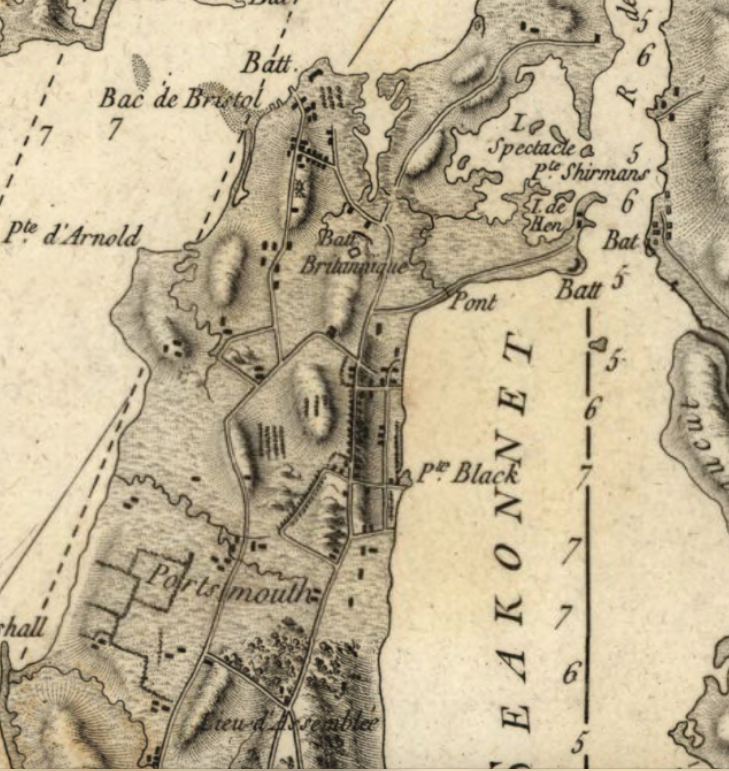
Blaskewicz Revolutionary War Map


The Portsmouth landscape was beautiful before the occupation. British officer Frederick Mackenzie was quartered there, and his December 16th journal entry described the beauty of the local area, even in winter.

“There is a hill about 7 miles from Newport, and on the Eastern side of this Island called Quaker Hill, from there being a Quaker meeting-house on it, from whence there is a very fine view of all the N. part of the Island, and the beautiful bays and inlets, with the distant view of towns, farms, and cultivated lands intermixed with woods, together with the many views of the adjacent waters, contribute to make this, even at this bleak season of the year, the finest, most diversified, and extensive prospect I have seen in America.”

This beauty did not last. Wood was the major source of fuel at the time, and it became difficult to provide enough wood from the mainland to supply both the local residents and the occupying troops. The British and Hessians chopped down most of the trees on Aquidneck Island and burned many houses. The fuel shortage was so severe that they regularly sent men in transports to Long Island to cut wood for Rhode Island. Mackenzie records that the citizens were given an opportunity to help feed themselves. They could keep one gun to hunt birds and they could keep a boat for fishing. During most of the occupation the British were particularly careful not to damage the mills on the island that ground corn.  The British ordered all Portsmouth men to work three days a week on the defensive works for the village.

Portsmouth Farm Heritage: Stonewalls

Leave a comment

Stone Wall by Glen Farm Road.

Glen Farm Road wall a few winters ago.

As Portsmouth was celebrating its 375th birthday in 2013, I was working on a booklet of historical locations in town.  I began to notice that everywhere I went to photograph these sites from our history, I found a stone wall.  I know that through the years these walls can be moved or rebuilt, but vintage maps show that many of these walls have been in place for a hundred years or more.  I began to wonder what stories the walls could tell us about the history of the sites if they had a voice.

There was a time when there were no walls here.  Oh the rocks were there, buried deep in the soil.  Ancient glaciers moved across Aquidneck Island and left behind the stones: gray-green slate, shale that breaks apart, puddingstone with pebbles cemented together, white quartz and granite.

The native people who used our island for hunting and planting may have unearthed rocks and pushed them out of the way of planting, but they were not constructing walls.  Early settlers and colonial farmers began to use the stones they dug out while clearing the land in walls that marked boundaries.  Another use was to hold animals in a pen or prevent pests from getting into the plantings.

Portsmouth stone walls are special.  If you notice the walls across the way in Bristol, Tiverton or South County you will see more rounded rocks.  Our walls are flatter and fit into patterns more easily.  Many of us have these walls in our backyards.  Some are rough farmer walls that are loosely stacked, but other walls are remarkable finished walls – capstone and all.  The walls give a special character to our town and should be preserved, protected and rebuilt when possible.

A Portsmouth Farming Myth: The Origins of the Rhode Island Greening Apple

Leave a comment

A Portsmouth Myth: The Origins of the Rhode Island Greening Apple

Even before the Revolutionary War, wealthy Newport merchants had their country farm out in Portsmouth.  At that time Newport was the fifth largest port in the colonies. Many merchants became rich in the shipping trade. Among the most successful merchants was Metcalf Bowler who owned many ships that sailed around the world.  Bowler’s Portsmouth farm, Vaucluse,  was off of Wapping Road.

One day one of Bowler’s ships was caught in a typhoon. Captain Chausan, the master of the ship, skillfully sailed his ship through the bad weather. Floating on the rough seas, however, was what remained of another ship that did not fare so well in the storm. Captain Chausan rescued the men who had clung to the pieces of the boat. Among these men was a man of great importance – he was the son of the Shah (ruler) of Persia in the Middle East. Captain Chausan brought the men into a safe port and went on his way with his journey.

When Captain Chausan returned to the East Indies area again, a group of men representing the shah arrived. They offered a gift to the Captain as a thanks for the rescue. Although it seemed like a simple gift of a graceful tree that had been planted in a porcelain pot, it turned out to be a priceless gift. The Shah’s representatives told the captain that the shoot of the tree had been carefully nourished because it was a very special tree. The Shah’s palace was on the very site of the famous Garden of Eden. The gift tree was a shoot from the very tree that tempted Adam and Eve.

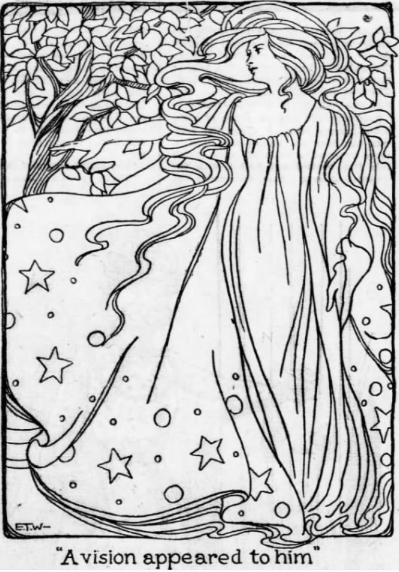
Bowler’s Vision

Captain Chausan accepted the gift and took good care of the plant on the way home to Newport. Upon landing he presented the tree to his employer, Metcalf Bowler. The potted tree was brought to Bowler’s Portsmouth farm. His intention was to place the tree in his green house. The first night the tree was in Portsmouth, Bowler had a dream. A woman appeared to him. She was dressed in shimmering clothes and she had a golden halo around her head. She told Bowler that she was Mother Eve and instructed him not to plant the tree in the green house. The soil and the climate of Aquidneck Island is the same as that of the Garden of Eden. The tree must be planted in open air under the heavenly sky. The Vision faded and disappeared, but Bowler followed the advice it gave. He very carefully planted the tree outside. It became a great tree that produced delicious apples that were green in color with a hint of yellow. The seeds of the fruit were planted and a whole new variety of apple was established – the famous Rhode Island Greening Apple.

There are other stories about the beginnings of the Rhode Island Greening Apple that are not quite as fanciful.

— Source: Brooklyn Daily Eagle, May 31, 1908

A Portsmouth Ghost Story

2 Comments

cornell-landRebecca Cornell, a 73 year old widow, lived in her 100-acre home in Portsmouth with her son Thomas; his second wife Sarah; their two daughters; his four sons from his first marriage; a male lodger and a male servant. Late afternoon on Feb 8, 1673, Thomas arrived home to find his mother feeling ill. Family members kept her company; Thomas talked with her for ninety minutes, but left at 7:00 p.m. to wind a “Quill of Yarn” before supper. Rebecca didn’t join the family supper because she didn’t want the “salt-mackrill” meal. About 45 minutes later grandson Edward went to her room to ask her if she wanted something else to eat. Seeing flames, he ran out to get a candle. Meanwhile, everyone ran into Rebecca’s room, where she was burned beyond recognition. Two nights later Rebecca’s ghost paid a surprise visit to her brother, John Briggs, a 64-year old grandfather. He reported that on seeing the shape of a woman by his bedside, he “cryed out, in the name of God what art thou…” The apparition replied, “I am your sister Cornell, and Twice sayd, see how I was Burnt with fire.” A later autopsy showed “A Suspitious wound on her in the upper-most part of the Stomake.” Circumstantial evidence was stacked against Thomas. There were bad feelings between mother and son because she’d given him her estate but he had to divide 100 pounds among his siblings and he had to care for his mother. His temper, which Rebecca told people she feared, didn’t help. There was also tension between Rebecca and daughter-in-law Sarah. Thomas had motive to murder. He also had access to a purported murder weapon, “sume instrumen licke or the iron spyndell of a spinning whelle.” And he was the last person to see Rebecca alive. Thomas Cornell, 46, was hung for her “murder” on May 23, 1673. Who were the other suspects, if it was murder? Two doors gave access to Rebecca’s downstairs bedroom. Unrest existed between Europeans settlers and the Indians. An Indian named Wickhopash (a.k.a. Harry) had a motive for the crime. He’d been on “the losing end of criminal action for grand larceny brought by Thomas in June 1671” and had received a punishment. Often Indian revenge was taken out by attacking lone female family members, and arson was their tactic. In 1674 he was tried and acquitted for the killing. In 1675 Thomas’s younger brother, William, presented persuasive evidence that Sarah had a role in Rebecca’s death. She was burdened with “catering to her demanding mother-in-law,” and she had a violent streak. She too was acquitted. The theory of accidental death also remains. Rebecca might have tried making her own fire, caught herself on fire, fallen and dragged herself away from the hearth. She’d also confided in her daughter Rebecca that she’d considered suicide three times. So whodunit? Was it murder? An accident? Or suicide? Sarah birthed Thomas’s last child, a daughter she named Innocent, after his hanging. Sources: Crane, Elaine F. Killed Strangely: The death of Rebeka Cornell. Ithaca: Cornell Univ. Press, 2002
 

Portsmouth Farm Heritage: What a Death Inventory Tells Us about Farming

Leave a comment

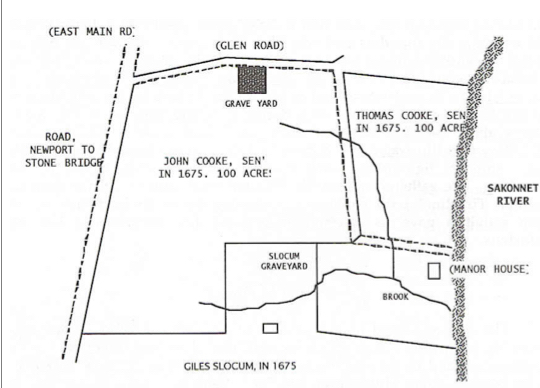
When Thomas Cooke died in 1677, he left us a valuable insight into farming in Portsmouth in colonial days.  Recorded in the Portsmouth Scrap Book on page 72 is an inventory of the Cooke’s estate done by John Albro and Joshua Coggeshall.  What livestock did he have? What kinds of tools did he work with?  After living in Portsmouth for thirty years, what possessions did he have? At the top of the inventory is “housing, lands, orchards”.  We know that the Cooke lands include what we think of as the “Glen” area.   Cooke’s home was located just about where the Glen Manor House is today.  In the early days, before his land was cleared, Cooke would ferry his livestock over to Fogland across the river in Tiverton to graze during the day.
What livestock did he have?  He had fifteen sheep, five lambs, two horses, six cows, three yearling cattle, and ten swine. What farm tools did he use?  He had sheep shears, three hoes, a whip saw, carpenter tools, and two scythes.  He had branding irons (marking livestock was an important duty then), stilliards (a type of scale), perhaps axes, a crow bar, iron chains, sieves,  and lumber.  He had a bridle for his horse. What household goods did he have?  For cooking he had brass kettles, iron pots, colanders, spits to cook meat over a fire, jugs, a bottle,  pewter and what may be a churn. He had household items made of materials and tools to make material.  He had flax, wool, linen yarn, four pairs of cards (to pull wool apart) and two spinning wheels.  He had bedding, a coverlet, sheets and even a “pillow bear”.  He had his “wearing clothes”. For furniture he had a table, and two cupboards, a chair, one bed, two chests, bags, boxes and a basket. Cooke had been a military man (he was sometimes called “Captain”) so he had weapons – two guns and two swords. And yes, he owned  “one Indian Boy”. Who was Thomas Cooke?  In 1637 Thomas, his wife and three sons left their home in Dorset in England to board the repaired Speedwell at the port of Weymouth in England.  Like many of Portsmouth’s early residents, the Cooke’s journey to Portsmouth passed through the Massachusetts Bay Colony and Taunton. Thomas and his family came to Portsmouth in 1643 and he was welcomed as a freeman who could vote and he was granted land. He had a house lot nearby Common Fence Point, the site of the first Portsmouth settlement. We know Thomas couldn’t read or write (his mark was a capital T), but he served the town in many ways as timber warden (protecting the trees), he made agreements with the Wampanoags and he took his turn as part of a jury. The Cookes prospered with hard work. Between Thomas, his sons and grandsons they owned property from what we call East Main Road on the west all the way to the Sakonnet River and from Glen Road to the north to Sandy Point Avenue. Thomas Cooke was not a wealthy man, but he left an inheritance of land and goods to pass down to his son and grandchildren. The whole inventory can be found here.

Portsmouth Farm Heritage: Colonial Farmers

Leave a comment

By 1657 most of the open land in Portsmouth was given out to freemen and inhabitants. Though Newport welcomed new settlers, Portsmouth residents were more guarded in accepting new residents. Settlers were not admitted without a vote of the town citizens. Once someone was accepted as a freeman, the town took responsibility to help them in time of need. Some colonists were given as much as 300 acres of pastureland.

There was a rule that farmers had to fence planting areas and orchards. They used stonewalls, rail fences and hedges as fences. We can still see stonewalls that mark the gardens and orchards of the old farms. By 1713 the final acres of town land were given out. This time freemen received twelve acres. In 1755 there were 1363 Portsmouth residents. Most of them were farmers. Farming continued to be an important part of Portsmouth life during colonial times.  Newport was a good market for Portsmouth farm produce, but Portsmouth farmers sold their products all along the East Coast. Animals were very important to the colonial farmers. The cattle herds did well and soon Portsmouth cattle were being sold to Boston and the Barbados in the Caribbean. Large flocks of sheep and herds of horses were common.

Mills developed to help farmers. Saw mills started as early as 1642 to saw lumber for fences and houses. Grinding corn meal was very important to farmers and early water powered gristmills began in Lawton Valley and the Glen. By 1668 the first of many Portsmouth windmills was built on the Briggs Farm. This is the Butt’s Hill area and was commonly called “Windmill Hill.”

Portsmouth Farm Heritage: Settler/Farmers

Leave a comment

As the spring of 1638 came, the little band of founding settlers began their journey to Aquidneck Island.  Some came over the land by way of Providence.  Others sailed around Cape Cod.  They settled at the North end of the Island around Founder’s Brook and another brook in the area.  They had left the security of Boston for tent like homes or dug out caves lined with wood.  Just like the Native Americans before them, they hunted and fished for food and they began to prepare the land for planting.   There was a new community on Aquidneck Island beginning as the old native community had ended.

Portsmouth has always been known for its farming, but the original settlers had little experience in farming when they came here.  They were craftsmen and tradesmen.  

William Coddington was a merchant, William and Edward Hutchinson had a textile business, John Coggeshall was a clothier, William Dyer was a milliner and fishmonger, William Baulston was an innkeeper, Nicholas Easton was a tanner.  

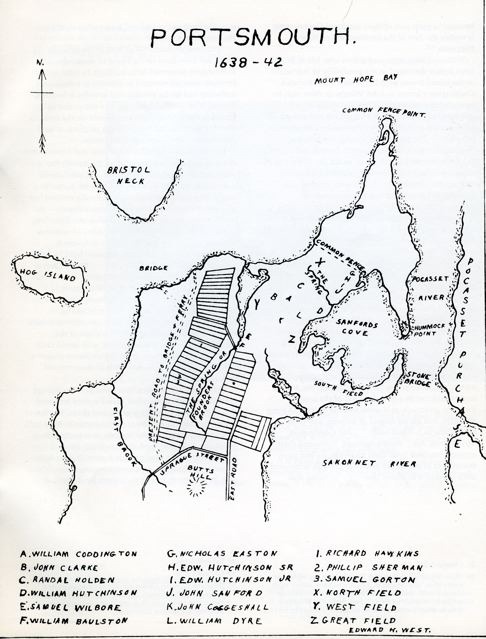
They had some experience with how land had been laid out in Boston, so they followed similar patterns here.  The house lots were clustered together with open fields around them.  Early town records show they were concerned about how land would be given out and that records of land ownership should be kept. They lived in the area between East and West Main roads from Sprague Street to the Mount Hope Bay. At first they were given two acre house lots near a spring and larger areas of grazing land further south from the settlement.

Edward West map of first settlement

The first settlers brought cattle with them. There was a common pasture for cattle in the area that became known as Common Fence Point.  All the settlers contributed to the cost of building and maintaining the fence.  This pattern of houses together with town planting fields around them was a practical solution for the settlers.  They didn’t yet have enough tools or time to clear land for planting nor did they have the plows or other equipment for planting and harvesting crops.  Later on the house lots were given up as families began to live on their farms instead of together in a community.  Caring for their animals and property became a real need.  Soon the pigs and other animals became a problem as they trampled over the fields that had been planted.  The grass on Hog Island was given to Portsmouth settlers and pigs roamed freely on Hog, Patience and Prudence Islands. Massasoit had granted grazing rights in the Fogland area of what is now Tiverton in exchange for wampum.


Older Entries Newer Entries