“The purpose of my writing to you at this time is to inform you, that slave in my possession, a Mulatto girl named Mariah, who by the laws of this state is deemed my slave; which I wish to you legally to manumit, that she may be her own free woman, and my estate not encumbered with her.” (Mary Lawton to the Portsmouth Town Council in 1797). *
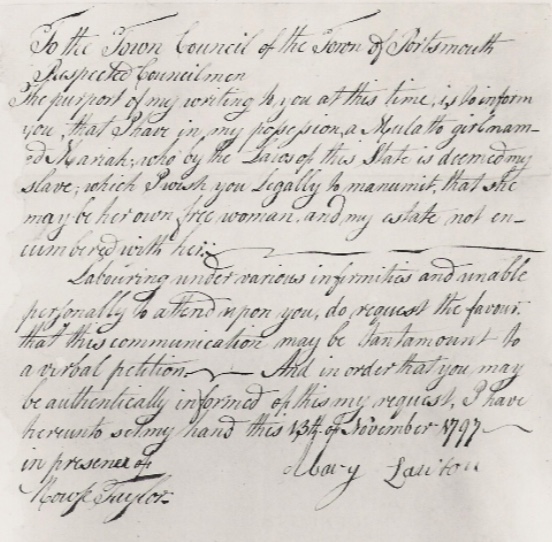
Mary Lawton document
I came across this document while looking for a particular vintage image of Portsmouth. In researching many topics in early Portsmouth history, I have encountered a variety of references to slaves. I have not made a study of this topic, but I would like to share some of the examples I have found. Portsmouth is not associated with the slave trade like Bristol and Newport, but many local families will find their ancestors held Native American or black slaves.
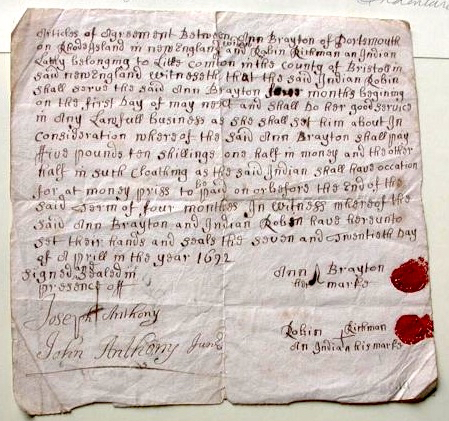
With the coming of the settlers, the native populations found themselves unable to live in their normal style. Their hunting grounds and summer camp areas were “sold” to the Europeans. Towns like Portsmouth restricted them and they found it impossible to live on their own. After King Philip’s War, many Native Americans found themselves sold into slavery. It was not unusual for them be in servitude to colonial farmers in Portsmouth.
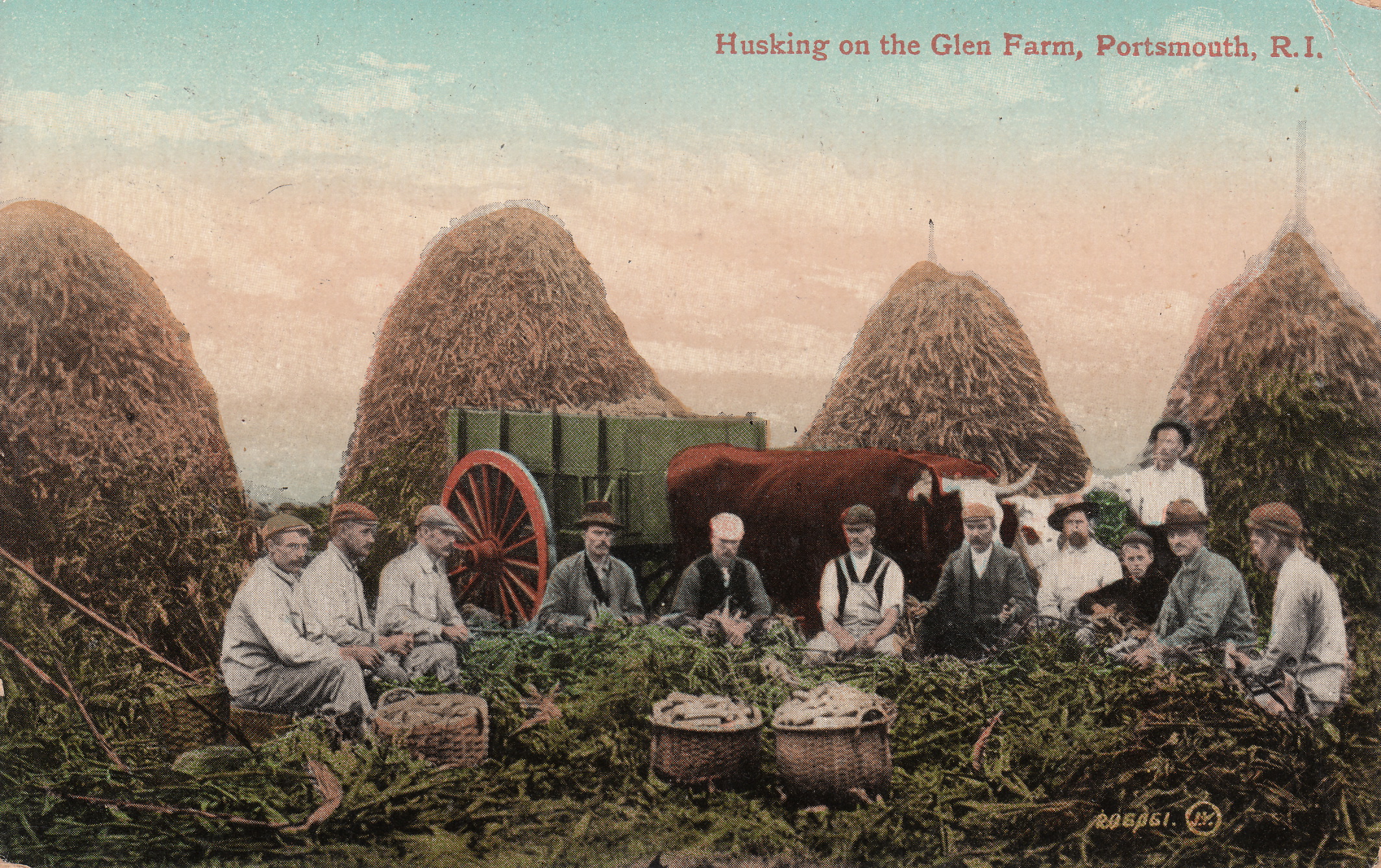
Researching the land history of the “Glen” was the beginning of my interest in Portsmouth history. My father was helping with the research and he brought me a copy of the death inventory of Thomas Cooke. The Cooke family originally settled the Glen lands from East Main Road to the Sakonnet River. The original of this document dated 1677 is included in the Portsmouth Scrap Book, page 72. ** Included close to the bottom of the inventory is “one Indian Boy.”
In researching the Cundall/Slocum graveyard by the Glen Barns, I came across this article: Rhode Island June 27th (1712). “An Indian servant man belonging to Mr. Giles Slocum of Portsmouth carry’d out to sea in a canoo(canoe) two of his masters sons, one of ten the other of nine years old, whom he kill’d and drown’d, and being examin’d before the Authority confesed that he knocked the eldest child in the head with the padle, and seeing the younger crying, he designedly oversett the canoo, and swam ashore himself, who is now in Irons in close/clofe? prison till he is try’d for his murder.” *** The slave, identified as Job, was found guilty and executed on Miantonomi Hill in Newport.
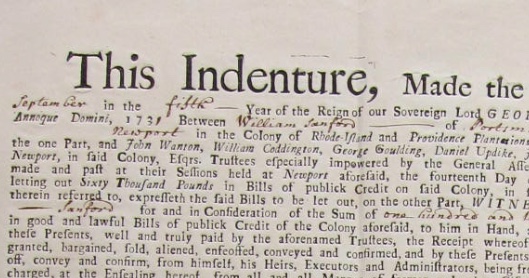
A son ( or maybe grandson) of the Giles Slocum mentioned above is shown to have had black slaves. The records of the Town of Portsmouth show: Apr. 1st, 1745, “Giles Slocum gave manumission to a negro slave ‘Jack’ and a negro woman ‘Heleno’ they paying him therefor one hundred and fifty pounds in current bills of publick credit of the colony”.
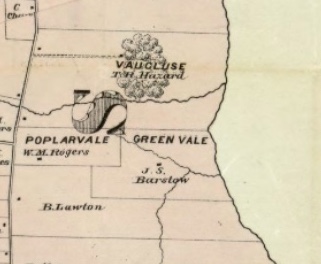
The Slocum family were Quakers, yet they held both Native American and Black slaves. We may think of the Quakers as being strong abolitionists and they did become so. However in the early days Quakers were active in the slave trade and held slaves themselves. Samuel Elam, who dressed in simple Quaker garb despite his rich lifestyle, is such an example. His Portsmouth estate was named “Vaucluse” and it was situated off of Wapping Road. This was no rustic rural retreat. Elam had enlarged the house to resemble a temple and he developed elaborate gardens on the grounds. One French visitor described Elam as “the only farmer in the island who does not personally labour upon his own ground.” **** He would be in need of workers for his estate.
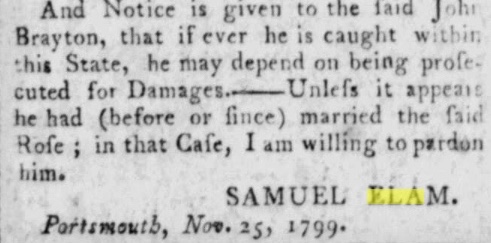
Ad in the Mercury 1799
In 1799 Elam posted a notice in the Newport Mercury for a runaway-slave. He does want the slave (named John Brayton) back, but he does show some mercy. Rose Phillips, “a lusty middle aged Woman” escaped with John. Rose had been freed on condition that she work for three years and she hadn’t completed that service. Elam shows some mercy, however. If John is caught he would prosecute him unless he had married Rose!!
Elam and other Portsmouth Quakers were finding a conflict between their faith and their slaveholding traditions. In earlier days Quakers could justify their slaveholding by saying they treated them well and educated them. Especially after the American Revolution, Quaker leaders were preaching that ownership of slaves contradicted their fundamental idea of equality of all human beings. In 1774 Quakers were told to give up their slaves or leave the Society of Friends. Portsmouth Quakers began to free their slaves.
Among Portsmouth citizens who freed their slaves for religious reasons were William Anthony (1 slave 1775), Thomas Brownell (1 slave 1775), James Coggeshall (3 slaves 1775), Cornell Walter (2 slaves, 1775). Weston Hicks (1 slave 1775), Isaac Lawton (1 slave 1775), James Sisson (3 slaves, 1775).
The Portsmouth 1790 Federal Census lists 19 slaves in Portsmouth. Their owners were Thomas Potter, Mary Lawton, John Thurston, Job Durfee, Matthew Cooke, Matthew Curney (who had 3 slaves), Peter Wales, Sarah Almy (who had 2 slaves), Jeremiah Hazard (who had 6 slaves) and James Allen (who had two slaves.)
The 1800 census showed the number of slaves was down to 12. Preservd Shearman, Andrew Corie, Jr, Benjamin Chase, Job Almy, Gideon Durfee, Isaac Anthony, Samuel Elam and John Cottorell (who had 2 slaves).
By 1821 there are no slaves listed on the census for Portsmouth.
Guests on Genealogy shows are often dismayed that there were slave holders in their families. Those with long Portsmouth roots should not be surprised that there are slaveholders among their ancestors. As a community we need to understand the legacy of slavery in the history of our town.
References:
*A facsimile the Lawton document is included in the Pierce Collection available online at the Portsmouth Free Public Library website.
**The transcription of the Cooke inventory was published in Thomas Cook of Rhode Island. Published by author Jane Fiske, Boxford Mass: 1987.
***Source: Boston News Letter, June 27. 1712.
****So Fine a Prospect: Historic New England Gardens.