 In preparation for a July 23rd celebration of Anne Hutchinson’s birthday at the Portsmouth Historical Society, we have been researching some of the women who were in Portsmouth with Anne. We are looking at those who came with Anne in that first wave, but also some of those who came shortly after and would have shared the settling experience with her. Mary Paine Tripp (1605 to 1687) was married to John Tripp. We came across an interesting story from Edward West’s 1932 article in the journal of the Rhode Island Historical Society on the “The Lands of Portsmouth, Rhode Island”. How much would you give for a glass of wine? Back in 1666 Richard Searl sold a three acre lot just above the Bristol Ferry to Mary Paine. Mary was the barmaid at Baulston’s Tavern and the land was exchanged for a “pint of wine.” Mary later married John Tripp who used the land for a ferry house. Although this deed wasn’t registered, the Town Council accepted the deposition of William Collinge as to how the land was transferred.
Founding Mothers: Mary Paine Tripp and the great land swap.
June 25, 2017
Bristol Ferry Area, Ferries, Portsmouth History John Tripp, Mary Paine Tripp Leave a comment
Out of the Attic: Mount Hope Bridge Construction Booklet
May 7, 2017
Bridges, Bristol Ferry Area, Out of the Attic, Portsmouth History Leave a comment
One of the small treasures in the collection of the Portsmouth Historical Society is a small booklet about the construction of the Mt. Hope Bridge. It was written and illustrated with photos taken by the chief engineer of the project. It is an incredible chronicle of a project of major importance to our town. 
The Portsmouth Historical Society has items from the opening festivities of the Mt. Hope Bridge in 1929. Those items include an invitation, guest badge and photographs of the construction and ribbon cutting. A front page newspaper article from the time helped us to understand how elaborate the ceremonies were. Senator William H. Vanderbilt presided over the pageant. Beginning at 10 in the morning a parade began in Bristol – a “tableau” depicting Roger Williams organized by the Rhode Island Historical Society. The Newport Historical Society organized a tableau and parade depicting John Clarke and they marched from the Aquidneck Island side. At 11 AM “Roger Williams” met “John Clarke” and unfurled flags at the center of the bridge and exchanged greetings. There was an Indian ceremony in which Governor Case and Senator Vanderbilt became members of the Algonquin Council. Vice President Charles Curtis signaled from Washington, D.C. at noon to begin the dedication of the bridge. The program lists events such as a christening of the bridge, ribbon cuttings and acceptance of bridge certification. The ceremony was even broadcast on WEAN at the old Outlet Building in Providence.
Out of the Attic: Mussel Shoal Lighthouse Blueprints.
April 17, 2017
Portsmouth History Leave a comment

Blueprint for last Mussel Shoal Bed Lighthouse
In researching our Civil War Sword, we rediscovered another item in our collection. We have the blueprints of the last Mussel Shoal Lighthouse. Musselbed Shoals is a dangerous spot for navigation through the channel from Narragansett Bay to Mount Hope Bay. It is even noted on colonial era maps. In 1871 a beacon was placed there followed by a new light in 1873. This structure was damaged by ice floes. A new structure with built with more protection, but ice floes in 1919 -1920 damaged this one as well. The light was abandoned in 1938 and the lighthouse was severely damaged by the Hurricane of 1938. Later the building was torn down and an automatic light was installed that remains today.

Lighthouse with Mt. Hope Bridge in the background.
Out of the Attic: Do we have a Civil War Cavalry Sword?
April 10, 2017
Bristol Ferry Area, Lighthouses, Out of the Attic, Portsmouth History Leave a comment
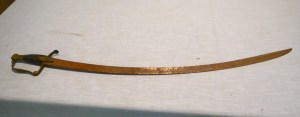
Possible Civil War Cavalry Sword belonging to a lighthouse keeper.
The sword in this picture has been laying on the top of a display case in the Portsmouth Historical Museum. It has been somewhat out of sight, so it is a good candidate for our Out of the Attic theme this year. It had an acquisition number written on it which refers to some old museum records. According to the record. It was a:
“Civil War sword (that) belonged to Sheridan Smith, Calvary man. His horse was shot out from under him and for recognition he was made keeper of the Mussel Bed Shoal lighthouse. This is how they came to this section from Norton MA.”
Is this true? How can we determine that?
An on-line search revealed that historical records for the Mussel Bed Shoal lighthouse list a Thomas and Andrew Smith as lighthouse keepers – Not Sheridan Smith. Was Sheridan a middle name?

Mussel Shoal Light – near Mt. Hope Bridge area.
The 1880 Federal census lists ”Thomas S. Smith” as a resident of Portsmouth and a “Lighthouse Keeper”. We learned that his wife’s name was “Roseanne.” Does the “S” stand for Sheridan? We noted that the census lists one of his sons as “Andrew.”
Thomas Smith died in 1881 and it appears that his son Andrew took over the role as lighthouse keeper.
A Veterans Schedule from 1890 lists Roseanne as the wife of Thos. S. Smith (Alias) “Thomas Sheridan.” It also says he was in the Cavalry.
Is this a cavalry sword? It is similar to images we have seen of a typical Civil War Cavalry Sword found online.
It appears that may indeed be a Civil War Calvary Sword that belonged to Thomas Sheridan Smith. Was his horse shot out from under him? That is more difficult to prove. Maybe someone in Smith’s family has more of the story.
Research by Richard L. Schmidt of the Curator’s Committee
Oscar Miller: Bristol Ferry Artist
April 7, 2017
Bristol Ferry Area, Out of the Attic, Portsmouth History Oscar Miller Leave a comment
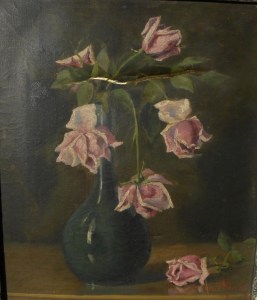
Oscar Miller painting on sale at Ruby Lane website.
Much due to Sarah J. Eddy’s influence, Bristol Ferry was a cultural and intellectual center. It was also a transportation center that made it easy to take the Fall River Line to New York, ferry to Bristol, take a train to Fall River and north or farmers to ship their produce from the freight dock. It was a perfect place for Oscar Miller and other artists to call home.
Oscar Miller was an artist with a national reputation. He created over 1500 works. Miller exhibited at most of the great American art institutions: The National Academy, painting titled “Girl Reading” at the 1904 World’s Fair. He painted marine seascapes, salon paintings, genre studies, and figure studies. Miller had many studios – New York and Paris as well as Portsmouth. His first Portsmouth studio was in the living room of the cottage he built in 1897-8 for his wife to be and then a purpose built 1904 Gambrel or “Dutch” style studio structure with a huge North window on Bristol Ferry Road which still exists today. A shop shed was added when Oscar returned from Europe just before the First World War.
Sarah Eddy liked Oscar’s paintings in a New Your City exhibition and first invited him up to Bristol Ferry in 1896 to “paint the spring.” In Bristol Ferry, Oscar would dress his subjects in costumes – as did Sarah Eddy and other artists of their day. Eddy taught him photography and his photography was just as good as his painting. His grandson, Gus, has glass plates of his grandfather’s photography work.
While in Portsmouth, Sarah Eddy introduced him to the woman who would become his wife – Clara Brownell May – daughter of Floride Mitchel. When their house was finished and furnished in 1898, they married. Clara believed that if she was to marry an artist, it should be one who could put a roof over her head.
Oscar Miller had married into a Bristol Ferry family. Clara’s aunts were part of the Bristol Ferry Art Colony – Sophie Mitchel (artist) and Cora Mitchel (poet and musician). Miller’s home and studio were built on Mitchel land that had been an asparagus farm. The Family raised and traded cotton in Florida. Mrs. Miller’s uncle Colby Mitchel had even been impressed into the Confederate Army and had to be rescued after he contracted malaria and smuggled back North. The family spent their time between Florida and Bristol Ferry.
Oscar Miller was a great organizer with a business mind. His Family had an art gallery on New York’s Fifth Avenue so he would also buy art as well as produce it. He always painted in a spotless suit because much of his work was painting portraits and he never knew when a client might drop by unannounced and he wanted to be able to shake their hand. Miller painted the portraits of many important New York, Providence and Fall River businessmen and matrons.
During the Spring, Summer and Fall, he would make the rounds of European locales – Holland, Northeast France, Brittany, St. Ives in England, Italy, Austria, Switzerland and Belgium. In the winter he would go back to work in his winter studio in Paris to paint works for the great Paris Salon exhibition. Every other year he would return to Bristol Ferry for a few months to visit family and to paint and exhibit locally.
He exhibited at many American and European institutions including: American Federation of Arts, American Water Color Society, Art Club of Philadelphia, Art Institute of Chicago, Le Salon de la Societe des Artistes Français, Memorial Art Gallery Rochester, Milwaukee Art Museum, Museum of Fine Arts Ghent, National Academy of Design, National Arts Club, Newport Art Association, Pennsylvania Academy of Fine Arts, Providence Art Club, Salmagundi Club, and the Society of American Artists in New York. A posthumous retrospective was held at the Rhode Island School of Design.
When he was in Bristol Ferry he loved to go out to paint at dawn or sunset. He thought the light in Bristol Ferry was like that of Holland or Venice because it was surrounded by water that reflected sunlight upward. More than that, Oscar Bristol Ferry among the most beautiful places in the world.
Bristol Ferry was unique. It had the warmest climate on the island and the surrounding water kept the growing fields moist even in drought. People would come to Bristol Ferry farms as a vacation destination. It was a wonderful area for artists to come for the summer season.
Most of my information on Oscar Miller was from an interview with August “Gus” Miller – Oscar Miller’s grandson. Sept. 12, 2014
The image of Oscar Miller’s painting is from this website: https://www.rubylane.com/item/230729-JB04415/OSCAR-MILLER-1867-1921-still-life
Out of the Attic: Bristol Ferry Artist Box
April 3, 2017
Bristol Ferry Area, Out of the Attic, Portsmouth History Leave a comment
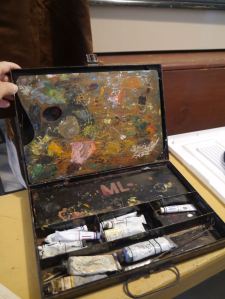 We received this artist box a number of years ago. It had belonged to Claire Fay, a longtime board member of the Portsmouth Historical Society. The paints are relatively new, but the box itself dates from a hundred years ago. A note said it originally belonged to Bristol Ferry Art Colony member Mariette Letourneau – the great aunt of Claire Fay. This item raised some questions. Who was Mariette Letourneau? Was there an “art colony” at the Bristol Ferry neighborhood of Portsmouth.
Finding Mariette Letourneau was not so easy. Genealogical resources show an aunt for Claire that was named Mariette Letourneau, but the birth date doesn’t match the date given on the card that was left with the box. Was she an artist at Bristol Ferry? Perhaps she stayed with the Fay family and they did live on Bristol Ferry Road.
Was there an artist colony? There were certainly a number of artists that lived in the Bristol Ferry neighborhood. Many of them were drawn there by Sarah J. Eddy. Sarah was a noted photographer, sculptor and painter. Her most famous works are portraits of Frederick Douglass and Susan B. Anthony. Sarah would invite artists to come visit and stay at her home (if they were female) or at Willowbrook, her guest house.
Among the most famous artists in the neighborhood was Oscar Miller who had international fame. He married into a family with Bristol Ferry roots and kept a studio there. Miller’s studio is still there under the care of his grandson.
Sophia Mitchell was another artist who had a national following. She traveled extensively and had studios in Brooklyn as well as Bristol Ferry. There were as many as six studios along Bristol Ferry Road.
Bristol Ferry had a reputation for having the quality of light that artists love – beautiful morning light and gorgeous sunsets.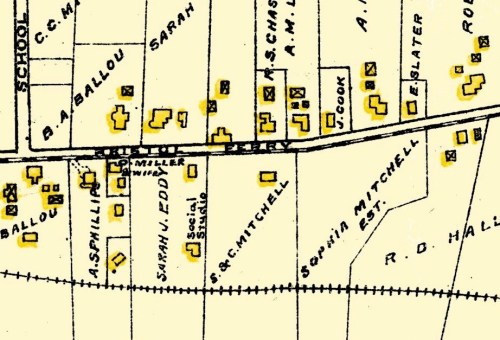
Out of the Attic: Thurston Meal Bag
March 29, 2017
Portsmouth History Leave a comment
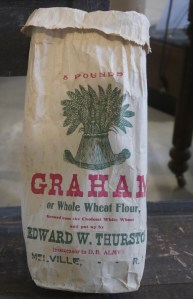
Thurston Mill Sack
Among the “Attic Treasures” that will be in this year’s Portsmouth Historical Society’s annual display is a paper sack. Much of what we know about the item is printed right on the bag. The bag held wheat ground at Thurston Mill at Melville, Rhode Island. It also tells us that the mill was once owned by D. Almy. Starting with this information, we began our research into our questions: Where was Thurston Mill? When did it operate? What did it look like? What happened to it?
Where was the mill? If you are familiar with Portsmouth you might think that it was located on the westside of Portsmouth near the old Melville Navy area. The Melville post office, however was located on East Main Road by Clearview Avenue. 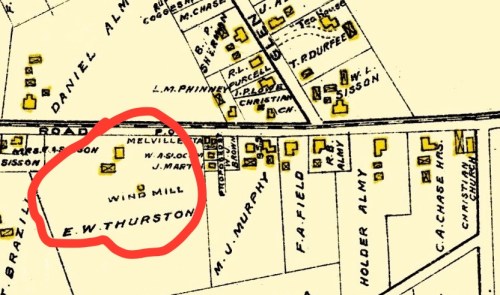 Maps from 1907 give us a clearer answer. It was just down East Main Road from the Christian Union Church which is Portsmouth Historical Society headquarters today. The Melville Post Office is right next to it.
When did the mill operate? The sack itself lists D. Almy as a previous owner. We know from newspaper articles that Almy Mill was operating in 1886. It seems that Richard Sisson’s horse, “Bootsey Barker” ran into an arm of the mill while it was grinding. (The horse was unharmed.). Newspaper articles also tell us that the mill passed from Almy to his niece who was Edward Thurston’s wife. Mills were a community gathering spot in Portsmouth and farmers from all around would bring their grain to the mill to be ground into flour. This bag is for wheat flour, but corn meal was commonly ground as well. The miller was entitled to a portion of the flour he ground. Thurston (and Almy) would have sold his portion of the flour to make an income.
What did the mill look like? Fortunately there is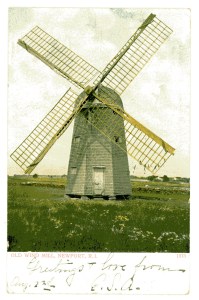 a postcard of the Thurston Mill.
What happened to the mill? In April of 1959 Thurston’s Mill was destroyed in a fire. A newspaper article tells us that it had stopped operating forty years before, so it had been used for storage before the fire. Among the photographs in the PHS collection is an image of the mill on fire. 
Out of the Attic: Glen Farm Ribbons
March 22, 2017
Glen Area, Out of the Attic, Portsmouth History Missy of the Glen Leave a comment
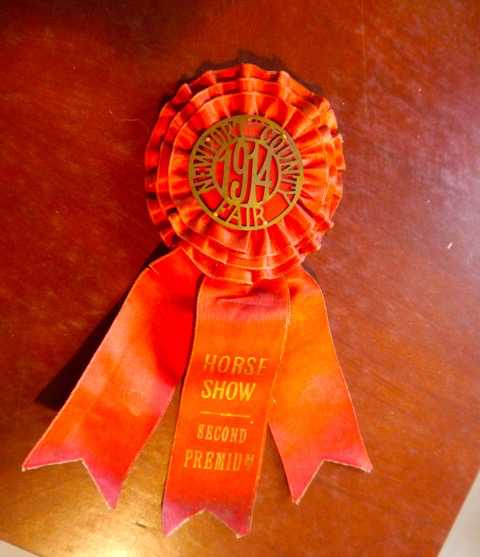
Second Place Ribbon from Newport County Fair 1914
The theme of this year’s Portsmouth Historical Society Museum displays is “Out of the Attic: Items of Interest from our Collection.” Among the items to be featured is a cache of award ribbons from Glen Farm. These are a recent addition to our collection and they offer an opportunity to highlight the outstanding success of Glen Farm. The Taylor family, like so many of the gentleman farmers in our town, were very proud of what they bred or grew on their farm. It was a matter of pride and sometimes a point of contention. A 1910 National Magazine article reports. ” In most national dairy shows and state expositions, the Glen Farm stock has taken many of the prizes, both for butter fat tests and as breeders. Perhaps the brightest star in all Mr. Taylor’s constellation of prize winners is “Missy of the Glen.” But another gentleman farmer claimed that Missy’s butter fat content was not as high as claimed. H.A.C. Taylor, the owner of Glen Farm, brought that farmer as far as the Supreme Court. Taylor won after the state college monitored Missy’s butter fat for an entire year. According to Taylor’s son Reginald, the award given by the court didn’t cover the legal costs, but Missy and the Glen Farm workers were vindicated.
Boyd’s Mill
February 21, 2017
Portsmouth History Leave a comment
 Benjamin Boyd shared his family’s history with wind mills in a 1942 newspaper article for the Fall River Herald. Although Boyd’s Mill stood in Portsmouth for many years, it has been moved to Paradise Park in Middletown and has been carefully preserved by the Middletown Historical Society. The mill stood nearby West Main Road in Portsmouth by Mill Lane.
In the article Boyd states that John Peterson, a retired ship captain, built the mill in 1810. Boyd comments that the millers are very much like “sea captains” in the skills they need to manage the mills in bad weather. The timber came from Wickford across the bay. The article gives many details about the construction of Boyd’s Mill. The main shaft is twenty-two inches in diameter and nineteen feet long and is made of hard Georgia pine. The Boyd Mill is unusual in that it has eight arms – each thirty one feet long. The arms carries sails twenty-eight feet four inches wide. The Boyds bought it after their Bristol Ferry mill was blown to pieces in the Gale of 1815. Boyd shares how difficult it was for millers when Rhode Island farms switched from growing grain to truck farming. To keep going, the Boyd family promoted the famous Rhode Island Johnny Cake meal. Their meal was shipped as far as South America.
The entire article is well worth reading. You can find it under the “Collections” section of the Portsmouth Historical Society website: portsmouthhisrorical.org. Look for the Scrapbook images.
Bristol Ferry Artists
September 19, 2016
Bristol Ferry Area, Portsmouth History Sarah Eddy Leave a comment

This image is from a glass plate negative. Captured in 1910, this was titled “Sunset at Bristol Ferry”. I don’t know that this image is by Sarah Eddy, but she was a marvelous photographer working around the Bristol Ferry area at that time. The Bristol Ferry area attracted many artists and photographers. The quality of the light there was special. Artists and photographers especially came during the summer season, but many had permanent studios in the area. I found this small glass plate on Ebay, but I know that other glass plates may be found in Portsmouth attics. Hopefully we can uncover more about the Bristol Ferry artist colony.
 portsmouthhistorynotes