Home

The Social Studio – Lost to Time

1 Comment

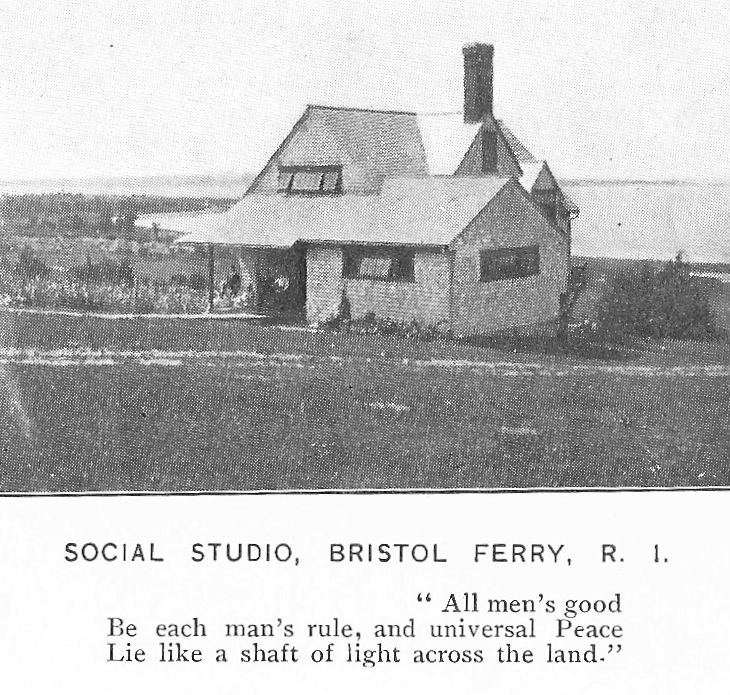
Social Studio postcard - GSchmidt collection

Social Studio postcard – GSchmidt collection

Wouldn’t it be nice if Portsmouth had a place where young and old could gather for social, artistic and cultural events?  There could be drawing and painting classes as well as craft and sewing lessons.  There would be stage where musicals and plays could be performed.  It would be a space for art exhibits, lectures and writing and reading.

Portsmouth residents have been looking for such a space in the past few years, but we used to have it.  The Social Studio on Bristol Ferry Road was such a spot a hundred years ago.

Magazines at the time describe the studio as “a large room for assemblies, one end of which is occupied by a small stage, is furnished simply and artistically.  Potted plants, a pianola, a huge open fireplace, oil painting on the wall and a good library-all lend great charm to the big room which is a delightful retreat for the young people who flock there from adjoining farms.  Lectures, readings, musicals and social gatherings are frequently held.  Classes in pyrography, drawing, water color painting and raffia are conducted by competent teachers, a nominal fee being charged for instruction.” (The Common, Vol. 10 – 1905)

The Social Studio was founded by Sarah J. Eddy.  This remarkable lady was a talented photographer, author, painter and sculptor.  She came to Portsmouth in the early 1890’s and lived in Portsmouth until her death at age ninety-three in 1945.  Sarah had a passion for the humane treatment of animals and was among the founders of the Rhode Island Humane Educational Society.

You can find out more about the Social Studio when you come to the Portsmouth Historical Society Museum for the “Lost to Time” Exhibit for 2014.  The Exhibit will be up and running at the museum (on the corner of East Main and Union St.) from Memorial Day weekend to Columbus Day Weekend.  On display will be s a large painting of a cook preparing vegetables for Thanksgiving dinner which was painted by Mrs. Eddy.  You will also be able to see animal books for children written and illustrated by Mrs. Eddy.  A Good Housekeeping Magazine article on the Social Studio and a series of postcards of events at the studio help us to understand the activities that took place there.  Newspaper clippings alert us to the various sales and lectures held at the site.  Even Julia Ward Howe came to speak and socialize. The Social Studio building still exists today as a private home.

Our research into Sarah Eddy in Portsmouth continues.  Look for future blogs on Sarah as artist and photographer
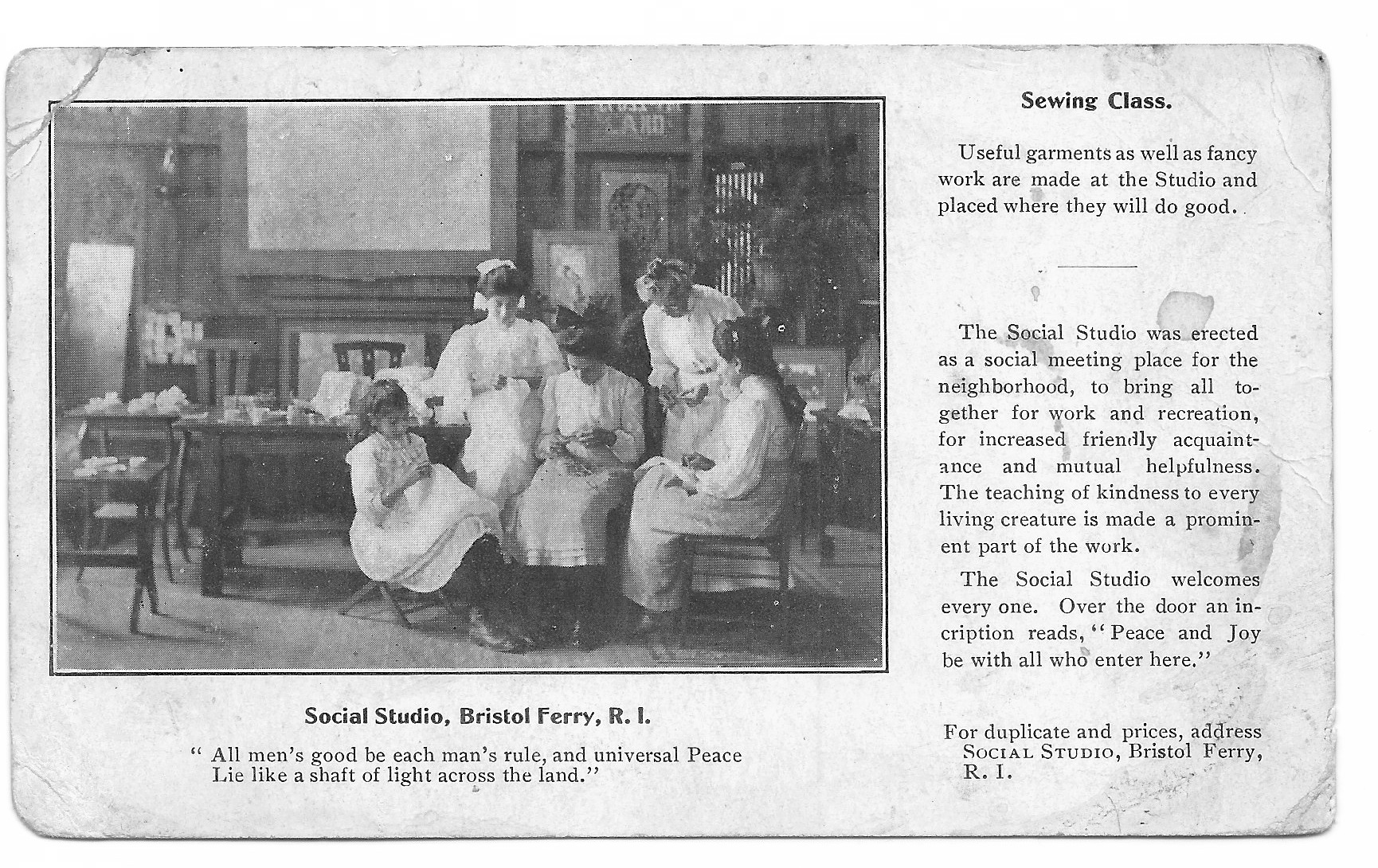
Classes at Social Studio:  collection of GSchmidt

Classes at Social Studio: collection of GSchmidt

and Sarah’s many causes (abolition, women’s suffrage, humane treatment of animal).

In Their Own Words: Marking the Border

Leave a comment

Do you know where the boundary between Portsmouth and Newport is today? Trick question. There hasn’t been a Newport/Portsmouth boundary since 1743. Aquidneck Island was divided about in half between Newport and Portsmouth after Newport’s founding in 1639. Middletown was carved out of Newport’s half of the island and became a town on its own in 1743.

One of the documents in the collection of the Portsmouth Historical Society is an account of how the boundary between Portsmouth and Newport was marked again in 1666. Like a number of our documents, it is a “true copy” of an earlier recorded document. The document includes a note saying that it is a “true copy extracted out of these records belonging to the Town of Portsmouth and compared. Mr. John Anthony signed the document and he was Clerk in the 1680s so this particular copy dates from that time.

According to the document, John Albro (for Portsmouth) and William Dyer (for Newport) were appointed to lay a line of division between the towns. They started in the northeastern corner and marked the boundaries by labeling trees with N on the Newport side and P for the Portsmouth side.

I believe that the 1666 boundary marking is a remarking of the border. Digging into old Aquidneck Island histories *, it is clear that there was a delegation from each of the two towns (Easton and Porter from Newport and Jeffreys and Sanford for Portsmouth) to mark the official boundaries by November of 1640. They started at the Sakonnet River south of William Brenton’s land (which was around the Glen area) and marked trees in a straight line toward the “sea” using a brook and a “hunting wigwam” as part of the landmarks.

What can we learn about life for early residents of Portsmouth from this document. Borders, boundaries and property lines were very important to them. Logically the borders needed to be remarked as trees fall and local landmarks change. There may have been many more such boundary markings. Today we may mark town borders at East and West Main Road, but we don’t seem as interested in marking the boundaries across the island.

Interested in reading the full transcription? The transcriptions will be available on the Portsmouth Historical Society website: http://www.portsmouthhistorical.com Click on the “transcriptions” heading.

*Bayles History of Newport County,1888.

Newport Portsmouth Border

Newport Portsmouth Border

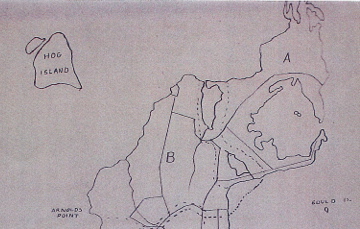
In Their Own Words: Hog Island Hay

Leave a comment

What was life like for Portsmouth settlers?  As Portsmouth celebrates the 375th anniversary of its 1638 founding, a treasure of documents held by The Portsmouth Historical Society may help us answer questions about life in early Portsmouth. An ongoing project at the society has been the organization and transcription of these papers to language we can understand today. My resolution in honor of our 375th celebration is to pick some interesting documents, try my best to transcribe them, and then share them with you in blog form. I’m not an experienced transcriber, but I have some background in Portsmouth history and working with primary sources.

These official records may not be what you imagine. The high cost of paper necessitated frugality so they are often literally scraps of paper. Sometimes they are written on the backs of used paper. But it was the high quality of that paper that allows this communication to survive three hundred plus years after pen was put to paper. Through the photography of Bruce Westgate and a data base created by Eileen Westgate the documents are available for research. We can work with the images and not handle the original documents. Assisted with a grant from Rhode Island Marine Archaeology Project, our records are now in a digital form available at the Society and the Portsmouth Free Public Library.

Many of our documents are hand written copies of originals and the first that I want to share with you falls into that category. The actual record is a scrap of paper about six inches by ten inches and is dated the 20th of the 6th month, 1638. It was copied from the second and third pages of a “Chapp Book.” It is basically an agreement that orders that the remainder of the hay on Hog Island would be granted to a Mr. Brenton (William) in return for his “mowing” (my best guess). It is signed by some of the same signers of the Portsmouth Compact: William Coddington, William Hutchinson, Jr. (husband of Anne Hutchinson), John Clarke, Samuel Wilbore, John Sanford, William Freeborne, Philip Shearman, Richard Carder, Randall Holden, Edward Hutchinson and William Dyer.

Trying to decipher this document was like solving a puzzle. I looked for pieces of information to confirm my guesses. I know that the settlers had a grant to Hog Island. They used the island for grazing their pigs because no fencing was needed to contain them. The names listed in the document were confirmed by looking at a list of the original signers of the Portsmouth Compact. The name of the person who was granted the hay rights was more of a puzzle. I worked out the name “Brenton” by comparing letters in words I could decipher. But was Brenton in Portsmouth the “20th of the sixth month, 1638”? My research said he arrived in Portsmouth in August of 1638. A note in the Early Records of the Town of Portsmouth gave me the clue I needed. The Julian calendar was used during that period and the year began on March 25th. March was the first month, so the 6th month was August or later.

This may be a simple document, but I could draw some interesting points from it. Even at that early time, within months of Portsmouth’s founding, Portsmouth settlers were conscious of recording agreements. The town fathers were acting together as a “body politic” to make decisions. This is probably one of the earliest records of William Brenton on our island. The Brenton name still is alive as a place name on our Island – Brenton Cove, Brenton Reef.

Transcribing a document like this one gives me the rare privilege of discovering the world of Portsmouth’s settlers through their own words.

Hog Island on Edward West's map

Hog Island on Edward West’s map

Hands on History

Leave a comment

Have you ever tried carding wool, using a washboard to clean clothes or cutting a lawn with a reel mower?  Would you like the opportunity to do a gravestone rubbing without intruding on a cemetery?  The whole family can try these hands on activities (and more) at the Portsmouth Historical Society’s Harvest Social next Sunday from 2 to 4 PM.  These activities will give you a glimpse of life in old time Portsmouth.  It is a great warm up for Portsmouth’s 375th celebration next year.

In the one room school house you can try your hand at making an old fashioned toy.  A whirligig is a homemade toy consisting of a length of string threaded through the two holes in a large button and tied in a continuous loop. When the string is wound up, then pulled apart, then brought back in repeatedly, the button spins quickly, winding and unwinding the string again and again. As a craft toy, the whirligig has perhaps been around long before buttons were commonly used. Evidence indicates that whirligigs were common toys for many centuries in cultures around the world. It was an easy toy for children to make.  

Outside the Old Town Hall you can try to push a reel mower.  Reel mowers have been around since at least October 25th, 1830, when Edwin Beard Budding patented the first known design. He described his reel mower as “a new combination and application of machinery for the purpose of cropping or shearing the vegetable surfaces of lawns, grass-plats and pleasure grounds.” One of the things he pointed out in his patent is that “country gentlemen may find in using my machine themselves an amusing, useful and healthy exercise.”

By the horse-drawn hearse in the Old Town Hall, you can do a rubbing of the gravestone of Joseph Cook.  Joseph died in 1726 and this broken stone has beautiful engravings.  When the Puritans settled in the New World in the 1600s, they brought with them a religion that feared the afterlife. They believed only a chosen few called the “elect” would go to heaven. A less pleasant fate awaited the rest, who were sinners in the hands of an angry God. Gravestone symbols in the colonial period reflect this religious belief system. The “death head,” a skull with or without wings, was the standard gravestone engraving and can be seen in many old New England cemeteries. As the concept of the afterlife shifted to a heavenly paradise, we begin to see the weeping willow replace the death head.

Towards the back of the Old Town Hall you can try carding wool.  From colonial days in Portsmouth,  wool was a major source of income, and being able to spin and weave it meant a woman could provide warm clothing for her family. Carding wool is the process by which wool fibers are separated and prepared for spinning. Carding wool by hand takes practice. The carder takes two carding combs, which have upstanding teeth, and loads one with the wool fibers. Using a back and forth motion, the person places one carder on top and “combs” the carder through the wool on the lower carding comb. When all the carding wool has been transferred from the bottom carder to the top, the carding combs are flipped over and the process is reversed. When the wool fibers are separate the fibers are rolled for use on a spinning wheel.

What is it like to wash your clothes by hand?  Washboards are still used to do laundry in many areas of the world. Clothes are soaked in hot soapy water in a washtub or sink, then squeezed and rubbed against the ridged surface of the washboard to force the cleansing fluid through the cloth to carry away dirt. A washboards is portable and could be taken to wash clothes in a river. The rubbing has a similar effect to beating the clothes and household linen on rocks, an ancient method, but the washboard is less damaging to the clothes.  

If you like to sing old fashioned songs like “Daisy” or “Take Me Out to the Ball Game,” you can participate in a “singing school” in the Upper Church.    The Portsmouth Historical Society’s building was once the Union Church and the church believed that everyone should learn to sing.  

If you have never been to the museum, this is a great time to visit.  If you have seen the museum, this is a special occasion with hands on activities and docents to guide you.  This is the traditional Harvest Social fundraiser, so there is a $5 donation for individuals or $10 for a family.  Refreshments will be served and there will be a sale of home baked goods.  This is the closing activity for the historical society for this year.  


Image


The Glen: Elmhurst School Days

Leave a comment

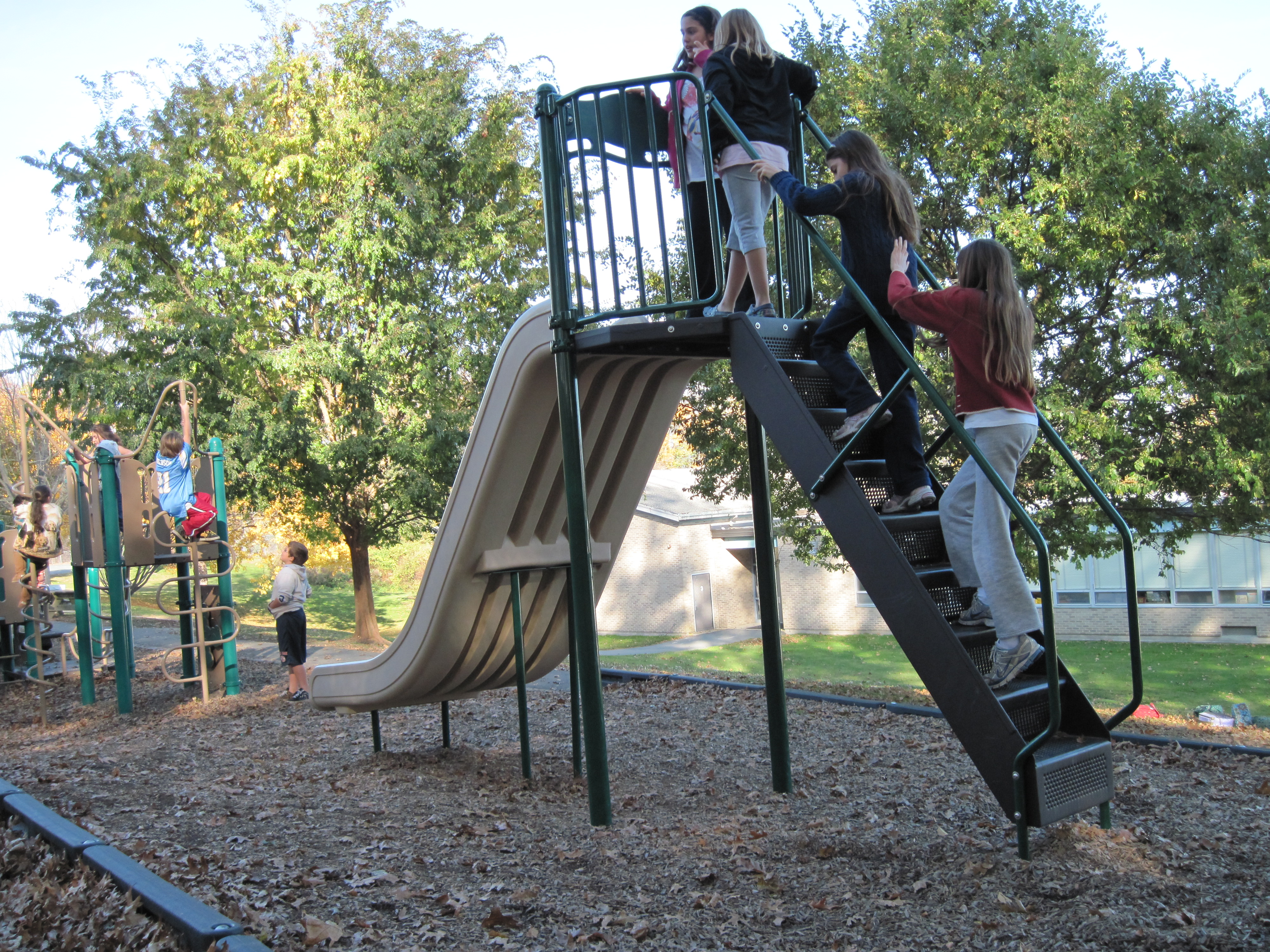
Principal Bob Ettinger greets students on the first day of school 2009.

Happy children on the Big Toy during recess, 2009.

As Portsmouth children go back to school, my thoughts turn to the excitement of the first days of new years at Elmhurst School.  As sad as the school building is now, I have great memories of Elmhurst Elementary School.  When Elmhurst Academy closed in 1972, the Town of Portsmouth purchased the property primarily because the school rooms were needed.

The fourth grade class of 1995 worked with me to write an oral history of the school.  We interviewed teachers who remembered the first days in 1973 that Elmhurst served as a public school.  Richard Donnelly was the first principal and Ruth Sears remembered that opening day was so hot that Mr. Donnelly wore shorts!  Students were coming from Hope and Anthony Schools and later Coggeshall School.   The faculty and students had to create the culture of a new school.

There were many problems to be solved.  Eileen Lacazette shared that one of the first problems was that there were no bathrooms for the boys.  They had to be created and they didn’t quite look like typical bathrooms.  Music teacher Susan Woythaler remembers that the original classrooms for the private school were tiny, but the classroom size for the public school didn’t fit well.  They made the best of the small rooms the first year, but later walls had to be removed to create more efficient space for an elementary classroom.

After shepherding the school through its first year, Mr. Donnelly went back into the classroom.   Mr. Crudup became the first long-term principal followed by Al Honnen.  There were many physical changes in the building during Mr. Honnen’s leadership.  Classrooms were added, the chapel was made into a cafeteria and gymnasium.  Mary Foley, Dennis Silva, and Hathaway’s principal Robert Ettinger were all Elmhurst School leaders.  All the principals leaned on School Secretary Ruth Ziegler.  She kept the school running efficiently.

It was a joy to come to work at Elmhurst.  The school setting was beautiful, the staff was dedicated and the parents were so supportive.  Elmhurst traditions added to the school culture.  Third grade teachers introduced “Egg Drop” day where students had to invent designs they hoped would protect their raw eggs when they were dropped from the roof by custodians (beginning with Mr. Augustus).  Market day for kindergarten and first grade grew out of a project for including the arts into subjects like science and math.  We turned the library into a market and watched third grade students make presentation of plays about seeds.   Field day was one of the oldest events when fourth grade students ran sports games for the other students.  Even Elmhurst Academy had a field day.

Piano Day, Colonial Fair, Immigration Day, Gingerbread Houses, Family Math and Science Nights, Arts for Life Week were all well loved traditions for a while.   As librarian, Reading Night was dear to my heart.  Themes of Arthur, Magic School Bus, Where in the World is Mrs. Foley, drew families for after school fun.

When the decision was made to close Elmhurst in 2010, I felt fortunate that I was retired and did not have to take my library collection apart.  It was a good school and it is sad to see it closed and vandalized now.  It would be good to see children playing in a new park if the school building is torn down.

Island Park: Recreation “On the Water”

Leave a comment

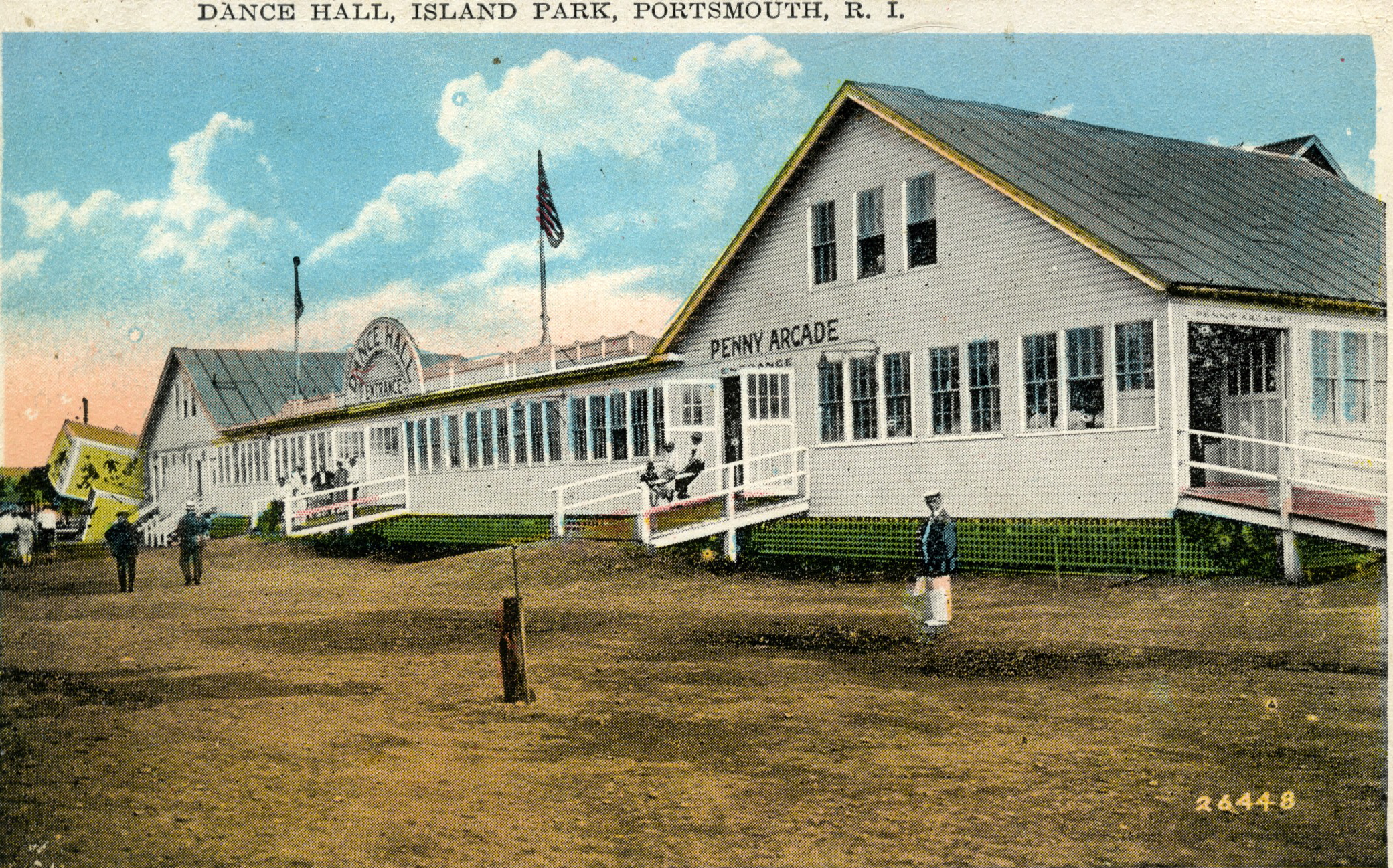
The Bullet Roller Coaster was one of the prime attractions at Cashman’s Park.

Cashman’s Dancehall stretched over the River.

The Island Park section of town was mainly a farming area until trolleys began to cross Stone Bridge from Tiverton.   The trolley company began to encourage recreation development to lure Fall River workers to come on their day off.  Barker’s Merry-go-round opened in 1898 and  in 1902 Joseph Lunan’s Shooting Gallery opened as well.  The area gradually added a wide variety of amusements such as glider swings, speak-easies, fortune tellers, tea rooms and food concessions. The biggest development was by Thomas Cashman who opened an amusement park in 1926.  It boasted the second largest roller coaster in New England. The Comet.  Cashman’s Park offered a Ballroom built over the beach,  a boardwalk into the Sakonnet River and a beach with boat rentals.  The park was devastated during the Hurricane of 1938.

The Portsmouth Historical Society has postcards of the hurricane destruction.  Our exhibit. “On the Water,” includes photos of Portsmouth families enjoying themselves at the Island Park beach.  You are welcome to add your family photos to the display.

Portsmouth Grove

1 Comment

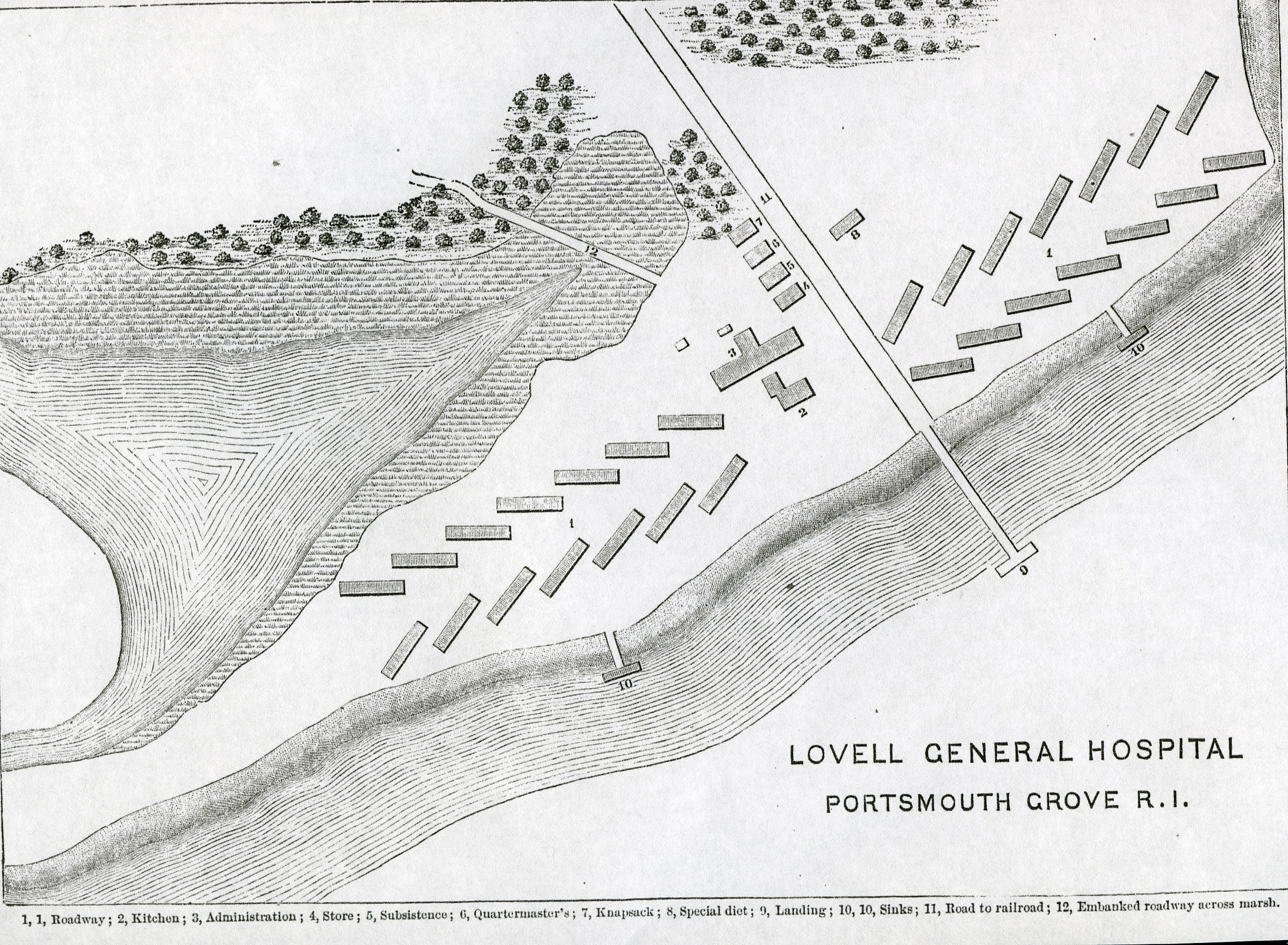
Diagram from a Civil War Medical book in the Portsmouth Historical Society Collection.

An area on Portsmouth’s west side (known as Portsmouth Grove, Bradford or Melville) was an important tourist destination “On the Water.”  Edmund Cole operated the “Portsmouth Grove House” before the Civil War.  During the Civil War Portsmouth served as the location for Lowell General Hospital near the Melville area of Portsmouth (known as Portsmouth Grove).  The Portsmouth Historical Society has the diaries of David Durfee Sherman in our collection, and he writes about the amusements there.  Portsmouth Grove welcomed hundred of guests who arrived on steamships.  For their recreation pleasure, Portsmouth Grove offered picnics, swimming, shore dining, a “fandango” and flying horses.  Groups like the Sons of Temperance came a thousand strong for clambakes and chowder.  There were even moonlight and torchlight excursions to Portsmouth Grove.

All that ended as the Civil War wore on.  The Portsmouth Grove House became the administration building for the Lovell Hospital.  The hospital, built in 1862, cared for wounded Union and Confederate troops. Again, these soldiers arrived at Portsmouth Grove by steamships.   The Rhode Island Hospital Guard which was made up of soldiers too disabled for battle, kept the peace and watched over prisoners.  After the war the hospital was dismantled and there are no signs of it left.  Frank L.Grzyb has written a book, Rhode Island’s Civil War Hospital:  Life and Death at Portsmouth Grove and he will be speaking at the Annual Meeting of the Portsmouth Historical Society on June 18th.

Leave a comment

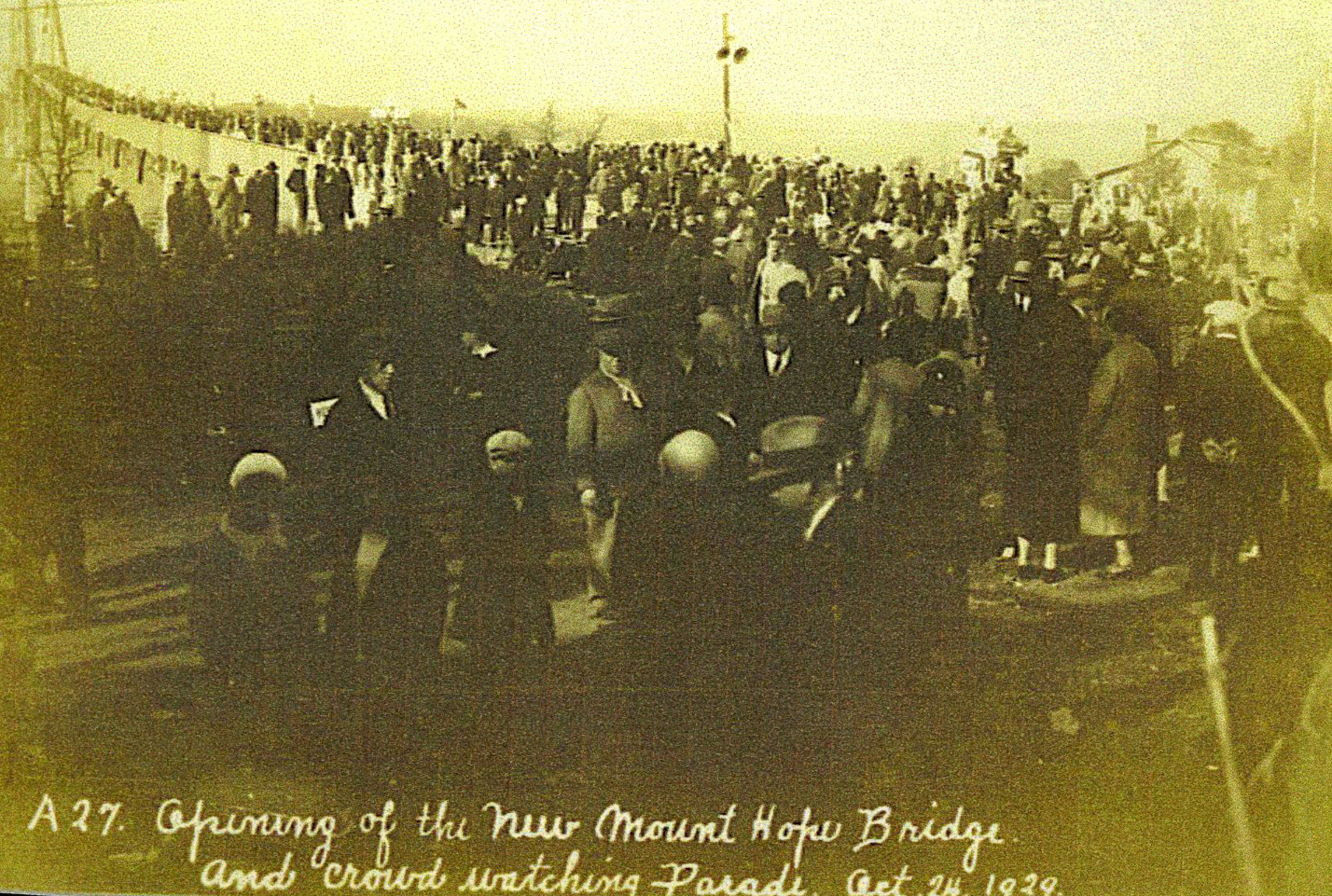
The Portsmouth Historical Society has items from the opening festivities of the Mt. Hope Bridge in 1929.  Those items include an invitation, guest badge and photographs of the construction and ribbon cutting.  A front page newspaper article from the time helped us to understand how elaborate the ceremonies were.  Senator William H. Vanderbilt presided over the pageant.  Beginning at 10 in the morning a parade began in Bristol – a “tableau”  depicting Roger Williams organized by the Rhode Island Historical Society.  The Newport Historical Society organized a tableau and parade depicting John Clarke and they marched from the Aquidneck Island side.  At 11 AM “Roger Williams” met “John Clarke”  and unfurled flags at the center of the bridge and exchanged greetings. There was an Indian ceremony in which Governor Case and Senator Vanderbilt became members of the Algonquin Council.  Vice President Charles Curtis signaled from Washington, D.C. at noon to begin the dedication of the bridge.  The program lists events such as a christening of the bridge, ribbon cuttings and acceptance of bridge certification.  The ceremony was even broadcast on WEAN at the old Outlet Building in Providence.

Part of the elaborate ceremonies at the Opening of the Mt.Hope Bridge in 1929.

Catboat Bristol Ferries

Leave a comment

Captain Hicks used a catboat to ferry bicycles and their riders.

Even in the late 1800’s sailboats were used as ferries.  Captain Oliver G. Hicks bought a large wide catboat for bicycle traffic.  The boat could carry up to 16 bikes.

(image from a book in the collection of the Portsmouth Historical Society)

Sakonnet River Bridge

Leave a comment

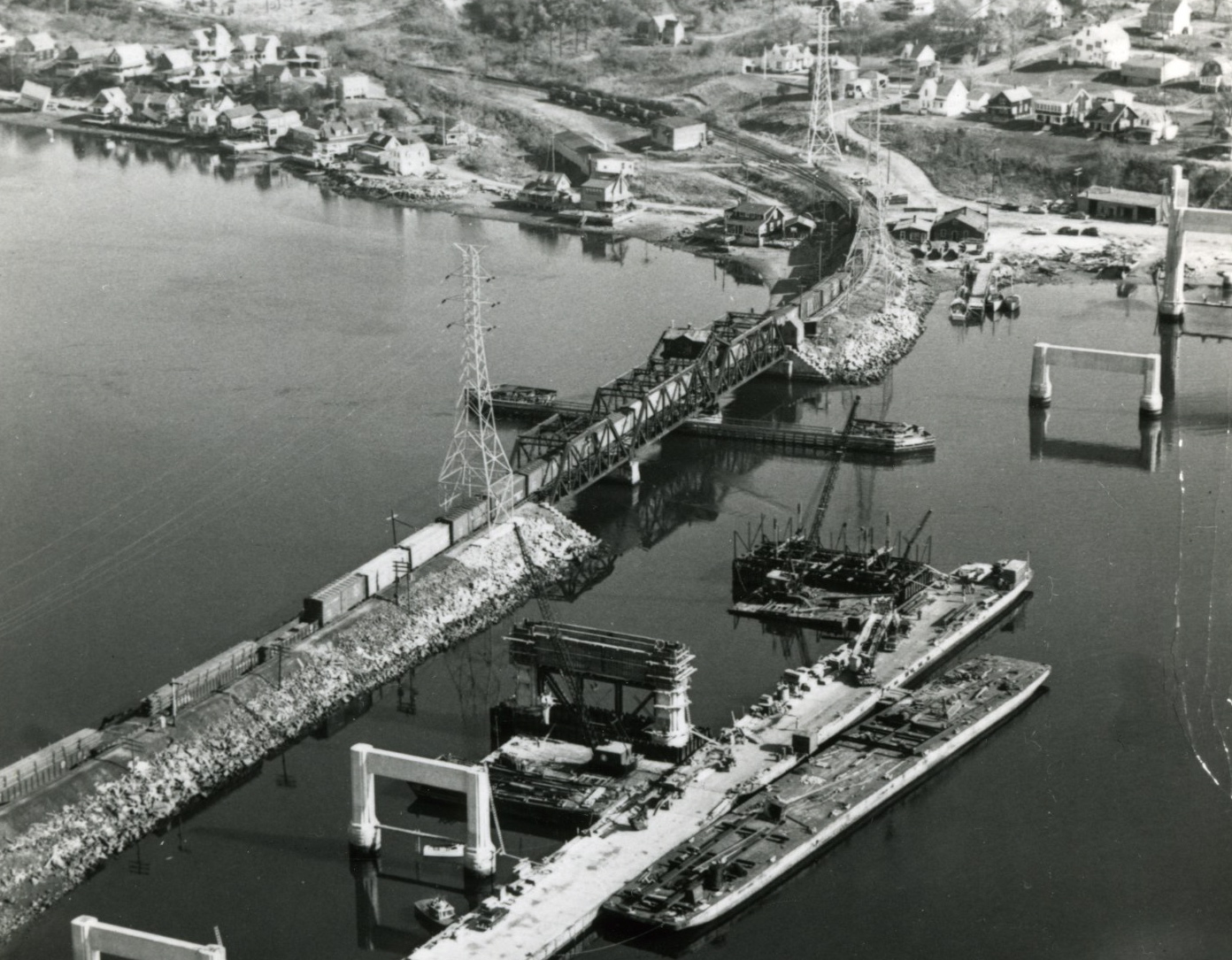
Sakonnet Bridge Under Construction. (PHS collection image)

Sakonnet Bridge (image from G. Schmidt collection)

The Sakonnet River Bridge opened in 1956 as a replacement for the Stone Bridge that was damaged in many storms.  The bridge has not been maintained well and a new bridge is under construction.  Note the railroad bridge to the left.

Older Entries Newer Entries