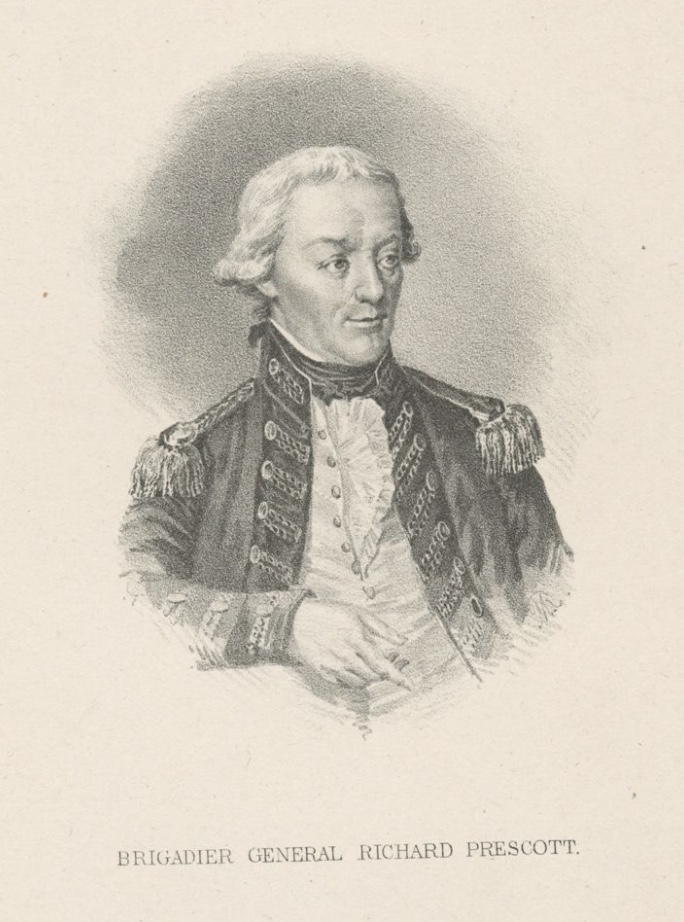
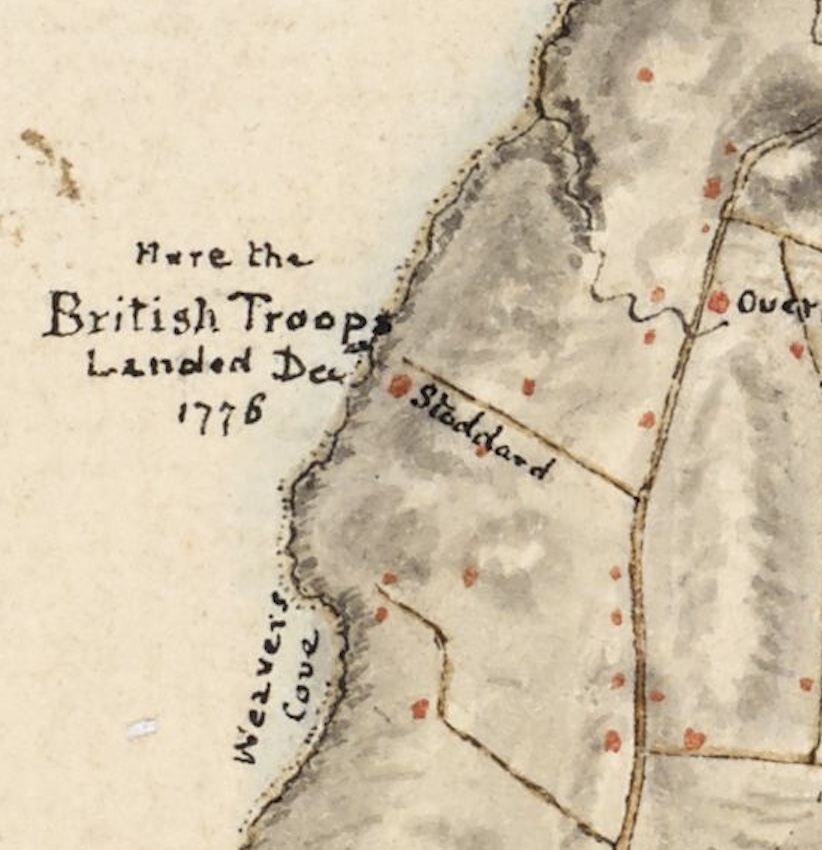
On December 8th, 1776 British General Prescott landed his troops on Aquidneck Island. They landed on the Western shore near the border of Middletown and Portsmouth at Weaver’s Cove. This was the beginning of the Occupation of Rhode Island (Aquidneck Island). The American militiamen were unable to mount a defense and they escaped by using the ferries to Bristol and Tiverton.
The British had ample reason to invade and occupy Aquidneck Island (called Rhode Island at that time). Newport had a fine harbor from which the British fleet could raid up and down the coast. It would enable them to blockade ships carrying supplies from abroad that were needed by the Americans.
Prescott from New York Public Library CollectionFage Map 1777
The British Occupation of Rhode Island would last until October of 1779. Life for the residents deteriorated throughout that time. There were different experiences for those who lived in Newport and those who lived in the farmlands of Middletown and Portsmouth. Newport had more British sympathizers and life for them was good at first. The “well to do” Newporters and British enjoyed concerts, dances, card parties, and Christmas concerts after the British first arrived in 1776. In 1777 daily routines continued. The occupiers took over houses, shops, wharves, and farms. The British and Hessians (German) came with wives and children and all needed food, supplies, housing and heat. The residents competed with the British for scarce items. The British took hay and confiscated cattle and livestock. Residents could hunt birds, catch fish and collect shellfish. The British collected boats and guns. The longer the Occupation lasted, the harder it was on those in the maritime trades such as coopers, sailors, rope makers, etc. Wharves were pulled up for fire wood. Merchants had no supplies coming in so they had little to sell.
Local citizens couldn’t count on growing food for their families. Gardens were raided, fruit was plucked from trees and potatoes were dug up by British soldiers. There was no freedom of movement. Women could travel a little more freely at first, but later they needed passes to leave town. The border of Newport and the rest of the island was gated and locked There was no free press or local government. Births, deaths, marriages were not recorded and Newport lost its property records when the British shipped them to New York and they were ruined by water.
Destruction was even more disastrous when the French fleet was arriving in August of 1778. In creating defensive works. the British demolished homes, chopped down orchards and trees for abatis (a defensive obstacle formed by felled trees with sharpened branches facing the enemy.). Conditions worsened after the Battle of Rhode Island and through to October of 1779 when the British left the island.
The Rhode Island Campaign was a plan by the Americans and their new allies the French to rid the island of the occupying forces.
“Do you know if the school taught girls alongside boys, and if so, when that co-ed started? Also, any indication of any Black or Indigenous ever being taught there?” I received these questions from a Portsmouth Historical Society board member and I have been searching through new and old resources to try and answer that question
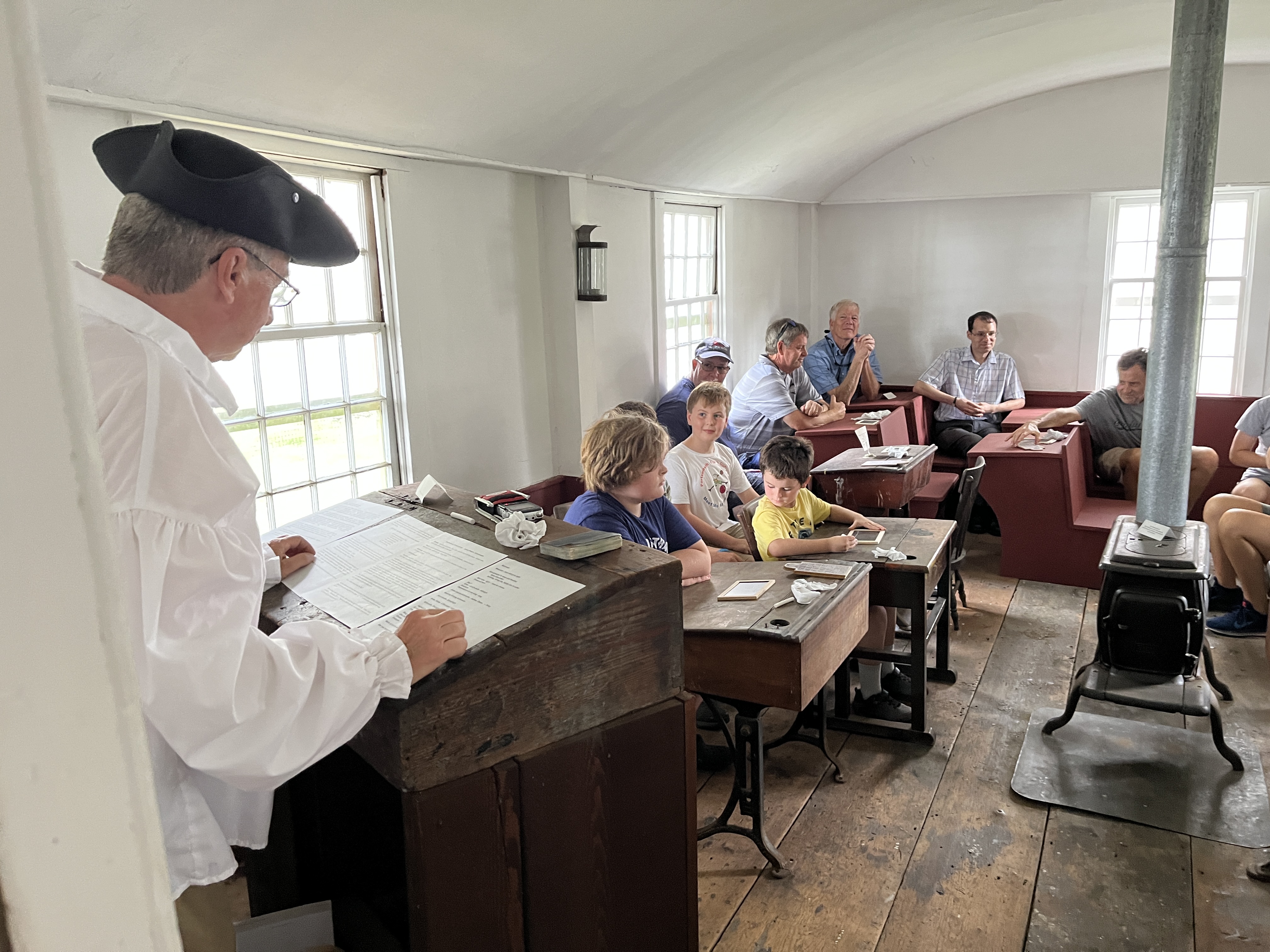
When my husband portrays James Preston to a school group, the “students” are a mixture of boys and girls. There are few sources on the students at Southermost, but state orders and details drawn from newpaper articles on the school may help us draw some tentative conclusions.
R. Schmidt portrays James PrestonInside Southermost
Public or Private?
Newport and Providence had schools that were established in earlier days then Southermost. These were private and religiously based schools. Portsmouth founders had a core belief in religious freedom and they had suffered under the hand of ministers. They may not have been interested in having their children’s education formed by religious leaders. Private schools and religious based schools were available on the island in Newport. Portsmouth residents advocated for a school that was open to all students (boys). The schoolmaster was not a religious leader. The first schoolmaster’s background seemed to be as a mariner judgeing from his books.
Boys and Girls?
Chances are that before 1800 education was for boys only.
State guidelines for education in public schools in 1800 show that at that point the general view was white students only.
“for the instruction of all the white inhabitants of said town, between the ages of six and twenty years, in reading, writing and common arithmetic, who may stand in need of such instruction, and apply therefor.” (1)
A chart in the History of Education book lists Portsmouth as having 4 schoolhouses in 1828. School was held in the winter, but one or two of the schoolhouses stayed open over the summer as well.
In 1832 there were 8 schools and 360 students. There were two male teachers. By 1844 there were 6 male teachers and 4 female teachers. That detail leads me to wonder of there were female students at that time.
By 1876 the laws were clear on girls attending.
Gexeral Provisioxs Relating to Public Schools. Section 1. No person shall be excluded from any public school in the district to which such person belongs, if the town is divided into districts, or if not so divided, from the nearest public school, on account of race or color, or for being over fifteen years of age… (A history of public education)
In newspaper articles from the time of the Hall family donation of the school, Herb Hall comments that there was grafiti left in the school from before it was moved to the Almy farm. Names included Sarah Coggeshall and Mary Spooner. If the school was moved around 1863, it would be evidence of girls attending the school before that. Herb said the family found a list of punishments at the school. That rules list refers to boys and girls.
List of Rules and Punishment posted at Southernmost School. • Boys and girls playing together – 1 lash • Fighting at School – 5 lashes • Quarreling at school – 3 lashes • Climbing for every foot over 3ft up a tree – 1 lash • Telling tales out of school – 8 lashes • Giving each other ill names – 3 lashes • Misbehaving to girls – 10 lashes • Leaving school without leave of the teacher – 4 lashes • Wearing long fingernails – 2 lashes • Boys going to the girls’ play place – 3 lashes • Girls going to the boys’ play place – 2 lashes • For every word you miss on your heart lessons without a good excuse – 1 lash • For not saying yes or no sir or yes or no marm – 2 lashes • Telling lies – 7 lashes • Swearing at school – 9 lashes.
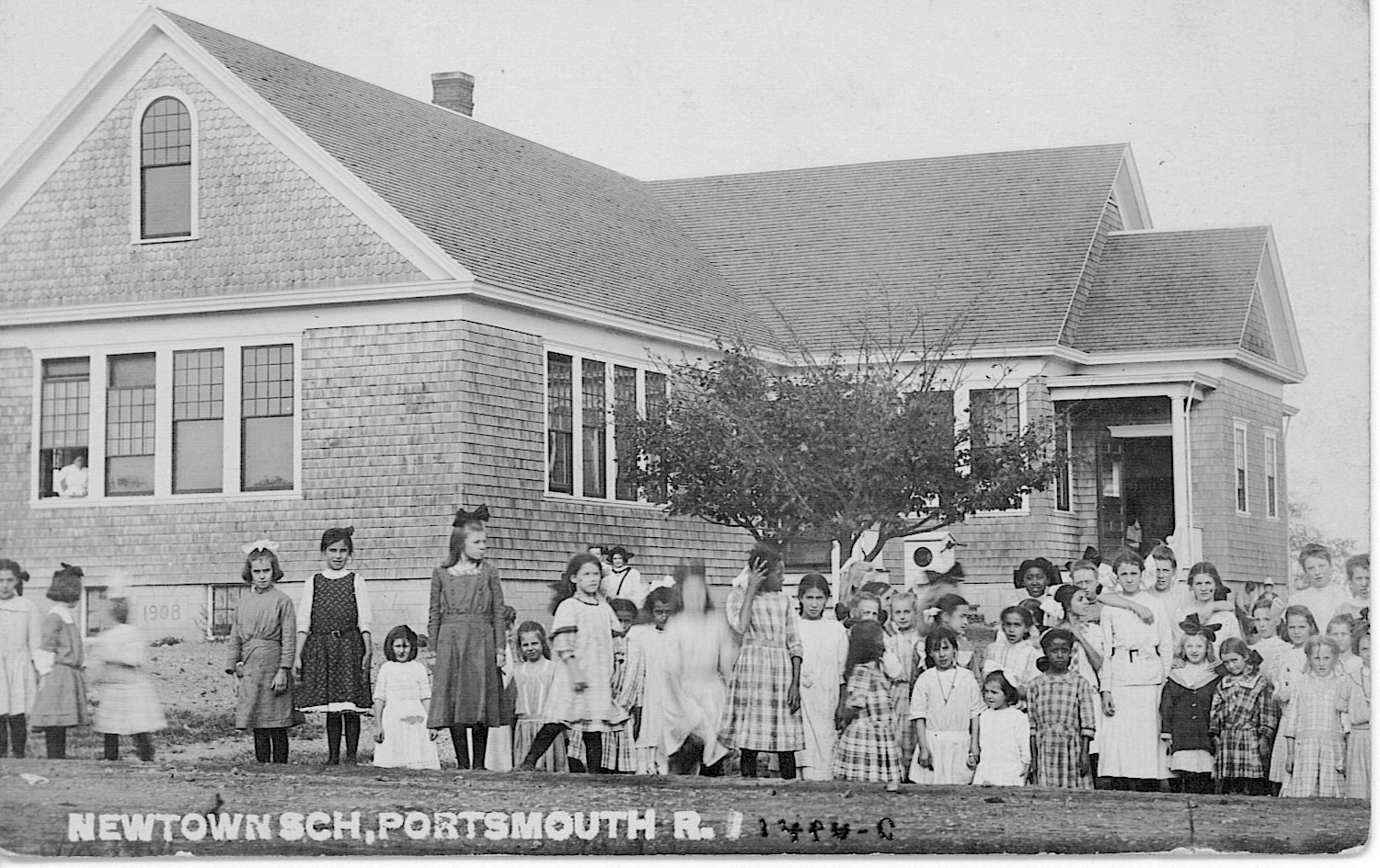
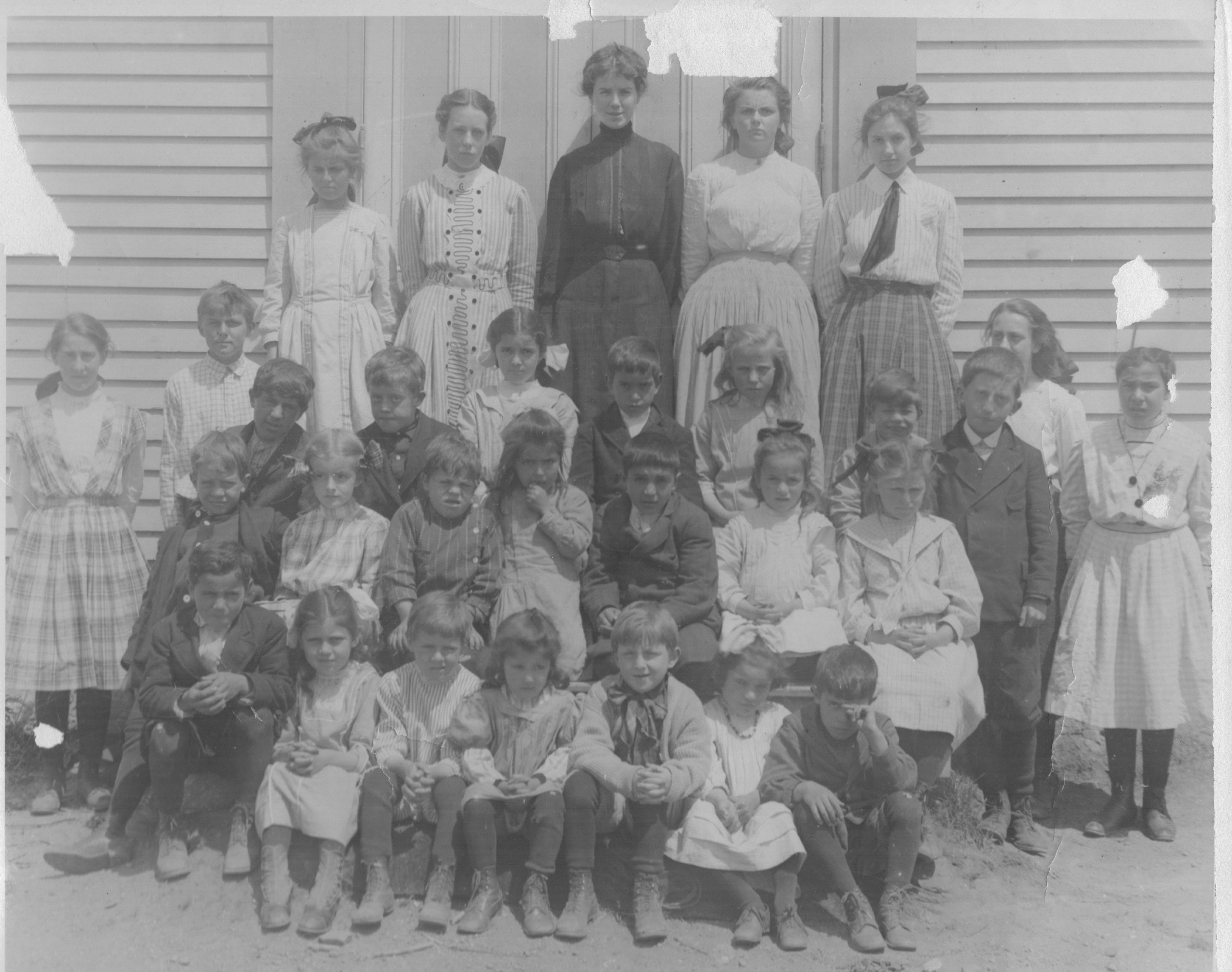
I haven’t found information on when “all races” could attend public school in Portsmouth. We gather through school photos at the turn of the 20th century that those classes were well integrated. Indigenous attendance is something I cannot determine.
Newtown SchoolBristol Ferry School
Extra Notes from historian Edward West.
The donor of the land, William Sanford, commended on his reason for the donation: “…for and in consideration of the venerable estreem I have for the Town of my Nativity and also to my very much esteemed friends and neighbors, but more especially for the better encouragement of bringing up and educating children in litteral learning. “
Sources:
Stockwell, Thomas B., Ed, Thomas Wentworth Higginson, Edwin Martin Stone, and Rhode Island. Board Of Education. A history of public education in Rhode Island, fromto 1876 . Providence, Providence press company, printers to the city and state, 1876.
Portsmouth Historical Society has images from one-room schools.
Newspaper articles. Daily News August 29, 1968 –
Edward West, Early Schoolhouses and Schoolmasters of Portsmouth, Rhode Island.
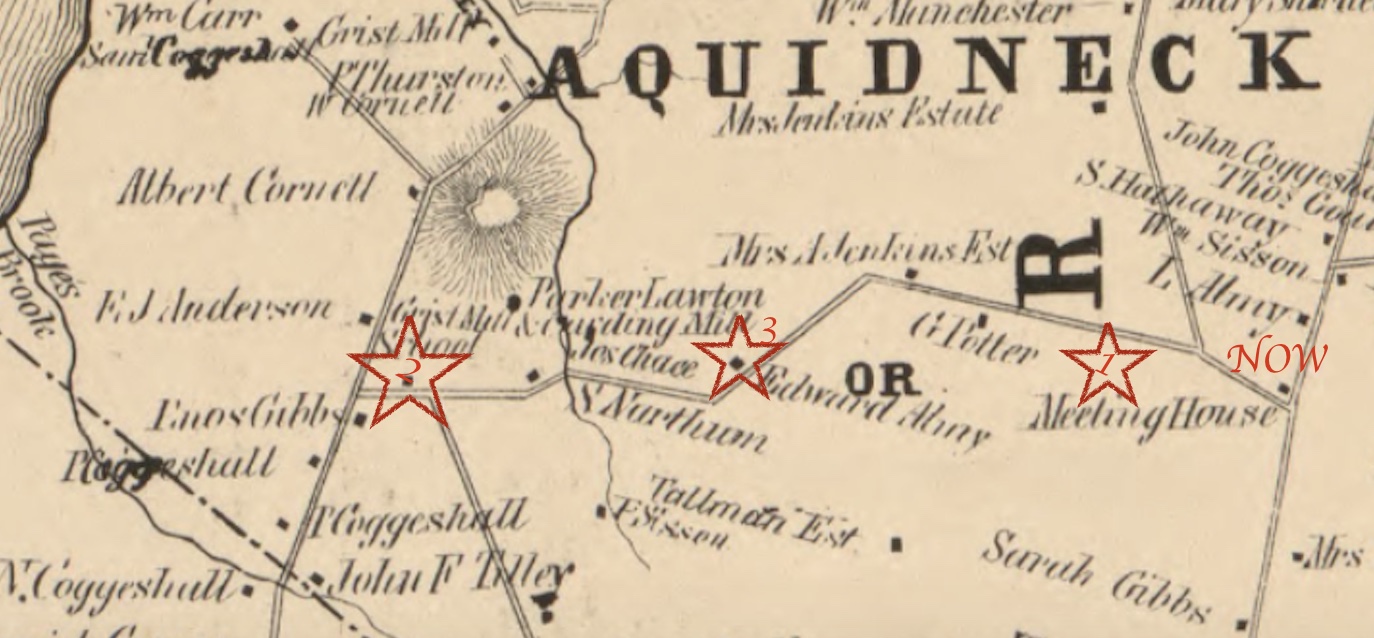
Travels of the Southermost School are pictured on this map.
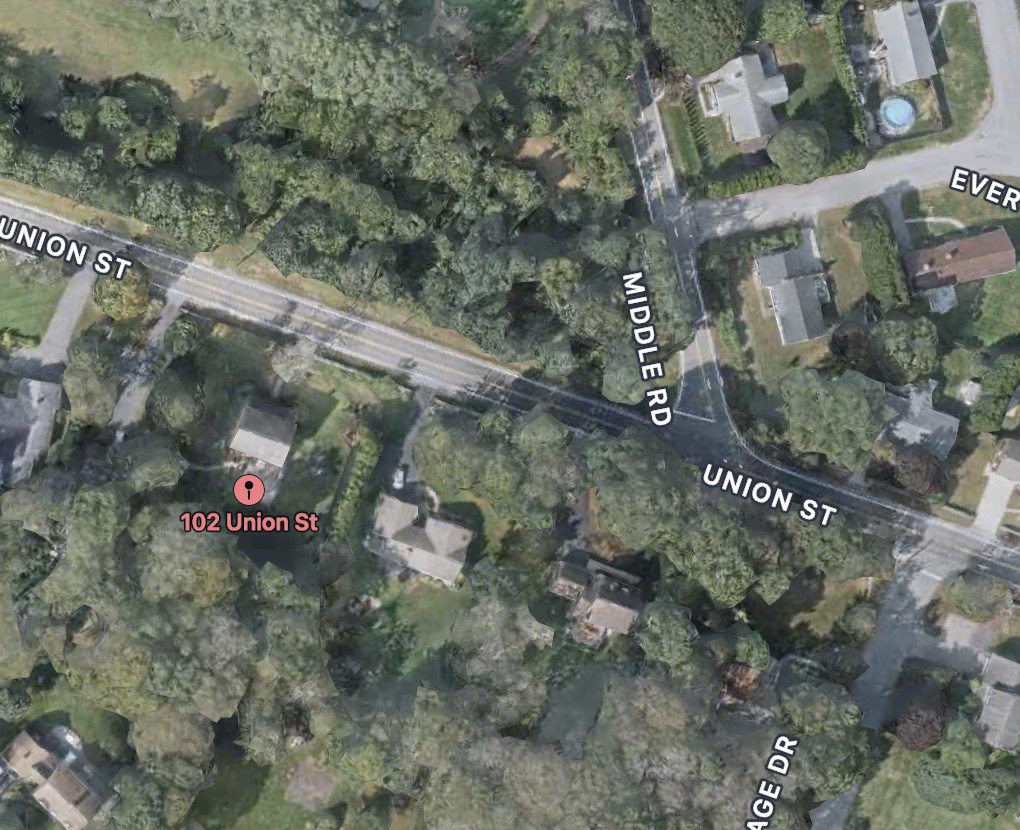
The original location was around 102 Union Street. One of the founders of the Portsmouth Historical Socity – J. Fred Sherman – lived at that location and he commented that in the first half of the 20th century remnants of the cellar were still visible there.
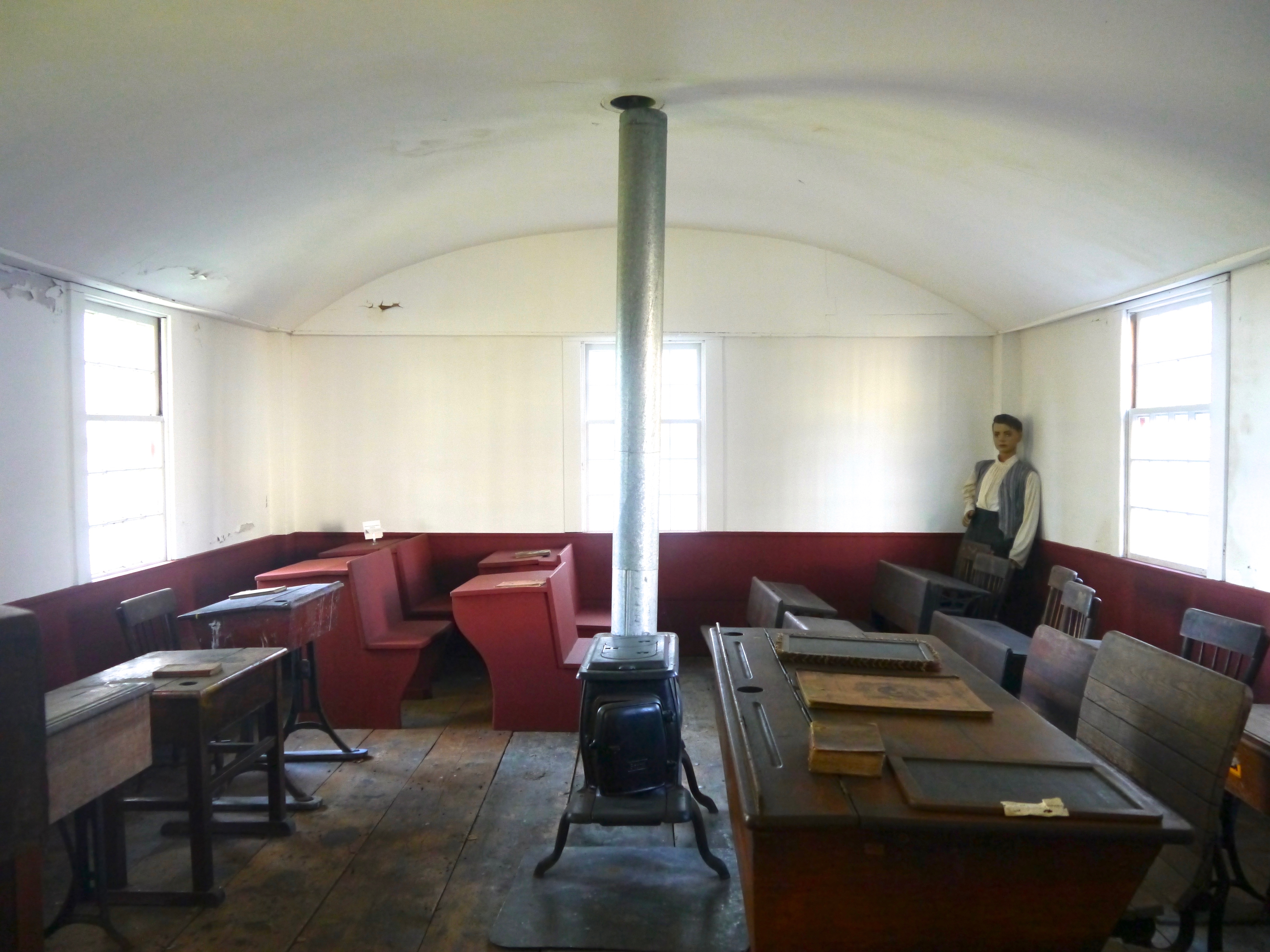
Around 1800 the Southermost School was moved to a location on the north side of Union Street nearer to West Main Road. That lot is used for a utility building for the town. At that time the entryway was added to the building and a wood stove was added because it no longer had a cellar and fireplace. At this time the Schoolhouse was still functioning as a school.
Around 1863 Southermost was no longer needed and the Almy family purchased the building at auction and moved it to Lakeside Farm at 559 Union Street. The remaining lot was used to build the Gibbs School. At Lakeside Farm the building was used as a tack or harness outbuilding. Members of the Hall family remembered that the the building wad moved to the farm by eight teams of oxen.
In 1952 the Hall family – the owners of Lakeside Farm – donated the school building to the Portsmouth Historical Society. With the building came the original lift part of schoolmaster’s desk and one of the original pupil desks. Through fundraising and grants through the years, the Portsmouth Historical Society has kept the one-room school in good condition.
What books would you think Portsmouth’s first schoolmaster had in his collection? You might guess an arithmetic book and a dictionary. Schoolmaster James Preston had those, but would you think of books for seamen and navigators? We happen to know what books he had because there is a record of the town selling eight books that comprised the library of the ” James Preston, school master, late deceased.”
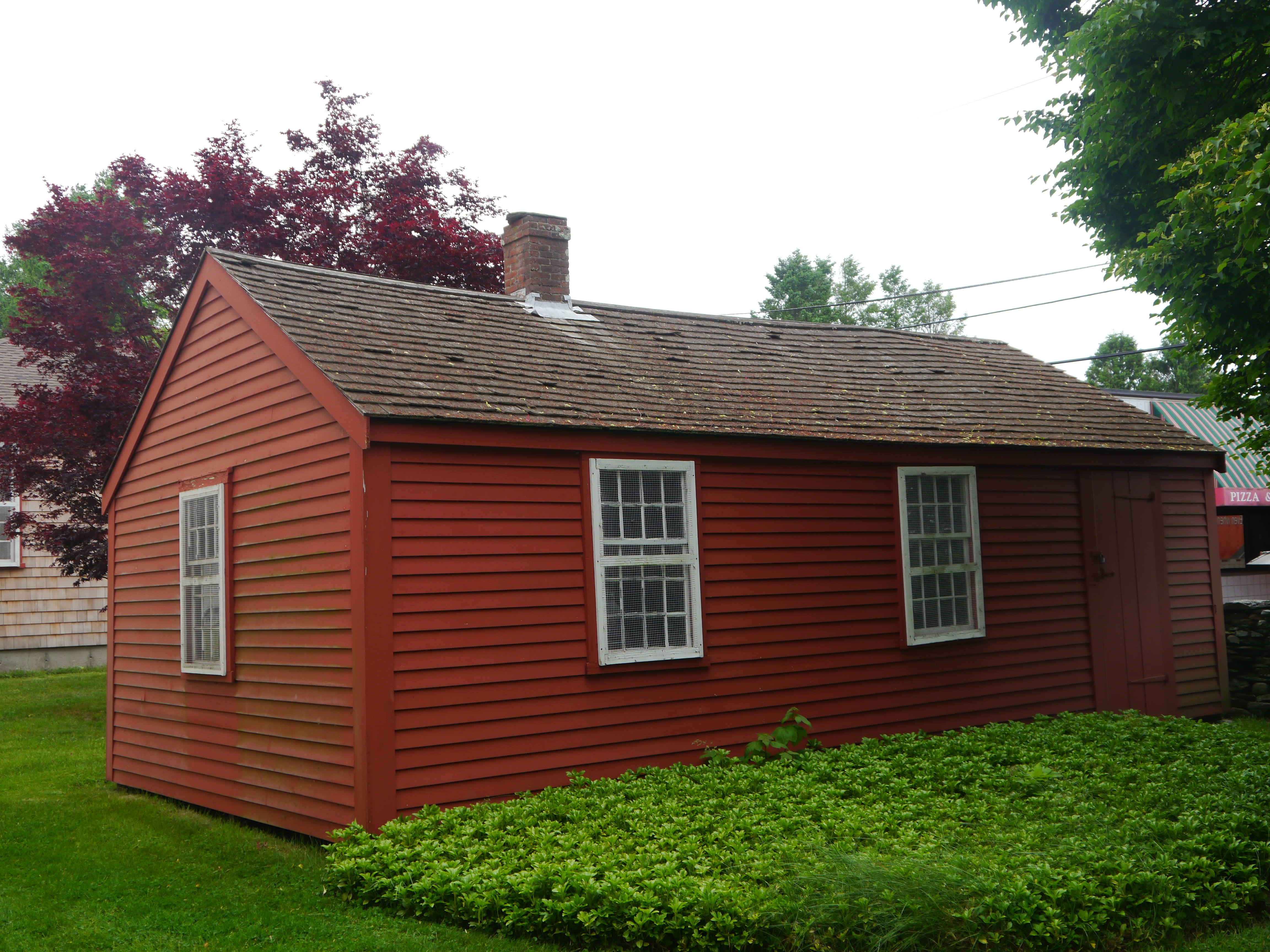
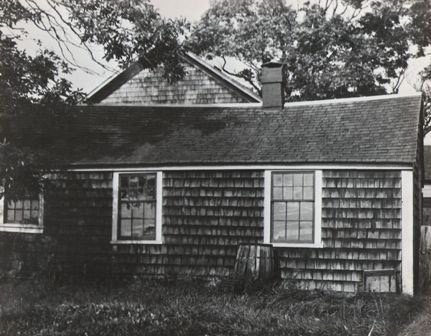
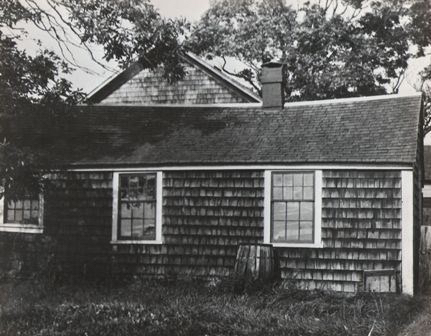
Southermost School on the grounds of the Portsmouth Historical Society.
Preston’s books:
Norwoods Epitomy of Navigation, Cockers Decimal Arithmetic, Mariners Compass Rectified, Seamans Kelender or an Ephemerides, The Art of Measuring, Marriners New Calendar, The Great English and Latin Dictionary and Gumbers Scale.
Preston’s book titles lead me to believe that Preston was trained as a navigator, not a teacher. Attracting a well trained teacher would have been difficult in the small town of Portsmouth. Town records show that in 1724 it was voted that “that the schoolhouse erected and built in said town be improved by the freemen of said town and will hire and settle a schoolmaster in each house for the benefit of all children as shall be sent to be instructed therein.” The Southermost School would serve the children in the south end of the town and the Northermost School would be built to serve the students in the more settled area of the north part of town. By the next year at least the Southermost School was open.
Historian Edward West was able to go through town records to write an article about Portsmouth’s early schools and schoolmasters. He found that our first school teachers were mostly poor, had large families and with the little salary they received they had a hard time providing for their families. West believed that Southermost School was built to house the families of the schoolmasters because it was constructed with an oven in the cellar. West found a mention in the town records that “James Preston (school master) present at this meeting Engaged upon his word that he would Remove himself and his family out of the School House by the first day of September next except the Freemen of the Town should see cause to Improve him to keep school there after the Expiration of said Term.”
Although Preston and his family had lived in the cellar of Southermost School, it was clear from the records that they also boarded with parents of students. West found records that it was the town’s responsibility to keep the schools in repair, but that the parents of the children who attended the school paid for the expenses of the school.
The town had responsibility for the poor and there were few public buildings to house someone who was down on his luck. In December of 1727 the Town Council heard that James Preston was sick and helpless. Two men were appointed to “take care for his relief,” to find a place of residence for him and his family and to provide a nurse for his wife (who was pregnant?). All that James Preston had, including his books and his cow, were sold to contribute to his upkeep. When James Strange refused to house Preston any longer, it was ordered the the family be relocated to Southermost School in the cellar. By 1729 the Town Council ordered ” that James Preston and his family be removed out of the School house wherein they now live…” His wife was ordered to “bind out” her oldest children so they would no longer be a burden on the town.
Richard Schmidt portrays James Preston at a Portsmouth Historical family day.
Credit to the work of Edward H. West: Early Schoolhouses and Schoolmasters of Portsmouth, Rhode Island. In the files of the Portsmouth Historical Society
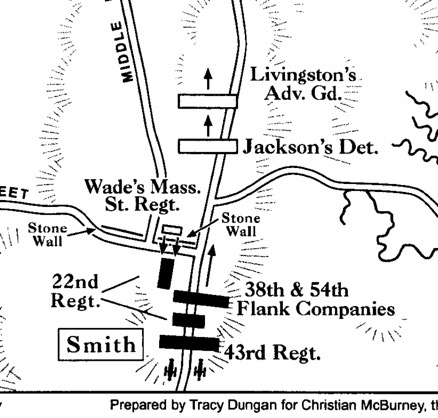
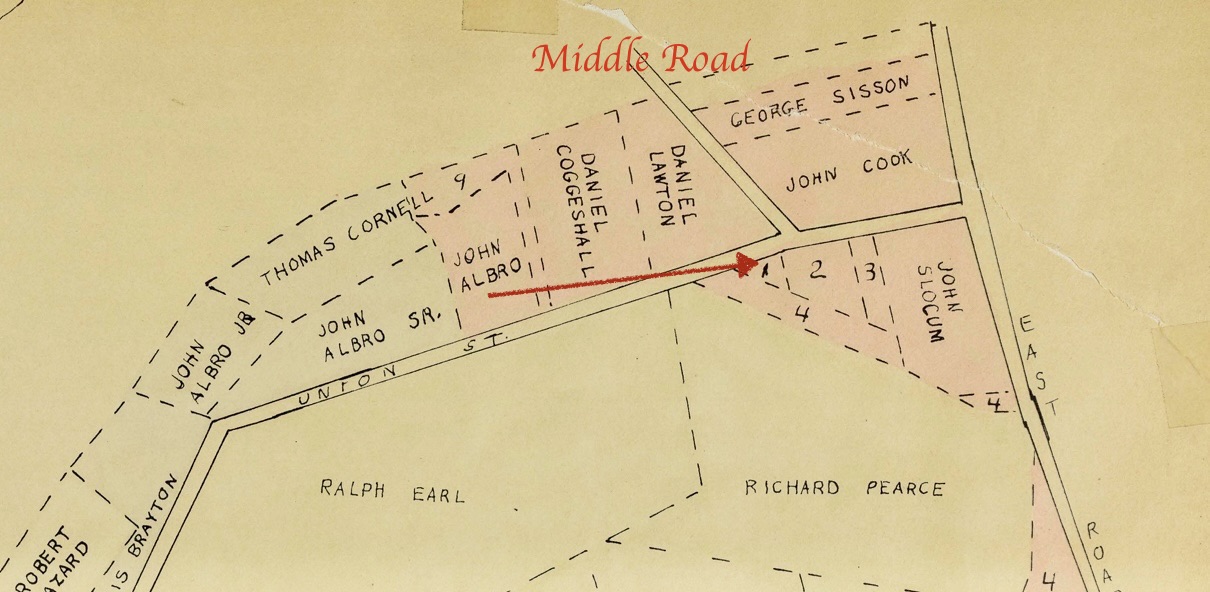
The original location of Southermost School may have been on Union Street near Middle Road. Edward West’s land grant maps are interesting, but may not be precise. A newspaper article quotes past Historical Society President Herb Hall as 102 Union Street as the location. That is slightly different from the land grant maps, but it still puts the building close to the action of the second skirmish of the Battle of Rhode Island. It would have been directly across from the stone walls where Wade’s men were hiding.
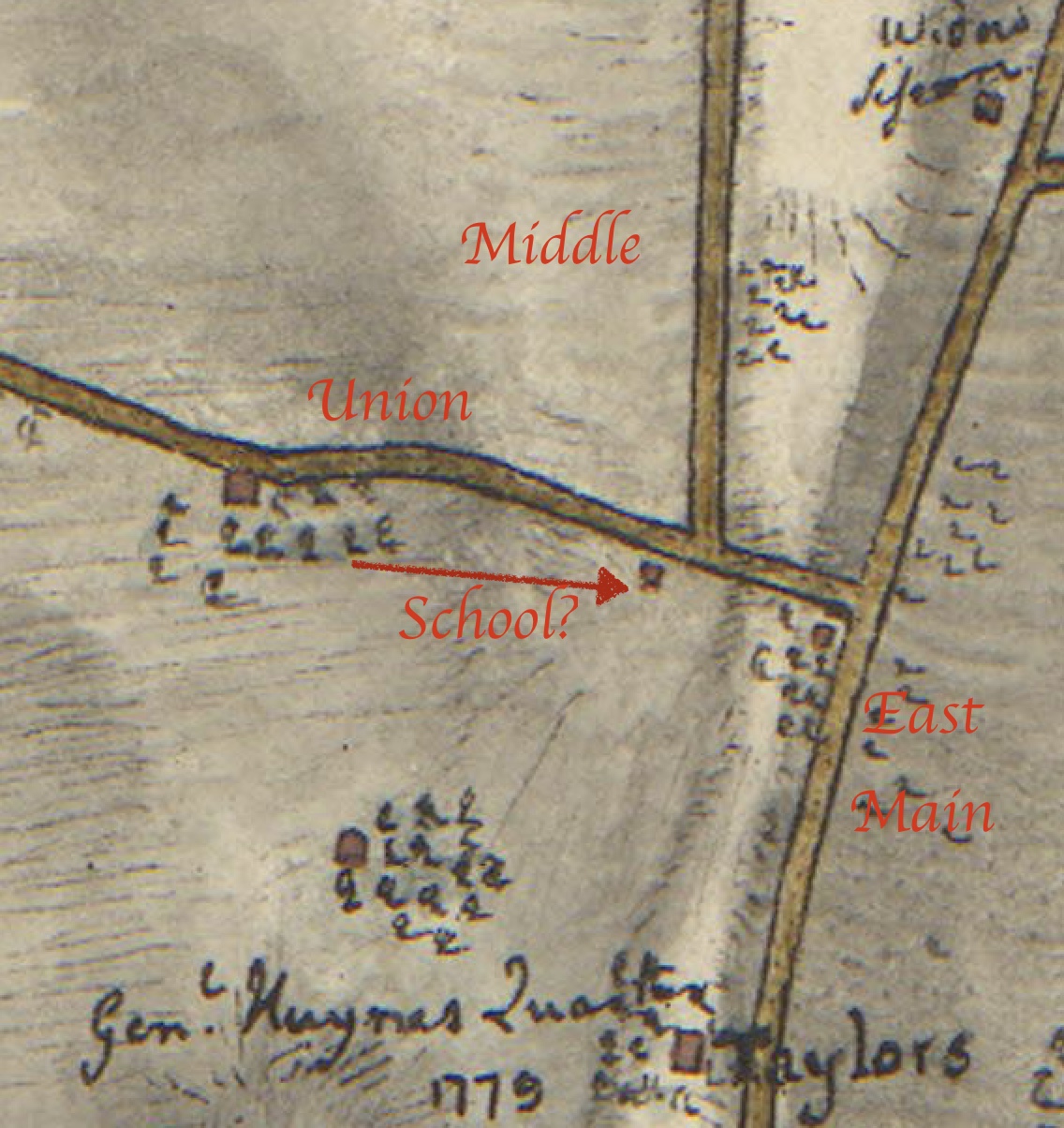
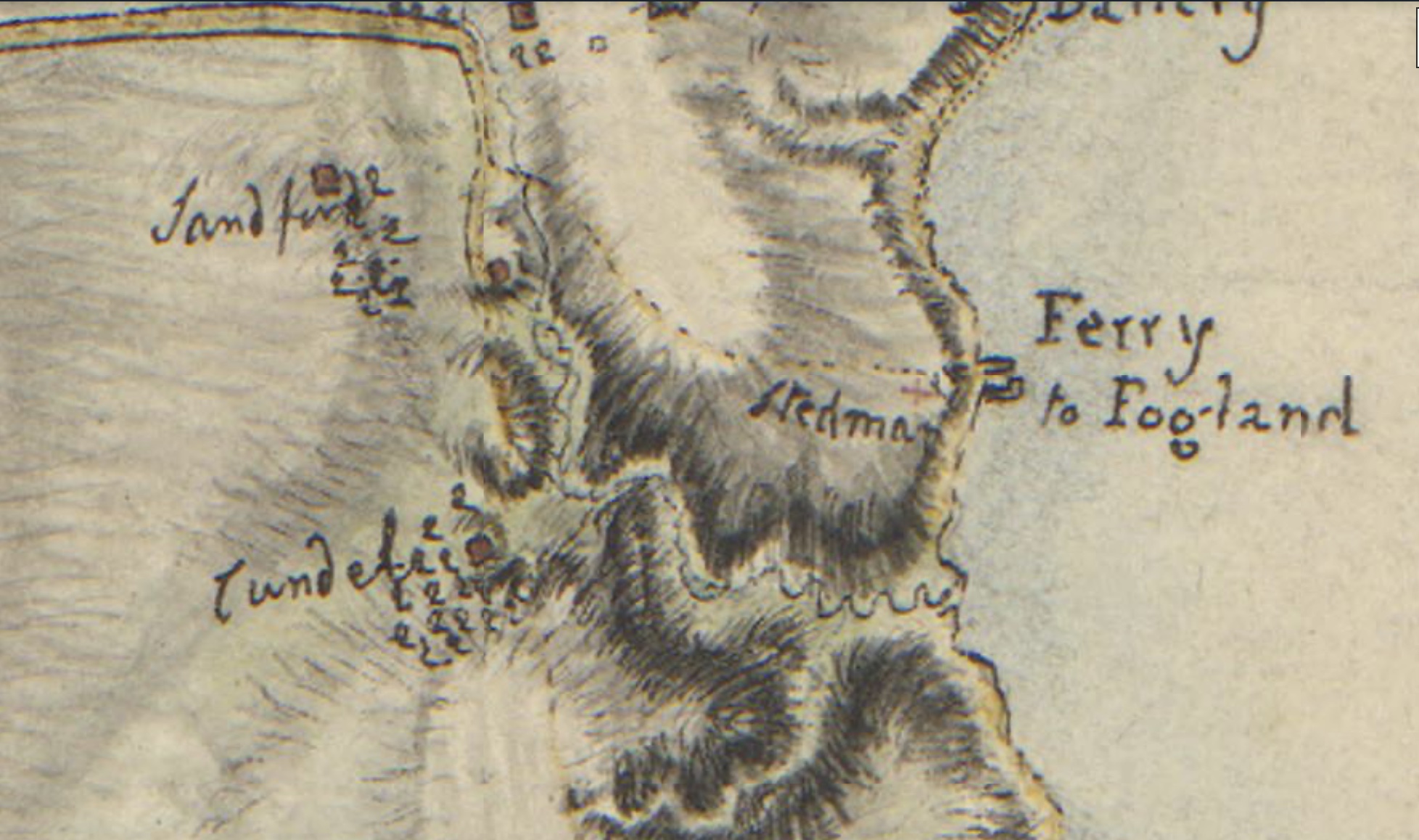
Another Revolutionary map (Fage 1779) shows a building that might be the school. The building on the corner of Union and East Main may have been the home of the Strange family. West’s maps show that was a small land grant to that family.
Fage Map – 1779Based on Google Maps
Portsmouth followed the example of Newport and Providence in wanting education for their children. Once Sanford had donated the necessary land, the town freemen “having considered how excellent an ornament learning is to mankind,” made in 1716 an appropriation for building a school-house. The experiment was successful, and six years later two others were built— one of them sixteen feet square, the other thirty by twenty-five.
Southermost School becomes a home.
Upstairs in the school room there was a hearth that provided warmth for the classroom. The town was to support the building and the students’ families provided room and board for the schoolmaster and his family. Schoolmaster James Preston and his family stayed close by at the home of the Strange family. As one of the few public buildings here in town it is also used for many purposes such as town meetings, church services and sheltering needy families. When the schoolmaster Preston became ill and later died, the Strange family refused to board Preston’s family. Schoolmaster James Preston was reported as being sick and helpless in 1727. In the early days it was the families of the school children that were responsible for the room and board of the schoolmaster and his family. In an article on “Relief Problems of Old New England,” West reports on Portsmouth Town Council decisions. “James Strange (Sarah’s husband) refuses to entertain James Preston and his family any longer in his dwelling house it is agreed by this council that said Preston and his family be settled in the Southermost School house in the town for the present, that is in the cellar part thereof…” The Town Council agreed to pay Preston’s wife money weekly to provide for the family. Now the building at that time was twenty-two feet by fourteen feet – not large at all to house a family and the school children.
In 1730 it was ordered “that James Preston and his family be removed out of the School house wherein they now dwell and that Rebecca his wife pay the charges of their removal and house rent out of the weekly allowance.” Rebecca was forced to “bind out her two eldest children otherwise the said council will put out the said Children in order for the lessening the Towns Charges therein.” Soon afterwards James Preston died and the town paid his funeral charges. There is no further mention of the family in town records.
In a turnabout, the Strange family ended up living at Southermost School. From the lands of Portsmouth – article by Edward West. pg 75
“Continuing along this road we come to the site of the Southern School House, where the widow Sarah Strange took up her residence after the death of her husband; for at a Town Meeting in 1746, she and her family were ordered out, so that the school house might be improved in the use for which it was built.”
Would the Southermost School have been witness to the early skirmishes in the Battle of Rhode Island?
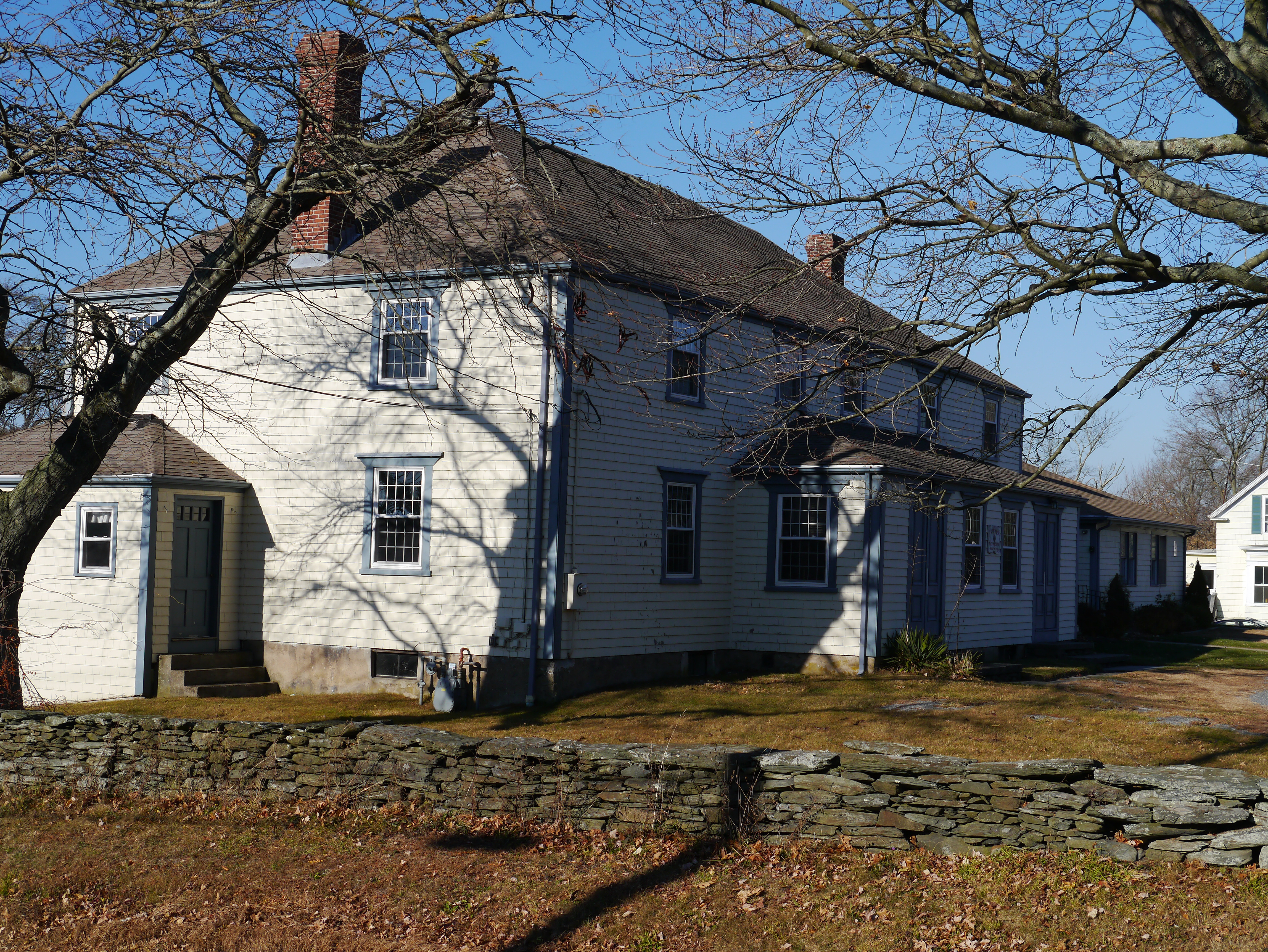
Southemost School before restoration
The Southermost School traveled up and down Union Street. Where was it located at times?
With the coming celebration of the 300th Anniversary of the Southermost School, I am revisiting the information I have gathered in the past. Maps, histories, and documents help us to answer those questions.
According to Portsmouth historian Edward West in his History of Portsmouth 1638-1936, in August of 1716 a school won approval at the Town Meetings. It was to be located on public land between Child Street and Church Lane. The other was approved on September 10th. It would be build on land donated by William Sanford. This was a small triangluar shaped parcel granted to him in 1713. West’s land grant maps help us visualize the location.
I have placed an arrow pointing to this piece of land Sanford Donated. It was labeled as 1. It is on the south side of Union Street and just past Middle Road.
The Portsmouth Historical Society today would be in part of the land of John Cook.
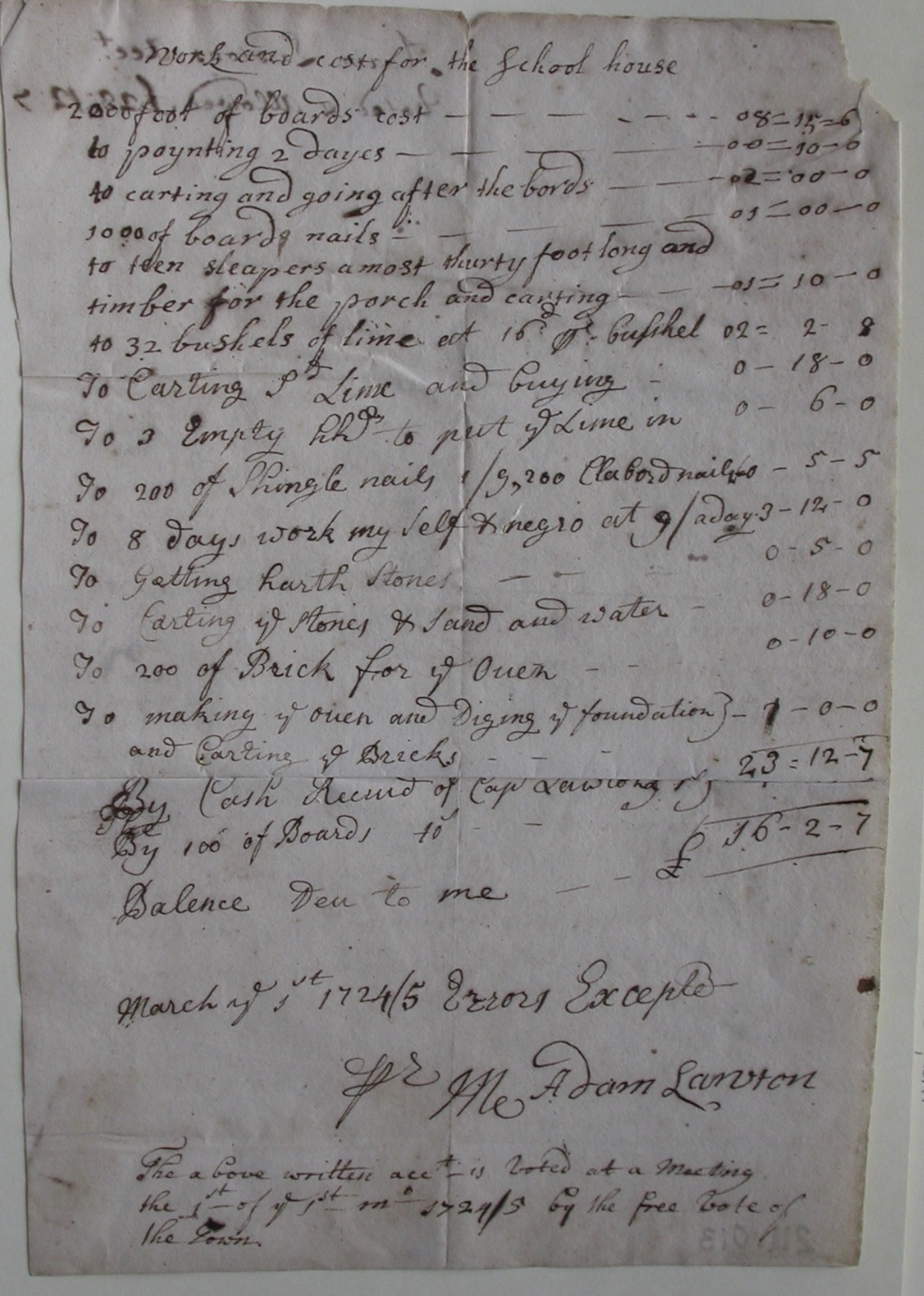
It took nine years for the school to actually be built. The Portsmouth Historical Society has a copy of the bill.
This document gives us some interesting details about what the schoolhouse looked like in its original form.
It had an oven made of 200 bricks. It had a stone hearth. Adam Lawton and a “negro” worked for 8 days on the building. It was completed in March 1725. It is listed as 24/25 because of the change over in the calendar. There was a porch. Lots of lime was used in the building. It took 2 days to paint. Some of the boards were as long as 30 feet.
I recognized the names of a number of those listed on the 1730 census. Some of them I have already researched, so I can give some information about them. So many of these families are inter-related.
John Butts
A son, John, was born to Zaccheus and Sarah in Little Compton in 1691. The family history is complicated, but John would have had his grandfather (Thomas Cornell, Jr.) hung for murder and his great grandmother (Alice Lake) hung for witchcraft. He moved to Portsmouth and is recorded to have had two wives. One of his wives was from the Wordell family and the other, Abigail, was from the Briggs Family. This Briggs connection is interesting because what we call Butts Hill was once called Briggs Hill. On January 15, 1725 John bought from Caleb Bennett a windmill and about one rood (about a quarter of an acre) of land on Windmill Hill (now called Butts Hill). He erected a house by the windmill. He must have owned other land in Portsmouth since he had been considered a freeman for some time. A 1726 map of the Newtown area of Portsmouth shows him having a small parcel of land on what would be the East Path (East Main Road today). John is recorded as being a tavern keeper. He was accused in 1747 of allowing card playing at his tavern and his future son-in-law Thomas Cook was called as a witness against him. John’s daughter Sarah married Cook in 1763. When John died in 1768 he left his daughter, Sarah Butts Cook, “my dwelling house and land, bounded southerly on land from my father-in-law Enoch Briggs, next to David Lake.” This is as far as I can trace the Butts presence on this Windmill Hill (Butts Hill). Some of Butts land was passed down through the Cook family. One Butts family genealogist wrote that the War for Independence had ruined the family fortunes. They lost their land and their business interests.
Joseph Cundall
In 1706 Joseph Cundall had left his native England to become an indentured servant in America. Becoming an indentured servant was a way a young person could learn a trade and get an education in exchange for working for seven years or more. Cundall seems to have learned his trade well and was in a good position to buy land as an adult. James Sisson sold his grist mill and 46 acres around the brook to Joseph Cundall. What we call “the Glen” becames commonly known as Cundall’s Mills. Water from the stream powered the carding and fulling mills to wash and pull woolen fibers. Joseph Cundall added almost a hundred more acres to his land around the Glen before he died in 1760.
A note: Joseph Cundall married Elizabeth Butts
“Plan of Rhode-Island / Surveyed and drawn by Edw: Fage, captn. Royal Artillery, in the years 1777, 78 & 79.”. https://quod.lib.umich.edu/w/wcl1ic/x-828/wcl000922. In the digital collection William L. Clements Library Image Bank. William L. Clements Library, University of Michigan Library Digital Collections. March 10, 2025.
What kinds of information does a census give us about Portsmouth? I have worked with other census documents and within the names and numbers there is a great deal that can be learned from them. An article by Christian McBurney in his blog Small State Big History encouraged me to find the 1730 census for Portsmouth. McBurney’s article, “South Kingstown’s Partial Census for 1730, Whites, Indians and Blacks” noted that the Portsmouth census had been posted in Rhode Island Roots magazine by Ruth Sherman. DAR genealogist Laurie Greaney was kind enough to find it for me.
Quaker Meeting House – dating from 1700.
The census is headed with the note: “The number of Inhabitants, whites, etc. belonging to ye town of Portsmouth 1730.” It goes on to say ” A true Account of the number of the Inhabentantans [sic] of the Town of Portsmouth Taken by me John Freeborn, Sargant –. whites 643, blacks etc 170. Unlike the South Kingston census, Freeborn did not list “Indians” separately but counted them with the “blacks, etc.” That makes the total inhabitants to be 813.
Many of the names remind us of the founding families. They are familiar to us in the street names of Portsmouth. Freeborn, Burden (Borden), Durfee, Shearman (Sherman), Anthony, Lawton, Hall, Earl, Cornell, Slocum, Coggeshall, are just a few of those familiar names.
Working with the census, you can get an idea of life in Portsmouth households. Rhode Island legally abolished slavery in 1652, but the Gradual Emancipation Act of 1784 did more to abolish slavery. Children born after March 1, 1784 could not be enslaved, but children born of an enslaved mother would be supported by the master until they reached adulthood. The census records help us understand who the people of Portsmouth were as a whole. Whites made up to 90.5% of the town residents in 1774 and 93.5% in 1782. In 2020 the white population is about 95%. According to the census of 1730, whites accounted for 79% of inhabitants. After the War for Independence the Quakers (Society of Friends) in Portsmouth began to free their slaves. Among Portsmouth citizens who freed their slaves for religious reasons were William Anthony (1 slave 1775), Thomas Brownell (1 slave 1775), James Coggeshall (3 slaves 1775), Cornell Walter (2 slaves, 1775). Weston Hicks (1 slave 1775), Isaac Lawton (1 slave 1775), James Sisson (3 slaves, 1775). I recognized the family names of several whose ancestors are listed as having blacks in 1730. The idea of “all” being created equal had an effect. In 1730 the situation was different. Out of the 123 households, more than half (68) had blacks in their household. Thomas Hix (Hicks) with 8 had the largest number of blacks. Joseph Martin had 7 and George Cornell had 6.
The average number of people (white and black) in a Portsmouth household was 6.6. Daniel Pears had the largest household with 12 whites and 4 blacks. Others with large households were Abral (Able) Tripp, John Alen, Gideon Freeborn, William and Nathanael Hall, William, Benjamin and Job Lawton, Jacob Mott Jr. and Abraham Anthony.
There were a few women listed as head of household. Abigail Shearman, Mary Hefland, Marah Lawton, Joan Taylor, Patience Durfie, Hanah Tallman, and Mary Burden (Borden). Only two – Marah Lawton and Hanah Tallman – had blacks in their household.
Below is a list copied from the census. Some figures had been crossed out and those are marked with XX. These were not included in Freeborn’s totals.
W = WHITES, B= BLACKS, (ETC)
Pears, John W-09 B-03 Pears, Daniel W-12. B-04 Hill, Jothan W-05, B-06 Sweet, James W-08, B-00 Alen, John W-10, B-02 Alen, Willim W-05 B-03 Rementon, Josias W-0X, B-00 Smith, Ebnezer W-10, B-04 Alen, Mathew W-0x B-XX Remington, William W-0X, B-XX Freeborn, Gideon W-10, B-04 Freeborn, Gideon, Jr. W-03, B-02 Denis, Joseph W-06, B-03 Earl, William W-06, B-01 Thomas, Joseph W-08, B-00 Corey, Thomas W-06, B-00 Shref, William W-02, B-00 Almory, Daniel W-07 B-02 Manchester, Nathaniel W-07, B-00 Bennett, Caleb W-02 B-00 Tallman, Peter W-04, B-00 Buts, John W-07, B-00 Durfie, Gideon W-06, B-01 Buranton, John W-03, B-01 Arnold, William W-07, B-00 Wing, John W-04, B-02 Burden, Thomas W-04, B-03 Bengman, Tallman W-08, B-01 Durfie, Thomas W-04, B-01 Tripp, Abial W-10, B-01 Earl, John W-06, B-01 Hall, William W-11, B-01 Tallman, Hanah W-06, B-01 Shearman, Ebnzer W-02, B-01 Fish, Thomas W-05, B-00 Anthony, Abraham W-10, B-00 Durfie, Patience W-08, B-00 Shearman, Pelick W-08, B-05 Shearman, Thomas W-03, B-02 Lawton, William W-10, B-04 Shearman, Joseph W-08, B-00 Sisel, Richard W-09, B-00 Sisel, George W-06, B-00 Fish, Prasuared W-06, B-00 Cook, Joseph W-01, B-02 Cook, Willam W-05, B-01 Sisel, James W-07, B-01 Cook, John W-05, B-03 Cornell, Gideon W-01, B-02 Hall, Pashans W-06, B-00 Taylor, Joan W-05, B-00 Thomas, George W-05 B-00 Hix, Thomas W-10 B-08 Sanford, Wm. W-06 B-01 Shearman, Abigail W- 05, B-00 Slocumb, John W-08, B-01 Cornell, George W-03, B-01 Lawton, Thomas W-06. B-00 Cornell, Willam W-06, B-02 Allen, Ralph w-06 Brown, William W-05, B-02 Freeborn, John W-04. B-02 Sanford, John W-06, B-01 Hunt, Adam W-02, B-03 Ward, Joseph W-05, B-02 Lawton, Adam W-05 – B-03 Earl, Joseph W-03, B-01 Lawton, Jeremiah W-04, B-00 Lawton, JeremiahJR W-09, B-00 Strang, James W-07, B-00 Albrow, John W-06, B-00 Shearman, John W-05, B-03 Lawton, Bengeman W-12, B-00 Wilbour, William W-8, B-00 Counsel, Joseph W-06. B-00 Tyler, William W-07, B-00 Lawton, George W-06, B-00 Brghtmon, William w-08, B-00 Lawton, Robert W-06, B-06 Cornell, Wator W-03, B-01 Cogshel, Joshey W-03, B-02 Martin, Joseph W-07, B-07 Lawton, John W-02, B-04 Sisel, John W-08. B-00 Anthony, John W-04, B-00 Andros, John W-03, B-00 Sodrick, Solomon W-05, B-00 Peteface, Samuel W-07, B-00 Shref, Caleb W-06, B-00 Lawton, Isaacs W-08, B-04 Braeton, Francis W-06, B-01 Hefland, Mary W-04, B-00 Cook, Thomas W-03, B-02 Springer, Bengeman W-XX B-00 Presen, Rabecker W-03, B-00 Mott, Jacpb W-03. B-00 Dexter, John W-08, B-02 Lawton, Job W-12, B-04 Albrow, Samuel W-06, B-00 Hall, Nathaniel W-10, B-03 Lawton, Marah W-06, B-02 Mott, Jacob Jr W-10, B-00 Cornell, George W-09, B-06 Fish, Daniel W-05, B-03 Tallman, Stephen w-06, B-03 Brownell, Stephen W-04, B-02 Brownell, Joseph W-02, B-03 Brigs, Eneck W-04, B-02 Lake, David W-08, B-00 Howland, Daniel W-04, B-03 Corey, Mikel W-05, B-00 Burenton, William W-02, B-01 Burenton, Roger W-06, B-01 Anthony, William W-09, B-01 Slocomb, Gils W-07, B-02 Arnald, Jesias W-04, B-01 Burden, Mary W-01. B-00 Anthony, Jacob W-09. B-00 Fish, Jothan W-05, B-00 Sref, John W-07, B-00 Coggeshel, William W-08, B-02 Wilcox, Joseph W-07, B-00
As twenty-first century residents of Portsmouth, it is hard for us to imagine how common slavery was in Colonial Portsmouth.
Sources:
This is a link to Christian McBurney’s blog which focuses on Rhode Island history.
The 1730 Portsmouth census can be found in an article by Ruth W. Sherman, “1730 Census, Portsmouth, R.I.,” Rhode Island Roots, vol 7, no. 2 (June 1981), p.16.
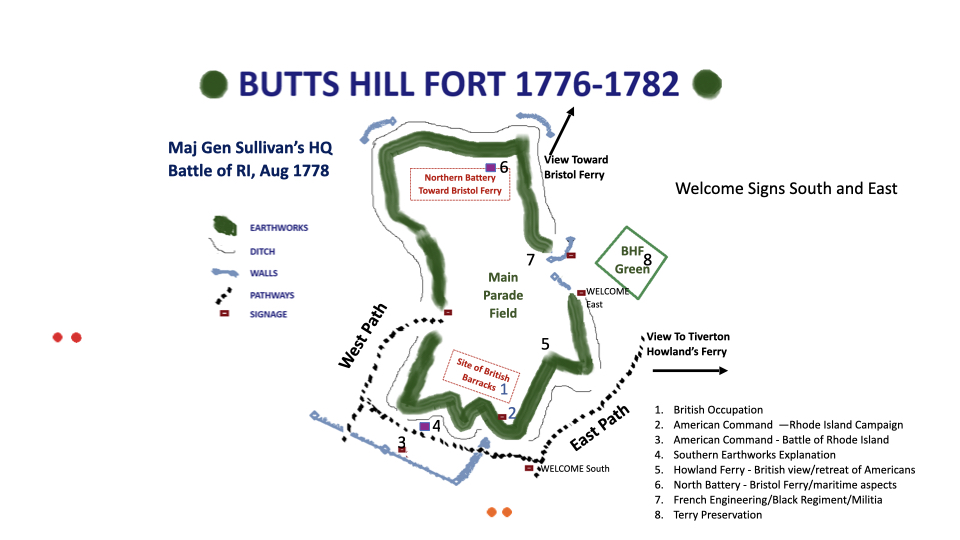
It is time for a new walking guide to Butts Hill Fort. I wrote one two years ago. However thanks to the scholarship of historians sponsored by the Battle of Rhode Island Association, we have added information. I am working on a grant for QR markers for a trail and I started by working with Butts Hill Fort Restoration Committee’s Paul Murphy about where information stations should be and what the topic of each site should be. As I was writing scripts for my husband to do audio clips, it seemed to me that those drafts would work into a book. I am a retired librarian and I have a soft spot for “hard copies.”
The self-publishing company I deal with offers downloadable pdfs and that is what I am posting here.
I hope readers will understand:
That although my husband and I have proofed this there are probably many corrections needed. I appreciate feedback to make corrections. I have only ordered a few copies and there is opportunity for changes.
That this is not a comprehensive tour. Each of the sites has a short introduction to the fort and phases of the Rhode Island Campaign.
That this was written for a tour with short audio clips. Some pages – timeline, glossary, etc. are in the booklet but will not be in the tour.
With grant funding tenuous these days, I have to think of other ways to finance signage for a walk.

 portsmouthhistorynotes