Home

What Precipitated the Battle of Rhode Island?

Leave a comment

Tomorrow we honor those who participated in the Battle of Rhode Island with a Sunset Salute at Butts Hill Fort. Why did we have a battle? What was the spark? Over the past week I have heard an historian and a US Senator tell us that it was initiated by the British. I have been working on a role playing activity to let students and adults experience the decision making that principals in the Battle of Rhode Island had to make in the heat of the action. I like to draw from primary sources as I provide background material to the decisions that had to be made. Drawing from the diary of British soldier Frederick Mackenzie, I believe that the British were reacting to the retreat that they discovered that the Americans had already started overnight on August 28th.
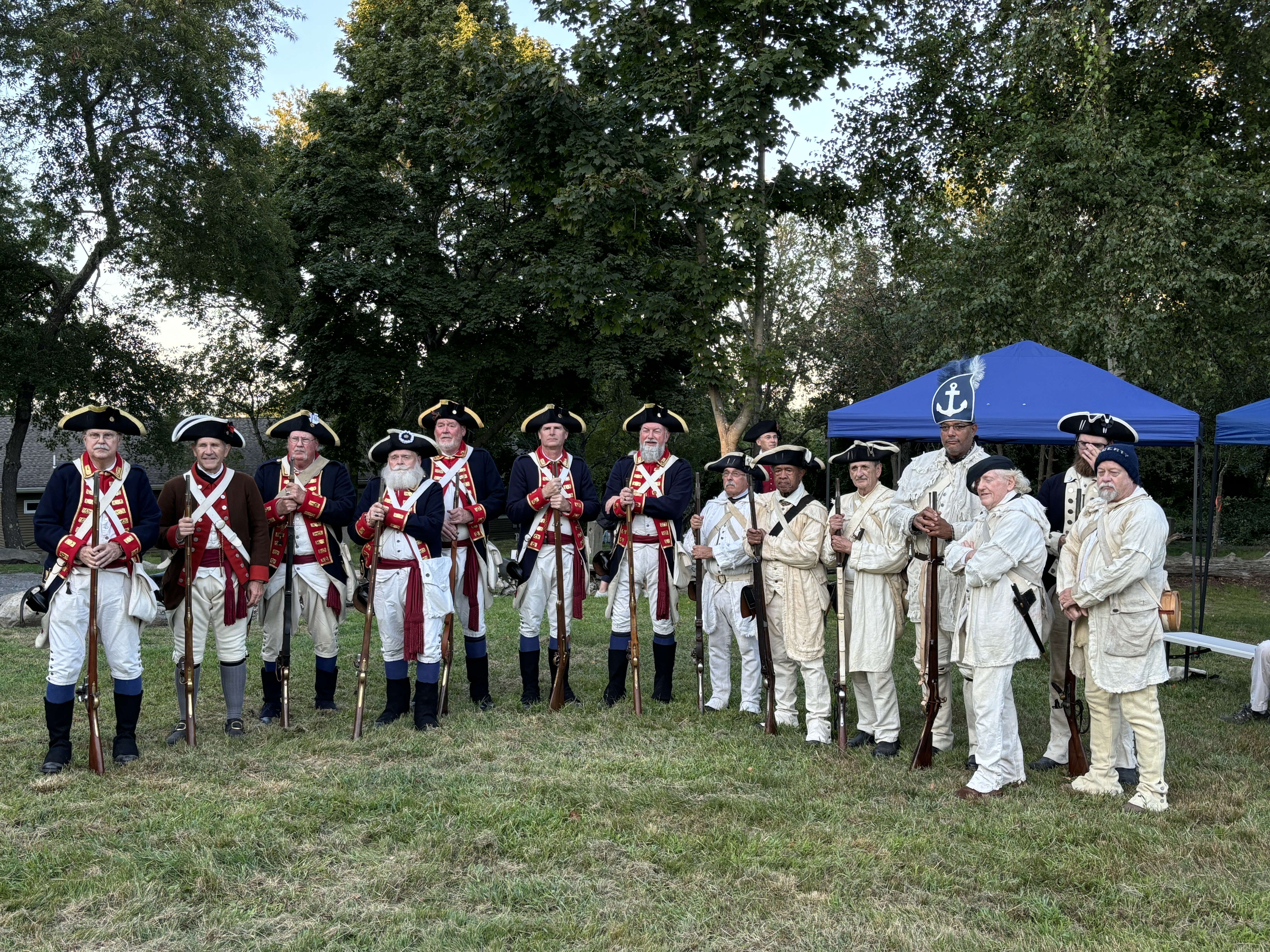
Sunset Salute 2024

“As soon as the day broke this Morning and we could see as far as the Enemys Encampment it was observed that their tents were struck; I went immediately on top of Dudleys house, and when it grew lighter, I could plainly perceive that the Rebels had struck their whole Camp, and had marched off; hardly a man was to be seen in their Batteries or Trenches. I rode as fast as possible to General Pigot’s quarters in Newport and informed him of it, and returned to the Camp with his orders for all the troops to get under arms with the utmost expedition. The General came to Irishes Redoubt by the time the Troops were assembled, and being satisfied that the Rebels had quitted their position, he gave orders for a part of the Army to march out, in three Columns, to pursue them, but to advance with caution, and not bring on an Action with a part of our force.” Mackenzie’s diary August 29, 1778

The British didn’t decide to go on the attack against the American Siege of Newport. Mackenzie notes that the British were “to advance with caution, and not bring on an Action with a part of our force.” The British found that Americans had left their positions and General Pigot decided to go after them to capture the American Army before it could retreat off Aquidneck Island. The goal of the Americans was to get their soldiers and equipment safely to Tiverton so they could fight another day. The American aim in the battle was to push the British and German (Hessian) troops back so that a successful retreat could be made. They were in an untenable position once it was clear that the French were not coming back to aide in the plans of the Rhode Island Campaign. The Americans were not trying for a full engagement either.
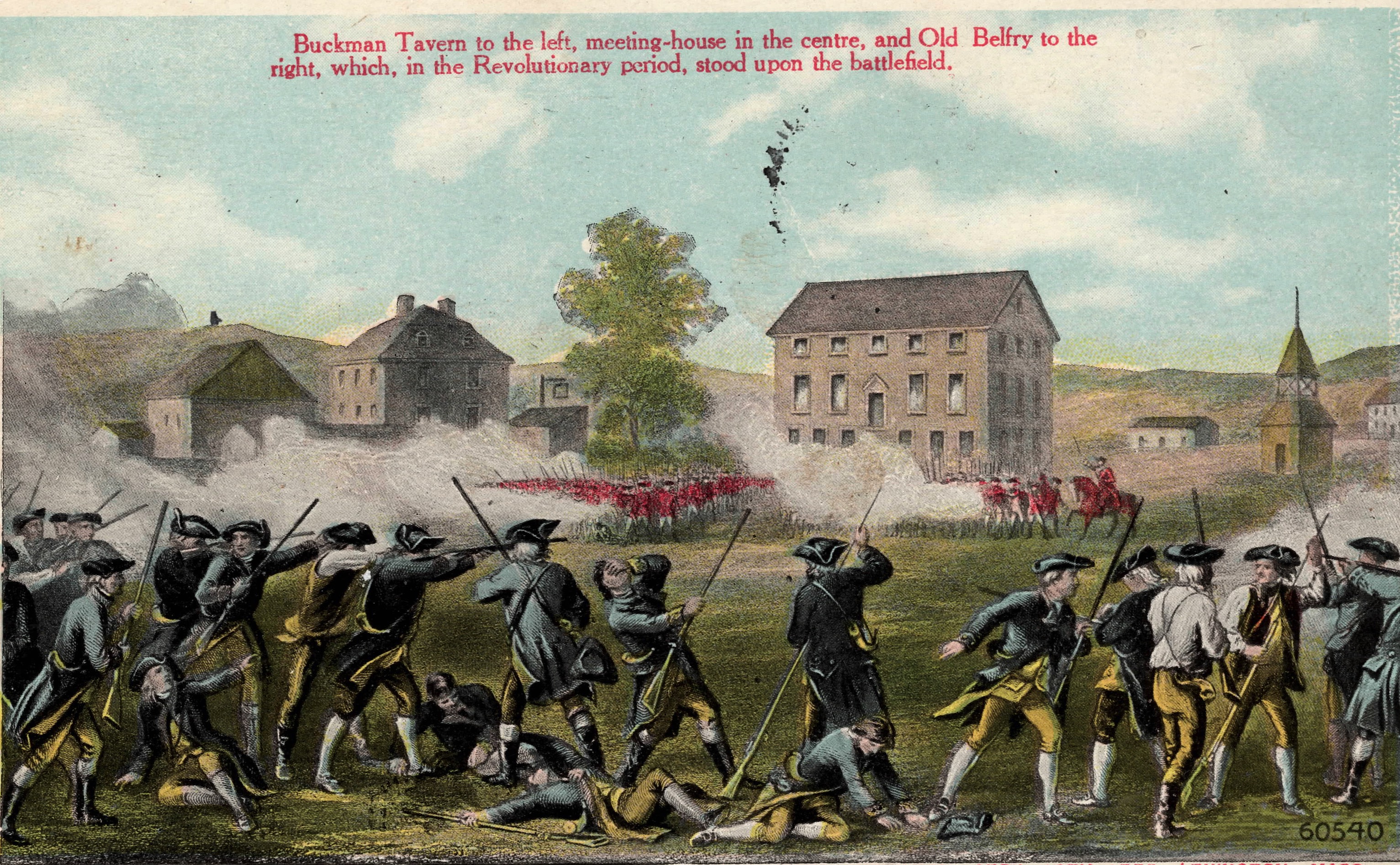
Military Tactics During the American Revolution

Leave a comment

I’m not a military historian. I am working on a role playing activity to give students and interested adults a sense of the decisions that had to be made on both sides in the Battle of Rhode Island. So I am learning about military tactics. If I ask role players to make decisions about what they would do when faced with certain situations during the Battle of Rhode Island, I need to inform the players about what their choices might be. What follows is a gathering of military tactics and an attempt to define them in a way players might understand. I appreciate feedback from readers that have more military experience.

    Tactics
    1. Linear formations: Both British and American forces often fought in close-order formations, relying on mass volleys because musket fire was not very accurate.

    2. Open formations: Instead of close formation in line, skirmishers are more spread out and use the terrain to take cover.

    3. Scouts: Used ahead of the main forces to gather information and to protect the flanks (sides) and rear of the army.

    4. Fabian Strategy: General Washington employed this tactic, which involved avoiding major battles while harassing the enemy and gathering intelligence, according to the American Battlefield Trust.

    5. Guerilla Tactics:

    • A. Surprise Attack: Element of surprise used to gain an advantage. Soldiers used the American landscape to their advantage – using forests and hills ( especially stone walls and corn stalks in Portsmouth) to hide and then surprise the enemy.
    • B. Ambush: A type of surprise attack where the attackers conceal themselves and then launch a sudden attack inflicting damage before the enemy can defend themselves.
    • C. Hit-and-run attacks: Using short surprise attacks and withdrawing before the enemy can respond in force. This inflicts damage on the enemy without a full-scale battle.
    • D. Harassing Tactics: Firing from a distance, disrupting formations, tactics that delay the enemy.

    Resources: An excellent overview was created by American Battlefield Trust. The same tactics were used on both sides:
    https://youtu.be/OYljJSZTVZA?si=9q1c5_ECJ-ApVQY3


    .

    Commanders of the Battle: Col. Edward Wigglesworth

    Leave a comment

    1742-1826

    Edward Wigglesworth was born and raided up in Newburyport, Massachusetts. He graduated from Harvard and worked for merchants in Newburyport. That gave him experience as a ship’s captain in the Caribbean. In 1776 he was commissioned a Colonel and he took command of the 6th Massachusetts Continental Battalion. His battalion was ordered to Fort Ticonderoga as the Americans were quickly building a fleet to counter the British on Lake Champlain. As an experienced mariner, General Gates appointed Wigglesworth as third in command of the American fleet. Wigglesworth joined the fleet and took part in the Battle of Valcour Island in October of 1776. With the destruction of the American fleet, Wigglesworth escaped back to Fort Ticonderoga and took command of his battalion again. When his battalion disbanded, he was took command of the 13th Massachusetts Regiment. He was at Valley Forge and took part in many battles.

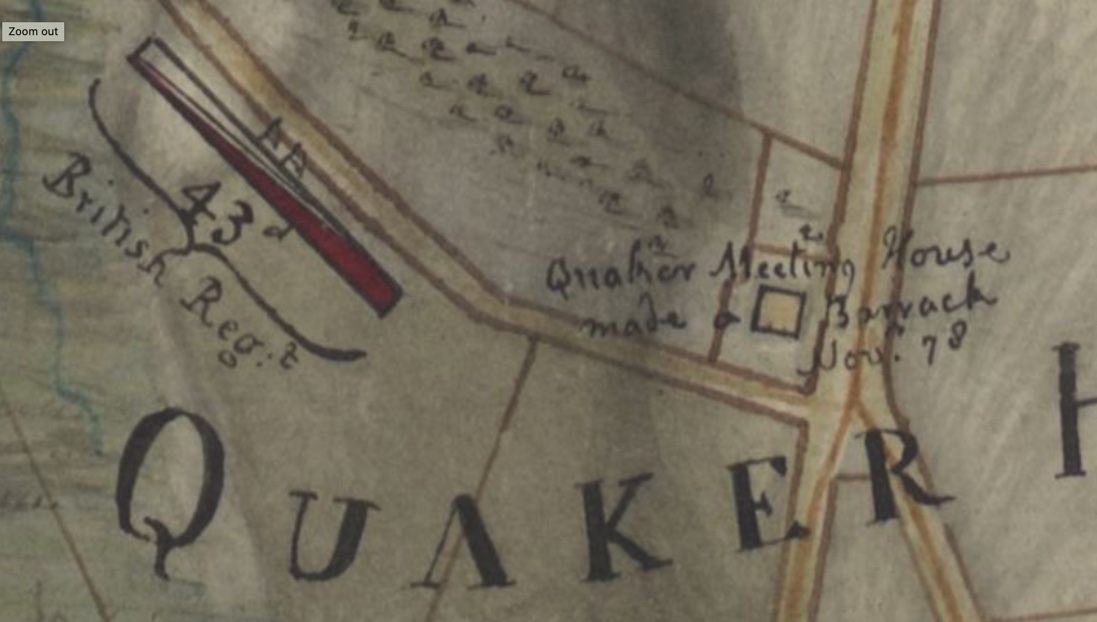
    During the Battle of Rhode Island, Wigglesworth was positioned at Quaker Hill. American units (Wiggleworth’s Regiment, Livingston’s advanced guard and Wade’s pickets) were waiting at the junction of Middle Road, East Road and Hedley Street near where the Quaker Meeting House was located. Wigglesworth mistook the uniform of the Hessians troops advancing for American soldiers. Sullivan sent John Trumbull up Quaker Hill to set Wigglesworth straight. American General Sullivan saw his troops retreating, so he sent in Shepard’s Regiment of Massachusetts Continentals. General Sullivan’s “Life Guards” were sent in as well. For a while the Americans had an advantage.

    A private from Jackson’s attachment described the action:

    Detail of Quaker Hill from Huntington Map.

    “We began to attack. The action began to be warm when we were reinforced by Col. Shepard’s Regiment under the command of Lieutenant Colonel Sprout. The action then commenced hot. We plied them so briskly that they began to give way. Our troops seeing this, gave three cheers and advanced. The enemy then gave way and left one piece of cannon but poorly supported. A party of our men then advanced, drove the artillerymen and took possession of the cannon. The enemy then rallied and being reinforced, advanced and gave our men so heavy a fire that they obliged them to quit their prize, the cannon.” (From: Diary of a soldier in the RI Expedition (Massachusetts Historical Society. Quoted in McBurney.)

    Like many other officers he exhausted his financial reserves and resigned from the army in 1779. He returned to Newburyport and ultimately was appointed tax collector for the port. He held this post for many years prior to his death on December 8, 1826.

    Resources

    Finding Wigglesworth’s Lost Diary.  All things liberty 2018.

    Christian McBurney’s book on the Rhode Island Campaign.

    Edwin Stone’s Our French Allies.

    Decision Points – Battle of Rhode Island

    Leave a comment

    Christian McBurney’s book on the Battle Rhode Island Campaign provides me with a step by step breakdown of the action, but I still need to digest it slowly. While I work on a tabletop role playing activity centered around the Battle of Rhode Island, I am trying to draw out the points in the battle where decisions had to be made. These are some of the decision points I may include in the role playing.

    August 28

    1. Once the Americans knew the French would not be returning, Sullivan’s council of war had to make a decision on whether to continue their Siege or Retreat.
    2. Once the decision was made to retreat – Sullivan had to devise a strategy for that retreat.

    August 29

    1. In making a decision to retreat, how did the geography of Portsmouth affect the strategy for the retreat?
    2. How would Sullivan decide to distribute the seasoned soldiers and raw militia?
    3. How would Sullivan decide where to place the advanced guards to hinder the enemy?
    4. The British had been on the defensive with the Siege. What decisions does Pigot make to go on the offensive?
    5. What is Pigot’s strategy?
    6. On Turkey Hill, Lauren asks Sullivan for more men. What decisions does Sullivan make?
    7. When Malsburg is out of ammunition past Turkey Hill, what decision does he make?
    8. What were Malsburg’s decisions on attacking the redoubt.
    9. What decisions did the British Navy make?
    10. Greene urged Sullivan to Fully Engage when the British got beyond Quaker Hill. What decision did Sullivan make?
    11. How did the American actions change the Navy’s decisions?
    12. What decisions did Nathanael Greene make in flanking the Hessians?
    13. What decisions did Smith make when he had orders not to make a general engagement?
    14. Later in the afternoon, when Sullivan was faced with the choice of counter attack or stay put – what decision did he make?

    Questions:

    1. How did both armies communicate?
    2. What were some of the tactics used by the Americans?
    3. What were some of the tactics used by the British?

    Commanders of the Battle: Robert Pigot

    Leave a comment

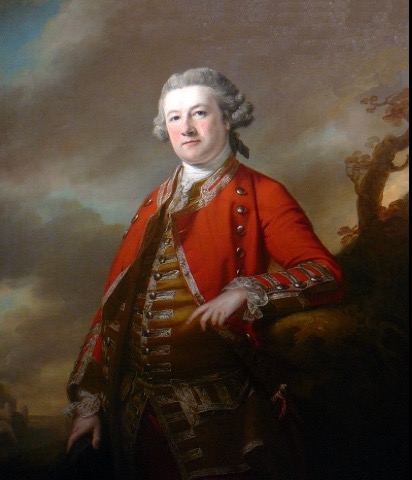
    Robert Pigott- 1720-1796
    Sir Robert Pigot was from a prominent Huguenot family in London. His brother Hugh was an admiral in the Navy. Pigot joined the British Army before the Revolutionary War and in 1758 was a major in Seventieth Regiment. Although he continued in the army, he was elected as a Member of Parliament. He commanded the Fifty-Fifth Regiment in Ireland as colonel in 1775. After this assignment he moved to America. During the Battle of Bunker Hill, Pigot commanded the left flank of Howe’s army. He led the second assault on the colonists’ position but he failed to break the Americans. In 1776, he was promoted to Major General and was placed in command of the British forces occupying Rhode Island. In 1778 he was in command of British forces during the Rhode Island Campaign. This was a joint effort of French and American forces, but the French pulled out unexpectedly when a storm damaged their ships. When the French ships had arrived near Newport, Pigot ordered his forces to evacuate Portsmouth. The Americans progressed close to Newport, but they began a retreat off the island when it was clear that the French would not come back to help them. Pigot’s forces hoped to catch the Americans in their retreat and his men chased the Americans as they prepared to leave via Howland’s Ferry. This action was known as the Battle of Rhode Island. The British were not able to prevent the Americans from retreating off the island. Rhode Island remained in British hands, but Pigot faced criticism for failing to capture the retreating army. He soon moved back to England.

    Eyewitness Account – Pigot gives his orders on August 29th: “As soon as the day broke this Morning and we could see as far as the Enemys Encampment it was observed that their tents were struck; I went immediately on top of Dudleys house, and when it grew lighter, I could plainly perceive that the Rebels had struck their whole Camp, and had marched off; hardly a man was to be seen in their Batteries or Trenches. I rode as fast as possible to General Pigot’s quarters in Newport and informed him of it, and returned to the Camp with his orders for all the troops to get under arms with the utmost expedition. The General came to Irishes Redoubt by the time the Troops were assembled, and being satisfied that the Rebels had quitted their position, he gave orders for a part of the Army to march out, in three Columns, to pursue them, but to advance with caution, and not bring on an Action with a part of our force.” Frederick Mackenzie’s Diary – August 29, 1778.

    Commanders of the Battle: John Sullivan

    Leave a comment

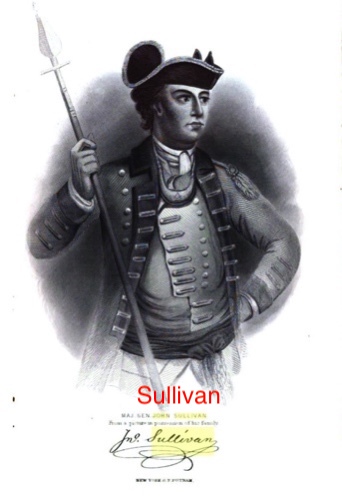
    Major General John Sullivan : Commander in Chief.

    1740-1795

    Sullivan was the son of Irish immigrants who settled in New Hampshire. He served as a Delegate to the Continental congress, Governor of New Hampshire, and United States district judge. The was trained as a lawyer. In 1772 the Royal governor of New Hampshire appointed him as major in The New Hampshire militia. Sullivan began to have rebel leanings. Sullivan was sent as delegate to first continental congress in 1774 and in 1775 he was sent to the Second Continental Congress. Congress appointed George Washington commander in chief and John Sullivan as brigadier general. Sullivan joined the American Army at the siege of Boston. Later he took command of a force in Quebec which ended as a failed invasion. Sullivan had to withdraw the survivors. He was captured in defeat at Battle of Long Island. British General Howe released him on parole to deliver a message to Congress. He was later released in a prisoner exchange for captured British general Prescott. He had some success in battle but had continued difficulties as well. In Early 1778 he was transferred to the post of Rhode Island where he led the continental troops and militia.

    His eyewitness account:

    General Sullivan writes in a letter to Congress:

    “To make a retreat in the face of an enemy, equal, if not superior in number, and cross a river without loss, I knew was an arduous task, and seldom accomplished, if attempted. As our sentries were within 200 yards of other, I knew it would require the greatest care and attention. To cover my design from the enemy, I ordered a number of tents to be brought forward and pitched in sight of the enemy, and almost the whole army employed themselves in fortifying the camp. The heavy baggage and stores were falling back and crossing through the day; at dark, the tents were struck, the light baggage and troops passed dawn, and before twelve o’clock the main army had crossed with the stores and baggage. The Marquis de la Fayette arrived about 11 in the evening from Boston, where he had been by request of the general officers, to solicit the speedy return of the fleet. He was sensibly mortified that he was out of action; and that he might not be out of the way in case of action, he had rode from hence to Boston in seven hours , and returned in six and a half, the distance near seventy miles — he returned time enough to bring off the pickets, and other parties, which converted the retreat of the army, which he did in excellent order; not a man was left behind, nor the smallest article left. I hope my conduct through this expedition may merit the approbation of Congress. Major Morris, one of my aids will have the honor of delivering this to your Excellency; I must beg leave to recommend him to Congress as an officer who is in the last, as well as several other actions, has behaved with great spirit and good conduct, and doubt not Congress will take such notice of him, as his long service and spirited conduct deserves. I have the honor to be, dear Sir, Your very humble servant – John Sullivan.”

    Commanders at the Battle of Rhode Island

    1 Comment

    I am working on a simple role playing game to take people through the Battle of Rhode Island. Right now I am working on cards to introduce the primary actors in the battle. I am going through the biographies of these men and I will post the material here on my blog.

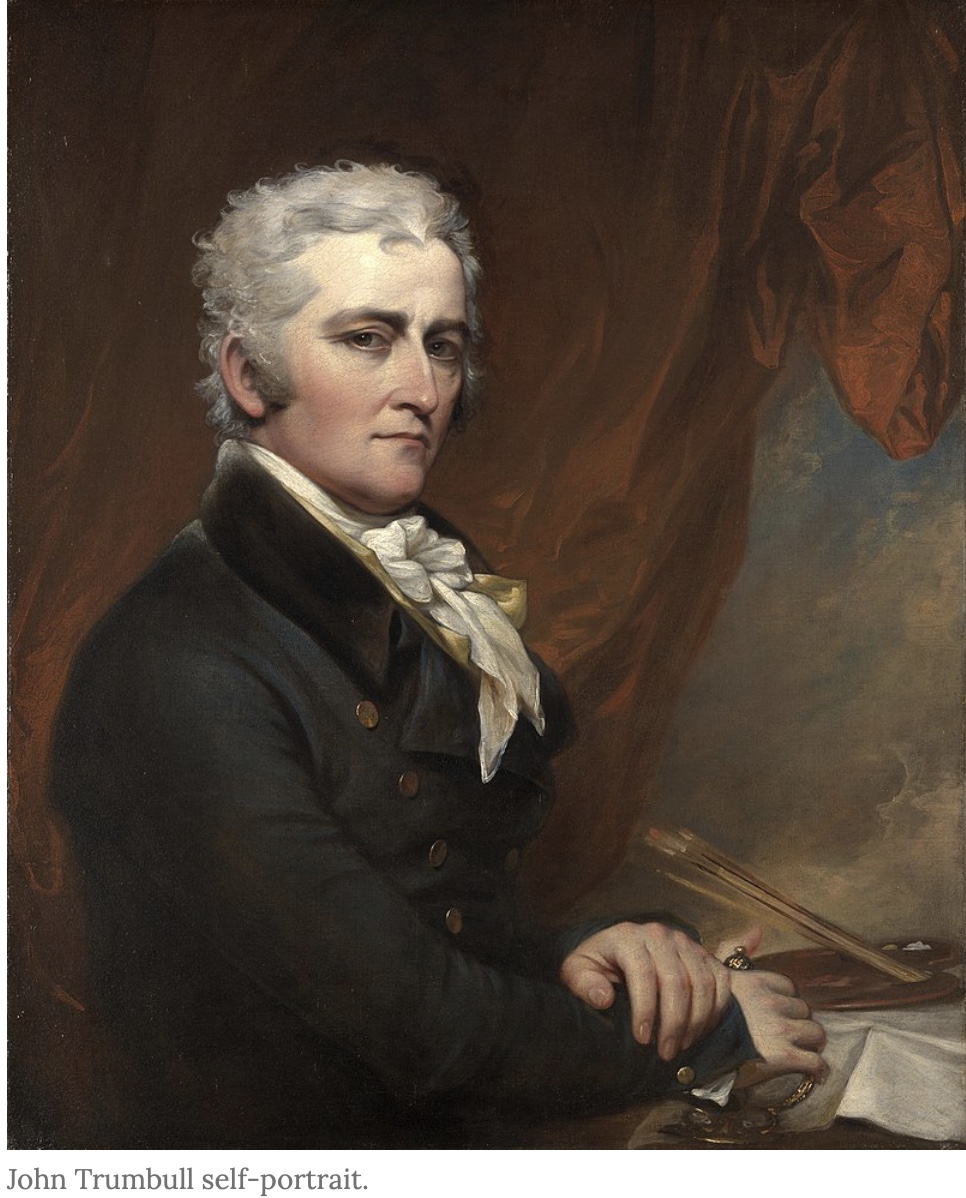
    John Trumbull

    Aide to General Sullivan – In Battle Nathanael Greene put him in charge of Lovell’s Brigade

    1756 – 1843

    Military Career up to Battle of Rhode Island

    Born in 1756 in Lebanon, Connecticut, John Trumbull graduated from Harvard College in 1773. He served with the Connecticut First Regiment in the early months of the revolution. Many of the biographical materials have him resigning from that regiment and going on to England to study painting, however he wrote about the Battle of Rhode Island. In 1778 he became an aide-de-camp to General John Sullivan in Rhode Island.

    An Eyewitness Account by Trumbull

    “Soon after daybreak the next morning, the rear-guard, commanded by that excellent officer, Colonel Wigglesworth, was attacked on Quaker, and General Sullivan, wishing to avoid a serious action on that ground, sent me with orders to commanding officer to withdraw the guard. ….. 

    Nothing can be more trying to the nerves, than to advance deliberatively and alone into danger. At first I saw a round shot or two drop near me, I spurred on my horse to the summit of the hill, and found myself in the midst of the melee. ‘Don’t say a word, Trumbull;’ cried the gallant commander, ‘I know your errand, but don’t speak; we will beat them in a moment.’ 

    ‘Col. Wigglesworth, do you see those troops crossing obliquely from the west road towards your rear?’ 

    ‘Yes, they are Americans, coming to our support.’ 

    ‘No sir, those are Germans; mark, their dress is blue and yellow, not buff; they are moving to fell late your rear, and intercept your retreat. Retreat instantly — don’t lose a moment, or you will be cut off.’ 

    And Wigglesworth did retreat.

    As the action in the battle shifted to the West side of Portsmouth, General Greene moved his men to action against the Hessian troops that were attacking the Artillery Redoubt. Greene put John Trumbull in charge of Lovell’s Brigade and sent it to flank the Hessians on their left and attack their rear. The combination of Lovell’s Brigade working with Sherburnes, Jacksons, Varnum’s 2nd RI, Livingston’s First Canadian and Webb’s and Lauren’s guards succeeded in forcing the Hessians back to Turkey Hill leaving their dead and wounded behind them.

    Resources used:

    Battle information from Christian McBurney’s book on the Battle of Rhode Island.

    Eyewitness account in Edwin Stone’s Our French Allies.

    Recent Booklets on Revolutionary Portsmouth

    Leave a comment

    A Children’s Book on Butts Hill

    Leave a comment

    There are not many books for children on the Battle of Rhode Island or on Butts Hill. There are bound to be corrections, so I haven’t printed many.

    A New Walking Guide

    Leave a comment

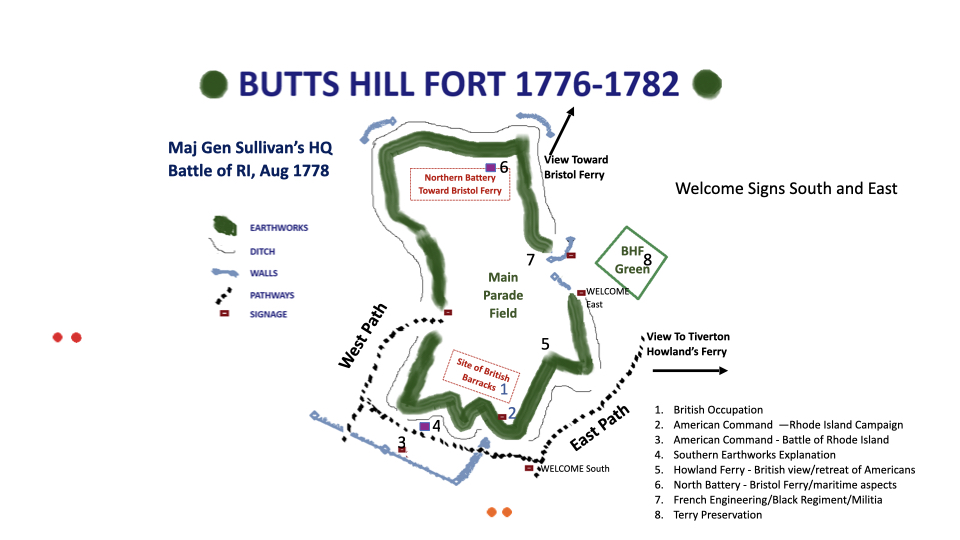
    It is time for a new walking guide to Butts Hill Fort. I wrote one two years ago. However thanks to the scholarship of historians sponsored by the Battle of Rhode Island Association, we have added information. I am working on a grant for QR markers for a trail and I started by working with Butts Hill Fort Restoration Committee’s Paul Murphy about where information stations should be and what the topic of each site should be. As I was writing scripts for my husband to do audio clips, it seemed to me that those drafts would work into a book. I am a retired librarian and I have a soft spot for “hard copies.”

    The self-publishing company I deal with offers downloadable pdfs and that is what I am posting here.

    I hope readers will understand:

    That although my husband and I have proofed this there are probably many corrections needed. I appreciate feedback to make corrections. I have only ordered a few copies and there is opportunity for changes.

    That this is not a comprehensive tour. Each of the sites has a short introduction to the fort and phases of the Rhode Island Campaign.

    That this was written for a tour with short audio clips. Some pages – timeline, glossary, etc. are in the booklet but will not be in the tour.

    With grant funding tenuous these days, I have to think of other ways to finance signage for a walk.

    Older Entries Newer Entries