Home

Annotated Timeline of Revolutionary Rhode Island: 1770 – Declaring Independence

Leave a comment

June 9, 1772: The Burning of the Gaspee

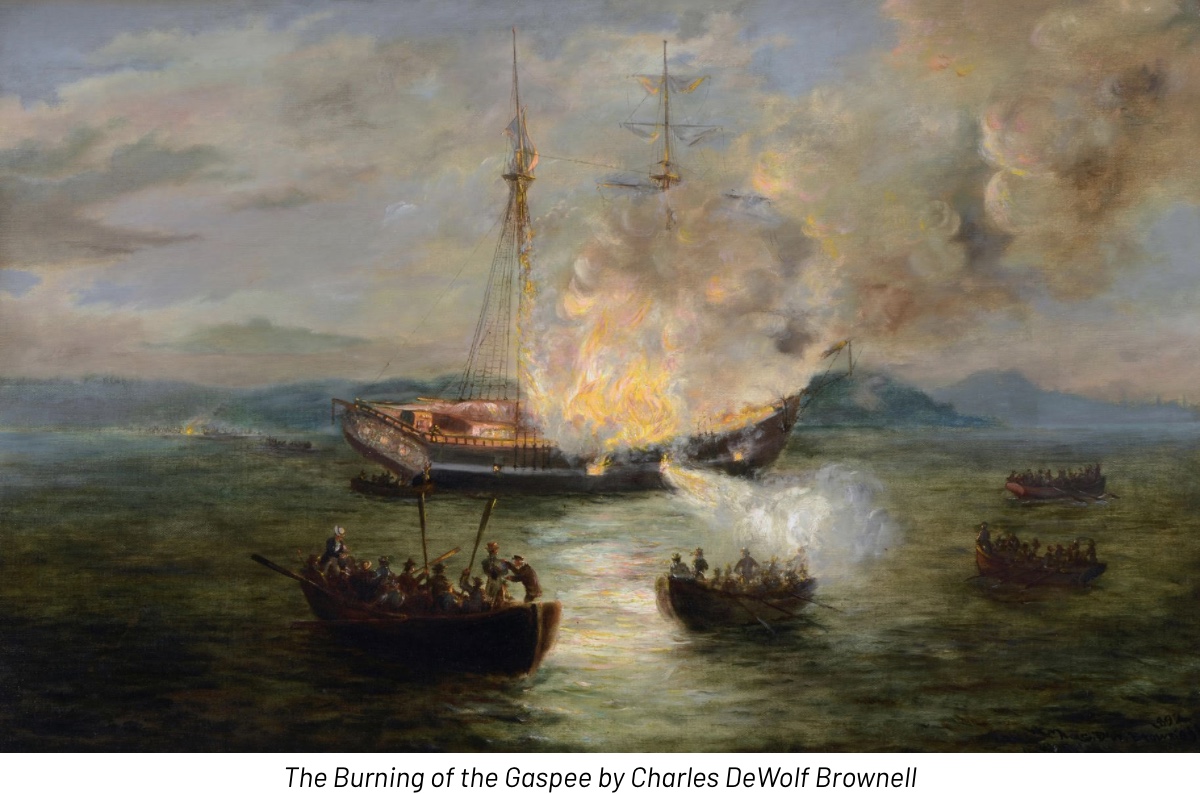
The burning of the British vessel, the HMS Gaspee on June 9, 1772 was a protest to the British Navigation Acts. The Navigation Acts were meant to force Americans to only trade with the British Empire. The Rhode Island economy was based in trade with the wider Atlantic. Just selling to the Empire was not enough for their molasses trade. That created a tension with the colonies (and Rhode Island in particular) and led to an increase in piracy and smuggling. The acts permitted the customs inspectors to board any colonial ship. In February of 1772, William Duddingston, the commander of the HMS Gaspee, arrived in Rhode Island. He used this permission to search any vessel as he saw fit. Merchants objected to his searches and seizures of their goods. The local Sons of Liberty, looked for an opportunity to retaliate.

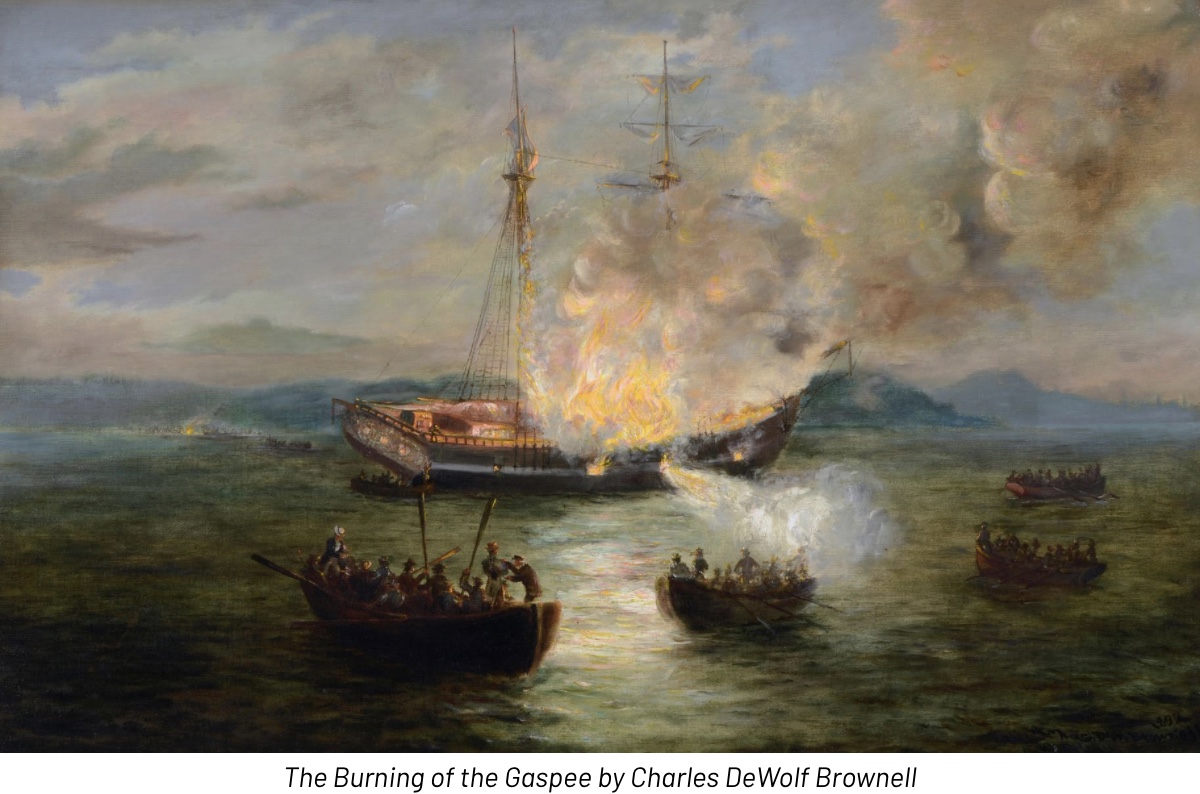
Their chance came in June 1772. The HMS Gaspee was alone and without a local pilot, but it chased a local boat called the Hannah . The Hannah could manage the shallower water, but the Gaspee ran aground. The Gaspee would be released by the tide early the next morning,. While the ship was in a vulnerable position, the Sons of Liberty rowed out and attacked the crew. Captain Duddingston was wounded. After all crew members were taken off the ship, the Sons of Liberty set fire to the Gaspee.
The event was too blatant to ignore and Parliament wanted prosecution of the attackers. Some famous names associated with the attackers are John Brown, Abraham Whipple and Ephraim Bowen. Although there was reward money offered, Rhode Islanders refused to cooperate with the British and no one was ever prosecuted. Duddingston, however, was courtmartialed.This event led to the Committees of Correspondence, a network that united the colonies in their resistance to British rule.

Every year for 50 year the village of Pawtuxet (near Cranston and Warwick) celebrates this event with Gaspee Days and a Parade.

October 29, 1774: Rhode Island General Assembly actively organizing militias for war

As the threat of war intensified, the Rhode Island General Assembly passed a resolution on October 29, 1774 which listed militia forces that were to enlist men to fight against Crown forces. The Assembly had already ordered monthly militia drills and war preparations. Among the independent companies were the Kingston Reds, Pawtuxet Rangers, Gloucester Light Infantry, Providence Fusiliers, Providence Train of Artillery, and more. Earlier, in September, the Kentish Guards had received their charter. There was renewed interest in the traditional militias and independent companies were formed or renewed. Independent companies – Smithfield, Cumberland, North Providence, Wickford, Tiverton, Newport and Portsmouth were active. The Assembly had to create a committee to examine requests for establishing independent military companies. In Jan. 1775, these companies were grouped to form the R.I. 1st and 2nd Regiments, to answer the call of the Continental Congress which required two regiments in each colony.

Kentish Guards

April 22, 1775: 1500 troops raised in Rhode Island as an Army of Observation.

Upon hearing of the Battles of Lexington and Concord, the Kentish Guards marched toward Massachusetts to help the colonists. The Kentish Guards were a militia group that formed in East Greenwich, R.I. to protect the town from British attacks as tensions grew among the American colonists. The Guard was turned back at the state border at the order of Governor Wanton. Nathanael Greene and others went on to Boston to help. On April 22nd the Rhode Island General Assembly ordered a force of 1500 to be called into service of the colony as an “Army of Observation.” The purpose of this Army was repelling any ” insult or violence that may be offered to the inhabitants .” The Army was sent to the Boston area where it went into camp. Nathanael Greene of the Kentish Guards was made Commander of this Army of Observation and given the rank of Major General. Greene worked with the Army to bring discipline to the organization. Later this Army would be placed under the control of the Continental Army and Greene would become one of Washington’s best generals.

June12, 1775: Rhode Island becomes the first colony to establish its own navy.

Colonial General Assembly enacted a resolution to charter and arm two vessels for the protection of trade. In 1774, the British frigate, the Rose, under the command of Sir James Wallace, was sent to Narragansett Bay in Rhode Island. The Rose was successful in ending the smuggling that had made Newport wealthy. John Brown and other leading merchants advocated for the protection of Rhode Island trade. The Rhode Island Assembly directed the Committee of Safety to charter two vessels for protection. This action created the Rhode Island Navy, the first American Navy of the Revolution. Merchant Brown chartered one of his sloops, the Katy, to this new Navy.

June 15, 1775: First Naval Battle of Revolution
Abraham Whipple

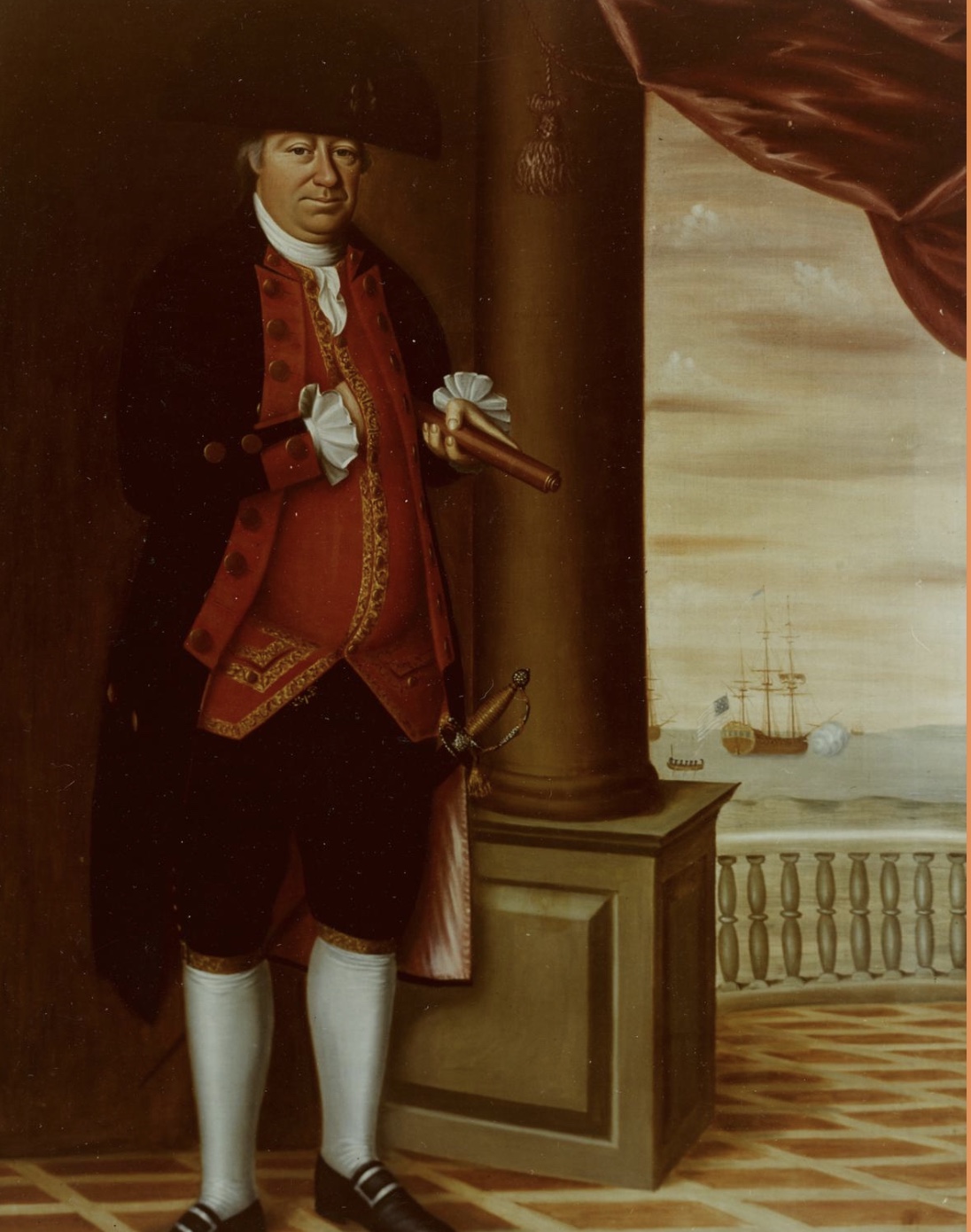
Abraham Whipple assumed command of the Katy and a smaller vessel – the Washington. As the new commodore, Whipple lost no time in trying to clear the smaller ship tenders of the Rose from their positions in Narragansett Bay. Whipple had more fire power than the tenders and he was able to fire on the sloop Diana and take her as a prize. Whipple towed the Diana back to Providence and when the Rose sailed up the Bay to investigate what happened to the Diana, Newport citizens were able to recapture five out of the six Newport merchant ships that Wallace had confiscated.

October 13, 1775: Creation of Continental Navy.

The new Rhode Island Navy was not powerful enough to take on the British frigate Rose, so the Rhode Island Assembly instructed their delegate to Congress, Stephen Hopkins, to introduce a bill to create the national navy. Congress passed the bill on Octber 13, 1775. The Katy (owned by John Brown) became the first ship of the Continental Navy and was renamed the Providence.

May 4,1776: RI Legislature breaks allegiance to King George III.. First declaration of independence in the colonies.

Rhode Island’s General Assembly rejected King George and broke its legal ties to him two months before the independence was declared by the Second Continental Congress. What it did was repeal an earlier document which pledged Rhode Island to the King and Great Britain and it repealed language that bound the colony to Royal Authority. Before the declaration each elected officer in the colony had sworn allegiance to the king before assuming his duties. The General Assembly would continue to govern itself, and all court proceedings would be performed in the name of the state not the King.
The Gaspee Affair – Protesting the Navigation Acts

Leave a comment

The burning of the British vessel, the HMS Gaspee on June 9, 1772 was a protest to the British Navigation Acts. In the colonies the Navigation Acts were meant to force Americans to only trade with the British Empire. The Rhode Island economy was based in trade with the wider Atlantic. Just selling to the Empire was not enough for their molasses trade. That created a tension with the colonies (and Rhode Island in particular) and led to an increase in piracy and smuggling.

The acts permitted the customs inspectors to board any colonial ship. In February of 1772, William Duddingston, the commander of the HMS Gaspee, arrived in Rhode Island. He used this permission to search any vessel as he saw fit. Merchants objected to his searches and seizures of their goods. The local Sons of Liberty, looked for an opportunity to retaliate.

Their chance came in June 1772. The HMS Gaspee was alone and without a local pilot, but it chased a local boat called the Hannah . The Hannah could manage the shallower water, but the Gaspee ran aground. The Gaspee would be released by the tide early the next morning,. While the ship was in a vulnerable position, the Sons of Liberty rowed out and attacked the crew. Captain Duddingston was wounded. After all crew members were taken off the ship, the Sons of Liberty set fire to the Gaspee.

The event was too blatant to ignore and Parliament wanted prosecution of the attackers. Some famous names associated with the attackers are John Brown, Abraham Whipple and Ephraim Bowen. Although there was reward money offered, Rhode Islanders refused to cooperate with the British and no one was ever prosecuted. Duddingston, however, was courtmartialed.

This event led to the Committees of Correspondence, a network that united the colonies in their resistance to British rule.

Every year for 50 year the village of Pawtuxet (near Cranston and Warwick) celebrates this event with Gaspee Days and a Parade.

Resources.

Park, Stephen. The Burning of His Majesty’s Schooner Gaspee. Westholme, Yardley PA, 2013.

Secretary of State’s website: https://www.sos.ri.gov/divisions/civics-and-education/for-educators/themed-collections/gaspee-timeline

Rhode Island Rebels: Stephen Hopkins

Leave a comment

I am working on new projects that have me looking at the whole of Rhode Island’s Revolutionary experience and those Rhode Islanders who played major roles in the action. Most of my research has been on the Rhode Island Campaign, the Battle of Rhode Island and the French role in converting Butts Hill into a proper fort. The general picture of rebellious Rhody is new ground for me. Timelines published in the Newport Mercury by John Millar and his book – Rhode Island: Forgotten Leader of the the Revolutionary Era, are helping me to focus on the larger picture.

Stephen Hopkins: 1707-1785

Lawyer, merchant, politician and co founder of Brown University.

28th, 30th, 32nd, and 34th Governor of the Colony of Rhode Island and Providence Plantations,

Represented Rhode Island Island at the Albany Congress of 1754 where he pressed for union of the colonies.

Wrote the Rights of Colonies Examined in 1764 which held that Britain’s authority over the colonies had little basis. This was in response to the Sugar Act.

In 1772, when the British vessel Gaspee was attacked and burned, Chief Justice Hopkins refused to sign the court order to arrest those responsible.

Delegate to the First and Second Continental Congress where he introduced bills to establish a navy. His brother Esek became the first admiral of the Navy.

Signer of the Declaration of Independence. Hopkins was frail and his hand shook, but the commented: “My hand trembles but my heart does not.”

Resources:

His house on Benefit Street in Providence is open to the public. http://www.stephenhopkins.org

Aisha Pierre’s Article on Stephen Hopkins as a Founding Father: https://rhodetour.org/items/show/284

“The Rights of the Colonies Examined”. Essay, 1764. From Teaching American History. https://teachingamericanhistory.org/document/the-rights-of-the-colonies-examined/ (accessed October 30, 2025).

Block Island Revolutionary Connections – Patriots

Leave a comment

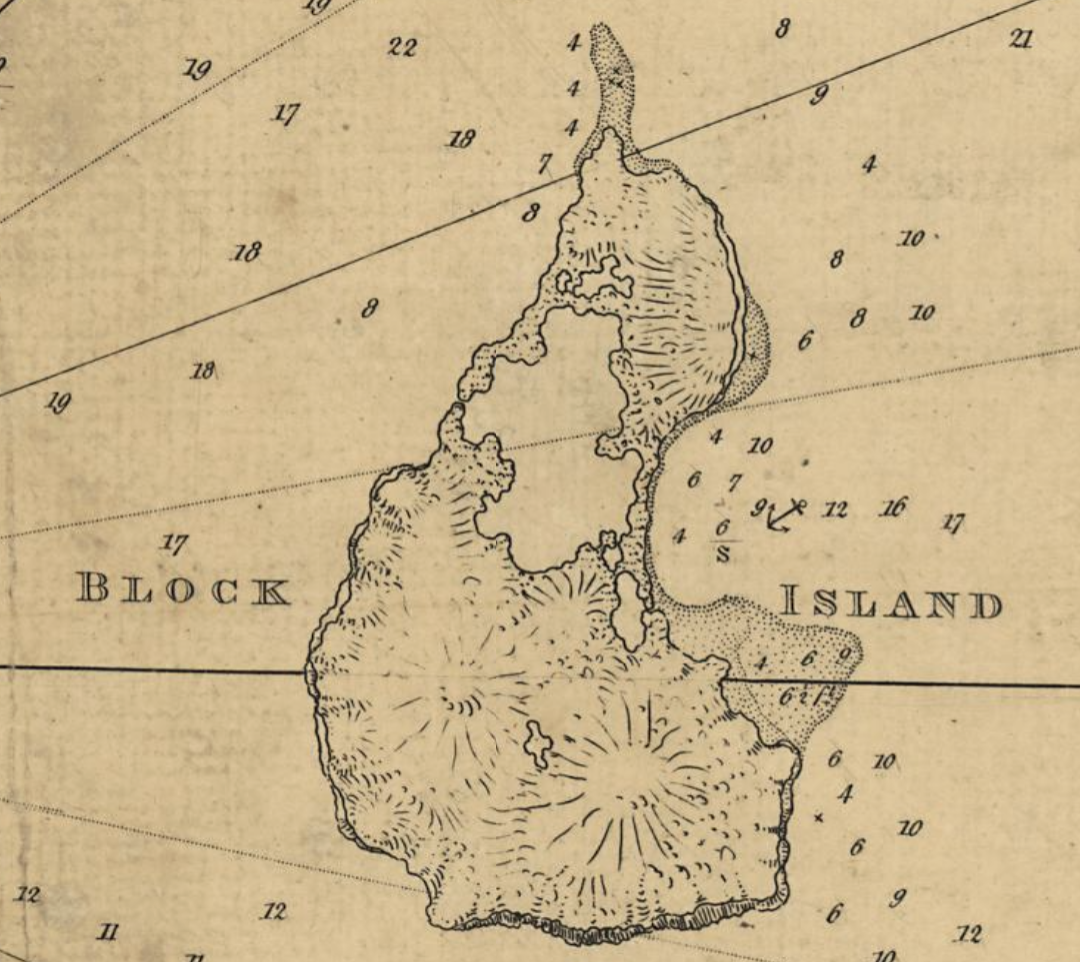
Block Island in the Revolution is on my mind as I prepare to visit a friend on Block Island. This is a collection of information on Revolutionary Block Island. My understanding is that the island remained uncommitted during the war, but Block Island people were involved in the fight for independence.

Caty Littlefield

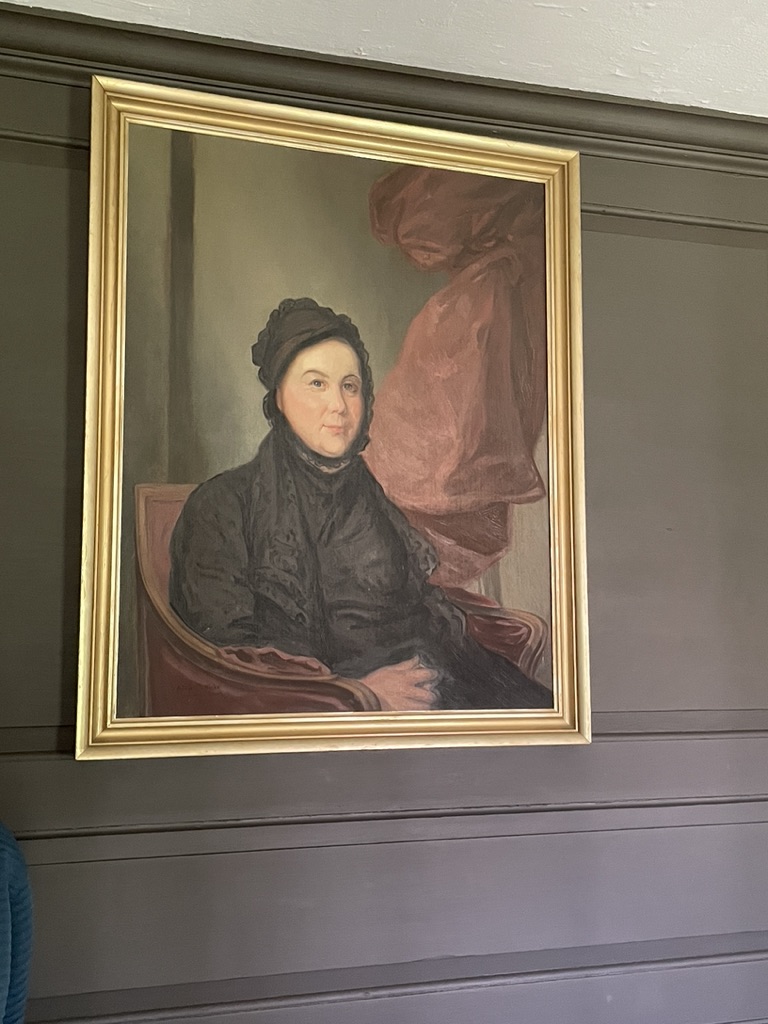
A while back I researched women in the Revolution and I learned the story of Catherine Littlefield Greene Miller. Her family called her Caty and she was born on Block Island in 1755. Her mother descended from Block Island founders and her father, John Littlefield, was a member of the Rhode Island legislature. Her Block Island childhood ended with her mother’s death when she was only 10 years old, and Caty went to live with and aunt and uncle. At that time her uncle, William Greene, was a Supreme Court justice, but he went on to being Governor of Rhode Island. Under the guidance of her aunt and uncle, Caty learned how to read and write and how to manage a household. Caty would meet and marry General Nathanael Greene and she took a prominent role in his efforts. She opened her home in Coventry as a hospital when the Rhode Island troops were inoculated for small pox. Caty followed her husband to just about every assignment including Valley Forge.

William Littlefield

William Littlefield was Caty’s younger brother. We learn a little bit about his service in a letter he wrote to Washington to secure a federal position.

“I served my Country upwards of five years in the Continental line of the Army part of which time was in General Greenes family.”

The notes below the transcript of the letter inform us that he didn’t get the job, but he had been active in the war.

William Littlefield (1753–1822), a native of Block Island, R.I., was the younger brother of Catharine Greene, widow of Maj. Gen. Nathanael Greene. Littlefield had served with Varnum’s Rhode Island brigade during the early years of the Revolution and in 1779 had become an aide to his brother-in-law. He resigned on 20 June 1780 and returned to Block Island where he fell under suspicion of trading with the enemy although he was later exonerated (Bartlett, R.I. Records, 10:45). In 1785 and 1792 he represented Block Island in the Rhode Island legislature. Littlefield received no post in the civil service and later in the 1790s apparently moved to Tennessee. https://founders.archives.gov/documents/Washington/05-04-02-0052

Before the war started he is listed as being an ensign in Block Island’s militia.

Captain Samuel Dunn

Another Block Island figure was involved in the Gaspee attack. The Gaspee Committeed issued this statement:
“We conclude that it was Captain Samuel Dunn, 1710-c1790 of New Shoreham (Block Island), RI that took part in the attack on the HMS Gaspee, and later went on to service in the Revolutionary War. The Gaspee Days Committee therefore recognizes Captain Dunn as a true American patriot.”

I am confused about which Samuel Dunn was part of the Gaspee action. This Samuel has a son Samuel Dunn, Jr. who was born in 1743. The elder Samuel Dunn would have been over sixty when the Gaspee incident occured.

The next blog will be on the “Battle of Block Island” that featured Esek Hopkins.