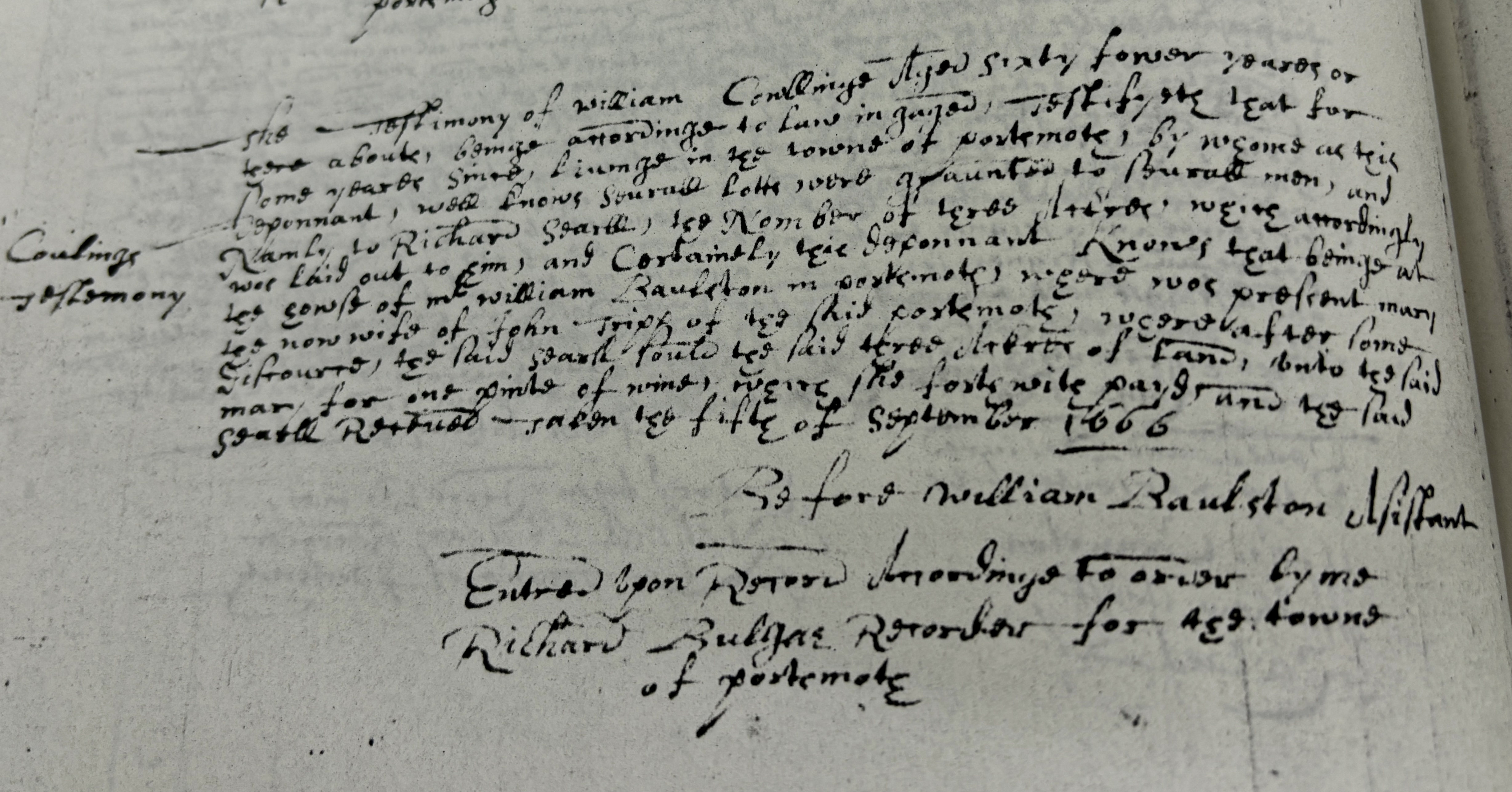
I recently shared the story of Mary Payne (Tripp) trading a 3 acre land grant for a pint of wine. One of the audience members questioned me about whether this was a just a story or really true. The story came from Portsmouth historian Edward West and I trusted his scholarship. He spent lots of time working with town records. I like to see the primary sources, so I began to look for confirmations. Tripp family genealogies gave me some clues of where to find the answers. One of these family histories said that the court of Commissions, on 8 Dec 1666, confirmed the sale. I wasn’t sure what the court of commissions was. Another family history stated that someone named Collings had testified in Mary’s behalf. A former Portsmouth Historical Society curator remembered seeing a transcription of Collings’ testimony in the society collection. The society’s collection has been re-organized and I wasn’t able to find it, but I knew it had to be somewhere. I went to the office of the Town Clerk to ask where I could find “Court of Commissions” records. A very helpful worker suggested that if a deed was involved, we could look for it in Land Evidence. We had a date and the name of who was granted a deed, so it was easy to find both the granting of the deed and the testimony of the witness.
I took images of the deed and now I needed to transcribe it. These Land Evidence books are photocopies, so legibility was difficult to begin with. Ancient forms of spellings and grammar make for difficult reading as well. While I had transcribed documents before, this seemed like quite a chore. I have seen a commercial touting artificial intelligence’s usefulness in transcribing old recipes. Well if AI can work on handwriting, maybe it could help me with transcription. I found an online transcription service and tried it. It wasn’t perfect, but I was helpful. Between what I can transcribe on my own and the suggestions of AI, I was able to get a general sense of the testimony.
There is confirmation of the story. Mary did get a deed for the property even though Searl left town without giving her the deed. Listening to the testimony of someone who was at the Tavern, the town gave the deed to Mary and her husband John Tripp more than twenty years later.
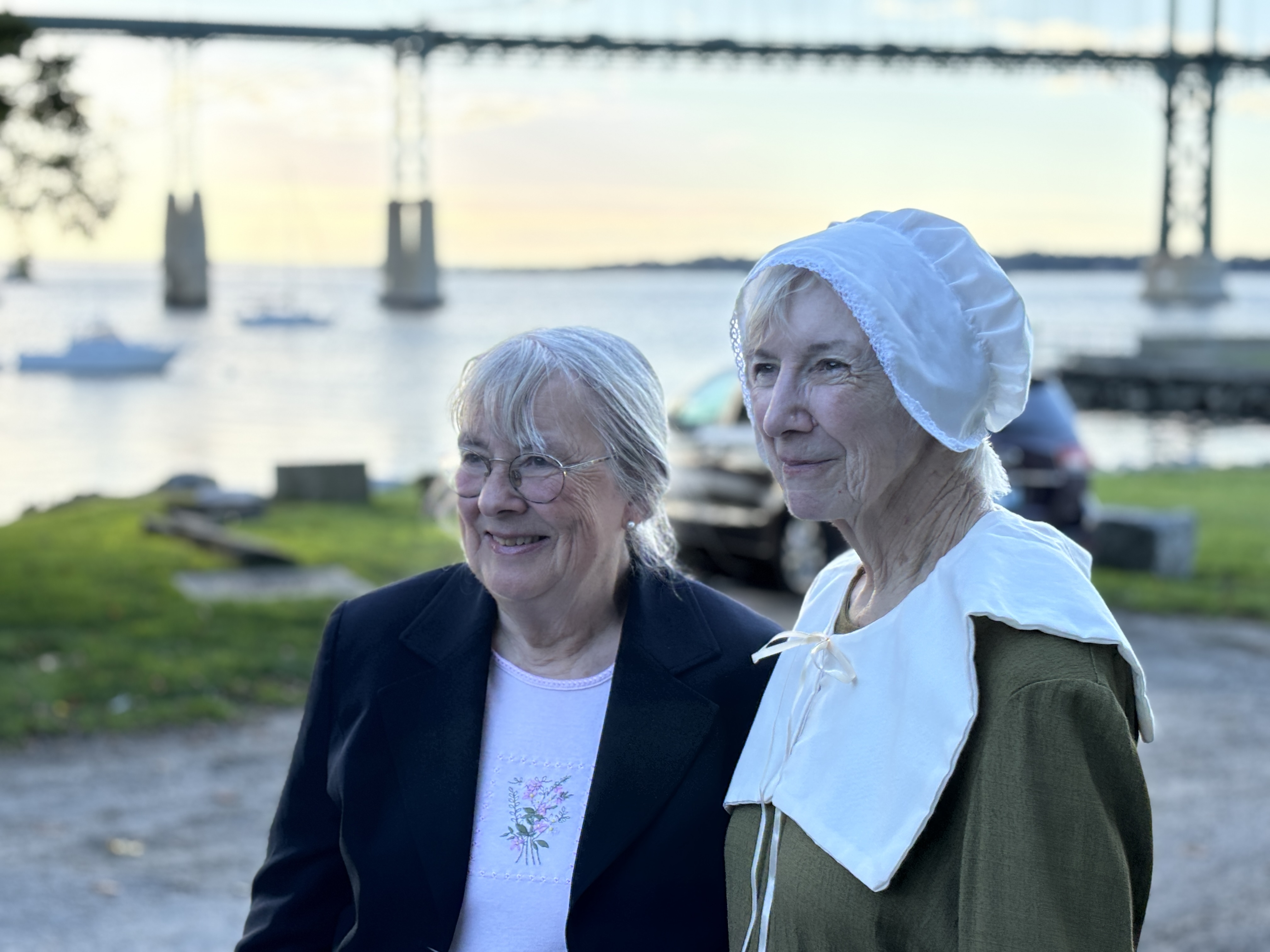
Left: 7th great granddaughter of Mary with Cindy Killavey who portrayed Mary.
For a number of years I have been gathering stories of Portsmouth women. Their stories can be forgotten when history is generally written about the men. In presentations I tell the story of Mary Paine Tripp, but John and Mary Tripp’s combined story gives us a glimpse of what was happening in the early days of Portsmouth. It also helps us to focus on what was happening in the Bristol Ferry neighborhood of our town. It was one of the first neighborhoods to be developed.
A story about Mary:
I came across an interesting story from Edward West’s 1932 article in the journal of the Rhode Island Historical Society on the “The Lands of Portsmouth, Rhode Island”. How much would you give for a glass of wine? Back in 1666 Richard Searl sold a three acre lot just above the Bristol Ferry to Mary Paine. Mary was the barmaid at Baulston’s Tavern and the land was exchanged for a “pint of wine.” Mary later married John Tripp who used the land for a ferry house. Although this deed wasn’t registered, the Town Council accepted the deposition of William Collinge as to how the land was transferred. Mary officially owned the land.
Note Searl Property on Land Grant Map. Marked with star.
John Tripp, early settler
An article by Tripp Family genealogist Janet Tripp Andrews provides us with information about John Tripp, 1611 – 1678, as well as the conditions in Portsmouth for the first settlers. John started life here as an indentured servant – perhaps to a ship’s carpenter. He was admitted as an “inhabitant” at Portsmouth’s founding. That allowed a settler to own land but not to vote or hold office. He must have paid off the indenture because a year later he was admitted as a freeman.
Early Records of the Town of Portsmouth show that the community developed quickly. The first house lots were assigned and an inn, brewery and general store were established with William Baulston in charge. Like all men between the ages of sixteen and fifty, John would have trained with the militia. To keep order a pair of stocks with a whipping post was ordered. To enable easier home construction a water mill was proposed. Meanwhile, that first summer settlers lived in caves or dugouts covered in branches. As wood was processed for construction more permanent one and two room structures with lofts and thatched roofs were considered permanent housing. Regardless of what their occupation had been in Massachusetts, the people of Portsmouth became farmers tending to hogs, goats, sheep and cattle. John Tripp, like the other Portsmouth settlers, would have been fencing property, digging wells, and planting orchards.
Although disagreements led to many residents leaving Portsmouth to establish Newport in 1639, John Tripp was among the thirty who signed the second Portsmouth Compact. He signed his own name. This was about the time that John Tripp married Mary Paine.
John Tripp would later become associated with boats and ferries, but Thomas Gorton was appointed ferryman to the Howland Ferry to Tiverton when it was established in 1640. Cattle were ferried across to graze in the Tiverton grasses. Early records show that in 1650 John had the approved weights to measure as the standard for the town. John took on other positions in town. In 1656 he was appointed to inspect cattle moving on and off the island. Tripp must have been able to read and write to do this job.
Meanwhile the Tripp family was growing. In 1640 their first son (John Jr.) was born. By 1650 their thrid daughter was born. Altogether Mary and John had ten or eleven children.
The process of becoming a “ferryman” was gradual for John. The shoreline around Bristol Ferry was owned by the town, but John Tripp, Ralph Earle and John Borden owned land that could add a pier. In 1658 the town treasurer was ordered to pay “Goodman” Tripp “for going into the Bay.” This could mean that Tripp was using his boat to deliver people and/or items like documents or goods.
In 1670 John Tripp had the honor of serving on the Governor’s Council. In 1673 John served as Town Moderator. With this service to the town and colony, Tripp was also serving as a ferryman. Captain Church’s writings have the first mention of “Tripp’ s Ferry” in 1676. After King Philip’s War Tripp’s son Abiel, William Earl, John Borden, and Joseph Anthony were given permission to build or finish wharfs on public land in 1682. Belore the Revolutionary War, the ferries were known by their owners – (Tripp’s Ferry, Borden’s Ferry). After the war it became know as the “Bristol Ferry” and was one of the most important ferries because it was a direct route from Newport to Providence. Washington, Lafayette, Rochambeau and other notables crossed to Bristol by way of this ferry.
Mary’s story continues
Mary Paine Tripp inherited John’s boats at his death in 1678. At a town meeting April 23, 1679 Widow Tripp was granted a license to sell food and drink to travelers. Perhaps she turned her house into a tavern. That would be full circle to her days at Baulton’s Tavern were she exchanged wine for a land grant.
Sources used:
Andrews, Janet Tripp. John Tripp, 1611-1678, A Glimpse into our Founder’s Life, Nov. 2016. In the collection of the Portsmouth Historical Society.
In preparation for a July 23rd celebration of Anne Hutchinson’s birthday at the Portsmouth Historical Society, we have been researching some of the women who were in Portsmouth with Anne. We are looking at those who came with Anne in that first wave, but also some of those who came shortly after and would have shared the settling experience with her. Mary Paine Tripp (1605 to 1687) was married to John Tripp. We came across an interesting story from Edward West’s 1932 article in the journal of the Rhode Island Historical Society on the “The Lands of Portsmouth, Rhode Island”. How much would you give for a glass of wine? Back in 1666 Richard Searl sold a three acre lot just above the Bristol Ferry to Mary Paine. Mary was the barmaid at Baulston’s Tavern and the land was exchanged for a “pint of wine.” Mary later married John Tripp who used the land for a ferry house. Although this deed wasn’t registered, the Town Council accepted the deposition of William Collinge as to how the land was transferred.


 In preparation for a July 23rd celebration of Anne Hutchinson’s birthday at the Portsmouth Historical Society, we have been researching some of the women who were in Portsmouth with Anne. We are looking at those who came with Anne in that first wave, but also some of those who came shortly after and would have shared the settling experience with her. Mary Paine Tripp (1605 to 1687) was married to John Tripp. We came across an interesting story from Edward West’s 1932 article in the journal of the Rhode Island Historical Society on the “The Lands of Portsmouth, Rhode Island”. How much would you give for a glass of wine? Back in 1666 Richard Searl sold a three acre lot just above the Bristol Ferry to Mary Paine. Mary was the barmaid at Baulston’s Tavern and the land was exchanged for a “pint of wine.” Mary later married John Tripp who used the land for a ferry house. Although this deed wasn’t registered, the Town Council accepted the deposition of William Collinge as to how the land was transferred.
 portsmouthhistorynotes