Home

Getting Ready for War: Rhode Island Military Units

Leave a comment

As the threat of war intensified, the Rhode Island General Assembly passed a resolution on October 29, 1774 which listed militia forces which were to enlist men to fight against Crown forces. The Assembly had already ordered monthly militia drills and war preparations. The colony was actively organizing its militias in case of armed conflict.

Among the independent companies were the Kingston Reds, Pawtuxet Rangers, Gloucester Light Infantry, Providence Fusiliers, Providence, train of Artillery, and more. Earlier, in September, the Kentish Guards had received their charter. There was renewed interest in the traditional militias and independent companies were formed or renewed. Independent companies – Smithfield, Cumberland, North Providence, Wickford, Tiverton, Newport and Portsmouth were active. The Assembly had to create a committee to examine requests for establishing independent military companies. In Jan. 1775, these companies were grouped to form the R.I. 1st and 2nd Regiments, to answer the call of the Continental Congress which required two regiments in each colony.

Kentish Guards

On September 24, 1774 the Kentish Guards were formed to protect the Town of East Greenwich from British attack. They were then charted by the RI Assembly in October 1774 to be an “elite” militia which took care of its own training and equipment. The Kent County Court House became the armory and they built Fort Daniel at the entrance of Greenwich Cove and equipped it with nine cannons.

The Guards took part in the Siege of Boston and 35 of its officers ultimately became officers in the Continental Army – including Nathanael Greene. When the British invaded Newport, the Guards went on continuous duty until 1781. They protected Warwick Neck, Prudence Island, Warren, Bristol, Tiverton, and Aquidneck Island. As American forces congregated at Tiverton under General Sullivan, Kentish Guard commander Col. Richard Fry led a regiment of Independent Militia Companies at the Battle of Rhode Island. During the summer of 1779, twenty-six of the Kentish Guard attacked Conanicut Island (Jamestown) and destroyed a British battery. The Guard moved on to Aquidneck Island when the British evacuated Newport and they guarded Sachuest (Second Beach). They were posted at Newport again in 1780 and 1781 to reinforce the French.

Pawtuxet Rangers

The Pawtuxet Rangers (Second Independent Company for the County of Kent) were among those chartered by the Colony of Rhode Island and Providence Plantations on October 29, 1774. There were two types of military units during the Revolutionary War – independent chartered commands (like the Rangers) and Continental Regulars. In the years before the beginning of the War for Independence, busy seaports like Pawtuxet were at the heart of the economy. Rhode Islanders began to resent British actions such as the Sugar Act (1764), the Stamp Act (1765) and the Townsend Acts (1767). These acts stifled the maritime trade of towns like Pawtuxet. Some Rhode Islanders reacted with acts of defiance like the burning of the Gaspee in Pawtuxet in 1772. The Rangers first duties were to defend the bustling town of Pawtuxet, but they were expanded to include the construction and manning of a fort and the protection of 400 miles of the Rhode Island coastline from the Royal Navy. 

With the British Occupation of Aquidneck Island (Rhode Island), the Rangers were kept busy. Besides guarding Pawtuxet, they were on duty on Prudence Island, Newport, East Greenwich, Bristol and Warwick Neck. 

One pension request from a veteran Ranger states: “It was the duty of said company always to be in readings to march to whatever station it was commanded either by the Governor or the General of the Army having the command in Rhode Island. It also had the principal charge of a fort built in said village of Pawtuxet to repel incursions of the enemy which were very frequent during the time the British were in possession of Newport. While Rhode Island was in the theater of War, frequent & daring incursions were made all along the shores of Narragansett Bay by the enemy for the purpose of plunder and this Corps never failed to be among the foremost to repel them.”

Members of the Rangers served in the Battle of Rhode Island, the Battle of Saratoga and the Siege of Boston. 

Kingston Reds

Like many of the ancient military units, the Kingston Reds were founded just before the start of the American Revolution. They were also created by an act of the Rhode Island Assembly in October 1775. Kingston was a wealthy port town at the time and the Kingston Reds were outfitted with uniforms of red coats, white shirts, white waistcoats, white breeches, long stockings, tricorn hats and dark buckled shoes.

They were part of the 3rd Kings County Regiment of Militia during the War for Independence. With other coastal militia groups, they shared the task of guarding Rhode Island’s long coast. They were active in battle at Little Rest Hill and the Battle of Rhode Island.
Preparing for a Visit of Rochambeau to Butt’s Hill

Leave a comment

Did Rochambeau visit Butts Hill? In a letter dated August 2, 1780 from Newport, Lafayette wrote to American General William Heath about how to prepare for Rochambeau’s visit.

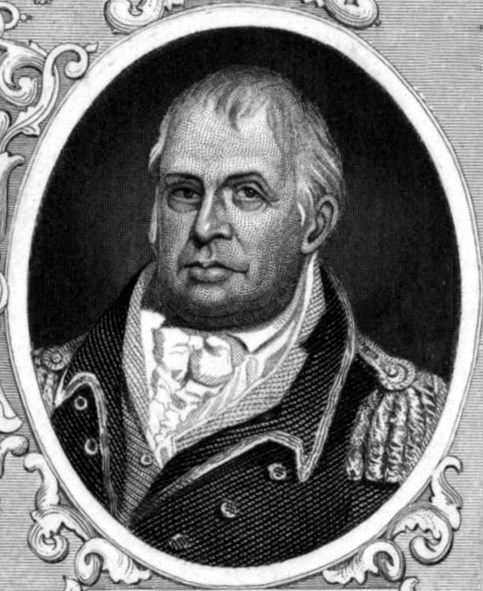
General William Heath

“On my coming into the town, I found that Count de Rochambeau was going to Butts Hill, and you easily guess that I did not like the plan. Our works are so disordered, and his dependence upon them so great, our tools, Boats &c. are in such a situation that I wanted some time to put it in a Better train.”

At this time the French are based on Aquidneck Island. There is an expectation that the British will again try to attack and occupy the island. Butts Hill is seen as a natural location to fortify as a prime spot to communicate with the mainland at Tiverton and Bristol. The French engineers and masons are working to turn fortifications left by the British and Americans into an actual fort. American militia soldiers under General Heath and the Rhode Island First Regiment (the Black Regiment) are aiding in the physical effort to complete the fortifications. The situation at what they call “Camp Butts Hill” is difficult. After three years of British occupation, basic resources like wood for fuel, water and food are lacking.

Lafayette goes on in the letter to encourage Heath and his men.

“From what you told me, my dear friend, I don’t doubt but that the thousand men with thousand tools will be tomorrow morning at work, and think they ought to Begin very early.”

Lafayette suggested ways Heath could prepare for Rochambeau’s visit. The boats should be gathered and men should be working to repair them. Fascines (bundles of sticks for fort construction) and cannons should be ready and guarded.

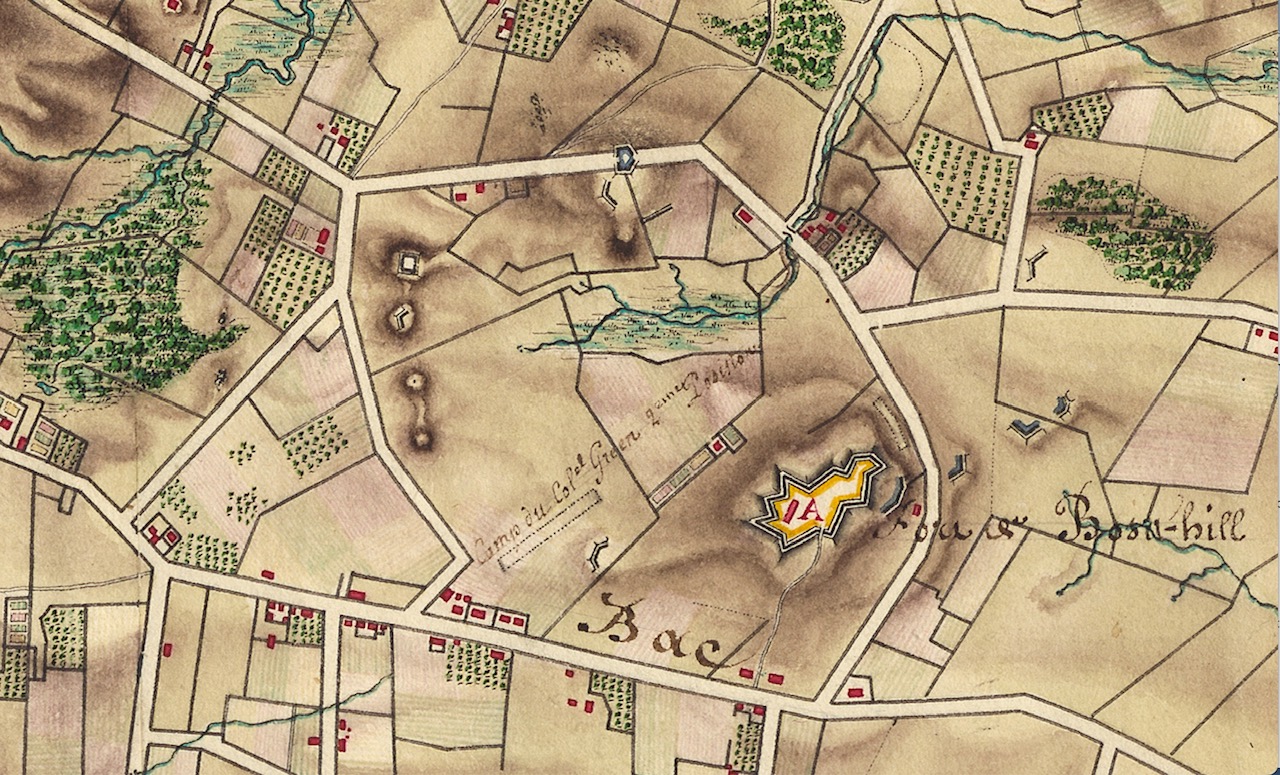
“As to the picquets I think we might have one of the Nigros upon the Road…” Picquets are “a soldier, or small unit of soldiers, placed on a defensive line forward of a friendly position to provide timely warning and screening against an enemy advance.” The “Nigros” Lafayette refers to would be from the Black Regiment (Rhode Island First Regiment) commanded by Col. Christopher Greene. Their camp is pictured next to Butts Hill in the Berthier maps of 1780. Greene’s men were Continentals and had been well trained. The militia, on the other hand, were volunteers that served three to six months and then went back to their homes.

“I believe we ought not to go through the militia Camp, but meet you at the fort with some of their officers to introduce to the count.” The barebones conditions at “Camp Butts Hill” were not something Lafayette wanted Rochambeau to see.

Berthier Map. Note Outline of Butts Hill Fort and location of Col. Greene’s men at Camp Butts Hill.

“Don’t you think, my dear Sir, that we ought to put every thing in a good train as to the tools, workmen &c. against the time the Count will come

The code word for the day would be “Boston.” Lafayette gives us a glimpse of their procedures. “When people are coming from without you know the Centry must say “Who is there,” and upon answering ‘friend’ the centry says ‘advance one’ and the Corporal comes immediately to Reconnoitre.’ Will send Mr Washington, and upon the Corporal’s telling advance, I think we ought to learn our men how to present properly their arms to Count de Rochambeau.”

A footnote explains that “Mr. Washington” is George Augustin Washington, Lafayette’s aide de camp.

The next day Lafayette writes again to Heath. “Count de Rochambeau will be with you between four and five this evening.” (Newport, August 3, 1780 – Lafayette to Heath.). I will look for more letters or orderly reports that will confirm that Rochambeau did visit the fort and what that visit might have been like.

Resources:

Idzerda, Stanley, Editor. Lafayette in the Age of the American Revolution. Selected Letters and Papers 1776-1790. Volume 3.

Rhode Island Military Units: Kingston Reds

1 Comment

Like many of the ancient military units, the Kingston Reds were founded just before the start of the American Revolution. They were created by an act of the Rhode Island Assembly in October 1775. Kingston was a wealthy port town at the time and the Kingston Reds were outfitted with uniforms of red coats, white shirts, white waistcoats, white breeches, long stockings, tricorn hats and dark buckled shoes.

They were part of the 3rd Kings County Regiment of Militia during the War for Independence. With other coastal militia groups, they shared the task of guarding Rhode Island’s long coast. They were active in battle at Little Rest Hill and the Battle of Rhode Island.
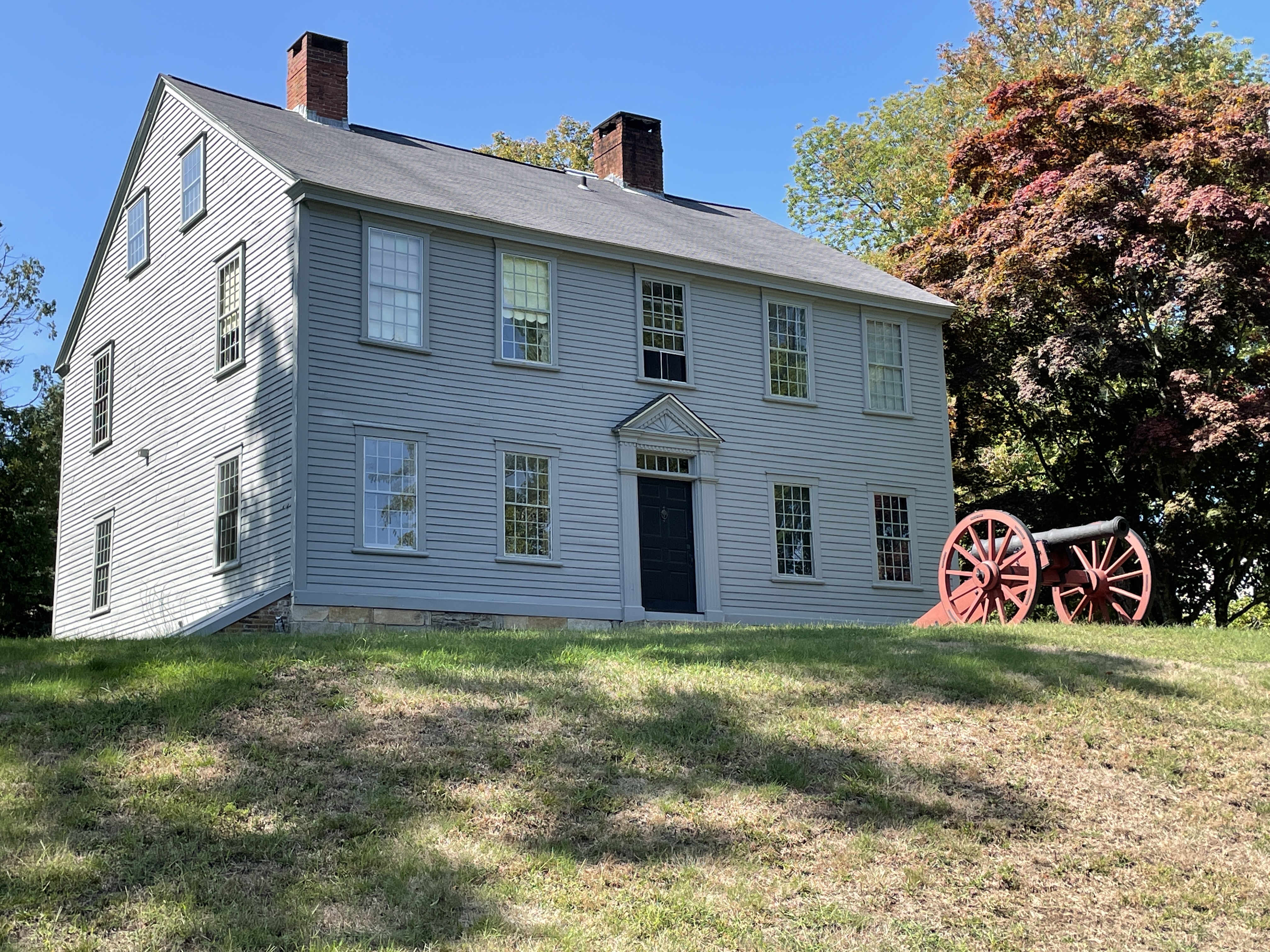
Their charter had been vacated due to dwindling numbers, but the charter of the Kingston Reds was re-instated on February 19, 2019. Today the Kingston Reds serve as a unit of the Rhode Island Charter of Historic Militia. It operates out of the Nathanael Greene Homestead with the newly constructed Barn/Education Center as the armory. Today the purpose of the group is:

“To portray a historically accurate picture of the 18th century militia which military unit (Kingston Reds) was formed originally in 1775 to serve and protect our state during the Revolutionary War.

To keep alive the historic traditions and preserve the records of their military achievements.

To maintain and promote by example, respect for the flag, and constitutions both Federal and State.

To educate the public about the 18th century New England history.”

Members march in parades and serve as guards on ceremonial occasions.

The Kingston Reds support the Gen. Nathanael Greene Homestead for all events on site, participate in parades and ceremonies, educational programs and living history events.

Greene Homestead

Sources:

https://www.ricentral.com/coventry_courier/news/local_news/historic-militia-groups-celebrate-july-fourth-at-greene-homestead/article_ab344f80-e325-11eb-8408-335aff251192.html

Kingston Reds Facebook page.

Rhode Island Militias began in Portsmouth

Leave a comment

I have been researching the histories of some of the military units in the state today. In reading a history of the militias in Rhode Island, I found that it was little Portsmouth that started it all. This militia system would be an important force in the War for Independence and the Battle of Rhode Island.

At the first meeting of settlers at Portsmouth in 1638, it was ordered that every inhabitant of the town be equipped with certain arms and prepared to perform certain military duties. At a subsequent meeting a military company or “Train Band” was organized and William Baulston and Edward Hutchinson named as officers, the very first officers of Rhode Island’s military forces. In August 1638 a general muster of all male inhabitants capable of bearing arms was called. This was Rhode Island’s first militia mobilization. In 1639 a “Traine Band” formed in Providence and general training day was designated. In 1640 the Portsmouth Militia law was amended. The number of drills was fixed at eight per year with two Muster Days – one in Portsmouth and one at Newport.

By 1647, Newport, Portsmouth and Providence had militias. Various towns were authorized to organize militia companies, select officers, assemble for drill the first Monday of each month except May, August, January and Feb. They set aside public lands for an “Artillery Garden” or drill ground. This law was the basis for the militia system of Rhode Island. These “Trained Bands” were maybe a dozen men strong, poorly armed and poorly equipped. The Newport Trained Band divided into two in 1673.

A 1680 board of trade statement described the Colonial forces “ten companies of foote, being Trained Bands under one General Commander (John Albro), their arms are flintlocks.”
John Coggeshall was the major of Island troops and John Greene commanded those of the mainland.

By the 1690s there were trained bands in all towns, including Jamestown, Block Island and Kingstown.
In 1741 a charter was granted to the Artillery Company in the Town of Newport, Jaheel Brenton Commander. In 1757, Metcalf Bowler was an officer of the Newport Artillery. Much later Bowler was proved to be a British spy.

Newport Artillery drawing by Jay Killian

A major change was made in 1774. Provision was made in the militia law by which Rhode Island’s troops were empowered to march to the assistance of any of the other colonies ”when invaded or attacked.”
But with the fighting at Lexington, this was changed. The militias were recalled by the Colonial Assembly as they reached the Massachusetts border. On April 22, 1775, following the shots at Lexington, Massachusetts, the Rhode Island General Assembly created a 1,500 man “Army of Observation” under the command of Brigadier General Nathaniel Greene. Greene and others from the Kentish Guards were sent to Boston to serve in the new Continental Army under General George Washington. The Rhode Island force at Boston was around 1700 men. Augustus Mumford, a member of the Kentish Guards, was struck by a shot from a British cannon during the siege. He was the first Rhode Islander to be killed in the war.

During 1775 the Assembly granted charters to a number of units include the Kingstown Reds. In 1776 an additional militia regiment was organized in Newport with Col. George Irish as the commanding officer. Rhode Island militia now consisted of ten regiments of infantry and twelve chartered companies.


On December 2, 1776, the British occupied Newport. About six hundred local militiamen stationed on the island retreated to Portsmouth and crossed to the mainland without loss. The entire state militia force was mobilized. Militia units were assigned all along the shore from Point Judith to Providence. Fortifications were constantly occupied by a strong militia force during the period the British remained in Newport. The 2nd Newport Regiment under Col. John Cook occupied Tiverton, while General West, with a strong force, was at Bristol. The militia regiments and the chartered commands were constantly on duty along the shores of Narragansett Bay.


On October 25th 1779, the British evacuated Newport. The next day Gen. Stark crossed from Tiverton and occupied Newport. The militia that had patrolled the coast was dismissed after three years of service. Another militia regiment of 630 men was ordered on duty for three months. The French arrived in 1780 and with the departure of the French in 1781, twelve hundred militia men were ordered to serve one month.


During the War for Independence the militias served continually. Often there was a merging of the organizations, so it is difficult to say which units were fighting. They blended into a force under different commands and titles. The Rhode Island militias contributed greatly to the fight for Independence.

References:

Much of this article is based on:

Rhode Island’s Early Defenders and their Successors – Brig. Gen. J.J. Richards, 1937, E.Greenwich, Rhode Island Pendulum, 1937 (Published by the Provisional Regiment of Chartered Commands Rhode Island Militia.

David Gifford and the Portsmouth Militia

1 Comment

The Portsmouth Historical Society has a rich collection of documents dating from the 1600s and 1700s, but we have very few documents from the Revolutionary War Era. War came to Portsmouth on December 8, 1776 when the British forces landed at Weaver Cove and they occupied the town until their forces left on October 25, 1779. Among the few documents that we do have, the name “David Gifford” is prominent. Gifford was a local ferry man and tavern owner. He took a leading role in the pre-war militia activity, he served as a Deputy from Portsmouth during the war, and state records show that he participated in military and naval activities during the war.

From its start Portsmouth traditionally had a militia. As war threatened in 1774, the Rhode Island General Assembly ordered monthly drills of all militia companies with full preparations for war. Since 1772, David Gifford had already been transporting town records and other items to and from Providence with his ferry boat. As the threat of war increased, the town records show that on August 29, 1775 the town voted “that David Gifford Draw the sum of Eighteen shillings out of this Town Treasury . . . for bringing . . . this Town’s Proportion of Powder & Balls from Providence.”

In the opening stages of war in 1775, Portsmouth raised a company of around sixty men to march to the support of Boston with a regiment raised in Newport County. A group of militia remained on guard at the town while the others were gone. Portsmouth created the fourteen-member volunteer “Artillery Company,” and provided it with 115 pounds of powder, 184 pounds of lead and 739 flints (spark making rocks). These local minutemen were to “March out to Action” when needed, and when they became part of the 1st Rhode Island Regiment in 1776, the Colony of Rhode Island provided cannons on carriages. In August of 1775 its leaders were Captain John Earl, Lieutenant James Peckham, and Ensign Cook Wilcox. Later artillery company leaders were David Gifford and Burrington Anthony. By the end of the Revolution almost all Portsmouth men from ages sixteen to sixty had served in the military.

The assembly in Providence called for additional troops and David Gifford was appointed to dole out the bounty of forty shillings to be paid to those who enlisted. Portsmouth was receptive to the calls for additional troops. Town records show that on September 17, 1776 the freemen voted that “seventeen able bodyed men be Enlisted into the servis of this State being the Town’s proportion, and that forty shillings Lawful Money be paid for every such person so Inlisted if they provide themselves with Arms & Accoutrements and that Capt. David Gifford provide the Money for said use & that he be Repayed out of this Town’s Treasury as soon as possible.”

By February 1776 the town meeting ordered their town council to draw up a list of people in town who could not provide their own firearms. The freemen voted 240 dollars or 75 pounds lawful money to purchase firearms. A committee of four men was assigned to get the money and purchase twenty small arms. David Gifford, one of the committee was selected to receive the weapons.

When the British and Hessians arrived in December of 1776, there were citizens who fled to Tiverton or Bristol. It is likely that David Gifford and his ferry boat left the island. In December of 1776 Rhode Island Records state “It is voted and resolved that Capt. David Gifford be permitted to proceed with a flag of truce to Rhode Island, under the direction of His Honor the Governor, upon his procuring three prisoners of war to exchange for three soldiers lately belonging to his company, and now detained as prisoners on said island.” It would be interesting to know which three of his Portsmouth militia company were part of the exchange.

By August of 1777 he was a member of the General Assembly and he was appointed a Lieutenant in Major Munroe’s Company. Being a ferry man, he took part in naval operations as well. The April 6, 1778 journal entry of Captain Joseph Crandall of the Rhode Island Navy Schooner-rigged Armed Galley Spitfire notes that Gifford and his ferry boat took part in a raid to Bristol Ferry on Aquidneck Island where they set fire and destroyed a British sloop. This daring raid was conducted while the Americans were being fired on from the British fortifications at Bristol Ferry.

We don’t have records of Gifford being in military service during the Battle of Rhode Island or during the remainder of the war. In 1780 and 1781 he was appointed Deputy from Portsmouth. He continued to receive recruits and handle bounties for the enlisted.

David Gifford led a full life. He was active in the Portsmouth community as a tavern keeper and ferry man at Bristol Ferry. He was a militia leader who was essential in recruiting soldiers and getting the militia armed and ready for war. He was trusted with a prisoner exchange. He used his skills as a ferry man on a daring raid to burn an enemy ship. He served Portsmouth as a Deputy. David Gifford died May 17, 1790 and is buried at St. Paul’s Cemetery. He was only in his forties, but he had lived a full life of service to Portsmouth.