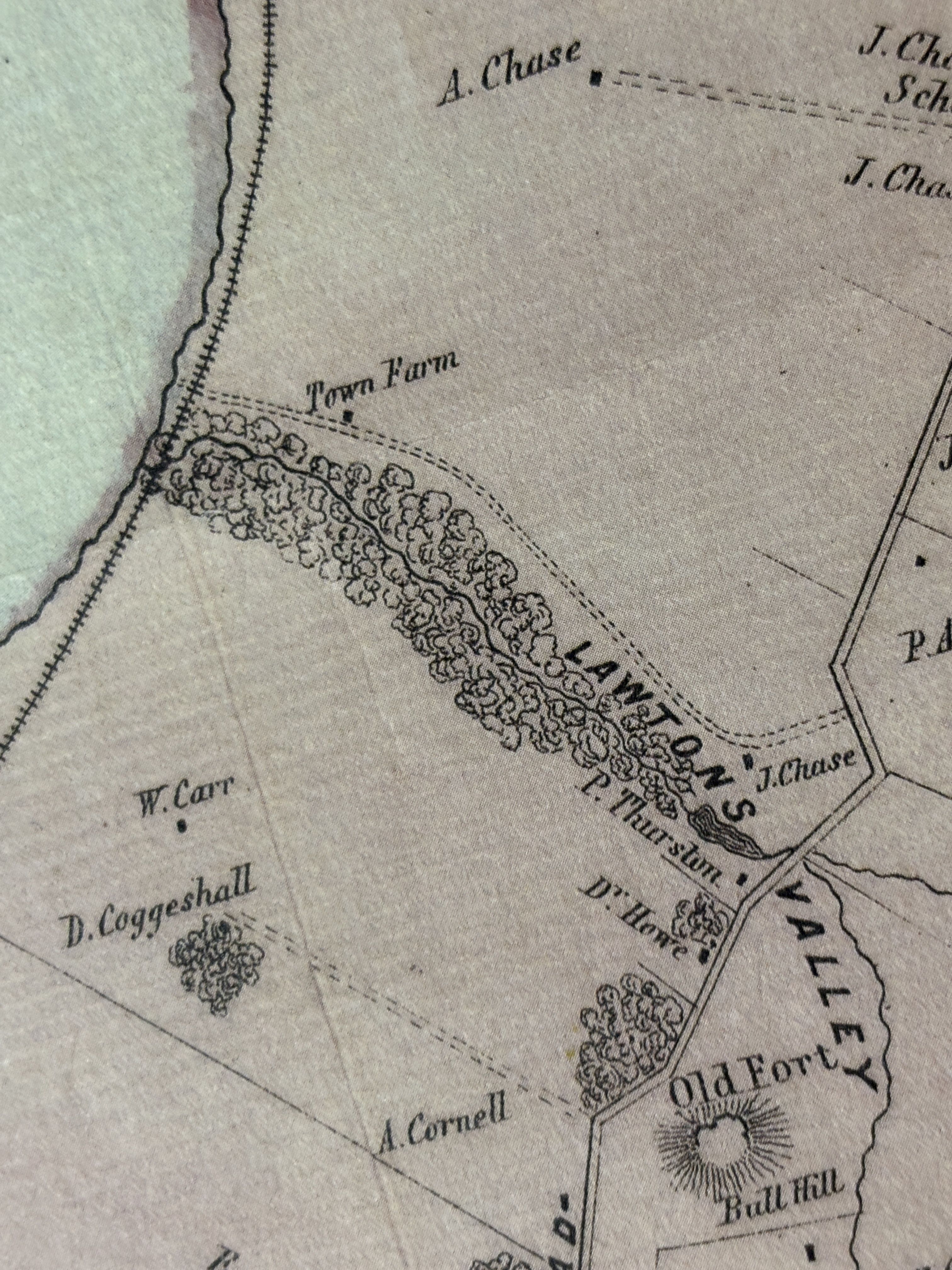
“The town of Portsmouth, a few years since, purchased a farm obtaining about 60 acres of land, as an Asylum for the Poor. It is most delightfully located, an every necessary comfort is furnished the inmates, which their condition requires.” This brief description was included by Edward Peterson’s 1853 book The History of Rhode Island and Newport. The farm’s location is on the north side of Lawton’s Valley and is Raytheon property today. While the “Town Farm” is “Lost to Time,” the Asylum Cemetery is left as a reminder of those who lived and worked there.
Whether the Asylum furnished all the needs of the inmates is debatable. The Asylum operated from 1833 to 1929. It’s aim was to be a home for the homeless, the disabled and the mentally ill. It was an “almshouse” that required residents to work if they were able.
Thomas Hazard of Portsmouth worked hard to improve the lot of the “poor and insane” in Rhode Island. He reported on all the asylums in the state and he visited the Town Farm often. One of those he visited and helped was William Fales who called himself the “Portsmouth Cripple” in his published memoir. Fales had been diagnosed with “inflammatory rheumatism” at the age of six. It was thought to be the result of a dip into cold water. Doctors tried the remedies of the day such as bleeding, but the pain never left him. By sixteen he could no longer stand. At age twenty-five he came to the Portsmouth Town Farm. When Hazard met him he could barely move and was in constant pain, but he didn’t feel sorry for himself. He thought of his suffering as bringing him closer to God. In 1848 his devotion to faith attracted pious visitors from Philadelphia and elsewhere. We know William’s story because they published his memoirs and letters to them.
In one of the published letters from December 5, 1849, he describes Hazard visiting and mentions his suffering.
“I had a visit from my kind friend T. R. H., who brought me a number of tracts to read, and then I am to distribute them among my comrades, and to those who may visit the house. Much of the time we have religious meetings once in two weeks, at which time I generally present a few tracts to those of the neighbors who attend. For some days past I have not felt so well as common ; my appetite is poor, and I have disagreeable, dull feelings through my head, especially across my forehead. A piece of my jaw-bone has protruded through the gum, yet it firmly adheres to the main portion; perhaps after a while it will work loose, and come out.“
Hazard ultimately frees Fales from the conditions at the Asylum.
“Surely the 28th of last month was an eventful day to me, for on that day I was removed from the Asylum, and though I felt loth to accept the kind offer, on account of my entire un-worthiness, yet I plainly saw the hand of Providence in it, and thought it would he wrong to refuse so desirable a change. My friend T. R. H. told me that you had desired him to procure a place for me in a private family, where I might have things that were convenient, and receive proper attention. Accordingly, I was removed on the 28th, and bore the ride much better than I had expected. Surely, my friend, this is “the Lord’s doing, and marvellous in my eyes.” Hazard had located him with a family whose property was very close to his own farm. Fales enjoyed the change, but died unexpectedly just before his thirtieth birthday.


Leave a Reply