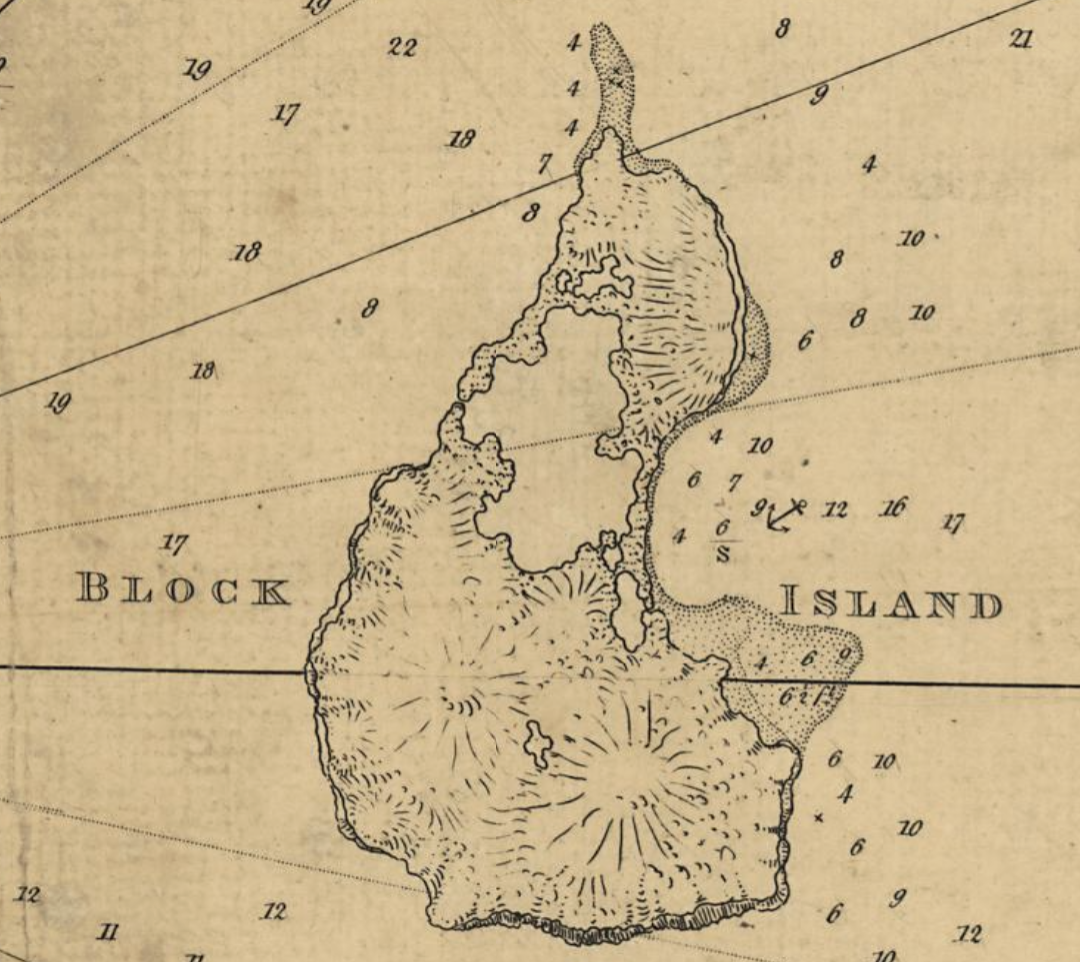
Block Island in the Revolution is on my mind as I prepare to visit a friend on Block Island. This is a collection of information on Revolutionary Block Island. My understanding is that the island remained uncommitted during the war, but Block Island people were involved in the fight for independence.
Des Barres Map 1779Catherine Littlefield Greene Miller
Caty Littlefield
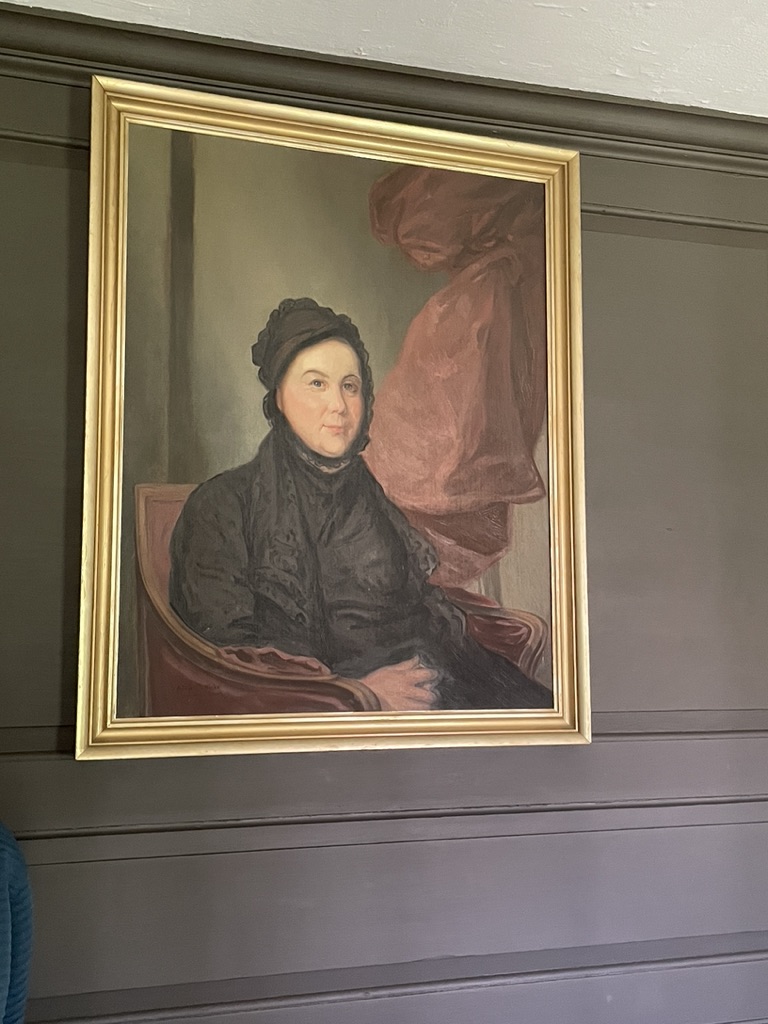
A while back I researched women in the Revolution and I learned the story of Catherine Littlefield Greene Miller. Her family called her Caty and she was born on Block Island in 1755. Her mother descended from Block Island founders and her father, John Littlefield, was a member of the Rhode Island legislature. Her Block Island childhood ended with her mother’s death when she was only 10 years old, and Caty went to live with and aunt and uncle. At that time her uncle, William Greene, was a Supreme Court justice, but he went on to being Governor of Rhode Island. Under the guidance of her aunt and uncle, Caty learned how to read and write and how to manage a household. Caty would meet and marry General Nathanael Greene and she took a prominent role in his efforts. She opened her home in Coventry as a hospital when the Rhode Island troops were inoculated for small pox. Caty followed her husband to just about every assignment including Valley Forge.
William Littlefield
William Littlefield was Caty’s younger brother. We learn a little bit about his service in a letter he wrote to Washington to secure a federal position.
“I served my Country upwards of five years in the Continental line of the Army part of which time was in General Greenes family.”
The notes below the transcript of the letter inform us that he didn’t get the job, but he had been active in the war.
William Littlefield (1753–1822), a native of Block Island, R.I., was the younger brother of Catharine Greene, widow of Maj. Gen. Nathanael Greene. Littlefield had served with Varnum’s Rhode Island brigade during the early years of the Revolution and in 1779 had become an aide to his brother-in-law. He resigned on 20 June 1780 and returned to Block Island where he fell under suspicion of trading with the enemy although he was later exonerated (Bartlett, R.I. Records, 10:45). In 1785 and 1792 he represented Block Island in the Rhode Island legislature. Littlefield received no post in the civil service and later in the 1790s apparently moved to Tennessee. https://founders.archives.gov/documents/Washington/05-04-02-0052
Before the war started he is listed as being an ensign in Block Island’s militia.
Captain Samuel Dunn
Another Block Island figure was involved in the Gaspee attack. The Gaspee Committeed issued this statement: “We conclude that it was Captain Samuel Dunn, 1710-c1790 of New Shoreham (Block Island), RI that took part in the attack on the HMS Gaspee, and later went on to service in the Revolutionary War. The Gaspee Days Committee therefore recognizes Captain Dunn as a true American patriot.”
I am confused about which Samuel Dunn was part of the Gaspee action. This Samuel has a son Samuel Dunn, Jr. who was born in 1743. The elder Samuel Dunn would have been over sixty when the Gaspee incident occured.
The next blog will be on the “Battle of Block Island” that featured Esek Hopkins.
I have to go back to my blog on places Lafayette stayed during the Rhode Island Campaign and make a note that the 1760 farm house associated with Lafayette in Tiverton has been torn down. Through the years Portsmouth has lost many historic buildings. One of Jim Garman’s early books was on historic Portsmouth homes and he has noted when one of the houses he studied are lost to us.
Within the last few years the Artemas Fish house on Glen Road (built circa 1760) was torn down to facilitate the building of new homes. Fish received a pension at Newport, Rhode Island, for eighteen months active service in Babcock’s Regiment, Rhode Island Militia during the American Revolutionary War. Babcock’s/Lippitt’s Regiment was a regiment raised for the defense of Rhode Island during the American Revolution. The regiment was one of two formed by the state of Rhode Island between November 1775 and January 1776 to deter an attack by the British against Rhode Island.
The regiment was again authorized by the Rhode Island General Assembly on January 8, 1776 with 12 companies under the command of Colonel Henry Babcock. The regiment was originally located on Aquidneck Island and along with Richmond’s Regiment left the island at the time of the British invasion.
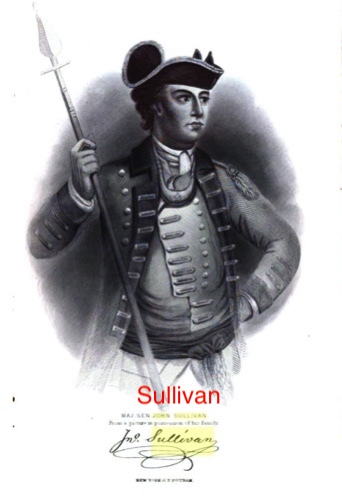
In his pension application when he was in his seventies, Fish listed his service during the Battle of Rhode Island – which he calls the Battle of Quaker Hill. Three witnesses for his pension application stated that Fish was part of Sullivan’s Life Guard. Sullivan sent this elite group into the thick of the battle at Quaker Hill.
..in the year 1778 he was employed, at least for six months, in the service in Capt. Joseph Knight’s company in the same regiment. He was much under Capt. Knight towards Sullivan’s expedition against Rhode Island – that he recollects that in the battle on Quaker Hill, besides the man who shot under him (near him?), & that on the evening of the second day after the battle, according to the best of his recollection, they retreated to Tiverton – that he also was a volunteer in Spencer’s expedition under the same Capt. Knight towards East Greenwich. Mentioned – that after the British left Rhode Island, he was often called out to guard, & in 1780 served for two months under Capt. Isaac Knight – that he was employed in actual service during the Revolutionary war for about twenty-six months. ” (Fish’s testimony in application for a pension can be found online – Fold3)
Artemas Fish had a long life. He served as Postmaster of Portsmouth 1808-1810. He died in February of 1834 in Rhode Island. His grave is in Fish Cemetery, Portsmouth, Newport County, Rhode Island, USA, Died at 90 in 1834,
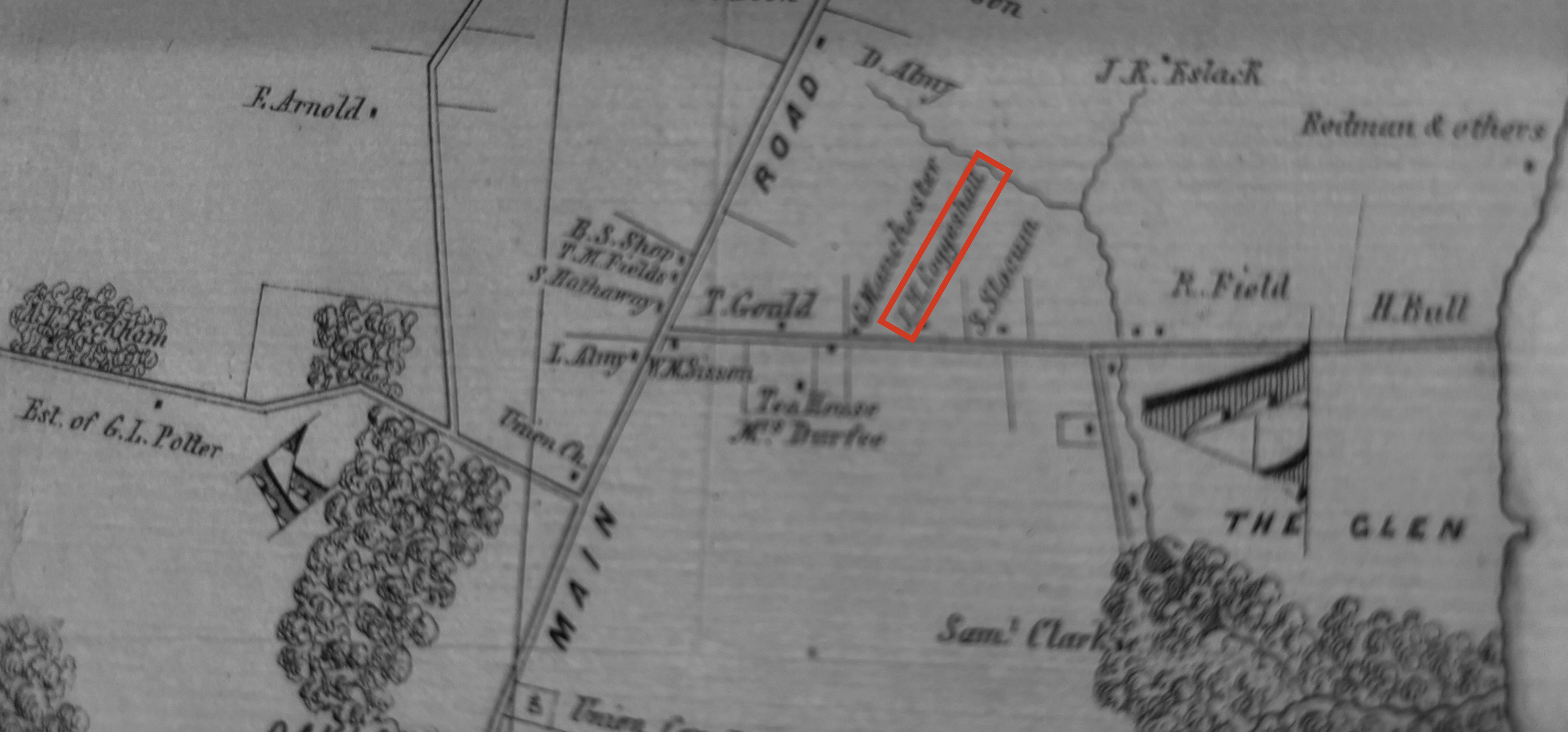
The house became the property of Dr. Peter Wales, Portsmouth’s first doctor. The house was passed down to his granddaughter, Lydia, who was married to one of Portsmouth’s best builders – John Coggeshall. Coggeshall was the builder for the Christian Union Church, now the headquarters of the Portsmouth Historical Society.
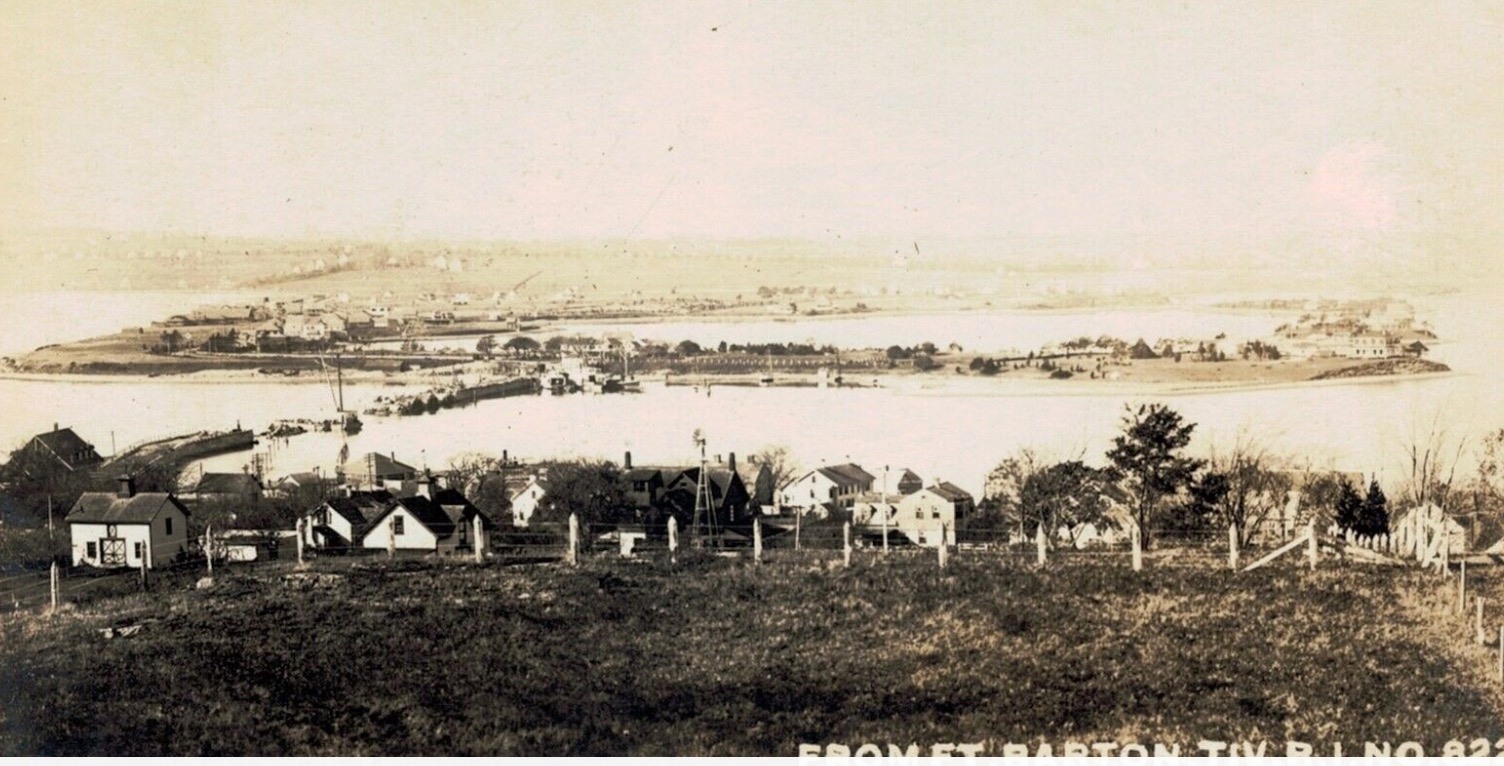
Howland Ferry was an important entry and exit point for the Rhode Island Campaign, but I haven’t spent much time researching what happened there. Today our eyes are on the relic of the Stone Bridge and it is hard to imagine the Revolutionary site.
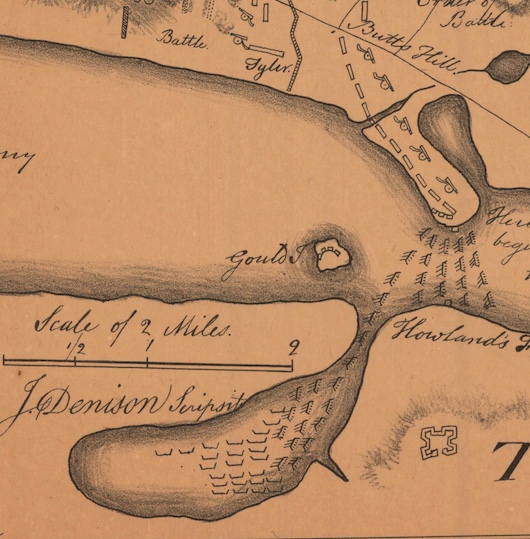
In colonial times the main roads in Portsmouth led to the ferry landings. What we call East Main Road was known as the Path to Howland’s Ferry. This site is one of the narrowest points on the Sakonnet River between Tiverton and Portsmouth. Use of this land as a ferry landing may date back to 1640. The name Howland Ferry comes from the family that ran it between 1703 to the British Invasion in 1776. Howland’s Ferry played an important part during the Battle of Rhode Island. American forces used the location to pour onto Aquidneck Island to fight the British who occupied it. When they were forced to retreat, many of the American forces used that route to make their escape.
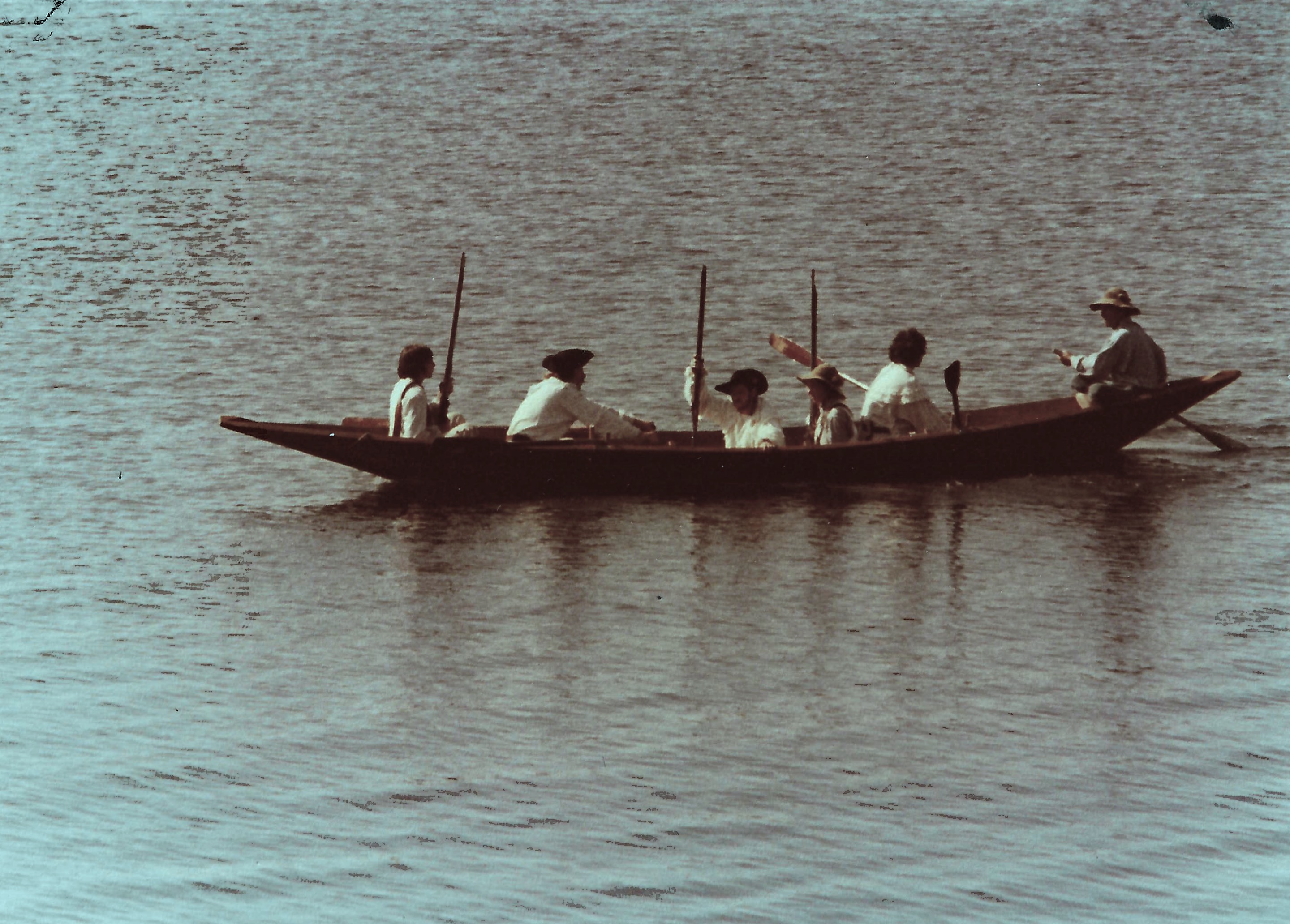
Arranging for transportation for thousands of soldiers from Tiverton to Portsmouth was a major undertaking. The British knew an American invasion would be coming, so they had already destroyed many of the flatboat boats the Americans had constructed in the Fall River area. The Americans had to secure the wood mills in Fall River and Tiverton to rebuild the flatboats that would be needed. Silas Talbot oversaw the building of 85 flatboats. Every carpenter in the army was put to work and every piece of boards and plankings in the area were used to make the transport boats. General Sullivan called out to New England mariners to come and operate the flatboats. On August 9, 1778 Howland Ferry was teeming with boats shuttling Americans to Portsmouth.
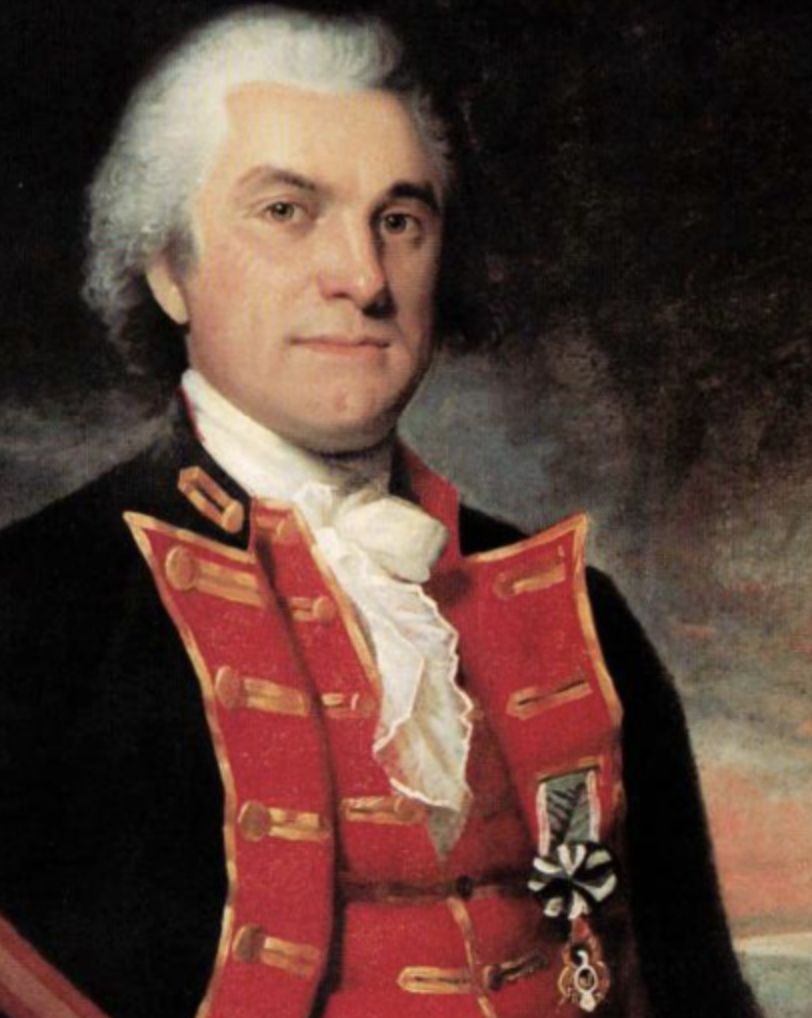
1978 Re-enactmentSilas TalbotDenison MapView of Island from Ft. Barton
The path to Howland’s Ferry was the escape route when the Americans had to evacuate on August 29th and 30th because the French had left. According to Christian McBurney, Captain Samuel Flagg of Salem and the boatmen from Salem, Marblehead and other New England towns worked day and night to ferry equipment and men off the island. William Whipple and Jeremiah Olney of the 2nd Rhode Island oversaw the embarkation. After the retreat John Laurens wrote – .”.we had a water passage of 1/4 mile to cross from the island to the main – a vast quantity of stores, heavy baggage, ammunition and cannon to transport. You will be filled with admiration at learning that the retreat was effected without the loss of a single man or even an entrenching tool”. Silas Talbot and John Laurens were among those holding off the British to give the Americans more time to retreat. At 11 PM Lafayette arrived from meeting with the French in Boston. He had taken the 70 mile journey and was disappointed that he had missed the action. Lafayette did have a role in bringing the piquets off the Island.
I have many questions about the preparation of the flatboats and Silas Talbot’s role. A biography I have of Talbot doesn’t even mention his supervision of the boat construction. In many ways this successful retreat was one of the most amazing parts of the Campaign and showed the professionalism of the budding American Army.
Last year at this time I published a blog on the “Daughters of Liberty”. Today I want to revisit the list of women associated with the Daughters. I have found that particular list in a few articles written around 1900 when chapters of the “Daughters of Liberty” were forming in various towns around Rhode Island. What I couldn’t find was any primary source confirmations of these women being involved in “Daughters of Liberty” – Mary Easton Wanton, Polly Wanton, Lucy Ellery, Patience Easton, Mary Champlin and Anne Vernon Olyphant. In searching for information on these women, I found these names and others listed in an Order of Cincinnatti in France 1905 book as giving hospitality to the French troops in Newport during 1780-1781. When I look at genealogical information on the women, I find that some were too young to participate in the 1766 spinning bees. The term “Daughter of Liberty” had been broadened to include patriotic women who furthered the cause for independence. Other sources list Martha Washington, Abigail Adams and Deborah Sampson (who actually fought as a man) as “Daughters of Liberty.”
Looking at primary sources, newspaper articles record the work of the Rhode Island “Daughters of Liberty” in protesting the Stamp Act and Townsend Act with boycotts of imported clothing. Most of the articles date from 1766. One of them is later, 1769.
An entry in The Boston Chronicle of April 7, 1766, states that on March 12, in Providence, Rhode Island, “18 Daughters of Liberty, young ladies of good reputation, assembled at the house of Doctor Ephraim Bowen, in this town. . . . There they exhibited a fine example of industry, by spinning from sunrise until dark, and displayed a spirit for saving their sinking country rarely to be found among persons of more age and experience.” At dinner, they “cheerfully agreed to omit tea, to render their conduct consistent. Besides this instance of their patriotism, before they separated, they unanimously resolved that the Stamp Act was unconstitutional, that they would purchase no more British manufactures unless it be repealed, and that they would not even admit the addresses of any gentlemen should they have the opportunity, without they determined to oppose its execution to the last extremity, if the occasion required.”
The Newport Mercury on April 14, 1766 included a letter to the editor that 20 young ladies met at the “invitation of some young Gentlemen of Liberty, and exhibited a most noble pattern of industry, from a quarter after sunrise til sunset, spinning 74 and 2/3 skeins of good Linen Yarn.” The toast was “Wheels and Flax, and a Fig for the Stamp Act and its Abettors.”
The Newport Mercury published a letter to the editor dated April 23, 1766. It detailed the results of two spinning matches held in Bristol on April 10th and 15th. A chart was attached with names and amounts of skeins spun. This is the only list of names I could find. I checked some of the names through genealogical sources and I could verify that many were Bristol girls and women.
From Rhode Island Historical Magazine – vol. 4, no 3 (1884)
New York Journal 24 August 1769: July 16. — Newport. July 10. “We can assure the Public, that Spinning is so much encouraged among us, that a Lady in Town, who is in very affluent Circumstances, and who is between 70 and 80 years of Age, has within about three Weeks become a very good Spinner, though she never spun a Thread in her Life before. Thus has the Love of Liberty and dread of Tyranny, kindled in the Breast of old and young, a glorious Flame, which will eminently distinguish the fair Sex of the present Time through far distant Ages.”
“Daughters of Liberty” seemed to be a term used for women who boycotted imported clothing, tea and other products. I can find mentions of the spinning bees in the period from 1766-1769. There was a patriotic organization of women’s groups around the country (circa 1900) which took the name “Daughters of Liberty.” They researched and promoted women who had been part of the Revolutionary War effort. In 1895 Alice Morse Earle wrote a book entitled Colonial Dames and Good Wives. She credits Rhode Island women with the beginning of the Daughters of Liberty.
“The earliest definite notice of any gathering of Daughters of Liberty was in Providence in 1766, when seventeen young ladies met at the house of Deacon Ephraim Bowen and spun all day long for the public benefit, and assumed the name Daughters of Liberty. The next meeting the little band had so increased in numbers that it had to meet in the Court House. At about the same time another band of daughters gathered at Newport, and an old list of the members has been preserved. It comprised all the beautiful and brilliant young girls for which Newport was at that time so celebrated.”[Pg 242].
I would love to see that “old list of the members.”
When Lafayette wrote Silas Talbot about a plan to capture the British vessel Pigot, he alluded to Talbots’s “reputation which you have already acquired by your zeal and skill in the artificial way (as a mechanic in the military).” Talbot was known as an “artificer” – “a soldier-mechanic attached to the artillery and engineer service, whose duty it is to construct and repair military materials.” 1. What was there in Talbot’s military history that had him known as a someone who could devise, construct and repair for a military campaign? Talbot had a record of invention, construction and even “daring do” to get the job done. All his past experiences made him useful to the American cause.
Silas Talbot was intimately involved in the Rhode Island Campaign. As someone with experience as a mariner and builder, Talbot helped to construct the flatboats that would take American forces to Portsmouth on August 9th of 1778. As a soldier, Talbot fought in the rear guard to protect the Patriots as they retreated to Tiverton on August 29th and 30th, 1778. Talbot alternated between roles as sailor and soldier throughout the American RevolutionSilas Talbot’s life was full of adventures. There were “rags to riches” stories and then again there were stories of monetary downfall. He was wounded in naval battles and sustained injuries on the Revolutionary War battlefields but he kept getting back into the action. This article will focus on some of those adventures of a representative figure in Revolutionary Rhode Island Talbot came from a humble background. He was born to a farming family in Dighton, Massachusetts in 1751. His father died when he was twelve and Silas was indentured to a local stonemason. He learned his skills as a bricklayer, but Dighton was a seaport and Silas signed on as a sailor on sloops transporting cargo from Narragansett Bay to as far as the Carolinas. By 1770 Silas settled in Providence where some of his older siblings had established themselves. Silas’ bricklaying skills were put to work in construction. Talbot wanted property and he put aside enough money to buy a lot of land on Weybosset Street. In 1772 Talbot married well. He continued to purchase land and he also began to purchase slaves. Owning a black servant was a status symbol for Talbot. He moved from being a laborer to owning a construction business.
In the aftermath of the burning of the Gaspee and the Boston Tea Party, Rhode Island merchants were alarmed. Independent militias were forming and Talbot joined and was commissioned as a Lieutenant. He joined others of his company in learning military skills in a Providence warehouse, but he didn’t have any real military experience. On June 28, 1775 Talbot answered the Rhode Island Assembly’s call to send units to Boston. He marched with his men to join the Second Rhode Island Regiment and by July 1, he was commissioned a captain. Talbot and the other 1200 men in the Rhode Island brigade took part in the Siege of Boston watching over the Red Coats but not in direct battle. Talbot’s skills as a bricklayer came in handy as they built barracks on Prospect Hill.
By April of 1776 the Siege was over and Talbot and the Rhode Island men were proud to welcome General Washington as he passed through town. As Washington arrived in New London, Rhode Islander Esek Hopkins presented Washington with a problem. Hopkins was Commander in Chief of the Continental Navy. Hopkins had sought safety in New London harbor after damage to his ships. Hopkins needed a crew to sail the ships home to Providence. Washington offered to loan Hopkins men from the Rhode Island Regiment. “All those acquainted with Sea Service that have a mind to join the Admiral as Volunteer have Liberty.” Silas Talbot took that opportunity to sail home to Providence. This was the first example of how Talbot’s military service frequently switched between the army and the navy. In August of 1776 he joined the Rhode Island troops in New York. In September he took part in an attempt to place a “fireship” (literally a ship set on fire with combustibles ) next to a British ship to catch it on fire. Talbot stayed on the “fireship” as long as he could to get it closer to the British vessel. Unfortunately the fireship did little damage, but Talbot was gravely burned.
While Talbot healed he served as a recruitment officer to enroll more Rhode Island troops to the cause. Talbot’s adventures continue in the next article.
Definition from Century Dictionary
Biographical information from William Fowler Jr’s Silas Talbot: Captain of Old Ironsides
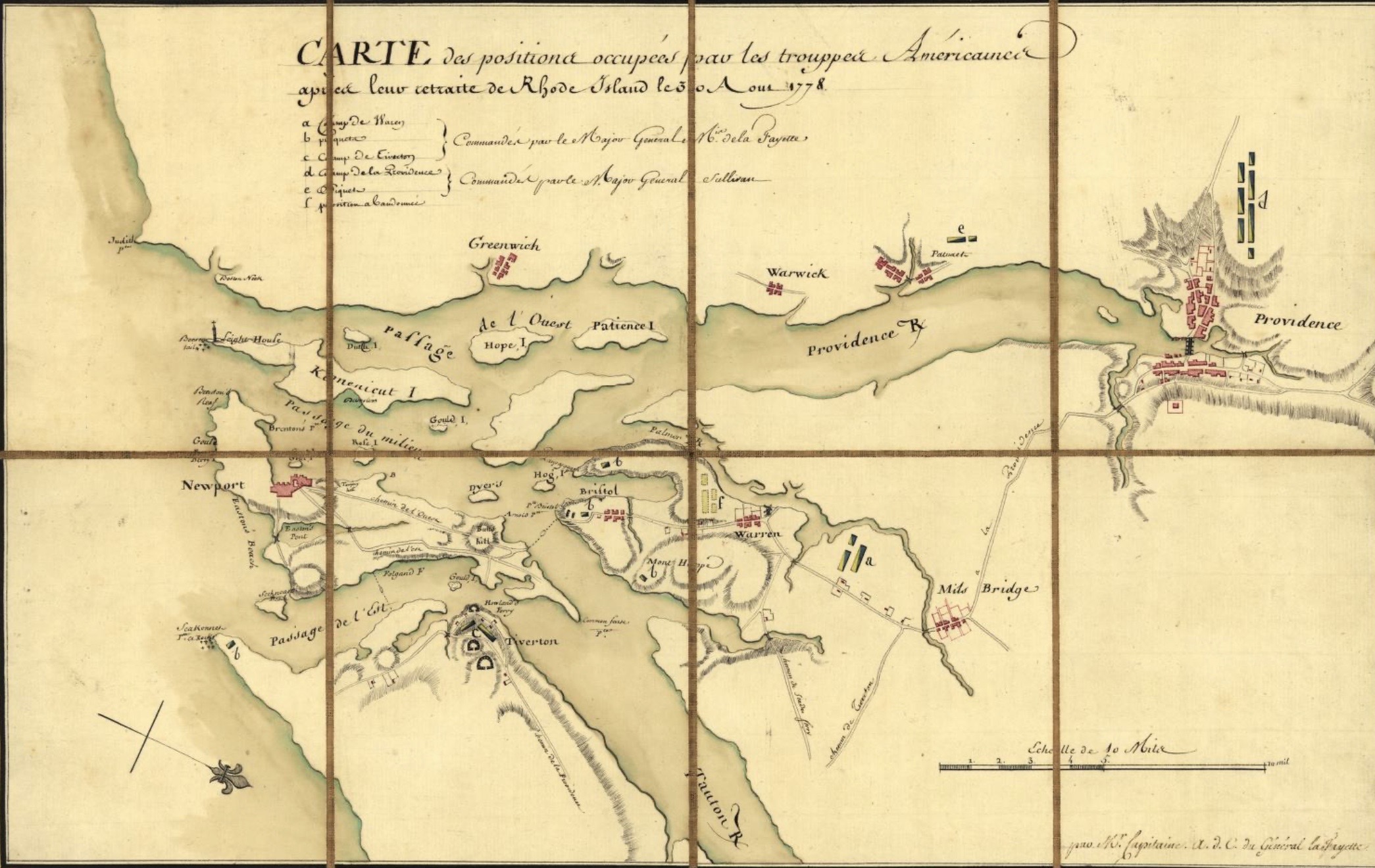
I have been searching for a way to illustrate the Marquis de Lafayette’s movements in Rhode Island and I came across a map that will be very helpful. It is a map of the positions of American troops in August of 1778. Rhode Island shorelines are prominent and the American camps are laid out so I can mark Lafayette’s positions throughout the Campaign.
I have seen (and used) this map before, but as I read Lafayette’s letters just before the Rhode Island Campaign, I came to appreciate this map and the French mapmaker, even more. The mapmaker was Michel Capitaine du Chesnoy. Chesnoy arrived in Charlestown, South Carolina with the teenage Lafayette. He was struck by an illness and it was only in the Spring of 1778 that he was well enough to help Lafayette. In his recovery he made maps of battles that he did not witness personally. He did a survey of the British positions at Ticonderoga, (Plan of Carillon or Ticonderoga). The map of Ticonderoga is unique, as mapmaker Chesnoy created the battlefield map through a combination of scouting accounts and secondary maps without visiting the area.
Chart of the positions occupied by American troops in Rhode Island August 1778 – Chesnoy
When Chesnoy came to America he was thirty-one years old and had been a lieutenant in the French army. He was made a Captain in the engineer corps of the Continental Army. Lafayette was unhappy with that because he considered Du Chesnoy his personal aide. The Marquis wrote to Henry Laurens in a letter dated July 23 from White Plains, New York.
“Mr. Capitaine one of my family has got the commission of a captain of engineers. ..Mr. Capitaine was in the Marshal of Broglios family, they made me a present of him and I attached him to serve me not only in America and in war but also to stay in the family in peaceable times. Such an officer I can’t spare, and I will employ him to make plans of our positions and battled for Gal. Washington, for me and for the king…The only way of getting him out of the engineer is to have for him a commission of Major in the line, he is now in my family but I want to have him entirely my supern-aide-de camp.” Note: A supernumerary aide had no regular duties and is held in reserve by the commander.
In January of 1779, Chesnoy followed Lafayette back to France. Chesnoy’s maps were used to persuade the French to continue to support the American forces. He presented a collection of his maps to the King of France. When he joined Lafayette in returning to America in 1780 he received a promotion to Captain in the French Army. He continued to serve as Lafayette’s mapmaker and aide-de-camp. His maps record the victories of the Virginia Campaign.
Chesnoy returned to France with Lafayette in 1781 but he kept his commission in the American army until it disbanded in 1783. He died in France in 1804, but his maps are still a valuable resource as we study the Rhode Island Campaign.
Resources:
Map: Capitaine Du Chesnoy, Michel, and Marie Joseph Paul Yves Roch Gilbert Du Motier Lafayette. Carte des positions occupeés par les trouppes Américaines apres leur retraite de Rhode Island le 30 Aout. [1778] Map. https://www.loc.gov/item/00555648/.
Did Paul Revere fight in the Battle of Rhode Island? No, but he participated in the Siege of Newport commanding his artillery company. A letter he wrote to his wife in August of 1778 gives us a glimpse of the experience of the American soldiers during the Siege.
We know the story of Revere’s “Midnight Ride,” but he was involved in more of the war effort than that. George Washington came to Boston in the Spring of 1776 days after the British had evacuated. Tradition has it that Washington asked Paul Revere (a craftsman) to repair the damage the British had done to the cannons on Castle Island. Revere was able to make the repairs and worked on a new type of gun-carriage as well. When Washington left Boston he took the majority of the Massachusetts troops with him. Boston was left to defend itself and on April 10th Revere was commissioned a major in the militia raised to defend Boston. Revere was sent to the Bridgewater area to learn from a French foundry man the method of casting of brass and iron to make cannons as well as the forges to make 18 pound shot. Revere would again meet this French foundry man, Louis de Maresquelle (a.k.a Lewis Ansart), when the Frenchman was an aide de camp to General Sullivan during the Rhode Island Campaign.
Newport Artillery Company fires a Paul Revere Cannon
Paul Revere took part in two efforts to remove the British from Aquidneck Island. The presence of the British in Rhode Island was a threat to Massachusetts. In the fall of 1777 Revere’s troops marched to Rhode Island and then back again. Boston printer John Boyle commented: “Nov 1 the 9000 Men lately raised to go upon a Secret Expedition returned home without effecting any Thing.”
Encouraged by the new French alliance, a second expedition was mounted in the summer of 1778. Col. Revere commanded the Boston artillery train and John Hancock was major general of the 3000 member Massachusetts militia. Revere’s heavy artillery headed for Rhode Island. At first Revere was encouraged about their chances of dislodging the British. While on Aquidneck Island Paul Revere wrote to his wife Rachel. (Annotations are added to make the references clearer to our modern readers.)
“My dear Girl, …Pray take care of yourself & my little ones. I hoped ere this too have been in Newport, my next hope will be dated there. We have had the most severe N. East Storms I ever knew, but thank Heaven, after 48 hours it is over.”
The storm was devastating to all sides. The French and the English warships were severely damaged. American troops had little shelter from the storm.
“I am in high health and spirits, & (so is) our Army. The Enemy dare not show their heads. We have had about 50 who have deserted to us; Hessians and others. They say more will desert & only wait for opportunity. I am told by the inhabitants that before we came on, they burned 6 of their Frigates; they have destroyed many houses between them & us. I hope we shall make them pay for all.”
When the French fleet entered Narragansett Bay on August 5, HMS Orpheus a 32 gun frigate was run aground at Almy’s Point and set on fire a few miles north of Newport on the west side of Aquidneck Island. The Juno, Lark and Cerberus were also scuttled and burned so that the French and Americans would not capture them. The were positioned so that the wrecks would block shipping lanes.
British maps recording the Siege of Newport show where houses were leveled in order to give British cannons a better line of fire.
“The French Fleet are not returned but I just heard they were off Point Judith with 3 frigates, prizes, this, I am told, comes from Head Quarters. I do not assert it for fact, but hope it is true”
When he wrote this letter, Revere was not aware of the damage to the French fleet.
“You have heard this Island is the Garden of America indeed it used to appeal so, but those British Savages have so abused and destroyed the Trees (the greater part of which was Fruit Trees) that it does not look like the same Island; some of the inhabitants who left it hardly know where to find their homes.”
After almost two years of occupation, Aquidneck Islanders lost almost all their trees and anything made of wood – docks, farm tools, wagons.
“Col. Crafts is obliged to act under Col. Crane which is a severe Mortification to him. I have but little to do with him having a separate command.”
Col. Crafts had turned down a military appointment because it was not high enough for someone of his stature. In the Rhode Island Campaign he was under the command of someone he had criticized as not being worthy of his position.
“It is very irksome to be separated from her whom I so tenderly love, and from my little lambs, but were I at home I should want to be here. It seems as if half Boston was here. I hope the affair will soon be settled. I think it will not be long first.”
The phrase, “It seems as if half Boston was here” is often quoted. The Boston militia was there.
“I trust that Allwise Being who has protected me will still protect me, and send me safely to the Arms of her whom it is my greatest happiness to call my own. Paul is well; send Duty and love to all. …Col. Matescall, (Lewis Ansart) who is one of General Sullivans Adi Camps, tell me this minute that the French have took a Transport with British Grenadiers, but could not tell particulars. Your own, Paul Revere”
Paul is Revere’s 18 year old son. He had been his father’s lieutenant and served with him.
When Paul Revere wrote this letter he did not know of the damage to the French fleet. When it was clear that the fleet would not return, the Massachusetts troops under John Hancock began to leave Aquidneck Island. Hancock complained of the length and tiresomeness of the campaign. He had heard that his child was sick and dying and he thought that if the the fleet had gone to Boston, he could facilitate the re-fitting of the ships. Hancock did his best to smooth over the testy relationship between D’Estaing who commanded the French fleet and the Americans.
Back in Boston Revere was losing men to service on three types of ships: privateers, Continental and Massachusetts. Some of his men had lost their blankets on the retreat from Rhode Island and lacked clothing, pay and ways to feed their families. Revere entered the action in Rhode Island with high spirits, but found discouragement in the aftermath.
Resources
Forbes, Esther. Paul Revere and the World He Lived In. Boston: Houghton, Mifflin, 1942. This source provided the background to Revere’s story and the letter from the Siege.
Boyle, John. Journal of Occurrences in Boston, 1759-1778 in N.E. Historical General Register. Quoted in Forbe’s book on Revere.
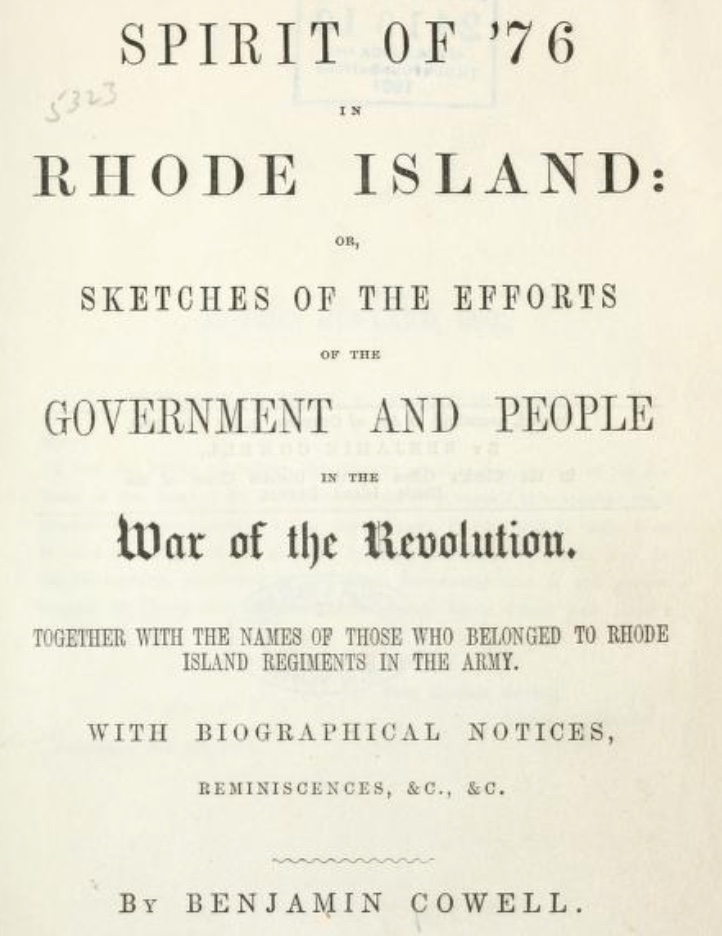
In researching another topic in Revolutionary Rhode Island, I came across a book by Judge Benjamin Cowell. Cowell was born in 1781, so he wasn’t a Revolutionary War Veteran, but he made it his aim in life to help Rhode Island veterans get their pensions. He began recording the stories these old soldiers had to tell to justify their service. Cowell began to gather eyewitness accounts, speeches, letters, rosters and every piece of information he could find on Rhode Island’s role in the War for Independence. In 1850 he gathered all this material into a book: Spirit of ’76 in Rhode Island. I am gradually making my way through this book, but I found a Portsmouth story to share.
Cowell introduces the story this way (he refers to himself as “the writer”: “In the summer of 1849, the writer reconnoitered the battle ground on Rhode Island to ascertain any interesting facts which might be within the recollection of any of the old inhabitants in the neighborhood; and in his researches, he called at the house of Mr. Seth Anthony, an aged “Friend” who now lives on the farm where the battle took place, and always lived in the neighborhood. From him he gathered no little information, and from questions which the writer put to him he received a few days afterwards the following reply, which deserves a place in these sketches.
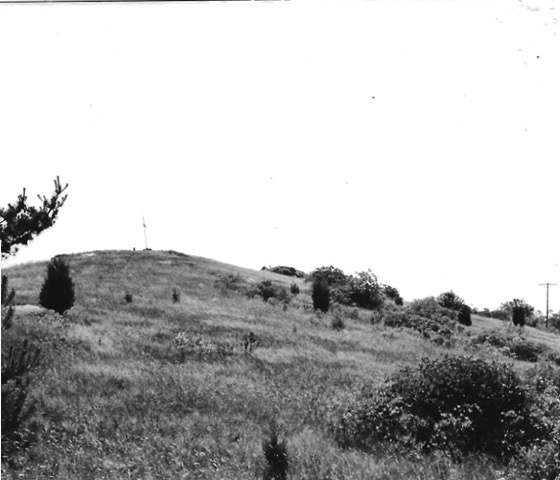
Portsmouth, Oct 13, 1849. To Benjamin Cowell, Providence, Respected Friend, —In answer to thy questions I have to say, that I was about twelve years of age at the time of Sullivan’s expedition against the British, and lived with my father on the west road on the Island, about two and a half miles from Bristol Ferry, lived there all the time the British were in possession of the Island, and I have now, although eighty-two years of age, a distinct recollection of most of the events that took place, at least in our neighborhood. The battle on the 29th of August, 1778, took place on the farm on which I now live, which is a little to the westward of the house where my father lived; there had been skirmishing all day, but the principal fight was a little northward of “Anthony’s Hill.” (Note that we call it Almy’s Hill.) Before the American troops came on the island, the British had fortified Butt’s Hill, one of their Generals (Smith) quartered at my father’s house, the Hessians quartered in the Friends’ Meeting House on Quaker Hill. After General Sullivan came on, the enemy retreated towards Newport, and I recollect General Greene took up his quarters at my father’s house.
Almy Hill Battle Site – Garman photo
When the enemy came back on the 29th, while Gen. Greene was eating his breakfast, our house-maid said to him, the British would have him; he observed very cooly “he would eat his breakfast first;” after he had done he went to his troops. During the day some Hessians entered our house, and plundered every thing they could,— they took my father’s silver knee-buckles; I saw one of them take hold of my father and demand his money and threatened his life, but he did not get it; my father had about two thousand dollars in gold and silver, but he had taken the precaution to bury it under an old stone wall. The Hessians also searched my mother’s pocket, turned it inside out, but there was no money in it. My father and mother were “Friends,” and we kept silence as to our political opinions. I remember Gen. Green once observed that his mother was a Friend, and was opposed to his going into the army, but she said “if he would go, to be faithful.” There appeared to be fighting all day, sometimes one side would drive the other and then be obliged to retreat. But as far as I could judge, the main armies did not fight. It appears to me the events of that day will always be fresh in my recollection.
I also remember the great storm some days before the battle, I never knew so severe a storm before; it lasted several days, and did a vast deal of damage. The day after the battle the Americans all left the Island. And I also do distinctly recollect that the day after the fighting the British determined to burn all the houses in our neighborhood, and would have done it if the Americans had not left the Island that night.- We had this information from the British Officers.. (Signed). Seth Anthony
We can get clues to what Butts Hill Fort may have looked like in 1781 from the orderly books of the American units who were helping the French reshape the fortifications into a proper fort. One of these orderly books was written by Ebenezer Thayer Jr. It covers August 16 to November 28, 1780. It is available through the Huntington Digital Library. There is another orderly book at the John Hay Library at Brown. It is difficult for me to transcribe the one at Brown. Thayer’s book was less difficult to transcribe and covered a greater period of time, so it was easier for me to draw material from it. Thayer, a Harvard educated minister, was in charge of a three-month regiment of a Massachusetts militia raised to support the Expédition Particulière, the French expeditionary army under the command of Rochambeau. The regiment was placed under the command of William Heath and stationed in Rhode Island at Butts Hill.
Oct 17. 1780 – Thayer’s orderly book. Transcription adapted for understanding.
The wagon masters of the Brigade are directed to attend on the works with their Wagons at the time the Fatigue party (Non Military chores) goes on the works and fetch one Load of Stones each for the purpose of Building the pillows (could that be pillars?) of the Fort every morning until they Receive further Orders from the Commandant. And they will apply to the (Linguister?) at the fort to know where the Stone shall be brought from.
One group that were assured of good provisions were those actively helping the French masons.
October 16th “There are four men to be detached from the brigade to attend constantly on the French Masons until the stone pillows (pillars?) of the Fort are completed and two masons detached to assist the French Masons until the works are finished and for their service they shall receive half a pint of rum a day when in the store.” Their provisions are ready for them so that they can complete the Fort works in a timely manner.”
Fort building was hard work. One entry records that the American wagons are bringing loads of stone to the works at Butts Hill Fort. They are building a “sally port” which is a secure, controlled entry way to an enclosure like a fort. All tools must be returned to the engineer. Members of the Black Regiment continued the “works” at Butts Hill Fort once the Massachusetts militias departed.
October 25, 1780: “The wagoners will attend on the works tomorrow and fetch two load of stones each for the building of the pillows of the sally port”
They are building a “sally port.” All tools must be returned to the engineer. What could a sally port to an earthenware fort look like? We have an example that gives us an idea. Below are examples of sally ports with earthen fortifications. Both images are in the collection of the Library of Congress. The image on the left is of Fort Wayne in Detroit. The image on the right is from Yorktown.
Sally Port in earth works – Detroit (Library of Congresss)Sally Port in midst of earthen works – Yorktown (LofCongress)
What have we learned about Butts Hill Fort in 1781 from the Orderly Book of Thayer?
In 1780 a sally port was being constructed.
French and American masons worked on the sally port.
Wagon loads of stone were being brought up to the fort.
“Pillows” or could they be pillars, were part of the sally port design.
I would welcome the help of those who understand more about military fortifications to guide me on the meaning of the “pillows.” The wagoner’s were getting guidance from the “Linguister” (Singuister) on where to get the stone. Who in the military could that be?







 portsmouthhistorynotes