Home

The Many Lives of the HMS Flora

Leave a comment

I am working on a tour of sites in Portsmouth that saw action in the Battle of Rhode Island. The top of Quaker Hill is one such site. Some historians even use the term “Battle of Quaker Hill” because of the heavy action at this place. British soldiers converged on this crossroads from East Main, Middle Road and Hedly Street. Americans were holding their line at that position.

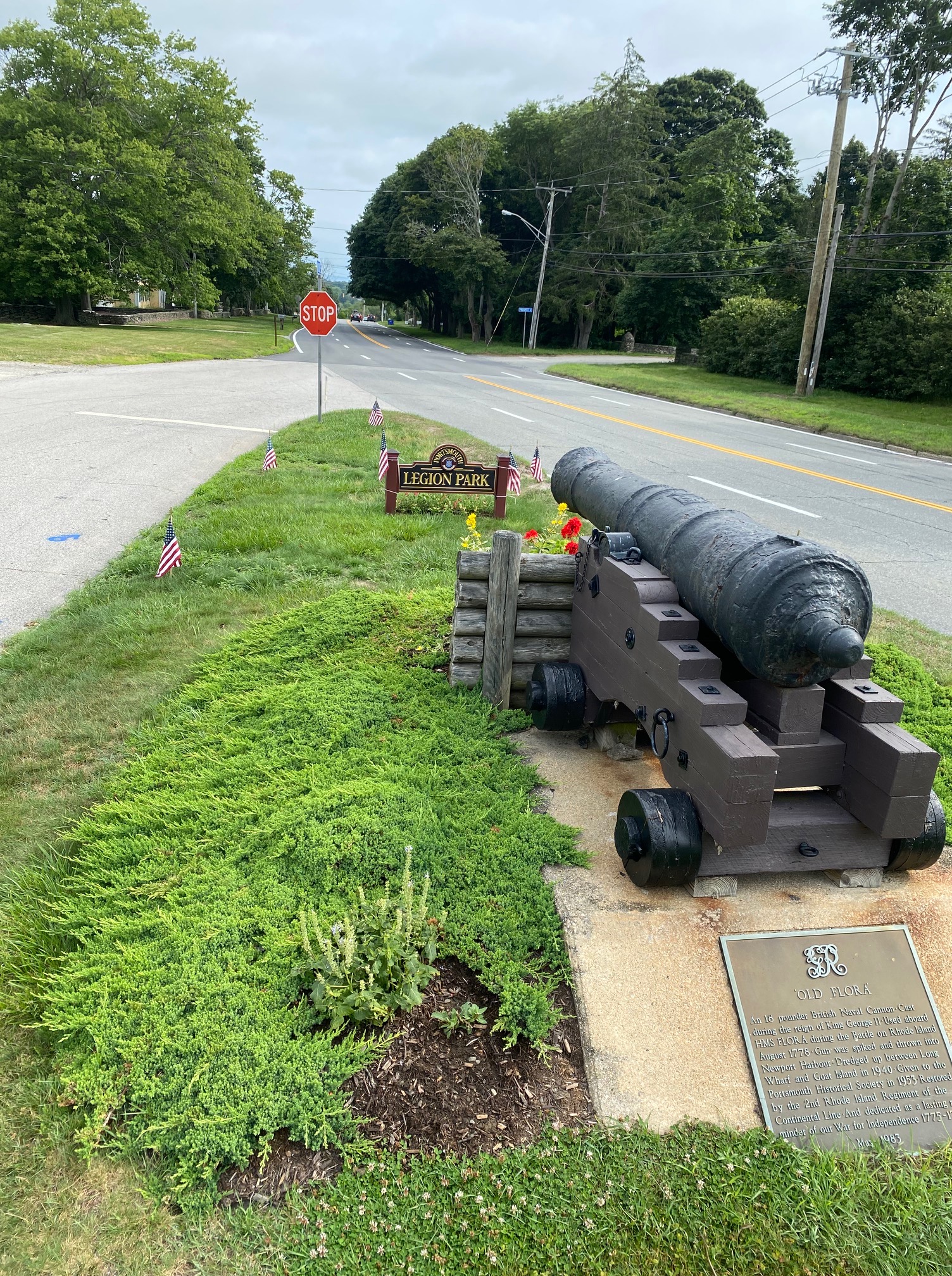
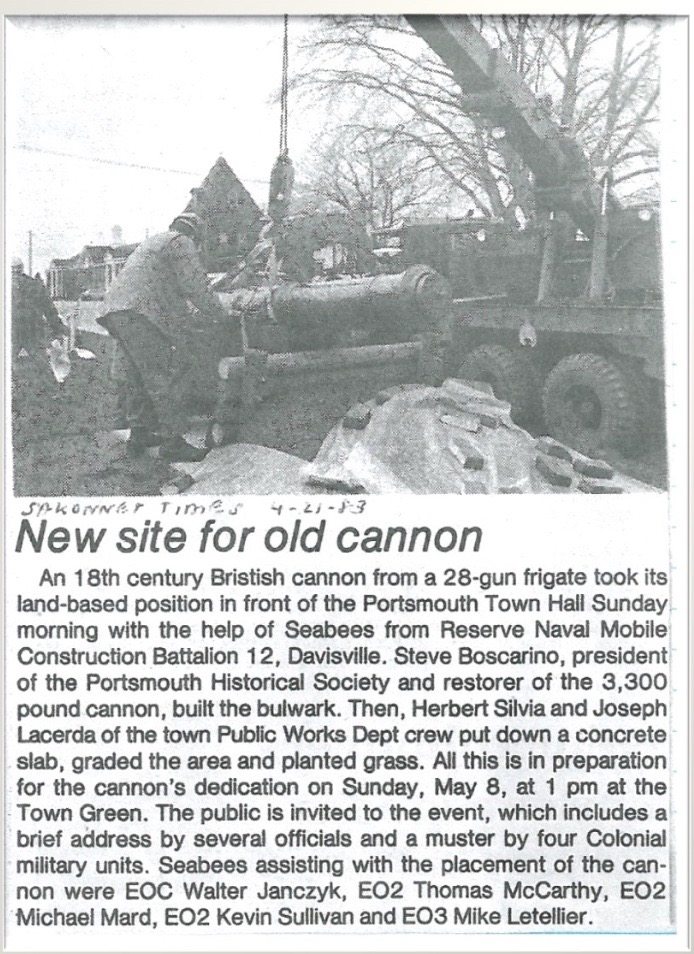
What Revolutionary Era sites can you still see today? The Friends Meeting House is an important landmark that was used by the British and Hessians as a hospital, barracks, and ammunition storehouse. The stonewalls are there to remind us of the American style of warfare in which the Patriots hid behind the walls in what we would call guerilla warfare aimed at harassing and delaying the British. In Legion Park across from the meetinghouse there is a cannon from the British ship Flora.

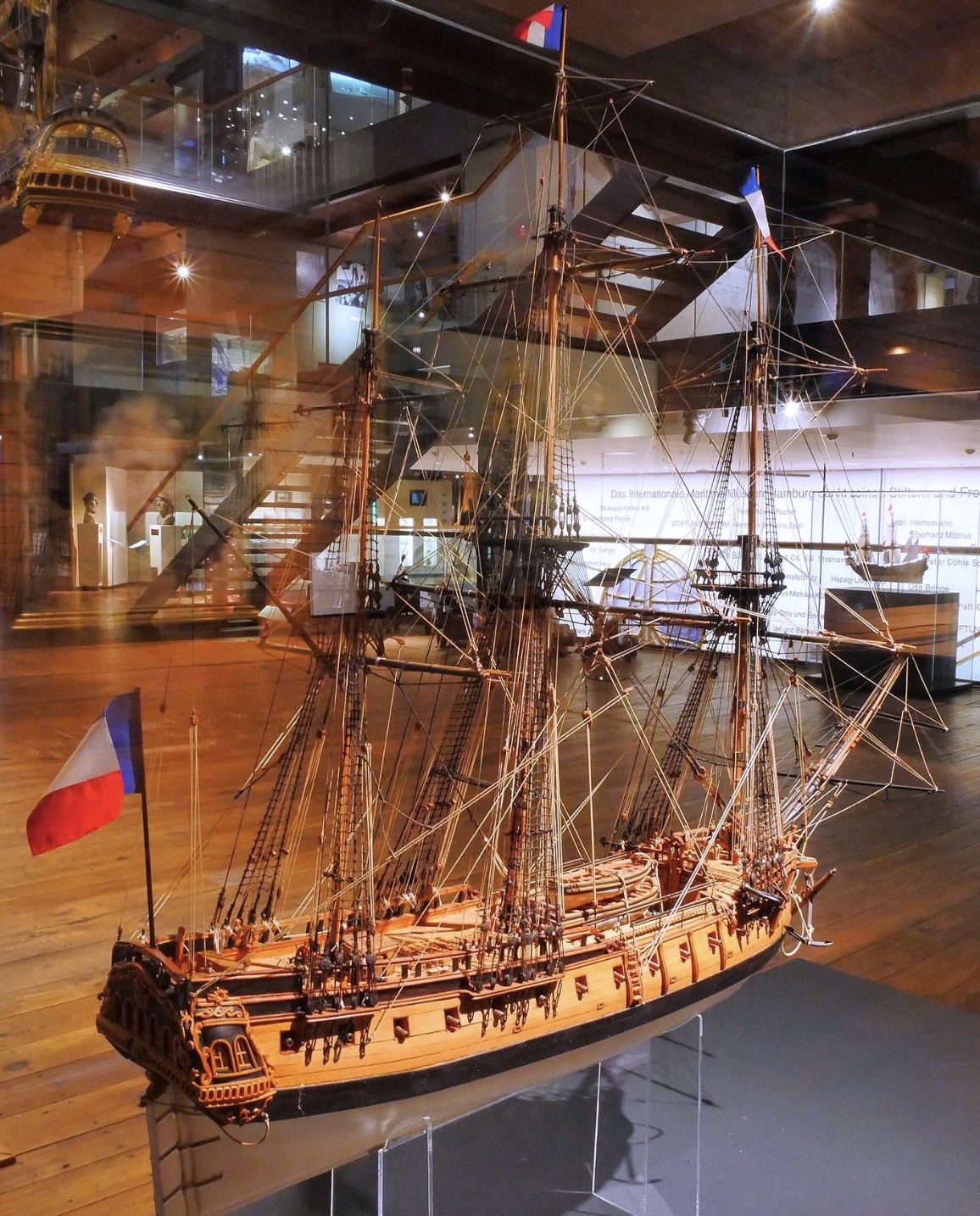
What is the story of the Flora? In researching why we have a ship’s cannon at Quaker Hill, I encountered the tale of a ship of many names and nationalities. According to an article by noted marine archaeologist D.K. Abbass, the Flora was a 698 ton, 32-gun Royal Navy frigate. Its original name was LaVestale and it was built by the French Navy in 1757. Once a ship was captured in those days, it was common practice for the vessel to be used in the navy of its captor. In 1761 the ship was captured by the British and was renamed the Flora. By 1776 the Flora was being used as a troop transport.

When the French fleet arrived in Newport in July of 1778, the British did not want the French to capture their ships. The British scuttled seven of their vessels and 13 of their transports were scuttled in the outer harbor. In Washington’s Wolfpack, the Navy before there was a Navy, author Edgar Maclay wrote that the Flora was heaved over on its side and beached for cleaning. It lay between Goat Island and Long Wharf in Newport until April of 1779 when she was raised again. The British used eight 12 pounders from the Flora on the newly outfitted HMS Pigot. The story of how American Silas Talbot outwitted the British on the Pigot is yet another story to tell. The British sank (and burned) the Flora again when they left Rhode Island in December of 1779. She was passed back and forth. 1784 – named “Reconaissance” (French), 1787 back to “Flora” (French), “Citoyenne Francaise” (a French pirate). By 1798 she was captured by HMS Phaeton and sent to the scrap heap.

Flora was not down at the bottom of the harbor, but at least one of her cannons was. In 1940 workmen repairing Long Wharf came across the cannon and the cannon is now displayed at Legion Park in Portsmouth.

A note about privateers: they are privately owned armed vessels, commissioned by a state to attack enemy ships, usually merchant ships. The privateers and their crews usually got the ship and a large percentage of the cargo they captured. Without a real Navy, Americans relied upon these privateers in maritime warfare.

Sick at Butts Hill: the Fort as Hospital

Leave a comment

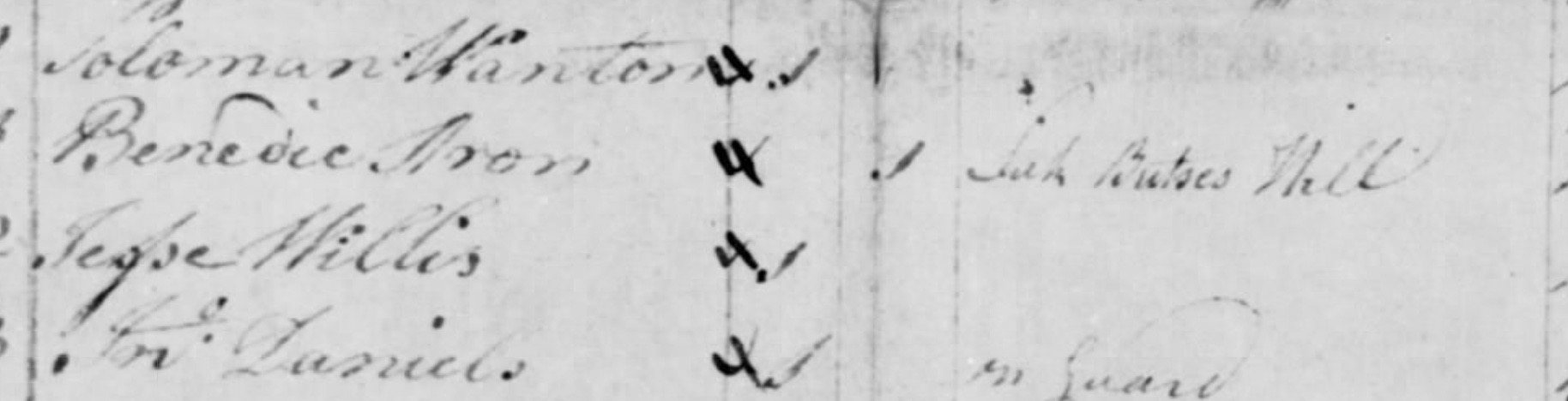
I have been trying to document the Black Regiment at Butts Hill, and Rhode Island historian Christian McBurney sent me a record of two soldiers who were listed as “sick, Butts Hill” in an August 22, 1778 muster roll. That led me to look into the role the fort played as a field hospital during the Siege of Newport and Battle of Rhode Island. I had come across a reference to this medical use in a orderly book for John Jacob’s Regiment of Massachusetts Militia. In this blog I will piece together what I have found so far on the Fort as a field hospital and what these field hospitals would have been like during Revolutionary War times.

Benedic Aron – Sick Butses Hill

A hospital was needed long before the Battle of Rhode Island and provisions had been made for it. The Hospital Department was created by Congress in 1775. There is a letter from Washington that made these provisions for Sullivan’s troops for the Rhode Island campaign.

From George Washington to Thomas Tillotson, 26 July 1778
To Thomas Tillotson
[White Plains, 26 July 1778]Sir,
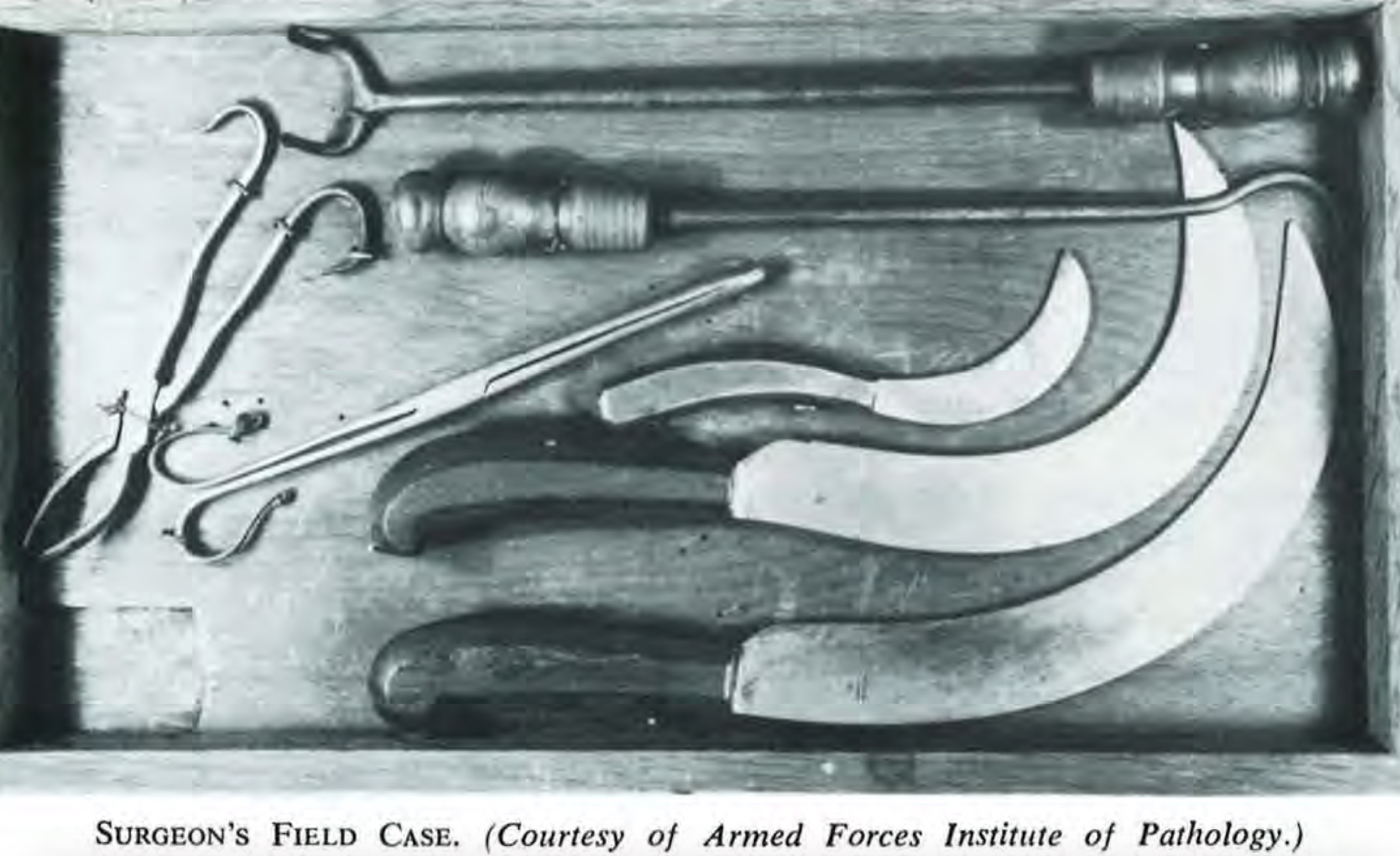
You are to proceed, immediately, with two assistants to Doctor Isaac Foster Director in the Eastern department, and take his instructions for the procuring of hospital furniture, medicines instruments, and such things as may be thought necessary in the formation of a military & flying hospital for the use and benefit of the troops under the command of Major General Sullivan, at Providence, Rhode Island, in case or provided a proper hospital arrangement has not already taken place in that quarter either by the orders of Major General Sullivan or Doctor Foster. But should there be as yet no establishment of this kind you will repair to and continue with Major General Sulliva[n] in the faithful exercise of the several functions of your profession till dismissed by General Sullivan, the commander in that quarter, or the commander in chief of the army of the United States. Given at Head Quarters this 26th day of July 1778.
G. W——n

There were three main types of hospitals to care for Revolutionary troops: 

1. The general hospital housed in buildings and run by the Continental military.

2. The mobile “flying hospital” also manned by Continental personnel in a hut or tent (with a few emergency beds and a surgeons table. These were like the later M.A.S.H. units.

3. The regimental hospital run by the regimental surgeon for larger numbers of soldiers. From the Orderly records it seems that the General Hospital was in Providence and Butts Hill would have been a “flying hospital.” Regimental surgeons and surgeon mates may have been closer to the battle doing triage and directing the wounded to Butts Hill.

Even before the Battle of Rhode Island there was a need for care of the “invalids.” The troops suffered through a major storm and there was little protection from the elements. During the Siege of Newport there were exchanges of fire and troops were wounded. 

Orders of August 12 included “A Return of all the Invalids and persons unfit for marching to be made at Headquarters Immediately that they may be properly Officered and left to man the Fort on the North End of the Island.” The “walking wounded” and sick were guarding the Butts Hill Fort area. The orders included asking the Regimental Surgeons to return their sick daily to the director general of the hospital. They also were to make an accounting of bandages and medicines “that they might be supplied.” 

On August 14th the orders included a statement that “a permit from the director General of the hospital will be a sufficient warrant for any Surgeon or sick person to pass to the main(land).” August 24th the orders read that Corporal Tilson is to grant papers to the mainland “as he thinks proper he will give only to the sick and those that attend them and the surgeon.” 

August 30, 1778 was a day of caring for the wounded and burying the dead. The orderly report expresses General Sullivan’s expectation the wounded and those who have care of them will not want for comfort. ”A party of 100 men from the front line are to collect and bury the dead of this Army who fell in action.” The orders from Tiverton on August 31st are ” All the sick and wounded of the Army are to be removed to Providence as soon as it may be done without endangering them.” 

There were more than 100 wounded in the Battle of Rhode Island. Others would have been injured in the storm and siege warfare. Accidents and illnesses would arise among the soldiers. There was a barracks at the Fort that might have served as a hospital caring for the wounded to stabilize them and send them on to more care in Providence. Regimental surgeons and their mates would have been providing the most immediate care, but the Battle of Rhode Island was an orderly retreat and all efforts would have been made to get the wounded to care at Butts Hill. 

Links to information about Revolutionary War Hospitals:

purposehttp://npshistory.com/publications/morr/medicine-surgery.pdf

Tredyffrin Easton Historical Society History Quarterly Digital archiveshttps://www.tehistory.org/hqda/html/v41/v41n1p025.html

On the Road with Lafayette 1778 – Part 5

Leave a comment

In command of the East Bay forces

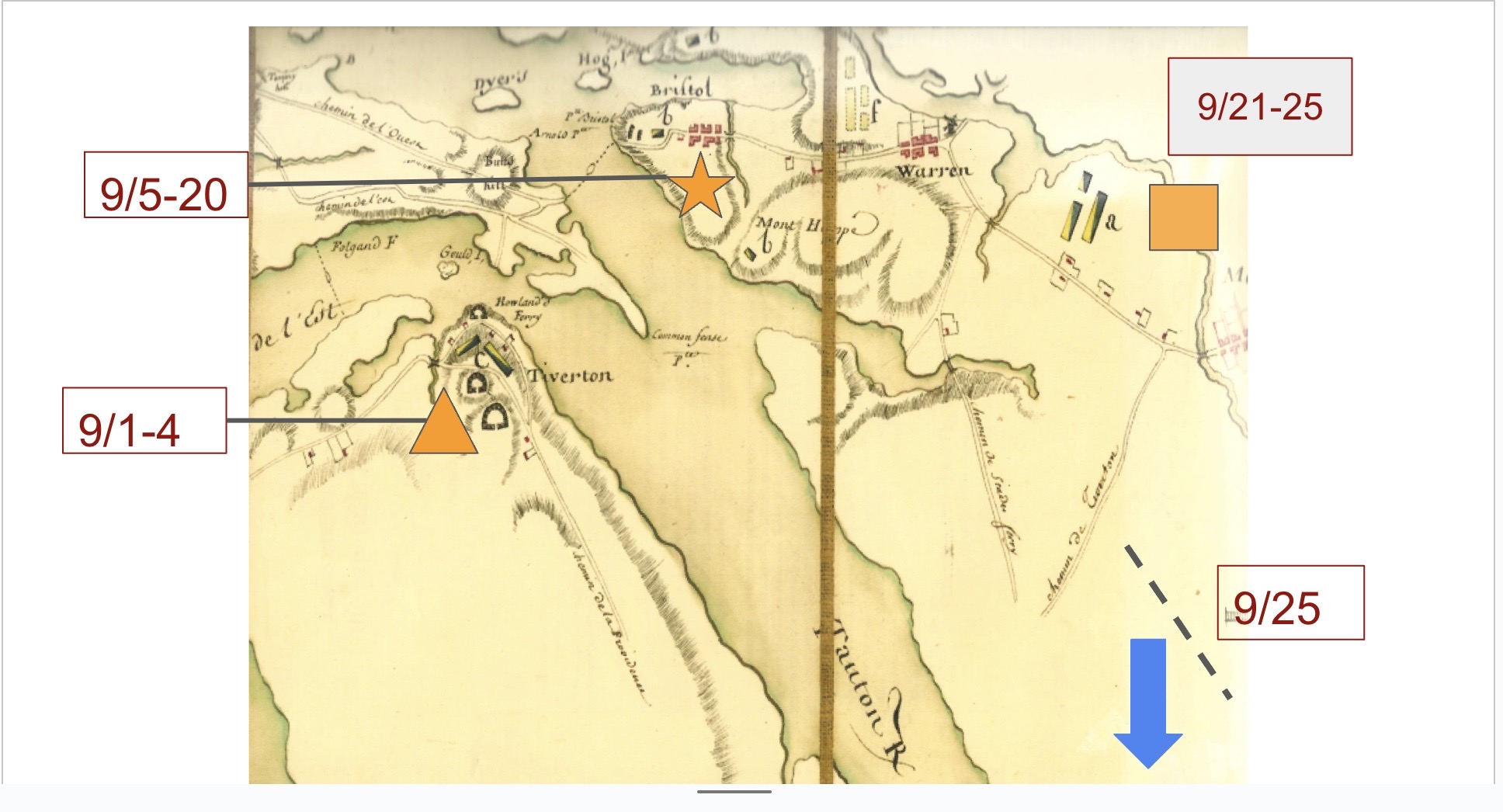
September 1st to 4th. Lafayette is in Tiverton (marked by ORANGE TRIANGLE). He has command of the Eastern Shore of Rhode Island. Lafayette writes a letter from Tiverton on 9/1. 

September 5th to 20th. Lafayette is in Bristol (marked by the ORANGE STAR). His headquarters was the Reynolds House. Lafayette writes a letter from Bristol on September 5. On September 8th he writes ”the Bristol post continues to be the most exposed one, and consequently I shall remain here.” Israel Angell’s diary reports he had dinner with Lafayette in Bristol on September 6 and heard that New Bedford had been attacked by the British. He dined with Lafayette on the 12th as well. On September 8th he writes to Silas Talbot from Bristol suggesting a plot to captures the British vessel Pigot. September 13th he writes to his wife Adrienne from Bristol.

September 21st through 24th. Lafayette camps outside of Warren (ORANGE SQUARE near Warren.) He writes to d’Estaing and George Washington from Warren on September 21. In his letter to Washington he comments that in response to advice from General Sullivan, he “is in a safer place behind Warren.” On September 23rd he writes to the President of Congress from outside Warren. ”The moment I heard of America, I loved her. The moment I knew she was fighting for freedom, I burnt with the desire of bleeding for her..”

September 25th. Lafayette left for Boston and the Rhode Island Campaign is at an end.
(BLUE LINES OFF TO BOSTON).

By October 5 Washington has requested that General Sullivan grant permission for Lafayette’s leave from duty.

Reynolds House, Bristol. Lafayette Headquarters

Resources: 1899, The Diary of Colonel Israel Angell Commanding Offifficer, 2nd Rhode Island Regiment, Continental Army, Edward Field, Israel Angell, Norman Desmarais

On the Road with Lafayette 1778 – Part 4

Leave a comment

Lafayette on a Mission

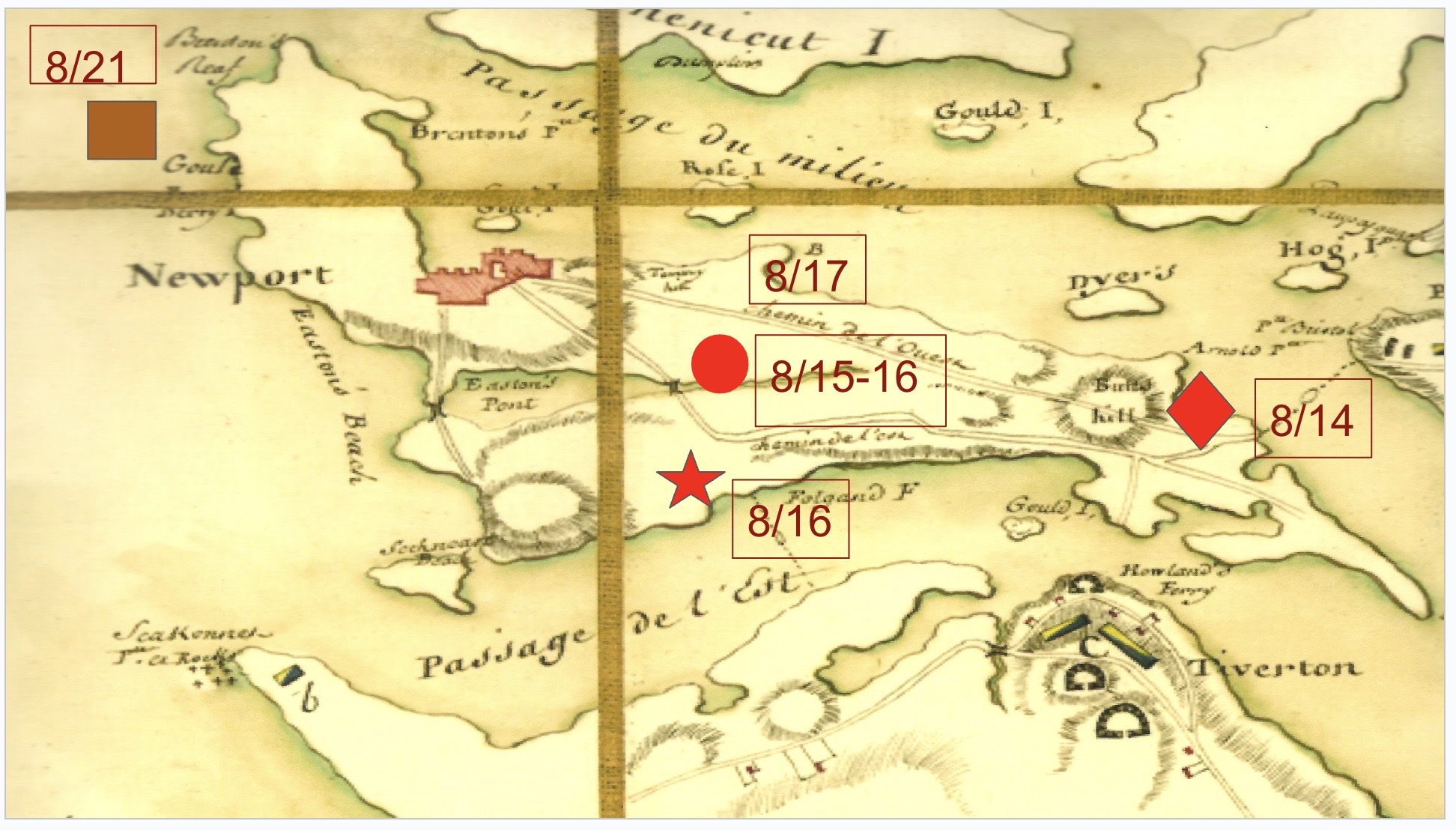
At the American Headquarters: (RED CIRCLE)

August 22. Lafayette is Major General for the Day. Lafayette and General Sullivan argue over Sullivan’s letter to D’Estaing. Lafayette refuses to agree to the letter because he finds it insulting to the French.

August 23. At counsel of War Lafayette backed an immediate retreat even though he was unhappy with the American position about the French. Lafayette is bitter about the claims the French deserted the Americans.

At Butts Hill (RED DIAMOND).

August 27. American forces decide to move to Butts Hill.

August 27. Lafayette leaves that evening to ride to Boston to talk to d’Estaing. Lafayette crosses Howland Ferry (RED TRIANGLE) to Tiverton.

August 28. Lafayette rode all night. 7 hours and 70 miles. Lafayette arrives in Boston about the same time the French Fleet Arrived. Boston is marked with a BLUE STAR.

August 29. Lafayette, John Hancock and General Heath meet with d’Estaing at Hancock’s home in Boston (BLUE STAR). The French will not return to Rhode Island.

August 30. Lafayette returns at 11 PM to Portsmouth by way of Howland Ferry (RED TRIANGLE>. He has missed the battle but has taken a role in the retreat.

August 31. Lafayette escorts the last pickets are off the Island via Howland Ferry (RED TRIANGLE) after 2 AM.

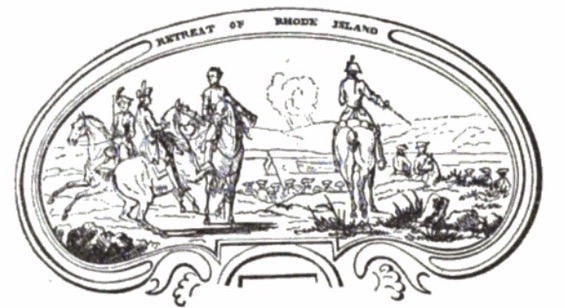
“Retreat of Rhode Island”
One of the medallions on the guard of the sword presented to Lafayette by the Congress. In Recollections of the Private Life of Lafayette by Cloquet.

Resources:

Kitchin, Thomas. “A map of the colony of Rhode Island.” Map. London: Printed for R. Baldwin at the Rose, Pater Noster Row, 1778. Digital Commonwealth, https://ark.digitalcommonwealth.org/ark:/50959/6t053p17c (accessed January 16, 2024).

On the Road with Lafayette 1778 – Part 3

Leave a comment

The Siege Begins

August 14th. The storm ends. Americans begin new earthworks at Butts Hill marked with RED DIAMOND. Early morning the soldiers “examine their arms and renewed their cartridges.” (Cutler’s diary) Supplies had been damaged in the storm.

August 15th. At 6 AM the whole army proceeds to march toward Newport in three columns. Americans halt advance at between 4 and 5 PM within site of the British lines. American lines run from West Main Road to Green End in Middletown marked with a RED CIRCLE.

August 16th. Americans are building a four cannon battery north of Green End marked by RED CIRCLE. The British fire their cannons at them. A diary notes that Lafayette is camped at the Bowler Farm on Wapping Road marked by the RED STAR. 

August 17th. Lafayette is Major General for the day. Siege operations (marked by RED CIRCLE) are in full force. Lafayette oversees the siege works from the top of a house. The British attacked the house and Culter’s diary entry remarks: “Stood by the Marquis when a cannon ball just passed us. Was pleased
with his firmness..”

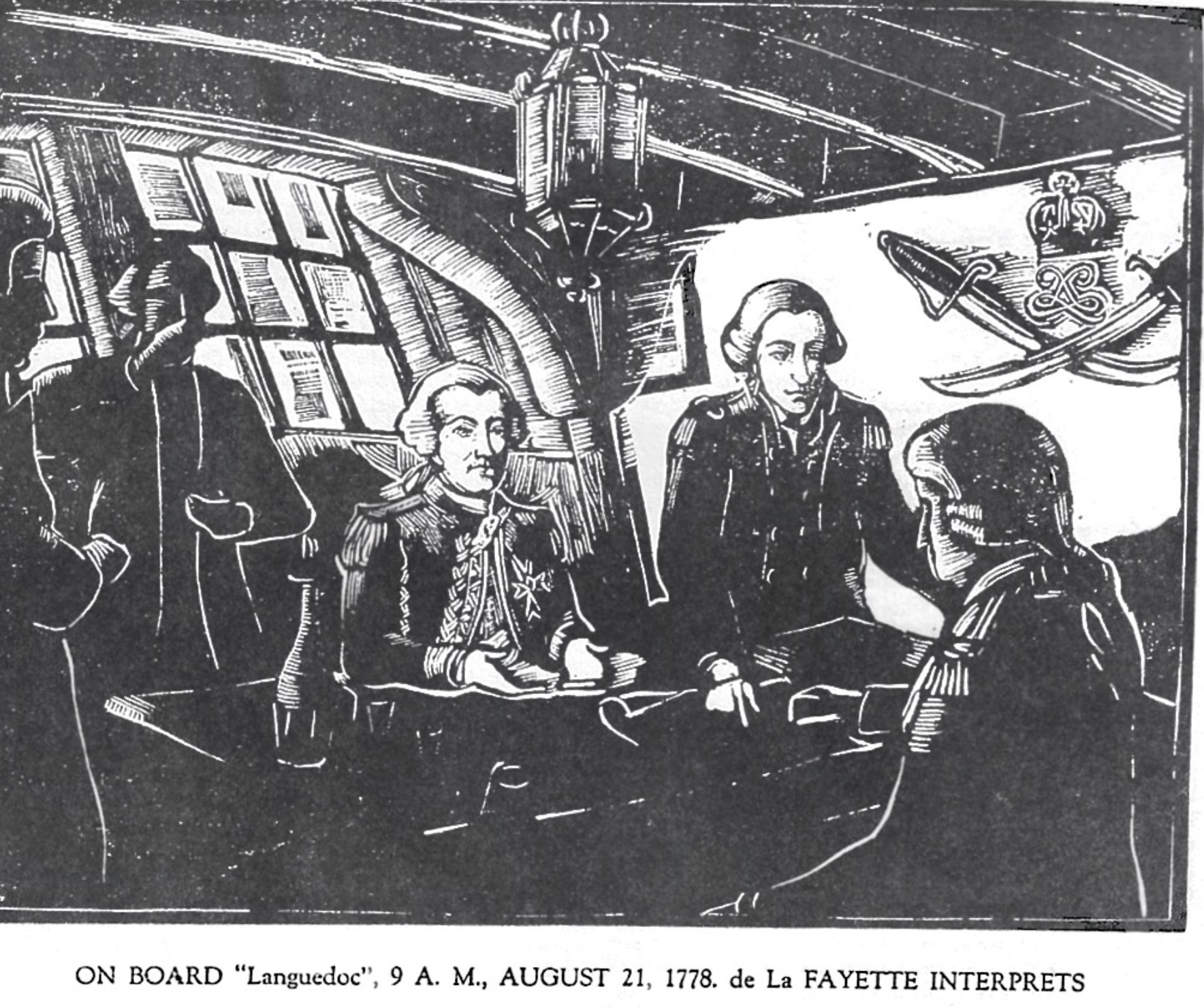
August 21. Lafayette, General Green and Col. Langdon go aboard the Languedoc marked with a BROWN CIRCLE. The French only agree to take American forces off of Aquidneck Island. Americans would not agree to that and the French fleet would sail away.

Woodcut by Howard Benson in Eric O.D. Taylor’s “The Campaign on Rhode Island.” Used with permission of Benson family.

Source: Life, Journals and Correspondence of Rev. Manassa Cutler. https://archive.org/details/lifejournalscorr01cutl

On the Road with Lafayette in Rhode Island 1778 – Part 2 – A gathering storm

Leave a comment

August 9th, 1778.    

  • Red Triangle: Americans learn the British have left northern Aquidneck Island known as Rhode Island.  Sullivan orders his troops to cross over to Portsmouth at Howland Ferry.   
  • Brown Square: At 4 PM Lafayette goes onboard D’Estaing’s ship Languedoc out to sea by Newport. The ship is out to sea by Newport.   The French decide to do battle with the British fleet that has appeared outside Newport.  They are also unhappy that the Americans have moved onto Aquidneck Island before them.

August 10 – 13th, 1778 

Red Diamond: Butts Hill area

August 10th, Lafayette and the Americans are camped around Butts Hill fortifications in Portsmouth.

August 11th, the Americans are still by Butts Hill with Lafayette as Major General of the Day.  American troops parade at 4 PM.  Lafayette’s  troops paraded on the left and Greene’s troops on the right.  A storm like a hurricane hits the island.

August 12th and 13th,  the Storm is at its most fierce.  Soldiers have no tents or shelter.  Lafayette and Col. Wade inspect the water-logged American camp around Butts Hill. 

British and French ships are returning damaged by the storm.

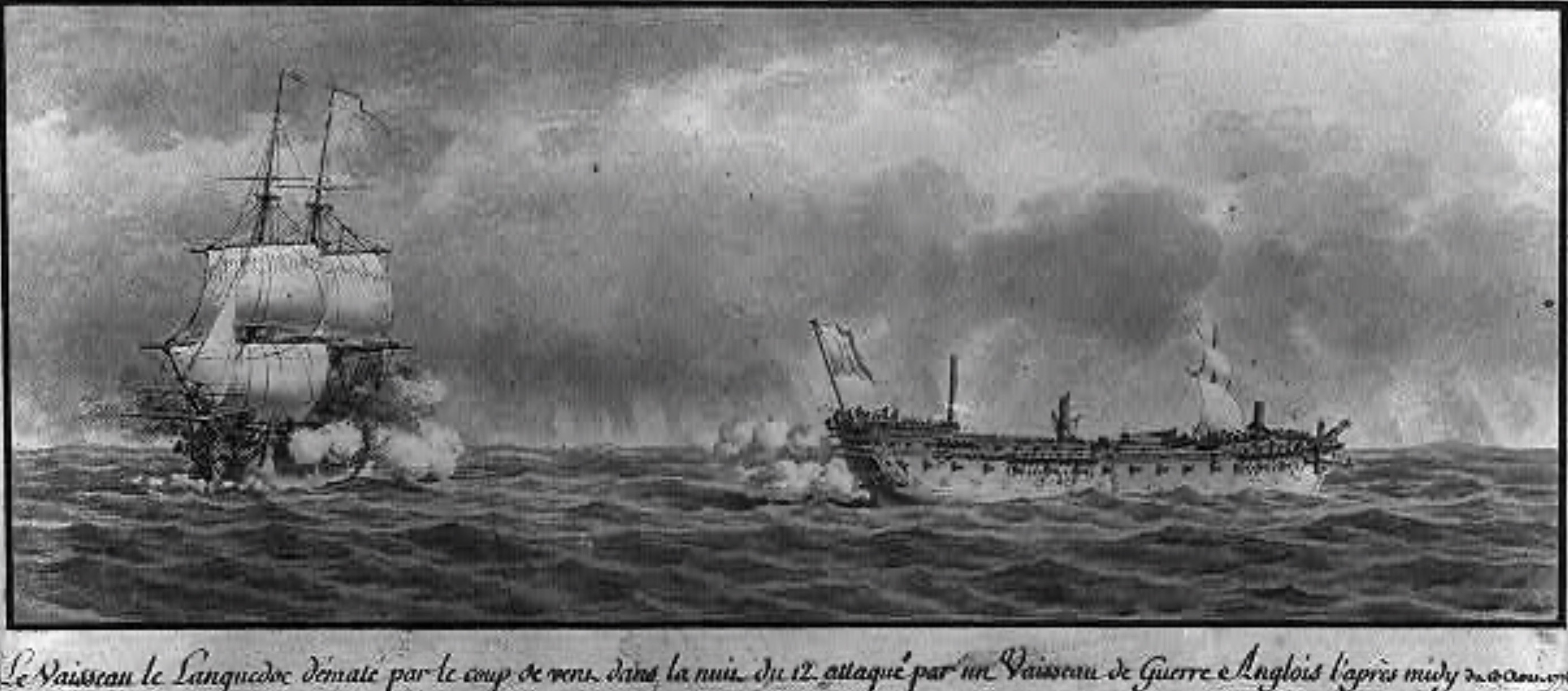
Languedoc returning without masts from Storm and Battle with British fleet.

Ozanne, Pierre, Artist. Le vaisseau le Languedoc dématé par le coup de vent dans le nuit du 12′ attaqué par un vaisseau de guerre Anglois l’après midy du 13 Aoust. [194] Photograph. Retrieved from the Library of Congress, <www.loc.gov/item/2004670063/>.

On the Road with Lafayette in Rhode Island 1778 -Part 1

Leave a comment

An Introduction to my project

As a researcher for the Battle of Rhode Island Association, I was asked to investigate Lafayette’s role in the Rhode Island Campaign. I looked at the usual “Lafayette stayed here” locations and I wrote about them, but the more I researched the more I realized the very special role Lafayette played in the Rhode Island Campaign. My current project is to trace Lafayette’s movements throughout Rhode Island. It is both a timeline and an attempt to follow him on a map made by his cartographer at the time. What I am sharing now are my approximations. I have used his letters, Orderly Reports, diaries, and trusted secondary sources. Accounts do not always agree, so I have tried to make sure I had confirmations before I listed places and times. This is a work in progress and I would welcome corrections that give me more factual information.  

On the Road: The Gathering of the Troops

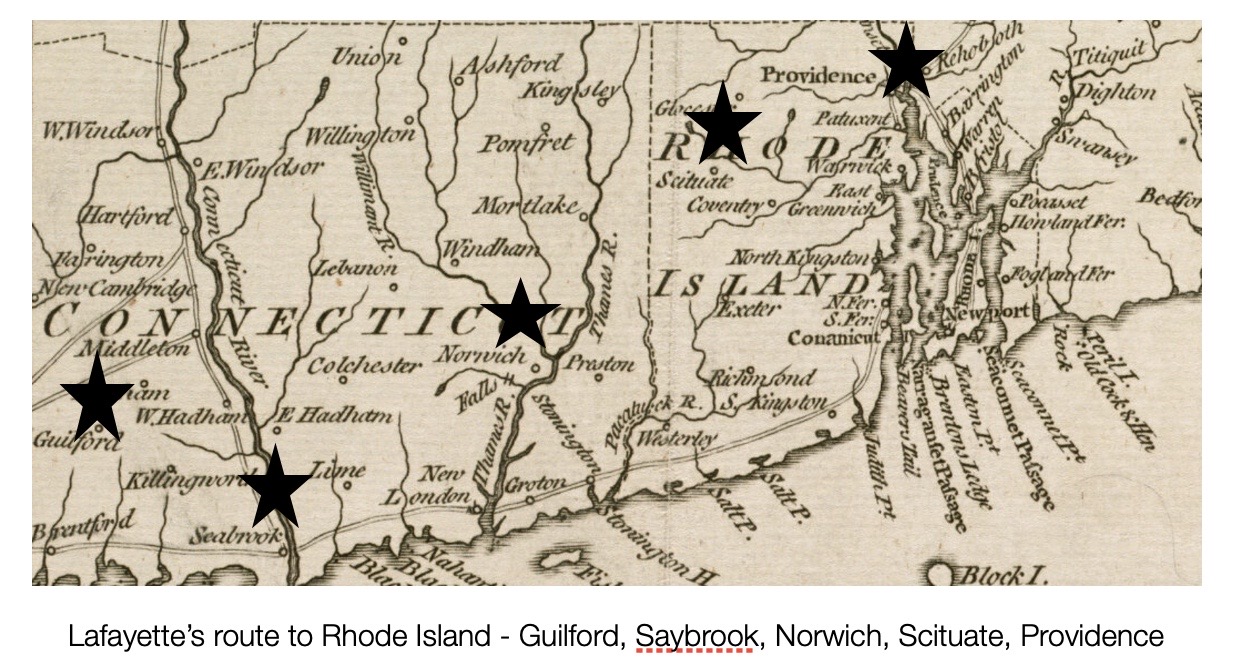
The Marquis de Lafayette was hopeful about the Rhode Island Campaign as he marched toward Rhode Island. He wrote to General John Sullivan from Saybrook on 28 July, 1778: “I hope a pretty decent set of laurels may be collected upon that island, and we will terminate the whole by joining English country dances to French cotillions in company with the fine and reputed ladies of the charming place.” (1) (Idzerda)

The Rhode Island Campaign was the first joint effort of the American and French forces during the American Revolution. In July of 1778 the French fleet under d’Estaing sailed to America. One idea was for the French to help American forces to free New York from British control, but the fleet had problems sailing in that direction. As d’Estaing steered his fleet toward Rhode Island, General Washington wrote to General Sullivan ordering him to raise 5,000 New England troops. He was to gather provisions and flatboats in preparation to work with the French fleet in releasing the British hold on Aquidneck Island (Rhode Island). Washington put twenty year old Lafayette in charge of General James Varnum’s four regiments as well as Glover’s and Jackson’s regiments. The troops had already started on the road to Rhode Island, and Lafayette had to catch up with them. By July 28th, 1778, Washington divided the forces into two divisions – one under General Nathanael Greene and the other under the leadership of Lafayette. The divisions would include both militia and the more experienced Continental troops. Lafayette caught up with his troops in Lyme, Connecticut. He took a route through Guilford, Saybrook, Norwich and Plainfield, Connecticut before he moved into Rhode Island.

Lafayette had a major role in the Rhode Island Campaign. To his dismay, he would miss being in the action at the Battle of Rhode Island, but he was active in every other phase of the Campaign. This timeline of his movements actually serves to illustrate the various stages of the Campaign. Lafayette was intimately involved in most segments of the action from August 1, 1778 to the end of September.

  1. George Washington gave him joint command of the American troops.
  2. He often served as “Major General of the Day” during the Siege of Newport. That meant he had the responsibility of reviewing the troops, checking supplies, attending the hospital, and carrying out discipline. He would assess the lines and entrenchments to place fortifications. He was the eyes and ears of the commander.
  3. He was an American representative in talks with d’Estaing. He was sent to Boston in a last ditch effort to bring the French Fleet back to Newport.
  4. On his return from Boston he led the last of the American forces off of Aquidneck Island.
  5. He commanded the American troops guarding the East side of Narragansett Bay.

August 1,1778. Lafayette’s first stop is Angell’s Tavern (the GREEN SQUARE) in South Scituate, Rhode Island. The 2 divisions which had headed for Rhode Island met there. This was about 12 miles from Providence, so it was an opportunity for the troops to rest.

August 2-5 1778. Lafayette goes to Providence (located at the Green Circle) ahead of his troops. He stays with Governor Bowen. He accepts Washington’s orders that he shares command with General Greene.

August 4,1778. Lafayette was aboard the French flagship Le Languedoc (Brown Square) to meet with French commander d’Estaing. The French fleet was waiting off of Point Judith and d’Estaing provided Lafayette with the ship Provence to bring him back to Providence. Lafayette writes to d”Estaing on August 5th summarizing their discussions and he also relays the hesitance of Sullivan and Greene to a plan where Lafayette would head a joint effort with French soldiers.

August 6th through the 8th, 1778. Lafayette and his men march toward Tiverton through Rehoboth, Swansea and Fall River to the Howland Ferry., marked by the BLUE STAR. Lafayette is at Sullivan’s Headquarters at Tiverton by August 8th.


  1. Idzerda, Stanley. Lafayette in the Age of the American Revolution, Selected Letters and Papers, 3 Volumes , 1776-1790. Cornell University : Ithaca,N.J. 1979.

Playing on Glen Farm: The Camara Sisters Interviews

Leave a comment

A friend let me know that the old sheep shed at Glen Farm is gone. Only the foundation remains. When my Elmhurst students interviewed the Camara sisters many years ago, Geri Leis talked about this shed fondly. This is her clubhouse in the 1940s. In honor of the memories of the Sheep Shed, I am posting clips from interviews the Camara Sisters where they talk about what it was like to play on Glen Farm.

The Adventures of Silas Talbot

Leave a comment

When Lafayette wrote Silas Talbot about a plan to capture the British vessel Pigot, he alluded to Talbots’s “reputation which you have already acquired by your zeal and skill in the artificial way (as a mechanic in the military).” Talbot was known as an “artificer” – “a soldier-mechanic attached to the artillery and engineer service, whose duty it is to construct and repair military materials.” 1. What was there in Talbot’s military history that had him known as a someone who could devise, construct and repair for a military campaign? Talbot had a record of invention, construction and even “daring do” to get the job done. All his past experiences made him useful to the American cause.


Silas Talbot was intimately involved in the Rhode Island Campaign. As someone with experience as a mariner and builder, Talbot helped to construct the flatboats that would take American forces to Portsmouth on August 9th of 1778. As a soldier, Talbot fought in the rear guard to protect the Patriots as they retreated to Tiverton on August 29th and 30th, 1778. Talbot alternated between roles as sailor and soldier throughout the American RevolutionSilas Talbot’s life was full of adventures. There were “rags to riches” stories and then again there were stories of monetary downfall. He was wounded in naval battles and sustained injuries on the Revolutionary War battlefields but he kept getting back into the action. This article will focus on some of those adventures of a representative figure in Revolutionary Rhode Island
Talbot came from a humble background. He was born to a farming family in Dighton, Massachusetts in 1751. His father died when he was twelve and Silas was indentured to a local stonemason. He learned his skills as a bricklayer, but Dighton was a seaport and Silas signed on as a sailor on sloops transporting cargo from Narragansett Bay to as far as the Carolinas. By 1770 Silas settled in Providence where some of his older siblings had established themselves. Silas’ bricklaying skills were put to work in construction. Talbot wanted property and he put aside enough money to buy a lot of land on Weybosset Street. In 1772 Talbot married well. He continued to purchase land and he also began to purchase slaves. Owning a black servant was a status symbol for Talbot. He moved from being a laborer to owning a construction business.


In the aftermath of the burning of the Gaspee and the Boston Tea Party, Rhode Island merchants were alarmed. Independent militias were forming and Talbot joined and was commissioned as a Lieutenant. He joined others of his company in learning military skills in a Providence warehouse, but he didn’t have any real military experience. On June 28, 1775 Talbot answered the Rhode Island Assembly’s call to send units to Boston. He marched with his men to join the Second Rhode Island Regiment and by July 1, he was commissioned a captain. Talbot and the other 1200 men in the Rhode Island brigade took part in the Siege of Boston watching over the Red Coats but not in direct battle. Talbot’s skills as a bricklayer came in handy as they built barracks on Prospect Hill.

By April of 1776 the Siege was over and Talbot and the Rhode Island men were proud to welcome General Washington as he passed through town. As Washington arrived in New London, Rhode Islander Esek Hopkins presented Washington with a problem. Hopkins was Commander in Chief of the Continental Navy. Hopkins had sought safety in New London harbor after damage to his ships. Hopkins needed a crew to sail the ships home to Providence. Washington offered to loan Hopkins men from the Rhode Island Regiment. “All those acquainted with Sea Service that have a mind to join the Admiral as Volunteer have Liberty.” Silas Talbot took that opportunity to sail home to Providence. This was the first example of how Talbot’s military service frequently switched between the army and the navy. In August of 1776 he joined the Rhode Island troops in New York. In September he took part in an attempt to place a “fireship” (literally a ship set on fire with combustibles ) next to a British ship to catch it on fire. Talbot stayed on the “fireship” as long as he could to get it closer to the British vessel. Unfortunately the fireship did little damage, but Talbot was gravely burned.

While Talbot healed he served as a recruitment officer to enroll more Rhode Island troops to the cause.
Talbot’s adventures continue in the next article.

Definition from Century Dictionary

Biographical information from William Fowler Jr’s Silas Talbot: Captain of Old Ironsides

Lafayette and Silas Talbot: the Pigot Plot

Leave a comment

We tend to think of the Rhode Island Campaign ending as the Americans retreated to Tiverton. I have been researching the movements of Lafayette in Rhode Island and I am more aware of the actions of the Continental troops on the East and West Bays directly after the retreat. Lafayette wrote letters that provide us with clues to what was happening in the East Bay. The Americans were successful in moving their troops and equipment off Aquidneck Island, but the decision of the French to leave for Boston to repair their ships left bitter feelings. Lafayette had an idea for a small victory to boost morale. On September 8th, 1778 he wrote to Silas Talbot . I am quoting the letter, but phrasing some of it in more modern language.

Sir,

The reputation which you have already acquired by your zeal and skill in the artificial way (as a mechanic in the military), leads me to communicate to you a plan where I think some success could be obtained. I wish to have heavy and strong scows upon each of them a twenty-four pounder would be fixed and then by a calm night, attack an English frigate who lies upon the North end of the island. The directions we could take should prevent her giving us any broadside before receiving many shots directed in such a way as to annoy them extremely.

In the same time she would be busy in her defense I wish two or four fire boats full of fascines, tar, old muskets, and bombs could be directed to the other side so as to enflame her.

If you believe, sir, such a scheme might succeed, I would be obliged to you to come immediately from Providence with such artificial provisions as would enable us to try the experiment without loss of time. You could take down two or three or more large scows or ferry boats who would extremely well do the business for fixing cannon on them. That affair must be kept very secret. With the greatest and more sincere esteem I have the honor to be dear sir your most obedient servant.

Silas Talbot did follow through with Lafayette’s idea. In coming blogs I will give more background on the adventures of Talbot and his daring exploits.

Letter taken from Lafayette in the Age of the American Revolution. Edited by Stanley J. Idzerda.

Older Entries Newer Entries