Plaques on the side of Vernon House on Clarke Street feature images of Rochambeau and Lafayette. Why are these French military officers associated with the home?
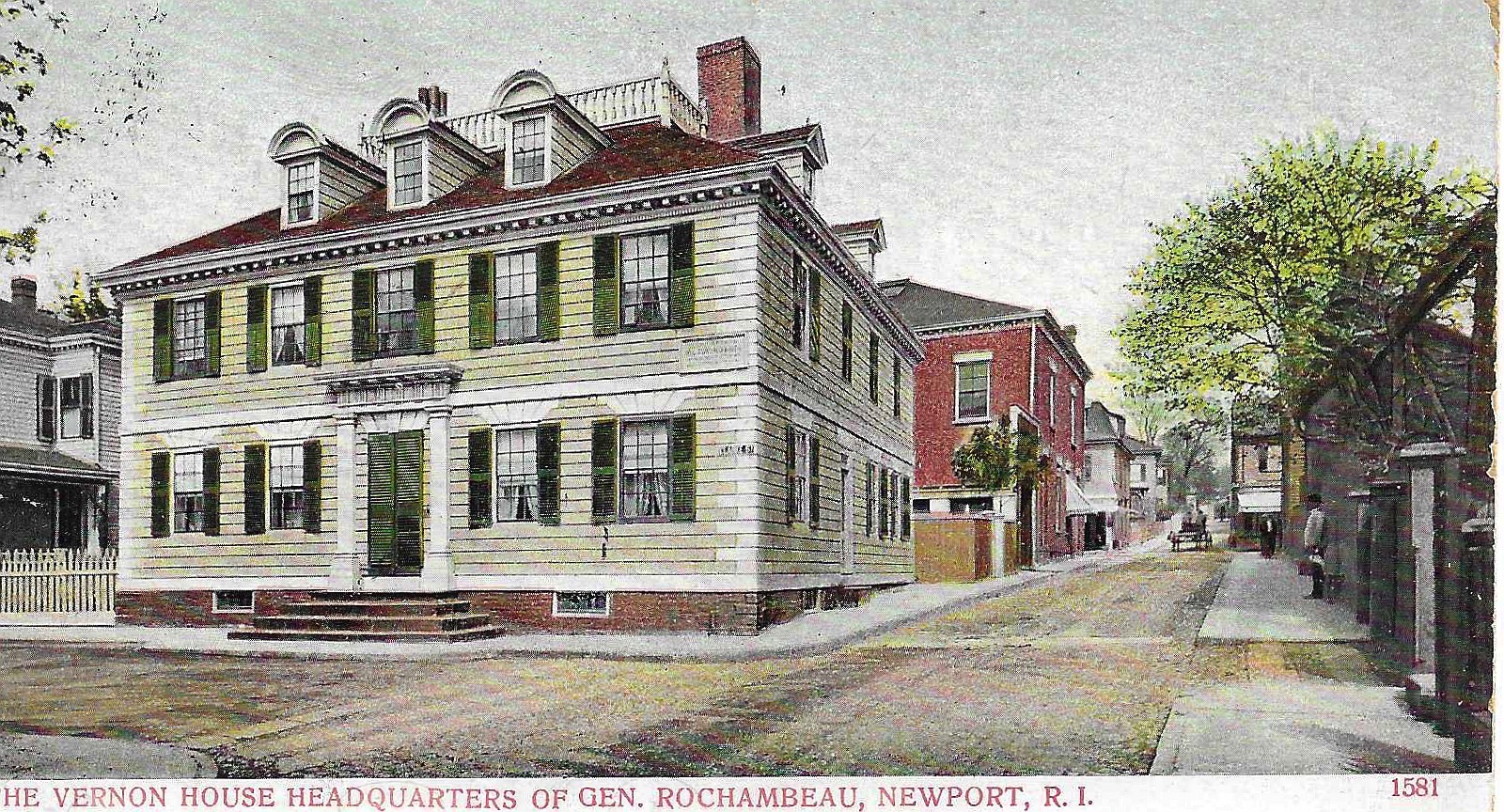
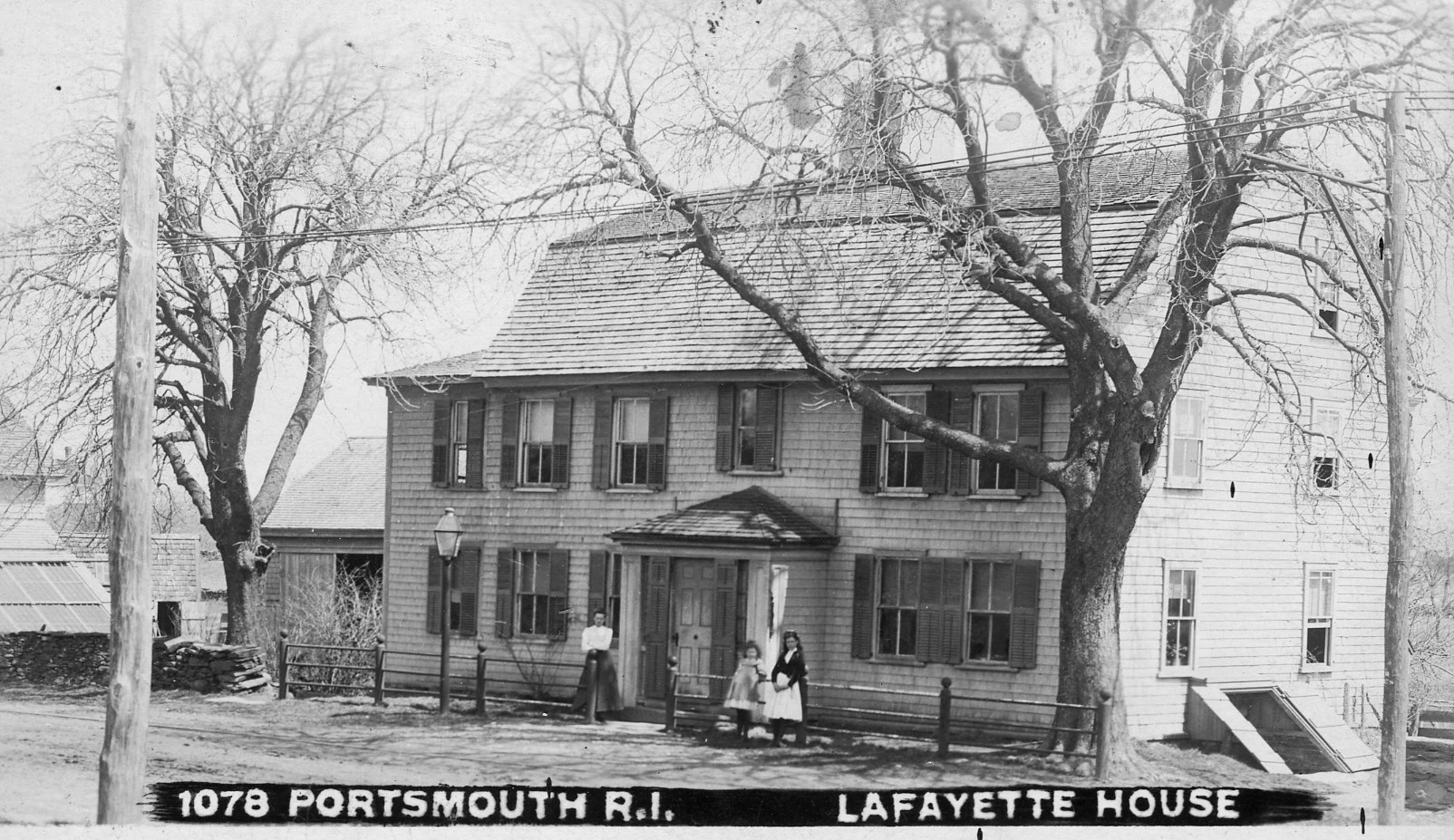
Vintage postcard of Vernon House
The application for inclusion in the National Register of Historic Places calls it one of Newport’s “most interesting buildings.” Peter Harrison, the designer of Redwood Library, is often mentioned as the architect of this colonial home. Re-modeling of the home in 1759 provided additions that give it an appearance of a Georgian mansion. Charles Bowler may have bought the property in 1753 when he became the Collector of Revenue. Bowler sold it to his son, Metcalf Bowler. Bowler was a noted merchant in the West Indies trade and he was active in local politics. He had a country home on Wapping Road in Portsmouth where Lafayette stayed during the Siege of Newport in 1778. Bowler fled to Providence and even held a state judgeship, but years later it was determined that he had acted as a British spy.
In 1773 Bowler sold the Newport home to William Vernon who was a successful merchant and ship builder. When the French arrived in Newport in 1780, Vernon offered the home as the quarters of Rochambeau. Rochambeau hosted both Lafayette and Washington while he resided at the home from 1780 to 1781.
The home is now in the hands of the Newport Restoration Foundation. The address is 46 Clarke Street.
Other homes associated with the French in Newport:
Hunter House: Headquarters of Charles Louis de Ternay before he died in December of 1780.
The Thomas Robinson House: Vicomte de Noailles of the Soissonain Regiment.
Buliod-Perry House occupied by Quartermaster Belville.
Sources: Application for inclusion in the National Register of Historic Place.
Lafayette’s last visit to Rhode Island was part of a grand tour as a guest of the government of the United States. It was an opportunity to refresh connections to the Revolutionary War generation and to highlight the progress the country had made as an independent state.
The Marquis de Lafayette came to Providence on August 23, 1824. The organizing committee was unsure which roads the Marquis would be traveling to Providence, so they posted messengers along various roads. He was met at Fisk’s Tavern in Scituate and escorted to the Providence town line where a delegation of the Town Council was waiting. He was transferred to a luxurious, open barouche carriage which was drawn by four white horses. He traveled along a predetermined line of march and was “welcomed by that most expressive token of affection interest, the waving of white handkerchiefs by the fair hands of the ladies.” (Providence Gazette, August 25, 1824)
Order of the Procession
Stephen Olney
There was a procession through High Street, down Westminister to Weybosset Bridge and up North Main Street and to the State House. As he reached the State House the United Train of Artillery fired a salute. As he arrived at the State House the streets were lined with women in white holding in their hands branches of flowers. As Lafayette walked up the State House steps they strew his path with flower petals. At the top of the stair landing he was greeted with affection by Col. Stephen Olney. Olney had served in the Rhode Island Regiment under the command of Lafayette at Yorktown as well as at the Battle of Rhode Island.
After being greeted by State and Town Officials in the Senate Chamber, Lafayette walked to his hotel (Horton’s). During a meal at the hotel dining room recollections of the War for Independence were shared. After the meal General Lafayette reviewed the troops and shook hands with all the “principal officers.” His carriage greeted him at the end of the line and brought him back to Sanford Horton’s Globe Tavern at 81 Benefit Street. This was also were Lafayette stayed in 1784 where he was entertained by Henry Rice when it was called the “Golden Ball.”
Hotel Lafayette stayed at on his 3rd and 4th visit to Rhode Island
Other houses connected to Lafayette by traditions are the Fenner Garrison House at Thornton and the house of William Field at Field’s Point.
By August 25th Lafayette was on to Boston and more celebrations.
_____________________
Resources:
Preston’s 1926 Article in the Rhode Island Historical Society Collections journal.
Rhode Island American, Providence, August 24, 1824.
General Lafayette’s first visit to Rhode Island was during the perilous times of the Rhode Island Campaign in 1778. His second visit was in the summer of 1780. Washington sent Lafayette to carry his greetings to Rochambeau. Lafayette was in New Jersey when he received his orders from General Washington. His route led him through Peekskill, Danbury, Hartford, Lebanon and finally arriving in Newport on July 25th. Lafayette remained in Newport with Rochambeau at Vernon House (Rochabeau headquarters) until July 31, 1780. By August 7th Lafayette was back in Peekskill commanding his troops.
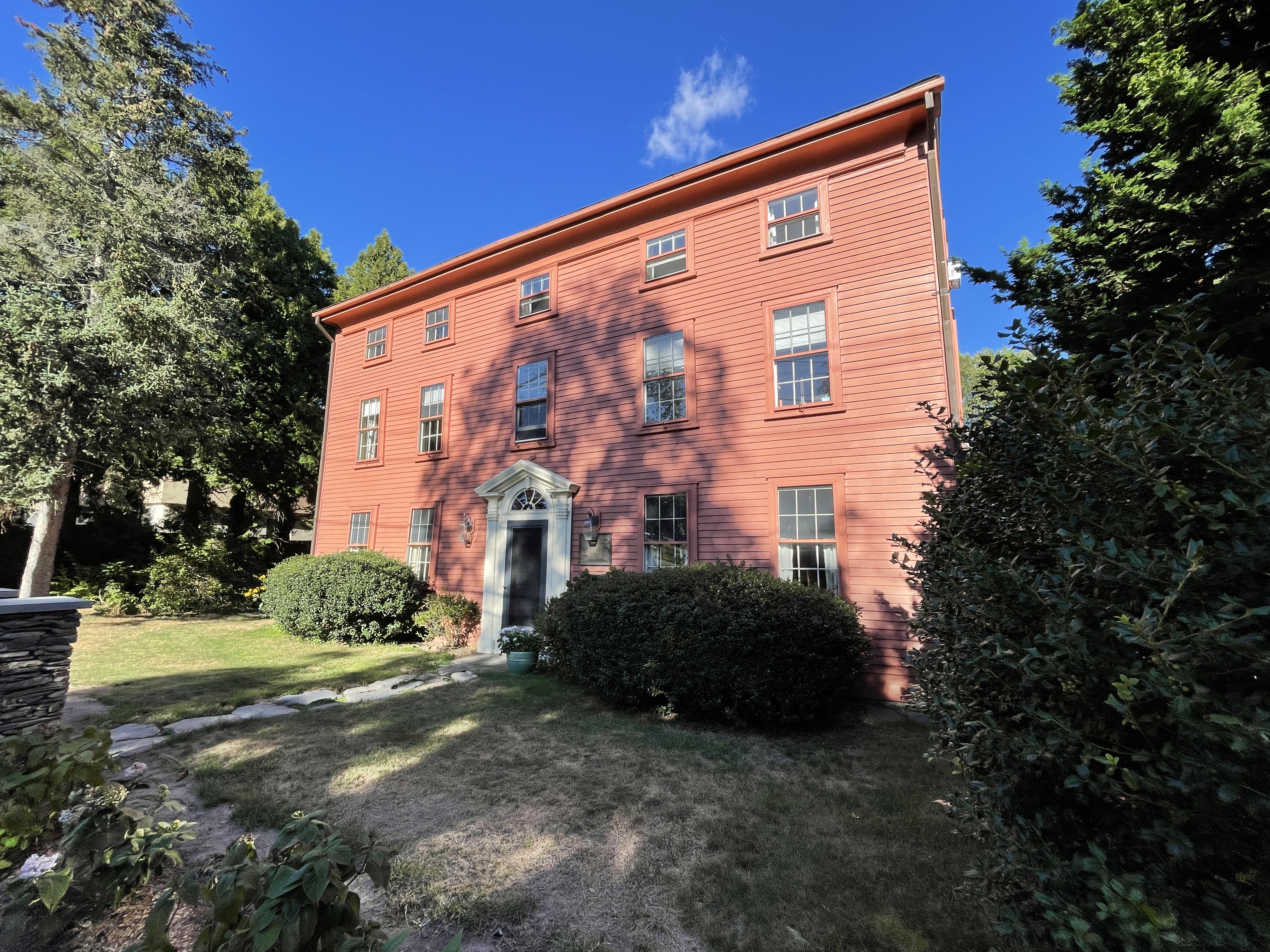
Vernon House in Newport where Lafayette stayed with Rochambeau
A Third Visit to Rhode Island
After the close of the Revolutionary War, Lafayette made a third trip to Rhode Island. In October of 1784 he arrived in Providence. The Providence Gazette of 1784 reported:
“Last Saturday Afternoon (October 23) the Honorable Marquis de la Fayette arrived here from Boston. He was met a few miles from hence by a Number of principal Inhabitants, and received at the Entrance of the Town and escorted in, by the United Company of the Train of Artillery under arms. On his Arrival he was welcomed by a Discharge of 13 Cannon at the State House Parade, the Bells were rung and at Sunset, the Salute was repeated by heavy Cannon on Beacon Hill.”
“The Marquis having visited Newport returned from thence on Monday Evening and on Tuesday partook of an Entertainment at Mr. Rice’s Tavern at which were present his Excellency the Governor, his Honor the Deputy-Governor, both Houses of Assembly, a Number of respectable Inhabitants, Officers of the late Army &c. After diner the Marquis set out for Boston and was again saluted with 13 Cannon.”
“On Monday last (October 25) the Society of Cincinnati of this State convened at Mr. Rice’s Tavern where an elegant Dinner was provided upon the Occasion; and having finished the Business of their Meeting they were honored with Company of his Excellency the Governor his Honor the Lieutenant Governor and the Honorable the Marquis de la Fayette accompanied by the Chevalier De L’Enfant.” Thirteen toasts were given.
References: Preston’s 1928 article in the Rhode Island Historical Society Collections.
Lafayette’s stay in Rhode Island during the Siege of Newport and the Battle of Rhode Island in August of 1778 was just the first time the General came to our state. The second visit was to Newport in 1781 when he came to confer with Rochambeau. In 1784 he came to Rhode Island on a tour after the War for Independence was over. His last visit came during a grand tour of America in 1824. This blog will focus on the first visit.
In the summer of 1778 Lafayette brought a detachment of troops from General Washington to assist General Sullivan in the Rhode Island Campaign, a joint French and American effort to free Rhode Island (Aquidneck Island) from the British Occupation.
A letter Washington wrote from White Plains, New York, on July 22, 1778 contained the orders:
“Sir, You are to have the immediate command of that detachment from this army which consists of Glover’s and Varnum’s brigades and the detachment under the command of Colonel Henry Jackson. You are to march them by the best routes to Providence in the State of Rhode Island. When there, you are to subject yourself to the order of Major General Sullivan, who will have command of the expedition against Newport and the British and other troops on the islands adjacent.”
Lafayette reached Providence with 2,000 men on August 3rd or (August 4th according to other accounts). On their way, Lafayette and his men stayed by “Angell’s Tavern” in Scituate. There his men had a chance to wash and refresh themselves with the spring that became known as Lafayette’s Spring. On August 5th, Lafayette was aboard the French flagship Le Languedoc to meet with French commander d’Estaing. The French fleet was waiting off of Point Judith and d’Estaing provided Lafayette with the ship Provence to bring him back to Providence.
There is some documentation for where Lafayette stayed in Rhode Island at that time, and there are other homes that have “Lafayette Stayed Here” legends that have come down through time.
The American forces gathered in Tiverton, close to the Howland Ferry. By August 6, 1778, Lafayette and his troops had moved to Tiverton where he is said to have stayed at the Abraham Brown House on Main Road close to Lafayette Street. He is said to have occupied the northwest chamber on the second floor. This may have been before the move to Aquidneck Island or it may be that he stayed there after the retreat.
“Lafayette House in Tiverton”
With the arrival of the French fleet, operations were set in motion. The British abandoned Butts Hill Fort and other strategic locations in northern Aquidneck Island. On August 10, 1778 Sullivan began crossing to the island and he moved into Butts Hill Fort and made it his headquarters. The diary of Rev. Manasseh Cutler who served as chaplain for General Titcomb’s Brigade, provides a few glimpses of what Lafayette and others were doing on the island before the Battle of Rhode Island. His entry for Sunday, August 16th, gives us one location of Lafayette’s quarters in Portsmouth.
“Went in the afternoon with a number of officers to view a garden near our quarters, belonging to one Mr. Bowler, – the finest by far I ever saw….” Cutler goes on to describe the garden. The last line in the diary entry reads, “The Marquis de la Fayette took quarters at this house.”
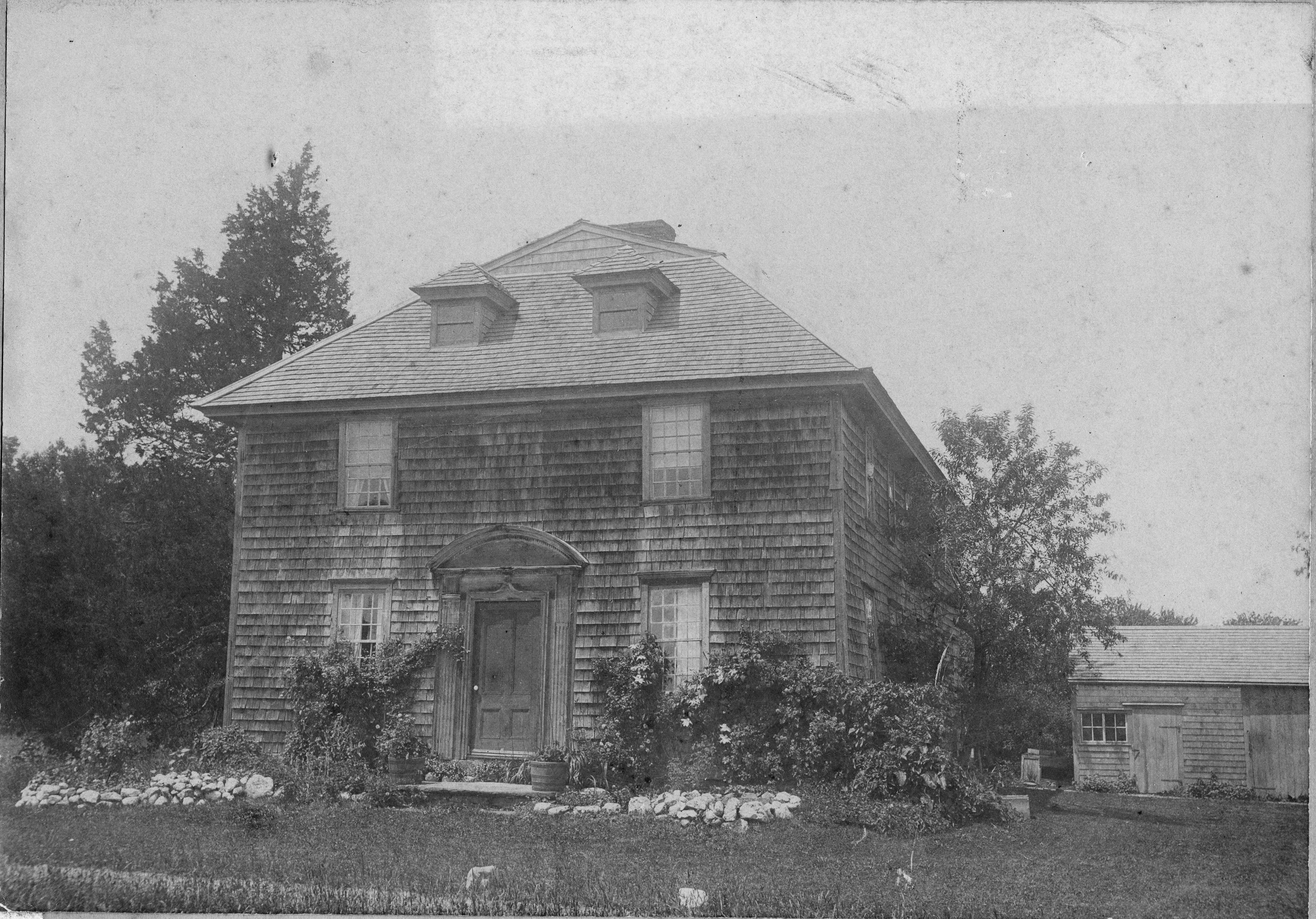
Metcalf Bowler House (now torn down)
Cutler’s entry for Monday the 17th also refers to the Marquis. The British had been firing since early in the morning and Cutler with General Titcomb had been observing the enemy lines from the top of a house. “stood by the Marquis when a cannon ball just passed us. Was pleased with his firmness.”
Metcalf Bowler’s estate has been torn down, but there are two homes in Portsmouth with “Lafayette” legends. One is the Dennis House on East Main Road and not far from Butts Hill Fort. The southeast room on the second floor has traditionally be associated with Lafayette. Lafayette has traditionally been associated with a house on Bristol Ferry Road (Bayles’ History of Newport County: p.665).
Dennis House, Portsmouth
Although the American forces had moved onto Rhode Island (Aquidneck), the French forces were unable to move forward with their attack of Newport. Their ships were damaged in a storm and d’Estang decided to head to Boston for repairs on August 21st. The joint French and American plan was about to fail without the French aid. On August 28th, Lafayette made the six and a half hour trip to Boston to talk to d’Estaing. The mission was fruitless and on August 30th Lafayette rode back to Portsmouth in record time. He had missed the battle, but he took command of the rear guard to bring it safely across to Tiverton.
Israel Angell’s Diary notes that on September 1st General Varnum’s brigade in General Lafayette’s detachment passed by boat to Warren. The next day they were in Bristol where Lafayette made the Hope Street home of Joseph Reynolds his headquarters. A plaque on the house reads: This house built about the year 1698 by Joseph Reynolds was occupied by Lafayette as his headquarters September 1778 during the War of American Independence.” Lafayette’s room was the northwest chamber. The southwest room on the first floor was his dining room and office.
Reynolds House today
By September 18th Lafayette had moved on to Warren where the brigade encamped on Windmill Hill. Lafayette’s quarters were at Coles Tavern which has since burned down. On September 28th he was in Boston and on his way to Philadelphia on October 1st.
Lafayette would return to Rhode Island under more peaceful circumstances. More on those visits in our next blog.
References: This article was based on Preston’s 1926 article with added information from other sources.
Preston, Howard. “Lafayette’s Visits to Rhode Island.” Rhode Island Historical Society Collections. January 1, 1926.
After the Battle of Rhode Island in September of 1778, this stately home became the headquarters of the
Reynolds House – 956 Hope Street, Bristol, RI
Marquis de Lafayette. General Lafayette was in command of the ports around the Island of Rhode Island (Aquidneck Island). He was responsible for the ports at Warren, Bristol and the Eastern Shore of Narragansett Bay. His troops were stationed in Bristol from September 7 to September 23. Lafayette himself used the Reynold House, especially the north parlor, as central command. There is a legend that on September 7, 1778, Mrs. Reynolds was awaiting her distinguished guest. About an hour before he was expected, a young Frenchman rode to the house, dismounted and tied his horse to a tree in the yard. The gentleman asked Mrs. Reynolds for something to eat. Mrs. Reynolds obliged, but after a while told the guest that she had to prepare for Lafayette’s arrival. The guest replied, “Madam, I am Lafayette.” The general was only 21 at the time and it is reasonable that Mrs. Reynold would not have recognized the Frenchman.
The Reynolds House has been listed on the National Register of Historic Places since 1972. Built circa 1698-1700, the house is three stories high. It stayed in the Reynolds family until the 1920s. It has endured much remodeling
As I was attending the Annual Commemoration Service of the 1st Rhode Island Regiment, I noticed the insignia on buttons some of the guests were wearing. That insignia is also carved in stone on one of the early monuments at Patriots Park. I am gathering materials for a lesson plan on the Black Regiment, and I would like to have students work with the correct flag. I often see two similar flag designs depicted with images of the Black Regiment. It is certainly possible that they would have fought under different flags. In February of 1781 the 1st and 2nd Regiments were combined into the Rhode Island Regiment. The insignia at Patriots Park resembles one of the flags and it is logical that the monument designers would want to reflect the flag used by the 1st Rhode Island Regiment while they were a separate unit.
Emblem at Patriot’s Park
An online search was confusing, but I remembered a 1930 book on Rhode Island flags and symbols by Howard Chapin. There was a depiction of the regimental flag of the 1st Rhode Island Regiment that is kept at the State House. It is described as:
“The field was white, charged with a blue scroll being the inscription “R. Island Regt.” In the upper corner there is a blue canton charged with thirteen white stars.”
The Regimental flag of the 2nd Rhode Island Regiment is pictured as well. This flag is also listed as being at the State House. The description reads:
“The Second Rhode Island Regiment carried a somewhat similar flag, having a white field, charged with a blue foul anchor and the motto, “HOPE,” and having in the corner a blue canton charged with thirteen gold stars…After the passage of the regulation of February 23, 1780, the flag bearing the blue anchor doubtless qualified in a sense partially as a State flag.”
2nd RI Regiment Flag1st RI Regiment Flag2
The anchor design is an ancient emblem in Rhode Island. Rhode Island was a seafaring colony. The seal of the colony drawn by William Dyer in 1647 has an anchor. The “foul anchor” described is the robes entwined in the anchor. One description notes that the white is the color of their uniforms and a symbol of the commonwealth. The 13 stars reflect the colonies and may be a reflection of the seals of Portsmouth and Providence.
In May of 1664, the General Assembly “Ordered, That the Seal, with the mottoe Rhod Iland and providence plantations, with the work Hope over the head of the Anker, is the present Seale of the Colony.”
Resources:
Chapin, Howard. Illustrations of the Seals, Arms and Flags of Rhode Island. Providence, RI, Rhode Island Historical Society, 1930.
There has been so much growth in vegetation that it is difficult to imagine the view that General Sullivan would have had from his command post at Butts Hill Fort. Jim Garman has loaned me his notebooks from the 1978 re-enactments of the Battle of Rhode Island. His images clarify things.
Butts Hill FortView looking across Sakonnet to TivertonView from Butts Hill of Howland Ferry AreaView from Butts Hill overlooking Turkey Hill to the South
Bristol Ferry Town Commons and Mount Hope Park (old ferry landing) End of Bristol Ferry Road at Bayview
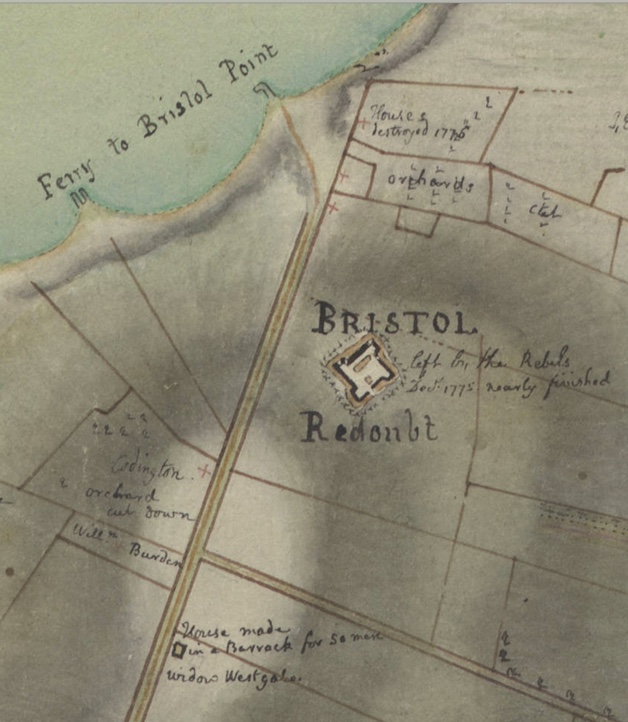
This is the site of a town common dating back to 1714. Ferry service started here in 1640. This 1.5 acre space was originally used by farmers and others to keep their livestock and other goods while waiting for the ferry to Bristol. The Bristol Ferry area had a British fort during the occupation. This area was the transportation hub for Aquidneck Island (Rhode Island) and there are records of George Washington passing through here after visiting with General Rochambeau in 1781. The French and Americans would make the start of their long journey to victory at Yorktown through Bristol Ferry.
Miantonomi Park on Hillside Avenue in Newport has a rich history. This hill was the seat of power for Narragansett Sachem Miantonomi. Colonial settlers used this hill for a lookout, for public executions and for a beacon light. By 1667 a beacon was constructed there which when lit signaled beacon lights in the rest of the Bay Area. In 1776 another beacon was erected “to give the country an alarm in case of invasion” and Col. Israel Putnam built fortifications here. When the British occupied Rhode Island (Aquidneck) they strengthened the fortifications with a powder magazine and other defensive works (1776-1779). When the French came (1780-1781) they manned fortifications here as part of their defensive lines for Newport.
In the 1920s when Dr. Roderick Terry purchased the land to preserve Butts Hill Fort, he also preserved the remains of Fort Barton in Tiverton. You can visit the remains of the Fort at 343 Highland Avenue across from the Tiverton Town Hall. The remains of Fort Barton are located on a rise over 100 feet above sea level so there are commanding views Portsmouth locations like Island Park. Fort overlooked a strategic narrow point of water between the Sakonnet River and Mount Hope Bay. It is the shortest distance between Aquidneck Island and the mainland. This is traditionally known as the Howland Ferry area.
Revolutionary Defences In Rhode Island Edward Field
After the British occupied Newport and Aquidneck Island in 1776, Tiverton was a gathering point for Americans. The governments of Rhode Island and Massachusetts worked together on the construction of the fort. On June 11, 1777, British officer Frederick Mackenzie described these efforts in his journal: “The Rebels have been busily employed in making a work on the hill above Howland’s ferry where their guns have been placed all the Winter. It appears to be very extensive, and must cost them a great deal of labour, as there is little or no soil on the hill.” On June 28, 1777, the Americans erected a flagstaff at the fort and raised their colors. The following day, Mackenzie described the fort as “irregular in its figure, but very extensive. From the situation, it must be strong.”
A short while later, Lieutenant Colonel William Barton led a daring raid to capture British General Richard Prescott on Aquidneck Island and the fort has been named in Barton’s honor.
In July of 1778, thousands of Colonial troops—including Paul Revere and John Hancock assembled in Tiverton for an invasion of Aquidneck Island. General Sullivan and 11,000 Continental troops and militia ferried across the narrows to participate in the Siege of Newport. When a storm crippled the French fleet that was off of Newport to support the Siege, American troops had to find their way back to Tiverton and Fort Barton. This military action was known as the Battle of Rhode Island and it was a successful retreat on August 30-31, 1778. After this battle, most of the soldiers scattered, leaving only a handful of men to man the fort.