According to the pension application testimony of Daniel Bowen, Sullivan’s body guard was recognized by Congress as a part of the Continental Army. (War Department Communication dated December 1, 1819). This was a company of volunteers called a “Life Guard” to Major General Sullivan who was appointed commander of the state of Rhode Island. He remembers Aaron Mann, Levi Hoppen, George Potter and John Prescott (may be John Wescott) as officers of the group.
Sullivan sent in his Life Guard to reinforce the American troops at Quaker Hill and there was intense fighting there.
From his testimony
“Our circumstance however, I recollect , —service between Butts and Tominy Hills, the Sullivan guards did not arrive at the commencement of the action and as we neared __ up to meet the British, we could but meet by some carrying off The wounded, who said to us, “that’s right my boys, go and give it to them’ as the were borne off, upon the shoulders of their comrades. And we did go on, until we were overpowered by numbers.”
Bowen would go on to serve with Silas Talbot on the Sloop Argo and then aboard the Privateer Washington (a ship of 20 guns) which was also commanded by Talbot. The Americans were taken prisoner and ultimately exchanged for British prisoners.
Bowen called his Revolutionary War experience “days of danger and fatigue and repeated misfortunes.”
Resources: Case Files of Pension and Bounty-Land Warrant Applications Based on Revolutionary War Service, compiled ca. 1800 – ca. 1912, documenting the period ca. 1775 – ca. 1900. I accessed this through Fold3 military records online.
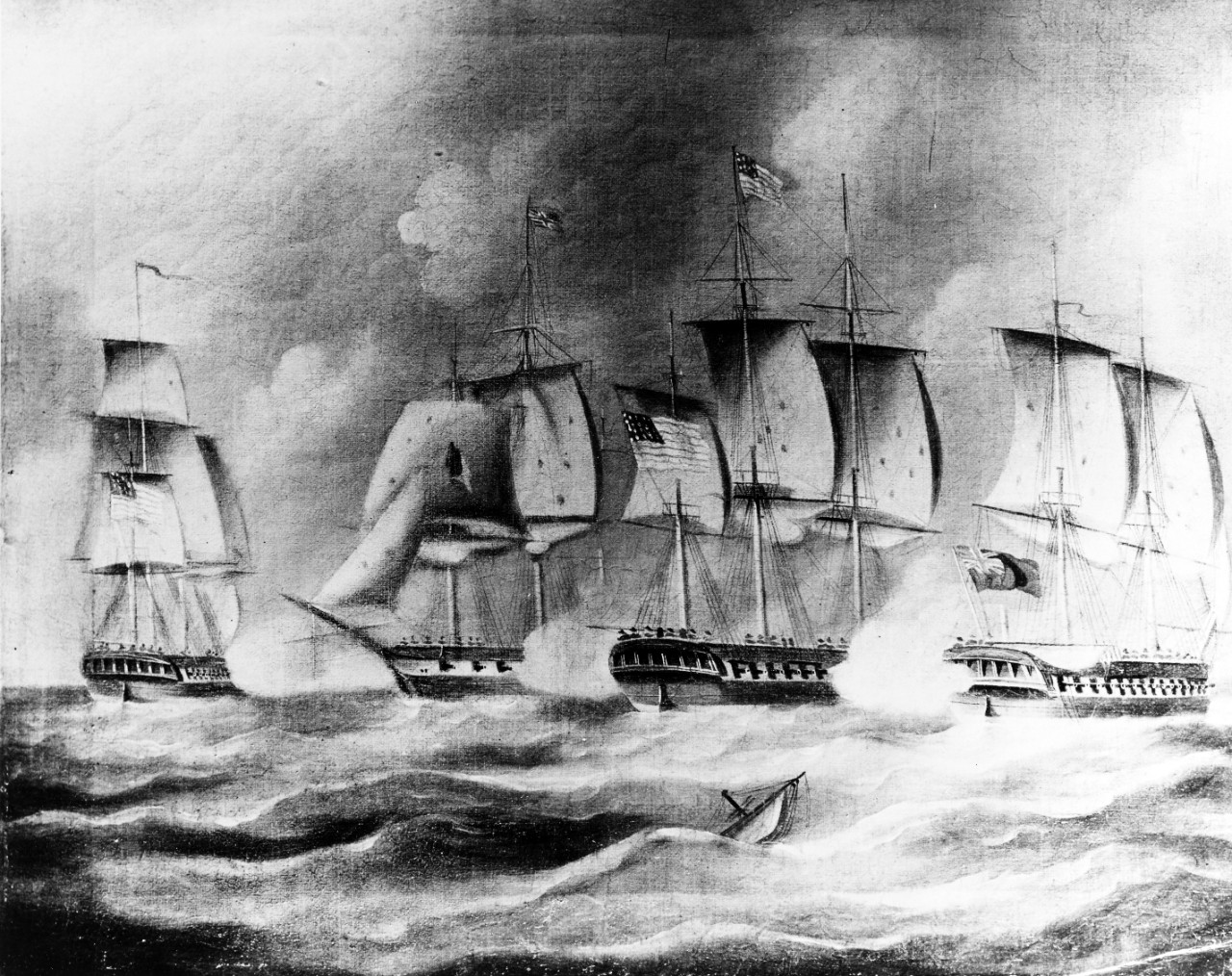
Image: PIGOT and ARGO capture British schooner LIVELY and two privateers, off the coast of Providence. Naval History and Heritage Command.
Aaron Mann of Providence was the commander of Sullivan’s Life Guard and his pension testimony offers us a first hand view of the American retreat on August 30, 1778. Mann had been serving as a soldier when needed beginning in 1775. He served in the Continental Navy in the ill fated Battle of Block Island. Next he was sent to Rhode Island (Aquidneck Island) to protect against British Captain James Wallaces’ raids around Narragansett Bay until the Americans had to flee the Island in December 1776 when the British invaded. He marched to Boston for the Battle of Bunker Hill and he took part in Spencer’s failed expedition in 1777.
From his testimony:
“In May or June 1778, then was got into a company called General Sullivan’s Life Guard – and I entered therein as a commander – Sullivan was quartered in Providence and I with him – I should think about through November 12 of 1778. I went on Sullivan’s expedition.”
He goes on to give a brief recounting of the Rhode Island Campaign. He went onto the island around the 12th of August. He talks about D’Estaing’s arrival and departure, and Lafayette’s efforts to persuade him back from Boston.
The part of his testimony that was most interesting to me was a description of the retreat. A portion of the Life Guard was to guard the retreat of the rear guard.
“Attached a portion of the life guard to guard the retreat of the rear guards and also make fires when lighted up through the camp to deceive the enemy. On this expedition I commanded the life guards – was wounded in my forefingers which were broke. Had Obadiah Brown one of my company killed. Israel Low of Providence wounded in the ankle. Antrum Fenner of Scituate wounded in the stomach and Charles Scot of Cumberland shot in his hip badly and made a cripple for Life.”
Because of his bravery in commanding the Guard during the retreat, Mann was appointed Captain on September 10, 1778. Records show Mann and the Guard at Tiverton through November 10 when the Guard may have been relieved of duty for a while.
In the book Spirit of ’76 Covell, who had listened to countless testimonies for pension applications, records that one of the Guard (Levi Lee) describes Mann in the action. “..while in the act of flourishing his sword, he had one of his fingers shot away, but the only remark he made..was “the d eternal souls shoot pretty close. Don’t mind, my boys, stick to em.” Covell writes that Sullivan’s Life Guards were selected by Lafayette to cover the “rear guard” in the retreat and suffered badly in the action.
Resources
Christian McBurney’s book The Rhode Island Campaign has most of this story on page 181. I was able to see and transcribe Aaron Mann’s testimony through Fold3/Ancestry.com.
Spirit of ’76 in Rhode Island: or, Sketches of the efforts of the government and people in the war of the revolution. Together with the names of those … notices, reminiscences, etc., etc
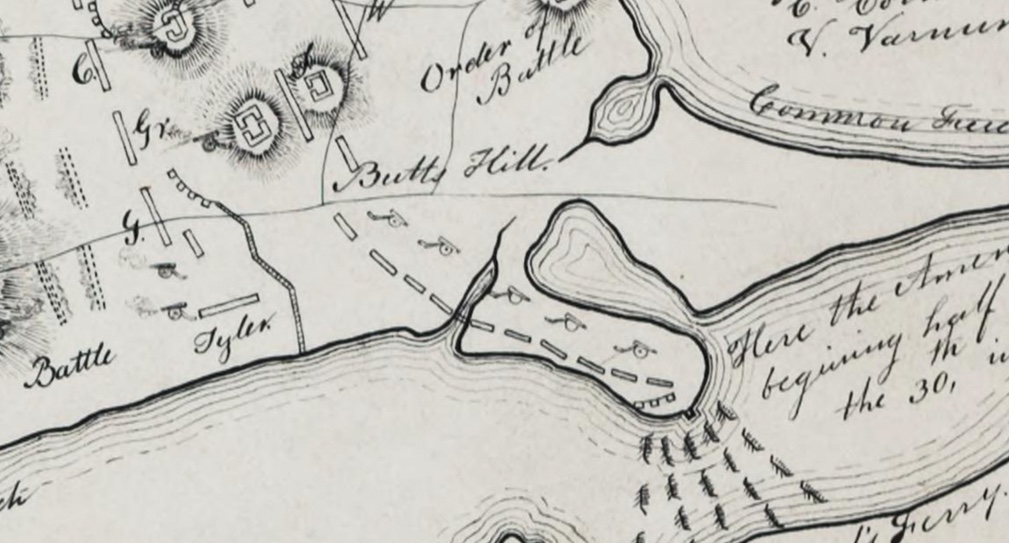
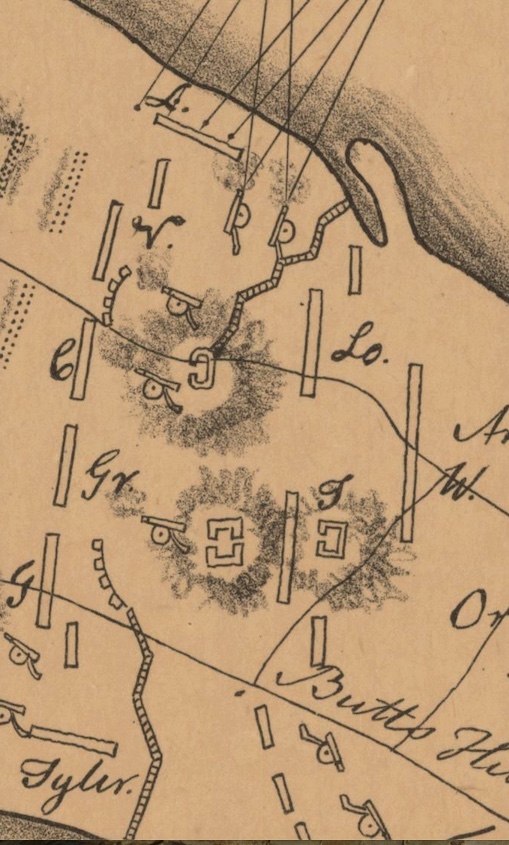
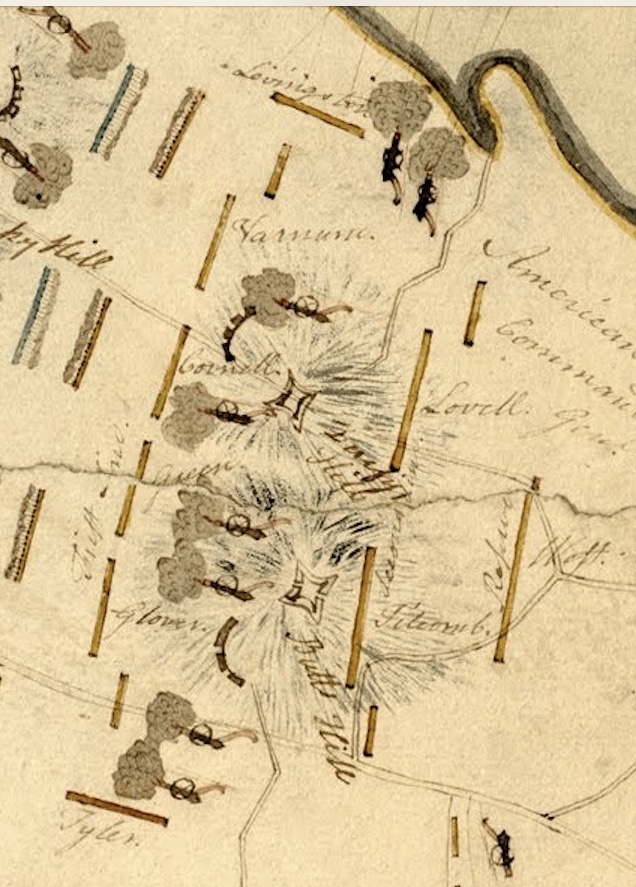
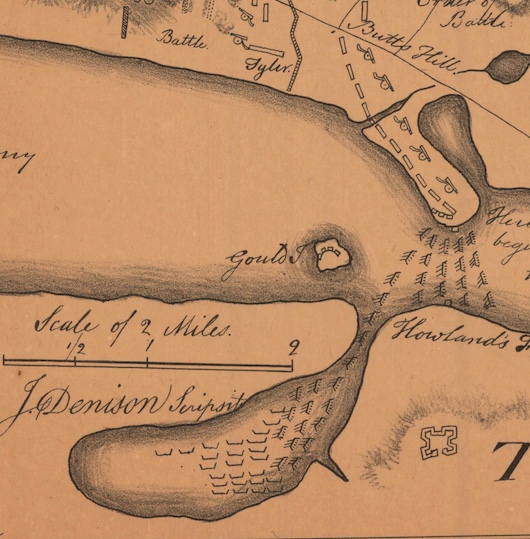
The Denison Map of the Battle of Rhode Island is filled with information. I generally look for specific pieces of information from this gem, but today I am going to methodically go through the information it provides. As I go through this map, I am comparing it to the map from the General Sullivan Collection that is in the state archives. I am noting that the handwriting and comments are very similar.
Looking at the Denison map in general there is a compass on the left hand side. There is a scale for two miles and there is a legend of sorts for the positions of the American commanders. The mapmaker lists himself as J. Denison “Scripsit” which means writer. The map covers the areas and dates involved in the “Rhode Island Campaign” – mainly Aquidneck Island and the surrounding waterways. Notes on the bottom of the map tell us that the original is at the Massachusetts Historical Society and that this version is a copy. A note at the bottom provides a legend for symbols in color in the original.
The legend for the battle positions is given at the bottom.
First Line:
G is for Glover, Gr is for Greene, C is for Cornell, V is for Varnum.
Second Line: T is for Titcomb, L is for Lovell.
Reserve: W is West
Flanking Divisions: L is for Livingston and Tyler
The Archives map has no key, but it does have a compass and scale. The names of the commanders are written out, but the positions are the same as in the Denison map.
Comments comparison:
By Howland Ferry: Denison: Here the American Army landed August 9th 1778 beginning half after 6 o’clock A.M. and retreated the 30th in the evening.
By Howland Ferry: Archives: Here the American Army landed August 9th 1778 beginning half after 6 o’clock A.M. and retreated the 30th in the evening.
The comments close to Union Street about the beginning of the battle were the same. :
The comments between East Main and West Main are the same.
What is different is that the Denison map has notations on the French Fleet. These are absent from the Archives map:
On the Sakonnet: “French ships going out to join the French Fleet going to Boston, August 20, 1778.”
In Newport Harbor”. “French fleet going out in pursuit of the British Fleet August 10th 1778, which were then at anchor Near Point Judith.”
By Hog Island: “British ships firing on the American Troops in time of Battle August 29, 1778.”
There is no Author statement on the Archive’s map, but I believe both maps were drawn by J Denison. The Dennison map is more finished. The Archive map looks to be more a record taken at that time and the basis for the Denison map. Perhaps others were aware that these two maps are basically the same, but this was revelation to me. I am still trying to find out about the mapmaker, j Denison. I would appreciate any information about him. He is credited with many more maps through the years.
As I research Portsmouth during Revolutionary times, I frequently come across a mention of the Redwood House. It was a place marker on West Main Road. The first shots fired during the Battle of Rhode Island were close to the Redwood House. What was special about the Redwood House and what happened to it.
The history of the house starts with Abraham Redwood Jr. The Redwood family had a large sugar plantation in Antigua. Abraham Redwood, Jr. was born in 1709 and he was active in the family sugar business from his teenage years. When his father died, the planation – along with the over 200 slaves that worked it – were signed over to Abraham Redwood, Jr. Some sources say he settled on his father’s estate in Portsmouth in 1727. It was known as Redwood Farm. Other sources say that in 1743 he purchased 140 acres of land in Portsmouth that was part of the Coggeshall land grant. It may be that he added to the land he had inherited from his father. He had a great interest in horticulture and he cultivated rare plants, shrubs and trees. He built a greenhouse, hothouse and a serpentine walk through a meadow. From the West Indies he imported orange and fig trees along with guava and pineapple roots. Redwood described a greenhouse 22 feet long, 12 feet wide and 12 feet high so he could raise West Indian fruits.
Redwood House in 1930s.
Samuel Drowne described the gardens in 1767. “Mr. Redwood’s garden. . . is one of the finest gardens I ever saw in my life. In it grows all sorts of West Indian fruits, viz: Oranges, Lemons, Limes, Pineapples, and Tamarinds and other sorts. It has also West Indian flowers—very pretty ones—and a fine summer house. It was told by my father that the man that took care of the garden had above 100 dollars per annum. It had Hot Houses where things that are tender are put for the winter, and hot beds for the West India Fruit. I saw one or two of these gardens in coming from the beach.”
The Redwood Farm estate stayed in the family until 1882. In her book “This Was My Newport,” Maud Howe Elliott (daughter of Julia Ward Howe) describes the garden when she was a child in the 1850s and 60s.
“The garden at “Redwood” was a marvel of taste and neatness. The high bush blackberries that topped the wall were known to every child within a radius of miles. At the corners of the long beds were enormous clumps of peonies. Flowers, fruit and vegetables amicably shared the sunny garden — a pair of acres in size — gooseberry and currant bushes forming the borders, while pear trees were planted at intervals in the center of the beds. There was a little garden-house where Miss Rosalie, the youngest daughter, held a Sunday school for children of the neighboring farmers. I have had cause all my life to bless Miss Rosalie for her gentle ministrations. The seeds of culture and breeding she sowed in the minds of her boys and girls have borne fruit and sweetened the life of generations.”
You can still see the “little garden-house.” It was moved to the grounds of the Redwood Library in 1917. It was originally designed by famed architect Peter Harrison for the Redwoods in 1766.
Through the years the Redwood House was allowed to deteriorate. Newspaper accounts in 1937 say that wealthy Bradford Norman was trying to restore the house, but it was demolished in the 1940s.
Redwood House 1940s. Garman collectionRedwood Garden House at Redwood Library
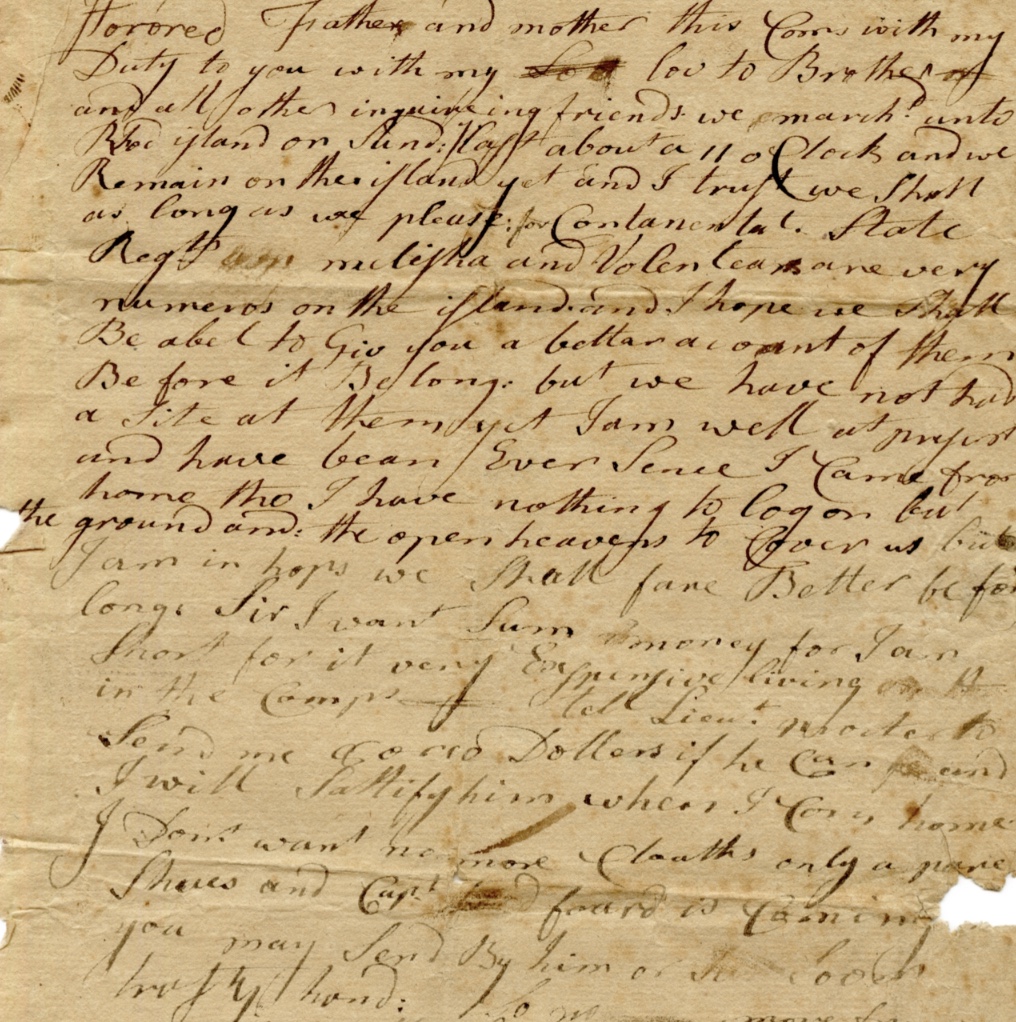
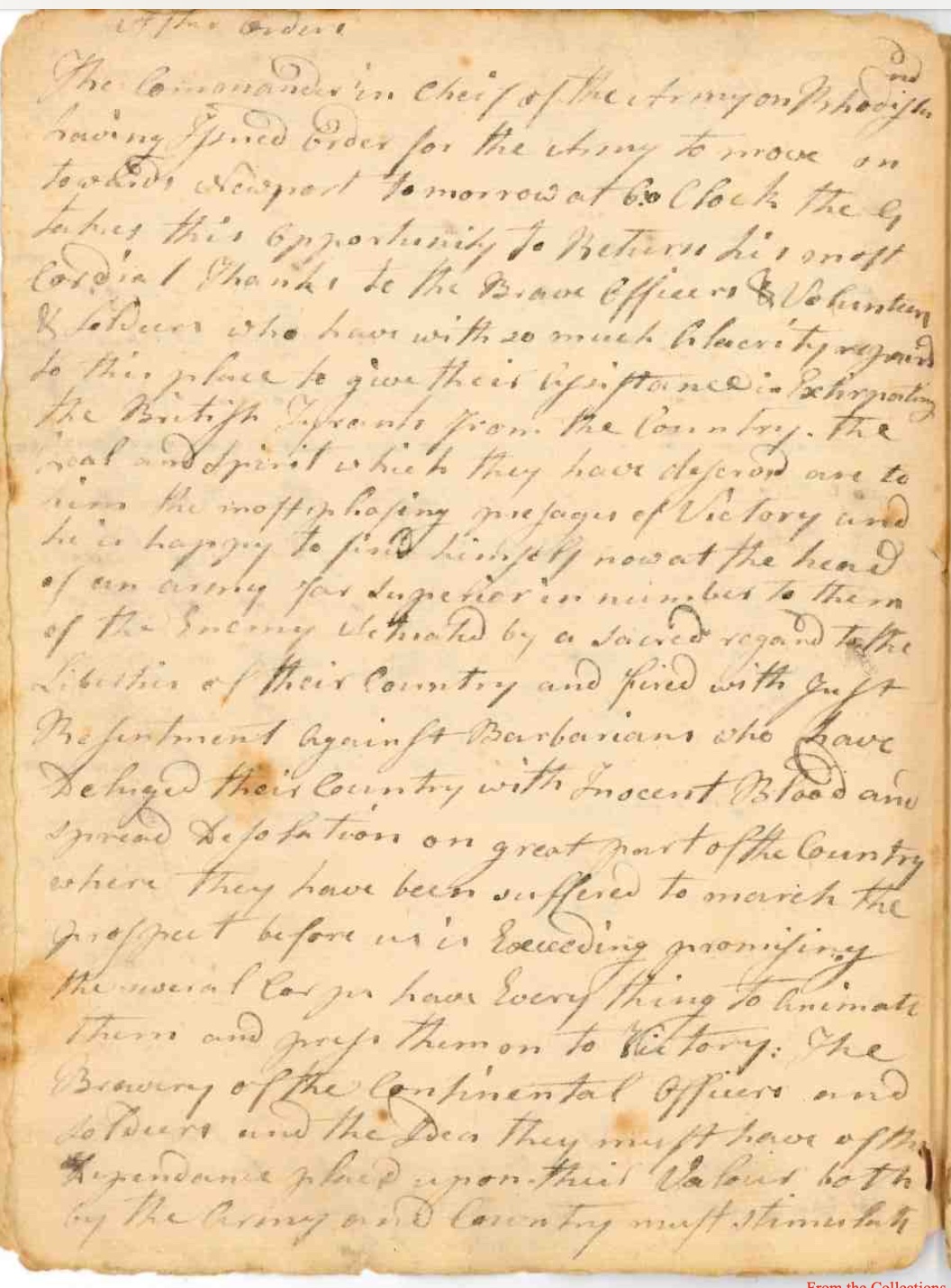
I am always on the look out for primary sources related to the Rhode Island Campaign. I recently came upon two such sources. One is a letter to home from the Portsmouth camp and the other is an orderly book that records orders, events, etc. for a militia regiment from Connecticut. A conversation at a reenactment of the Bristol and Warren raid led me to a letter home from a soldier in the Massachusetts militia. Thankfully the owner of the letter shared both the image and the transcription. The orderly book is in the collection of the Henry Ford Museum, and the museum graciously sent me scans. Historian John Robertson had already transcribed the book so I benefited from his work. The letter was written on a date covered by the orderly book and the two sources together can give us some added details of the early days in the camp before the Siege of Newport.
The auction advertised that the letter was written by John Bettey of Chelmsford, Massachusetts to his father, on August 11, 1778, from the American camp near Portsmouth, Rhode Island.
Bettey wrote: “We march onto Rhode Island on Sunday last about at 11 oClock and we remain on the island yet..” The Sunday would have been August 9th. He is hopeful that they can remain on the island “as long as we please for Continental State Regt. Militia and Volunteers are very numerous on the island.” …”But we have not had a site at them (the enemy) yet.”
Conditions were very poor. Bettey says he is “well at present” although “I have nothing to lay on but the ground and the open heavens to cover us but I am in hope we shall fare better before long.” He complains that it is very expensive at camp and he could like some money. He also wanted his family to send some shoes.
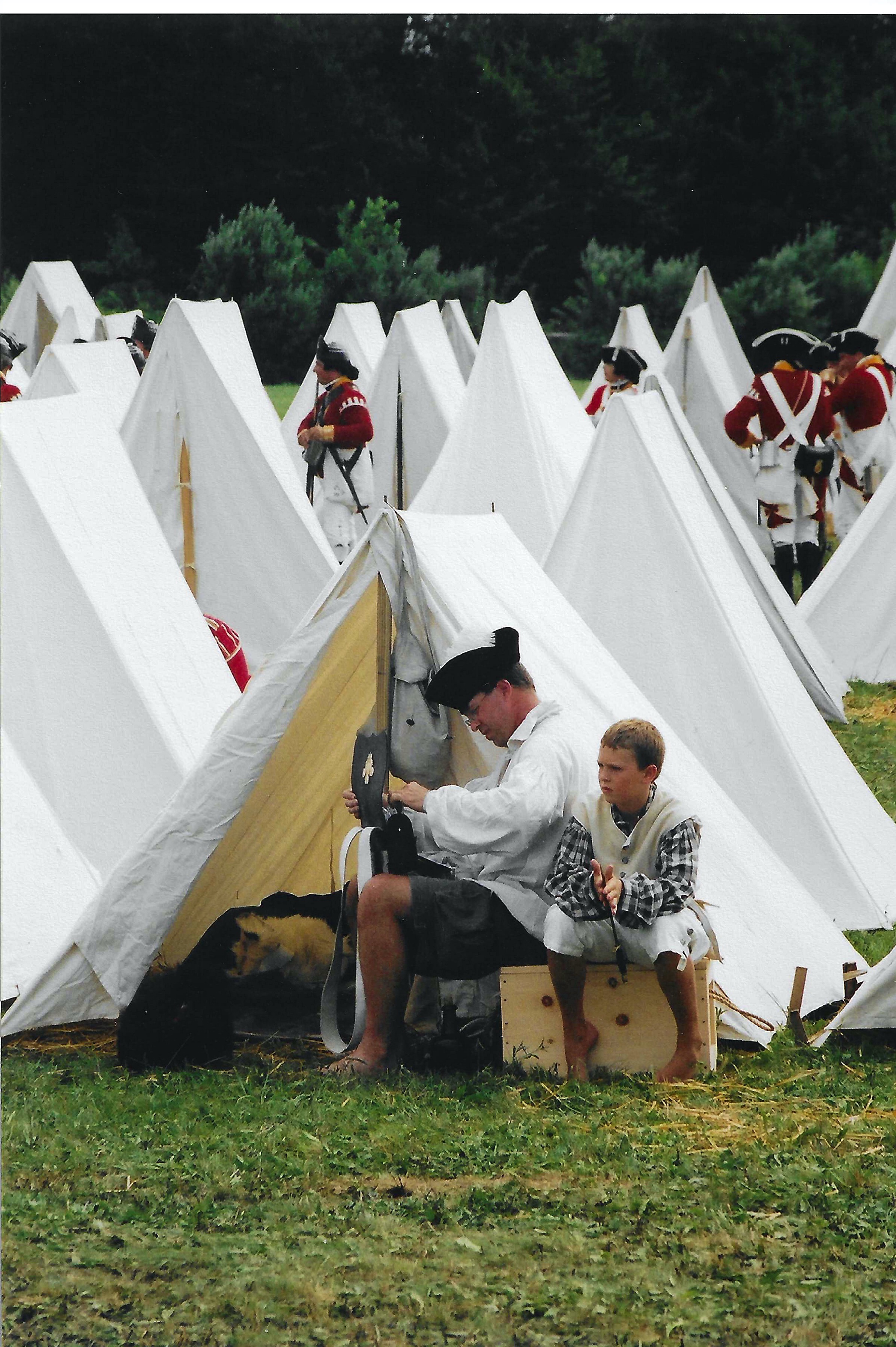
The Orderly Book of Col. Samuel Chapman’s Connecticut Militia Regiment gives us a similar view. From headquarters on August 10th General Sullivan had “Directed to send over all the spare Tents and Destribute them among the Troops that are destitute of Covering also the Volunteers…. Those men that cannot be furnished with Tents are to build Huts and Bush houses …..Comders of Regts and Corps who have Tents on the other side of the River will Immediately send a Detachment from their Companies to bring them over.”
It is hard for me to imagine the soldiers having to build huts and bush houses around Butts Hill just to have shelter. When the storm (hurricane like) hit over the next several days, that lack of shelter would be a major issue.
The letter and the orderly book are small pieces of the puzzle of what happened during the Rhode Island Campaign. However, these small pieces bring the events to life. I will continue to gradually share the events listed in the orderly book as time goes by.
Bettey LetterMissing tentsConnecticut Orderly Book
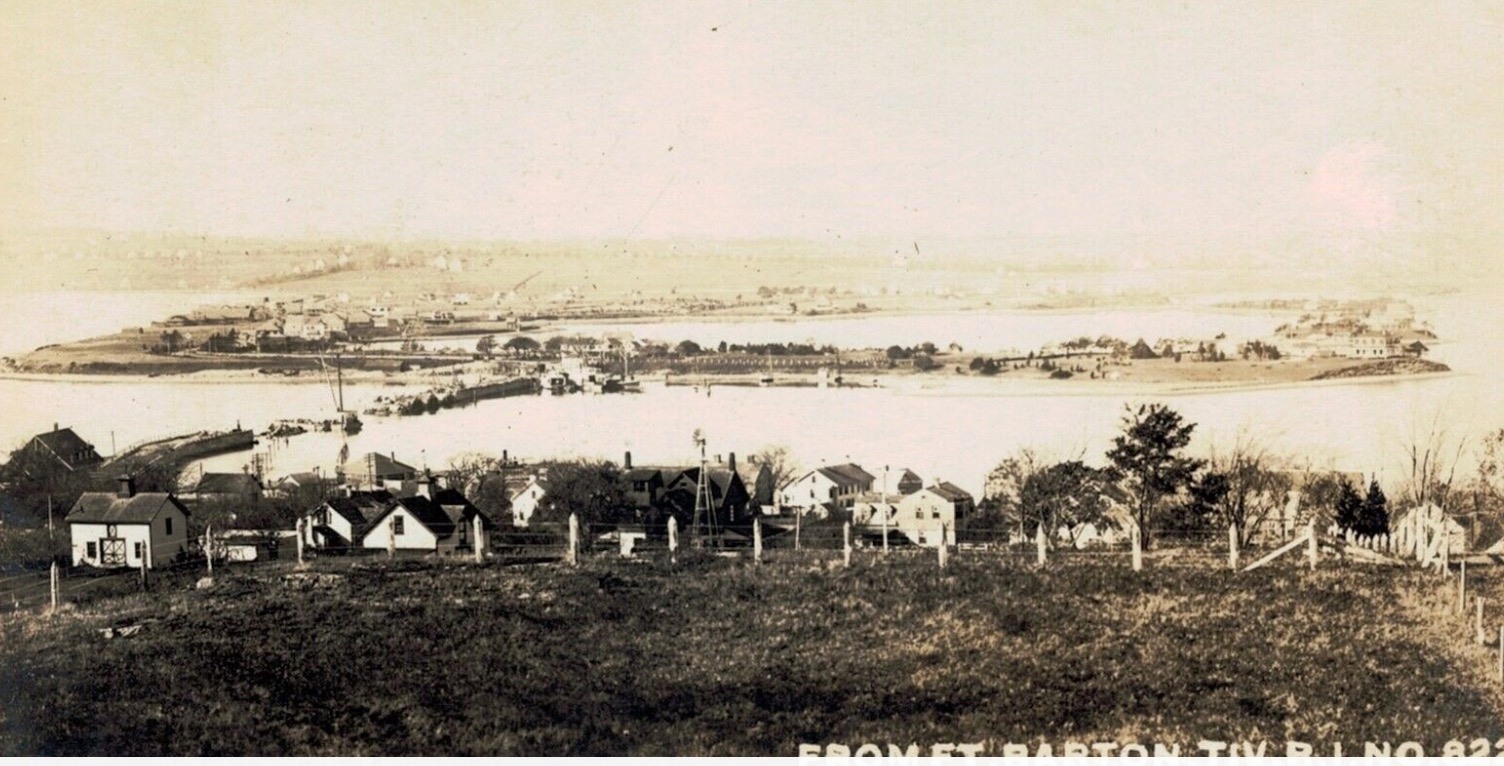
Howland Ferry was an important entry and exit point for the Rhode Island Campaign, but I haven’t spent much time researching what happened there. Today our eyes are on the relic of the Stone Bridge and it is hard to imagine the Revolutionary site.
In colonial times the main roads in Portsmouth led to the ferry landings. What we call East Main Road was known as the Path to Howland’s Ferry. This site is one of the narrowest points on the Sakonnet River between Tiverton and Portsmouth. Use of this land as a ferry landing may date back to 1640. The name Howland Ferry comes from the family that ran it between 1703 to the British Invasion in 1776. Howland’s Ferry played an important part during the Battle of Rhode Island. American forces used the location to pour onto Aquidneck Island to fight the British who occupied it. When they were forced to retreat, many of the American forces used that route to make their escape.
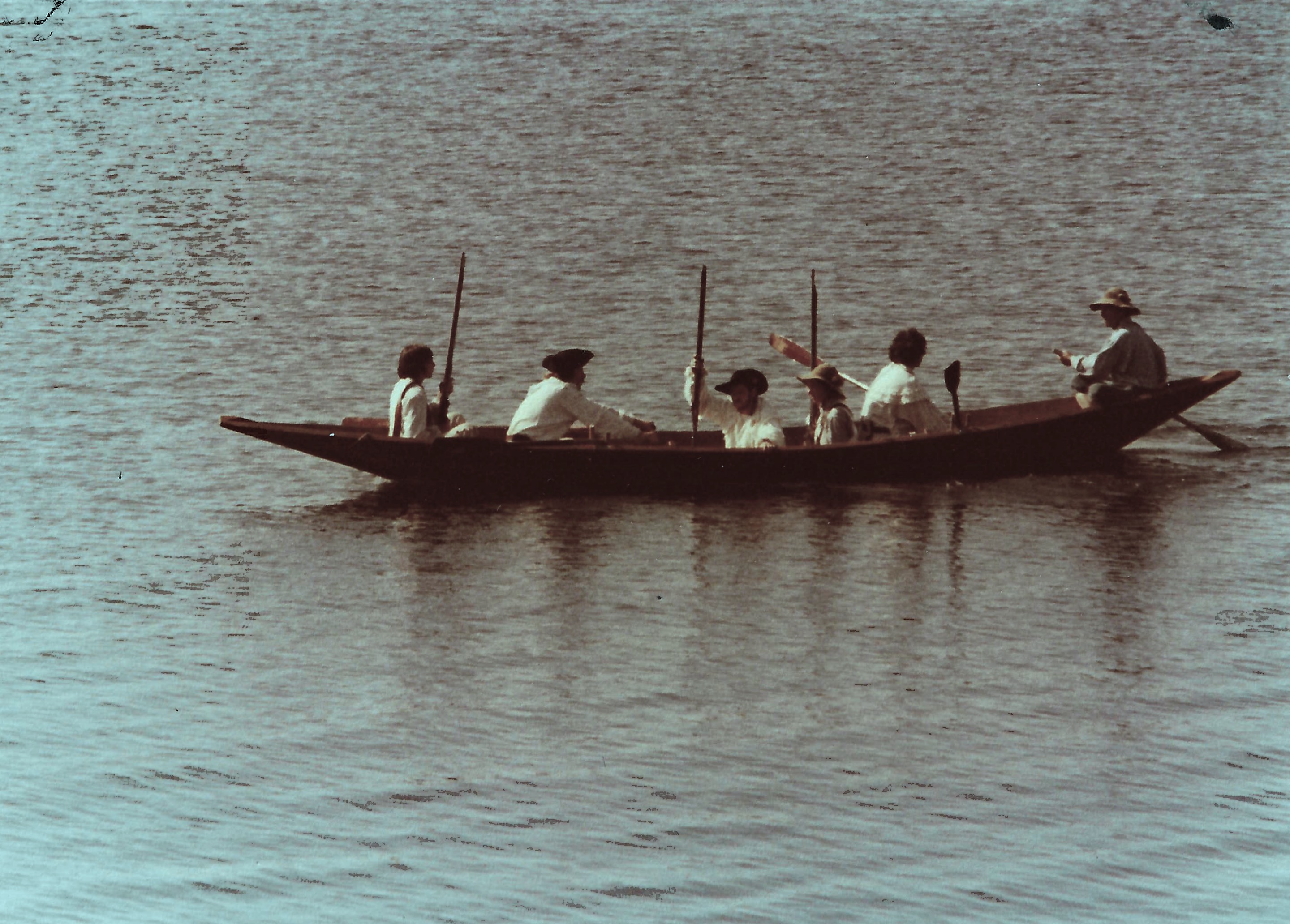
Arranging for transportation for thousands of soldiers from Tiverton to Portsmouth was a major undertaking. The British knew an American invasion would be coming, so they had already destroyed many of the flatboat boats the Americans had constructed in the Fall River area. The Americans had to secure the wood mills in Fall River and Tiverton to rebuild the flatboats that would be needed. Silas Talbot oversaw the building of 85 flatboats. Every carpenter in the army was put to work and every piece of boards and plankings in the area were used to make the transport boats. General Sullivan called out to New England mariners to come and operate the flatboats. On August 9, 1778 Howland Ferry was teeming with boats shuttling Americans to Portsmouth.
1978 Re-enactmentSilas TalbotDenison MapView of Island from Ft. Barton
The path to Howland’s Ferry was the escape route when the Americans had to evacuate on August 29th and 30th because the French had left. According to Christian McBurney, Captain Samuel Flagg of Salem and the boatmen from Salem, Marblehead and other New England towns worked day and night to ferry equipment and men off the island. William Whipple and Jeremiah Olney of the 2nd Rhode Island oversaw the embarkation. After the retreat John Laurens wrote – .”.we had a water passage of 1/4 mile to cross from the island to the main – a vast quantity of stores, heavy baggage, ammunition and cannon to transport. You will be filled with admiration at learning that the retreat was effected without the loss of a single man or even an entrenching tool”. Silas Talbot and John Laurens were among those holding off the British to give the Americans more time to retreat. At 11 PM Lafayette arrived from meeting with the French in Boston. He had taken the 70 mile journey and was disappointed that he had missed the action. Lafayette did have a role in bringing the piquets off the Island.
I have many questions about the preparation of the flatboats and Silas Talbot’s role. A biography I have of Talbot doesn’t even mention his supervision of the boat construction. In many ways this successful retreat was one of the most amazing parts of the Campaign and showed the professionalism of the budding American Army.
What was George Washington’s view of the Battle of Rhode Island?
Washington wrote many letters in the days after the Battle. Letters he wrote to Lafayette and French commander D’Estaing were to smooth over hard feelings about the French withdrawal from Newport. In writing to General John Sullivan, Washington stressed that he wanted a healing of the French/American relationship: “The disagreement between the army under your command and the fleet has given me very singular uneasiness.” 1)
Washington’s letter to brother John Augustine Washington (dated September 23) provides us with a summary written on a personal level to someone not involved in the conflict. I had seen this quotation before, but a director of the Battle of Rhode Island Association brought it to our attention because it is such a thoughtful description.
“The whole may be summed up in a few words, and amounts to this: that an unfortunate storm (so it appeared, and yet ultimately it may have happened for the best,) and some measures taken in consequence of it by the French Admiral, perhaps unavoidably, blasted in one moment the fairest hopes that ever were conceived; and, from a moral certainty of success, rendered it a matter of rejoicing to get our own troops safe off the Island. If the garrison of that place, consisting of nearly six thousand men, had been captured, as there was, in appearance at least, a hundred to one in favor of it, it would have given the finishing blow to British pretensions of sovereignty over this country; ..” 2)
Washington is writing a personal letter to a younger brother. John Augustine Washington is an officer in the Virigina Militia, but his role is more administrative.
Washington writes about:
“An unfortunate storm”: but he suggests it may have happened for the best!!
Measures taken by a French Admiral blasted our “fairest hopes.”
American plans “had a moral certainty of success.“
Americans were “rejoicing to get our own troops safe off the island.”
Had the 6,000 strong British been captured, “it would have given the finishing blow to British pretentions of sovereighty over this country.”
In short, the American plan was certain to succeed in capturing the British forces and ending British control over the colonies, but a storm led the French fleet to withdraw from Newport and we had to rejoice that we got our troops out of harms way.
George WashingtonJohn Agustine Washington
References:
Letter September 1, 1778 – Washington to General Sullivan.
Letter September 23, 1778 – Washington to John Augustine Washington.
The Writings of George Washington, collected and edited by Worthington Chauncey Ford (New York and London: G. P. Putnam’s Sons, 1890). Vol. VII (1778-1779).
Washington Portrait: General Washington, Commander of the Continental Army, a 1776 portrait by Charles Willson Peale
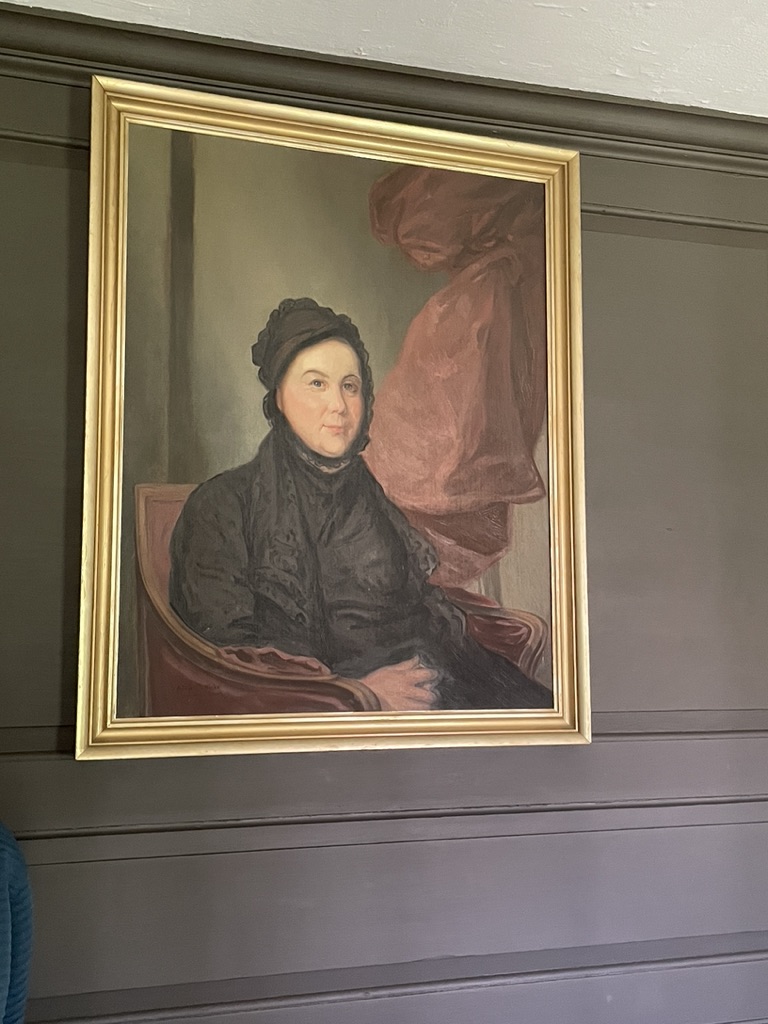
I became aware of Catharine Greene’s role in Revolutionary Rhode Island when I visited the Coventry home of General Nathanael Greene. I learned more about her as I read biographies of her husband. One of my goals this month (Women’s History Month) is to tell the stories of Rhode Island women who endured the hardships of the Revolutionary War and I will start with Catharine Littlefield Greene.
Her family called her Caty and she was born on Block Island in 1755. Her mother descended from Block Island founders and her father, John Littlefield, was a member of the Rhode Island legislature. Her Block Island childhood ended with her mother’s death when she was only 10 years old, and Caty went to live with and aunt and uncle. At that time her uncle, William Greene, was a Supreme Court justice, but he went on to being Governor of Rhode Island. Under the guidance of her aunt and uncle, Caty learned how to read and write and how to manage a household.
Nathanael Greene was a frequent visitor to Caty’s household and the pair married on July 20, 1774. The couple had little time together before the battles in the Revolutionary War began. Nathanael moved quickly from commander of the Rhode Island militia to general in the Continental Army. She opened her home in Coventry as a hospital when the Rhode Island troops were inoculated for small pox.
Caty traveled to wherever her husband was stationed (New York City, Valley Forge, Carolinas), even after the birth of their first child in 1776. There were women and children were “camp followers” who served as cooks or clothes washers. Caty had more comfortable quarters than they did, and she put her efforts into organizing events for the soldiers. She became friends with Martha Washington because they were often in camp together. She gave birth to five children during the years of the Revolution, but when she travelled she often left her children in the care of others. Being away from her children and being away from her husband were heartaches for Caty
We don’t have the letters that Caty wrote to her husband because she burned them. We do have some of his letters to her and we can get a sense of what her letters were like from how he answered her. During the Siege of Newport, Nathanael wrote:
“I am sorry to find you are getting unwell. I am afraid it is the effect of anxiety and fearful apprehension. Remember the same good Providence protects all places, and secures from harm in the most perilous situation. Would to God it was in my power to give peace to your bosom, which I fear, is like a troubled ocean….” Caty, like many other spouses of Americans in the Rhode Island Campaign, must have been fearful of the battle ahead.
Caty hoped that with the end of the war she could return to life in Rhode Island, but that did not happen.
In order to care for his troops, her husband had taken out loans, but Congress later denied his petitions to help him pay off the loans. Rhode Island properties were sold off to cover debts and the Greene moved to a plantation in Georgia. By 1786 Greene died of a sunstroke and Caty was left a young widow.
Catharine GreeneSpell Hall – CoventryNathanael Greene
There is more to her story that I will tell in a later blog.
For over sixty years the Newport Chapter of the National Associate of Colored People (NAACP) has been calling attention to the valor of the soldiers of the First Rhode Island Regiment (called the Black Regiment). I heard the story of their efforts at last year’s commemoration of the Black Regiment’s efforts in the Battle of Rhode Island. Mrs. Fern Lima recounted all the milestones in the NAACP’s efforts to create a memorial to these soldiers and to continue to tell their story. Mrs. Lema’s presentation is from the notes of her father, Lyle Matthews, a past NAACP president and one of the earlier workers in the effort. I recently had the opportunity to talk to longtime Newport County NAACP members, Mrs. Lema and Mrs. Victoria Johnson. I had gathered a timeline from newspaper articles, but they had been participants and could give me their personal perspectives.
One of the key information sources Mrs. Lema provided was a copy of the program for an earlier monument dedicated in 1976. In the booklet for the Dedication, May 2, 1976, NAACP President William Trezvant quoted from historian Charles A. Battle’s booklet “Negroes on the Island of Rhode Island”.
“In August 1928 the one-hundred and fiftieth Anniversary of the Battle of Rhode Island was fittingly celebrated by the citizens of Rhode Island. At that time the suggestion was made that the State of Rhode Island honor in bronze or stone the memory of Colonel Greene’s regiment.”
The dedication of the Black Patriot’s Monument in 1976 was just one milestone in a larger effort to bring the story of the Black Regiment to the attention of Rhode Island and the nation. In an earlier letter (Nov. 12, 1975) Trezvant wrote: “The Goal is to have the Black Regiment take its rightful place in Rhode Island History and in the Nation’s fight for freedom.” Early steps toward that goal were made by historian Charles Battle and those who researched the role of the First Rhode Island Regiment. NAACP members Lyle Mathews, John Benson and State Senator Erich O’D. Taylor did the spade work in determining where the redoubt was located that the Black Regiment defended so valiantly. Mathews was President of the NAACP at the time and Fern, his daughter, remembers field trips out to the Bloody Run Brook area where the men scouted a location that would be an appropriate site for a monument. One of the men, John Howard Benson, was a noted carver and created a woodcut map of the Battle with the redoubt’s position marked with a star. This beautiful map was included in the program.
Mrs. Lima and Mrs. Johnson helped me with a timeline of the events in the completion of Patriot’s Park.
In 1967 the NAACP began an annual celebration of the valor of the Black Regiment and to call attention to their role in history. In July of that year a boulder on the property was dedicated to the Black Regiment. State Senator Taylor was master of ceremonies and he introduced Oliver Burton who knew Charles Battles and was an early advocate for recognition of the Black Regiment’s role in history.
In 1969 the remembrance was held in August and a flagpole was added to the site. Children who had learned about the regiment from Battle’s book attended and Oliver Burton spoke. Both Mrs. Johnson and Mrs. Lima have their own copies of Battle’s book and having a good history of the story of the First Regiment in the battle was helpful in making the community aware of the special role they played.
In 1972 over 150 gathered at the memorial area on the anniversary of battle. Newspaper accounts state that this was the 9th annual commemoration organized by the NAACP.
In 1973 a large portion of the battleground was named a national historic site. This portion of the battlefield was called “Patriot’s Park.” At this time the site contained a small monument designating the historical site, a flagpole and simple boulder. Ceremonies celebrating the role of the Black Regiment continued to be held there.
In November of 1975 a fund drive was started to erect a monument to Rhode Island’s black patriots of Bloody Brook in Portsmouth. The Newport NAACP raised funds through the sale of commemorative pins. The plans for the monument were that it would be six feet high by 4 inches wide. The insignia of the 1st Rhode Island Regiment would be carved into the granite. The State Department of Natural Resources would prepare the landscape.
May 6, 1976 was the unveiling of a monument at Patriot’s Park. The monument was unveiled by Mrs. Oliver Burton, widow of a man who knew Charles Battle and had dreamed of erecting the memorial Battle had wanted. Plaques were presented to State Senator Erich O.D. Taylor and Dennis J. Murphy of the RI Dept. of Natural Resources for their efforts in the project.
In 1994 funding from the Federal Highway Administration for projects to improve or preserve historic sites associated with the federal highways became available. The Black Patriots Committee of the Newport NAACP and the RI Black Heritage society proposed improving the site.
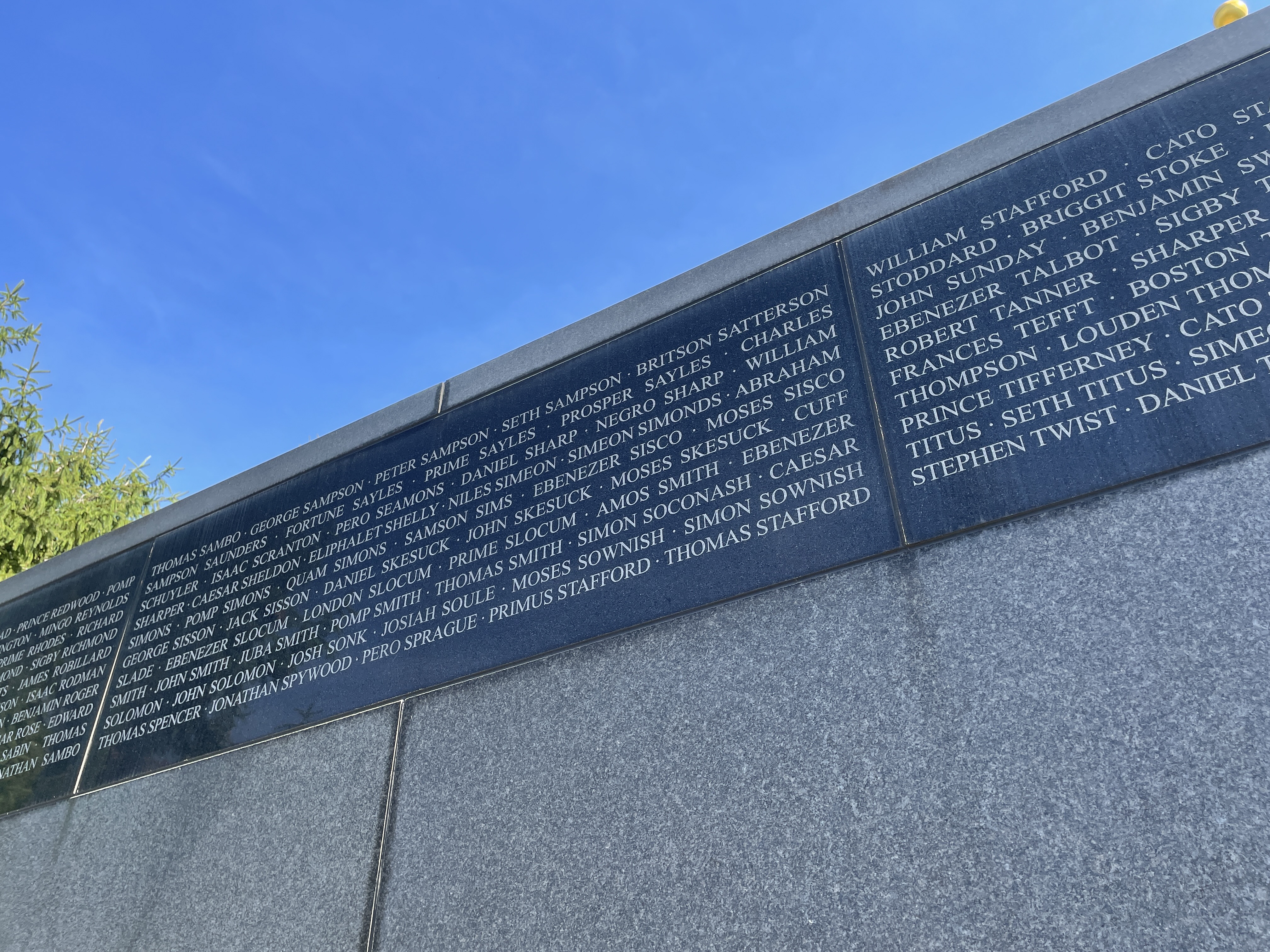
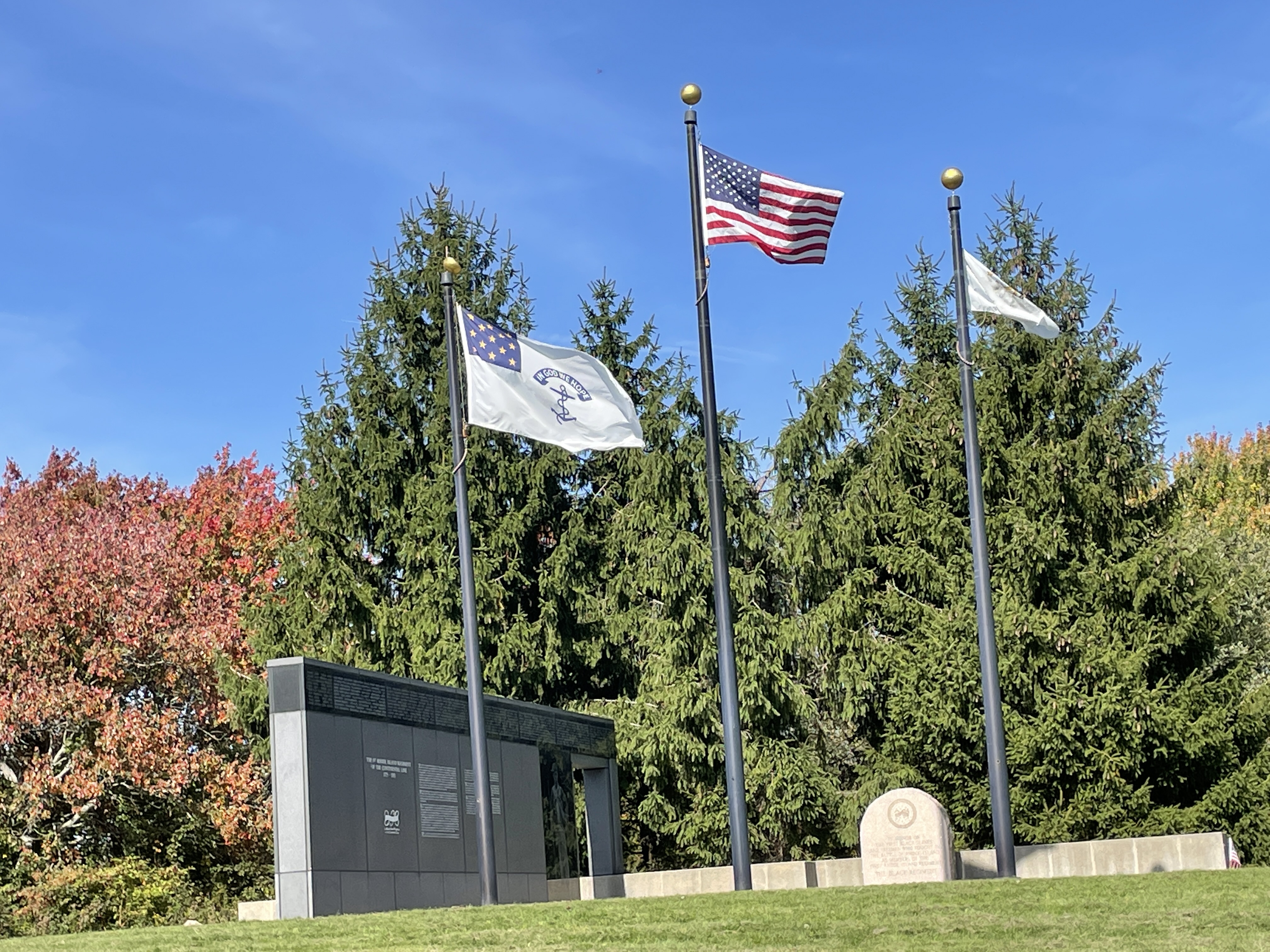
In 1996 the head of the Rhode Island Department of Transportation (RIDOT), William F. Bundy, selected the Patriot’s Park Landscape Project as the state’s first enhancement project. Paul Gaines was chosen to coordinate the creation of the memorial and he was working with designer Derek Bradford. Gaines and his committee spent 10 years on the project that created a 36-foot-long, 10-foot-high black granite memorial to the First Rhode Island Regiment.
By 1999 Bradford submitted plan for the larger monument. The design was a simple: platform with a wall that has two doorways and names of First Regiment soldiers engraved on the wall. Since no muster rolls were available for those just involved in the Battle of Rhode Island, Bradford agreed to engrave the names of all known members of the regiment.
Federally funded projects require an Environmental Impact Assessment in which groups with direct interest are given opportunity to comment. RIDOT invited 12 groups – Black organizations, Native tribes, local institutions like Rhode Island Historic Preservation and Heritage to comment on the plans. The basic list was the known black soldiers, but the list for inclusion was open to the families of indigenous soldiers and many of those names were added at their family’s request.
By February of 2000, two narratives had been written explaining the creation of the regiment. The battle narrative (written by Carl Becker and Louis Wilson) was agreed upon with corrections. It took 4 years to reach agreement on the following text:3 “And to the soldiers of the Narragansett Indian Nation who fought alongside them.”
In 2006 the Memorial to Black Regiment was dedicated. The story of the valiant efforts of the 1st Rhode Island Regiment (the Black Regiment) is engraved for all to see and the names of these soldiers are remembered.
The efforts to tell the story of the Black Regiment are not over. The cause continues because the Memorial is in need of repairs and funds must be raised to do the required work.
Through the efforts of the NAACP the story of the Black Regiment is being told and there is a dedicated spot on the battlefield to honor their valor at Bloody Run Brook.
I am working on a tour of sites in Portsmouth that saw action in the Battle of Rhode Island. The top of Quaker Hill is one such site. Some historians even use the term “Battle of Quaker Hill” because of the heavy action at this place. British soldiers converged on this crossroads from East Main, Middle Road and Hedly Street. Americans were holding their line at that position.
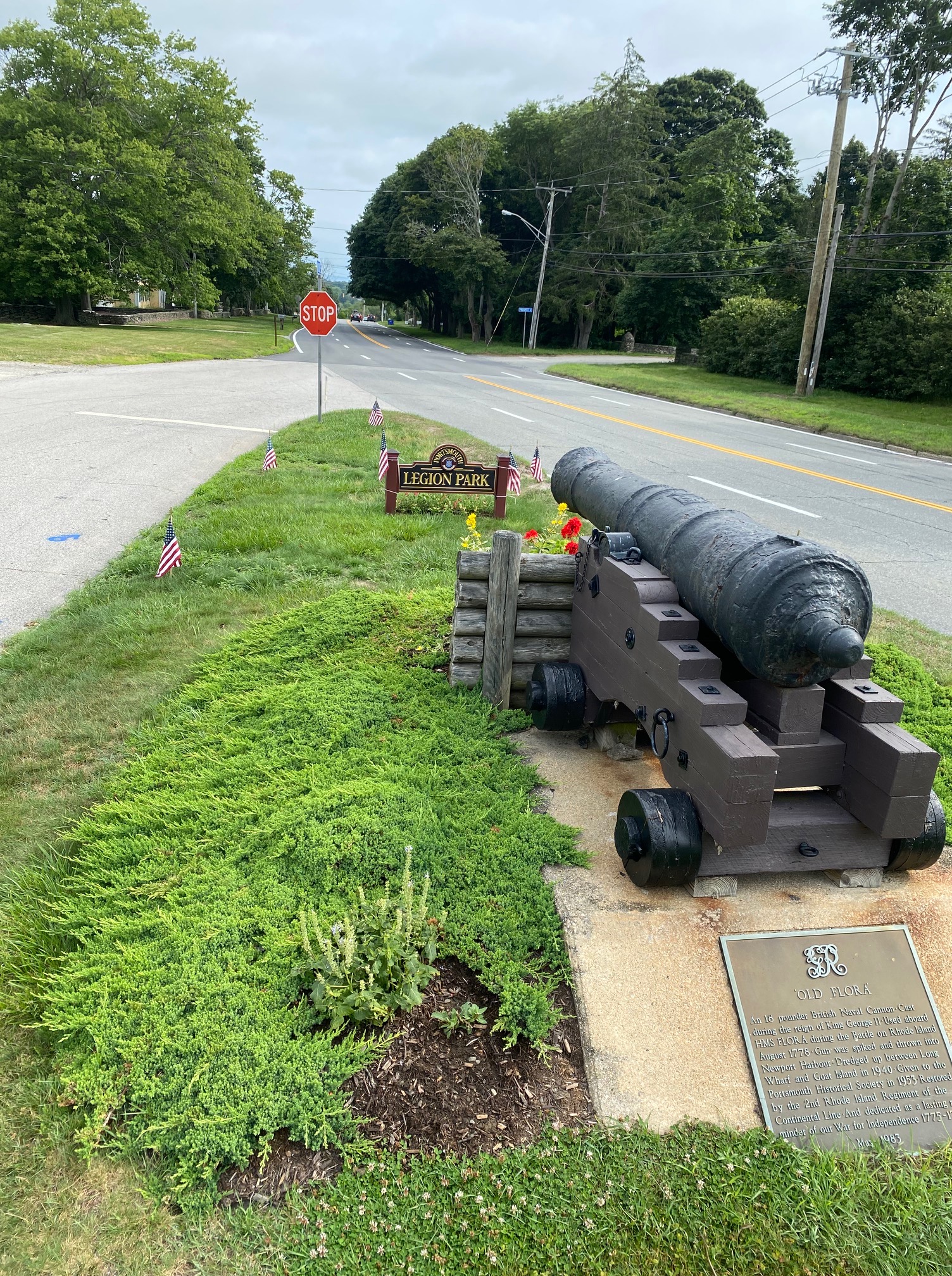
What Revolutionary Era sites can you still see today? The Friends Meeting House is an important landmark that was used by the British and Hessians as a hospital, barracks, and ammunition storehouse. The stonewalls are there to remind us of the American style of warfare in which the Patriots hid behind the walls in what we would call guerilla warfare aimed at harassing and delaying the British. In Legion Park across from the meetinghouse there is a cannon from the British ship Flora.
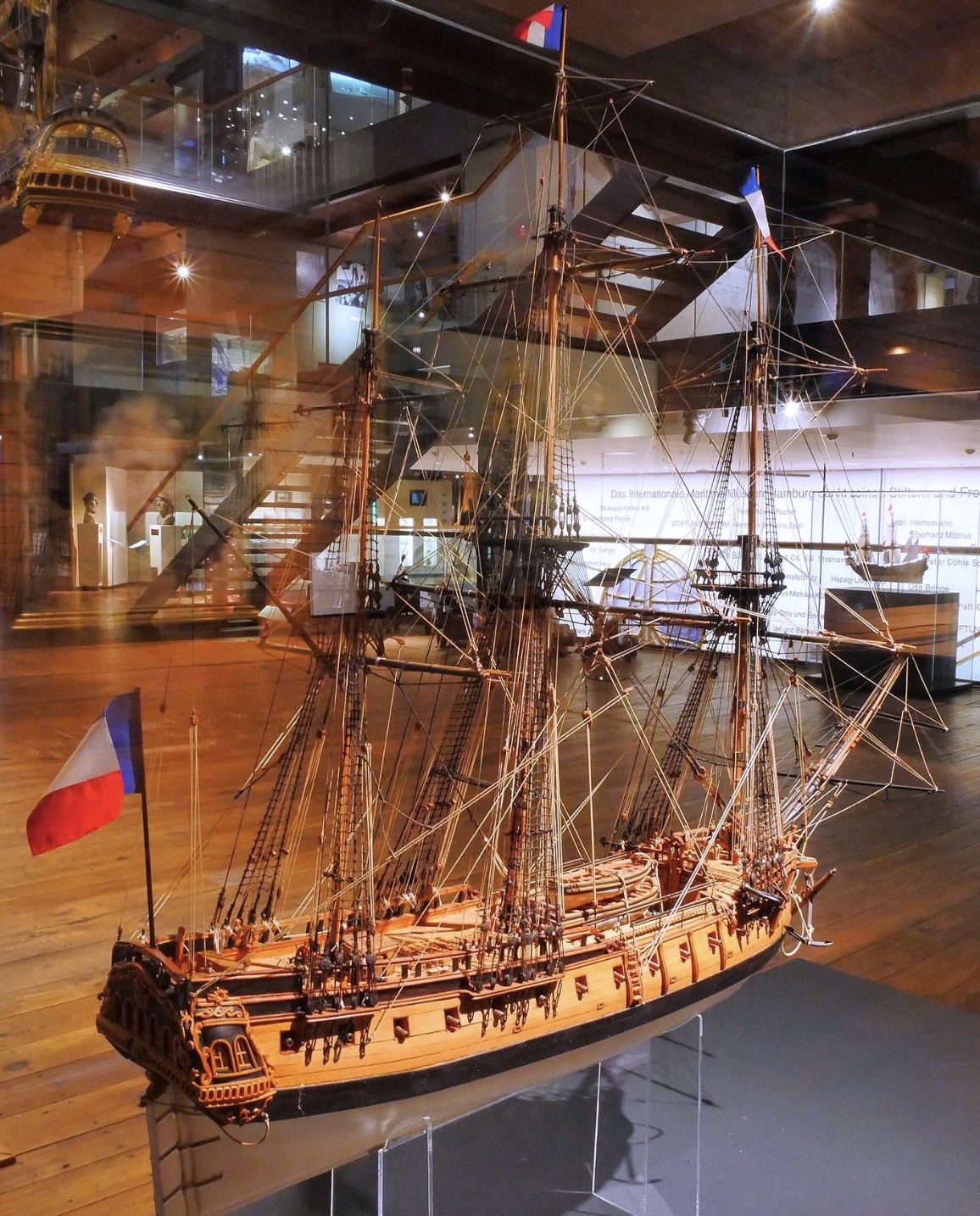
What is the story of the Flora? In researching why we have a ship’s cannon at Quaker Hill, I encountered the tale of a ship of many names and nationalities. According to an article by noted marine archaeologist D.K. Abbass, the Flora was a 698 ton, 32-gun Royal Navy frigate. Its original name was LaVestale and it was built by the French Navy in 1757. Once a ship was captured in those days, it was common practice for the vessel to be used in the navy of its captor. In 1761 the ship was captured by the British and was renamed the Flora. By 1776 the Flora was being used as a troop transport.
When the French fleet arrived in Newport in July of 1778, the British did not want the French to capture their ships. The British scuttled seven of their vessels and 13 of their transports were scuttled in the outer harbor. In Washington’s Wolfpack, the Navy before there was a Navy, author Edgar Maclay wrote that the Flora was heaved over on its side and beached for cleaning. It lay between Goat Island and Long Wharf in Newport until April of 1779 when she was raised again. The British used eight 12 pounders from the Flora on the newly outfitted HMS Pigot. The story of how American Silas Talbot outwitted the British on the Pigot is yet another story to tell. The British sank (and burned) the Flora again when they left Rhode Island in December of 1779. She was passed back and forth. 1784 – named “Reconaissance” (French), 1787 back to “Flora” (French), “Citoyenne Francaise” (a French pirate). By 1798 she was captured by HMS Phaeton and sent to the scrap heap.
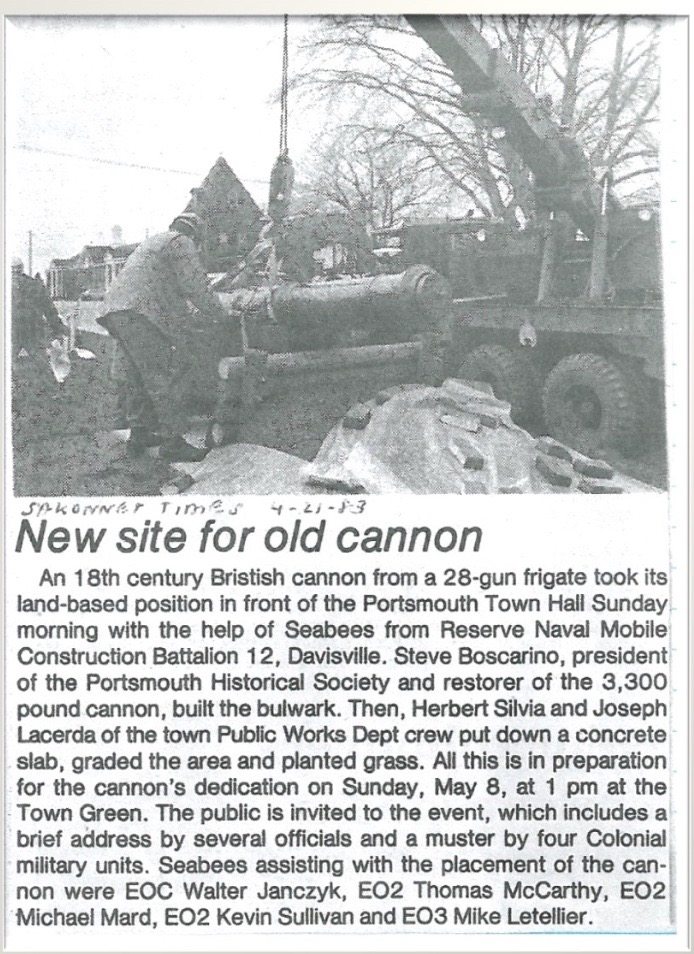
Flora was not down at the bottom of the harbor, but at least one of her cannons was. In 1940 workmen repairing Long Wharf came across the cannon and the cannon is now displayed at Legion Park in Portsmouth.
A note about privateers: they are privately owned armed vessels, commissioned by a state to attack enemy ships, usually merchant ships. The privateers and their crews usually got the ship and a large percentage of the cargo they captured. Without a real Navy, Americans relied upon these privateers in maritime warfare.
Photo by Paul MurphyModel of Flora in Hamburg Museum








 portsmouthhistorynotes