On September 24, 1774 the Kentish Guards were formed to protect the Town of East Greenwich from British attack.
Jay Killian Image
They were then charted by the RI Assembly in October 1774 to be an “elite” militia which took care of its own training and equipment. The Kent County Court House became the armory and they built Fort Daniel at the entrance of Greenwich Cove and equipped it with nine cannons.
The Guards took part in the Siege of Boston and 35 of its officers ultimately became officers in the Continental Army – including Nathanael Greene.
When the British invaded Newport, the Guards went on continuous duty until 1781. They protected Warwick Neck, Prudence Island, Warren, Bristol, Tiverton, and Aquidneck Island.
As American forces congregated at Tiverton under General Sullivan, Kentish Guard commander Col. Richard Fry led a regiment of Independent Militia Companies at the Battle of Rhode Island.
During the summer of 1779, twenty-six of the Kentish Guard attacked Conanicut Island (Jamestown) and destroyed a British battery. The Guard moved on to Aquidneck Island when the British evacuated Newport and they guarded Sachets (Second Beach).
They were posted at Newport again in 1780 and 1781 to reinforce the French.
After the war the Guard continued to provide defense to the East Greenwich area.
Eyewitness accounts help us to understand what was going on during the Siege of Newport and the Battle of Rhode Island. Robert Geake has provided researchers with a glimpse of the life of a young private in the local militia. Titled “Fired a Gun at the Rising of the Sun,” Geake transcribes and richly annotates the diary entries of Noah Robinson, an Attleboro soldier. I am very grateful to Robert Geake for making this diary accessible to researchers. Transcribing and annotating are tedious jobs but they contribute greatly to our understanding of events in Revolutionary Rhode Island.
Volume III is entitled: “Journal of a Six Month Campaign by God’s Permition in the State of R. Island in a Company Commanded by Capt. Caleb Richardson…from the town of Attleboro.
“Boys to Play
The horn does blow for us to go
And fight our Enemies
We’ll take our guns & swing our packs
In God we Trust
and Fear em’ not
Brave Sullivan’s
to Lead us on.”
Noah Robinson had gone out to war with the militia on a number of occasions. This time he served in place of his uncle who was paying him. Robinson was educated and often served as a scribe in his units.
In the entries below, I have chosen to share the pieces of writing that speak most about the Rhode Island Campaign. Noah Robinson was among the troops being gathered for General Sullivan in Tiverton to take part in a French and American effort to take Aquidneck Island from British control.
Wednesday, August 5, 1778: Noah reports that he “Heard one of the Enemies ships was blown up. ….Towards Night heard two more British ships were blown up.” This is a reference to the Cerebus, Orpheus, the Juno and the Lark, British ships whose captains were given the order that under no circumstances would they allow their ships to be captured. With the French ships threatening, the British captains rain their ships aground and set them on fire.
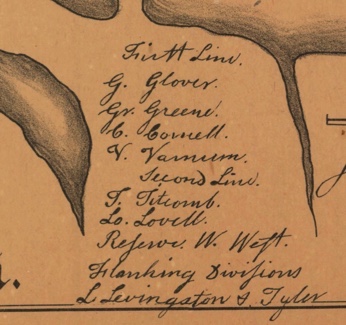
Friday 7th: Gen. Varnum’s & Gen. Glovers brigade, Col. Jackson & Col. Shearburne’s Regt of Continental troops crossed the ferry ..
Saturday 8th: “…about Twelve o’clock marched on through heat and dust to Howland’s Ferry and encamped on the ground. Heard some firing towards Newport.”
Sunday 9th August: “…About eight o’clock pack up, took boat & crossed Howland Ferry on to R. Island. Formed and marched boldly up to the Fourth on the N. end of ye island then was informed ye enemy had retreated to the end of ye island so we lay on our post until about four o’clock when a shower came up so that we got very wet..”
Monday, 10th August: ” ..Much firing below ye island. ” Geake notes that day there was an exchange of fire between the French ships and the British batteries. By the next day, August, 11th, the whole army paraded and they had general orders to march by 6 AM to Newport. By August 15th they marched to within two and a half miles of Newport. August 16th Noah comments that “since last night our men have been very delinquent in trench making.” In his annotations Geake comments the some 800 men were digging trenches for the coming assault. 400 men were digging a four cannon battery just north of Green End Road in Middletown. Another 400 were making a concealed trench from the first battery down the west slope of Honeyman Hill.
Wednesday, August 19th, Noah could hear cannonading and he heard that some of the men were killed at the lines the night before. On Thursday the 20th of August Robinson reports that he washed his clothes, there was cannonading and he heard that the French fleet returned to Newport harbor. By August 24 he heard the French fleet had definitely left the harbor.
Geake’s notes add needed background to the brief entries. On the eve of battle, August 28th, Robinson noted that “At 2 o’clock a man was hanged in our camp.” Geake tells us that a soldier from Webb’s Regiment of Continentals was hanged for desertion because Sullivan wished to set an example.
On Saturday, August 29th, Noah reports that “Last night (8/28/1778) about 8 o’clock struck tents and returned back to the N. end of Island, about 9 o’clock an action began, the enemy pressing on our light party. It appeared there would be a general action however our Army looking for the rights of their country; fighting like heroes, the enemy dare not press on our main body.” Geake’s notes tell us that Robinson was one of about the 120 Bristol County men which were in the rear guard of Titcomb’s brigade.
Robinson writes that action ceased at about 4 PM but cannon shot continued. He writes on Sunday, August 30: “Last night returned to our former station (from the wall) and blanketed down. (Some cannonading on both sides). Dug an intrenchment, drawer some provision and Rum &c. The loss of killed and wounded yesterday I can not certify but it appeared considerable on both sides.
Denison Map
August 31st Robinson reported that “Last night (August 30) mustered up about 5 o’clock, evacuated the lines. The whole Army crossed H(Howland) Ferry. Encamped for the night…
Reference:
“Fired a Gun at the Rising of the Sun.” Transcribed and Annotated by Geake, Robert. Privately printed by author. 2018.
“Who won the Battle of Rhode Island?” someone asked me recently. I cautiously answered that I thought it was a draw. The Americans were able to get out of a tough situation with their men and equipment. They retreated from Aquidneck Island but lived to fight another day. They proved they could fight valiantly. The question of who won or lost has always been a sore point for me, especially when people dismiss the importance of the battle simply because it was not a Patriot victory.
Nathanael Greene
I have been reading “Washington’s General: Nathanael Greene and the Triumph of the American Revolution” by Terry Golway. In battle after battle it seems that the Patriots had to retreat and retreat strategically. Golway quotes Greene writing to a French ally, “We fight, get beat, rise and fight again.” I found another similar quote in a letter about the Southern Campaign from Greene to Washington 1 May, 1781: “My public letters to Congress will inform your Excellency of our situation in this quarter. We fight, get beat and fight again.”
I understand a little more today than I did a week ago. Yes, we should celebrate the victories like Yorktown. But… we shouldn’t dismiss the retreats. They kept the Patriots going, wore down the British, and ultimately worked towards gaining Independence.
Lafayette’s stay in Rhode Island during the Siege of Newport and the Battle of Rhode Island in August of 1778 was just the first time the General came to our state. The second visit was to Newport in 1781 when he came to confer with Rochambeau. In 1784 he came to Rhode Island on a tour after the War for Independence was over. His last visit came during a grand tour of America in 1824. This blog will focus on the first visit.
In the summer of 1778 Lafayette brought a detachment of troops from General Washington to assist General Sullivan in the Rhode Island Campaign, a joint French and American effort to free Rhode Island (Aquidneck Island) from the British Occupation.
A letter Washington wrote from White Plains, New York, on July 22, 1778 contained the orders:
“Sir, You are to have the immediate command of that detachment from this army which consists of Glover’s and Varnum’s brigades and the detachment under the command of Colonel Henry Jackson. You are to march them by the best routes to Providence in the State of Rhode Island. When there, you are to subject yourself to the order of Major General Sullivan, who will have command of the expedition against Newport and the British and other troops on the islands adjacent.”
Lafayette reached Providence with 2,000 men on August 3rd or (August 4th according to other accounts). On their way, Lafayette and his men stayed by “Angell’s Tavern” in Scituate. There his men had a chance to wash and refresh themselves with the spring that became known as Lafayette’s Spring. On August 5th, Lafayette was aboard the French flagship Le Languedoc to meet with French commander d’Estaing. The French fleet was waiting off of Point Judith and d’Estaing provided Lafayette with the ship Provence to bring him back to Providence.
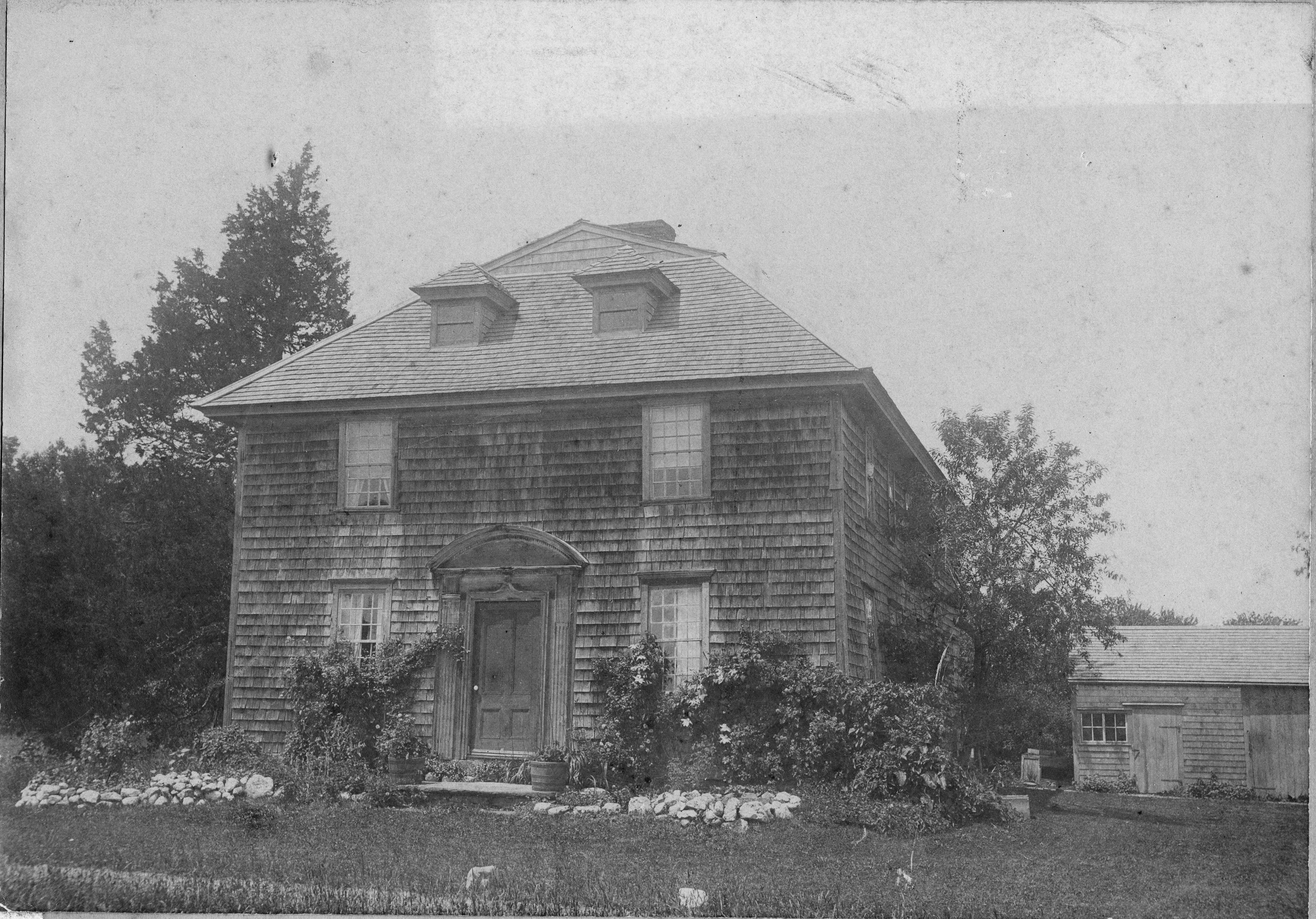
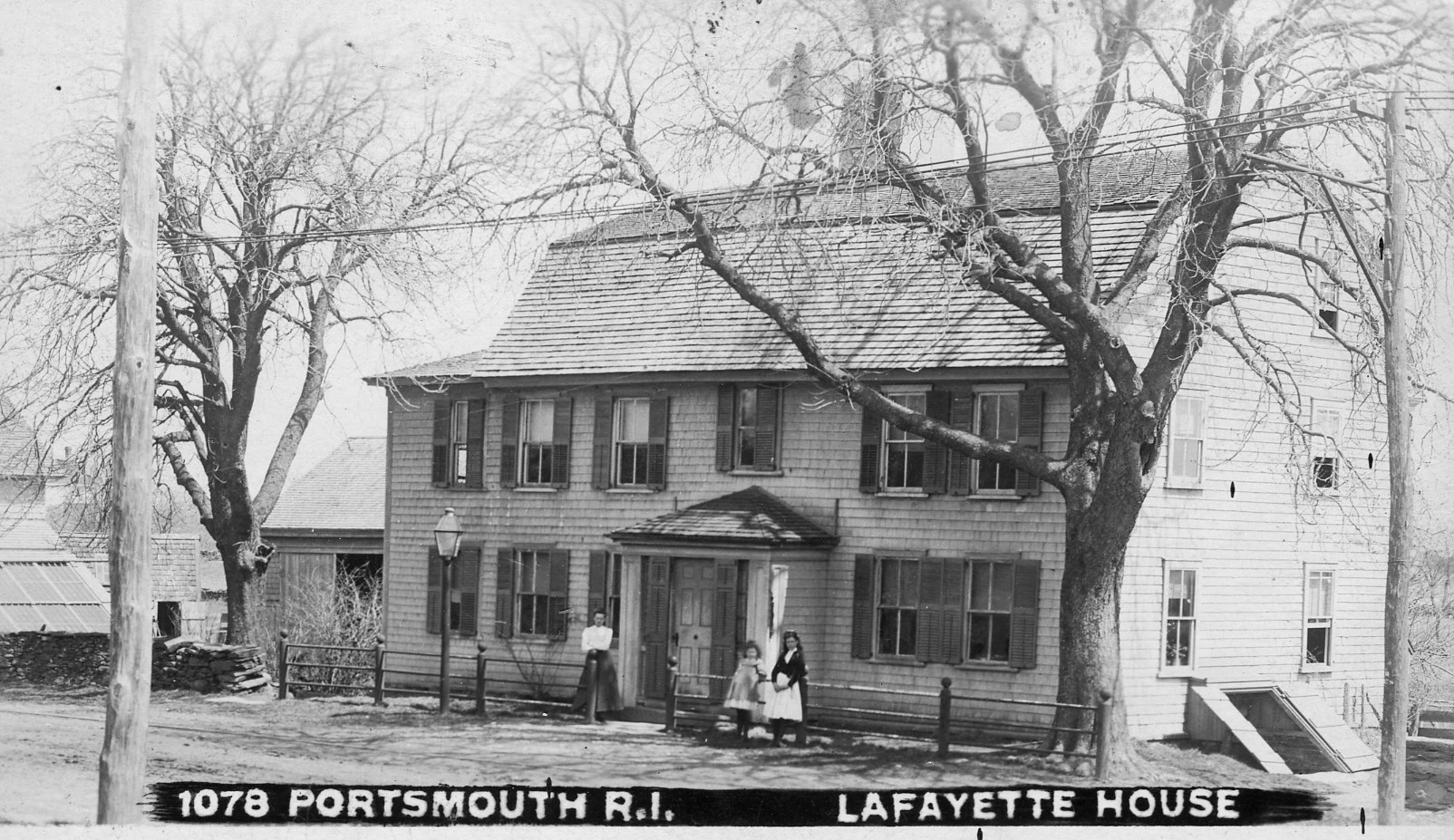
There is some documentation for where Lafayette stayed in Rhode Island at that time, and there are other homes that have “Lafayette Stayed Here” legends that have come down through time.
The American forces gathered in Tiverton, close to the Howland Ferry. By August 6, 1778, Lafayette and his troops had moved to Tiverton where he is said to have stayed at the Abraham Brown House on Main Road close to Lafayette Street. He is said to have occupied the northwest chamber on the second floor. This may have been before the move to Aquidneck Island or it may be that he stayed there after the retreat.
“Lafayette House in Tiverton”
With the arrival of the French fleet, operations were set in motion. The British abandoned Butts Hill Fort and other strategic locations in northern Aquidneck Island. On August 10, 1778 Sullivan began crossing to the island and he moved into Butts Hill Fort and made it his headquarters. The diary of Rev. Manasseh Cutler who served as chaplain for General Titcomb’s Brigade, provides a few glimpses of what Lafayette and others were doing on the island before the Battle of Rhode Island. His entry for Sunday, August 16th, gives us one location of Lafayette’s quarters in Portsmouth.
“Went in the afternoon with a number of officers to view a garden near our quarters, belonging to one Mr. Bowler, – the finest by far I ever saw….” Cutler goes on to describe the garden. The last line in the diary entry reads, “The Marquis de la Fayette took quarters at this house.”
Metcalf Bowler House (now torn down)
Cutler’s entry for Monday the 17th also refers to the Marquis. The British had been firing since early in the morning and Cutler with General Titcomb had been observing the enemy lines from the top of a house. “stood by the Marquis when a cannon ball just passed us. Was pleased with his firmness.”
Metcalf Bowler’s estate has been torn down, but there are two homes in Portsmouth with “Lafayette” legends. One is the Dennis House on East Main Road and not far from Butts Hill Fort. The southeast room on the second floor has traditionally be associated with Lafayette. Lafayette has traditionally been associated with a house on Bristol Ferry Road (Bayles’ History of Newport County: p.665).
Dennis House, Portsmouth
Although the American forces had moved onto Rhode Island (Aquidneck), the French forces were unable to move forward with their attack of Newport. Their ships were damaged in a storm and d’Estang decided to head to Boston for repairs on August 21st. The joint French and American plan was about to fail without the French aid. On August 28th, Lafayette made the six and a half hour trip to Boston to talk to d’Estaing. The mission was fruitless and on August 30th Lafayette rode back to Portsmouth in record time. He had missed the battle, but he took command of the rear guard to bring it safely across to Tiverton.
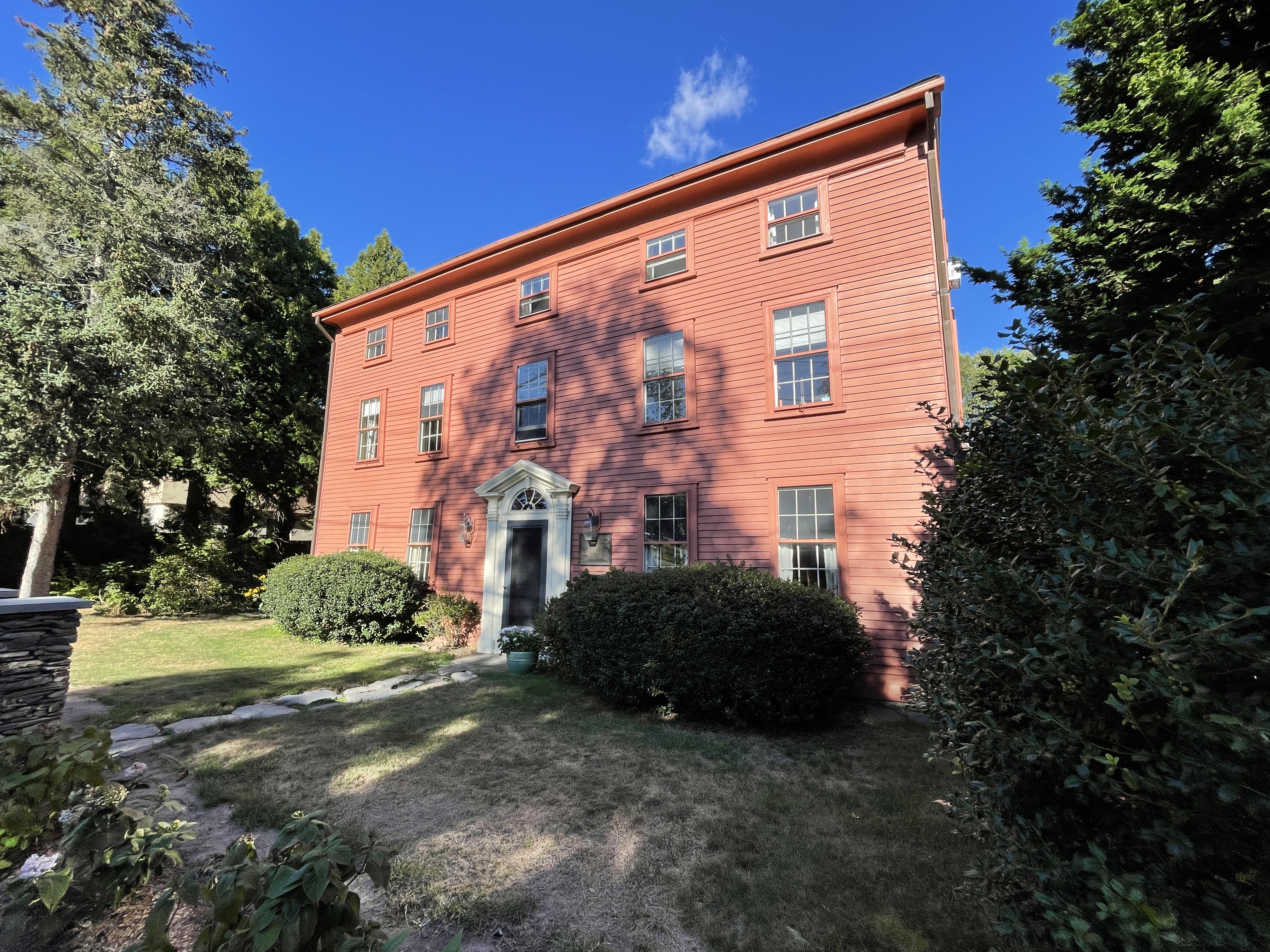
Israel Angell’s Diary notes that on September 1st General Varnum’s brigade in General Lafayette’s detachment passed by boat to Warren. The next day they were in Bristol where Lafayette made the Hope Street home of Joseph Reynolds his headquarters. A plaque on the house reads: This house built about the year 1698 by Joseph Reynolds was occupied by Lafayette as his headquarters September 1778 during the War of American Independence.” Lafayette’s room was the northwest chamber. The southwest room on the first floor was his dining room and office.
Reynolds House today
By September 18th Lafayette had moved on to Warren where the brigade encamped on Windmill Hill. Lafayette’s quarters were at Coles Tavern which has since burned down. On September 28th he was in Boston and on his way to Philadelphia on October 1st.
Lafayette would return to Rhode Island under more peaceful circumstances. More on those visits in our next blog.
References: This article was based on Preston’s 1926 article with added information from other sources.
Preston, Howard. “Lafayette’s Visits to Rhode Island.” Rhode Island Historical Society Collections. January 1, 1926.
There has been so much growth in vegetation that it is difficult to imagine the view that General Sullivan would have had from his command post at Butts Hill Fort. Jim Garman has loaned me his notebooks from the 1978 re-enactments of the Battle of Rhode Island. His images clarify things.
Butts Hill FortView looking across Sakonnet to TivertonView from Butts Hill of Howland Ferry AreaView from Butts Hill overlooking Turkey Hill to the South
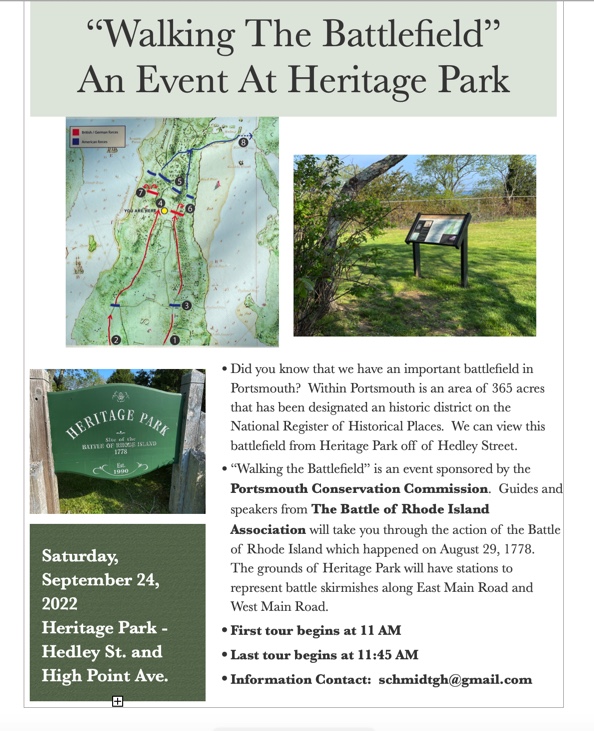
On Saturday September 24th ,2022, the Battle of Rhode Island Association is proud to partner with the Portsmouth Conservation Commission as we present “Walking the Battlefield.” The event will be held at Heritage Park, located at Hedley St and Highpoint Ave. Visitors will be guided through the action of The Battle of Rhode Island that took place August 29th, 1778.
Called Turkey Hill in 1778 and occupied by both Patriot and British forces, the Park will be laid out with stations representing key skirmishes of the Battle, the largest action in Rhode Island during the War for Independence. Guides and Speakers will take visitors through the events of the day to provide a clear understanding of a complex series of individual fights. The event is free to the public. First tour starts at 11 am, 2nd tour at 11:45. For more information visit: https://portsmouthhistorynotes.com/
Since 1956 the Portsmouth Conservation Commission has worked to protect and preserve the town’s natural resources as well as protecting the natural aesthetic areas within the town. The BUTTS HILL FORT RESTORATION COMMITTEE is a committee of the BATTLE OF RHODE ISLAND ASSOCIATION. The mission of the Committee is to restore and maintain the Revolutionary War fort in order to provide a safe and accessible educational and recreational site that raises public interest in this National Historic Landmark and its role in the Battle of Rhode Island. The Association is a registered 501(c)(3) non-profit committed to raising awareness of Rhode Island’s role in the War for Independence. Donations may be made payable to “BoRIA” at PO Box 626, Portsmouth, RI 02871.a
French Map 1778 (Library of Congress) Shows the Retreat Route via Howland’s Ferry area.
A diary entry by Israel Angell gives us a glimpse of the aftermath of the Battle of Rhode Island:
August 30th. “A Cloudy morning and the wind very high it rained a Considerable in the night the Enemy Remained on their Ground this morning two English friggats Came up yesterday to prevent our retreat but could do but little they Still Remained here. I was Relieved this morning and got Some provisions and being much worn out for the want of sleep went to a hous and took a good knap there was a Cannonade kept up to day and Some small arms from the Sentries at night we Recd orders to Retreat off the Island which we did without the loss of anything, this Retreat was in Consequence of an Express from Genl Washington informing Gen Sullivan that the Brittish Ships of war and transports had sailed from New York Some days before.”
The diary entry tells us
That the troops were worn out.
They had had little to eat and had not slept.
The enemy remained in its position overnight and two English frigates stayed in position.
On the day after the battle a cannonade was kept up and there was occasional gunfire at sentry positions.
The Americans received orders to retreat because the British ships were on the way.
August 30th was also a day to tend to the dead and wounded.
Sullivan listed the American casualties as 30 killed, 138 wounded, and 44 missing.
Pigot reported that British forces sustained 38 killed, 210 wounded, and 12 missing.
American General Sullivan ordered a hundred men to bury the American dead.
The wounded were transported to mainland hospitals in Providence, Bristol and elsewhere.
A diary entry by Israel Angell:
August 31st, 1778. “Our retreat off the Island was completed by three o’clock this morning it is Supos’d that the Enemy attempted a Retreat last Evening but after finding that we Had Retreated they Returned to their ground as it was late in the morning before they took possession of the forts we left …………..After we had Crost at howlands ferry we Encampt about a mile from Sd. ferry where we tarried this day at Night……”
On the night of August 30/31, American forces departed Aquidneck Island and moved to new positions at Tiverton and Bristol.
Resources:
Diary of Colonel Israel Angell: Commanding the Second Rhode Island Continental Regiment During the American Revolution, 1778-1781.
Christian McBurney’s book on the Rhode Island Campaign.
Paul Dearden’s book The Rhode Island Campaign of 1778.
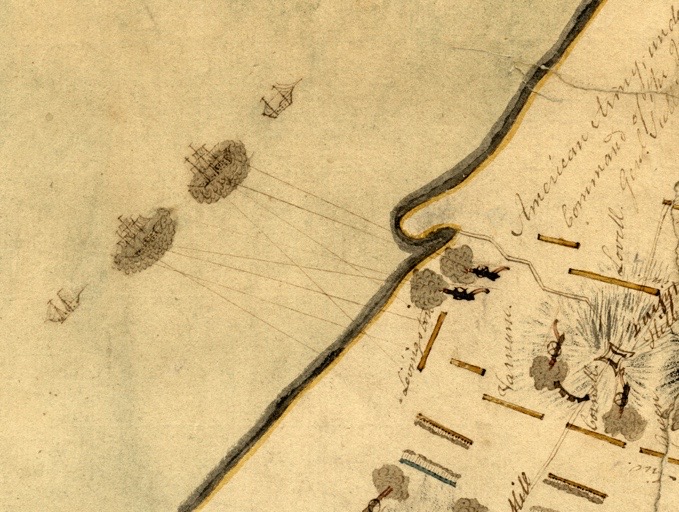
There was a significant naval component to the Battle of Rhode Island. Maps from the time period may show three or four British vessels firing on the west side of Portsmouth, but scholars such as Dr. D.K. Abbass believe there were five vessels. The ships were under the command of Captain Alexander Graeme.
Sphynx: 20-gun frigate (Graeme’s ship) Vigilant: 20-gun armed ship Spitfire: 10-gun row galley. This was a former Rhode Island row galley (used oars) A loyalist brig Another unidentified vessel
The main goal of this little British fleet was to destroy the American battery at Bristol Ferry (on the Bristol side) and block the Americans from retreating to Bristol.
The captain’s log of the Vigilant recorded that at 7:30 a.m. he “received orders to Weigh & try to cut off the Retreat of the Rebels at Bristol Ferry.”
While “working up” toward the ferry, (this would be Bristol Ferry) at 10 a.m. he “Observed the British and Hessian Troops engaged with the Rebels who had posted themselves on Quaker and Windmill hills,”
At 11:30 a.m.the ship “Stood close in & fired Several Shot to facilitate the operations of the Hessians who were by this time driveing the Rebels out of the Wood.”
Observing the Americans “turning a Work up” at Portsmouth Point (maybe Arnold’s Point), he “Stood close in and fired Several Guns with Round & Grape among those people which only disturbed them for the time.”
At 1 p.m. “Stood up as far towards Bristol Ferry as the Pilot would take Charge of the Ship the Rebels kept a Constant fire … from a Battery above the Ferry most of which Shot fell close on board and the rest passed over between the Mast Hd and kept fireing.”
The shallowness of the water in the area around Bristol Ferry may have been the factor that made the vessels turn around and pass by Portsmouth’s Narragansett Bay shores again.
“Shot at the Rebels posted on Wind Mill and Quaker hills.”
At 2 p.m. the ship again “Stood Close in” to support the Hessians, “but … the Rebels began a Cannonade from three 24 pounders the three first Shot hulled the Ship and the others fell all round her, received orders … to move.”
Thereafter the ship was “employed Standing off and on frequently exchangeing Shot with the Enemy. … “
At 6 p.m. the Cannonade on shore began to abate D[itt]o received orders … to Anchor on the Flank of the British Army during the Night with the Reprisal Brig and the Sphynx with the other two Armed Vessels stood over and Anchored under the No. end of Prudence Island”
There is another account from the diary of British officer Frederick Mackenzie, who was very critical of the Vigilant’s failure to continue its bombardment.
“As soon as the Troops marched out in pursuit of the Rebels, The Sphynx, and Vigilant, with the Spitfire Galley and the Privateer Brig, got under way with the wind at N.E. and worked up the passage between Rhode-Island and Prudence, in order to annoy the Enemy’s right if there should be an opportunity. The Vigilant got up in time to have some shots at the right of the Rebels when drawn up in front of the Artillery Redoubt, but they turning some 18 prs [18-pounder cannons] against her from thence and from Arnold’s point, she dropt lower down, and anchored with the other vessels opposite Slocum’s. We were of opinion that had the Vigilant continued in the position she had gained, and persisted in cannonading the Enemy’s right with her 24 prs she would have galled them exceedingly, and possibly have enabled us to turn that flank. ‘Tis certain there was no necessity for her moving back so soon as she did.”
British ships firing on American positions – Map 1778 Rhode Island Archives
Resources:
Abbass, D.K. The Forgotten Ships of the Battle of Rhode Island: Some Unpublished Documents. Rhode Island History Magazine, Winter/Spring 2009.
Diary of Frederick Mackenzie: Giving a Daily Narrative of His Military Service as an Officer of the Regiment of Royal Welch Fusiliers during the Years 1775- 1781 in Massachusetts, Rhode Island, and New York (Cambridge: Harvard University Press, 1930), 383.
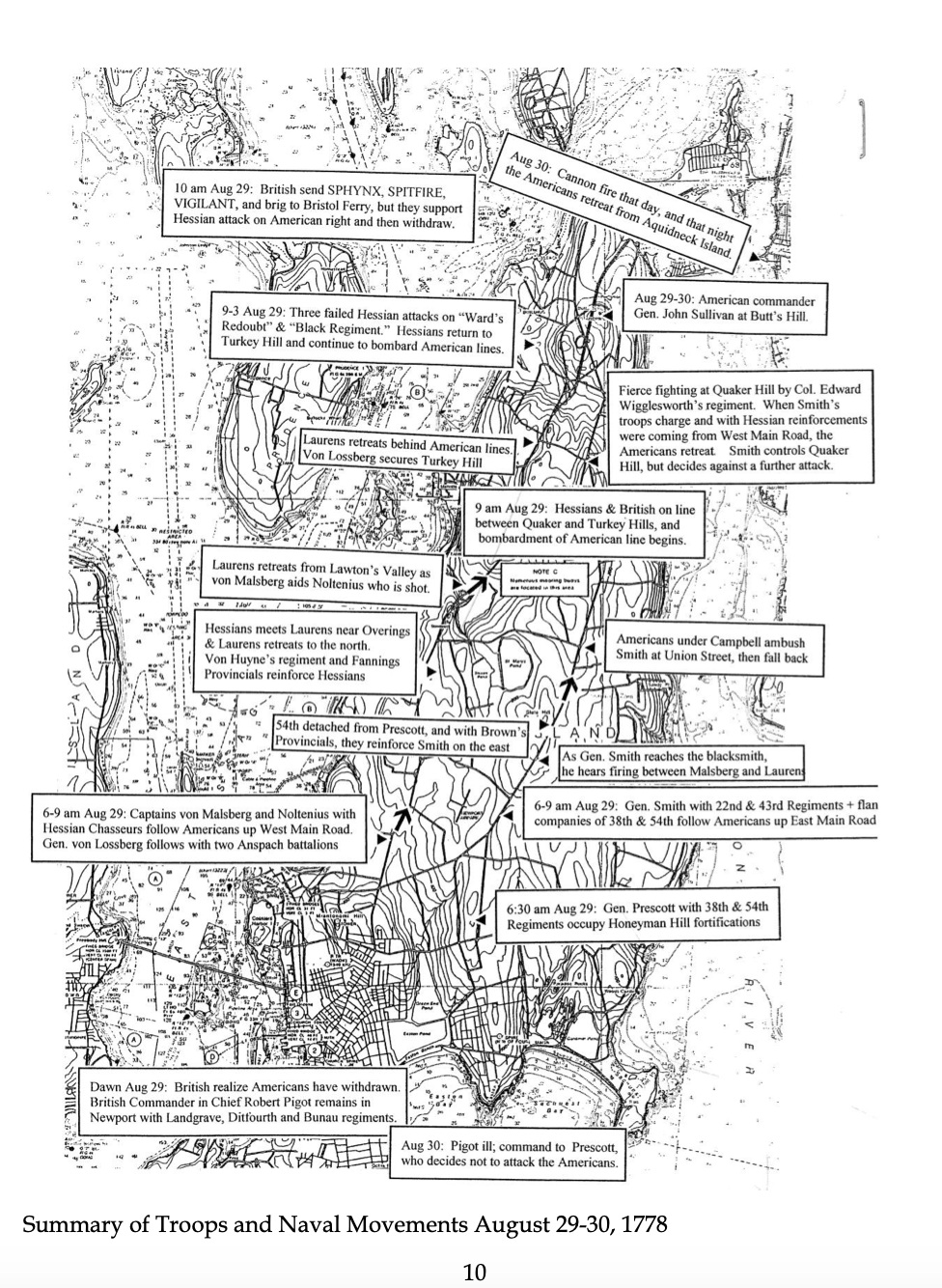
Action in the Battle of Rhode Island took place along East and West Roads. Sometimes there were two or more actions going on at approximately the same time. This brief timeline is an approximation.
For clarification the British and Hessian leaders are noted with a (B) and the American leaders are noted with an (A).
August 29, 1778
Dawn: *Captain Mackenzie (B) saw empty American works. He travels to Pigot’s (B) headquarters to inform him of withdrawal. Pigot decides to hamper the retreat.
6:30 AM: *General Prescott (B) moved out with the 38th and 54th Regiments to occupy fortifications at Honeyman’s Hill in Middletown. *Brigadier General Smith (B) marched toward Quaker Hill by East Road with 22nd and 33rd Regiments with the flank companies of the 38th and 54th. *On West Road Captain von Malsburg (B) and Captain Noltenius (B) with Hessian Chasseurs advanced toward Laurens (A). Behind them came Major General von Lossberg (B) leading two Anspach battalions.
7 AM: *Von Malsburg (B) spotted Laurens (A) and Talbot (A) with their Light Corps behind stone walls to the south of Redwood House. Americans were driven back up West Road. *Livingston’s men (A) attacked Smith’s men (B) from behind stone walls on East Road. Commander Pigot ordered von Huyne’s Regiment (B) and Fanning’s Regiment (B) to support von Lossberg (B) on West Road. *Pigot (B) orders Prescott (B) to send 54th Regiment and Brown’s Regiment to reinforce Smith (B) on East Road.
8 AM: *Von Lossberg (B) sent troops toward Lauren’s positions on three sides. *Coore’s and Campbell’s troops (B) ran into group fo Wade’s (A) pickets by the intersection of East Road and Union Street. *British moved down Middle Road and East Road toward Quaker Hill.
8:30 AM: *Von Lossberg (B) came to aid of Hessian Chasseurs. *Laurens (A) and his Light Corps was forced to retreat across Lawton’s Valley to the works on a small height in front of Turkey Hill. *Lauren retreats to Turkey Hill. Laurens was told to retire to main army as soon as possible. Hessian (B) attackers arrived on top of Turkey Hill.
9 AM: *Wigglesworth’s Regiment (A), Livingston’s Advanced Guard (A) and Wade’s pickets (A) waited for British at intersection of East Road, Middle Road and Hedley Street. *Quaker Hill was the scene of intense fighting. *Americans retreated toward Butts Hill and Glover’s (A) lines.
9:30 AM: *From top of Quaker Hill, Smith (B) could see strength of Glover’s position. *Smith was under orders not to begin a general engagement, so he decided against a frontal assault. *Smith withdrew forces to top of Quaker Hill.
*10 AM: *Von Lossberg’s (B) troops arrived at Turkey Hill. *Americans had positions on Durfee’s Hill and Butts Hill. *Samuel Ward (A) and the 1st Rhode Island Regiment (Black Regiment (A)) held an Artillery Redoubt. *His men repulsed von der Malsberg’s (B) men.
11:30 AM: *Von Lossberg (B) ordered von der Malsburg’s men (B) to try to attack Ward’s (A) First Rhode Island Regiment position again. *British ships Sphynx, Spitfire, and Vigilant shelled the American positions from the West shore, but they did little damage. *The Americans held their position.
1PM: *British ships planned to attack American positions. *General Greene’s (A) men dragged cannon down to beach and forced the British ships to retreat.
2 PM: *Pigot B) reached Quaker Hill to observe the action. *Pigot ordered Landgrave (B) and Ditfurth Regiment (B) to march to von Lossberg’s (B) troops.
4PM: *General Glover (A) saw movement in British lines and ordered Tyler’s Connecticut militia (A) and Titcomb’s (A) Brigade of Massachusetts militia to positions behind stone walls (maybe Freeborn Street), but the British did not engage.
7PM: *Landgrave (B) and Ditfurth (B) Regiments arrived at von Lossberg’s lines.
7PM (August 29) to 3AM (August 30) : *There was sporadic artillery fire and light skirmishing. Musket and cannon shots were heard for seven hours. *The Battle of Rhode Island was basically over. *The Americans and British forces retired to their lines.
Dr. Abbass’ map
Resources: The timeline was culled from McBurney’s Rhode Island Campaign and Dearden’s The Rhode Island Campaign of 1778. Map from Dr. Abbass’ proposal to restore Butts Hill Fort.
The action on Quaker Hill on the morning of August 29th, 1778 was hot and heavy. General John Glover and his New Hampshire officers were having breakfast at a house on Quaker Hill. Their horses were saddled by the door. General Smith’s Redcoats were firing furiously. Glover ordered Rufus King, an aide de camp, to investigate the action. As he left the table, Major John Sherburne took his place. The enemy fired a field piece from a range of three-quarters of a mile. A cannon ball tore through one of the horses outside (it may have been Glover’s) and smashed Sherburne’s foot. Sherburne’s leg had to be amputated, but the circumstances of the wounds bothered him. “The loss of a leg might be borne, but to be condemned all future life to say I lost my leg under the breakfast table is too bad.” Sherburne’s injury did not hinder him from progressing in a law career. He served as a US Attorney for the District of New Hampshire from 1789 to 1793 and from 1801 to 1804; he also served in the US House of Representatives from 1793 to 1797. He went on to serve as a federal judge for the District of New Hampshire from 1804 until his death in 1830.
Sherburne was in Rhode Island under the command of General William Whipple. Whipple was a signer of the Declaration of Independence from the State of New Hampshire. As New England militias and Continentals were gathering for General John Sullivan’s Rhode Island Expedition in 1778, Whipple followed his New Hampshire General. The Expedition was based on the aid of the French, but the French navy sailed off to Boston to repair their ships that had been damaged in a storm. By August 26, 1778 it was clear that the French were not coming back. To Whipple’s dismay, 1,100 of the New Hampshire volunteers left.
John Trumbull’s Portrait of Whipple – National Portrait Gallery
Whipple stayed through the battle and a group of his men stayed in service until September 5, 1778. Records list a “Prince Whipple” as a servant of Whipple. Whipple was a merchant and ship owner and he engaged in the slave trade. He personally owned slaves and Prince was one of them. There is a story that in preparing to go off to the battlefield, Whipple said: “Hurry up Prince, we’ve got to go and fight for our freedom.” Prince responded “But I have no freedom to fight for.” Supposedly Whipple answered, “From this moment on you are a free man, Prince. Hurry up now and we will fight for our freedom together.” Prince was loyally at Whipple’s side throughout the war. After the war Whipple officially gave Prince his freedom. As a reward for his service, Prince was granted a plot of land that he eventually used for a school for African children.
Payroll Records from Fold3
Resources:
“General Glover’s Role in the Battle of Rhode Island,” by George Billias. Rhode Island History, April 1959.
Fold3 Military records for William Whipple, Prince Whipple and J. Samuel Sherburne.








 portsmouthhistorynotes