Home

Annotated Timeline: Battle of Rhode Island and Aftermath

Leave a comment

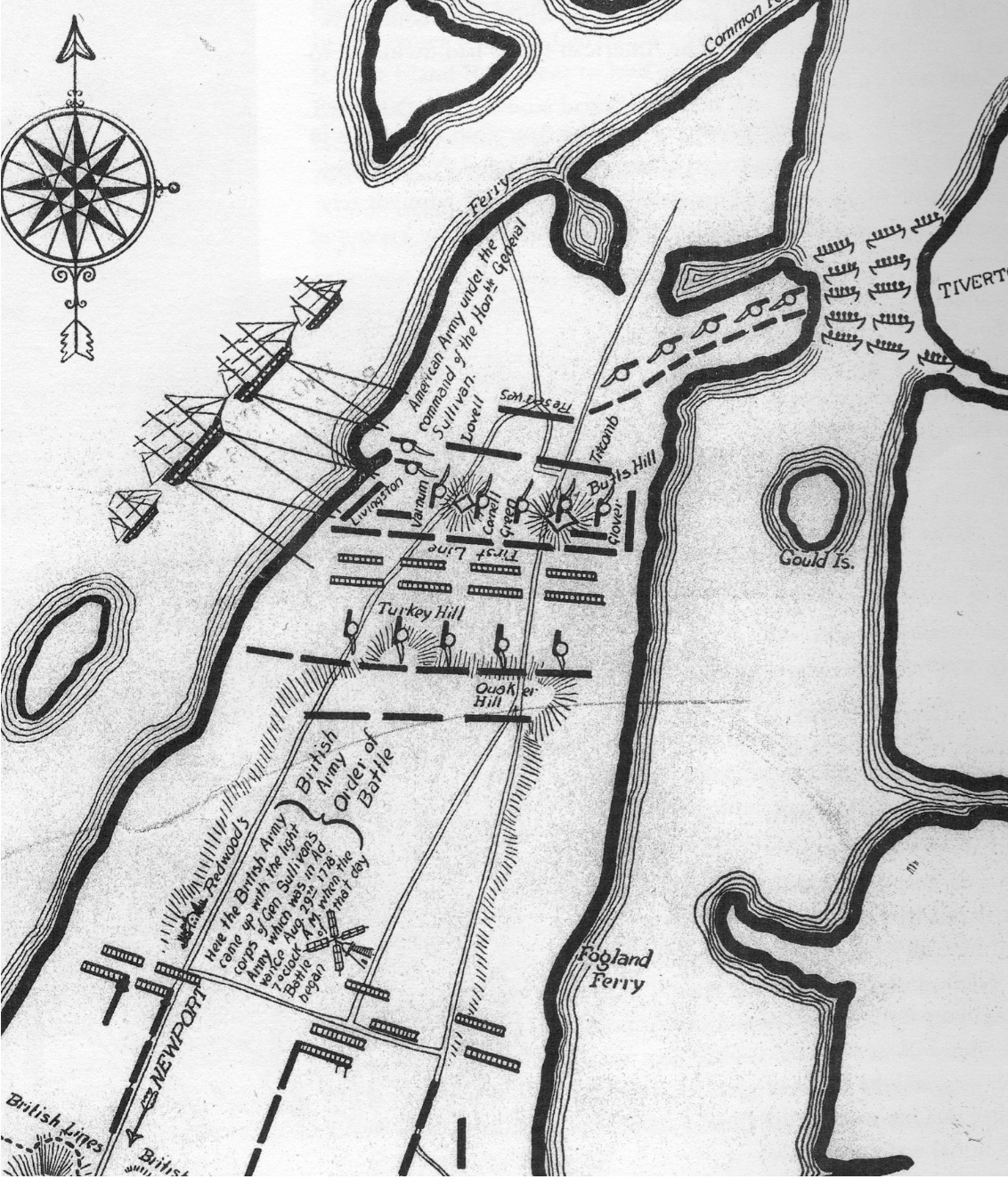
Overnight August 28 – 29, Sullivan began his preparations to defend the route to the Howland ferry towards safety in Tiverton. He positioned forces in a line from Turkey Hill by West Road and Quaker Hill on East Road. Holding this area so all his troops and baggage could get off the island was his aim. His best men, divided between militia and Continentals, were positioned to delay the British troops. John Glover commanded the troops on the left wing on the eastern side of the island. Command of the right wing was given to Nathanael Greene. Men were positioned in various positions up East and West Roads. Action in the Battle of Rhode Island took place along those two main road and Middle Road. Sometimes there were two or more actions going on at approximately the same time. This brief timeline is an approximation.

For clarification the British and Hessian leaders are noted with a (B) and the American leaders are noted with an (A).

August 29, 1778

Dawn:
*Captain Mackenzie (B) saw empty American works. He traveled to Pigot’s (B) headquarters to inform him of withdrawal. Pigot decided to hamper the retreat.

6:30 AM:
*General Prescott (B) moved out with the 38th and 54th Regiments to occupy fortifications at Honeyman’s Hill in Middletown.
*Brigadier General Smith (B) marched toward Quaker Hill by East Road with 22nd and 33rd Regiments with the flank companies of the 38th and 54th.
*On West Road Captain von Malsburg (B) and Captain Noltenius (B) with Hessian Chasseurs advanced toward Laurens (A). Behind them came Major General von Lossberg (B) leading two Anspach battalions.

7 AM:
*Von Malsburg (B) spotted Laurens (A) and Talbot (A) with their Light Corps behind stone walls to the south of Redwood House. Americans were driven back up West Road.
*Livingston’s men (A) attacked Smith’s men (B) from behind stone walls on East Road.
Commander Pigot ordered von Huyne’s Regiment (B) and Fanning’s Regiment (B) to support von Lossberg (B) on West Road.
*Pigot (B) orders Prescott (B) to send 54th Regiment and Brown’s Regiment to reinforce Smith (B) on East Road.
8 AM:
*Von Lossberg (B) sent troops toward Lauren’s positions on three sides.
*Coore’s and Campbell’s troops (B) ran into a group of Wade’s (A) pickets by the intersection of East Road and Union Street.
*British moved down Middle Road and East Road toward Quaker Hill.

8:30 AM:
*Von Lossberg (B) came to the aid of Hessian Chasseurs.
*Laurens (A) and his Light Corps was forced to retreat across Lawton’s Valley to the works on a small height in front of Turkey Hill.
*Lauren retreated to Turkey Hill. Laurens was told to retire to the main army as soon as possible.
Hessian (B) attackers arrived on top of Turkey Hill.

9 AM:
*Wigglesworth’s Regiment (A), Livingston’s Advanced Guard (A) and Wade’s pickets (A) waited for British at the intersection of East Road, Middle Road and Hedley Street.
*Quaker Hill was the scene of intense fighting.
*Americans retreated toward Butts Hill and Glover’s (A) lines.

9:30 AM:
*From top of Quaker Hill, Smith (B) could see strength of Glover’s position.
*Smith was under orders not to begin a general engagement, so he decided against a frontal assault. *Smith withdrew forces to the top of Quaker Hill.

*10 AM:
*Von Lossberg’s (B) troops arrived at Turkey Hill.
*Americans had positions on Durfee’s Hill and Butts Hill.
*Samuel Ward (A) and the 1st Rhode Island Regiment (Black Regiment (A)) held an Artillery Redoubt. *His men repulsed von der Malsberg’s (B) men.

11:30 AM:
*Von Lossberg (B) ordered von der Malsburg’s men (B) to try to attack Ward’s (A) First Rhode Island Regiment position again.
*British ships Sphynx, Spitfire, and Vigilant shelled the American positions from the West shore, but they did little damage.
*The Americans held their position.

1PM:
*British ships planned to attack American positions.
*General Greene’s (A) men dragged cannon down to the beach and forced the British ships to retreat.

2 PM:
*Pigot (B) reached Quaker Hill to observe the action.
*Pigot ordered Landgrave (B) and Ditfurth Regiment (B) to march to von Lossberg’s (B) troops.

4PM:
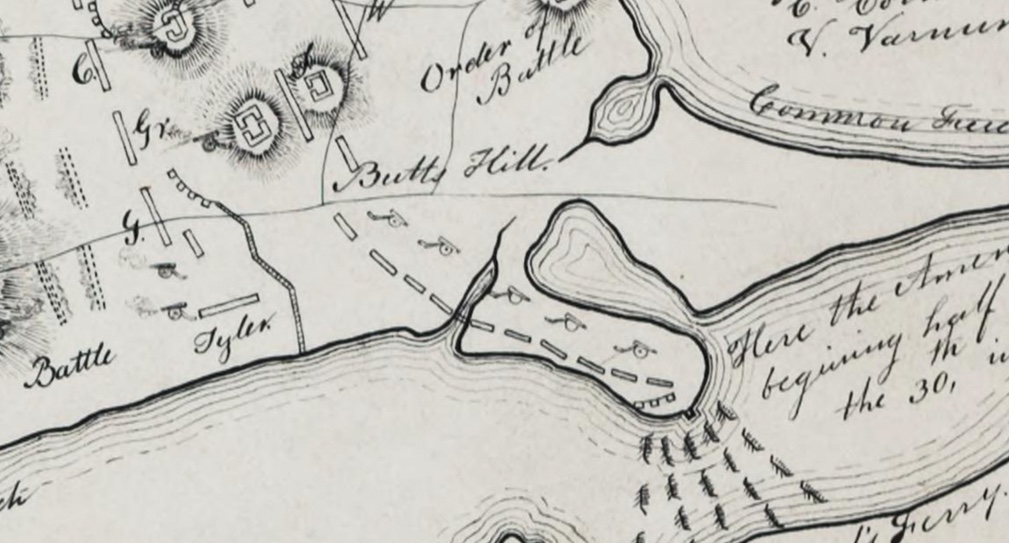
*General Glover (A) saw movement in British lines and ordered Tyler’s Connecticut militia (A) and Titcomb’s (A) Brigade of Massachusetts militia to positions behind stone walls (maybe Freeborn Street), but the British did not engage.

7PM:
*Landgrave (B) and Ditfurth (B) Regiments arrived at von Lossberg’s lines.

7PM (August 29) to 3AM (August 30) :
*There was sporadic artillery fire and light skirmishing. Musket and cannon shots were heard for seven hours.
*The Battle of Rhode Island was basically over.
*The Americans and British forces retired to their lines.

Aftermath of Battle

August 30

Sullivan assigns men to bury the dead. The wounded are ferried to hospitals on the mainland. American troops use the day to rest and recover. Sullivan receives word that d’Estaing is not coming back. He also receives a letter from Washington warning that Howe’s British fleet is on the way. The fleet is observed off Block Island. Sullivan moved quickly to complete a retreat off Aquidneck Island, but he staged Butts Hill to look like they were fortifying for a fight.

6PM:

*After all the baggage had been removed, Sullivan issued the order for all his men to depart the island.

11 PM:

*Lafayette returns from Boston. He assumes supervision of the retreat of the last of the pickets. He orders the building of fires to suggest the army was hunkering down.

*By midnight: Most of the troops are off the island.

August 31st: By 3 AM all the troops are on Tiverton side.
A Vistor’s Guide to Revolutionary Rhode Island

Leave a comment

The French in Newport: The Road to Yorktown Begins

Leave a comment

October 25, 1779: The British evacuate Newport to consolidate their position in New York.

On July 11, 1780 a squadron of French warships approached Newport. It was not the first time the French came to Newport’s waters. The Treaty of Alliance with France was signed on February 6, 1778. On July 29, 1778 a French squadron sailed into Narragansett Bay. It created a military alliance between the United States and France against Great Britain. On the American side it was negotiated by Benjamin Franklin, Silas Deane, and Arthur Lee. This treaty stipulated that France and America would not negotiate a separate peace with Britain and that American independence would be a requirement before any peace treaty was signed. The Rhode Island Campaign in 1778 was the first French and American operation under the treaty. This joint action ended prematurely when damage from a storm took the French out of the Campaign.

In 1780 the “Expedition Particuliere” or Special Expedition would be a successful alliance. In July of 1781 Rochambeau’s French troops would leave Newport to join Washington’s army for the ultimate victory over the British in Yorktown.

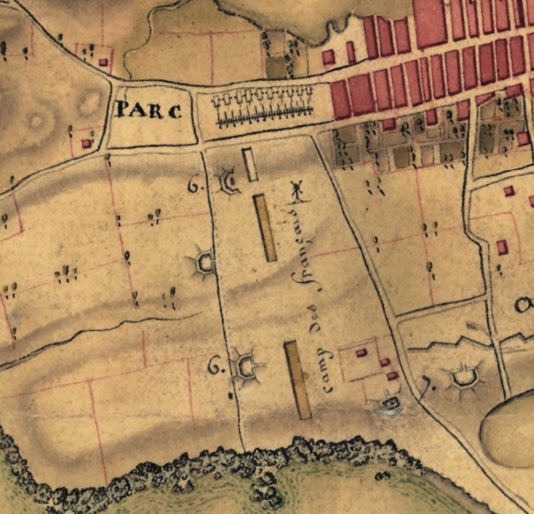
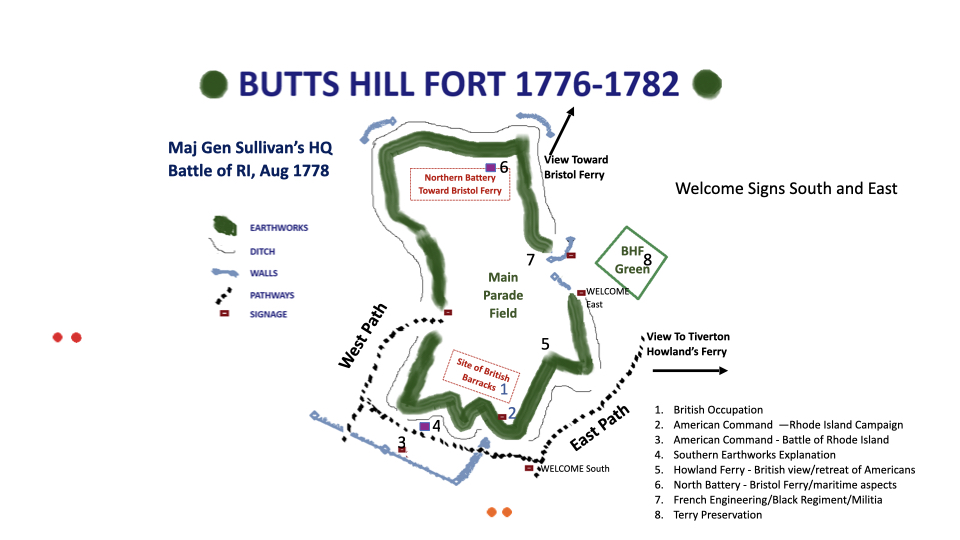
The French arrived in Newport in July of 1780. Most of the forces wintered in Newport except the Lauzun Legion which camped in Connecticut. Rochambeau was very skillful in handling his troops and the Americans began to appreciate their presence. Where the British had demolished defenses, the French engineers worked on rebuilding them. Major General William Heath’s diary for September of 1780 notes that “The batteries were strengthened, a very strong one erected on Rose-Island, and redoubts on Coaster’s-Island: the strong works on Butt’s-Hill (were) pushed..” A few days later he would remark: “The French army continued very busy in fortifying Rhode-Island: some of their works were exceedingly strong, and mounted with heavy metal.” We know from orderly books (daily records) that the American militiamen were aiding the French masons as they enlarged and fortified Butts Hill Fort.

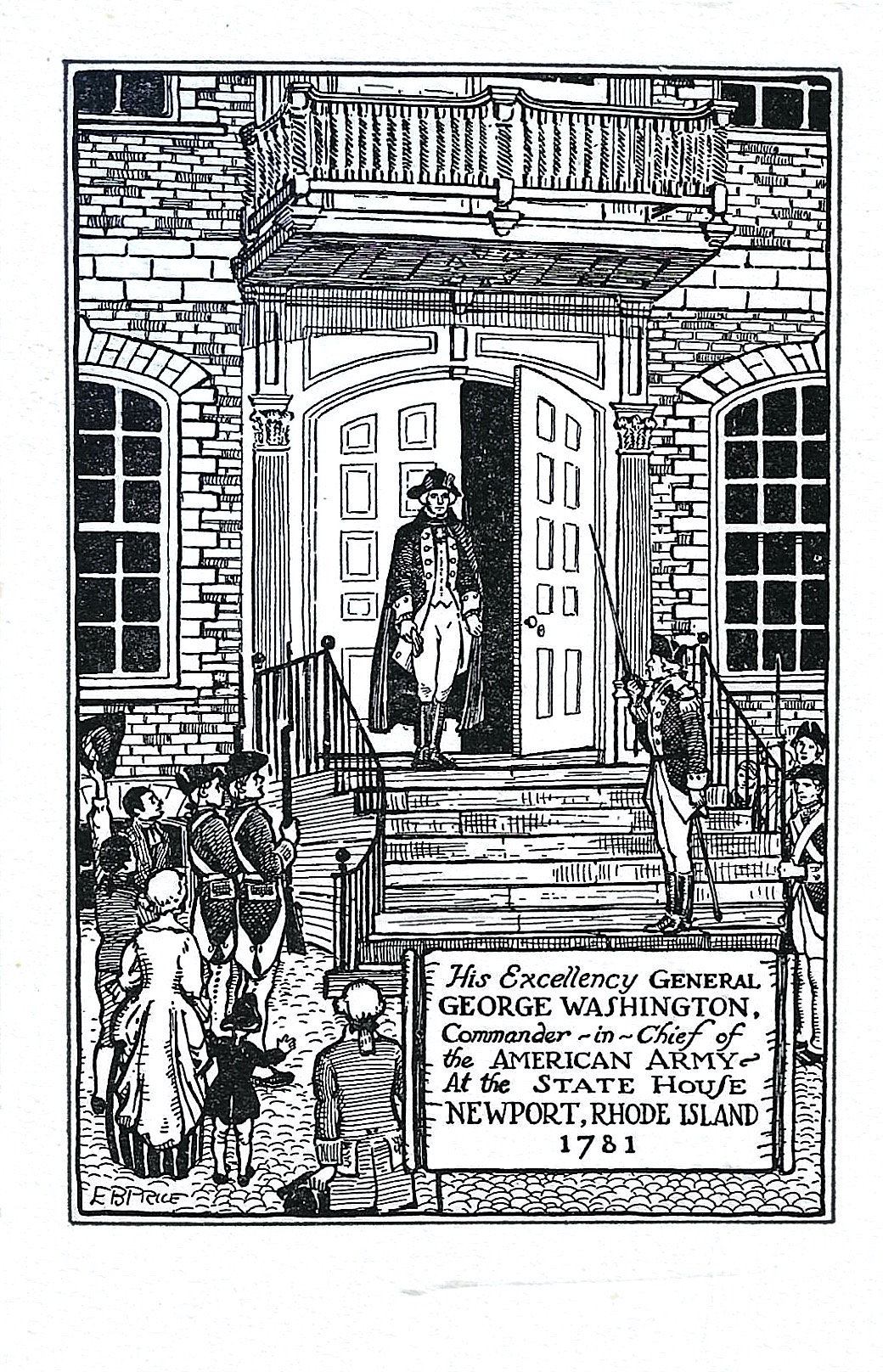
On March 6, 1781, three months before the French army departed from Newport, General Washington visited Count de Rochambeau to consult with him concerning the operation of the troops under his command. Washington was hoping to encourage Rochambeau to send out his fleet to attack New York City. In an address to the people of Newport, Washington expressed gratitude for the help of the French:

“The conduct of the French Army and fleet, of which the inhabitants testify so grateful and affectionate a sense, at the same time that it evinces the wisdom of the commanders and the discipline of the troops, is a new proof of the magnanimity of the nations. It is a further demonstration of that general zeal and concern for the happiness of America which brought them to our assistance; a happy presage of future harmony…appeasing evidence that an intercourse between the two nations will more and more cement the union by the solid and lasting times of mutual affection.” (Quote taken from New Materials for the History of the American Revolution by J. Durant. Henry Holt, New York, 1889.)

Washington left Newport and journeyed overland to Providence. On his departure he was saluted by the French with thirteen guns and again the troops were drawn up in line in his honor. Count de Rochambeau escorted Washington for some distance out of town, and Count Dumas with several other officers of the French army accompanied him to Providence. We know that General George Washington travelled by Butts Hill Fort on the old West Main Road on his way to the Bristol Ferry because the West Road was the customary route from Newport to the ferry. Washington’s aide, Tench Tilghman, recorded the fee for the Bristol Ferry on the expense book.

In May of 1781 Washington and Rochambeau met again, this time in Weathersfield, Connecticut. This meeting confirmed the joining of the forces and the march South.

The French left Newport in stages:
Regiment Bourbonnois under the vicomte de Rochambeau, left on June 18
Regiment Royal Deux-Ponts under the baron de Vioménil, left on June 19
Regiment Soissonnois under the comte de Vioménil, left on June 20
Regiment Saintonge under the comte de Custine, left on June 21.

Brigadier General de Choisy was left behind in Newport with some French troops. He sailed with Barras’ fleet to the Chesapeake area in August. In the summer of 1781, General Rochambeau’s French Army joined forces with General Washington’s Continental Army, With the French Navy in support, the allied armies moved hundreds of miles toward victory in Yorktown, Virginia in September of 1781.

Resources:

https://www.nps.gov/waro/learn/historyculture/washington-rochambeau-revolutionary-route.htm

By Robert Selig, PhD. for the Washington-Rochambeau Revolutionary Route Resource Study & Environmental Assessment, 2006.
https://digitalcommons.providence.edu/cgi/viewcontent.cgi?article=1018&context=ri_history. Visit of George Washington to Newport in 1781 – French E. Chadwick. 1913
Loughrey, Mary Ellen. France and Rhode Island, 1686-1800. New York, King’s Crown Press, 1944.

What Precipitated the Battle of Rhode Island?

Leave a comment

Tomorrow we honor those who participated in the Battle of Rhode Island with a Sunset Salute at Butts Hill Fort. Why did we have a battle? What was the spark? Over the past week I have heard an historian and a US Senator tell us that it was initiated by the British. I have been working on a role playing activity to let students and adults experience the decision making that principals in the Battle of Rhode Island had to make in the heat of the action. I like to draw from primary sources as I provide background material to the decisions that had to be made. Drawing from the diary of British soldier Frederick Mackenzie, I believe that the British were reacting to the retreat that they discovered that the Americans had already started overnight on August 28th.

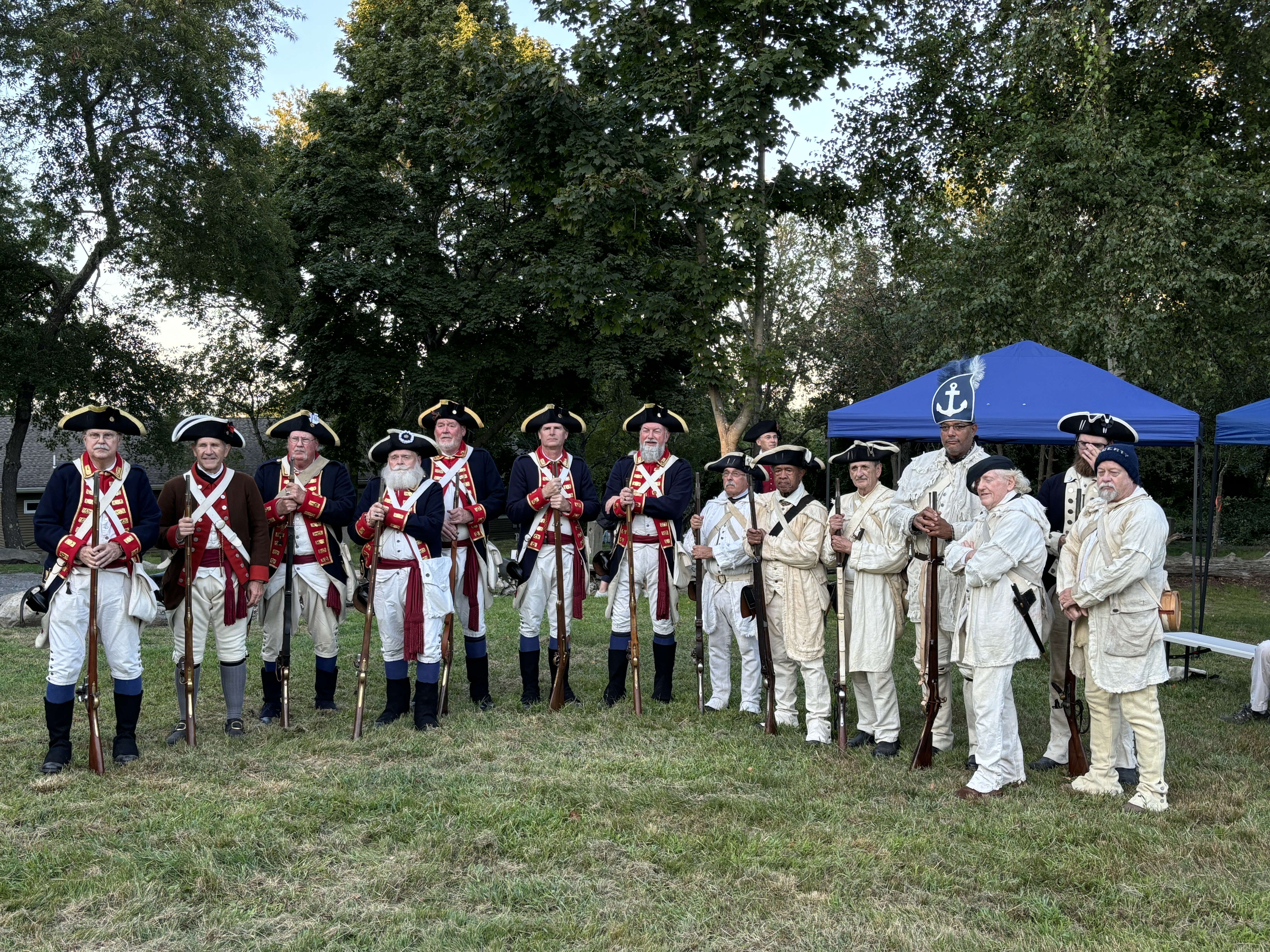
Sunset Salute 2024

“As soon as the day broke this Morning and we could see as far as the Enemys Encampment it was observed that their tents were struck; I went immediately on top of Dudleys house, and when it grew lighter, I could plainly perceive that the Rebels had struck their whole Camp, and had marched off; hardly a man was to be seen in their Batteries or Trenches. I rode as fast as possible to General Pigot’s quarters in Newport and informed him of it, and returned to the Camp with his orders for all the troops to get under arms with the utmost expedition. The General came to Irishes Redoubt by the time the Troops were assembled, and being satisfied that the Rebels had quitted their position, he gave orders for a part of the Army to march out, in three Columns, to pursue them, but to advance with caution, and not bring on an Action with a part of our force.” Mackenzie’s diary August 29, 1778

The British didn’t decide to go on the attack against the American Siege of Newport. Mackenzie notes that the British were “to advance with caution, and not bring on an Action with a part of our force.” The British found that Americans had left their positions and General Pigot decided to go after them to capture the American Army before it could retreat off Aquidneck Island. The goal of the Americans was to get their soldiers and equipment safely to Tiverton so they could fight another day. The American aim in the battle was to push the British and German (Hessian) troops back so that a successful retreat could be made. They were in an untenable position once it was clear that the French were not coming back to aide in the plans of the Rhode Island Campaign. The Americans were not trying for a full engagement either.

Commanders of the Battle: John Sullivan

Leave a comment

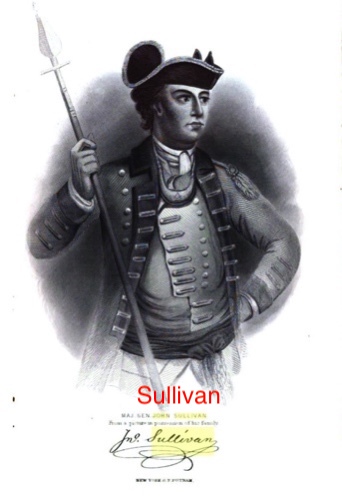
Major General John Sullivan : Commander in Chief.

1740-1795

Sullivan was the son of Irish immigrants who settled in New Hampshire. He served as a Delegate to the Continental congress, Governor of New Hampshire, and United States district judge. The was trained as a lawyer. In 1772 the Royal governor of New Hampshire appointed him as major in The New Hampshire militia. Sullivan began to have rebel leanings. Sullivan was sent as delegate to first continental congress in 1774 and in 1775 he was sent to the Second Continental Congress. Congress appointed George Washington commander in chief and John Sullivan as brigadier general. Sullivan joined the American Army at the siege of Boston. Later he took command of a force in Quebec which ended as a failed invasion. Sullivan had to withdraw the survivors. He was captured in defeat at Battle of Long Island. British General Howe released him on parole to deliver a message to Congress. He was later released in a prisoner exchange for captured British general Prescott. He had some success in battle but had continued difficulties as well. In Early 1778 he was transferred to the post of Rhode Island where he led the continental troops and militia.

His eyewitness account:

General Sullivan writes in a letter to Congress:

“To make a retreat in the face of an enemy, equal, if not superior in number, and cross a river without loss, I knew was an arduous task, and seldom accomplished, if attempted. As our sentries were within 200 yards of other, I knew it would require the greatest care and attention. To cover my design from the enemy, I ordered a number of tents to be brought forward and pitched in sight of the enemy, and almost the whole army employed themselves in fortifying the camp. The heavy baggage and stores were falling back and crossing through the day; at dark, the tents were struck, the light baggage and troops passed dawn, and before twelve o’clock the main army had crossed with the stores and baggage. The Marquis de la Fayette arrived about 11 in the evening from Boston, where he had been by request of the general officers, to solicit the speedy return of the fleet. He was sensibly mortified that he was out of action; and that he might not be out of the way in case of action, he had rode from hence to Boston in seven hours , and returned in six and a half, the distance near seventy miles — he returned time enough to bring off the pickets, and other parties, which converted the retreat of the army, which he did in excellent order; not a man was left behind, nor the smallest article left. I hope my conduct through this expedition may merit the approbation of Congress. Major Morris, one of my aids will have the honor of delivering this to your Excellency; I must beg leave to recommend him to Congress as an officer who is in the last, as well as several other actions, has behaved with great spirit and good conduct, and doubt not Congress will take such notice of him, as his long service and spirited conduct deserves. I have the honor to be, dear Sir, Your very humble servant – John Sullivan.”

Recent Booklets on Revolutionary Portsmouth

Leave a comment

A Children’s Book on Butts Hill

Leave a comment

There are not many books for children on the Battle of Rhode Island or on Butts Hill. There are bound to be corrections, so I haven’t printed many.

A New Walking Guide

Leave a comment

It is time for a new walking guide to Butts Hill Fort. I wrote one two years ago. However thanks to the scholarship of historians sponsored by the Battle of Rhode Island Association, we have added information. I am working on a grant for QR markers for a trail and I started by working with Butts Hill Fort Restoration Committee’s Paul Murphy about where information stations should be and what the topic of each site should be. As I was writing scripts for my husband to do audio clips, it seemed to me that those drafts would work into a book. I am a retired librarian and I have a soft spot for “hard copies.”

The self-publishing company I deal with offers downloadable pdfs and that is what I am posting here.

I hope readers will understand:

That although my husband and I have proofed this there are probably many corrections needed. I appreciate feedback to make corrections. I have only ordered a few copies and there is opportunity for changes.

That this is not a comprehensive tour. Each of the sites has a short introduction to the fort and phases of the Rhode Island Campaign.

That this was written for a tour with short audio clips. Some pages – timeline, glossary, etc. are in the booklet but will not be in the tour.

With grant funding tenuous these days, I have to think of other ways to finance signage for a walk.

Butts Hill Fort December 2024/December 1778

1 Comment

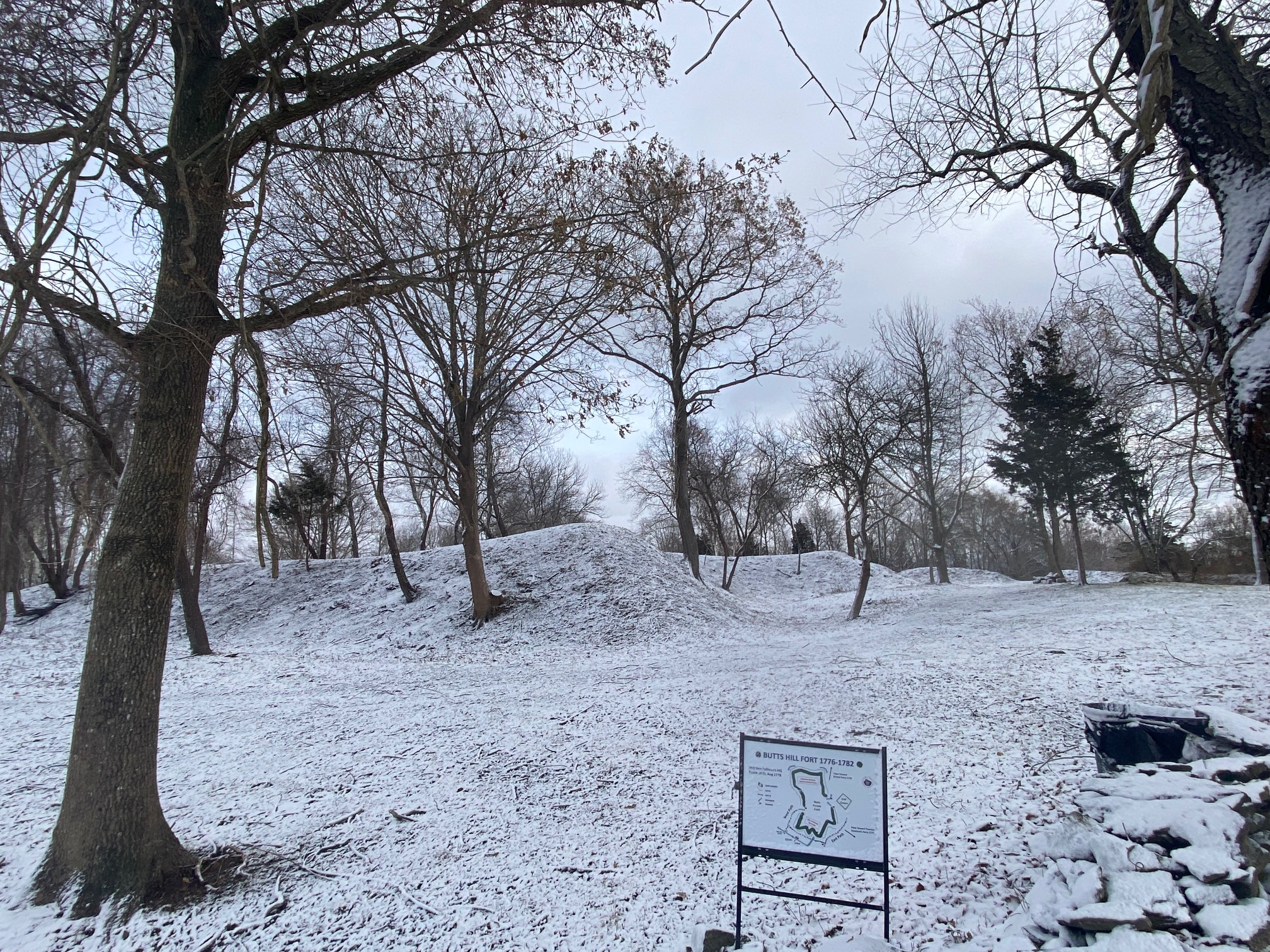
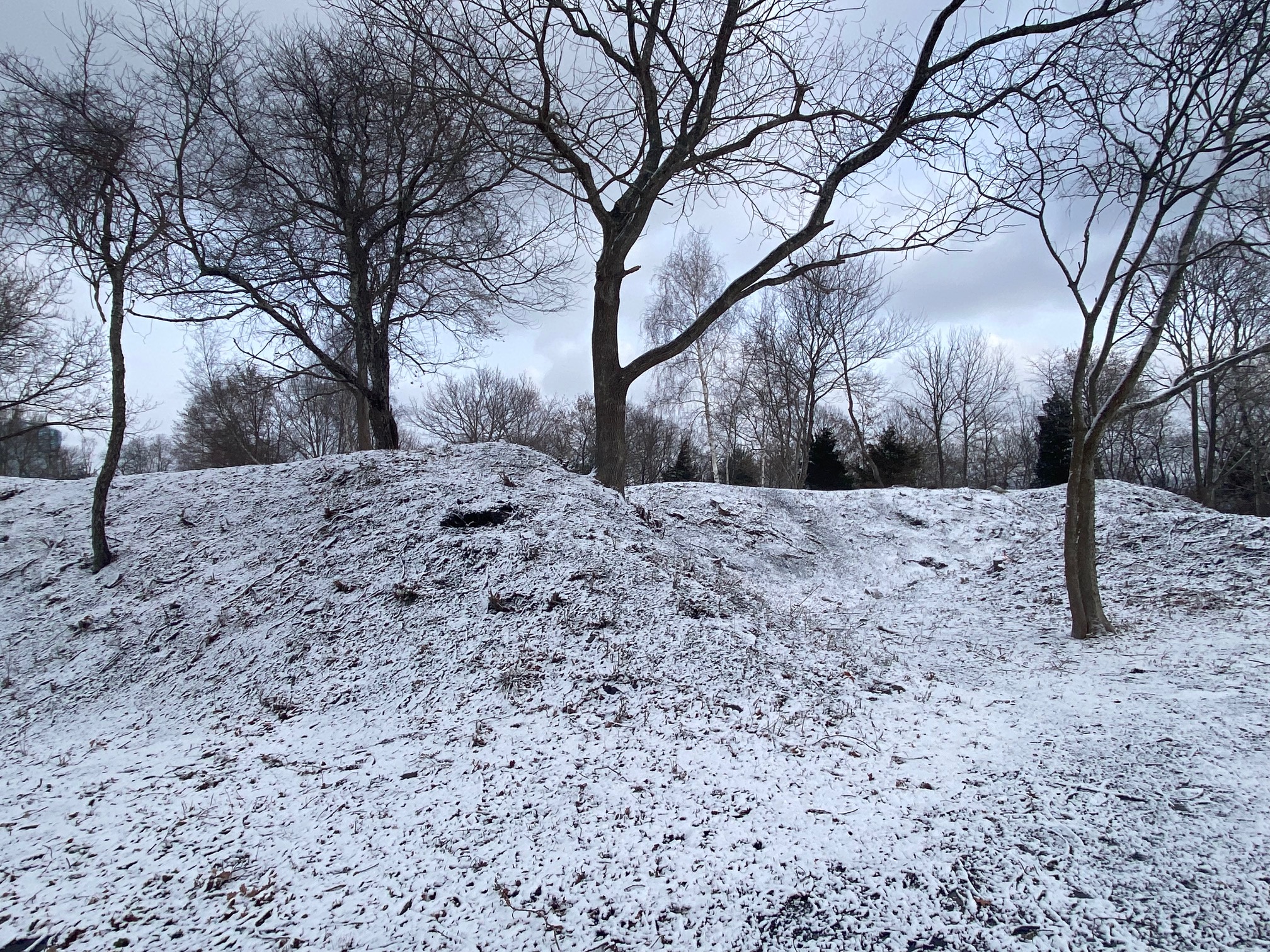
The Butts Hill Fort is emerging through the efforts of the Butts Hill Fort Restoration Committee this year.

Image of Butts Hill Fort – first day in Winter by Paul Murphy.

Butts Hill Fort 2024

“As we close 2024, we can report that the Butts Hill Fort complex has now emerged as a truly open and accessible historic campus. One with fully connected and improved pathways circumnavigating the site, while offering full visibility of the steeply sloping historic earthworks–from the outside looking in–for the first time in many decades. Moreover, the preservation clearing work has also opened up the site to be more understandable as Revolutionary War Era Aquidneck Island’s central defensive feature with improved view corridors to key battle landmarks such as Quaker, Turkey and Durfee hills to the south, and Howland’s Ferry, Tiverton and the Sakonnet to the east. (From: Butts Hill Fort 2024 Southern Earthworks Improvement Project Completion Report)

Butts Hill Fort 1778

The December after the Rhode Island Campaign was a harsh one. The British had systematically gathered all the fuel for fires on Aquidneck Island. At first the British and Hessians (Germans) felled the trees closest to their camps. The Hessians had a camp above Fogland Ferry. They continued to cut further away from their camps until there were no trees to cut and burn. British officer Frederick Mackenzie records that they then turned to cutting down orchards next on Common Fence Point and other locations. After the orchards, all other sources of wood were eyed. Vacant houses, wood carriages, and even wooden farm tools went into the wood supply.

Mackenzie writes on December 6th, 1778: “Every step is being taken to supply fuel: All the timber trees on the island are cutting down and the old wharves will be broken up.” Vacant houses were taken apart and the wood was used for fuel. Rail fences were taken apart and burned. On December 13th Mackenzie’s diary entry reads: “All the carriages that can be collected on the Island are employed in bringing in the wood which is cut by the party out on the island.” Turf” was cut on Brenton’s Neck and used for fuel. When the island’s wood supply was exhausted, they sent fleets to collect wood on Conanicut, Block Island and Long Island.

On Christmas Day of 1778 a blizzard began that lasted until December 28th. Hessian soldier Johann Dohla records in this diary: “26 December: A frightful snow fell here, accompanied by strong winds and a violent snowstorm such that we could hardly remain in our houses because of the snow. Tonight a Hessian sergeant got stuck in the snow near Quaker Hill and froze to death.” In another diary Hessian soldier Stephen Popp records the snow depth to be three or four feet. Mackenzie records drifts of up to 20 feet.

Portsmouth residents were huddled in their homes on Christmas Day of 1778. The mostly Quaker residents would not have had grand celebrations anyway. Christmas was yet another day to do God’s work.

Photo by Paul Murphy

Tackling the Question: Did the American Militia have fortifications at Butts Hill in 1776?

Leave a comment

I am working on a simple timeline for Butts Hill Fort that might go into signage sometime. There are a lot of dates I have firmly determined, but I am stumped on an origin date and credit to which side first began to construct fortifications.

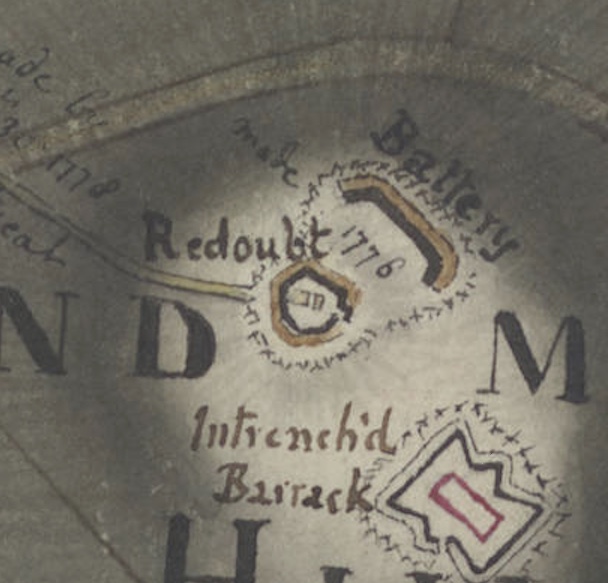
I am not a military historian, but John Robertson is. He credits the British with the first fortification in December of 1776. One reason I have believed that the American militia had to have created some fortifications is notations on the Huntington Library’s map of North Portsmouth. The note reads “made in 1776.” The British did not invade Aquidneck Island until December 8th, 1776. They would have had to work quickly in the cold winter to construct a battery that quickly.

Robertson believes that when the British arrived they found only two American fortifications and they were by the ferries.

Our best resource on British activities in Occupied Portsmouth is the diary of Frederick Mackenzie. Unfortunately Mackenzie was away from the island for the beginning months of 1777, but we have his accounts of December 1776. His account of troop distribution on December 17th doesn’t show any troops stationed at “Windmill Hill” (Americans called it Butts Hill). Those mentioned were “At Bristol ferry house,” (which would have been close to the Commons area today) detached to a house at the point (probably Common Fence Point), Town Pond, at the Neck and at the road to Howland’s Bridge.

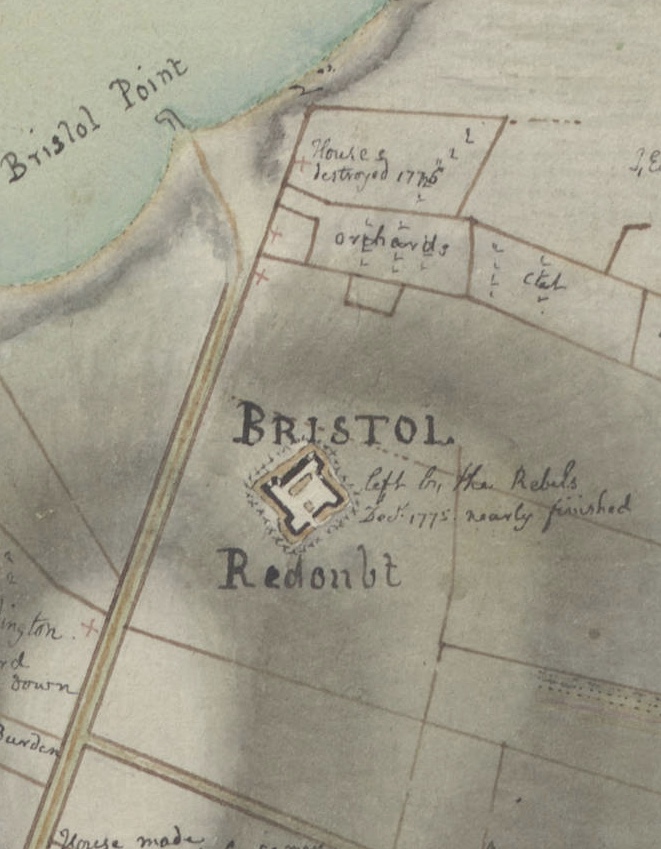
Mackenzie diary on December 30 mentions that the British took over a fort that had been constructed by the American up the hill at Bristol Ferry. The notation here specifically mentions that they Rebels built this fortification in 1775. His diaries mention the hard frosts the British encountered so I imagined that digging for battery building would have been hard to accomplish.

After a being away in New York, Mackenzie mentions “Windmill Hill” June 3, 1777.

” A Picquet of one of the Regiments on Windmill, is ordered to reiRnforce the advance posts every evening ’til further orders.” What happened from January until June is missing in the diary.

D.K. Abbass writes that the American Militia had a fortification on the hill. I have tried to find confirmations when I research the Rhode Island Militia. Although Portsmouth did have an active militia, I can’t find mentions of specific use of the hill. I have looked at locations of signal beacons. Butts Hill would be the perfect place to put a beacon. I know there were reports of a beacon in Portsmouth, but I cannot find a specific mention of the Butts Hill site.

Readers – help me write the origin line.

1776 Americans

1776 British

1777 British

I am aware that as we research and find other sources, there might be a change in how we write an origin of the fort. But for now….I have to put something down.

Older Entries