Home

Annotated Timeline: Battle of Rhode Island and Aftermath

Leave a comment

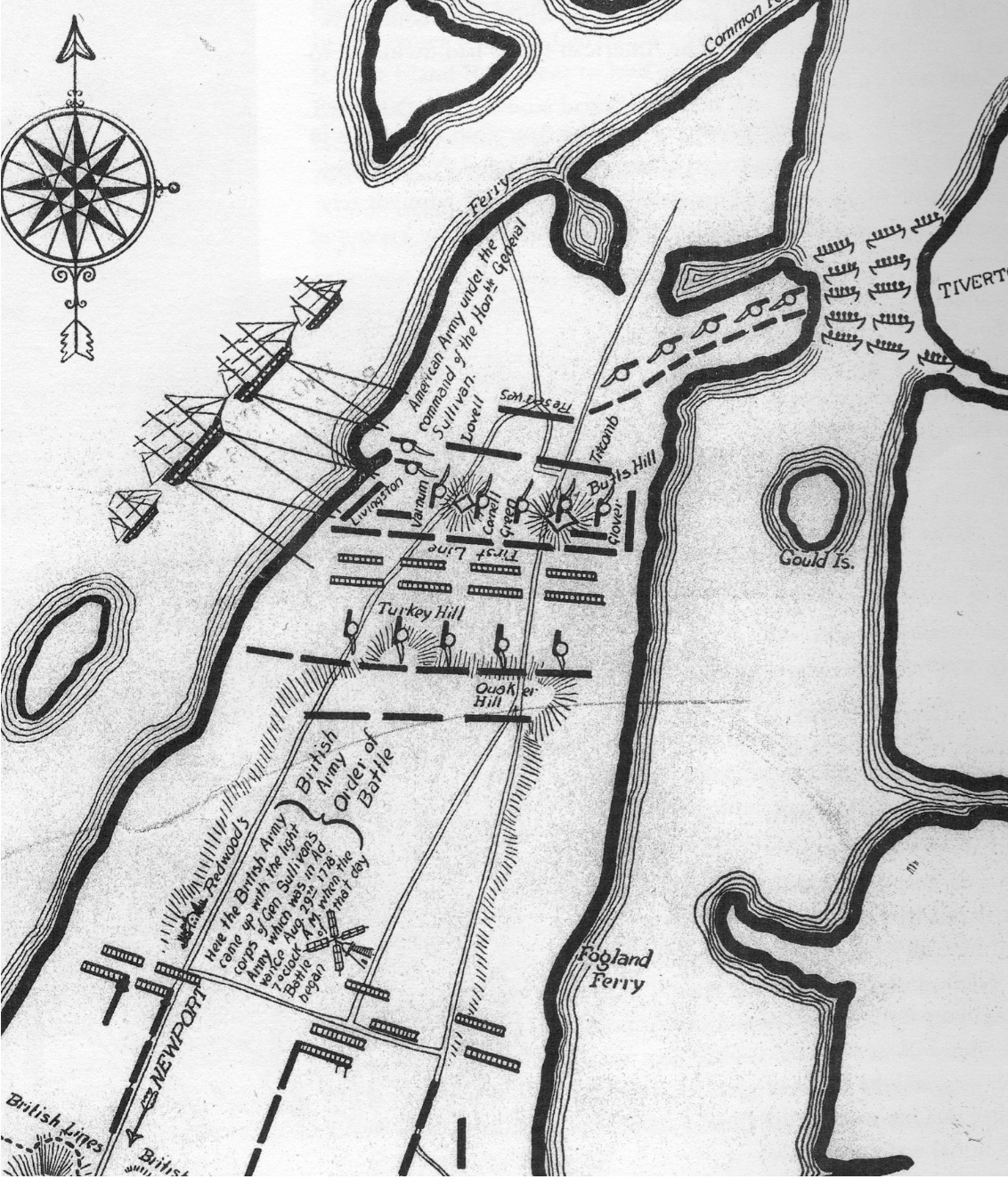
Overnight August 28 – 29, Sullivan began his preparations to defend the route to the Howland ferry towards safety in Tiverton. He positioned forces in a line from Turkey Hill by West Road and Quaker Hill on East Road. Holding this area so all his troops and baggage could get off the island was his aim. His best men, divided between militia and Continentals, were positioned to delay the British troops. John Glover commanded the troops on the left wing on the eastern side of the island. Command of the right wing was given to Nathanael Greene. Men were positioned in various positions up East and West Roads. Action in the Battle of Rhode Island took place along those two main road and Middle Road. Sometimes there were two or more actions going on at approximately the same time. This brief timeline is an approximation.

For clarification the British and Hessian leaders are noted with a (B) and the American leaders are noted with an (A).

August 29, 1778

Dawn:
*Captain Mackenzie (B) saw empty American works. He traveled to Pigot’s (B) headquarters to inform him of withdrawal. Pigot decided to hamper the retreat.

6:30 AM:
*General Prescott (B) moved out with the 38th and 54th Regiments to occupy fortifications at Honeyman’s Hill in Middletown.
*Brigadier General Smith (B) marched toward Quaker Hill by East Road with 22nd and 33rd Regiments with the flank companies of the 38th and 54th.
*On West Road Captain von Malsburg (B) and Captain Noltenius (B) with Hessian Chasseurs advanced toward Laurens (A). Behind them came Major General von Lossberg (B) leading two Anspach battalions.

7 AM:
*Von Malsburg (B) spotted Laurens (A) and Talbot (A) with their Light Corps behind stone walls to the south of Redwood House. Americans were driven back up West Road.
*Livingston’s men (A) attacked Smith’s men (B) from behind stone walls on East Road.
Commander Pigot ordered von Huyne’s Regiment (B) and Fanning’s Regiment (B) to support von Lossberg (B) on West Road.
*Pigot (B) orders Prescott (B) to send 54th Regiment and Brown’s Regiment to reinforce Smith (B) on East Road.
8 AM:
*Von Lossberg (B) sent troops toward Lauren’s positions on three sides.
*Coore’s and Campbell’s troops (B) ran into a group of Wade’s (A) pickets by the intersection of East Road and Union Street.
*British moved down Middle Road and East Road toward Quaker Hill.

8:30 AM:
*Von Lossberg (B) came to the aid of Hessian Chasseurs.
*Laurens (A) and his Light Corps was forced to retreat across Lawton’s Valley to the works on a small height in front of Turkey Hill.
*Lauren retreated to Turkey Hill. Laurens was told to retire to the main army as soon as possible.
Hessian (B) attackers arrived on top of Turkey Hill.

9 AM:
*Wigglesworth’s Regiment (A), Livingston’s Advanced Guard (A) and Wade’s pickets (A) waited for British at the intersection of East Road, Middle Road and Hedley Street.
*Quaker Hill was the scene of intense fighting.
*Americans retreated toward Butts Hill and Glover’s (A) lines.

9:30 AM:
*From top of Quaker Hill, Smith (B) could see strength of Glover’s position.
*Smith was under orders not to begin a general engagement, so he decided against a frontal assault. *Smith withdrew forces to the top of Quaker Hill.

*10 AM:
*Von Lossberg’s (B) troops arrived at Turkey Hill.
*Americans had positions on Durfee’s Hill and Butts Hill.
*Samuel Ward (A) and the 1st Rhode Island Regiment (Black Regiment (A)) held an Artillery Redoubt. *His men repulsed von der Malsberg’s (B) men.

11:30 AM:
*Von Lossberg (B) ordered von der Malsburg’s men (B) to try to attack Ward’s (A) First Rhode Island Regiment position again.
*British ships Sphynx, Spitfire, and Vigilant shelled the American positions from the West shore, but they did little damage.
*The Americans held their position.

1PM:
*British ships planned to attack American positions.
*General Greene’s (A) men dragged cannon down to the beach and forced the British ships to retreat.

2 PM:
*Pigot (B) reached Quaker Hill to observe the action.
*Pigot ordered Landgrave (B) and Ditfurth Regiment (B) to march to von Lossberg’s (B) troops.

4PM:
*General Glover (A) saw movement in British lines and ordered Tyler’s Connecticut militia (A) and Titcomb’s (A) Brigade of Massachusetts militia to positions behind stone walls (maybe Freeborn Street), but the British did not engage.

7PM:
*Landgrave (B) and Ditfurth (B) Regiments arrived at von Lossberg’s lines.

7PM (August 29) to 3AM (August 30) :
*There was sporadic artillery fire and light skirmishing. Musket and cannon shots were heard for seven hours.
*The Battle of Rhode Island was basically over.
*The Americans and British forces retired to their lines.

Aftermath of Battle

August 30

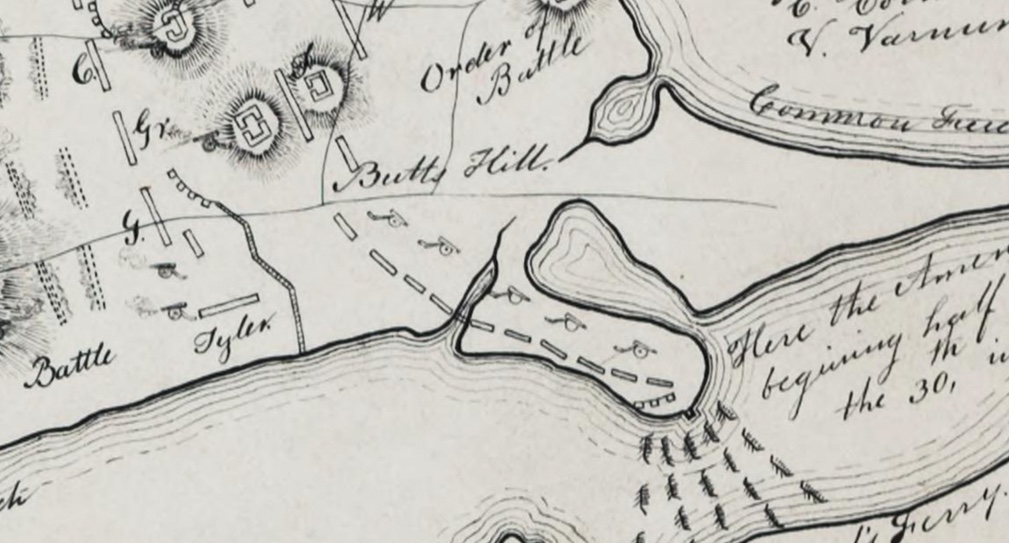
Sullivan assigns men to bury the dead. The wounded are ferried to hospitals on the mainland. American troops use the day to rest and recover. Sullivan receives word that d’Estaing is not coming back. He also receives a letter from Washington warning that Howe’s British fleet is on the way. The fleet is observed off Block Island. Sullivan moved quickly to complete a retreat off Aquidneck Island, but he staged Butts Hill to look like they were fortifying for a fight.

6PM:

*After all the baggage had been removed, Sullivan issued the order for all his men to depart the island.

11 PM:

*Lafayette returns from Boston. He assumes supervision of the retreat of the last of the pickets. He orders the building of fires to suggest the army was hunkering down.

*By midnight: Most of the troops are off the island.

August 31st: By 3 AM all the troops are on Tiverton side.
Annotated Timeline of Rhode Island in the Revolution: Rhode Island Campaign – Siege of Newport

Leave a comment

The Occupation of Aquidneck Island dragged on for almost two years when a plan was devised to work with French allies in pushing the British out of the island. On May 4, 1778 Congress ratified a treaty of alliance with France. The Rhode Island Campaign was devised as a wedge action. The Americans, under the leadership of John Sullivan, would cross from Tiverton to Portsmouth and drive south to set up a siege of Newport. Meanwhile the French, led by d’Estaing, would arrive by sea and attack the British from the sea.

July 11, 1778, Continental Congress authorized Washington to request the northeastern states to raise militia for a joint operation with the French.

July 20, 1778, d’Estaing announced he would sail for Newport and not the alternate target of New York.

July 22, 1778, Washington’s delayed letter informs Sullivan that the French fleet is headed to Newport, and he directs Sullivan to increase the size of his militia forces from 5000 to 7500. Varnum’s and Glover’s brigades along with an additional attachment under Henry Jackson would head towards Providence.

July 27, 1778, Washington dispatches two Continental Army divisions under General Nathanael Greene and General Lafayette to Rhode Island. Although Greene was the Army Quartermaster, he was anxious to have a command, especially in his home state.

July 29, 1778, French ships arrive at Narragansett Bay. Washington had arranged for pilots to guide the French ships in the Bay. Two or three ships were stationed in the shallow Sakonnet River to the East of Aquidneck Island. Other ships positioned anchored near the entrance to the Sakonnet Channel. Most of the French ships had anchored about three miles south of Conanicut Island (Jamestown).

Four British frigates anchored at various points of the west side of Aquidneck Island where they would remove their cannons, ammunition and supplies. On the Sakonnet side the Spitfire and Alarm and the sloop Kingfisher were unloading at Fogland Ferry. In Newport harbor the Flora and Falcon did the same.

July 30, 1778, trapped by the French navy, British ships the Kingfisher, Alarm and Spitfire were ordered to be torched. Ammunition that had remained on the vessels caused explosions.

August 1, 1778, General Sullivan and Admiral d’Estaing meet, agree on simultaneous attacks on the Island on August 8. British Commander Pigot was expecting a siege and he ordered all sheep and cattle in Portsmouth and Middletown (except one per family) to be driven behind British lines in Newport. Carts, wagons, and tools like picks and axes were all collected and brought to Newport. The soldiers’ families and regimental baggage were brought to Newport. Wells in Portsmouth and Middletown were filled in so there would be no drinking water for the enemy.

August 3, 1778, British forces felled trees to block the roads running from Portsmouth and Middletown into Newport. To prevent the French from landing their troops, five or six transports were sunk by Goat Island. One of them (the Lord Sandwich) had been James Cook’s ship Endeavour.

August 5, 1778, more British ships (Orpheus, Lark, Cerberus, Juno and Pigot) were purposely sunk in the harbor to hinder the French and to avoid their capture.

August 6, 1778, Due to late arriving militia, Sullivan informs d’Estaing of postponement of the attack. British cannons fire on French ships.

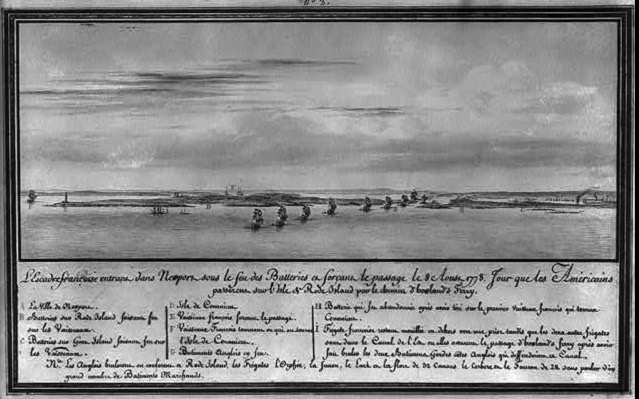
August 7-8, 1778, d’Estaing enters Narragansett Bay, causing the British to withdraw from north end of the Island into prepared positions along the Newport-Middletown border.

French ships in a row

August 9, 1778, Realizing the British had withdrawn south, Sullivan moves his forces onto the Island. Two to three thousand French forces land on Conanicut Island. D’Estaing is furious that the Americans have reached Aquidneck Island early. D’Estaing is alerted to the imminent arrival of Howe’s fleet which was coming from New York. He decides to go out and fight Howe’s fleet and then go to the aid of the Americans. There was shelling between the French fleet facing Newport and the shore batteries controlled by the British.

August 10, 1778, French head out to sea. Both French and British fleets maneuver for advantage, but before they can engage, both fleets are scattered and damaged by a hurricane. Both leave for port and repairs. American commander John Sullivan prepared to shorten the distance between the American lines and the British line. He was going to lay a siege because by then he had 11,000 men.

August 11 – 12, 1778, General Sullivan prepares to work toward British positions, but the hurricane causes him to delay. The weather during the night of the 12th was especially fierce and the Americans had little shelter from the pelting rain and wind. The camp was a swamp.

For the British and French fleets out on the water, the weather turned to serious wind gusts. Heavy rain, gale force winds and thick fog hampered both fleets. The winds began to topple the masts. By 4 am on the 12th the French flagship Languedoc had lost its bowsprint, all of its masts and its rudder. It was simply floating without being able to steer.

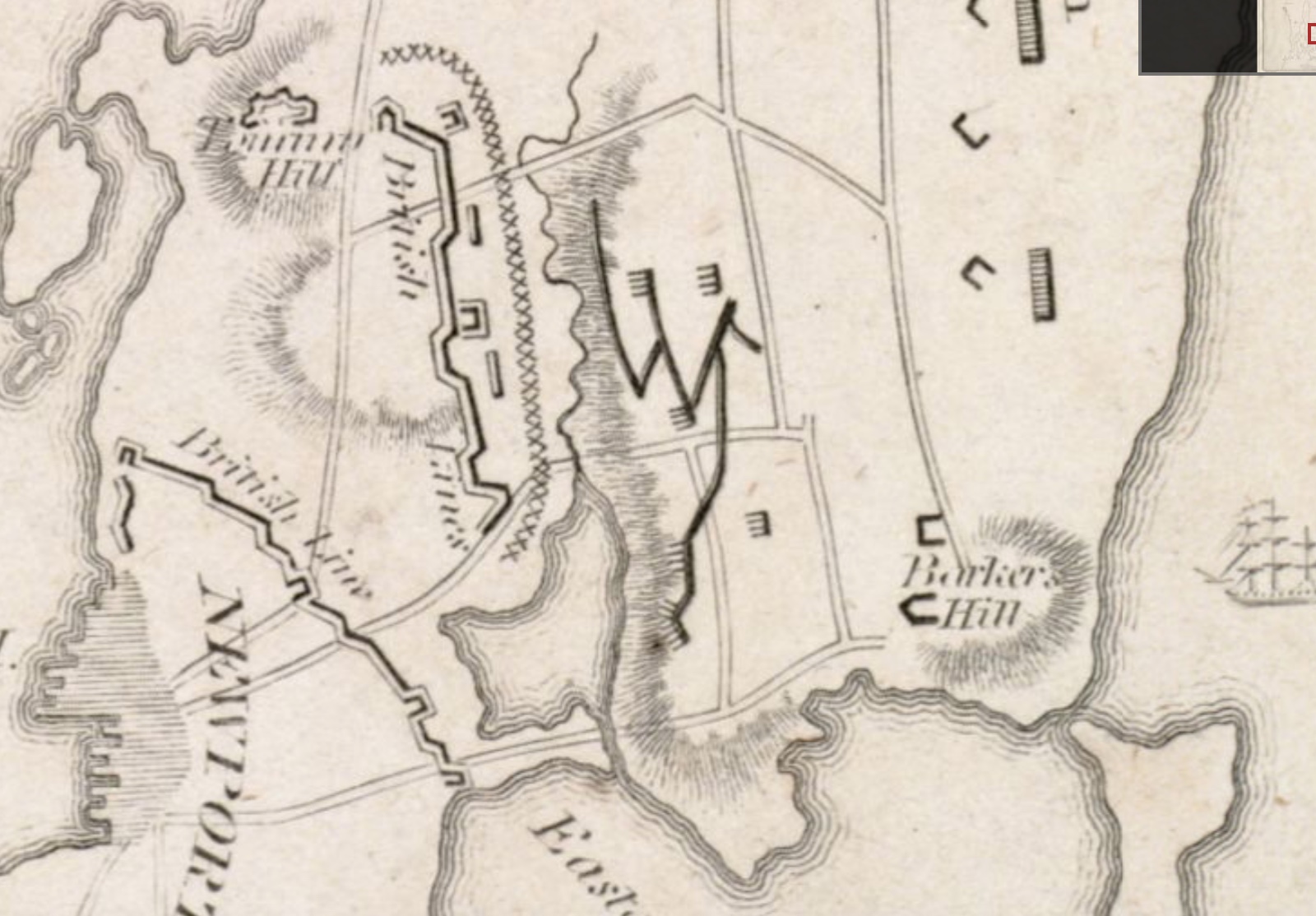
August 15, 1778, Americans open the Siege of Newport. The Americans needed to construct defensive works, so Sullivan marched them south with banners flying. By 5 PM they halted and pitched camp by Honeyman Hill in Middletown. This was a high point where the Americans could view the British lines. However the 20 day enlistments of many militia units were up and they left. Sullivan was waiting for new units to arrive. Col. Paul Revere commanded the Boston artillery train and John Hancock was major general of the 3000 member Massachusetts militia.

British lines on the left – American lines on the right.

August 16, 1778, Americans were preparing a four cannon battery on the western slope of Honeyman Hill. The British opened fire as the fog lifted, so the Americans worked on the trenches and battery in the dark or fog.

August 20, 1778, d’Estaing’s battered ships return to Narragansett Bay. D’Estaing informs Sullivan he must immediately leave for Boston for repairs. His order from the King of France was to protect his fleet.

August 21, 1778, Sullivan sends Nathanael Greene, Lafayette and Col John Langdon to board the Languedoc – d’Estaing’s ship and talk with d’Estaing. D’Estang still decides to have the fleet sail for Boston.

August 24, 1778, Sullivan receives word that a British naval force is on its way to Newport. Sullivan and his officers prepare for a quick withdrawal. At a council of war there is unanimous agreement to move the troops to the Portsmouth end of the island to wait for the French return. Sullivan advocated for a gradual and orderly retreat.

August 25, 1778. All unnecessary baggage was removed off the island. Work on the trenches stopped. Volunteers began to leave in large numbers. Revere and his artillery and Hancock and his Massachusetts militia are among those leaving the island. Hancock asks for a letter of introduction to talk to d’Estaing in Boston. Mortars and heavy cannon were taken off the island.

August 27, 1778, Sullivan sends Lafayette to Boston to determine when d’Estaing would come back to Rhode Island. Lafayette made the 70 mile trip in just 7 hours. By this time Sullivan had lost 3,000 volunteers through illness or decisions to leave the island.

August 28, 1778, American council of war decides to withdraw Patriot forces to defensive positions around Butts Hill. They would be close to the ferry landings if they needed to withdraw completely. By 8PM the soldiers put down their tents and marched out with Greene commanding the West column up West Main Road and Glover leading the other column up East Main.

Resources: This timeline is based on Christian McBurney’s book – The Rhode Island Campaign.

Revolutionary Places: Stories from Vernon House in Newport – A Spy, A Patriot, A Black Regiment Soldier, and French Heroes

Leave a comment

The Spy: Metcalf Bowler

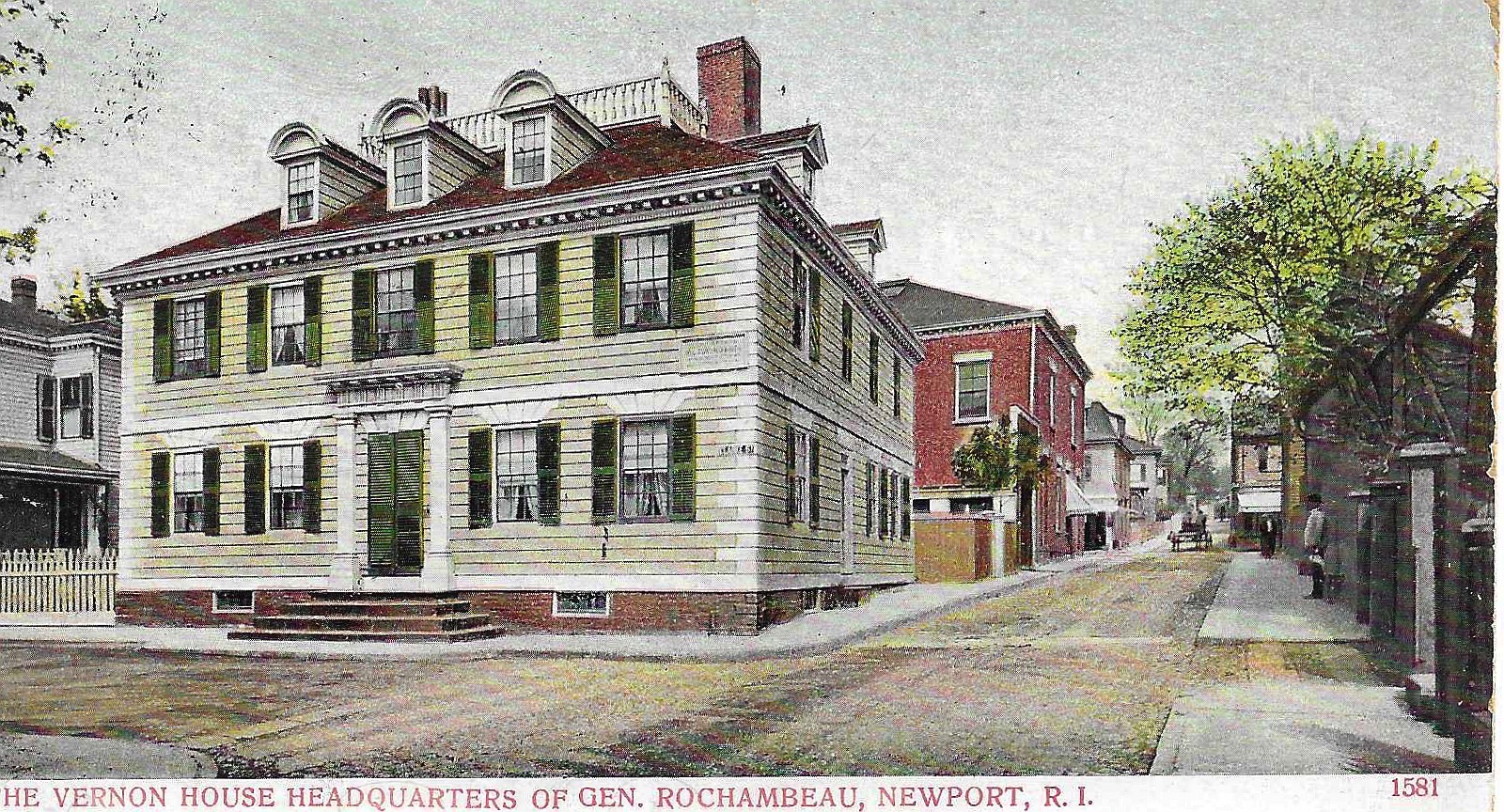
The Vernon House at 46 Clarke Street in Newport has special significance in the history of the Revolution in Rhode Island. It has connections to a British spy, an American war heroes and the French in Newport. It has a history dating from 1744, but the first owner with Revolutionary connections was Metcalf Bowler who bought the property from his father in 1759. Bowler was a noted merchant and judge, but we know now that he was also a British spy. He was concerned about his country estate in Portsmouth and hoped to salvage it from British destruction by providing information to British General Gates. In 1774 he sold the house on Clarke Street to William Vernon, a merchant and slave trader. Unfortunately for Bowler, his work as a spy did not protect his Portsmouth farm.

The Patriot: William Vernon

William Vernon and his brother Samuel were early supporters of the revolution, so when the British came to Newport, William fled Newport for Rehoboth, Massachusetts. Vernon moved to Boston and In 1777 Vernon was appointed by the Continental Congress as president of the Naval Board – a role resembling Secretary of the Navy. He was responsible for building and outfitting ships for the Continental Navy. He supported the Navy cause with his own money.

The Black Soldier: Cato Vernon

Cato Vernon was probably one of the two Black males aged under sixteen listed in the 1774 census as part of William Vernon’s household in Newport. By December of 1776 the British were in Newport and William Vernon had fled. In late 1776, Cato was working in East Greenwich as an apprentice to a ship carpenter.

On March 11, 1778, Cato enlisted in the First Rhode Island Regiment of Continentals (the famous “Black Regiment”). Cato may have enlisted without permission from William Vernon who was in Boston, but by law William was entitled to Cato’s value. Enlisting in the regiment for the duration of the war had the promise of securing freedom. The Black Regiment played a key role in the American retreat during the Battle of Rhode Island on August 29, 1778. The Regiment held back three charges of British allied Hessian troops and that was one factor enabling the Americans to get away to fight another day. Cato and the Black Regiment served all the way to the surrender at Yorktown.

Life was not easy for Cato after the war. In August 1793, Cato Vernon was in a Newport jail because he could not pay his debts. He wrote a letter from jail to William Vernon and there is a record of William Vernon paying that debt so Cato would be free.

The French in Newport

On July 11, 1780, the French Fleet arrived in Newport. The Comte de Rochambeau The commander in-chief of the French forces, used the house as his quarters and the headquarters of the French forces. Records show that on March 6, 1781 General George Washington slept at the Vernon House. On July 25, 1780. Lafayette remained in Newport with Rochambeau at Vernon House until July 31, 1780.

Resources:

Newport Restorations website on the Vernon House: https://www.newportrestoration.org/programs-initiatives/telling-stories-dispersed-monument/vernon-house/

Walking Butts Hill

Leave a comment

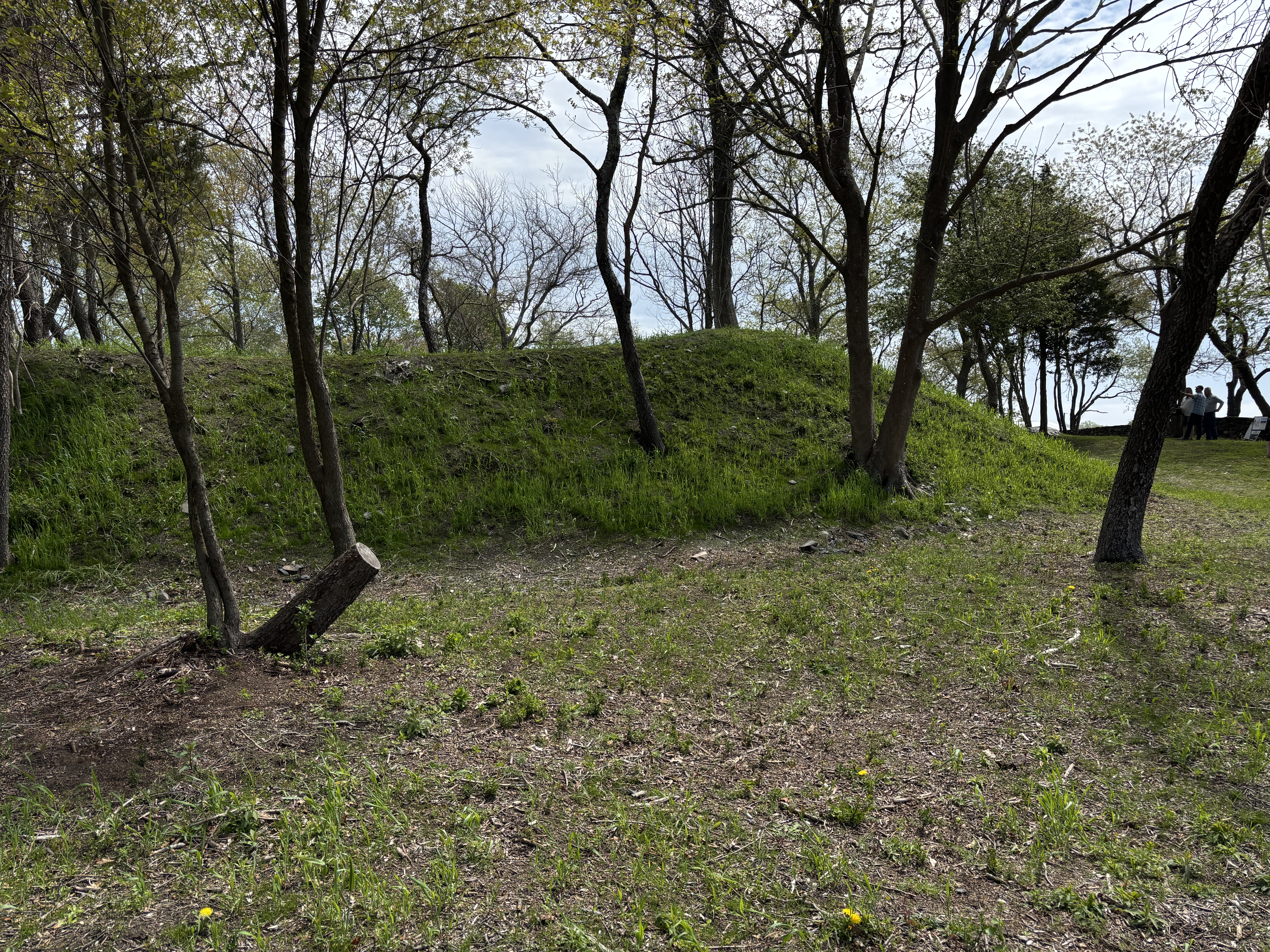
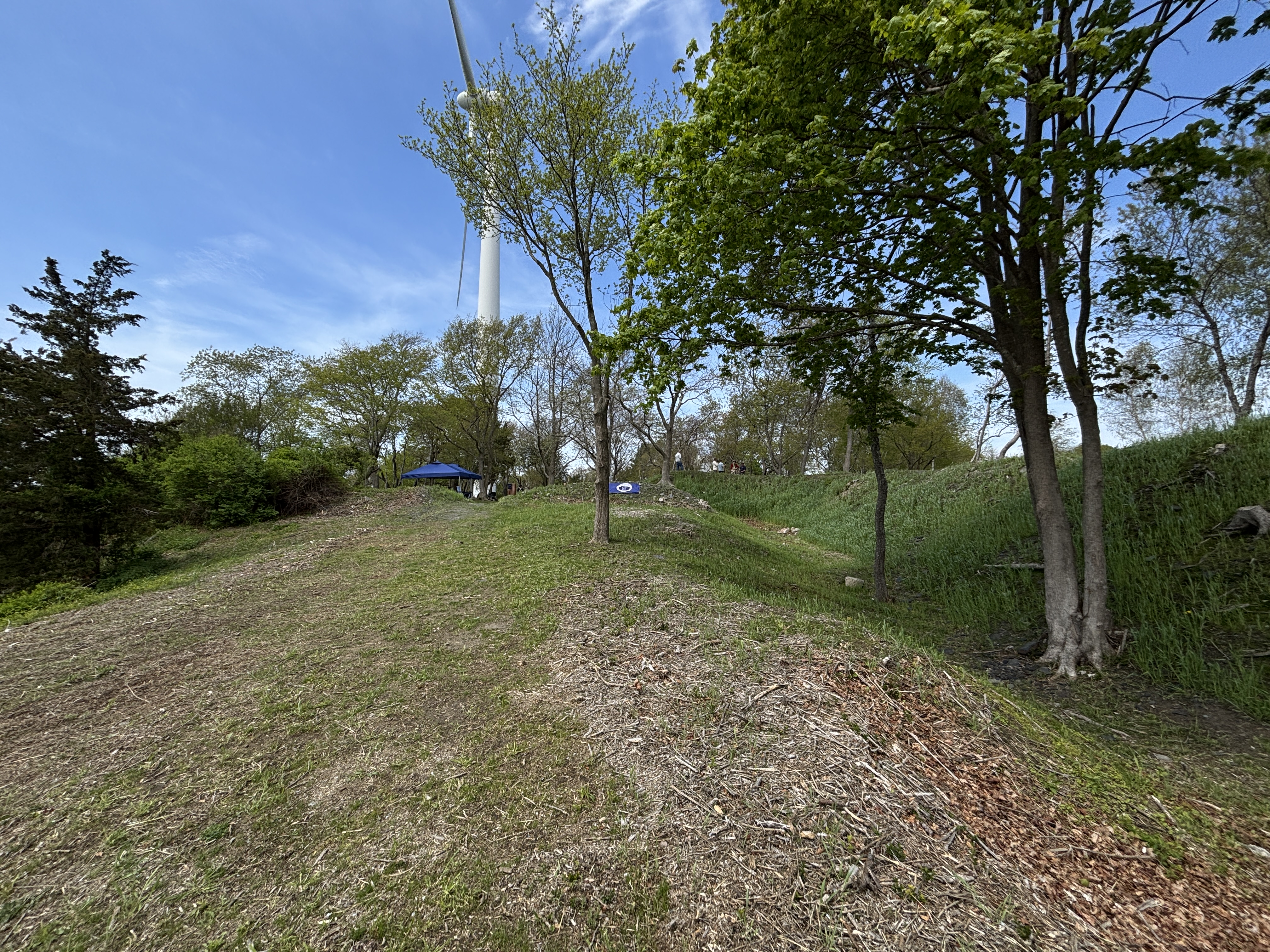
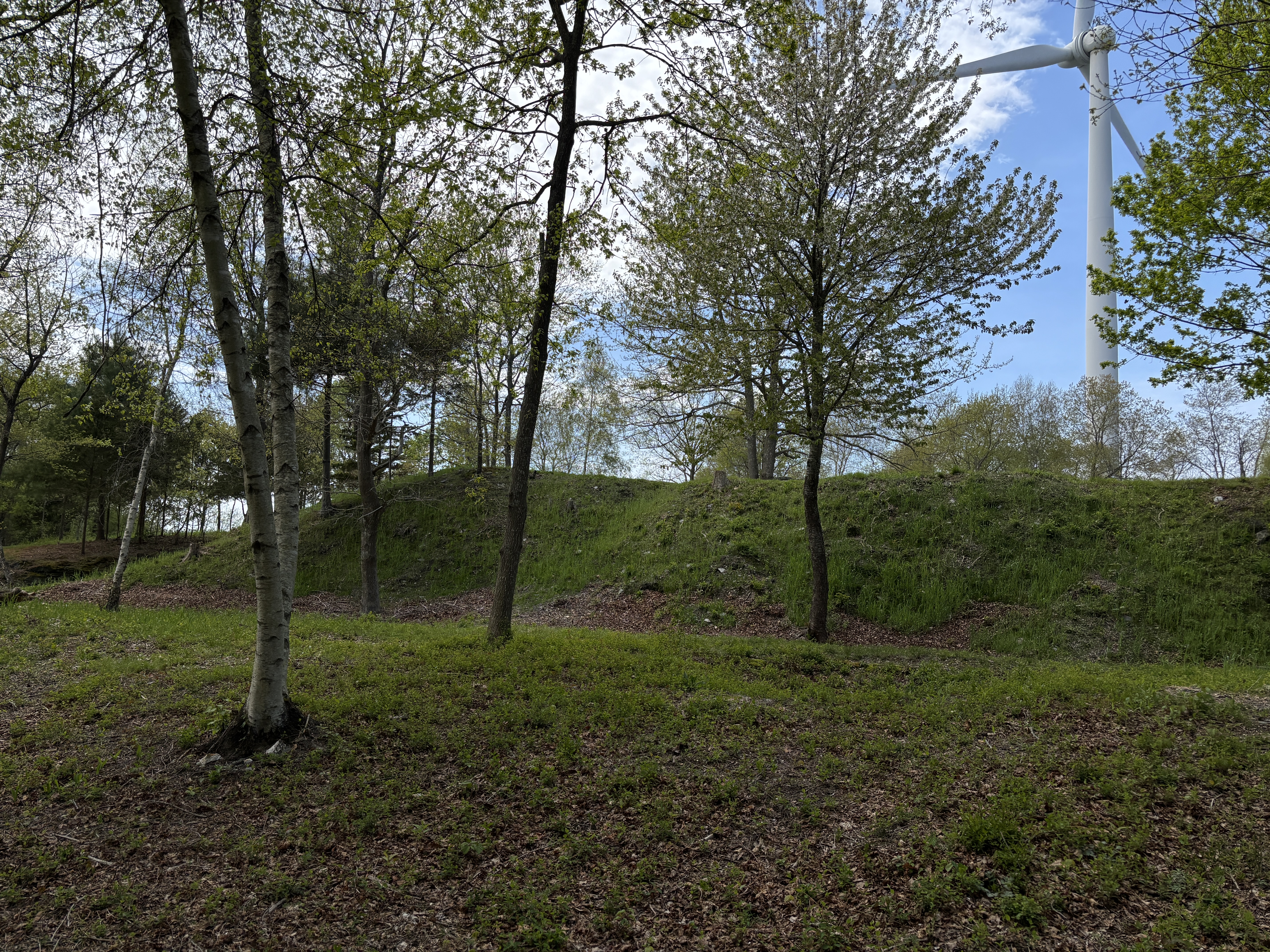
If you haven’t been to Butts Hill lately, this is an excellent time to go. This week we hosted 46 AP History students from Portsmouth High Schools on a tour of Battle of Rhode Island skirmish sites. We ended with a walking tour of the fort.

We hope to have better signage up in the coming year and full self-tour with QR codes. Meanwhile we have some resources to help explain what you see walking through the fort.

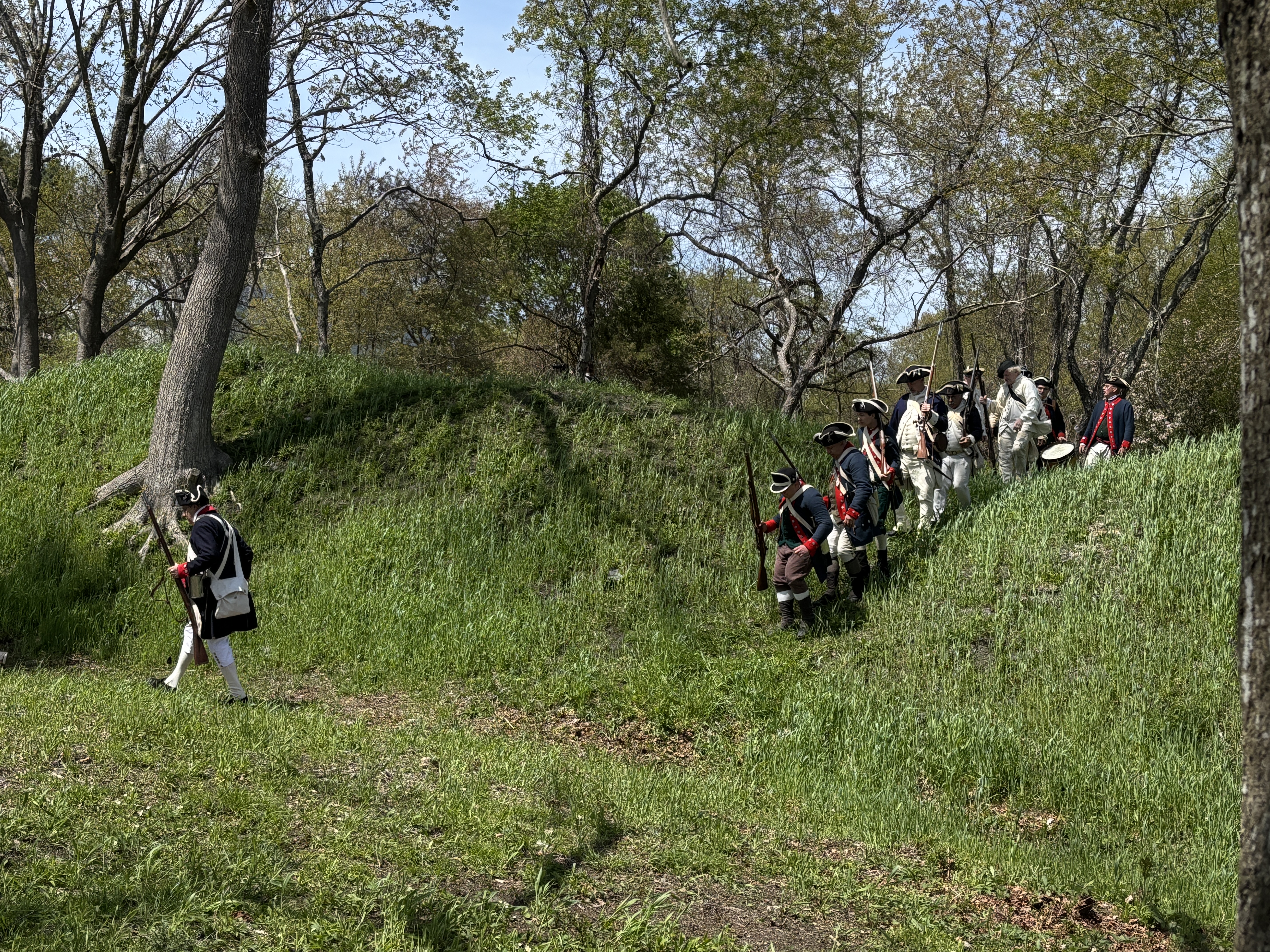
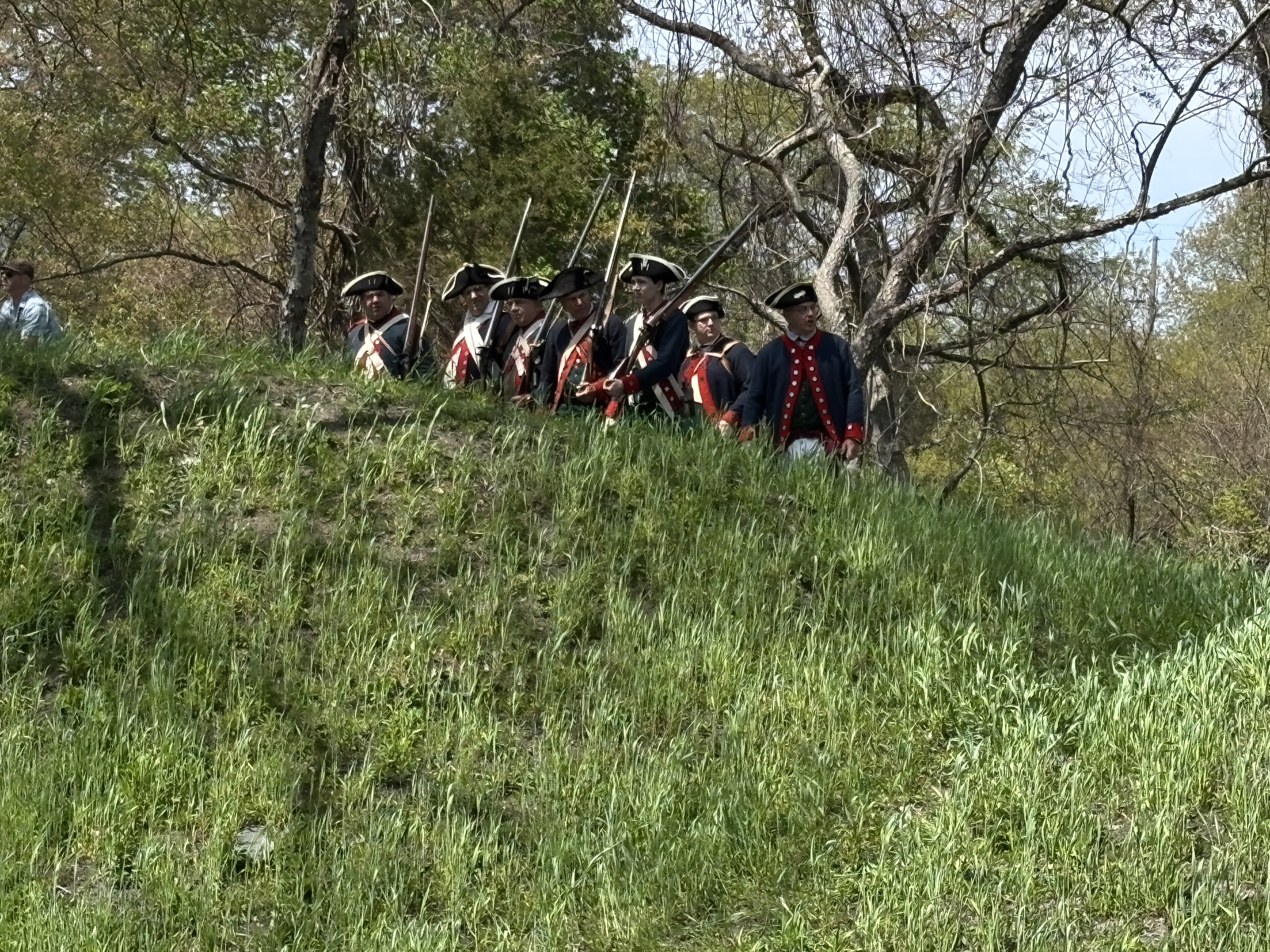
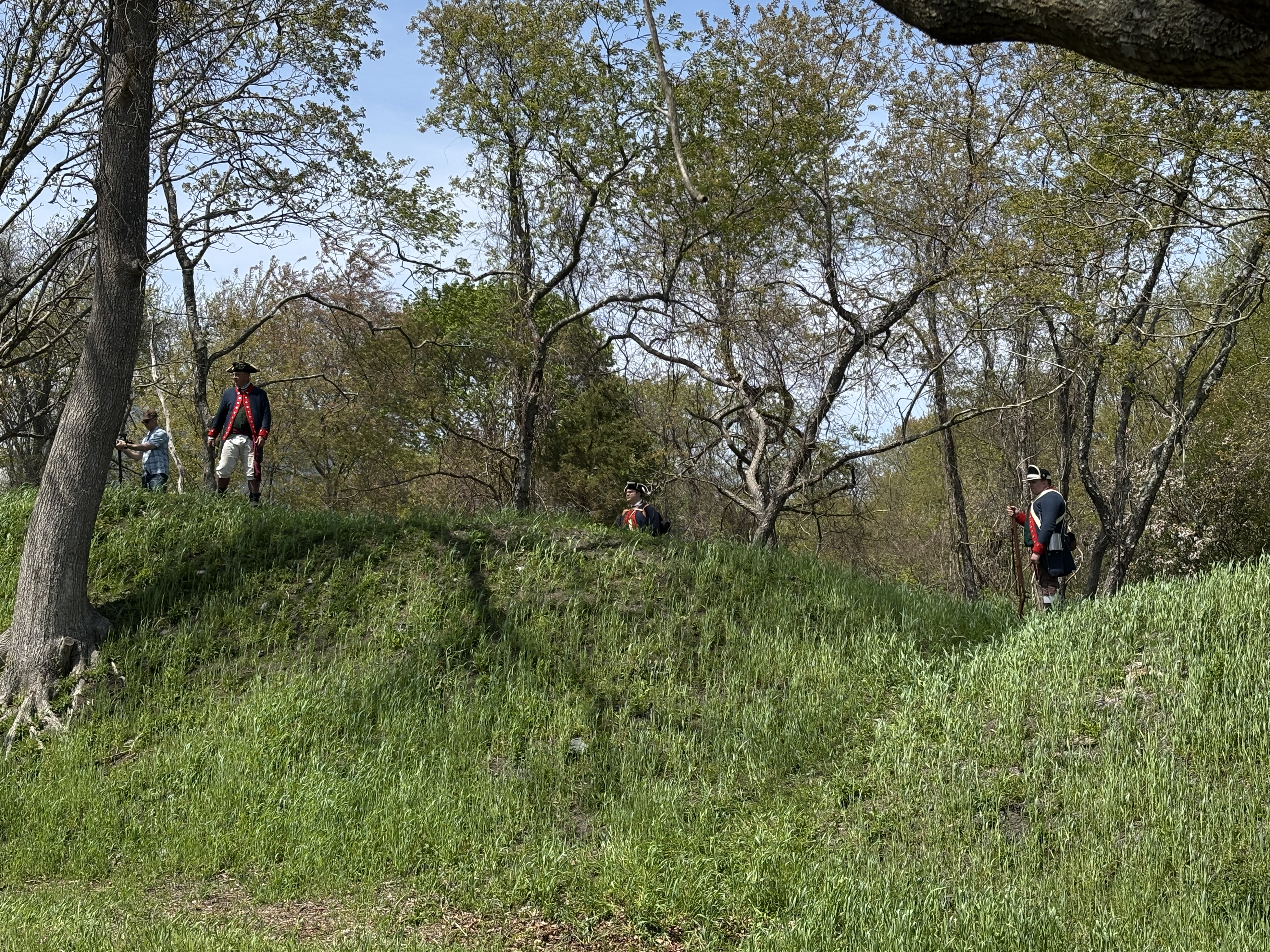
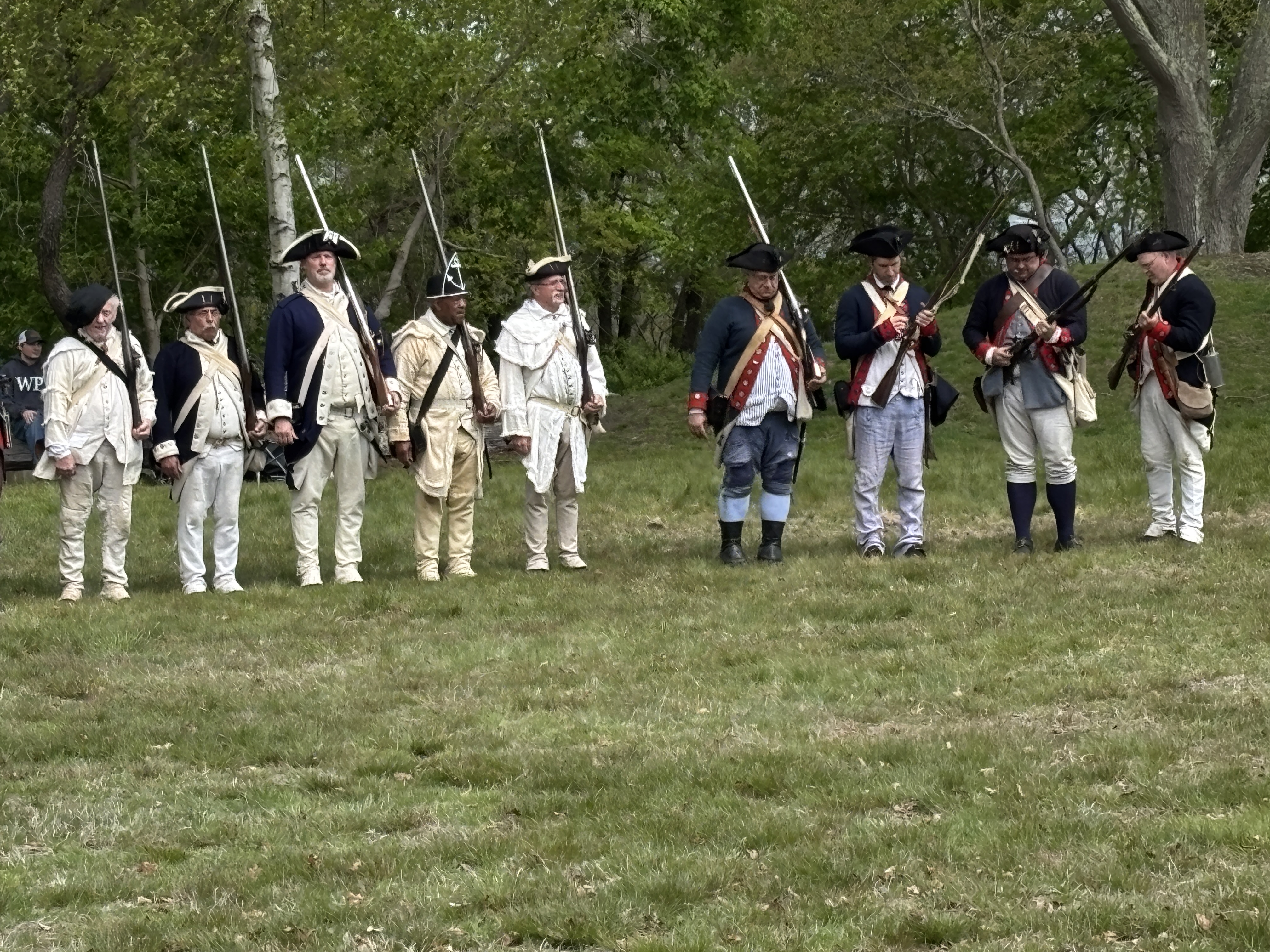
Photos from Brigade of the American Revolution event in May 2025

Captain Aaron Mann’s Testimony: Sullivan’s Life Guard at the Battle of Rhode Island and Retreat

Leave a comment

Aaron Mann of Providence was the commander of Sullivan’s Life Guard and his pension testimony offers us a first hand view of the American retreat on August 30, 1778. Mann had been serving as a soldier when needed beginning in 1775. He served in the Continental Navy in the ill fated Battle of Block Island. Next he was sent to Rhode Island (Aquidneck Island) to protect against British Captain James Wallaces’ raids around Narragansett Bay until the Americans had to flee the Island in December 1776 when the British invaded. He marched to Boston for the Battle of Bunker Hill and he took part in Spencer’s failed expedition in 1777.

From his testimony:

“In May or June 1778, then was got into a company called General Sullivan’s Life Guard – and I entered therein as a commander – Sullivan was quartered in Providence and I with him – I should think about through November 12 of 1778. I went on Sullivan’s expedition.”

He goes on to give a brief recounting of the Rhode Island Campaign. He went onto the island around the 12th of August. He talks about D’Estaing’s arrival and departure, and Lafayette’s efforts to persuade him back from Boston.

The part of his testimony that was most interesting to me was a description of the retreat. A portion of the Life Guard was to guard the retreat of the rear guard.

“Attached a portion of the life guard to guard the retreat of the rear guards and also make fires when lighted up through the camp to deceive the enemy. On this expedition I commanded the life guards – was wounded in my forefingers which were broke. Had Obadiah Brown one of my company killed. Israel Low of Providence wounded in the ankle. Antrum Fenner of Scituate wounded in the stomach and Charles Scot of Cumberland shot in his hip badly and made a cripple for Life.”

Because of his bravery in commanding the Guard during the retreat, Mann was appointed Captain on September 10, 1778. Records show Mann and the Guard at Tiverton through November 10 when the Guard may have been relieved of duty for a while.

In the book Spirit of ’76 Covell, who had listened to countless testimonies for pension applications, records that one of the Guard (Levi Lee) describes Mann in the action.
“..while in the act of flourishing his sword, he had one of his fingers shot away, but the only remark he made..was “the d eternal souls shoot pretty close. Don’t mind, my boys, stick to em.” Covell writes that Sullivan’s Life Guards were selected by Lafayette to cover the “rear guard” in the retreat and suffered badly in the action.

Resources

Christian McBurney’s book The Rhode Island Campaign has most of this story on page 181. I was able to see and transcribe Aaron Mann’s testimony through Fold3/Ancestry.com.

Spirit of ’76 in Rhode Island: or, Sketches of the efforts of the government and people in the war of the revolution. Together with the names of those … notices, reminiscences, etc., etc 

by  Benjamin Cowell 

Digging in: Information from Robert Selig’s work on the French at Butts Hill

Leave a comment

The Battle of Rhode Island Association has sponsored valuable research on the construction of Butts Hill Fort by Robert Selig and John K. Robertson. I am just now getting around to digesting the reports as I work on a timeline of what happened at the fort during the “Camp Butts Hill” period of 1780 to 1781. This is the first in a series of “Digging In” to the research. Today I am doing a close reading of Robert Selig’s article “Rochambeau’s Engineers at Butts Hill Fort July 1780 to June 1781.” The article appears in the Battle of Rhode Island website – battleofrhodeisland.org.

When the French arrived on Aquidneck Island, they found that work was being done on Butts Hill Fort. Selig writes about a diary entry of Ervoil d’Oyré. Describing the defensive works, he found upon arrival in Newport in July 1780:
“Finally, the works built by the Americans on the north of the island were re-established and repaired to assure communication with the continent.”

Selig writes about the French intentions on Aquidneck Island in their early days on the island.

“Prior to the arrival of Rochambeau’s forces in Rhode Island in mid-July 1780, Butts Hill Fort ‘was the only fort active on the north end of the island.’ As Rochambeau set up defenses against the anticipated and feared British attack, he sought to strengthen Butts Hill Fort to block any access from the north. Earthworks had been set up earlier in the war and repairs and additions were made by Massachusetts State troops, but French engineers almost immediately provided the expertise that the Americans lacked.”

Selig goes on to say that on the 9th of July, 21 British ships were seen near Newport Harbor. .

“The next morning Rochambeau accelerated the construction of defensive works, not only around Newport but at Butts Hill Fort as well. An entry in the journal of Major Marius de Palys’s Journal de Campagne, mentions the redoubts at Howlands Ferry and Butts Hill Fort.

” ‘Eight days had elapsed since the commencement of the work, and no thought had yet been given to fortifying the point of the island which should have 1st thought of. This is the point of Howlands Ferry, and Monsieur de La Fayette decided to occupy it better than it was at the time. There were two bad redoubts, which were connected and formed into a respectable fort, which had not been finished, the fort and another in the shape of a star, which protected the ferry together with a battery on the mainland assured communication with the mainland, which was essential for relief or retreat in case of misfortune.'”

Palys’s Journal continued: “Eight days had elapsed since the commencement of the work.”

That would place the date of the beginning of the work to around 28 or 29 July 1780. Selig tells us that La Fayette spent ten days in Newport from the evening of 24 July to late afternoon 3 August 1780. In a letter to General George Washington, dated “Newport july the 26th at seven o’clock P.M.,” he informed Washington that he “could not help advising him [i.e., Rochambeau] very Strongly and very often to erect works and keep a communication oppenn’d with the Continent By Howland’s Ferry or Bristol Point. That matter will I hope be attended to in the Course of the next day.”

When I started researching Butt Hill Fort, I found several orderly books from Massachusetts militias who were at the fort. I imagined a few French engineers supervising the American workers. Reading through Selig’s translation of a French orderly book gives me a different image. There was a constant French presence at the fort with a five day rotation of men from Soissonnois, Santonge, Royal Deux Ponts, and Bourbonnais. Every five days a new detachment would leave Newport at 7 AM. “This detachment will march with arms and baggage to Butts Hill Fort near Howland’s Ferry to work there as directed to them by the engineer who will be there. They will take with them cooking pots, mess tins, asks, and provisions for five days …The captain who will command the detachment order to work at Butts Hill Fort, a mile from Howland’s Ferry, will keep his soldiers in good order and discipline, he will order each day one corporal and four men as guards, and will not allow more than one cook to be employed per regiment in order to keep as few men as possible from the work.” (Order of 9 December 1780).

The orders of December 28, 1780 provide the duties of the French troops -“for the security of the post, the police of the guard, and the preservation of the fort’s works,” The detachment takes orders from Monseur de Palisse, Major of the Royal Corp of Engineers and from Monsieur Planchard.

The French Orderly book lists orders from December 23, 1780 to June 7, 1781. French forces left Aquidneck Island to travel south in June of 1781. The road to Yorktown began with Aquidneck IsIand. On their way to Bristol Ferry the French army would pass nearby the fort they had been working to build.

Preparing for a Visit of Rochambeau to Butt’s Hill

Leave a comment

Did Rochambeau visit Butts Hill? In a letter dated August 2, 1780 from Newport, Lafayette wrote to American General William Heath about how to prepare for Rochambeau’s visit.

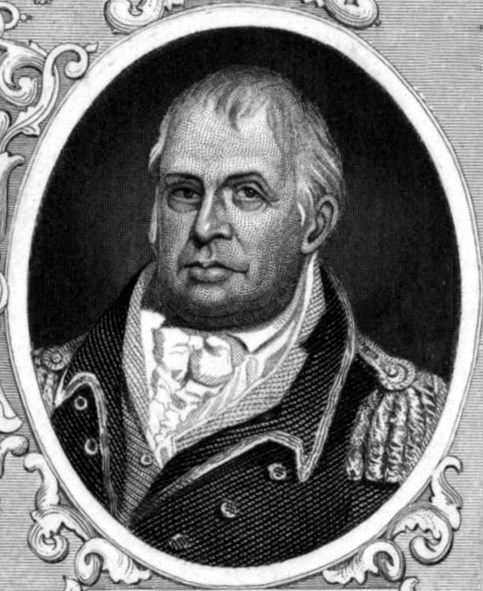
General William Heath

“On my coming into the town, I found that Count de Rochambeau was going to Butts Hill, and you easily guess that I did not like the plan. Our works are so disordered, and his dependence upon them so great, our tools, Boats &c. are in such a situation that I wanted some time to put it in a Better train.”

At this time the French are based on Aquidneck Island. There is an expectation that the British will again try to attack and occupy the island. Butts Hill is seen as a natural location to fortify as a prime spot to communicate with the mainland at Tiverton and Bristol. The French engineers and masons are working to turn fortifications left by the British and Americans into an actual fort. American militia soldiers under General Heath and the Rhode Island First Regiment (the Black Regiment) are aiding in the physical effort to complete the fortifications. The situation at what they call “Camp Butts Hill” is difficult. After three years of British occupation, basic resources like wood for fuel, water and food are lacking.

Lafayette goes on in the letter to encourage Heath and his men.

“From what you told me, my dear friend, I don’t doubt but that the thousand men with thousand tools will be tomorrow morning at work, and think they ought to Begin very early.”

Lafayette suggested ways Heath could prepare for Rochambeau’s visit. The boats should be gathered and men should be working to repair them. Fascines (bundles of sticks for fort construction) and cannons should be ready and guarded.

“As to the picquets I think we might have one of the Nigros upon the Road…” Picquets are “a soldier, or small unit of soldiers, placed on a defensive line forward of a friendly position to provide timely warning and screening against an enemy advance.” The “Nigros” Lafayette refers to would be from the Black Regiment (Rhode Island First Regiment) commanded by Col. Christopher Greene. Their camp is pictured next to Butts Hill in the Berthier maps of 1780. Greene’s men were Continentals and had been well trained. The militia, on the other hand, were volunteers that served three to six months and then went back to their homes.

“I believe we ought not to go through the militia Camp, but meet you at the fort with some of their officers to introduce to the count.” The barebones conditions at “Camp Butts Hill” were not something Lafayette wanted Rochambeau to see.

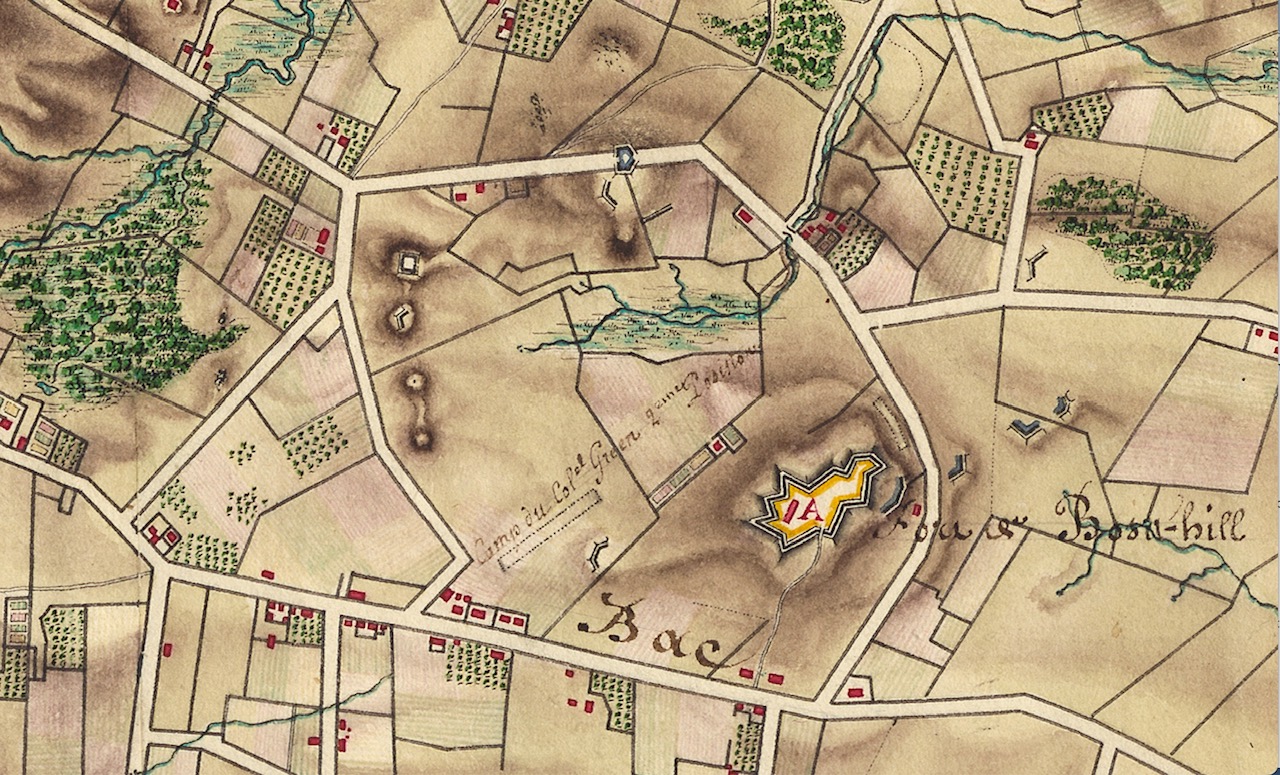
Berthier Map. Note Outline of Butts Hill Fort and location of Col. Greene’s men at Camp Butts Hill.

“Don’t you think, my dear Sir, that we ought to put every thing in a good train as to the tools, workmen &c. against the time the Count will come

The code word for the day would be “Boston.” Lafayette gives us a glimpse of their procedures. “When people are coming from without you know the Centry must say “Who is there,” and upon answering ‘friend’ the centry says ‘advance one’ and the Corporal comes immediately to Reconnoitre.’ Will send Mr Washington, and upon the Corporal’s telling advance, I think we ought to learn our men how to present properly their arms to Count de Rochambeau.”

A footnote explains that “Mr. Washington” is George Augustin Washington, Lafayette’s aide de camp.

The next day Lafayette writes again to Heath. “Count de Rochambeau will be with you between four and five this evening.” (Newport, August 3, 1780 – Lafayette to Heath.). I will look for more letters or orderly reports that will confirm that Rochambeau did visit the fort and what that visit might have been like.

Resources:

Idzerda, Stanley, Editor. Lafayette in the Age of the American Revolution. Selected Letters and Papers 1776-1790. Volume 3.

A Sham Battle in Portsmouth 1780 – a Note to add to John Robertson’s presentation.

Leave a comment

Howland Ferry Area- Beginning and End

Leave a comment

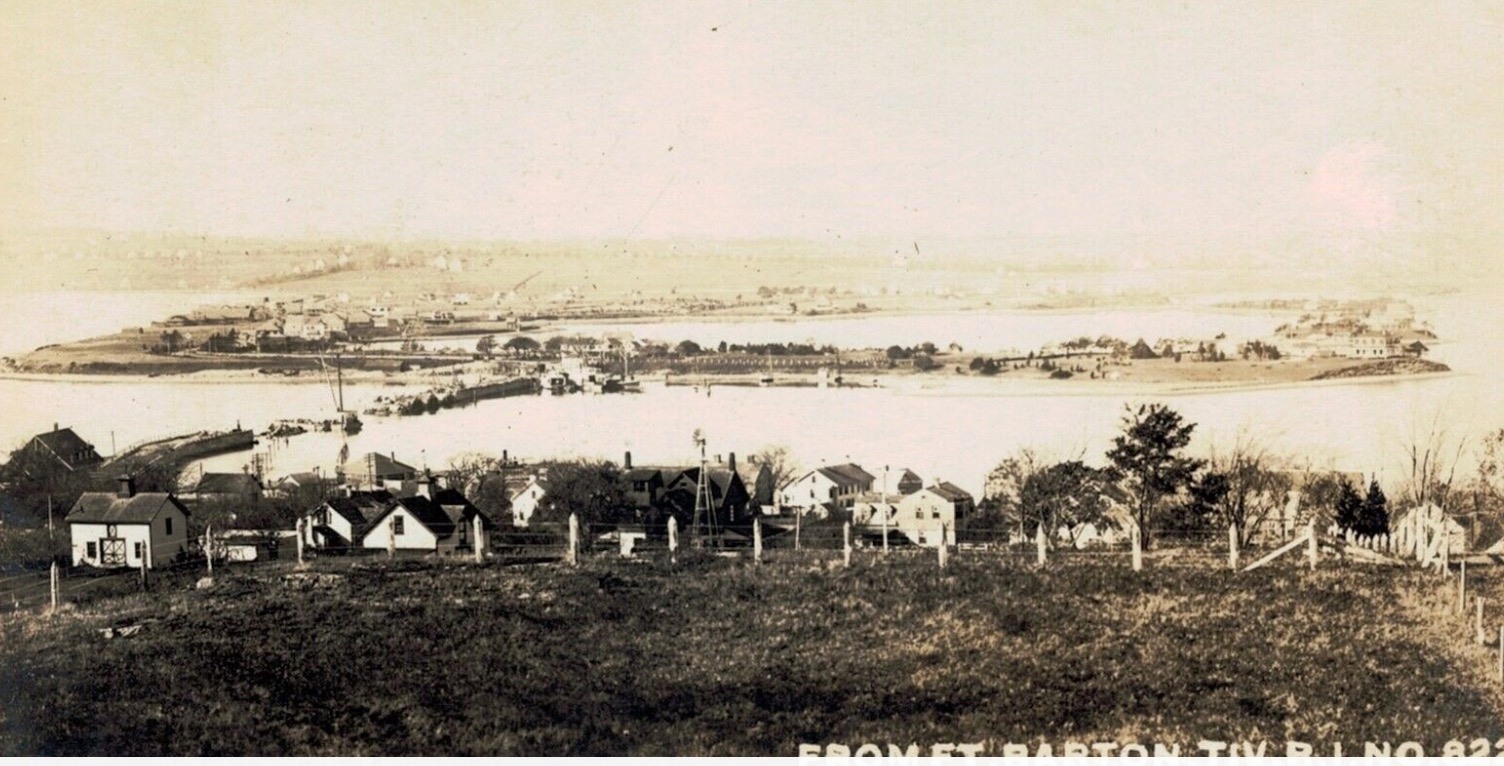
Howland Ferry was an important entry and exit point for the Rhode Island Campaign, but I haven’t spent much time researching what happened there. Today our eyes are on the relic of the Stone Bridge and it is hard to imagine the Revolutionary site.

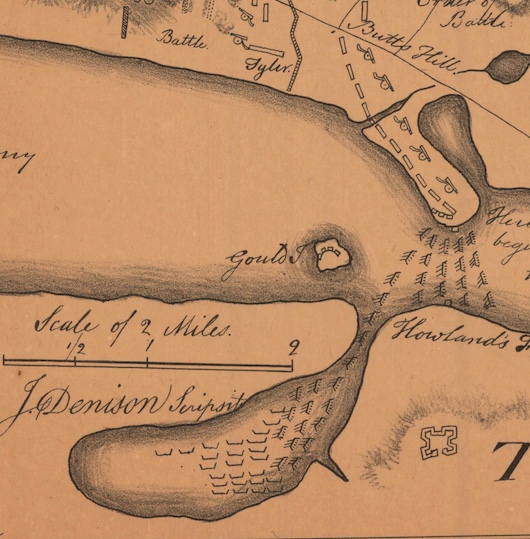
In colonial times the main roads in Portsmouth led to the ferry landings.  What we call East Main Road was known as the Path to Howland’s Ferry. This site is one of the narrowest points on the Sakonnet River between Tiverton and Portsmouth. Use of this land as a ferry landing may date back to 1640.  The name Howland Ferry comes from the family that ran it between 1703 to the British Invasion in 1776.  Howland’s Ferry played an important part during the Battle of Rhode Island. American forces used the location to pour onto Aquidneck Island to fight the British who occupied it. When they were forced to retreat, many of the American forces used that route to make their escape.

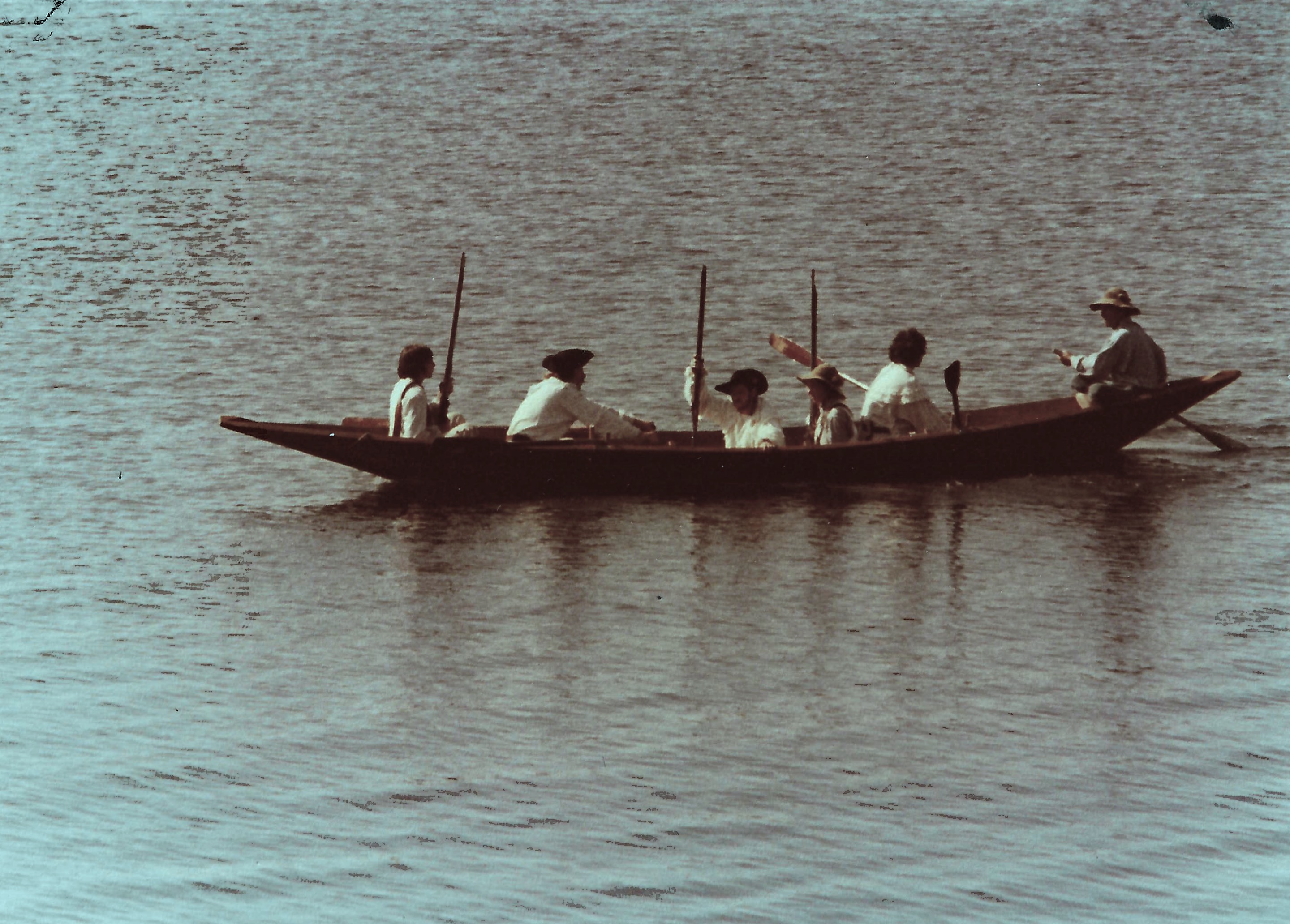
Arranging for transportation for thousands of soldiers from Tiverton to Portsmouth was a major undertaking.  The British knew an American invasion would be coming, so they had already destroyed many of the flatboat boats the Americans had constructed in the Fall River area.   The Americans had to secure the wood mills in Fall River and Tiverton to rebuild the flatboats that would be needed.  Silas Talbot oversaw the building of 85 flatboats.  Every carpenter in the army was put to work and every piece of boards and plankings in the area were used to make the transport boats. General Sullivan called out to New England mariners to come and operate the flatboats.  On August 9, 1778 Howland Ferry was teeming with boats shuttling Americans to Portsmouth. 

The path to Howland’s Ferry was the escape route when the Americans had to evacuate on August 29th and 30th because the French had left.    According to Christian McBurney, Captain Samuel Flagg of Salem and the boatmen from Salem, Marblehead and other New England towns worked day and night to ferry equipment and men off the island. William Whipple and Jeremiah Olney of the 2nd Rhode Island oversaw the embarkation. After the retreat John Laurens wrote – .”.we had a water passage of 1/4 mile to cross from the island to the main – a vast quantity of stores, heavy baggage, ammunition and cannon to transport. You will be filled with admiration at learning that the retreat was effected without the loss of a single man or even an entrenching tool”. Silas Talbot and John Laurens were among those holding off the British to give the Americans more time to retreat. At 11 PM Lafayette arrived from meeting with the French in Boston. He had taken the 70 mile journey and was disappointed that he had missed the action. Lafayette did have a role in bringing the piquets off the Island.

I have many questions about the preparation of the flatboats and Silas Talbot’s role. A biography I have of Talbot doesn’t even mention his supervision of the boat construction. In many ways this successful retreat was one of the most amazing parts of the Campaign and showed the professionalism of the budding American Army.

On the Road with Lafayette 1778 – Part 5

Leave a comment

In command of the East Bay forces

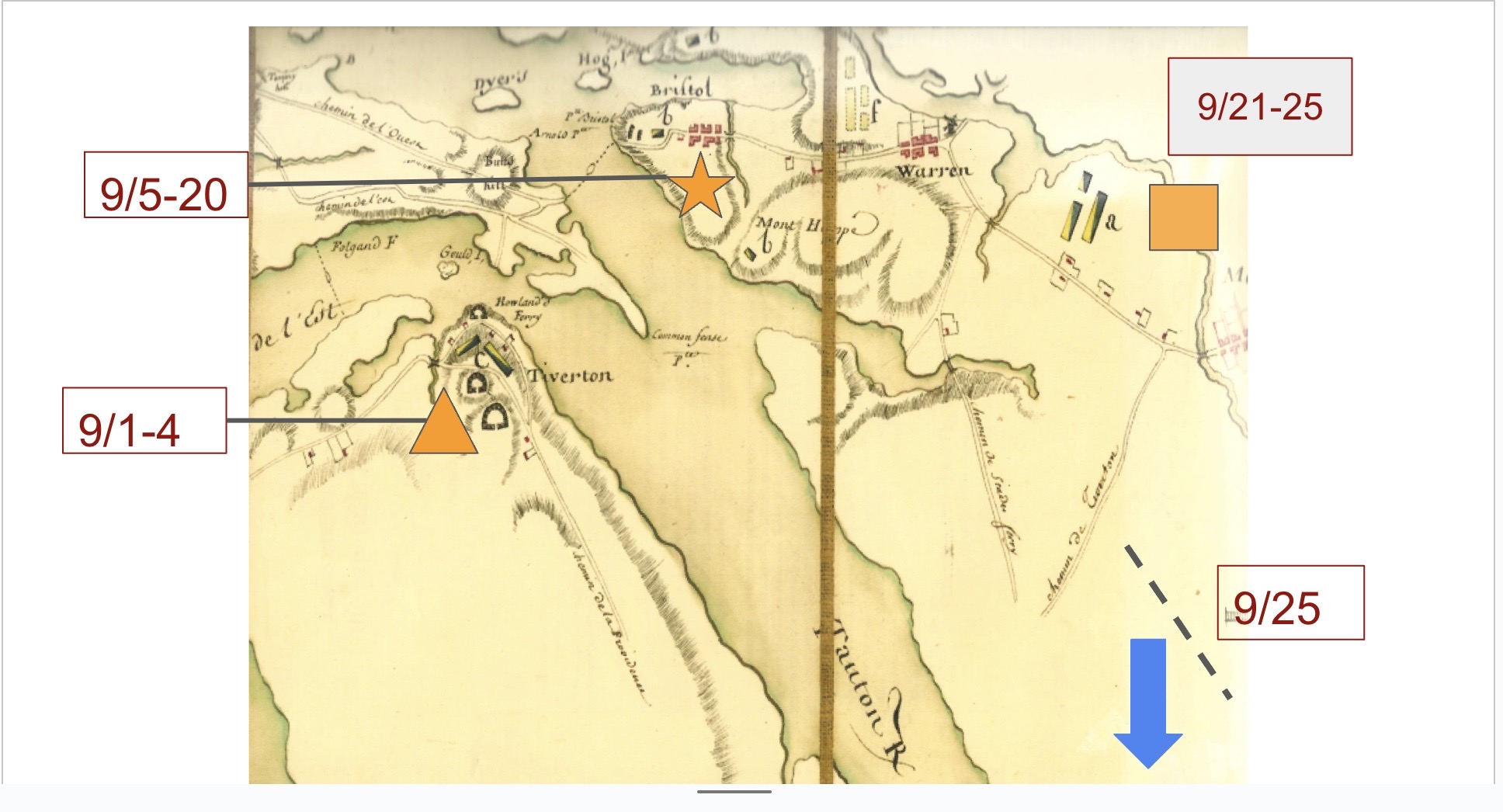
September 1st to 4th. Lafayette is in Tiverton (marked by ORANGE TRIANGLE). He has command of the Eastern Shore of Rhode Island. Lafayette writes a letter from Tiverton on 9/1. 

September 5th to 20th. Lafayette is in Bristol (marked by the ORANGE STAR). His headquarters was the Reynolds House. Lafayette writes a letter from Bristol on September 5. On September 8th he writes ”the Bristol post continues to be the most exposed one, and consequently I shall remain here.” Israel Angell’s diary reports he had dinner with Lafayette in Bristol on September 6 and heard that New Bedford had been attacked by the British. He dined with Lafayette on the 12th as well. On September 8th he writes to Silas Talbot from Bristol suggesting a plot to captures the British vessel Pigot. September 13th he writes to his wife Adrienne from Bristol.

September 21st through 24th. Lafayette camps outside of Warren (ORANGE SQUARE near Warren.) He writes to d’Estaing and George Washington from Warren on September 21. In his letter to Washington he comments that in response to advice from General Sullivan, he “is in a safer place behind Warren.” On September 23rd he writes to the President of Congress from outside Warren. ”The moment I heard of America, I loved her. The moment I knew she was fighting for freedom, I burnt with the desire of bleeding for her..”

September 25th. Lafayette left for Boston and the Rhode Island Campaign is at an end.
(BLUE LINES OFF TO BOSTON).

By October 5 Washington has requested that General Sullivan grant permission for Lafayette’s leave from duty.

Reynolds House, Bristol. Lafayette Headquarters

Resources: 1899, The Diary of Colonel Israel Angell Commanding Offifficer, 2nd Rhode Island Regiment, Continental Army, Edward Field, Israel Angell, Norman Desmarais

Older Entries