Home

Annotated Timeline of Rhode Island in the Revolution: Rhode Island Campaign – Siege of Newport

Leave a comment

The Occupation of Aquidneck Island dragged on for almost two years when a plan was devised to work with French allies in pushing the British out of the island. On May 4, 1778 Congress ratified a treaty of alliance with France. The Rhode Island Campaign was devised as a wedge action. The Americans, under the leadership of John Sullivan, would cross from Tiverton to Portsmouth and drive south to set up a siege of Newport. Meanwhile the French, led by d’Estaing, would arrive by sea and attack the British from the sea.

July 11, 1778, Continental Congress authorized Washington to request the northeastern states to raise militia for a joint operation with the French.

July 20, 1778, d’Estaing announced he would sail for Newport and not the alternate target of New York.

July 22, 1778, Washington’s delayed letter informs Sullivan that the French fleet is headed to Newport, and he directs Sullivan to increase the size of his militia forces from 5000 to 7500. Varnum’s and Glover’s brigades along with an additional attachment under Henry Jackson would head towards Providence.

July 27, 1778, Washington dispatches two Continental Army divisions under General Nathanael Greene and General Lafayette to Rhode Island. Although Greene was the Army Quartermaster, he was anxious to have a command, especially in his home state.

July 29, 1778, French ships arrive at Narragansett Bay. Washington had arranged for pilots to guide the French ships in the Bay. Two or three ships were stationed in the shallow Sakonnet River to the East of Aquidneck Island. Other ships positioned anchored near the entrance to the Sakonnet Channel. Most of the French ships had anchored about three miles south of Conanicut Island (Jamestown).

Four British frigates anchored at various points of the west side of Aquidneck Island where they would remove their cannons, ammunition and supplies. On the Sakonnet side the Spitfire and Alarm and the sloop Kingfisher were unloading at Fogland Ferry. In Newport harbor the Flora and Falcon did the same.

July 30, 1778, trapped by the French navy, British ships the Kingfisher, Alarm and Spitfire were ordered to be torched. Ammunition that had remained on the vessels caused explosions.

August 1, 1778, General Sullivan and Admiral d’Estaing meet, agree on simultaneous attacks on the Island on August 8. British Commander Pigot was expecting a siege and he ordered all sheep and cattle in Portsmouth and Middletown (except one per family) to be driven behind British lines in Newport. Carts, wagons, and tools like picks and axes were all collected and brought to Newport. The soldiers’ families and regimental baggage were brought to Newport. Wells in Portsmouth and Middletown were filled in so there would be no drinking water for the enemy.

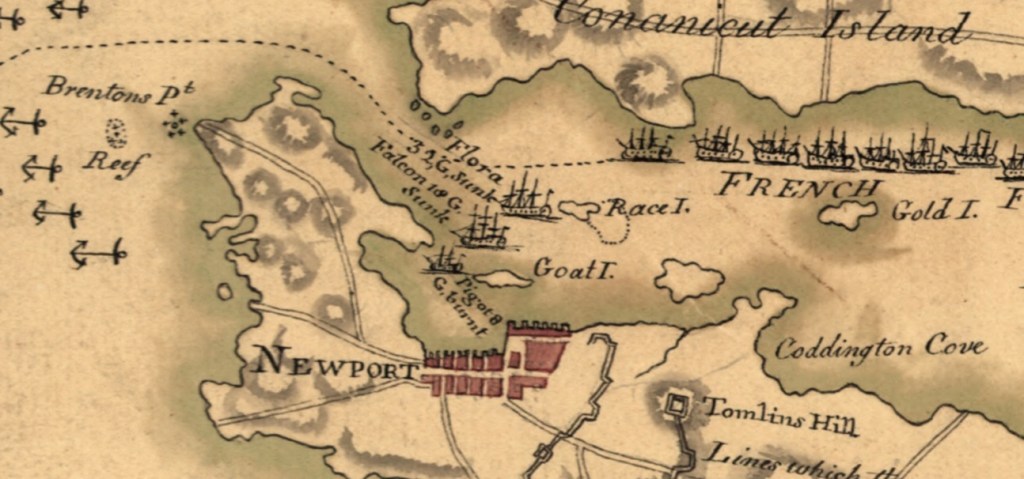
August 3, 1778, British forces felled trees to block the roads running from Portsmouth and Middletown into Newport. To prevent the French from landing their troops, five or six transports were sunk by Goat Island. One of them (the Lord Sandwich) had been James Cook’s ship Endeavour.

August 5, 1778, more British ships (Orpheus, Lark, Cerberus, Juno and Pigot) were purposely sunk in the harbor to hinder the French and to avoid their capture.

August 6, 1778, Due to late arriving militia, Sullivan informs d’Estaing of postponement of the attack. British cannons fire on French ships.

August 7-8, 1778, d’Estaing enters Narragansett Bay, causing the British to withdraw from north end of the Island into prepared positions along the Newport-Middletown border.
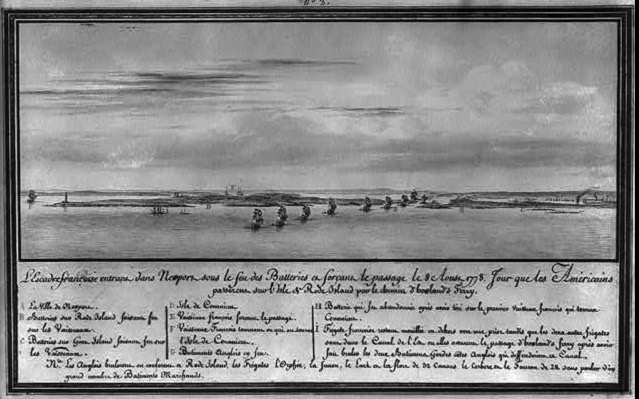
French ships in a row

August 9, 1778, Realizing the British had withdrawn south, Sullivan moves his forces onto the Island. Two to three thousand French forces land on Conanicut Island. D’Estaing is furious that the Americans have reached Aquidneck Island early. D’Estaing is alerted to the imminent arrival of Howe’s fleet which was coming from New York. He decides to go out and fight Howe’s fleet and then go to the aid of the Americans. There was shelling between the French fleet facing Newport and the shore batteries controlled by the British.

August 10, 1778, French head out to sea. Both French and British fleets maneuver for advantage, but before they can engage, both fleets are scattered and damaged by a hurricane. Both leave for port and repairs. American commander John Sullivan prepared to shorten the distance between the American lines and the British line. He was going to lay a siege because by then he had 11,000 men.

August 11 – 12, 1778, General Sullivan prepares to work toward British positions, but the hurricane causes him to delay. The weather during the night of the 12th was especially fierce and the Americans had little shelter from the pelting rain and wind. The camp was a swamp.

For the British and French fleets out on the water, the weather turned to serious wind gusts. Heavy rain, gale force winds and thick fog hampered both fleets. The winds began to topple the masts. By 4 am on the 12th the French flagship Languedoc had lost its bowsprint, all of its masts and its rudder. It was simply floating without being able to steer.

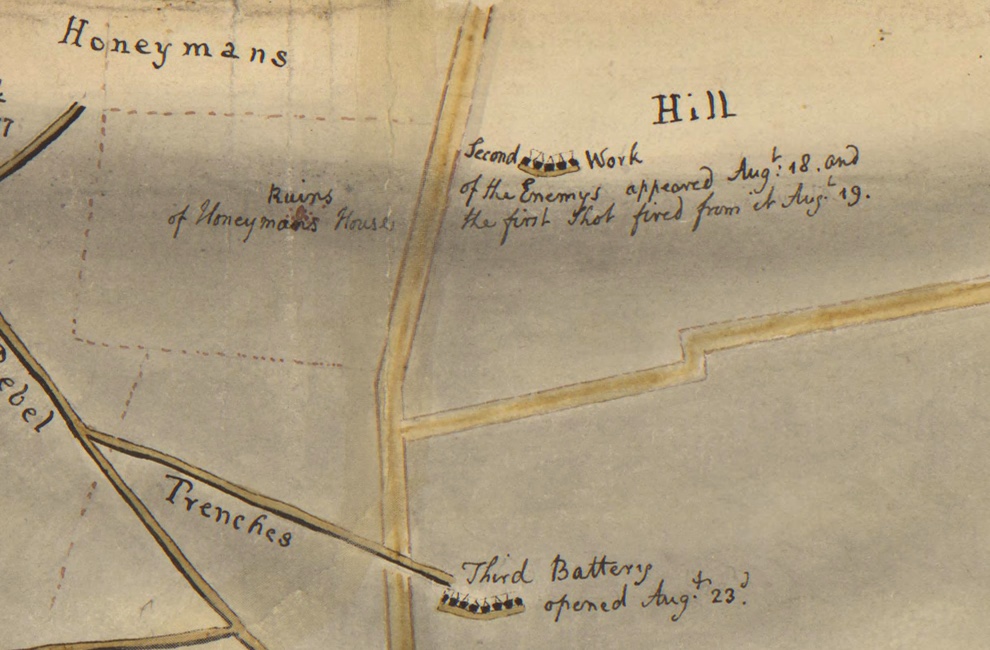
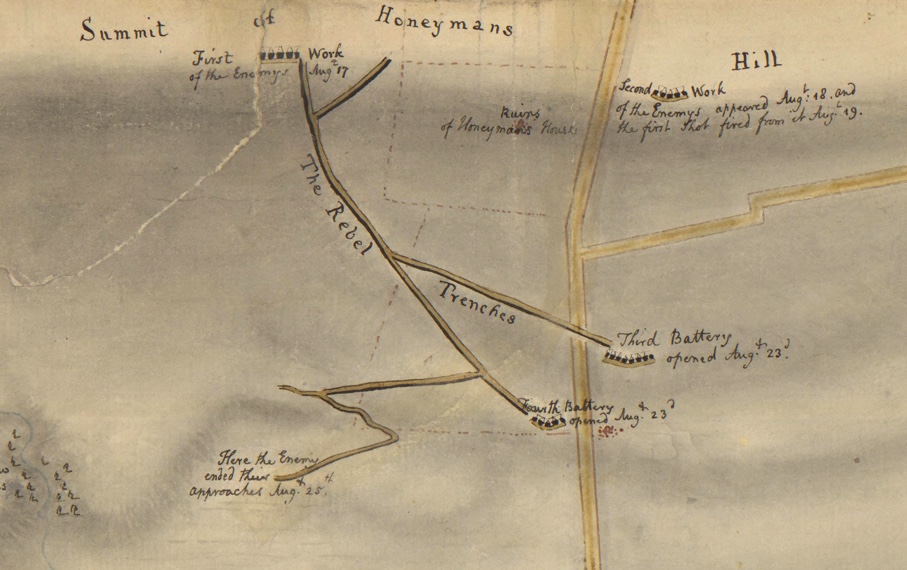
August 15, 1778, Americans open the Siege of Newport. The Americans needed to construct defensive works, so Sullivan marched them south with banners flying. By 5 PM they halted and pitched camp by Honeyman Hill in Middletown. This was a high point where the Americans could view the British lines. However the 20 day enlistments of many militia units were up and they left. Sullivan was waiting for new units to arrive. Col. Paul Revere commanded the Boston artillery train and John Hancock was major general of the 3000 member Massachusetts militia.
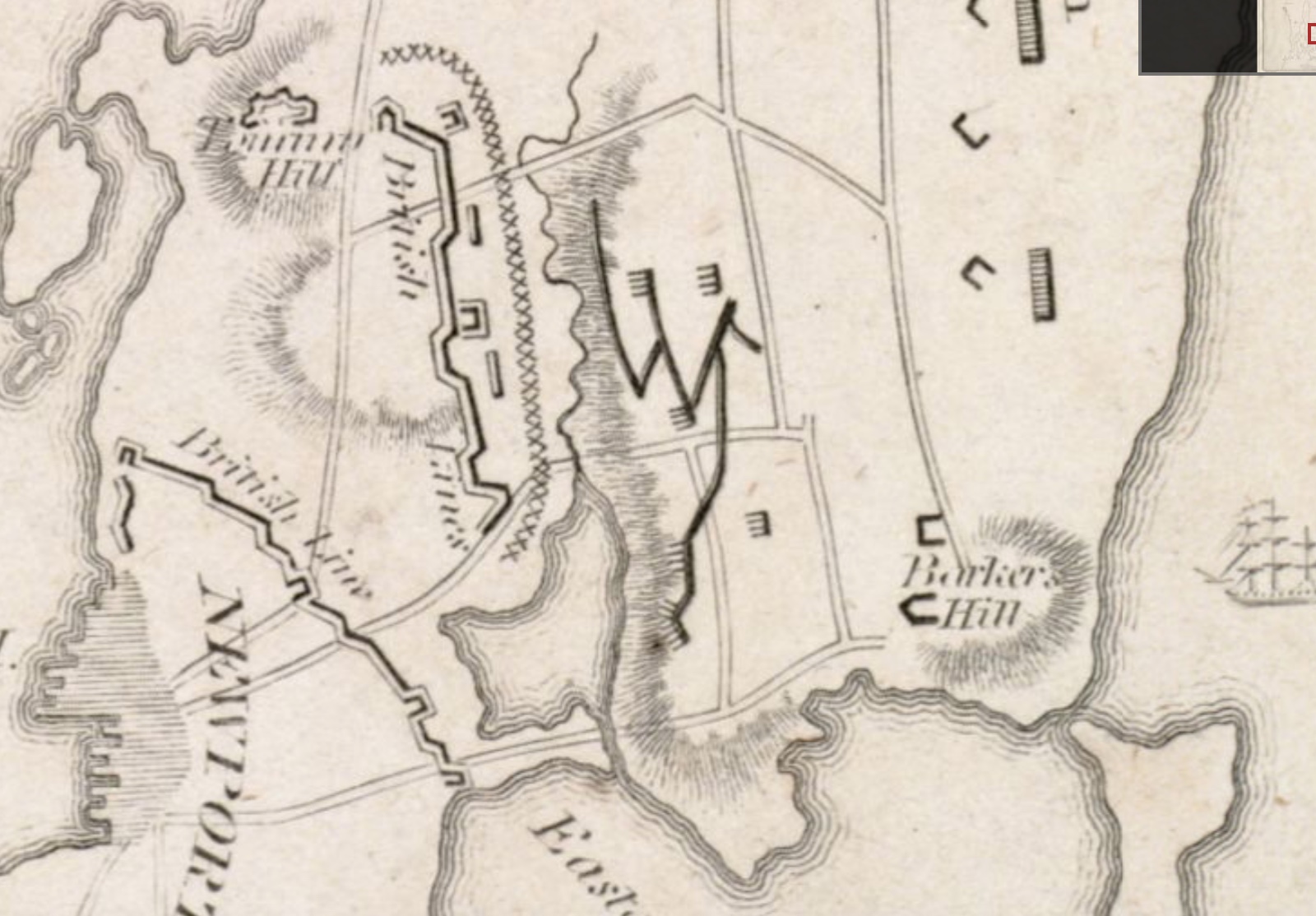
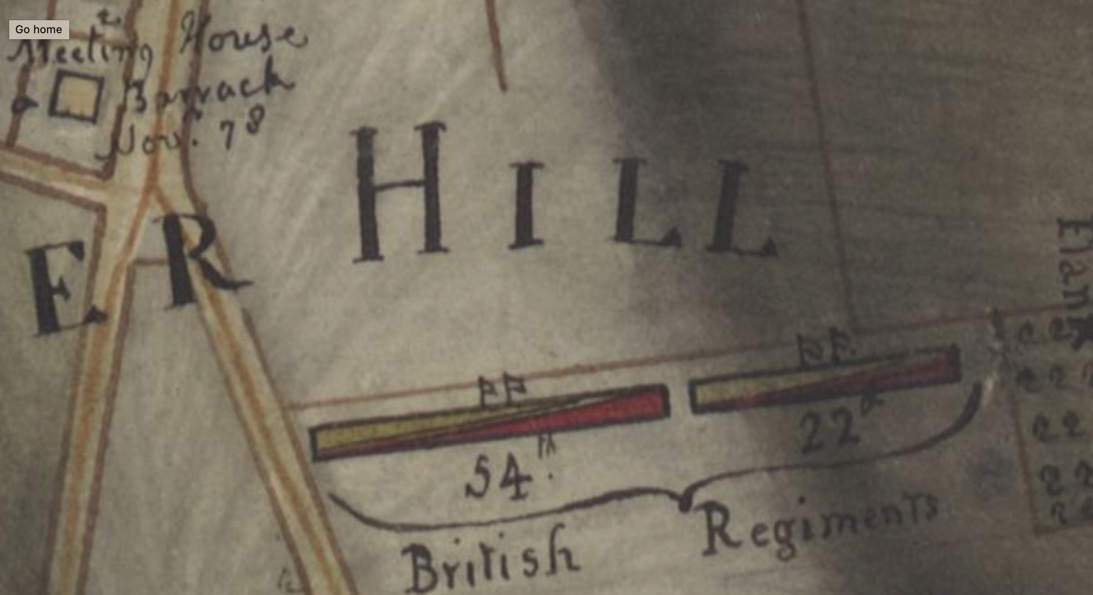
British lines on the left – American lines on the right.

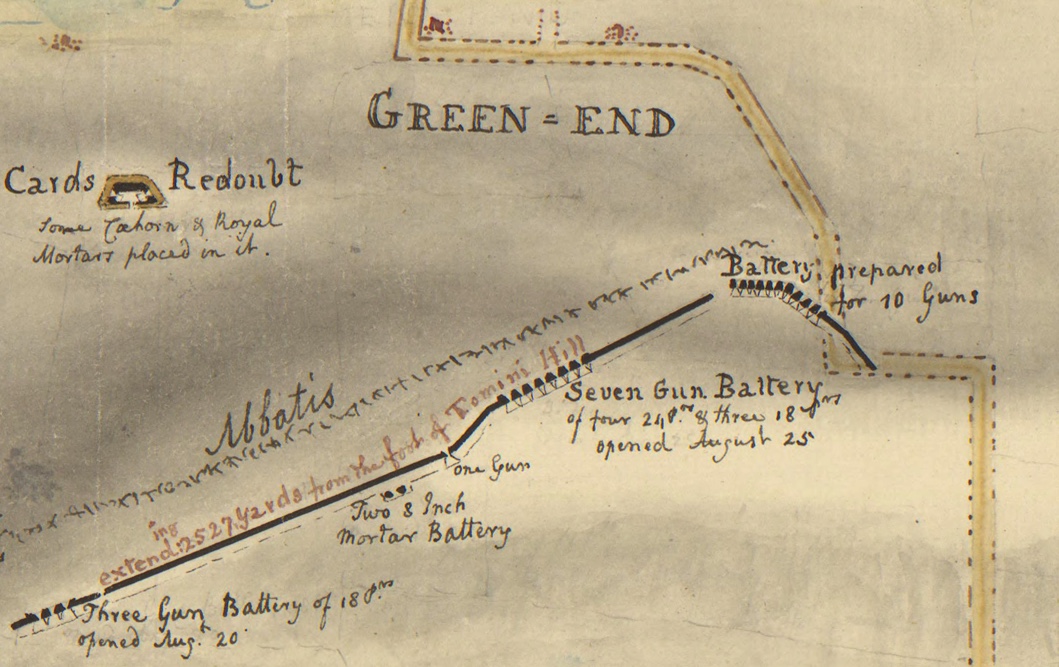
August 16, 1778, Americans were preparing a four cannon battery on the western slope of Honeyman Hill. The British opened fire as the fog lifted, so the Americans worked on the trenches and battery in the dark or fog.

August 20, 1778, d’Estaing’s battered ships return to Narragansett Bay. D’Estaing informs Sullivan he must immediately leave for Boston for repairs. His order from the King of France was to protect his fleet.

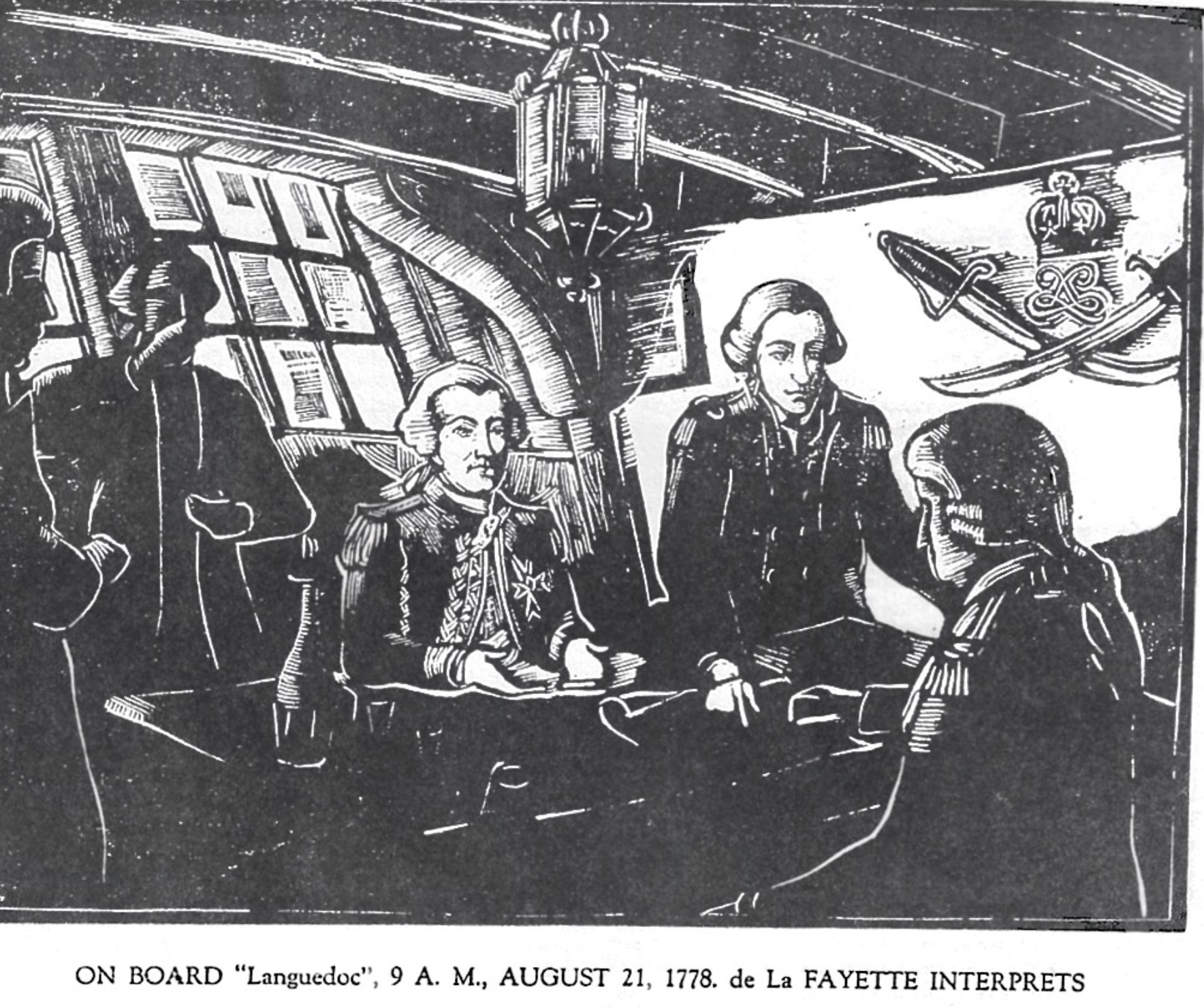
August 21, 1778, Sullivan sends Nathanael Greene, Lafayette and Col John Langdon to board the Languedoc – d’Estaing’s ship and talk with d’Estaing. D’Estang still decides to have the fleet sail for Boston.

August 24, 1778, Sullivan receives word that a British naval force is on its way to Newport. Sullivan and his officers prepare for a quick withdrawal. At a council of war there is unanimous agreement to move the troops to the Portsmouth end of the island to wait for the French return. Sullivan advocated for a gradual and orderly retreat.

August 25, 1778. All unnecessary baggage was removed off the island. Work on the trenches stopped. Volunteers began to leave in large numbers. Revere and his artillery and Hancock and his Massachusetts militia are among those leaving the island. Hancock asks for a letter of introduction to talk to d’Estaing in Boston. Mortars and heavy cannon were taken off the island.

August 27, 1778, Sullivan sends Lafayette to Boston to determine when d’Estaing would come back to Rhode Island. Lafayette made the 70 mile trip in just 7 hours. By this time Sullivan had lost 3,000 volunteers through illness or decisions to leave the island.

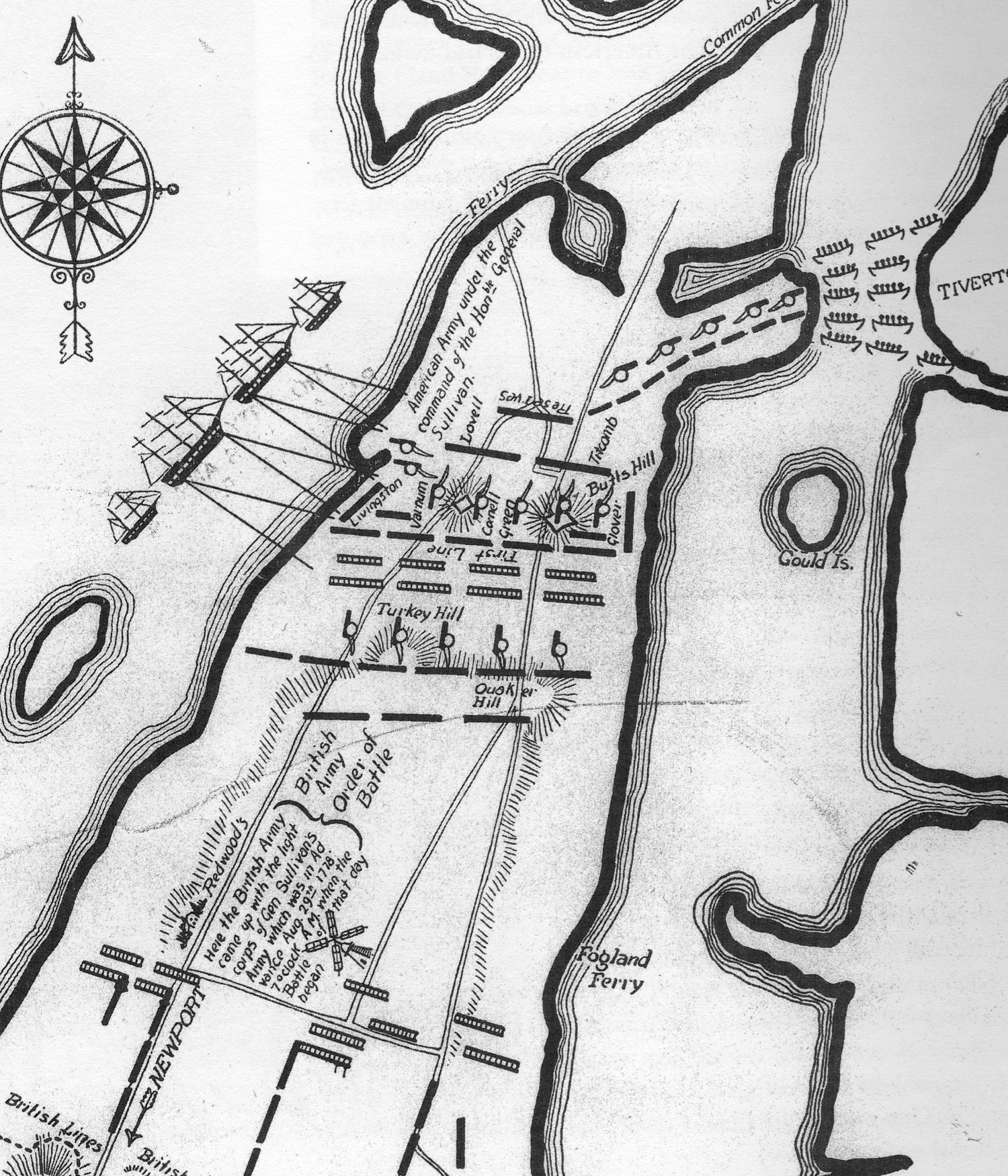
August 28, 1778, American council of war decides to withdraw Patriot forces to defensive positions around Butts Hill. They would be close to the ferry landings if they needed to withdraw completely. By 8PM the soldiers put down their tents and marched out with Greene commanding the West column up West Main Road and Glover leading the other column up East Main.

Resources: This timeline is based on Christian McBurney’s book – The Rhode Island Campaign.
Revolutionary Rhode Island Timeline Trifold

Leave a comment

On the Road with Lafayette 1778 – Part 3

Leave a comment

The Siege Begins

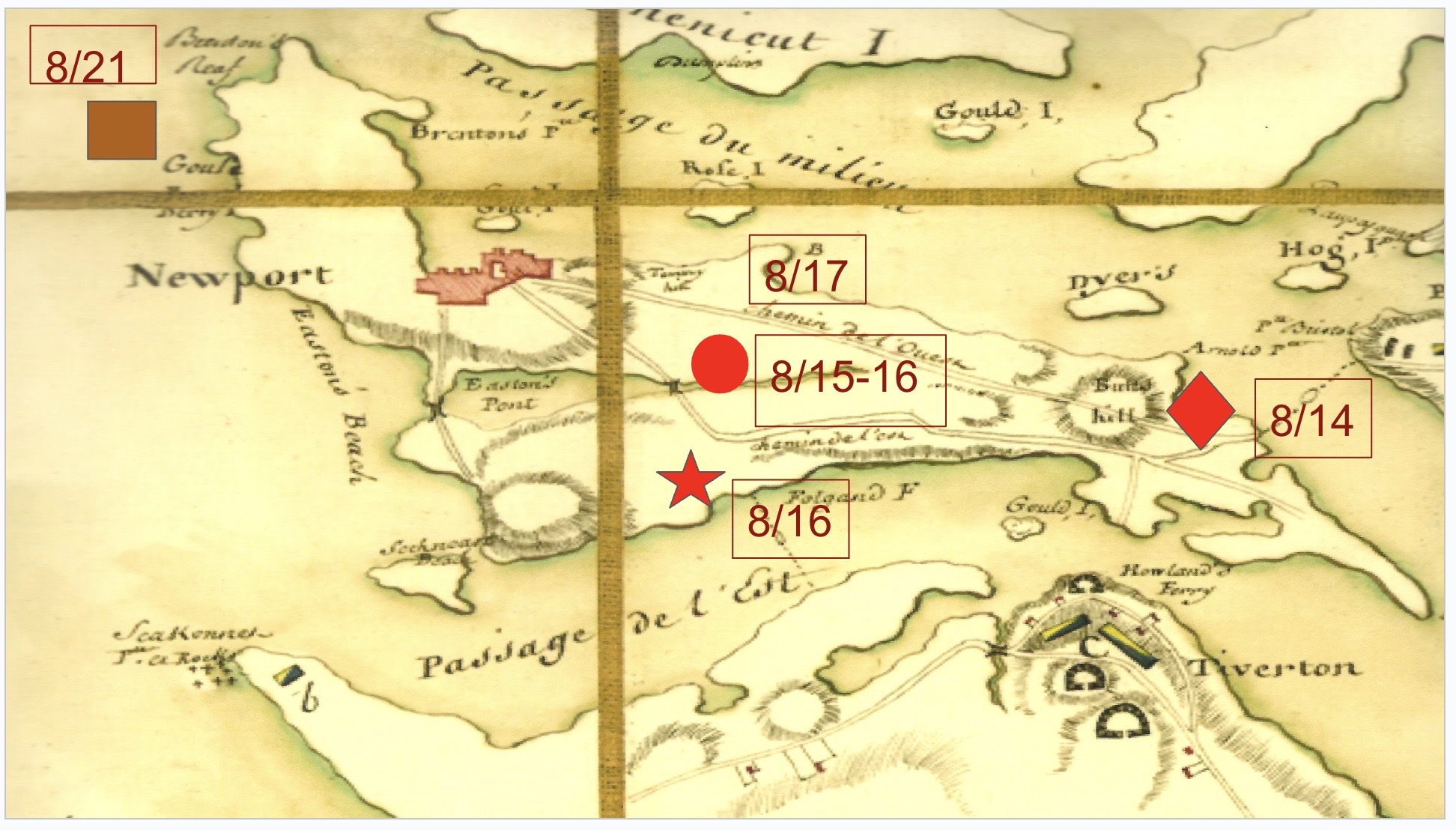
August 14th. The storm ends. Americans begin new earthworks at Butts Hill marked with RED DIAMOND. Early morning the soldiers “examine their arms and renewed their cartridges.” (Cutler’s diary) Supplies had been damaged in the storm.

August 15th. At 6 AM the whole army proceeds to march toward Newport in three columns. Americans halt advance at between 4 and 5 PM within site of the British lines. American lines run from West Main Road to Green End in Middletown marked with a RED CIRCLE.

August 16th. Americans are building a four cannon battery north of Green End marked by RED CIRCLE. The British fire their cannons at them. A diary notes that Lafayette is camped at the Bowler Farm on Wapping Road marked by the RED STAR. 

August 17th. Lafayette is Major General for the day. Siege operations (marked by RED CIRCLE) are in full force. Lafayette oversees the siege works from the top of a house. The British attacked the house and Culter’s diary entry remarks: “Stood by the Marquis when a cannon ball just passed us. Was pleased
with his firmness..”

August 21. Lafayette, General Green and Col. Langdon go aboard the Languedoc marked with a BROWN CIRCLE. The French only agree to take American forces off of Aquidneck Island. Americans would not agree to that and the French fleet would sail away.

Woodcut by Howard Benson in Eric O.D. Taylor’s “The Campaign on Rhode Island.” Used with permission of Benson family.

Source: Life, Journals and Correspondence of Rev. Manassa Cutler. https://archive.org/details/lifejournalscorr01cutl

Paul Revere’s Letter from Rhode Island – August 1778

2 Comments

Did Paul Revere fight in the Battle of Rhode Island? No, but he participated in the Siege of Newport commanding his artillery company. A letter he wrote to his wife in August of 1778 gives us a glimpse of the experience of the American soldiers during the Siege.

We know the story of Revere’s “Midnight Ride,” but he was involved in more of the war effort than that. George Washington came to Boston in the Spring of 1776 days after the British had evacuated. Tradition has it that Washington asked Paul Revere (a craftsman) to repair the damage the British had done to the cannons on Castle Island. Revere was able to make the repairs and worked on a new type of gun-carriage as well. When Washington left Boston he took the majority of the Massachusetts troops with him. Boston was left to defend itself and on April 10th Revere was commissioned a major in the militia raised to defend Boston. Revere was sent to the Bridgewater area to learn from a French foundry man the method of casting of brass and iron to make cannons as well as the forges to make 18 pound shot. Revere would again meet this French foundry man, Louis de Maresquelle (a.k.a Lewis Ansart), when the Frenchman was an aide de camp to General Sullivan during the Rhode Island Campaign.
Newport Artillery Company fires a Paul Revere Cannon

Paul Revere took part in two efforts to remove the British from Aquidneck Island. The presence of the British in Rhode Island was a threat to Massachusetts. In the fall of 1777 Revere’s troops marched to Rhode Island and then back again. Boston printer John Boyle commented: “Nov 1 the 9000 Men lately raised to go upon a Secret Expedition returned home without effecting any Thing.”

Encouraged by the new French alliance, a second expedition was mounted in the summer of 1778. Col. Revere commanded the Boston artillery train and John Hancock was major general of the 3000 member Massachusetts militia. Revere’s heavy artillery headed for Rhode Island. At first Revere was encouraged about their chances of dislodging the British. While on Aquidneck Island Paul Revere wrote to his wife Rachel. (Annotations are added to make the references clearer to our modern readers.)

“My dear Girl,
…Pray take care of yourself & my little ones. I hoped ere this too have been in Newport, my next hope will be dated there. We have had the most severe N. East Storms I ever knew, but thank Heaven, after 48 hours it is over.”

The storm was devastating to all sides. The French and the English warships were severely damaged. American troops had little shelter from the storm.

“I am in high health and spirits, & (so is) our Army. The Enemy dare not show their heads. We have had about 50 who have deserted to us; Hessians and others. They say more will desert & only wait for opportunity. I am told by the inhabitants that before we came on, they burned 6 of their Frigates; they have destroyed many houses between them & us. I hope we shall make them pay for all.”

When the French fleet entered Narragansett Bay on August 5, HMS Orpheus a 32 gun frigate was run aground at Almy’s Point and set on fire a few miles north of Newport on the west side of Aquidneck Island. The Juno, Lark and Cerberus were also scuttled and burned so that the French and Americans would not capture them. The were positioned so that the wrecks would block shipping lanes.

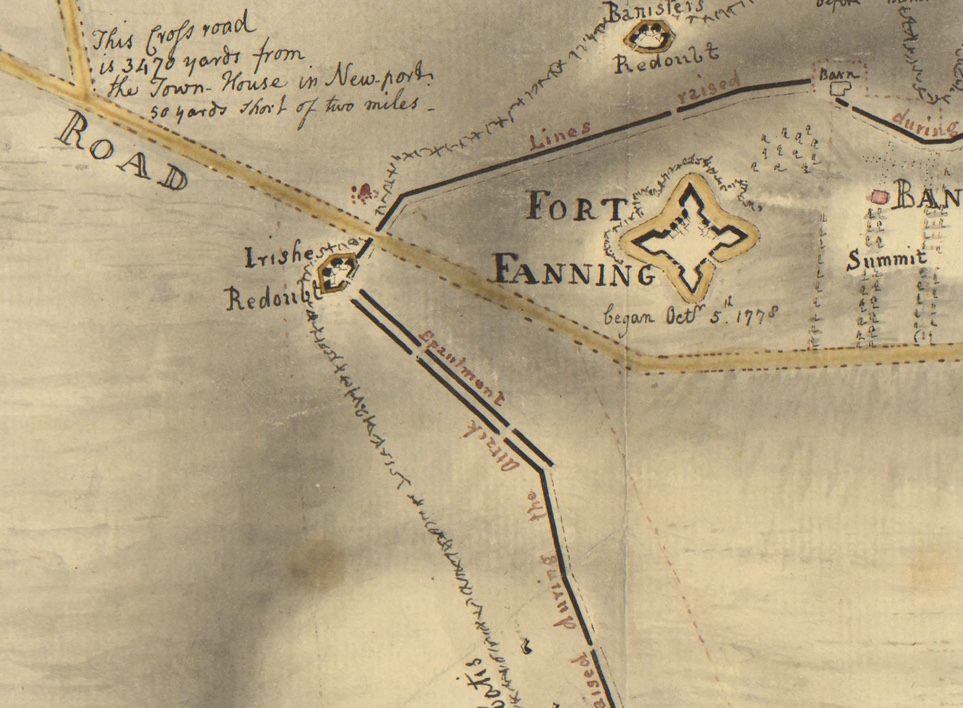
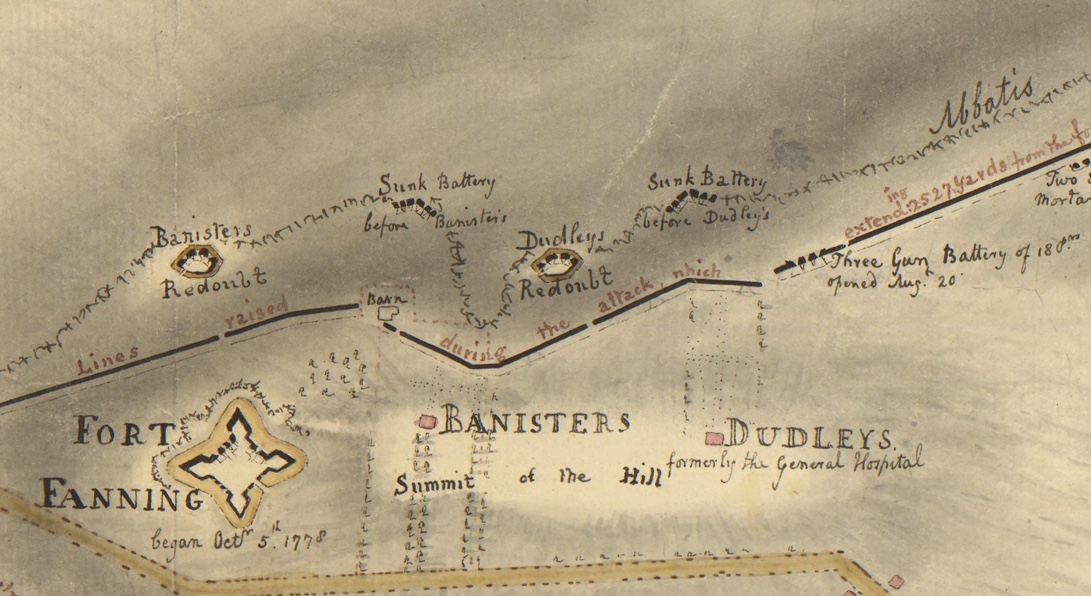
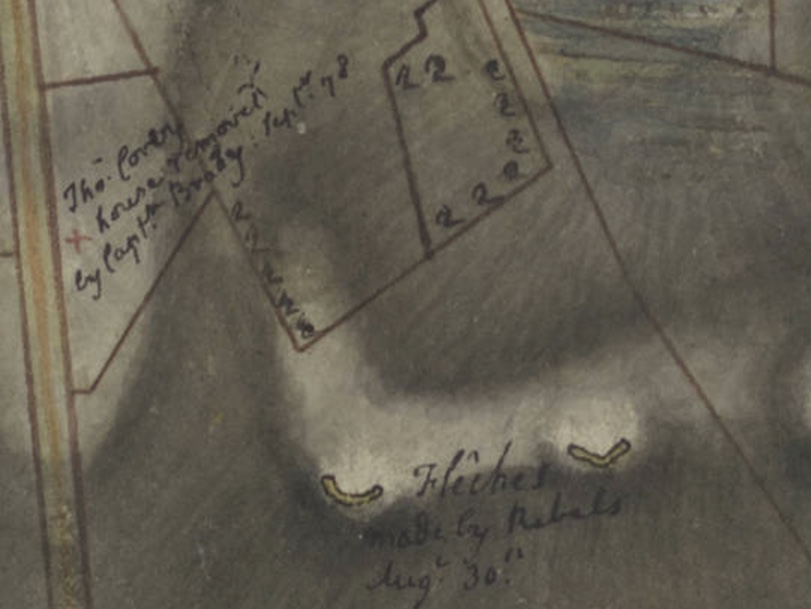
British maps recording the Siege of Newport show where houses were leveled in order to give British cannons a better line of fire.

“The French Fleet are not returned but I just heard they were off Point Judith with 3 frigates, prizes, this, I am told, comes from Head Quarters. I do not assert it for fact, but hope it is true”

When he wrote this letter, Revere was not aware of the damage to the French fleet.

“You have heard this Island is the Garden of America indeed it used to appeal so, but those British Savages have so abused and destroyed the Trees (the greater part of which was Fruit Trees) that it does not look like the same Island; some of the inhabitants who left it hardly know where to find their homes.”

After almost two years of occupation, Aquidneck Islanders lost almost all their trees and anything made of wood – docks, farm tools, wagons.

“Col. Crafts is obliged to act under Col. Crane which is a severe Mortification to him. I have but little to do with him having a separate command.”

Col. Crafts had turned down a military appointment because it was not high enough for someone of his stature. In the Rhode Island Campaign he was under the command of someone he had criticized as not being worthy of his position.

“It is very irksome to be separated from her whom I so tenderly love, and from my little lambs, but were I at home I should want to be here. It seems as if half Boston was here. I hope the affair will soon be settled. I think it will not be long first.”

The phrase, “It seems as if half Boston was here” is often quoted. The Boston militia was there.

“I trust that Allwise Being who has protected me will still protect me, and send me safely to the Arms of her whom it is my greatest happiness to call my own. Paul is well; send Duty and love to all. …Col. Matescall, (Lewis Ansart) who is one of General Sullivans Adi Camps, tell me this minute that the French have took a Transport with British Grenadiers, but could not tell particulars. Your own, Paul Revere”

Paul is Revere’s 18 year old son. He had been his father’s lieutenant and served with him.

When Paul Revere wrote this letter he did not know of the damage to the French fleet. When it was clear that the fleet would not return, the Massachusetts troops under John Hancock began to leave Aquidneck Island. Hancock complained of the length and tiresomeness of the campaign. He had heard that his child was sick and dying and he thought that if the the fleet had gone to Boston, he could facilitate the re-fitting of the ships. Hancock did his best to smooth over the testy relationship between D’Estaing who commanded the French fleet and the Americans.
Back in Boston Revere was losing men to service on three types of ships: privateers, Continental and Massachusetts. Some of his men had lost their blankets on the retreat from Rhode Island and lacked clothing, pay and ways to feed their families. Revere entered the action in Rhode Island with high spirits, but found discouragement in the aftermath.

Resources

Forbes, Esther. Paul Revere and the World He Lived In. Boston: Houghton, Mifflin, 1942. This source provided the background to Revere’s story and the letter from the Siege.

Boyle, John. Journal of Occurrences in Boston, 1759-1778 in N.E. Historical General Register. Quoted in Forbe’s book on Revere.

Cembrola, Bob. Discovery of British Frigates and the University of Rhode Island. Naval war College Museum Blog, April 16, 2020. https://navalwarcollegemuseum.blogspot.com/2020/04/discovery-of-british-frigates-and.html. Accessed Nov. 1, 2023.

The Battle of Rhode Island On the Map

Leave a comment

From Israel Angell’s Diary
Commonwealth Land Title Insurance Co. Map 1926
Library of Congress – Attacks Upon Rhode Island

Huntington Library Map of North Portsmouth

Black Regiment Memorial

zS

Siege of Newport/Battle of RI Map – Rhode Island Historical Society
Denison, J. Map of Newport, Rhode Island, and vicinity showing the disposition of American and British forces in August 1778 [map]. No Scale Provided. Retrieved June 15, 2022, from https://geodata.lib.utexas.edu/catalog/princeton-s7526f86c

The Role of Butts Hill in the Siege of Newport

Leave a comment

This blog is part three of information that might be provided on a tour of Butts Hill Fort today. We are at the southern fortifications.

The narrative of our tour of Butts Hill Fort has taken us through the British improvements to the fortifications. This part of the story takes us to the three weeks in August of 1778 when the Americans held this high position during the Siege of Newport.

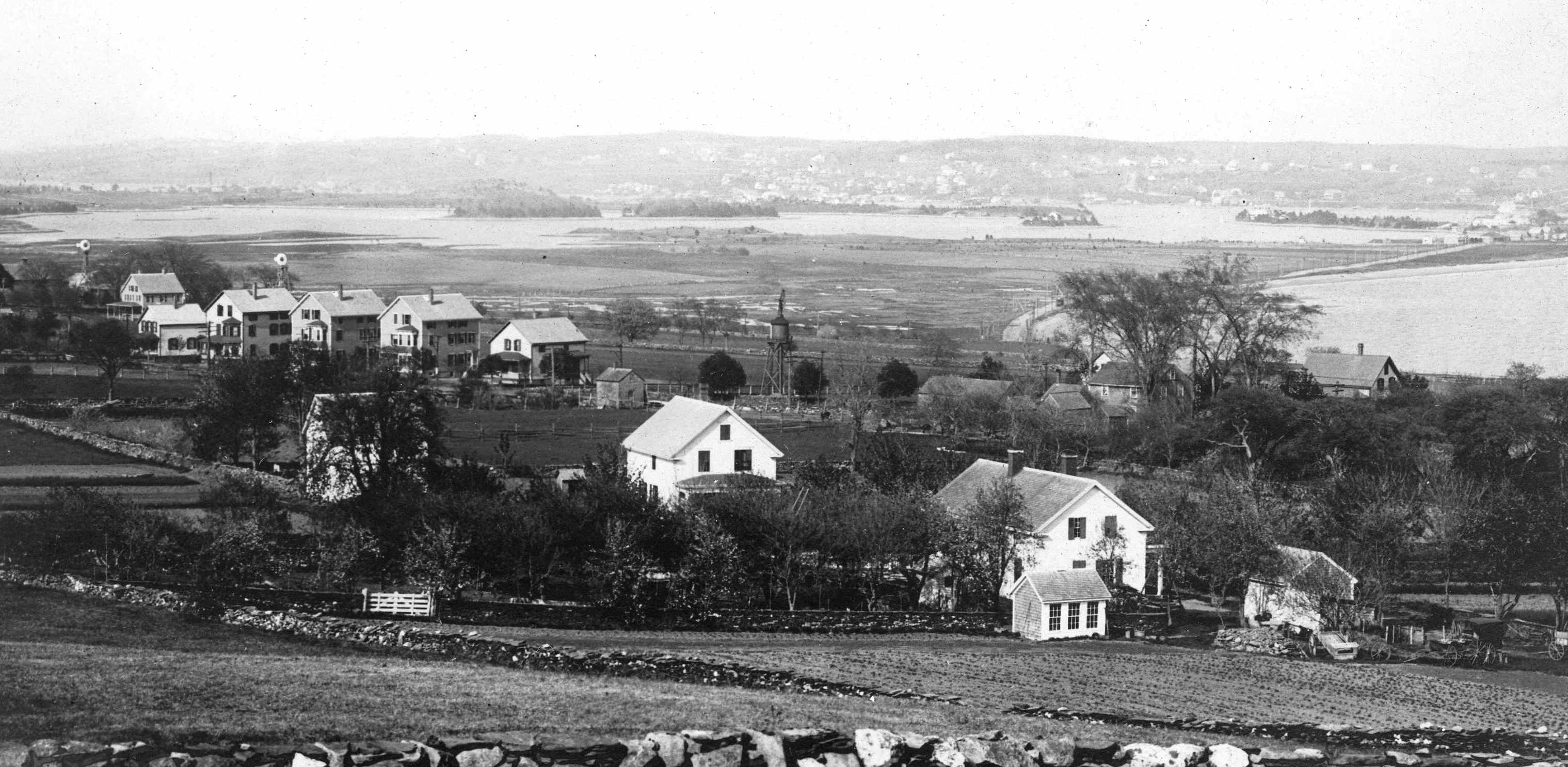
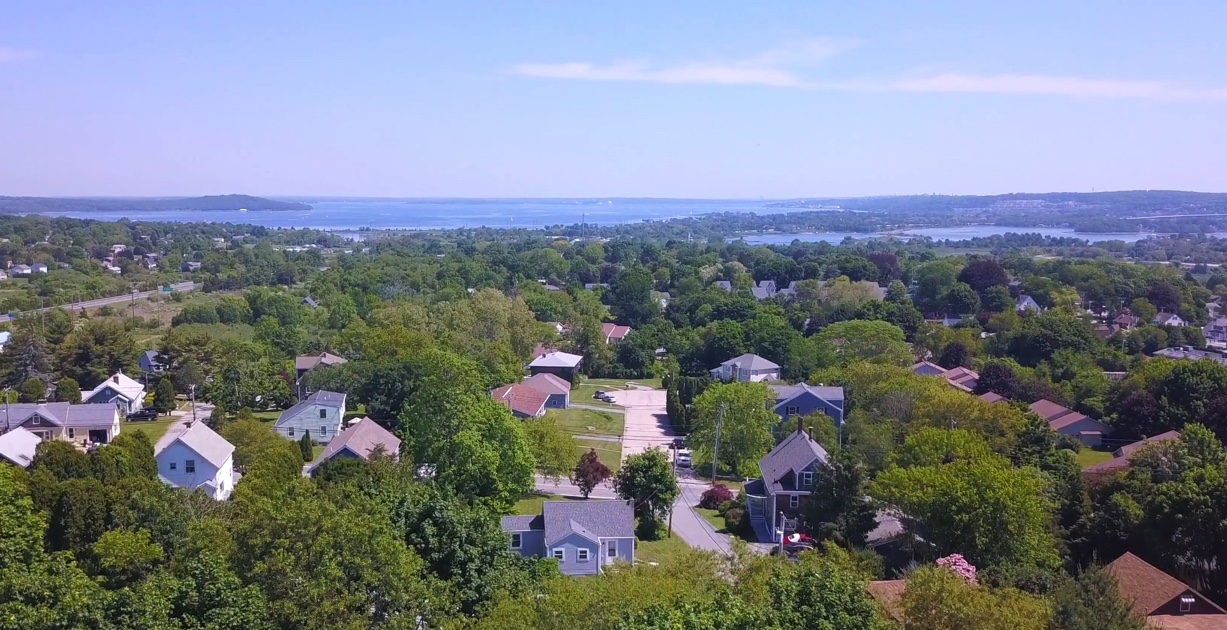
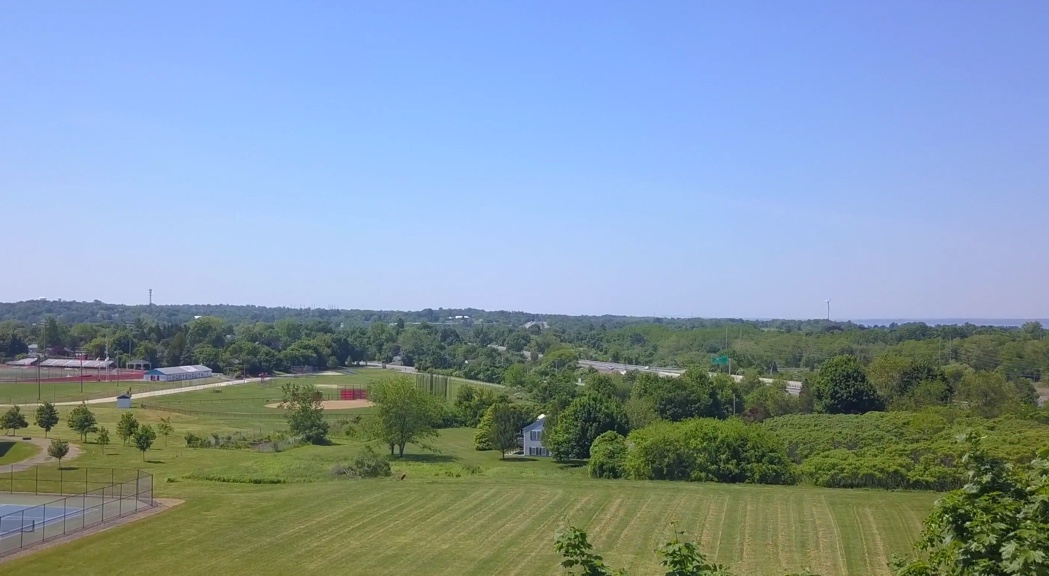
Drone images from Butts Hill illustrate what a commanding view was possible from this location. The British were concerned with the view of possible American invasions from the North from Bristol and Tiverton. For the Americans, however, the view south was essential.

With the French sailing to Newport to help the American forces, Butts Hill became a strategic site.

July 29th: d’Estaing met with American Commanders when he arrived at Point Judith. Plans called for Sullivan’s American forces to cross from Tiverton to Aquidneck Island and advance to the British fortifications at Butts Hill. The French would land on Conanicut Island (Jamestown) before arriving in Newport to cut off the British forces.

August 9th: Fearing an attack, British forces abandoned Butts Hill and General Pigot withdrew his forces to Newport as the French were landing on Conanicut. Sullivan discovered that the British had abandoned Butts Hill, so he crossed over to Aquidneck and occupied the high fortifications. He called for the heavy cannon at Fox Point to be moved to Portsmouth. Sullivan was supposed to wait until August 10.

August 11: Most of the American troops were camped about Butts Hill. The diary of Rev. Manasseh Cutler who served as chaplain for American General Titcomb’s Brigade, provides a few glimpses of what was going on around Butts Hill. He wrote on August 11th that at 4 o’clock the whole army paraded and passed in review by the general officers. “The right wing of the army was commanded by General Greene and the left by the Marquis de Lafayette.”

August 12-13: A hurricane hit that destroyed men, horses, camps and supplies on both the British and American sides. Rhode Island’s governor (William Greene) replaced the ruined powder on the American side.

August 16: As the Americans built earthworks and dug trenches toward Newport, American reserves and the sick who were healthy enough to do garrison work remained at Butts Hill which served as Sullivan’s headquarters.

August 17: Sullivan calls a council of War. All officers recommend holding positions until they could be reinforced.

August 26: Americans now know that the British fleet is coming and that it would be at least three weeks before French would arrive. They begin to send their heavy cannon back to northern locations like Butts Hill. The Council of War again determines to hold American positions until they could be reinforced. General Sullivan began to prepare for a retreat. He knew that enemy reinforcements were coming and his best course was to retreat. Cutler’s entry on Monday, August 24th “As much of the heavy baggage moved off last night as possible. A body of men retreated to strengthen the works at Butts’ Hill. At the lines – heavy fire – army preparing to retreat.” Cutler’s story ends on August 26th when he, like many in the militias, escaped to Tiverton and away from battle.

This was not a hasty retreat. Sullivan ordered increased defenses in the North (especially Butts Hill and fortifications guarding the Bristol Ferry and the ferry to Tiverton). He wanted to get all his weaponry out so it would not fall into enemy hands to use against them another day. In his letter to Congress after the retreat, he makes it clear that this was an “unanimous” decision to first retreat to Portsmouth and hope that the French would return.

Initial positions of Americans

Resources

Providence Gazette on September 26, 1778. “Letter from the Hon. Major General Sullivan to the President of Congress dated headquarters Tiverton, August 31, 1778″.

Cutler’s Diary is found in Edwin Stone’s “Our French Allies.” This is an old book (1884, Providence) but it was a great help. It is available online through Google Books. https://www.google.com/books/edition/Our_French_Allies/YY8LAAAAIAAJ?hl=en&gbpv=1

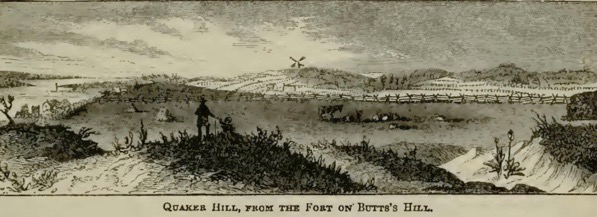
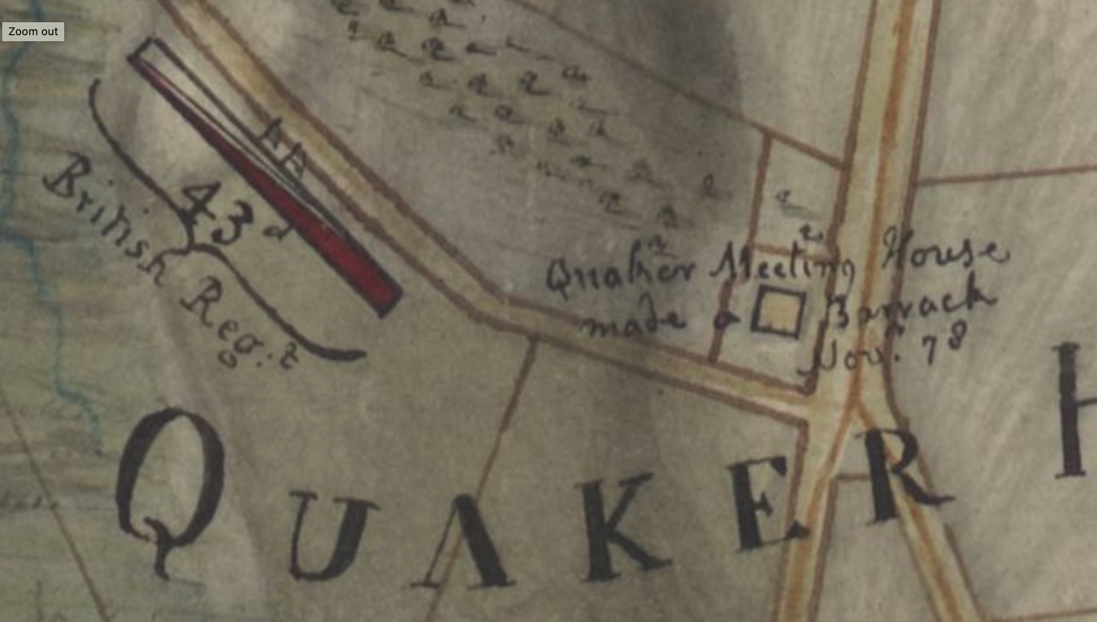
Image of Quaker Hill: Benson John Lossing, ed. Harper’s Encyclopedia of United States History (vol. 7) (New York, NY: Harper and Brothers, 1912)

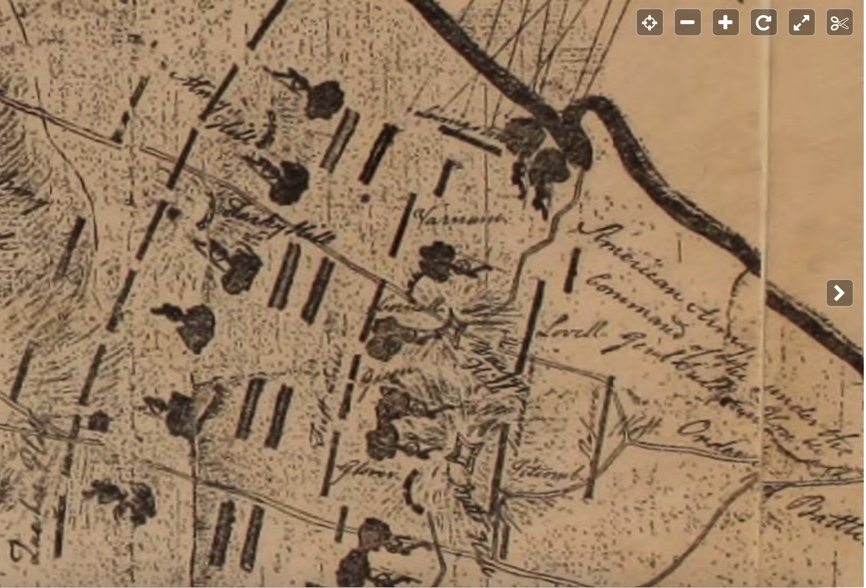
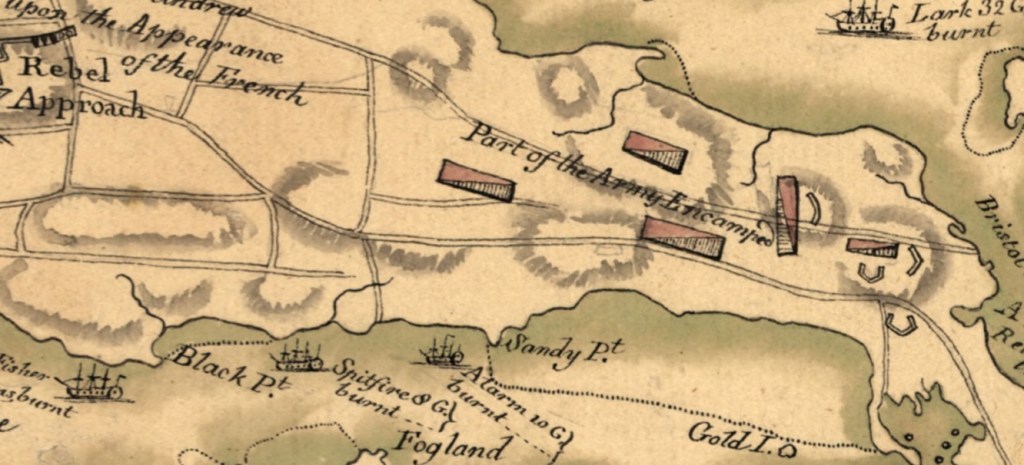
A map of part of Rhode Island shewing the positions of the American and British armies at the Siege of Newport, and the subsequent action on the 29th of August 1778. [1807]. Original in Boston Public Library Leventhal Map Center.

The British Scuttle Their Ships

Leave a comment

Recorded in the London Gazette is a letter from Major General Pigot to General Clinton – dated August 31st, 1778. From this letter we learn of the preparations the British made with the threat of French ships approaching. With the appearance of the French, Pigot began to gather provisions, ammunitions and stores of goods in order to prepare a fortified camp.

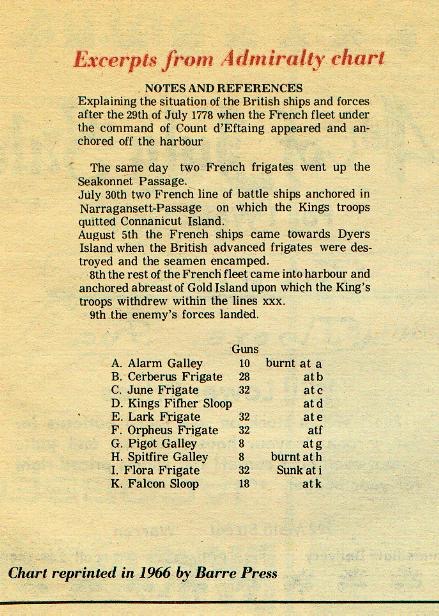
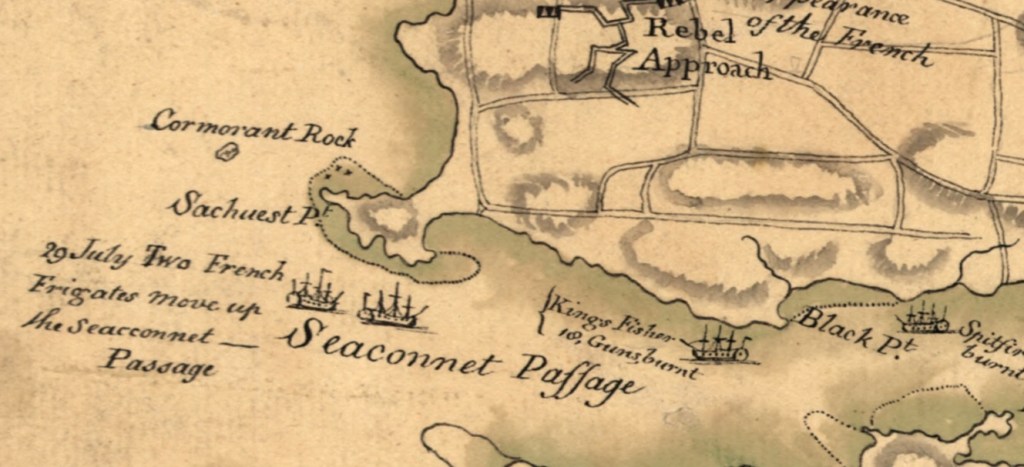
With the French in the Sakonnet, Pigot ordered the Kingfisher and two Galleys (Alarm and Spitfire) to be set on fire; and afterwards … the four advanced Frigates (Juno, Orpheus, Cerberus, Lark). These ships were destroyed to keep them from being captured.

According to the annotations by John Hattendorf:

  1. Kingfisher was a sloop. She was deliberately set on fire, broke from anchorage and blew up off High Hill Point in Tiverton
  2. Alarm was a galley. She was set on fire and exploded south of McCorrie Point.
  3. Spitfire was a galley. She also was set on fire off High Hill Point in Tiverton.
  4. Juno was sunk in Coddington Cove.
  5. Orpheus was sunk off Melville.
  6. Cerberus was sunk about 400 feet off Carr Point.
  7. Lark was sunk on the south side of Arnold’s Point in Portsmouth.

A few years ago I had come across a newspaper clipping dealing with these scuttled British ships. I’m not sure where the clippings came from, but Barre Press 1966 was sited in the article. Note that Flora, Pigot and Falcon are also listed as burned or sunk. Red circles show the locations of the downed ships.


The ship locations also appear on an early map 1778- Attacks upon Rhode Island that is in the collection of the Library of Congress.

Resources:

John Hattendorf – The Battle of Rhode Island in 1778: the Official British View as Reported in the London Gazette.2021 Stone Tower Press, Middletown, Rhode Island