Home

Rhode Island Commanders in the Battle of Rhode Island

Leave a comment

Major General Nathanael Greene: He was born into a Quaker family in the Coventry area of Rhode Island. Greene worked as the resident manager of the Coventry Iron Works, working at the forge making large ship anchors and chains until you enlisted in the army. Although of Quaker background, he was active early in the colonial fight against British revenue policies in the early 1770s. He was self educated and valued books and learning – especially about military topics. He helped establish the Kentish Guards, a state militia unit, but a limp prevented you from joining it. Rhode Island established an army after the April 1775 Battles of Lexington and Concord. Greene was tapped to command it. Later that year he became a general in the new Continental Army. He served under George Washington in the Boston campaign, the New York and New Jersey campaign, and the Philadelphia campaign. He was appointed quartermaster general of the Continental Army in 1778, but reserved the right to command troops in the field. Before the Battle of Rhode Island, he was placed in charge of the right flank of the army. He had the reputation of being one of Washington’s most talented Generals. In 1780 Washington put him in charge of the Army’s Southern Campaign and he fought through the end of the War.
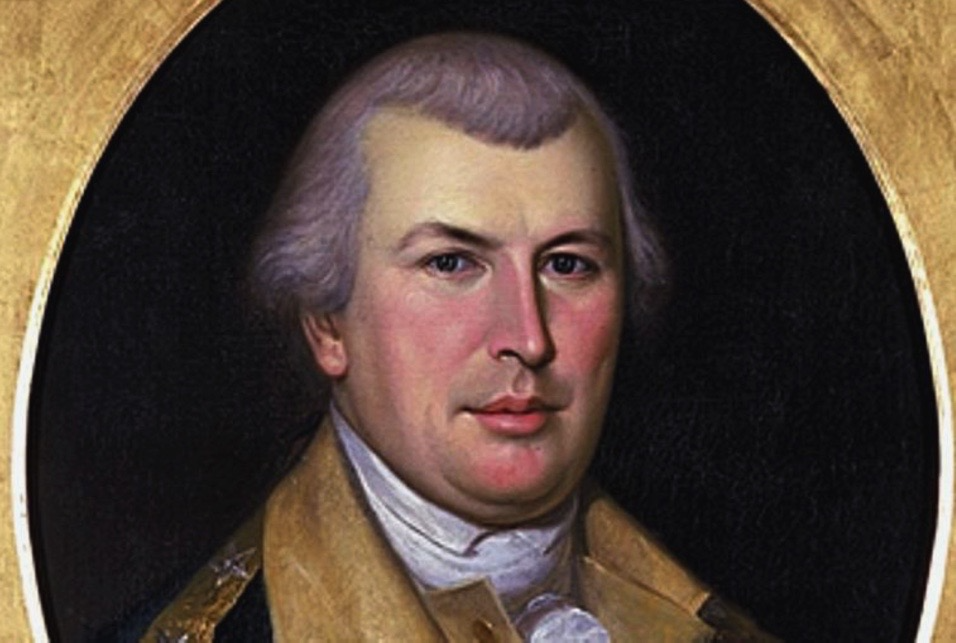
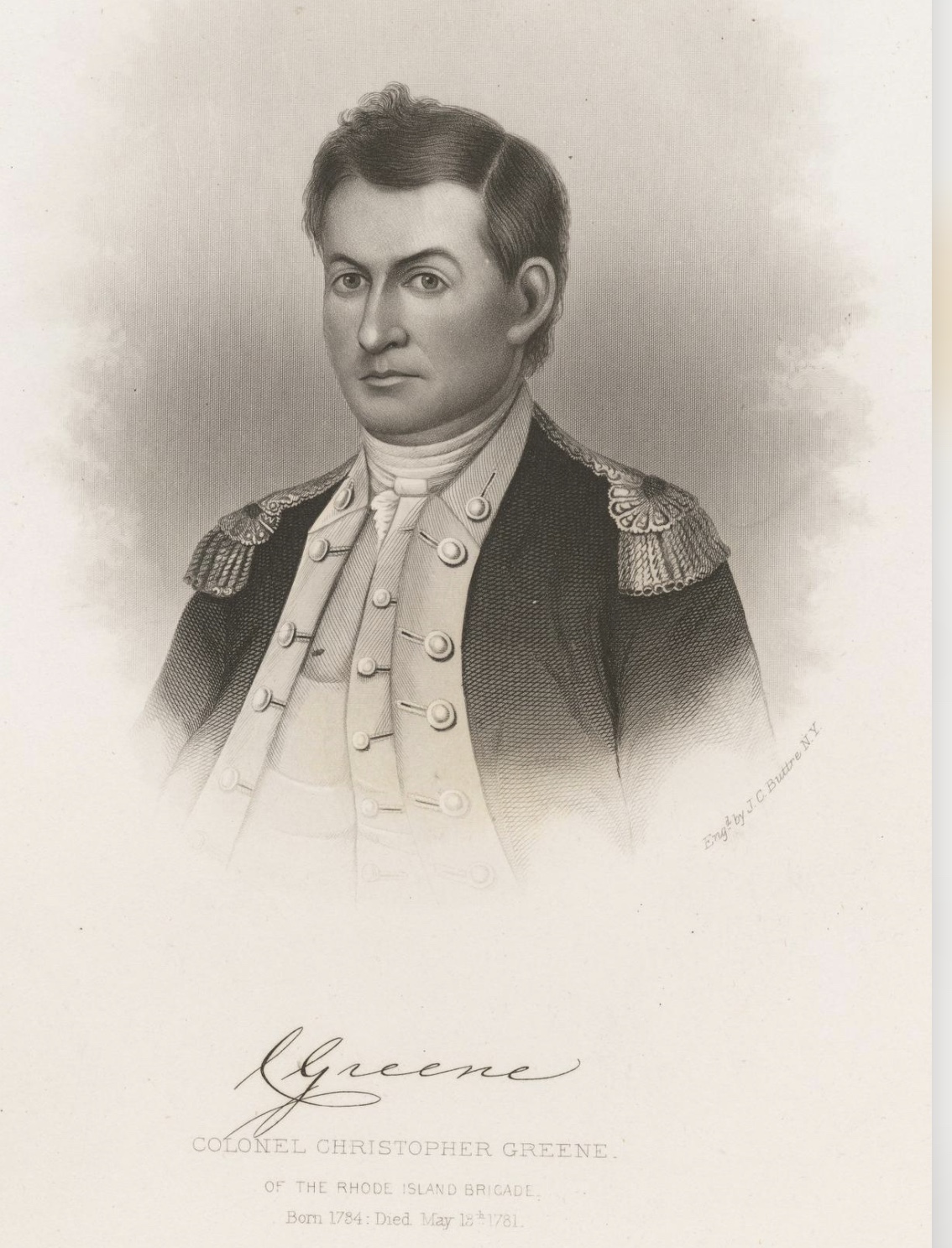
Col. Christopher Greene: He had long Rhode Island roots. He was a descendent of Rhode Island founder Roger Williams. Christopher Greene was a distant cousin of Nathanael Greene. Before the Revolutionary War, Christopher Greene served in the Rhode Island legislature from 1771 to 1772. With Nathanael he helped organize a militia unit, the Kentish Guards. After the Battles of Lexington and Concord he joined the army around Boston. He voluntarily joined Col. Benedict Arnold and was promotion to lieutenant colonel. He was with Arnold at the siege of Quebec and was was captured. He was released in August 1777 and joined the Continental Army for the Philadelphia Campaign. He was given command of the First Rhode Island Regiment. He defended Fort Mercer on the Delaware River. Washington agreed to enlist blacks and indigenous men to fill the ranks of a Rhode Island Regiment. The enlistments granted the soldiers their freedom if they served throughout the war. It benefited their owners with compensation. Christopher Greene was in charge recruiting, training and leading the 1st Rhode Island (the Black) Regiment. Colonel Greene died on May 14, 1781 at the hands of Loyalists by his headquarters on the Croton River in New York.

Col. Israel Angell: Angell came from one of the founding families of Providence. He served throughout the Revolutionary War. He was a major in Hitchcock’s Regiment at the beginning of the war and served with that regiment at the Siege of Boston. As the Continental Army was organized in 1776, Angell was part of the 11th Continental infantry. When Hitchcock was appointed brigade commander, he commanded the regiment. His regiment was re-named the 2nd Rhode Island Regiment on January 1, 1777. He was promoted to lieutenant colonel and shortly after to Colonel. He commanded the regiment following the death of Hitchcock. Angell was an experienced soldier who served at Valley Forge, the Siege of Boston, Brandywine, Red Bank, Monmouth and then the Battle of Rhode Island. At the Battle of Rhode Island he commanded 260 men. American General Nathanael Greene ordered Colonel Israel Angell’s 2nd Rhode Island Regiment to support Ward’s 1st Rhode Island Regiment. They were able to reach the key artillery redoubt before the British forces. He served in New York, but he retired from the army on January 1, 1781, after the two Rhode Island regiments were consolidated into a single regiment known as the Rhode Island Regiment.

Major Silas Talbot: He was born in Dighton, Massachusetts. He trained as a mariner and as a builder and made his home in Providence. In the aftermath of the burning of the Gaspee and the Boston Tea Party, Rhode Island merchants were alarmed.  Independent militias were forming and he joined and was commissioned as a Lieutenant.  He joined others in his company in learning military skills in a Providence warehouse, but he didn’t have any real military experience. On June 28, 1775 he answered the Rhode Island Assembly’s call to send units to Boston.  He marched with his men to join the Second Rhode Island Regiment and by July 1, he was commissioned a captain.  Talbot and the other 1200 men in the Rhode Island brigade took part in the Siege of Boston watching over the Red Coats but not in direct battle.  His skills as a bricklayer came in handy as they built barracks on Prospect Hill.  By April of 1776 the Siege was over and Rhode Islander Esek Hopkins, Commander in Chief of the Continental Navy, needed a crew to sail the ships home to Providence.  Washington offered to loan Hopkins men from the Rhode Island Regiment and he switched from soldier to sailor. He was involved in the Rhode Island Campaign. As someone with experience as a mariner and builder, he helped to construct the flatboats that would take American forces to Portsmouth on August 9th of 1778. During the Battle of Rhode Island, Talbot led men in the early skirmishes on West Main Road. Talbot had success fighting on both land and sea. In 1779 he was made a Captain in the American Navy after he captured a British ship.

Major Samuel Ward: Ward was the son of a Rhode Island governor. His military career began when you were commissioned a captain in the Army of Observation in May, 1775, at the age of eighteen. He participated in Benedict Arnold’s attack on Quebec in December, 1775, under Lieutenant-Colonel Christopher Greene. He was taken prisoner by the British and released in August, 1776. He was promoted to the rank of major in the First Rhode Island Infantry and, between 1776 and 1778, served with his regiment at Morristown, New Jersey (1777); Peekskill, New York (1777); Red Bank (Fort Mercer) under Christopher Greene (1777); Valley Forge (1778); and the Battle of Rhode Island (1778). Ward retired from the Continental Army on January 1, 1781, when the 1st and 2nd Rhode Island Regiments were consolidated into the Rhode Island Regiment. Ward was the grandfather of Julia Ward Howe

General James Mitchell Varnum: Varnum was born in Massachusetts but he came to Rhode Island to attend Brown. He married and set up a law practice in East Greenwich, and he independently studied military affairs. In October of 1774 he became a founder and commander of the Kentish Guards a imilitia company in East Greenwich, Rhode Island. With the fighting at Lexington and Concord, Varnum started to march his militia to Boston but they were not needed and headed home. In May 1775 Varnum was commissioned as a Colonel of the 1st Regiment of Rhode Island. By 1776 the regiment was folded into the Continental Army under the command of Brigadier General Nathanael Greene, Varnum’s friend. From Varnum and his Rhode Islander troops took part in participated major engagements including the Battle of Bunker Hill and the Battle of Rhode Island. Varnum and his men were at Valley Forge. Varnum was another proponent of raising a regiment of black and indigenous soldiers. In March 1779, he retired from the Continental forces and accepted a commission as Major General of the Rhode Island militia. Upon returning home to East Greenwich he was elected to the Continental Congress in 1780.

Commanders of the Battle: Laurens and Talbot

Leave a comment

Lt. Colonel John Laurens – 1754-1782

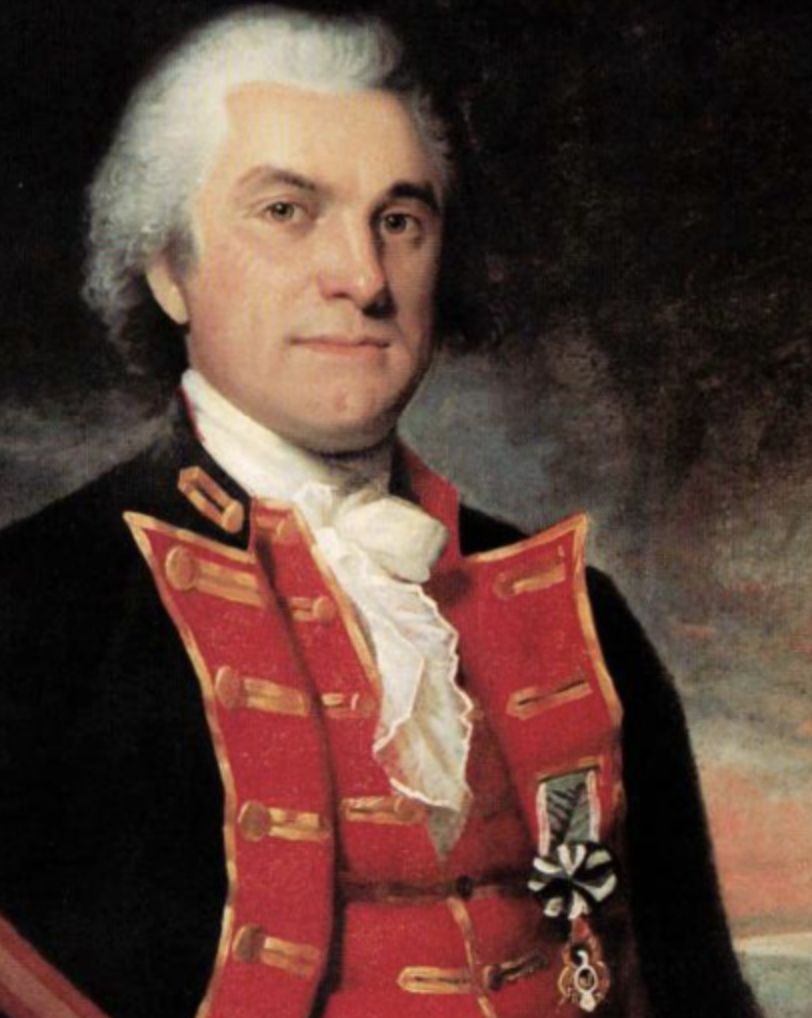
John Laurens was from a wealthy South Carolina family. He was educated in England and arrived in Charleston in 1777. He wanted to join the Continental Army, and his father Henry secured a position for his 23 year old son. His father would serve in the Continental Congress. George Washington invited him to join his stall in August of 1777 as a volunteer aide-de-camp. Laurens became close friends with two other aides – Lafayette and Alexander Hamilton. On September 11, 1777 he served at the Battle of Brandywine and later the Battle of Germantown in which he was wounded. He was known for his recklessness, but he was given his official position of aides-de-camp to Washington and commissioned a lieutenant colonel. He served at the Battle of Monmouth in June of 1778.

John Laurens
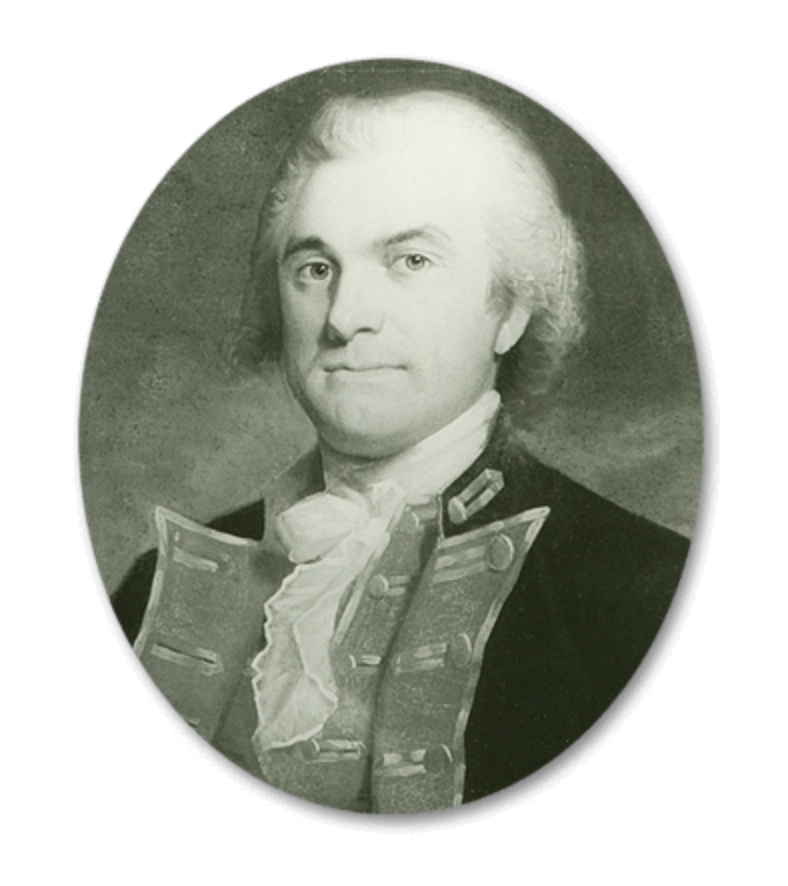
Silas Talbot

Major Silas Talbot – 1751 – 1813

Talbot was born in Dighton, Massachusetts. He was trained as a mariner and as a builder and made his home in Providence. In the aftermath of the burning of the Gaspee and the Boston Tea Party, Rhode Island merchants were alarmed.  Independent militias were forming and Talbot joined and was commissioned as a Lieutenant.  He joined others of his company in learning military skills in a Providence warehouse, but he didn’t have any real military experience. On June 28, 1775 Talbot answered the Rhode Island Assembly’s call to send units to Boston.  He marched with his men to join the Second Rhode Island Regiment and by July 1, he was commissioned a captain.  Talbot and the other 1200 men in the Rhode Island brigade took part in the Siege of Boston watching over the Red Coats but not in direct battle.  Talbot’s skills as a bricklayer came in handy as they built barracks on Prospect Hill.  By April of 1776 the Siege was over and Rhode Islander Esek Hopkins, Commander in Chief of the Continental Navy needed a crew to sail the ships home to Providence.  Washington offered to loan Hopkins men from the Rhode Island Regiment and Talbot switched from soldier to sailor. Silas Talbot was intimately involved in the Rhode Island Campaign. As someone with experience as a mariner and builder, Talbot helped to construct the flatboats that would take American forces to Portsmouth on August 9th of 1778.

Accounts of Members of Sullivan’s Life Guards: Daniel Bowen

Leave a comment

According to the pension application testimony of Daniel Bowen, Sullivan’s body guard was recognized by Congress as a part of the Continental Army. (War Department Communication dated December 1, 1819). This was a company of volunteers called a “Life Guard” to Major General Sullivan who was appointed commander of the state of Rhode Island. He remembers Aaron Mann, Levi Hoppen, George Potter and John Prescott (may be John Wescott) as officers of the group.

Sullivan sent in his Life Guard to reinforce the American troops at Quaker Hill and there was intense fighting there.

From his testimony

“Our circumstance however, I recollect , —service between Butts and Tominy Hills, the Sullivan guards did not arrive at the commencement of the action and as we neared __ up to meet the British, we could but meet by some carrying off
The wounded, who said to us, “that’s right my boys, go and give it to them’ as the were borne off, upon the shoulders of their comrades. And we did go on, until we were overpowered by numbers.”

Bowen would go on to serve with Silas Talbot on the Sloop Argo and then aboard the Privateer Washington (a ship of 20 guns) which was also commanded by Talbot. The Americans were taken prisoner and ultimately exchanged for British prisoners.

Bowen called his Revolutionary War experience “days of danger and fatigue and repeated misfortunes.”

Resources:
Case Files of Pension and Bounty-Land Warrant Applications Based on Revolutionary War Service, compiled ca. 1800 – ca. 1912, documenting the period ca. 1775 – ca. 1900. I accessed this through Fold3 military records online.

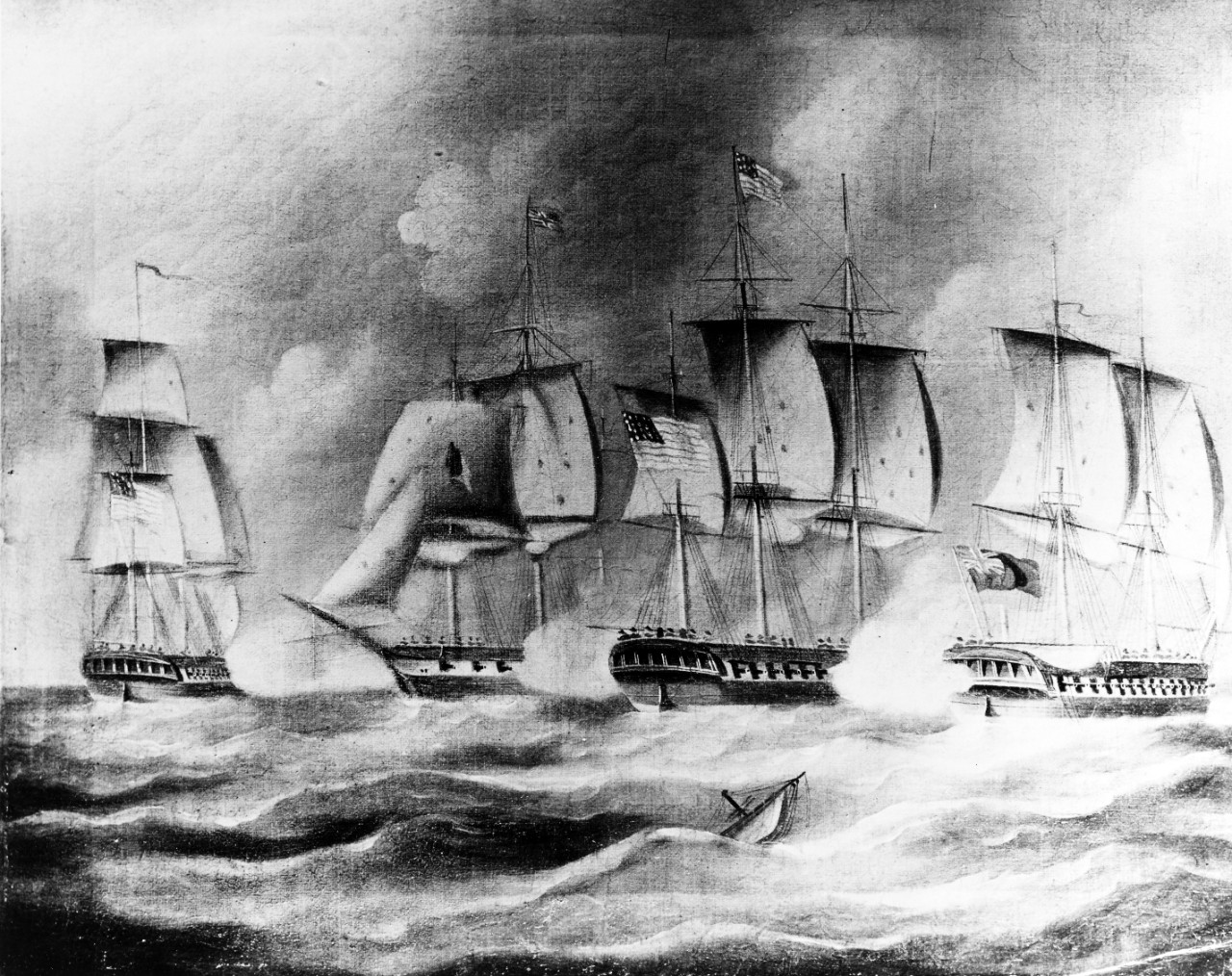
Image: PIGOT and ARGO capture British schooner LIVELY and two privateers, off the coast of Providence. Naval History and Heritage Command.

Silas Talbot and the Capture of the Pigot

Leave a comment

In a previous post I set the stage for the story of Talbot’s capture of the British ship Pigot. Right after the Battle of Rhode Island, Lafayette suggested a plan to remove a British schooner that had been blocking Narragansett Bay. He reached out to Silas Talbot because Talbot was a seaman who knew the Rhode Island waters. Talbot agreed to the plan, but he had profit in mind as well as serving the American cause.

As he was preparing for the attack, Talbot met with Nicholas Cooke, the Governor of Rhode Island. Cooke owned a ship called “Hawke” and with the help of local Providence merchants, the Hawke was fitted out and armed for the mission. General Sullivan gave Talbot permission to recruit Continental soldiers. Talbot was acting as a privateer. The Battlefield Trust definition of privateer is: “the term privateer refers to a privately-owned ship or sailor commissioned by a government to raid an enemy’s military and merchant shipping. Although controversial, there is a long history of privateering that dates back to the seventeenth century. The main difference between pirates and privateers is that privateers are commissioned by a specific government and can only attack ships that fly under an enemy flag, while pirates are not sanctioned by any government and can attack whomever they choose.”

Talbot had made a deal. Talbot and his men, fifty percent / Cooke and his associations, fifty-percent.

October 25, 1778, the Hawke made its way from Providence to a remote anchorage off of Bristol. The next day the Hawke sailed passed the Bristol Ferry area to Mount Hope in Bristol. Two days later she quietly made her way down the Sakonnet River. They moved toward the Pigot, but a sentry saw it and began firing from a battery on Aquidneck Island (perhaps by Fogland Ferry). Talbot took the Hawke to safety up the Taunton River and he took a small boat down to the Sakonnet River to spy on his quarry (he may have gone on horseback). He saw that the Pigot had netting to defend it from an invading party, so when he returned to the Hawke he ordered a kedge anchor lashed to the jib boom. Talbot was finding a way for the Americans to get through the defensive netting by ramming through it with their spare anchor as a point.

On the night of October 28, 1778, the Hawke sailed from the Taunton River to the Sakonnet River. The sentries at the Fogland Batteries did not see her. When the Hawke got within sight of the Pigot, Talbot positioned his craft so he could ram his jib boom and kedge anchor through the netting to shred it. The crew of the Hawke swarmed over the deck of the enemy skip. The Pigot crew stayed below deck, but the captain was the only one to resist. The prisoners were locked below while members of the Hawke crew sailed the Pigot to Stonington, Connecticut.

British Lieutenant Frederick Mackenzie recorded the event in his diary – 29 October, 1778:

“The galley off Black Point in the Sakonnet with eight twelve pounders and two eighteen pounders plus swivels was surprised this morning about 02:00 by rebels, who boarded and took her with little or no resistance. They cut her cable and stood out to sea. We sent the King George privateer to chase them but they got clear off toward New London.”

This was a profitable venture for Talbot. The Rhode Island General Assembly voted him a silver sword and the Continental Congress promoted him to Lieutenant Colonel. His share of the sale of the Pigot was 500 pounds.

Silas Talbot would go on to further adventures with the Pigot. The website of Naval History and Heritage Command reports: “In the spring of 1779, the Navy Board at Boston purchased prize Pigot, and she operated under Talbot as the Argo guarding Narragansett Bay. During Argo’s cruises she alone kept these important waters open to vital American coastal shipping. Legend holds that she was subsequently burnt.”

Sketch of Pigot from Heritage of Courage.

Resources:

Fowler, William. Silas Talbot Captain of Old Ironshides. Mystic Seaport, Mystic Connecticut, 1995.

” Silas Talbot and the British warship Pigot, 29, October 1778″. Heritage of Courage. John Peck Rathbun Chapter Rhode Island Society, Sons of the American Revolution, 1992.

Diary of Frederick Mackenzie. Harvard University, Cambridge: 1930.

Article of Pigot in Naval History and Heritage: https://www.history.navy.mil/research/histories/ship-histories/danfs/p/pigot.html

The Adventures of Silas Talbot

Leave a comment

When Lafayette wrote Silas Talbot about a plan to capture the British vessel Pigot, he alluded to Talbots’s “reputation which you have already acquired by your zeal and skill in the artificial way (as a mechanic in the military).” Talbot was known as an “artificer” – “a soldier-mechanic attached to the artillery and engineer service, whose duty it is to construct and repair military materials.” 1. What was there in Talbot’s military history that had him known as a someone who could devise, construct and repair for a military campaign? Talbot had a record of invention, construction and even “daring do” to get the job done. All his past experiences made him useful to the American cause.


Silas Talbot was intimately involved in the Rhode Island Campaign. As someone with experience as a mariner and builder, Talbot helped to construct the flatboats that would take American forces to Portsmouth on August 9th of 1778. As a soldier, Talbot fought in the rear guard to protect the Patriots as they retreated to Tiverton on August 29th and 30th, 1778. Talbot alternated between roles as sailor and soldier throughout the American RevolutionSilas Talbot’s life was full of adventures. There were “rags to riches” stories and then again there were stories of monetary downfall. He was wounded in naval battles and sustained injuries on the Revolutionary War battlefields but he kept getting back into the action. This article will focus on some of those adventures of a representative figure in Revolutionary Rhode Island
Talbot came from a humble background. He was born to a farming family in Dighton, Massachusetts in 1751. His father died when he was twelve and Silas was indentured to a local stonemason. He learned his skills as a bricklayer, but Dighton was a seaport and Silas signed on as a sailor on sloops transporting cargo from Narragansett Bay to as far as the Carolinas. By 1770 Silas settled in Providence where some of his older siblings had established themselves. Silas’ bricklaying skills were put to work in construction. Talbot wanted property and he put aside enough money to buy a lot of land on Weybosset Street. In 1772 Talbot married well. He continued to purchase land and he also began to purchase slaves. Owning a black servant was a status symbol for Talbot. He moved from being a laborer to owning a construction business.


In the aftermath of the burning of the Gaspee and the Boston Tea Party, Rhode Island merchants were alarmed. Independent militias were forming and Talbot joined and was commissioned as a Lieutenant. He joined others of his company in learning military skills in a Providence warehouse, but he didn’t have any real military experience. On June 28, 1775 Talbot answered the Rhode Island Assembly’s call to send units to Boston. He marched with his men to join the Second Rhode Island Regiment and by July 1, he was commissioned a captain. Talbot and the other 1200 men in the Rhode Island brigade took part in the Siege of Boston watching over the Red Coats but not in direct battle. Talbot’s skills as a bricklayer came in handy as they built barracks on Prospect Hill.

By April of 1776 the Siege was over and Talbot and the Rhode Island men were proud to welcome General Washington as he passed through town. As Washington arrived in New London, Rhode Islander Esek Hopkins presented Washington with a problem. Hopkins was Commander in Chief of the Continental Navy. Hopkins had sought safety in New London harbor after damage to his ships. Hopkins needed a crew to sail the ships home to Providence. Washington offered to loan Hopkins men from the Rhode Island Regiment. “All those acquainted with Sea Service that have a mind to join the Admiral as Volunteer have Liberty.” Silas Talbot took that opportunity to sail home to Providence. This was the first example of how Talbot’s military service frequently switched between the army and the navy. In August of 1776 he joined the Rhode Island troops in New York. In September he took part in an attempt to place a “fireship” (literally a ship set on fire with combustibles ) next to a British ship to catch it on fire. Talbot stayed on the “fireship” as long as he could to get it closer to the British vessel. Unfortunately the fireship did little damage, but Talbot was gravely burned.

While Talbot healed he served as a recruitment officer to enroll more Rhode Island troops to the cause.
Talbot’s adventures continue in the next article.

Definition from Century Dictionary

Biographical information from William Fowler Jr’s Silas Talbot: Captain of Old Ironsides

Lafayette and Silas Talbot: the Pigot Plot

Leave a comment

We tend to think of the Rhode Island Campaign ending as the Americans retreated to Tiverton. I have been researching the movements of Lafayette in Rhode Island and I am more aware of the actions of the Continental troops on the East and West Bays directly after the retreat. Lafayette wrote letters that provide us with clues to what was happening in the East Bay. The Americans were successful in moving their troops and equipment off Aquidneck Island, but the decision of the French to leave for Boston to repair their ships left bitter feelings. Lafayette had an idea for a small victory to boost morale. On September 8th, 1778 he wrote to Silas Talbot . I am quoting the letter, but phrasing some of it in more modern language.

Sir,

The reputation which you have already acquired by your zeal and skill in the artificial way (as a mechanic in the military), leads me to communicate to you a plan where I think some success could be obtained. I wish to have heavy and strong scows upon each of them a twenty-four pounder would be fixed and then by a calm night, attack an English frigate who lies upon the North end of the island. The directions we could take should prevent her giving us any broadside before receiving many shots directed in such a way as to annoy them extremely.

In the same time she would be busy in her defense I wish two or four fire boats full of fascines, tar, old muskets, and bombs could be directed to the other side so as to enflame her.

If you believe, sir, such a scheme might succeed, I would be obliged to you to come immediately from Providence with such artificial provisions as would enable us to try the experiment without loss of time. You could take down two or three or more large scows or ferry boats who would extremely well do the business for fixing cannon on them. That affair must be kept very secret. With the greatest and more sincere esteem I have the honor to be dear sir your most obedient servant.

Silas Talbot did follow through with Lafayette’s idea. In coming blogs I will give more background on the adventures of Talbot and his daring exploits.

Letter taken from Lafayette in the Age of the American Revolution. Edited by Stanley J. Idzerda.