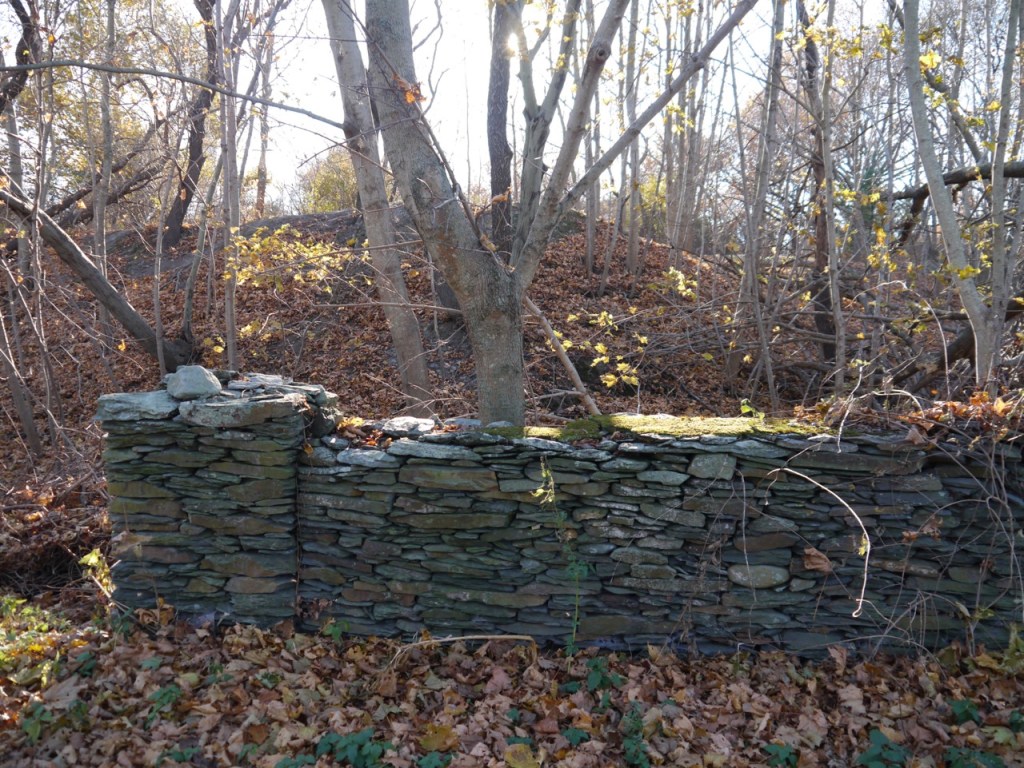
Who created the inscribed stone’s makings? Theories abound. We know that similar stones in the area are attributed to the Wampanoag but experts are not certain that this was true for the Arnold’s Point Stone. The experts do agree that the holes were definitely manmade employing a time consuming process with rudimentary tools. They also agree that the carvings show considerable age.
In place at Arnold’s Point
Underlying the uncertainty is that the holes are deeper than traditional cups and the connecting grooves are even cruder than the cups. One theory is that it is a true cup stone! – but that the cups were “enhanced” in the 1880s leaving the channels untouched.
Could this have been done, just as we trace over fading writing with an effort to preserve rather than to vandalize or deceive? Could coal miners in the area have used their tools in their idle moments to alter the cups?
This is but one theory. We recognize that if true, an altered artifact relocated from its original location is not ideal. Yet we are grateful that it is preserved and that you are able to view it on the grounds of the Portsmouth Historical Society today.
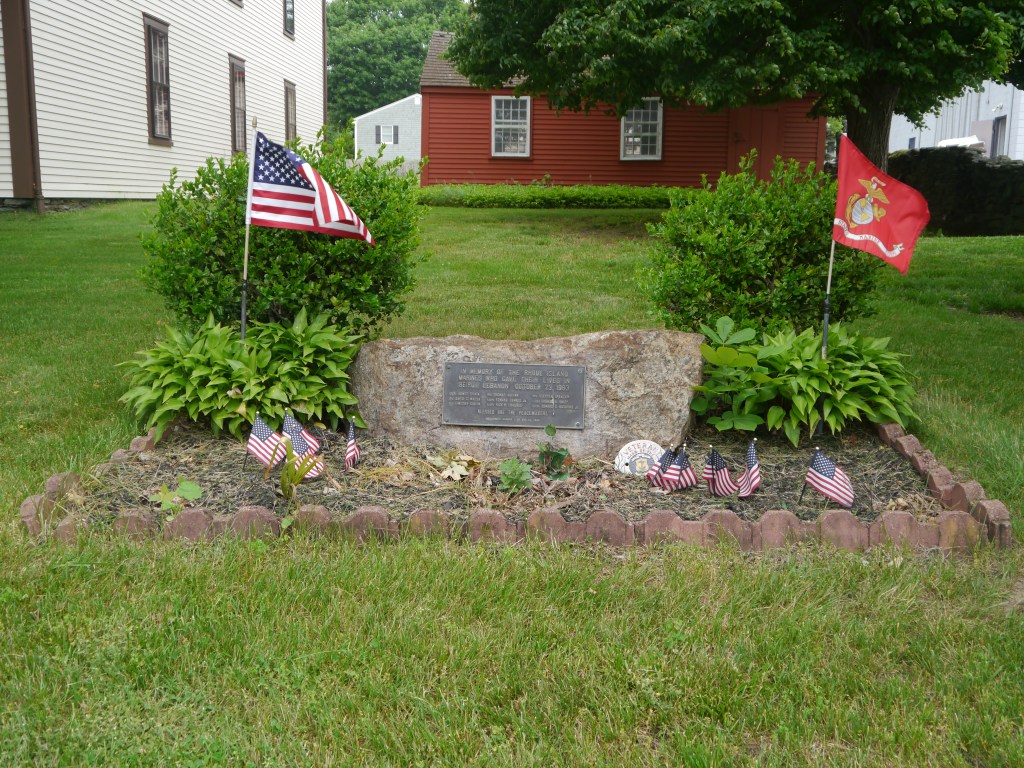
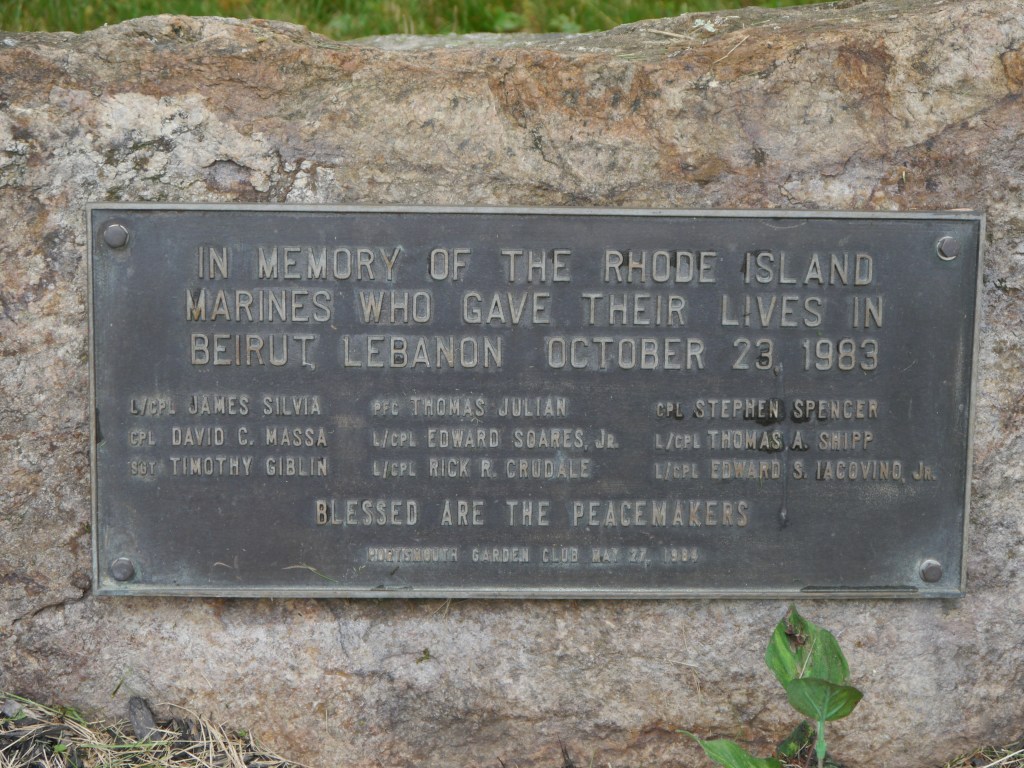
On October 23, 1983, at about 6:20 a.m. on a Sunday morning, a yellow Mercedes truck crashed into the lobby of the barracks for the 1st Battalion 8th Marines. Then the driver detonated a suicide bomb killing 241 servicemen. FBI forensics experts later determined the bomb was the equivalent to about 12,000 pounds of T.N.T. and was the largest non-nuclear blast since World War II. Across town, a second suicide attack killed 58 French soldiers.
You can read the names on the plaque of the nine Marines from Rhode Island who perished. They came from all over the state including two from Portsmouth: Corporal Stephen Spencer, and Private First Class Thomas Julian, a graduate of Portsmouth High School.
Duty called these Marines and they responded — and they gave their last full measure. They are forever part of a brotherhood that doesn’t feel self-pity but is willing to serve as our nation’s guardians.
This memorial was placed by Shirley Zdanuck in 1984 in memory of the Rhode Island marines killed in this tragedy including PFC Thomas Julian, who as a high school student, used to cut the lawn here at the Portsmouth Historical Society.
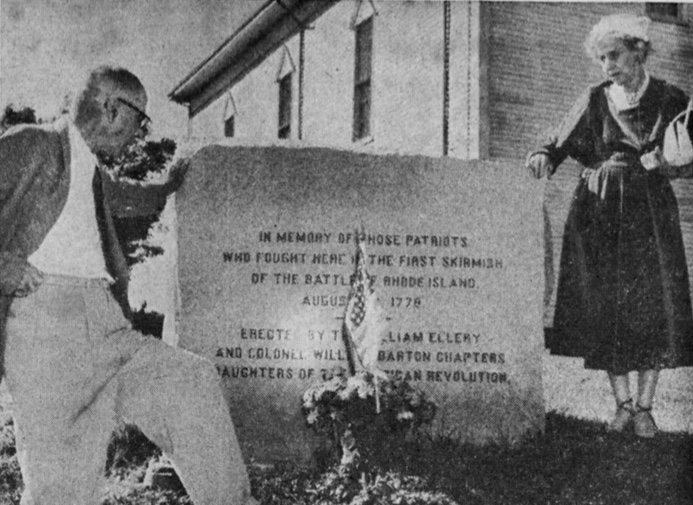
On a morning in August of 1778, American troops ambushed a British advance group nearby at the corner of Middle Road and Union Street. The Americans were waiting behind some stone walls. As the British troops marched from Newport half went straight ahead on the East Path and the rest turned left on Union Street. The Americans rose from their hiding places and slaughtered one quarter of the British. Some historians refer to this corner as “Bloody Angle.”
Image from in 1940s – PHS President Fred Sherman and Vice President Ms. Chase
This skirmish was commemorated with the dedication of a monument on the grounds of the Christian Union Church, now the headquarters of the Portsmouth Historical Society. This skirmish was only one event in what we call the Battle of Rhode Island. This battle was the only major action in Rhode Island during the Revolutionary War and fighting took place up and down East and West Main Roads in Portsmouth. Action took place at earthen fortifications at Fort Butts, on Quaker Hill, and on Turkey Hill. Although the American troops were forced to retreat to Tiverton, the patriots lost few troops.
Chapters of the Daughters of the American Revolution in Newport and Portsmouth worked together to erect a monument to the “patriots who fought here in the first skirmish of the Battle of Rhode Island, August 29th, 1778.” The monument is made of Westerly granite and is dressed on one side but left natural on the other side. The stone itself weighs about two tons. The dedication ceremony took place on August 29, 1910. Festivities included a “stirring and patriotic speech” by Congressman William Paine Sheffield. Descendants of soldiers who took part in the battle unveiled the inscription and the program ended with the singing of the Star Spangled Banner.
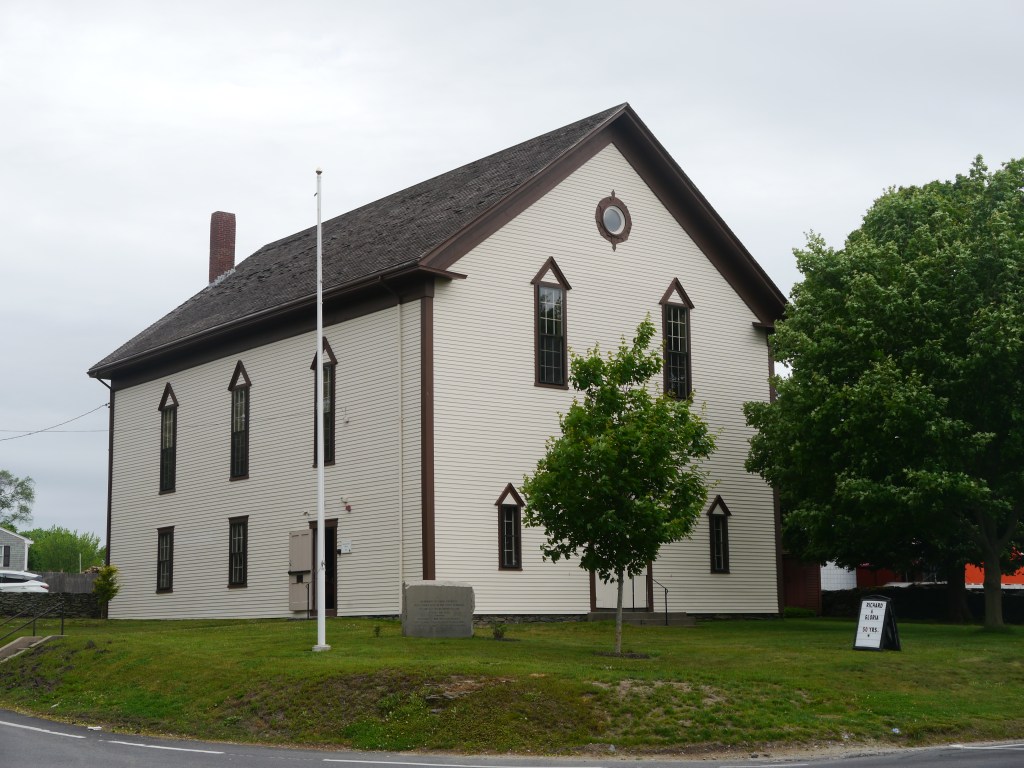
The Christian Church of Portsmouth was formed in 1810. Their meetinghouse was erected in 1824 at the corner of Union Street and East Main Road. They had previously met in private homes. As their flock grew there was a need for a larger building. In 1865 they moved the old meetinghouse to the Sisson farm on Glen Road and replaced it with the building that exists today.
Christian Union Church – PHS Headquarters
The congregation expressed an openess to a variety of expressions of their Christian faith. William Ellery Channing, a noted Unitarian who lived close by, frequently spoke with the church members on Sunday afternoons. Women were invited to preach. Julia Ward Howe, another neighbor up on Union Street, would come to “supply the pulpit.” Their reach stretched beyond the Portsmouth community. Membership records indicate that in1881 approximately 50 of their 155 members resided off Aquidneck Island.
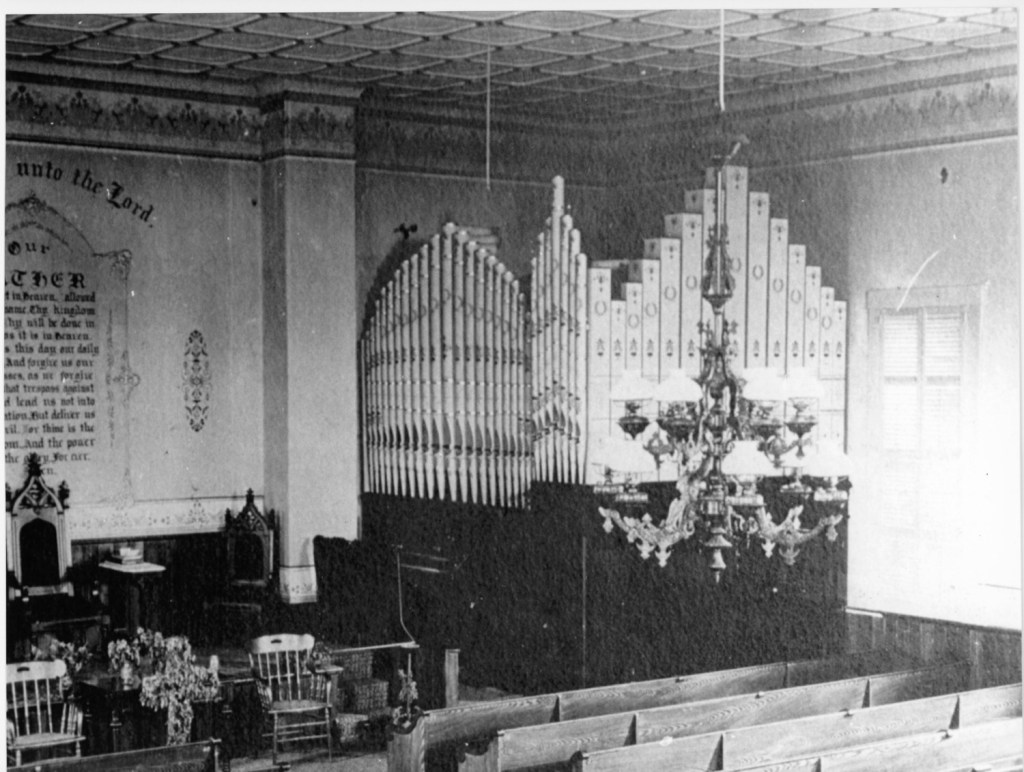
Social, cultural and educational opportunities were offered to the members. The church members believed that everyone should have access to a musical education. The church had a singing school and organ lessons were given. Social and cultural activities included turkey suppers, road trips, masquerade parties and theatrical performances. A lending library was established. It predated Portsmouth’s public library.
Vintage photo of Audience Room
The group was an active, thriving congregation for the half century between the Civil War and World War I. It then went through a decline from which it never recovered. The last church service was held in the summer of 1937.
Most people think that we have a barn on the Portsmouth Historical Society grounds. They are surprised when we tell them it was actually the Old Town Hall. Yes, the building did serve as a stable and carriage house, but before that it was Portsmouth’s Town Hall from 1840 to 1895. We have a good idea of the building date because we have a card in the historical society collection that is an invitation to the town hall opening ceremonies.
Old Town Hall today
The building was originally located where the present town hall is today. When a grander town hall was erected in 1895, the old town hall was moved to the south side of the town hall lot. At this time the building was used like a barn. One story we have from these days takes place around 1907 when George Hicks was Town Clerk. When he had to work late in the evening for special meetings, he would hitch his horse and buggy in the Old Town Hall. One night some young people decided to play a trick on Hicks. Somehow they managed to get his buggy on the roof of Old Town Hall. We are not sure of who the culprits were or how Hicks got the buggy down, but a picture in the John Pierce Collection at the Portsmouth Free Public Library proves the story was true.
The buggy on the roof – 1907
Later the building served as headquarters for the Portsmouth Volunteer Fire Department. When the new firehouse was built, Old Town Hall served for a storage and meeting room. Around the late 1970s the town offered the building to the Portsmouth Historical Society and the building was moved to our grounds.
Today the Old Town Hall houses our horse drawn vehicles including the coroner’s hearse and the last mail wagon. It also displays a fine collection of local farm tools and machines.
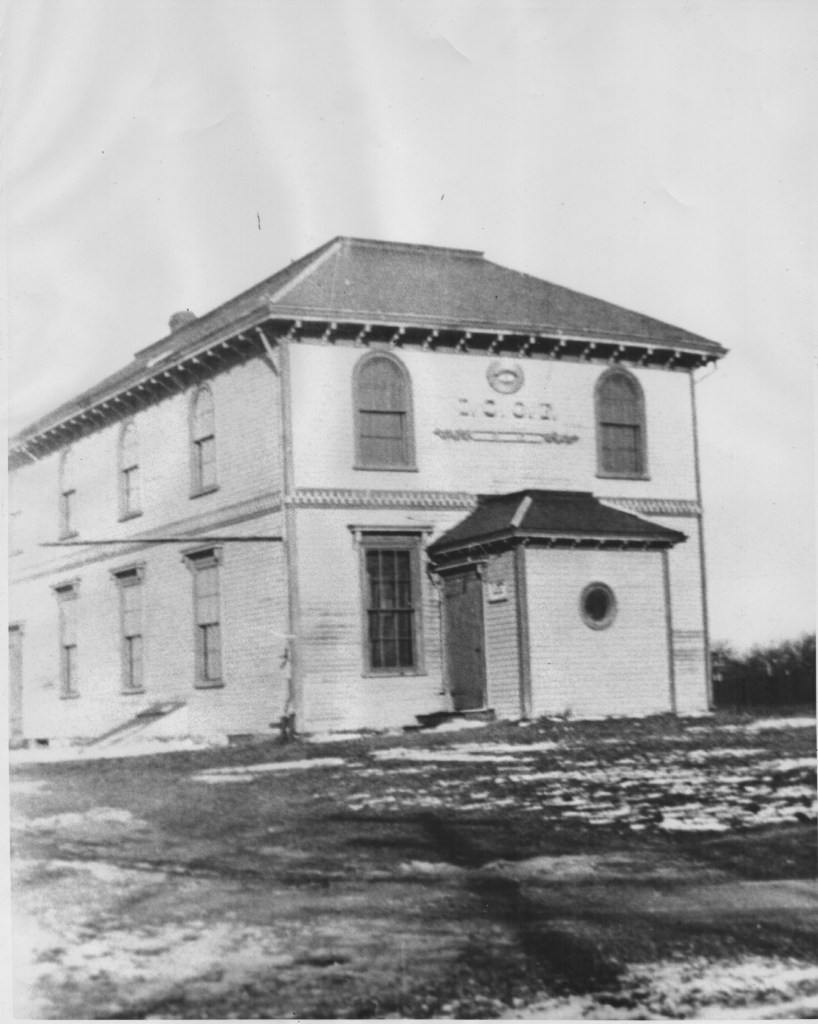
“A roaring fire last night destroyed the Oakland Odd Fellows Hall at 126 East Main Road, Portsmouth, after 250 people attending an auction walked quietly outdoors to safety.” (Newport Daily News – January 19, 1955).
Lost to Time? The Oakland Lodge was lost to time and Portsmouth in a rather dramatic way – a fire.
The fire that took the building in 1955 must have been a traumatic event. John E. Janes of Newport was the auctioneer and his assistant smelled smoke and discovered it on the second floor. Janes calmly led his patrons out of the building. He saved some of his merchandise, but lost 125 chairs in the blaze.
Fire equipment from Portsmouth, Middletown, Glen Farm and the Navy tried to put out the flames, but the water supply was limited. Fifteen thousand gallons of water had to be shuttled from a hydrant on the corner of Forest Ave and East Main Road. Empty petroleum trucks helped to ferry the water. Chief Henry W. Wilkey said that he could have had three 500 gallon pieces from Tiverton, but the Stone Bridge was not passable. Wilkey believed the fire probably started from an overheated stove pipe running through the partition.
In a recent blog I wrote about the arts in Portsmouth. In researching what was going on with the arts in Portsmouth in the 1920s, I came across a theater troop centered at Oakland Lodge. As I gathered materials for our 1920s exhibit at the Portsmouth Historical Society, I came across a photo of the Lodge. The Lodge was located close to the Middletown border on East Main Road. On the back of the photo (taken in April of 1925) there is a brief history of the Lodge.
“Oakland Lodge, No. 32, I.O.O.F., was chartered January, 1874, with twenty members, of whom Charles C. Slocum was Noble Grand; Samuel G. Arnold, Vice P.S., Constant C. Chace, W.S.; Peleg L. Thurston, P.S. and Herbert Chace, R.S. Oakland Lodge Hall was built in 1875. It was destroyed by fire on the night of January 18, 1955. The one story building that was built to replace it was used by the Lodge for about twenty years, until its membership grew so small, that it merged with the Excellent Lodge of Newport and the property was sold.”
The Independent Organization of Odd Fellows was a fraternal organization – one of the largest groups in the United States. Newspaper accounts show that the Oakland Lodge was a very active organization. The Odd Fellows were one of the first fraternal groups to welcome women – “Daughters of Rebekah.” Their purpose was:
To improve and elevate the character of mankind by promoting the principles of friendship, love, truth, faith, hope, charity and universal justice.
To help make the world a better place to live by aiding each other in times of need and by organizing charitable projects and activities that would benefit the less fortunate, the youth, the elderly, the environment and the community in every way possible.
To promote good will and harmony amongst peoples and nations through the principle of universal fraternity, holding the belief that all men and women regardless of race, nationality, religion, social status, gender, rank and station are brothers and sisters.
To promote a wholesome fraternal experience without violence, vices and discrimination of every form.
Although the Odd Fellows rebuilt and continued to meet for twenty more years, the members dwindled and they closed the doors in the 1970s.
I have been doing some research on Maud Howe Elliott as I learn about the women of the Newport County Woman’s Suffrage League. As I read Maud’s book – This Was My Newport – I came across much about her childhood summers in Portsmouth. She details a very interesting memory of visiting Lovell Hospital.
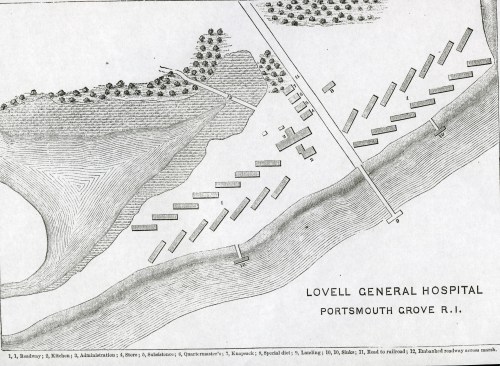
The Howe family summered at a house off of East Main Road by Lawton Valley. When Howe was around seven or eight, she decided to run away with a boy who lived on the Redwood Estate (where Redwood Farms is today.) She walked down the valley to the shore, pass the Portsmouth Asylum (the location of Raytheon) and to the railroad tracks by the shore. They two children were headed for Portsmouth Grove where the Providence boat stopped to take on and leave passengers.
The two “tallerdemalions” (as she called them) were confronted by a sentry for Lovell Hospital. “Who goes there? Halt!” Two sentries pacing their beat at the entrance of the military hospital grounds crossed their bayonets above the young couple’s heads and proceeded to chaff them. Then, relenting, the good natured soldiers returned to their beat while the children wandered down the broad middle path between the oaks and the hospital tents to the boat-landing. One point of dread they touched: a place of torture, where, in a small shed, a culprit stood with water falling drop by drop upon his head…”
The steamer “Perry Mail” was at the dock, but the children didn’t have any money for the fare. The sun was setting and the sentries told them to “put for home, young ones, as tight as you can go.” The long road climbing the steep hill from Portsmouth Grove was trim and well-kept, then. The children soon reached the summit, and turned for one last look at the camp with its white tents gleaming among the dark trees. The bugle sounded, the sunset gun boomed, and the “Flag of our State Battles” came at a run down the tall flagstaff.
The Portsmouth Grove House had became the administration building for the Lovell Hospital. The hospital, built in 1862, cared for wounded Union and Confederate troops. Again, these soldiers arrived at Portsmouth Grove by steamships. The Rhode Island Hospital Guard which was made up of soldiers too disabled for battle, kept the peace and watched over prisoners. After the war the hospital was dismantled and there are no signs of it left.
More on Lovell Hospital coming in feature blogs.
Resources:
Frank L.Grzyb has written a book, Rhode Island’s Civil War Hospital: Life and Death at Portsmouth Grove.
Elliott, Maud Howe: his Was My Newport. Cambridge, Mass, Mythology Company, 1944.
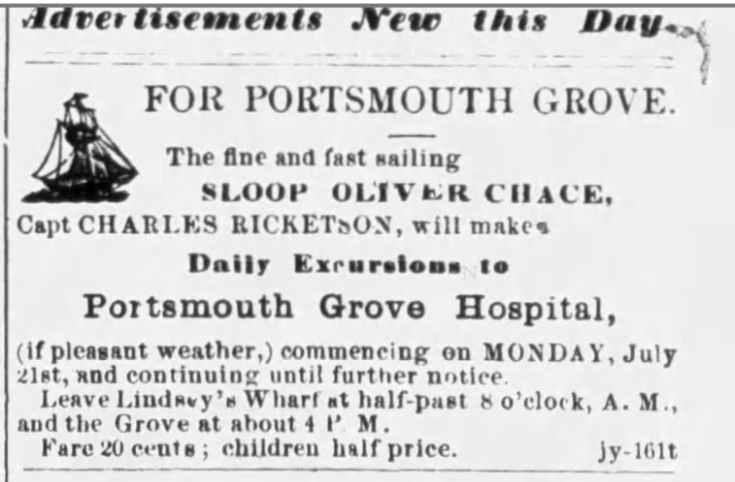
In the mid 1800s excursion boats used to make their way to the dock at Portsmouth Grove. Portsmouth Grove was a good place for a group picnic and for a day out by the water. Located on the west side (known later as Bradford or Melville) it was an important tourist destination. Even with an operating hospital, newspaper ads show that visitors still came to visit as late as 1862.
Edmund Cole operated the “Portsmouth Grove House” before the Civil War. During the Civil War it served as the location for Lovell General Hospital. More on Lovell Hospital will come in a later blog. This blog entry will focus on the happenings before the Civil War. The Portsmouth Historical Society has the diaries of David Durfee Sherman in our collection, and he writes about the amusements there at Portsmouth Grove Amusements Fandango & Ten Pin Alley.
1 September 1859 ”I went down to the Grove House & turned the Fandango (a merry-go-round) about 6 hours & got $1.50, It is very hard work to turn it, especially when not evenly balanced. The steamboat Cononicus came twice from Providence leaving 1300 people – all Irish – to enjoy themselves until nearly 8 o’clock when the boat came & took them all off…they expect this to be the last party of the season”
Portsmouth Grove welcomed hundreds of guests who arrived on steamships. For their recreation pleasure, Portsmouth Grove offered picnics, swimming, shore dining, a “fandango” and flying horses. Groups like the Sons of Temperance came a thousand strong for clambakes and chowder. There were even moonlight and torchlight excursions to Portsmouth Grove.
Detail from 1860 map at Portsmouth Historical Society.
Transcription of Shearman Diary by Marjorie Webster.
On Memorial Day we think of those who have lost their lives in defense of our country. For us in Portsmouth, we have places that remind us of those who fought and died so that we might have a country. We do honor those of the Black Regiment at a special site near the entrance to Route 24. However, Portsmouth has a gem of Revolutionary War history that is being neglected: the But’s Hill Fort. Portsmouth residents are unaware of this remarkable place in our midst.
Butts Hill Fort is the largest remaining Revolutionary War fortification in southeastern New England.
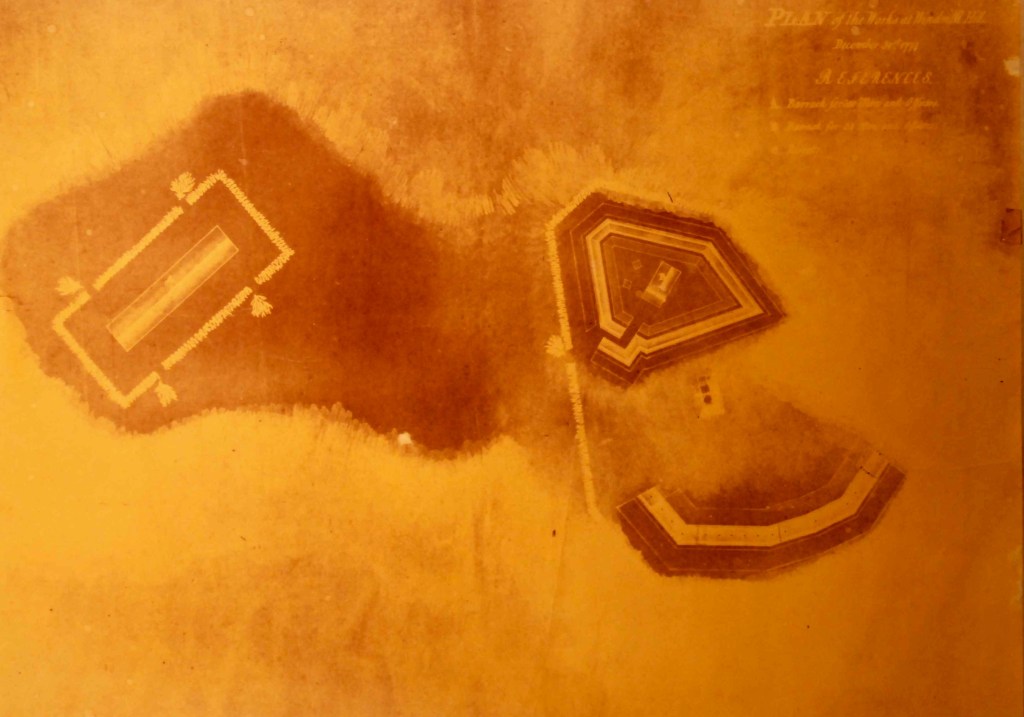
Butts Hill Fort Blueprint from Collection of the Portsmouth Historical Society
In 1776 Americans built a fort on what was known as Windmill Hill. After British troops invaded Aquidneck Island, British and Hessian troops occupied the earthworks fort that the Americans had started. Records show that in 1777 Portsmouth residents were pressed into service three days a week to construct a more substantial earthworks fortification and barracks for 200 men. In 1778 the French fleet was expected in Newport so the British abandoned the fort to reinforce lines around Newport. By August 11 the Americans once again occupied the fort at Butts Hill (Windmill Hill). When the Americans received the news that the French fleet had moved to Boston, the Americans tried to make a retreat from the island. The British came after them in what came to be known as the Battle of Rhode Island. The heights of Butts Hill Fort provided the American Commanders with a view of the battlefield – Butts Hill, Quaker Hill and Turkey Hill. Although the Americans occupied the fort for only 17 days, it was their command post during the battle. On August 31 the Americans retreated off the island to Fort Barton in Tiverton. When the British abandoned Aquidneck Island, the Americans once more controlled the fort in 1779. French forces would occupy the fort as well.
What happened to the fort after the Revolutionary War. Most earthen forts were destroyed by farming, but this area was much too rocky to be farmed. When the land around it was to be developed for housing lots, Dr. Roderick Terry of the Newport Historical Society was able to purchase the land. There were celebrations and the land was used as a park with historical markers. Dr. Terry deeded it to the Newport Historical Society, but with reservations.
Postcard Circa 1907
That the said Newport Historical Society and its successors and assigns shall forever preserve, keep and maintain the said premises as a memorial or monument to the memory of those who fought in the American-Revolutionary War and as a place where the public may enter, view and study the battle field on which our soldiers fought, be enlightened in the battles thereon fought, and in American history.
That said premises shall always retain the name of “Butts Hill Fort”.
That said premises shall never be used as a means of obtaining pecuniary gain or profit. Dr. Terry gave instructions:
I further provide that in the event that said Newport Historical Society shall at any time fail to preserve, keep and maintain the said premises as aforesaid or shall violate or fail to observe and carry out any of the foregoing conditions, then in that event the said Newport Historical Society shall forthwith stand seized of said premises to the use of the State of Rhode Island, in which State of Rhode Island the title to said premises shall forthwith vest; and I hereby grant and convey to said State the right to re-enter and take possession of said premises for any breach of the foregoing conditions by the said Newport Historical Society, said premises to be held, kept and, maintained by said State of Rhode Island for the uses and purposes aforesaid; and the Attorney General for the time being of said State or any other proper officer representing the said State shall have the right and authority to take possession thereof to the use of the State and may also be any appropriate remedy either at law or in equity, enforce the provisions of this deed. These provisions continue to control the property to this day!
By 1934 the Butts Hill Fort was overgrown and the State of Rhode Island took over the property. By 1968 the State transferred the property to the Town of Portsmouth for one dollar. Much of the land around it has been developed. Water towers, Portsmouth High School and the Wind Turbine all surround it. The earthworks are being eroded by vegetation. I’m not sure of the effect of the vibrations from the Wind Turbine The isolation of the spot seems to encourage vandalism. It is neglected, yet it is a site we should honor as we remember those who gave their lives for us to have a free country.
Resources:
National Register of Historic Places – Inventory Nomination Form for “Battle of Rhode Island Historic District.
“Planning, Preservation and Management Plan for Butts Hill Fort, Portsmouth, RI,” A Project of the Rhode Island Marine Archaeology Project, Funded by the National Park Service American Battlefield Protection Program, in Partnership with Newport Collaborative Architects (2009).
In the 1920s (and even before) Portsmouth was home to some well known professional actors. Aquidneck Island has always attracted summer residents with its mild climate. Portsmouth was a transportation hub and the Fall River Line made travel to New York City theater sites easier. Newspaper articles from the end of World War I to 1929 record the activities of professional actors who lived in Portsmouth.
The January 5th 1918 Newport Mercury reported that the Christian Union Church pastor Robert Downing entertained the troops aboard the U.S.S. Massachusetts for New Year’s Day celebrations. The boat carrying Rev. Downing had to break its way through the thick ice. The troops enjoyed the performance and gave the minister three cheers and wished him a happy New Year. Robert Downing was not an ordinary pastor. Before he became a minister, he performed Shakespearean plays and even had his own touring company. He retired from the theater in 1909 to became a minister. Downing’s church – the Christian Union Church in Portsmouth – is now the headquarters of the Portsmouth Historical Society. Downing used to dramatize scripture readings for his congregation. Some church members enjoyed the drama while others did not. He served as minister from 1915 to shortly after this performance for the troops. He continued to live in Portsmouth even after he resigned as minister. At first the congregation had a hard time getting the Downings to leave the parsonage. Late newspaper articles show the Downings continued to come back to their home on Quaker Hill in the 1920s. The New York Times reported in 1919 that he would take a role in a moving picture called Termination.
Robert Downing as Marc Anthony
Newspaper articles also tell us about an actors’ colony at Island Park that continued to spend summers in Portsmouth for over eighteen years. A 1908 Fall River Evening Herald article let us know that the actors enjoyed the pleasures of Island Park.
“Gertrude Dion Magill, Nat Leffington, and Mr. Royan of the Puritan Theater are having the time of the their lives rising, bathing and securing fine coat of tan coloring on their complexions. Miss Magill is remarked along the shore as an expert swimmer. The trio says they are charmed with the park as a summer resort and will surely laud its beauties to other members of their profession the summer season.”
In 1921 the Fall River paper includes an article on the arrival of actors Mr. and Mrs. Hill who have been coming to the Island Park Actor’s Colony there for over 18 years.