Home

Portsmouth in the 1920s: Artists

1 Comment

Three Portsmouth artists illustrate the importance of the arts in Portsmouth during the 1920s. Sarah Eddy of Bristol Ferry, Finis Macomber MacLeod of Quaker Hill and Elizabeth Anthony Wilkey of Elm Farm on Park Avenue were accomplished artists who shared their love of art with the community.

Sarah Eddy trained at the Pennsylvania Academy of Fine Art. She was a nationally known painter, sculptor, and master photographer. She established her own studios on her property on Bristol Ferry Road around 1900 and founded the Social Studio which taught artistic skills to Portsmouth youth. She drew artists to Bristol Ferry and an artist community grew there. Often her students stayed at her guest house, Willowbrook – the Connors Funeral Home today. Dressed in smocks and berets, Sarah and her students would venture out early to capture the beautiful light. Sarah contributed the money to add a room to the Portsmouth Free Public Library that would be used to display art work. Sarah’s work was regularly displayed there during the 1920s and one painting mentioned in a newspaper article is now in the collection of the Portsmouth Historical Society. It is a painting of an older woman, Mrs. Burke, and she is preparing a vegetarian Thanksgiving dinner.
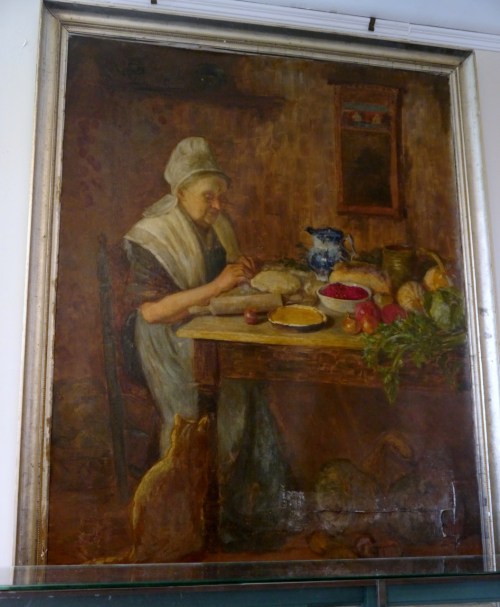
Finis Macomber MacLeod was one of Sarah Eddy’s students. She continued her studies at Moses Brown School and in Boston where she took up sculpture. Finis later studied with Helena Sturtevant, a very accomplished artist, at the Newport Art Association. Finis was a minister’s wife and often moved around New England, but she kept coming back to the area. Newspaper accounts show she shared her skills in portrait sculpture with local artists. She exhibited her paintings and sculptures locally including the Newport Art Association and the Portsmouth Free Public Library.
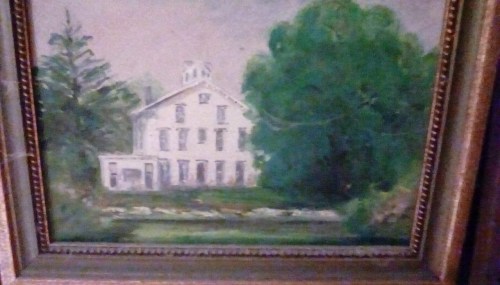
Elizabeth Anthony Wilkey began teaching art in the 1920s and continued to train Portsmouth artists throughout a lifelong career as Art Teacher and Arts Director for Portsmouth schools. Elizabeth was a graduate of the Rhode Island School of Design. A 1929 newspaper article is centered around a exhibition of her students work at her studio on Park Avenue.  She designed the insignia for the town of Portsmouth based on old drawings of the original insignia. Her seal design appears on official Town of Portsmouth vehicles and documents.
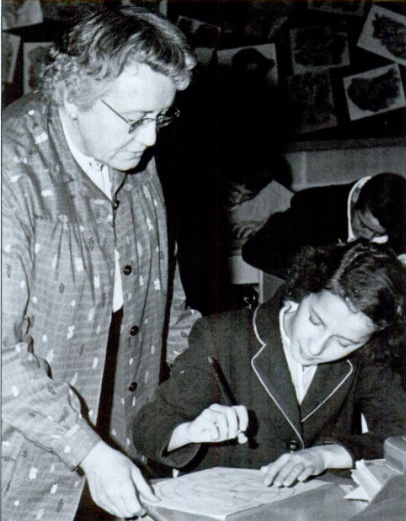
If you know of other Portsmouth artists who worked in the 1920s, I would love to learn about them and see images of their work. Hopefully we will have displays on the artists this summer at the Portsmouth Historical Society Museum.

Photo of Finis Macomber MacLeod and her painting courtesy Christine Stockman – her granddaughter.

Portsmouth in the 1920s: The Crystal Radio

1 Comment

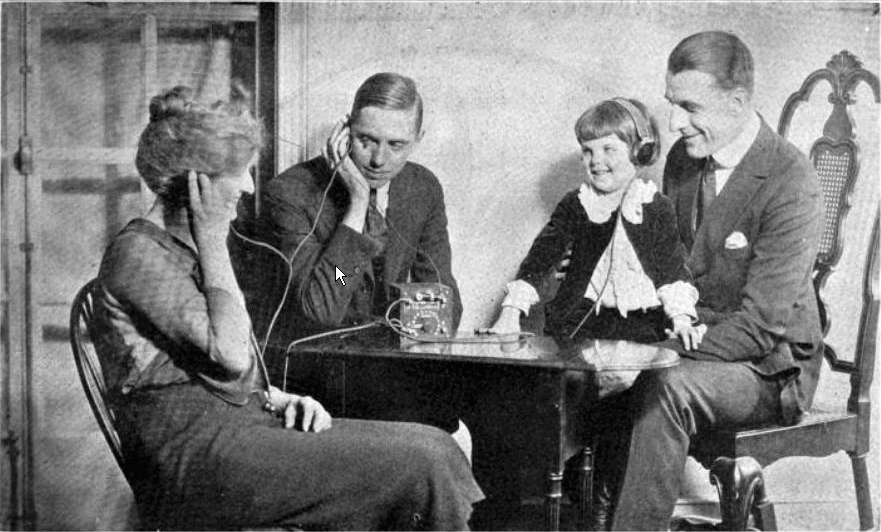
At the Portsmouth Historical Society Museum the curator’s committee is focusing on life in the 1920s. We have a crystal radio set donated to the museum by Annie and Fred Sherman and it is from the J. F. Sherman estate.


This lower photo shows an American family in the 1920s listening to a crystal radio. It is from a 1922 advertisement for Freed-Eisemann radios in Radio World magazine. The small radio is on the table. Crystal sets work off the power received from radio waves, so they are not strong enough to power loudspeakers. Therefore the family members each wear earphones, the mother and father sharing a pair. Although this is obviously a professionally posed, promotional photo, it captures the excitement of the public at the first radio broadcasts, which were beginning about this time. Crystal sets like this were the most widely used type of radio until the mid 1920s, when they were slowly replaced by vacuum tube radios.

Portsmouth in the 1920s : Listening to Radios

1 Comment

Radio historians generally agree that broadcasting for the public began in 1920 with a broadcast on station KDKA out of Pittsburg, PA. On November 2, 1920, station KDKA out of Pittsburg, PA, made the nation’s first commercial broadcast. They chose that date because it was election day, and the power of radio was proven when people could hear the results of the Harding-Cox presidential race before they read about it in the newspaper.

However, very few folks heard the broadcast because few radio receivers were privately owned. After word of that original broadcast spread people overwhelmed radio manufacturers. They stood in line for hours to fill out order forms because the manufactures had run out of radio receivers. Between 1923 and 1930 fully 60% of American families purchased radios and gathered around the new devices to listen to nightly entertainment broadcasts.

The more folks purchased radios the more radio stations were needed to satisfy the public. In just two years 600 stations were up and operating nation-wide.

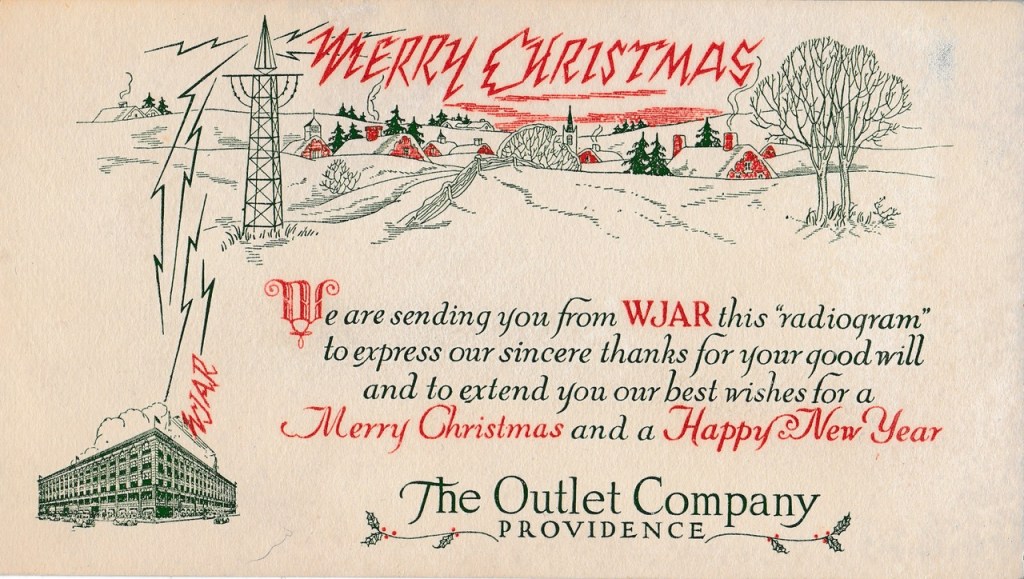
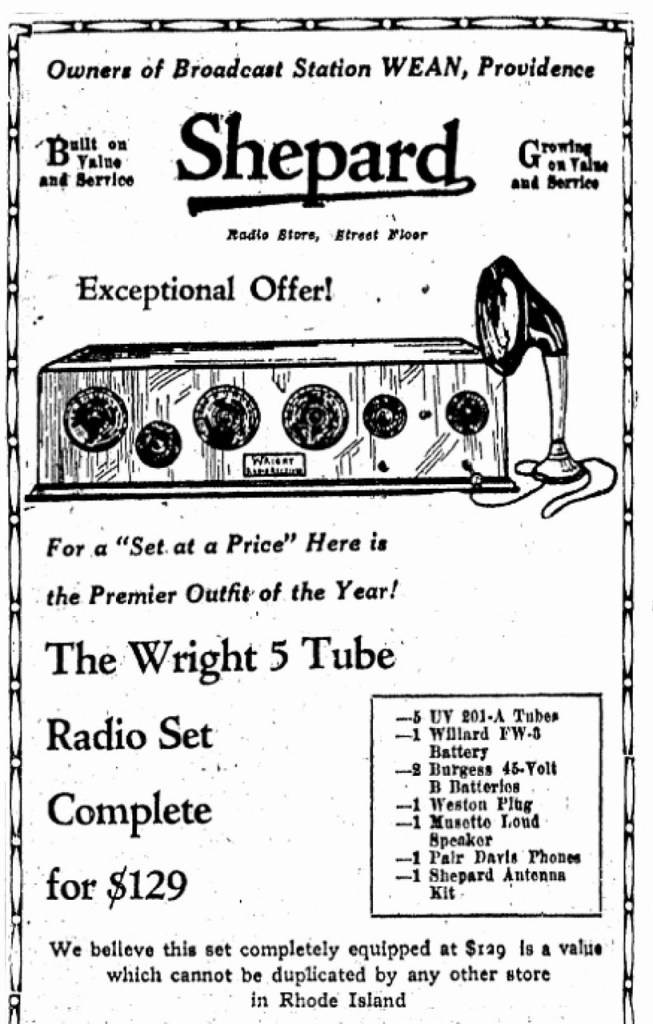
In Providence RI thriving downtown department stores like Outlet, Shepard’s, Gladding’s, Diamond’s, the Boston Store, and Cherry & Webb competed for shoppers. Of those stores, the Outlet and Shepard’s were the boldest of rivals. Radio in Rhode Island was born out of this intense department store rivalry. In June of 1922, Shepard’s launched WEAN, the first radio station in Rhode Island. Just three months later and not to be outdone, the Outlet premiered WJAR. Not long after, Cherry & Webb debuted WPRO. The new technology provided these stores with an exciting promotional vehicle unlike anything the world had ever seen – or heard.

Portsmouth in the 1920s: Community Theater

1 Comment

Portsmouth may not have had professional theater troupes in the 1920s, but it had its share of community based theater to entertain local audiences. Newspaper accounts show that church, school and social groups often presented plays. One group associated with Oakland Hall and the Oakland Lodge seems to have performed in a very professional way for an amateur group.

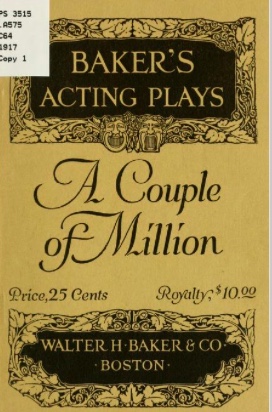
Newport Mercury and Newport Journal-Weekly News articles in 1928 tell us about performances of a comedy – “A Couple of Million.” I was able to find a copy of the play online and this four act play is funny. An audience today might find it dated and they would cringe at the racial dialects used and references to women as “skirts.” A modern group might perform this with some dialogue modifications. The plot opens at a lawyer’s office where a young man gets the news that he has inherited a “couple of million” from his uncle, but he has some difficult requirements to meet or the inheritance goes to someone else. The Journal Weekly article states: “From the rising of the curtain to the final drop there were few who were not convulsed with laughter or secured a thrill from the compromising situations in which the players became involved.”

The Oakland Players had all roles necessary for a quality performance. There was a fourteen member cast, a stage manager with three assistants, a prompter, a director of costume and makeup, an electrician and a carpenter. There were several parts for women and these were all performed by MEN.

The players did several performances on Aquidneck Island, but were also invited to perform in East Greenwich.

Portsmouth in the 1920s: Going to the Picture Show

1 Comment

You might be surprised to know that the early movie theater for Portsmouth was the Town Hall. Newspaper articles from the time show that churches and local groups showed picture shows at the hall. There wasn’t a movie theater in Portsmouth at that time, but most movies were shown where you could set up a screen and darken the room. The Town Hall provided that. I found newspaper articles that show that church groups and community organizations used the Town Hall to show their films. Some were for entertainment or fundraising. Others were more of a “community service” performance.

In the 1920s the films didn’t have sound, but they were far from “silent.” The first full length feature that included sound was “The Jazz Singer” in 1926. The early movie shows were short and the often included lectures, music and audience participation. A January 1920 Newport Mercury article shows that the Red Cross showed a movie called “Winning the Way.” It was shown to an “appreciative audience” and included a speaker from Boston who discussed public health.

Entertaining religious “photo-plays” were shown to raise money for St. Anthony Church. An article in the The Newport Mercury in November of 1922 shows one film called “The Eternal Light” on Friday and Saturday evenings at the Town Hall. “Photo-Play” was a new term for me and it was one description given to early films.

The most interesting film was graphically described in a December of 1922 article of the Fall River Globe. ” ‘Fabiola’ a selfish heartless, cruel women overcome by a Faith which triumphed over treachery, hate and greed” would be shown for the benefit of St. Anthony’s Church. The ticket price seems rather steep for those days: Fifty cents for adults and twenty-five cents for children under 12.

The Newport County Woman’s Suffrage League Ends with a “Jubilee”

1 Comment

When the state of Tennessee ratified the 19th Amendment to grant suffrage to women, suffrage groups throughout the nation celebrated the victory with jubilees. Philadelphia, New York City, Tacoma in Washington, San Francisco, Minneapolis and Chattanooga were among the locations to hold the jubilees. On Aquidneck Island, the suffragists gathered back where it all began – at Sarah Eddy’s Social Studio in the Bristol Ferry neighborhood.

The Jubilee was planned even before Tennessee cast its vote on August 18th. An article in the Newport Mercury on August 14th announced the coming celebration. The gathering was set for August 17th. “It is expected that by that time the necessary number of State legislatures will have ratified the Constitutional amendment to make it effective.”

The article ends by saying “A large number of invitations have been issued.” Among those attending were two Catholic suffragists from the Philadelphia area – Jane and Marianne Campbell. In a letter from Jane to her nephew, she writes: “We are staying over a day here to attend a Jubilee Suffrage Meeting, the practical dissolution of the Newport and Bristol Ferry Suffrage Society. The women in Rhode Island had Presidential Suffrage and the gentle Misses Chace have registered so they can cast a ballot in the Presidential Elections. The Rhode Island Constitution gives the legislature the power of conferring Presidential Suffrage on the women and that legislature has done that” (August 13. 1920) letter of Jane Campbell to John J. Campbell.) The envelope to the letter had a return address of “Willowbrook” in Portsmouth, Rhode Island. This was a guest house owned by Sarah Eddy.

The program of the Jubilee included speeches by Rhode Island Governor, R. Livingstone Beeckman. The clergy were represented by the former pastor of St. Paul’s Episcopal Church in Portsmouth, Reverend Charles Jarvis Harriman and the pastor of Channing Memorial Church in Newport, Reverend William Safford Jones. Miss Sarah Louise Arnold, the Dean of Simmons College in Boston, also spoke. Other speakers were George Moriarty, a Newport Genealogist and Dr. Alfred Johnson.

Music was part of the program as well. Kate Durfee (Mrs. Charles H. Durfee) of Fall River and Mr. Augustus Hazard Swan of Newport performed solos. Kate performed the “Battle Hymn of the Republic.” That would be a fitting note in a celebration to end a Portsmouth suffrage group that included Julia Ward Howe as one of the founding members. Julia’s daughter Maud Howe Elliott presided over the celebration. The Social Studio, the home of many of the first meetings was an appropriate place to celebrate a victory in securing the vote for women.

Suffrage Work Branches Out County-wide: Middletown Suffragists

Leave a comment

True to its name, the NEWPORT COUNTY Woman Suffrage League (NCWSL) began to quickly branch out county wide from its Bristol Ferry roots. Founded with eight members in 1907, by 1909 there were seventeen members.  One of the 1909 officers, Mary Osborn, was from Tiverton.  Cora Mitchel and Veva Storrs went to the Kingston state fair to promote the suffrage cause.  NCWSL was active in giving lectures and socials.  The group hosted the Rhode Island Woman Suffrage Association and there were sixty people present.  By 1910 membership was up to thirty-three members.

There was a critical shift in 1912 once Maude Howe Elliott became the President.  Cora Mitchel stepped into the Vice President role.  In 1913 there were ninety members and they were from Portsmouth, Middletown, Newport and Tiverton.  Newport, Middletown and Tiverton meetings began. Julia Ward Howe had died in 1910 and her daughter Maude Howe Elliott moved into the Oak Glen home on Union Street.  Meetings were conducted there, but they were also held at the Channing Parlors in Newport and at the summer residence of socialite Mrs. Katherine McCormick.  The League keeps its contact with the Rhode Island Suffrage League in Providence.

The Middletown Suffragists

Mary Clark Sturtevant (1843-1931) and daughters Mary, Helena and Alice Sturtevant Howard

Mrs. Eugene Sturtevant (Mary) was a prime founder of St. Columba’s (the Berkeley Memorial Chapel). Mary was the daughter of Thomas Clark – Episcopal Bishop of RI.  She and her husband donated the land.   Eugene Sturtevant was a real estate developer and he bought up large parcels of land on the eastern shore of Middletown and sold the lots.

Mary was a local historian and she researched, wrote and spoke about the history of the East Side of Middletown.  She had been a Middletown resident since 1871. Mary was an active member of the Art Association and would have worked with Maud Howe Elliott there.   She worked for the preservation of Whitehall, the Middletown home of Bishop Berkeley.  She was an advocate of child welfare causes and was on the board of St. Mary’s Home for Children in Providence.

Mary Sturtevant was active in the suffrage cause.  In The History of Woman Suffrage it states that “In Middletown the [Newport County Woman Suffrage] league’s work was ably carried on by Mrs. Eugene Sturtevant and her daughters.” In November 1914, Mary Sturtevant was named Vice President of the Newport County Woman’s Suffrage League. Her daughter Mary was named treasurer. In February 1915, Mary Clark Sturtevant was the Newport representative on the Rhode Island State Committee of Woman Suffrage. She also was a member of the Congressional Union, the offset of the National American Women’s Suffrage Association (NAWSA), in Rhode Island in 1915.  In a newspaper article “Woman Suffragists Invade State House” Cora Mitchel, Maud Howe Elliott and Mrs. Sturtevant “buttonholed” (detained them in conversation against their will)  state senators and representatives. They had pictures taken with the statesmen.    She was a speaker before NCWSL at Oak Glen 1913.  When the suffragists entertained the troops as war service, Mary would play the organ.  She wrote a booklet countering the arguments of the Anti-Suffrage speakers.

Lila Pierce Peckham 1864-1948  (Mrs. Elisha Peckham) hosted meetings at her Middletown home, “Seven Pines”.  A Newport Mercury account of a meeting there in 1914 tells of a “Preparation Day” meeting for a national woman Suffrage demonstration.  Lila’s daughter, Elizabeth A. Peckham presented readings for “The Woman’s Journal.”  Interestingly, the meeting was presided by a man – R. Wallace Peckham.

Lila Peckham (1864-1948) was a newspaper reporter and was noted for club work, especially the Oliphant Reading Club.  She was a member of the Middletown School Committee.

The Youngest Suffragist: Olivia Watson (1900-1985)

Leave a comment

Olivia Watson Hoffman and her poetry book – The Four Seasons.

Olivia Lyman Watson was only seventeen or eighteen when she served as a corresponding secretary for the Newport County Woman’s Suffrage League in 1918 and 1919. Maud Howe Elliott, Julia Ward Howe’s daughter, had taken over the presidency of the group and Olivia might have joined through her influence. Later newspaper articles mention that Olivia was related to Julia Ward Howe. Olivia was very proud of her deep Rhode Island family roots.  She was a descendent of one of the first Newport founders, Thomas Hazard.  Ancestors William Green Arnold and John Cook served as colonels in the Continental Army.

Early newspaper articles identify her as “Olive” but she seemed to use “Olivia” as she was older.  She thought of herself as a literary woman.  In a newspaper interview she said that her forebears were founders of the Redwood Library in Newport, one of the oldest libraries in the United States.  She was a member of the League of American Pen Women and contributed articles and poetry to a number of publications.  Olivia was a published poet and she said she wrote poetry from childhood.  In an interview she said – “I can’t remember when poetry did not sing itself to me.”

She married a Navy officer, Joseph H. Hoffman, in Newport in 1929 and she moved all over the country as a Navy wife.  She always kept her Newport connections and visited Aquidneck Island frequently.  Later in life she became a song writer and  wrote the words to a “Breaker’s Ball” song and it was performed at the Breakers by the Meyer Davis Orchestra.  She even wrote a campaign song in 1968 for Richard Nixon called “Win with Dick” which was used at campaign rallies.

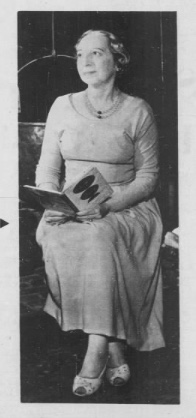
Georgie Nichols Wentz (1858-1945) – Society Suffragist

Leave a comment

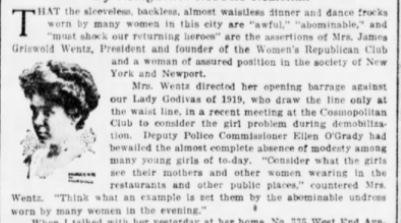
What is your image of the suffragists?  Georgie Wentz may not fit the stereotypes.  Her campaign against immodesty in women’s evening dress got  coverage in the New York Times and other publications.  She opposed cocktails, cigarettes and the “drug habit.”  Apart from suffrage, her passion was electing Republicans.  Even before she was able to vote she worked on the campaigns of Benjamin Harrison and William McKinley.  She actually went door to door in the tenements of New York to campaign for her candidates.

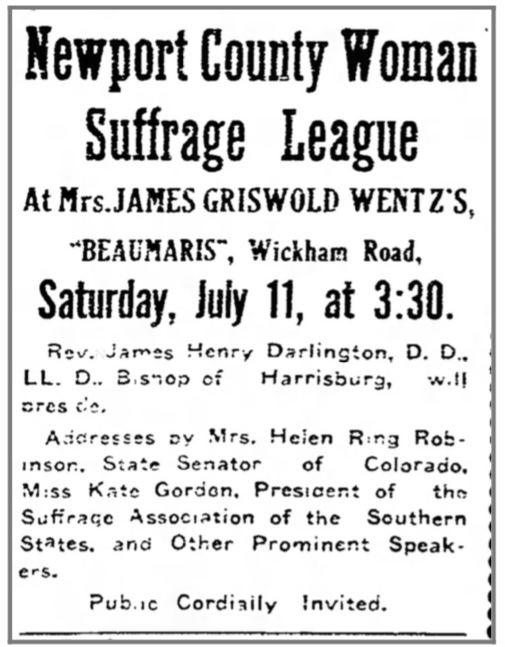
When Maude Howe Elliott took over as President of the Newport County Woman Suffrage League the center of league activities moved to Newport. Georgie Nichols Wentz (Mrs. James Griswold) is a good example of the Newport summer colonists that joined the league and helped the effort. While in Newport, Georgie Wentz worked hard for her causes.  As early as 1914 Newport County Woman Suffrage League meetings were being held at the Wentz home – “Beaumaris.” Newspaper articles show her as a speaker at  suffrage meetings and demonstrations.   In 1915 she helped with Mrs. Belmont’s event at Marble House.  Mrs. Wentz (along with several other socialite suffragists) are listed as Vice-Presidents of the Newport County Woman Suffrage League in 1917.

Like many of the suffragists, Georgie Wentz helped in the war effort during World War I.  She opened her estate in Newport to entertain sailers from the Naval Training School.  She was an active member of the Red Cross.

Once women secured the vote, Mrs. Wentz focused on organizing the Newport County Woman’s Republican Club.  She established her headquarters on Thames Street and by the mid 1920’s she had 400 members.

Sources:  Biographical Cyclopaedia of American Women, Alvord Publishing, 1924.

Newspaper clippings from Newport Mercury and New York papers.

“Society Suffragist Replies to Attack of Professor”

1 Comment

Katherine McCormick’s glamorous image graced the front page of national newspapers in October of 1913. The newspaper articles told of a scene at the Colonial Theater in Newport.  The Rhode Island Association Opposed to Woman Suffrage rented the hall for a free lecture by a noted journalist who opposed the suffrage movement.  The Boston Globe (11/11/1913) reported that after Talcott Williams spoke against “votes for women” the three women (Katherine McCormick, Maude Howe Elliott and Mrs. James Wentz) “arose one after another, and refuted every argument he had made.  Their pointed questions worried Mr. Williams considerably, it is said, but he stood his ground — that is, he remained on the platform until the end of the meeting.   The Anti-Suffragists, however, marched indignantly out of the hall – a pantomime of what they thought of the performance. Then the Suffragists forces ended the meeting with a demonstration for their ’cause,’ the Anti-Suffragists having paid for the use of the theatre for the evening.”

Who was  “Society Suffragist” Katherine Dexter McCormick?  Katherine was well educated.  She graduated from the Massachusetts Institute of Technology in 1904 with a degree in biology. That same year she married Stanley McCormick whose father, Cyrus McCormick, had patented the mechanical reaper.  By 1906 Stanley McCormick was diagnosed with a catatonic dementia.  Katherine had little say over Stanley’s care and she and all other women were kept from seeing him.  Katherine remained married to Stanley and sought to use new hormone treatments to cure him.  There were constant legal battles over his care.

She fought for a voice on other issues and by 1908 she began to be quite an active speaker and benefactor for the cause of woman suffrage.  Based in Boston, Katherine was an officer in the Massachusetts and national suffrage movement.  She became the first auditor for the National American Woman Suffrage Association in 1912 and 1913.  She went to the International Woman Suffrage Alliance Congress at Budapest and was elected to the International board.

How was Katherine connected to the Newport County Woman Suffrage League?  Mrs. McCormick spent her summers in Newport, renting properties on Bellevue Avenue.  When in Newport, Katherine would be a speaker for the league and she would host league meetings at her gracious homes.  The local suffrage league benefited from her state, national and international connections.  For example, she shared her personal experiences at the International Congress at Budapest at a time when news resources were limited to the newspapers.

She is quoted as saying:  “To come into contact with the suffrage movement means, to some individuals, to come into a larger world of thought and action than they had known before.  To others it means approaching the same world in a more real and effective way.  To all it gives a wider horizon in the recognition of one fact – that the broadest human airs and the highest human ideals are an integral part of the lives of women.” (Hutchinson Gazette, 10-12-1912)

When the vote for women was won, Katherine was one of the founders of the League of Women Voters.  She continued her philanthropy by funding housing for women at MIT and she provided necessary funding for the development of “the Pill” and research on the long term effects of the birth control pill.  She may have been a “socialite” but she used her considerable resources for social causes dear to her.

Older Entries Newer Entries