Home

A Rhode Islander at the Alamo: Albert Martin

Leave a comment

The Alamo today

On a recent visit to the Alamo, I was surprised to see the Rhode Island flag displayed. The flag was in honor of Albert Martin, a Providence native who was among those who died defending the Alamo against the Mexican forces under General Santa Anna.  I knew about such heroes as Davey Crocket and Jim Bowie, but I had not known that a Rhode Islander was among those considered a hero during the Texas fight for Independence.  This was, in part, due to the fact that Martin was inaccurately listed as being from Tennessee.  It took a long time for the error to be corrected.

Who was Albert Martin?  How did he get to Texas?  What role did he play in the battle for Texas independence?

Albert Martin’s name on Memorial outside Alamo

Albert Martin was born in Providence in 1808 to Joseph and Abby Martin.  It seems he might have had some military training.  Some accounts say he attended what is now Norwich University.   At the time it was called “The American Literary, Scientific and Military Academy” and was located in Connecticut.  Other sources say he was admitted to West Point in 1824.  Military training would have come in handy when the family moved to Texas.

The family had been prominent merchants, but they fell on hard times.  The family was lured to the Texas area by the promise of land grants. The newly independent Mexican government wanted to populate the area.   Joseph, Albert and an older brother left Rhode Island in 1832.  They came by way of Tennessee and spent some time in New Orleans along the way.  They moved to Gonzales, Texas in 1835 where they ran a general store – a part of “Martin, Coffin & Company.”

Albert Martin arrived in Texas just in time to take a role in the battle for Texas Independence.  As General Santa Anna attempted to get more centralized control over the Texas area, the Texians (Anglo-American settlers) and the Tejanos (the Texans of Mexican and Native American  descent) joined together to fight for independence.

Martin’s military training would come to play in three  battles.  He joined the Gonzales Rangers and was one of the “Old Eighteen” defenders. The people of Gonzales had been given an old six pound cannon that was to be used to defend against attacks by local tribes.  In September of 1835 the Texans were shinning up the cannon to use it in defense of their town, but then over a hundred Mexican troops came to take it back.  Albert Martin had buried the cannon in a peach orchard and he and seventeen other defenders taunted the Mexicans with the cry “Come and Take It!” This allowed the rebels time to gather 150 troops for the Battle of Gonzales. On a foggy night the Texans crept up on the Mexican forces.  As the fog lifted the two sides faced each other.  After some musket fire from the Mexicans,  the Gonzales cannon shot nails and old horseshoes at the Mexican troops and they turned and headed away.  The men of Gonzales were jubilant.  The Texas Revolution had officially begun. In December of 1835 Martin was involved in the Battle for Bexar.

In February of 1836, Albert Martin arrived at the Alamo.  Beginning Feb. 23, 1836, a group of Texas rebels were holding a fort/church (the Alamo) from about 4000 Mexican forces under President/General Santa Anna.  The 13 day siege enabled Texas General Sam Houston to gather an army at San Jacinto.  Santa Anna had raised the flag that meant they would take no prisoners, so those defending in the Alamo knew what their fate might be.  The Texans replied with a shot of their cannon.  When the Texans learned that the Mexicans had requested to meet, both Jim Bowie and William Travis (co-leaders of the rebels) sent out emissaries.  Albert Martin went to speak for Travis.  Martin crossed the river under a flag of truce and met with Mexican Colonel Almonte on the footbridge. He said he was speaking for Travis and that if Almonte wanted to speak with Travis he would be received “with much pleasure.”   Almonte said he was just there to “listen” and stressed that the Texans’ only hope was to surrender.  Martin reported back to Travis.  Travis wrote to Sam Houston – “I answered them with a cannon shot.”

On February 24th, Colonel Travis decided to send off a letter for help.  Albert Martin would be his messenger.

Commandancy of the The Alamo

Bejar, Feby. 24th. 1836

To the People of Texas & All Americans in the World-

Fellow Citizens & compatriots-

I am besieged, by a thousand or more of the Mexicans under Santa Anna – I have sustained a continual Bombardment & cannonade for 24 hours & have not lost a man – The enemy has demanded a surrender at discretion, otherwise, the garrison are to be put to the sword, if the fort is taken – I have answered the demand with a cannon shot, & our flag still waves proudly from the walls – I shall never surrender or retreat. Then, I call on you in the name of Liberty, of patriotism & everything dear to the American character, to come to our aid, with all dispatch – The enemy is receiving reinforcements daily & will no doubt increase to three or four thousand in four or five days. If this call is neglected, I am determined to sustain myself as long as possible & die like a soldier who never forgets what is due to his own honor & that of his country – Victory or Death.

William Barret Travis.

Lt. Col.comdt.

P. S. The Lord is on our side – When the enemy appeared in sight we had not three bushels of corn – We have since found in deserted houses 80 or 90 bushels and got into the walls 20 or 30 head of Beeves.

Martin slipped out of the Alamo and the Mexicans made no effort to stop him.  He could hear the rumble of cannons behind him.  He reached Gonzales the next day.  Martin wrote on the back of that Travis letter “Hurry on all the men you can.”  He passed the letter on to a fresh rider, Launcelot Smithers who road on to San Felipe and arrived there February the 27th.  More couriers spread the word on to settlements to the Gulf Coast.

According to Martin’s obituary in the July 1836 Manufacturers and Farmer’s Journal, Martin’s father tried to persuade him not to go back to the Alamo and certain death.  Albert said “This is no time or such considerations.  I have passed my word to Colonel Travers, that I would return, nor can I forfeit a pledge thus given.”  He gathered a group of 62 who would go to the Alamo with him, but in the end only 32 from Gonzales arrived with him on March 1st.    Although the group was small, it did revive the spirits of the rebels.

March 6th was the final battle.  The battle took only 90 minutes.  Santa Anna would not allow a proper burial for the men who had defended the Alamo.  Their bodies were burned. The women and children were allowed to go to spread the message of the Mexican victory.

Martin’s  obituary goes on to say:  “Thus died Albert Martin, a not inapt illustration of New England heroism.”  Although Albert Martin has no burial place, Rhode Islanders did not forget him  There is a marker in a North Burial Ground, Providence.  “Albert Martin fell at the Alamo, Texas in defense of his adopted country, March 6, 1836.  Aged 28 y’rs and 2 mo’s.”

Sources:

Lord, Walter:  A Time to Stand:  The Epic of the Alamo.  1961, Harper Row, NY.

Handbook of Texas Online, Bill Groneman, “MARTIN, ALBERT,” accessed December 02, 2019, http://www.tshaonline.org/handbook/online/articles/fma57.

Small State Big History:  http://smallstatebighistory.com/two-rhode-islanders-make-it-big-in-texas-albert-martin-at-the-alamo-and-shanghai-pierce-the-cattle-baron/

Sarah Eddy and Susan B. Anthony: The Artist and Her Subject

1 Comment

Sarah Eddy’s mother and grandmother left Susan B. Anthony money in their wills to further the cause of woman’s suffrage, but the two ladies had not met until 1885.  Miss Anthony had been able to get away from her work to go to the “Progressive Friends” (a Quaker offshoot) meeting in Pennsylvania.  In her diary she wrote:  “Last evening as I sat on the sofa Miss Eddy put her arms around me and said, ‘I am so glad I love you; I should have felt very sorry if I had not.’ And so should I, for the sake of her dear mother and grandfather, who had so much confidence in me.”

Sarah and Susan went on to New York together and then to visit Elizabeth Cady Stanton.  A friendship was formed that lasted until Susan’s death.  Miss Anthony could not be there when Sarah would visit Rochester for a convention.  Miss Anthony wrote a friend “I am sure you would be glad to entertain her, she is a sweet, lovely little woman; thoroughly sympathizing with everything and everybody that suffers injustice.  I am very sorry that sister Mary and I must be away and can not have the dear girl with us.” *

Larger portrait re-creating 80th Birthday

Susan B. Anthony came to Portsmouth to visit Sarah and sit for a portrait.  In August of 1901 a Rochester newspaper account quotes Miss Anthony saying that after a meeting in Buffalo – “Oh, after that I am going to make a long promised visit at Bristol Ferry, with Mrs. Sarah Eddy,…Mrs. Eddy has been trying to get me to sit for her for my portrait for years, but I have never seen the time when I could stay long enough, but now that I am taking life so easy that I have consented, and she will see what she can do with me as her subject…**

Small portrait now at Bryn Mawr

Miss Anthony would write to her sister about the visit.  Every morning was spent sitting for the two portraits Sarah was painting.  One was a “bust portrait” – the other was a larger image of Susan’s 80th birthday celebration.  This birthday celebration was two years before in Washington, D.C. Eighty children filed pass Miss Anthony to bring her an American Beauty rose.  Sarah used local children as her models.  As a subject, Susan B. Anthony didn’t consider the portrait flattering.  In a letter almost a year later to Sarah, she would write that “There is something about the hollowness of the left cheek that makes me look as if I had had a ball thrown at me and hit me good and hard!  Could you fill it out with a touch of the brush?” ***

Turret Room with 5 windows.

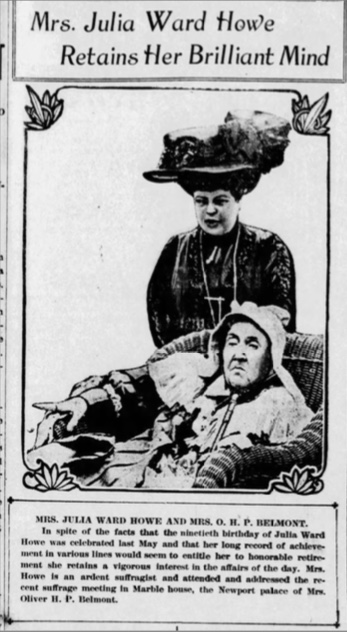
In her letter to her sister Susan wrote: “Every afternoon I have the most refreshing sleep and when I wake the slanting rays of the sun are shining on Narragansett Bay and from all the five windows of my big room is the most glorious view imaginable. We have delightful drives over the old stone bridge that connects us with the mainland, to Tiverton and along the shores of Sconset River, which is really an arm of the ocean, and here we can see the whole length of the island with Newport in its beauty on the coast.  It is ten miles away and we went by train one day, took the famous ocean drive and passed the palaces of the nabobs.  I went in the carriage one afternoon to call on Julia Ward Howe, whose summer home is six miles from here; she was charming and I had an interesting time.” ****

A Rochester newspaper account of the visit reports that Miss Anthony visited the women’s section of Brown University.  She remarked to the women:  I see you girls at present have to peek over the fence at the boys, but the time will come when you will be admitted there on equal terms with them.”  The 200 women students applauded the idea. *****

  • *From “Selected Papers of Elizabeth Cady Stanton and Susan B. Anthony, 1880-1887.  Rutgers, 1997.
  • **Rochester Democrat and Chronicle (Rochester NY, 8/11/1901)
  • ***Letter from Susan B. Anthony to Sarah Eddy – June 12, 1903 in the collection of the University of Rochester.
  • ****The Life and Work of Susan B. Anthony, Vol. 3, Ida Husted Harper 1908.
  • *****Rochester Democrat and Chronicle (11/8/1901).

A Turkey as a Guest at Thanksgiving? Sarah Eddy and Vegetarian Thanksgivings

1 Comment

Mrs. Burke prepares Thanksgiving Dinner

Hanging on the wall at the Portsmouth Historical Society is a painting of Mrs. Burke cooking Thanksgiving Dinner.  Sarah Eddy was the painter and this particular painting was our introduction to this Portsmouth artist and philanthropist.  What is unusual about the “Thanksgiving Dinner” is that there is no turkey.  There is pumpkin pie, cranberry sauce, breads and vegetables.  This would be a tradition with Miss Eddy because she was a vegetarian.  When Susan B. Anthony came to Bristol Ferry to have her portrait painted, she wrote that the neighbors sent over “roast beef for Sarah’s cannibal friends.”

In researching Sarah, I have come across an interesting article from the New York Times from 1902.  Sarah was part of a Thanksgiving Dinner sponsored by the New York Vegetarian Club. The article began with a statement that:  “A live and very lively turkey bearing over his head a placard, ‘I Am Safe Here’ was the feature of the decorations..”  The poor turkey was behind a “strong wire netting for protection” but wasn’t calm until the dessert plates were cleared and “he settled down quietly with what seemed to be a feeling that his turn was not coming next.”  Among the courses were mushroom soup, cranberry sauce, pineapple and celery cream salad and raspberry ice cream.

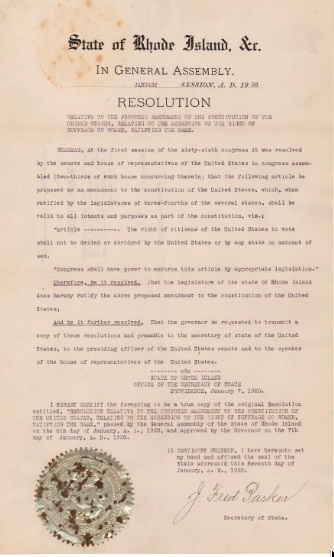
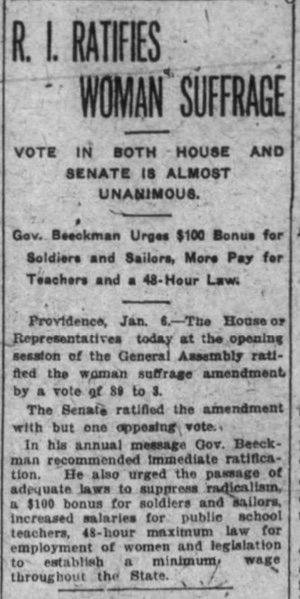
Sarah would attend another “Thanksgiving Dinner” when Rhode Island finally passed the Federal Suffrage Amendment on January 6, 1920.  Sarah Eddy was among those celebrating at the victory dinner.  Turkey was served, but I imagine Sarah did not partake of that main course.

Sarah Eddy’s Suffrage Work

2 Comments

Sarah Eddy was a woman of many causes and in a sense many of them are intertwined.  Her work on woman’s suffrage is part of a larger effort of encouraging kindness and fairness to all.  She advocated for humane treatment of animals, temperance, fair treatment of black people and for arts and cultural education. The motto of her Social Studio, a neighborhood meeting center, was “All men’s good be each man’s rule and universal Peace Lie like a shaft of light across the land.”  Sarah’s goal was teaching kindness to every living creature and humane treatment of animals was her passion until her death in Portsmouth in 1945.

Sarah was born in Boston in 1851 and her family moved to Providence in the 1860s.  She studied at the Pennsylvania Academy of Fine Arts and the Arts Students League of New York.  She was back in Providence by 1880 and was active in the art community. By 1900 Sarah seemed to move permanently to the Bristol Ferry area of Portsmouth.   Sarah never sold any of her work – she gave it away.  She thought of her art as a way of reaching out to help others. She was a painter, sculptor and master photographer.  She continued to paint even into her nineties.

Even though she was a photographer, she made a habit of avoiding her image being taken.  We have only one photograph of her that appeared in a journal for humane treatment of animals.  One newspaper account seems to capture her spirit: “Miss E(ddy) is an enthusiastic humanitarian and vegetarian, a believer in woman’s rights and dress reform, and withal an artist and a lovely little lady. (Times-Picayune-New Orleans, 10/31/1887)

She followed in her mother’s footsteps with her commitment to suffrage.  She was part of national, state and local organizations.  She was never a leader, but she was an organizer and worker for the cause. Sarah had lifelong membership in the National American Woman Suffrage Association.  She was a delegate to national conventions in 1904 and 1906. She was on the executive committee of the Rhode Island Woman Suffrage Association in 1886 and she chaired their legislative committee in 1905.  Sarah organized “parlor meetings” when there was a push to pass a state constitutional amendment giving women the vote.

FR Evening News 11/12/1918

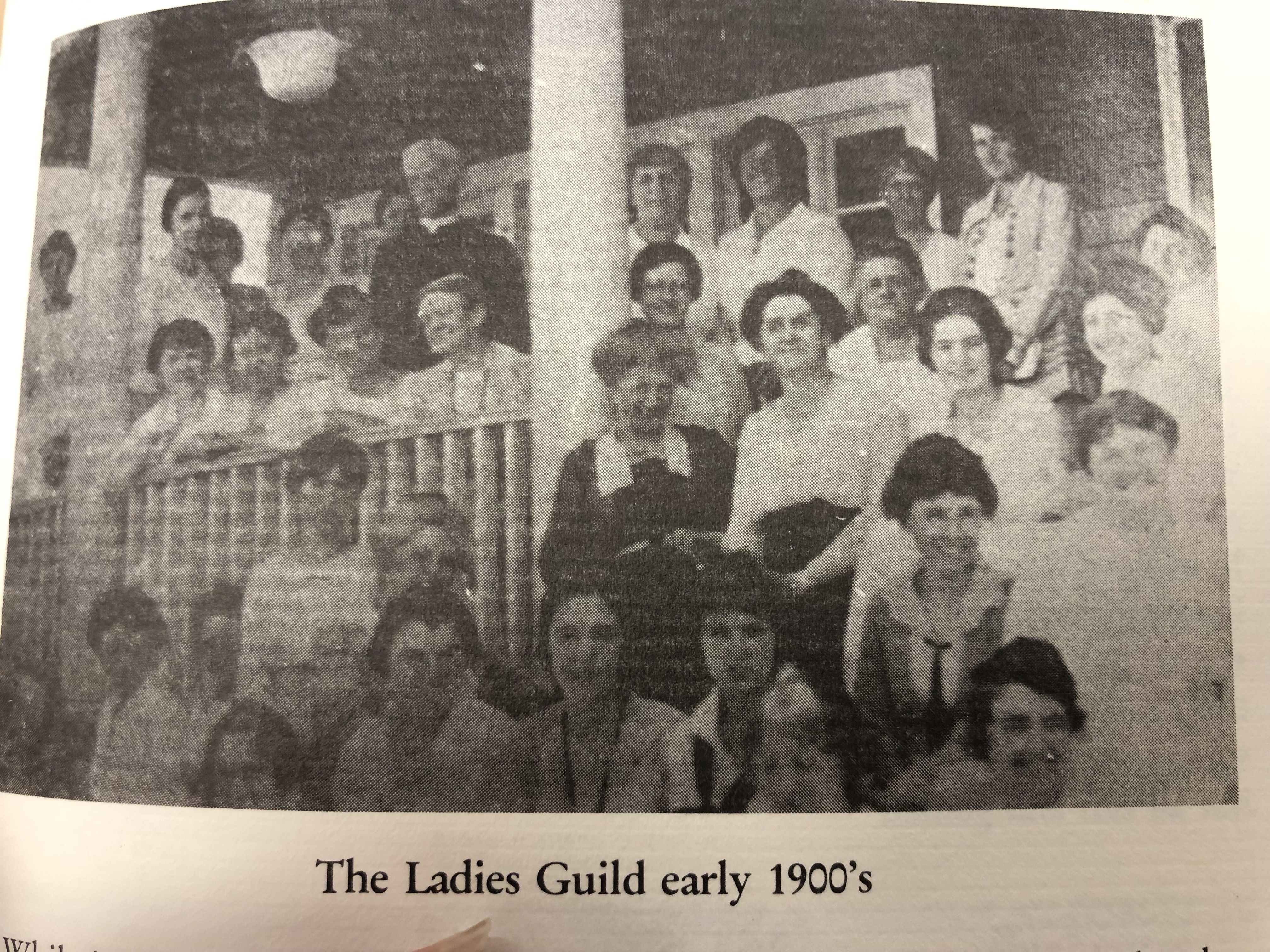
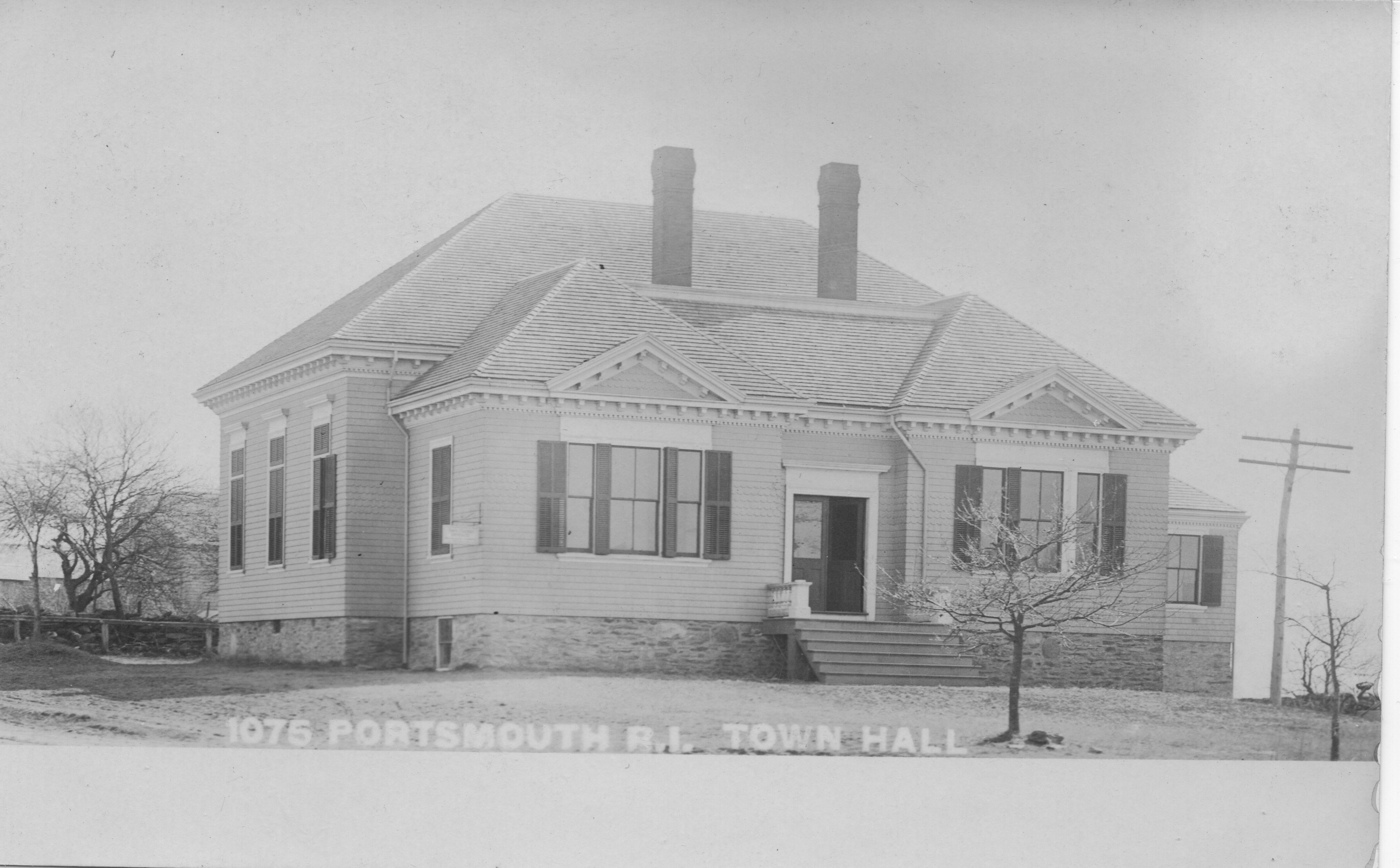
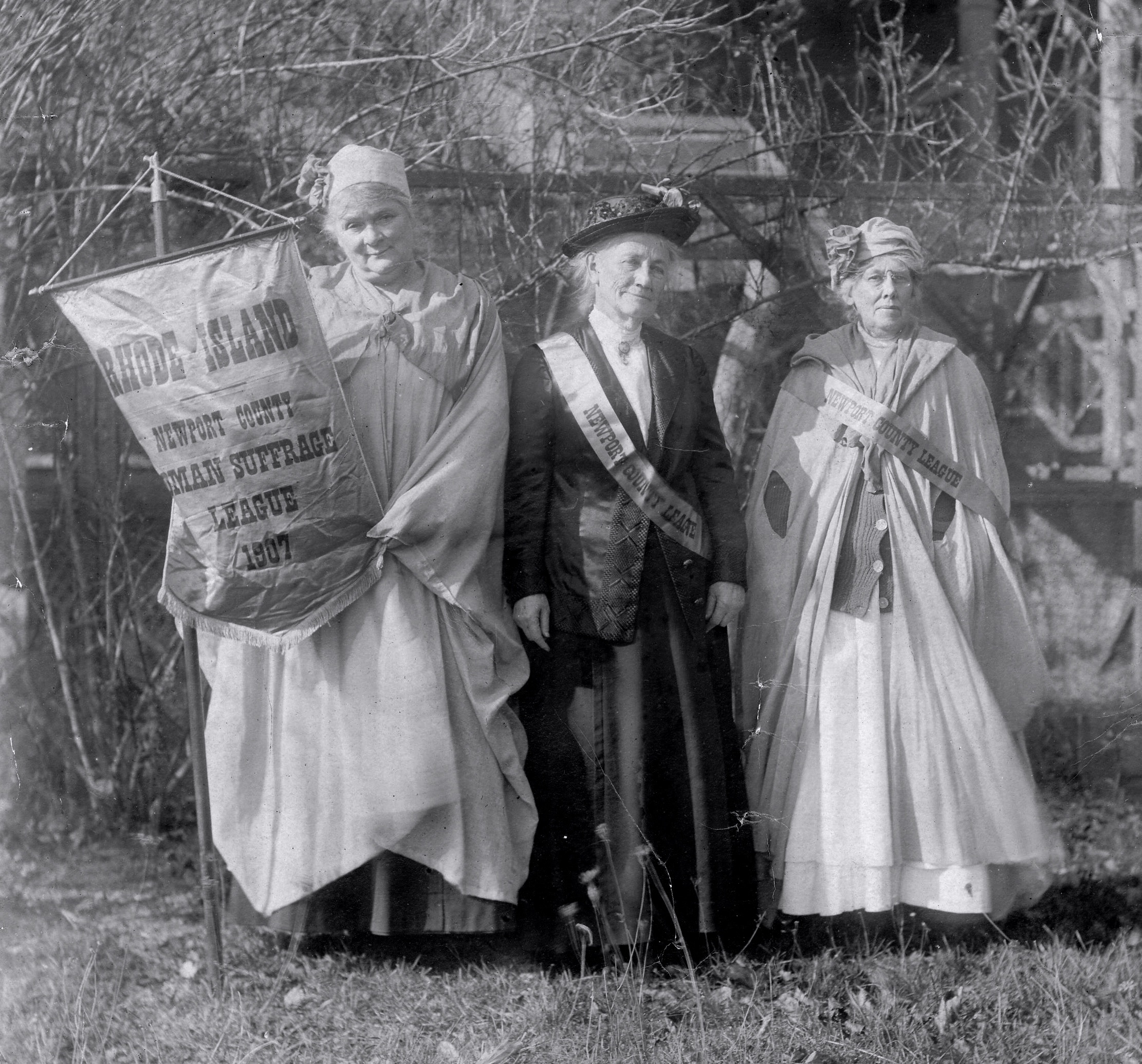
In Portsmouth Sarah Eddy  was a part of the Bristol Ferry women who organized the Newport County Woman Suffrage League in 1908. Gradually the Suffrage League grew throughout Aquidneck Island.  Sarah protested against paying her Portsmouth property taxes because she had no representation.  Sarah the philanthropist didn’t hold grudges.  After women could vote, she donated a storage cabinet that was sorely needed by the Portsmouth Town Clerk.  Sarah’s home on Bristol Ferry or her Social Studio across the street was often a meeting place for the Newport County Woman Suffrage League.  It was the scene of celebration after the vote was won and it was the place for the centennial meeting of the League.

Sarah brought national and state leaders to Portsmouth.  She encouraged her Bristol Ferry friends and neighbors to be active in the cause.  She hosted meetings large and small.  Sarah Eddy was a force in the woman’s suffrage movement in Portsmouth.

Sarah Eddy: Suffrage was a Family Affair

2 Comments

Portsmouth artist and philanthropist Sarah Eddy was the heart of the Bristol Ferry suffrage group.  Three generations of her family were actively supporting the cause of the vote for women.

Francis Jackson – Boston Public Library, 1850

When he died in 1861, Sarah’s maternal grandfather, Francis Jackson of Boston, left Susan B. Anthony and Lucy Stone $5,000 to use as they sought fit “to secure the passage of laws, granting women, whether married or unmarried, the right to vote, to hold office, to hold, manage, and devise property, and all other civil rights enjoyed by men..”   Jackson was very active in the abolition movement and counted William Lloyd Garrison as a good friend.

Eliza Eddy

Francis Jackson’s daughter, Eliza carried on this family interest in suffrage and Sarah was her daughter.  Like her father, when Eliza died in 1882, she left money to both Lucy Stone and Susan B. Anthony.  In her will she said “I request said Susan & Lucy to use said fund thus given to further what is called, the Woman’s Rights cause.”  After other deductions from her estate were made, Susan B. Anthony and Lucy Stone received about $57,000.  Susan is quoted in a newspaper article :  “..I am going to make a long-promised visit at Bristol Ferry, with Mrs. Sarah Eddy, daughter of the woman who left me $24,000 for suffrage work, and which I used mostly in getting up the history of woman suffrage.” (Rochester Democrat and Chronicle 8/11/1901).

Sketch of James Eddy by Sarah Eddy

Sarah’s father, James Eddy, also gave generously to the social causes of his time.  Eddy’s fortune was self made.  Eddy was born in Providence and learned the trade of an engraver.  He traveled throughout Europe and made high quality copies of European works he loved.  He became a collector of fine art and his home in Providence was filled with masterpieces.  Sarah’s interest in art might have come from being surrounded by an art gallery at home.  One newspaper account stated that Eddy might have been worth three million dollars.  (Boston Globe 7/17/1887).

Eddy gave generously to the anti-slavery movement, temperance reform and the improvement of women’s status in society.  Eddy came from a family of ministers, but his own views on religion are hard to follow.  He advocated for the Free Religious Society and built the Bell Street Chapel in Providence by his residence.  He split with the society and often the ministers invited to speak at the Bell Street Chapel found themselves speaking to him alone.  I could not find Sarah Eddy listed as part of any formal church in Portsmouth and that might have been her father’s influence.

Sarah Eddy’s philanthropy and advocacy for causes had strong roots in her family heritage.  From grandfather Francis Jackson, mother Eliza and father James, Sarah had strong examples to follow as a supporter of Woman’s Suffrage.  They also provided her with connections to national leaders in the movement like Susan B. Anthony.  Like her family members, Sarah was in the background – supporting, encouraging and enabling those who led the fight.

Portsmouth Suffragists: A circle of families and neighbors

1 Comment

The Portsmouth Historical Society curator’s committee is working on displays for next season that are centered around the 1920s. I chose to work on the women’s suffrage movement in Portsmouth because I thought I had an abundance of material on it already. Little did I know that when I began to research again, I would see ever widening rings of Portsmouth families and neighbors that were part of the movement. The short list of Portsmouth women active in the movement has begun to grow and grow. In subsequent blogs I will focus on these women individually.

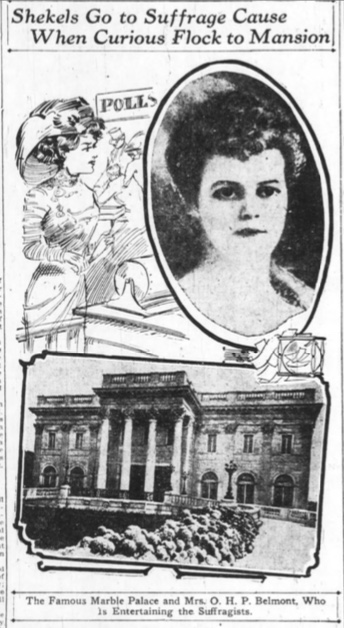
Whole generations of families (women and men) were active in promoting the cause of the right of women to vote. The Mitchel Family, the Ballou Family and the Howe Family were prime examples of movement activity passing from one generation to another. The Bristol Ferry neighborhood in general was a “hotbed” of women’s rights efforts. Our Portsmouth women had connections, too. There was a natural connection to other women on the island through the Newport County Women’s Suffrage League. Through Portsmouth artist and reformer Sarah Eddy national leaders such as Susan B. Anthony came to visit Portsmouth. Through the hospitality of the Ballou Family, Rhode Island and Providence leaders came to visit and speak. Julia Ward Howe was a national leader in her own right and gave the Portsmouth women a connection to Massachusetts women as well.

These women were reformers and were involved in other efforts. Abolition, temperance and social welfare issues were part of their heritage. After women got the vote, they devoted their energies to the League of Women Voters and local political parties (primarily the Republican Party).

My research is continuing, but a blog enables me to revisit blogs as I uncover more information. My goal is to focus on the women individually or in families. What is their background, education, and what other causes were important to them? How did they fit into the life of Portsmouth?

Letitia Lawton, Cora Mitchel and Emeline Eldredge

Tidbits from Abby Sherman’s Diary

Leave a comment

Diaries are a special source of historical information. We are fortunate to have David Durfee Sherman’s diary from the 1850s and a transcription of Abby Sherman’s Diary from late 19th and early 20th century.  The entries give us a rare glimpse of the happenings in Portsmouth through the eyes of contemporary observers. We are researching the 1920s and Abby has a lot to share with us.  Transcription courtesy Jim Garman.

Cast of Characters : The Witnesses

1 Comment

The Portsmouth Community Theater is rehearsing for a performance of “The Ghostly Witness” Sunday (Sept. 8) , at 4 PM at the Portsmouth Historical Society Museum.  The actors appreciate knowing more about he characters they portray.

Henry Strait

Henry Strait might have been about 21 at the time of the trial. He boarded with the Cornells, but he was the apprentice of  Greshom Woddell and was learning to be a wheelwright. He was from Wales and when he was 15 he came to Rhode Island under contract to Woddell. That was how he paid his way to America. He was obligated to Woddell for six years work.   He could not write, but he did seem to have the ability to speak with the Native Americans in the area.  Strait was one of the first to come into Rebecca’s room after the fire and his testimony contradicted Thomas Cornell Jr. about Rebecca not eating with them when they had salted mackerel.

Sarah Cornell

Denise Betz as Sarah Cornell rehearses with Ron Marsh who portrays Thomas Cornell

Sarah Earle Cornell grew up in a affluent family in the household of her father, Ralph Earle.  That household would have had servants to help the women with their work at home and in the garden.  After her marriage to Thomas Cornell, Jr, she was the only able bodied woman in the household and would have milked cows, picked berries and fruit, tended the garden as well as tended to the indoor chores of cooking, cleaning and washing.  Her testimony alone put a potential murder weapon in Thomas’ hand. 

Sarah was the second wife of Thomas, so she entered marriage with a full household, Thomas, his four sons and Rebecca.  Sarah had two daughters  with Thomas and was pregnant with the third daughter at the time of the trial. She named that child “Innocent” and this daughter was an ancestor of Lizzie Borden.

Thomas’ younger brother William advocated for Sarah to stand trial in 1675 even though Thomas had already been tried, found guilty and hanged. Some thought that Sarah was a co-conspirator because another person said they overheard a conversation between Thomas and his wife.  The couple promised that “If you will keep my Council, I will keep yours.”   Sarah was indicted and stayed in prison while awaiting trial.  She was found “not guilty”.  

She was remarried to a man named David Lake and had more children with him.  

Mary Cornell

Mary was the daughter in law of Rebecca Cornell, the wife of John Cornell.  Her father was John Russell.  His testimony, along with that of John Briggs, helped re-open the Cornell case.  John Russel said that a friend reported a conversation in which Rebecca showed fear of her son Thomas and wanted to leave his home.  Mary lived in the Dartmouth area and her testimony centered around how Rebecca believed that her son Thomas neglected her.

Rebecca Woolsey

Rebecca was one of the older children of Thomas Cornell, Sr and Rebecca.  After the rest of the family came home from the Bronx after the massacre of the Hutchinson family, Rebecca stayed in New York.  Her testimony was given by deposition in Flushing, New York.  Rebecca Woolsey’s testimony added another possibility – that her mother had some suicidal thoughts.

Cast of Characters: John Briggs and his vision

Leave a comment

Although his sister Rebecca Cornell was buried and the coroner’s inquest labeled her death an accident, John Briggs re-opens the case with a “ghost story” – he claimed he had seen his sister.  With Briggs’ story and the testimony from a Dartmouth resident that Rebecca feared her son, the case was re-opened.  Who was John Briggs and why would his story lead to the exhumation of the body and ultimately a trial?

Born in 1609, John Briggs was one of the youngest of the signers of the compact of 1638 that led to the settlement of Aquidneck. He played a prominent part in the government of the town, serving as juryman, constable, town councilor, surveyor of lands, special commissioner, and Deputy to the General Assembly.  John Briggs married Sarah Cornell – sister of Thomas Cornell Senior.  A brother and sister Briggs (John and Rebecca)  married a brother and sister Cornell (Thomas and Sarah).

John came to Boston in 1635 on the ship, the Blessing.  This was a few years before his sister and her family came over.   He was a follower of Anne Hutchinson, and when when she ran into trouble with the leaders of the Massachusetts Colony it became unsafe for her supporters to stay there.  They banded together to found a new settlement in Portsmouth.

John Briggs is documented as having a license to operate an ordinary (tavern)  in Portsmouth RI, and in Dartmouth.  It was customary for town meetings to be held at taverns and it is clear from the records that many town meetings were frequently held at the house of Mr. John Briggs, Sr.   Although Briggs was unable to write – he was a long standing town leader. He was a credible man with a good reputation.

Ghosts were taken seriously even among the Protestant reformers.   The view at the time was that ghosts were spirits of the dead who always had a reason for their appearance – usually to correct an injustice that would not be detected by other means. Antinomians and Quakers believed that God could speak to them in their dreams.  John Briggs dream or vision of his Sister Cornell would not be easily dismissed.

Briggs landgrant

Cast of Characters: The Accused – Thomas Cornell, Jr.

2 Comments

Thomas Cornell, Jr was accused of murdering his mother, Rebecca Cornell. Who was he? By most accounts Thomas was an integral part of the Portsmouth community. He was born in 1627 in Saffron Walden, Essex, England. He may have attended school there because he was able to read and write – a very valuable skill in early Portsmouth. He was eleven years old when his family emigrated from England to Boston. The Cornells were coming to Boston just at the time that Anne Hutchinson’s and her followers were leaving to begin a community in Portsmouth.  The Cornells bought William Baulston’s tavern in Boston, but they ran into trouble with the authorities there.  Thomas’ uncle, John Briggs, was in the group of Portsmouth founders and the Cornells followed him to Portsmouth in 1643. They were friends of Anne Hutchinson and went with her group to a new settlement in the Bronx.  The Cornells escaped the fate of the Hutchinson family and they returned to Portsmouth.

Thomas Cornell, Jr serving as Town Clerk 1658

Thomas played many roles in the Portsmouth community.  In 1658 he was chosen as town clerk.  He was a juror and even oversaw the construction of the prison he would eventually inhabit. He was a constable, deputy to the high court, set tax rates and was a town councilman.    Thomas seems to have left Portsmouth in 1661 after some quarrels with the town over his late father’s failure to construct a brew house.  The town wanted the return of the land that was granted.  Thomas may have been in the Dartmouth area since we know he had property there. He held offices in Dartmouth at the same time he held offices in Portsmouth.   In July of 1663 Rebecca Cornell deeded the family homestead to her son Thomas effective at her death.

Thomas Jr. had been married to Elizabeth Fiscock and they had four sons, Thomas, Stephen, Edward and John. There are indications that mother Rebecca and Elizabeth had a good relationship.   The speculation is that Thomas came back to the family homestead and his mother Rebecca when he was left a widower.  Thomas married Sarah Earle in 1668 and they had three daughters (one of whom was born after Thomas’ death).  The friction between Sarah and her mother-in-law was brought to light in the testimony of witnesses at Thomas’ trial.

Meanwhile Thomas worked the family homestead well.  They kept a good dairy, and used the wool from their sheep to spin valuable “trading cloth.”  A native American called Wickhopash (or Harry) was convicted of stealing Thomas Cornell’s rapier and a valuable length of this trading cloth.    Thomas was raising horses on his Dartmouth property for the West Indian market.  Thomas Cornell, Jr was not a poor man, but he wanted the resources to join in the Narragansett purchases and other financial deals that the Portsmouth men around him were capable of making.

Thomas’ last request was to be buried in the family plot next to his mother, Rebecca.  That request was denied, but he was buried at the homestead far away from his mother.

Older Entries Newer Entries