Home

Joseph Cundall: Lost in a Snowstorm

2 Comments

Many vintage guides to Aquidneck Island call the Glen “Cundall’s Mills.”  The old history books tell the sad sorry of Joseph Cundall who was “engaged in the woolen manufacture, in the pursuit and improvement, of which he was uncommonly skillful, ingenious and enterprising” (Newport Mercury, December 1811).  This is the story of the Cundall family in Portsmouth and of the tragic ending to a life well spent.

Cundall Family Mills

The Glen had been associated with mills since colonial times.  The Cundall family had strong roots in the area.  The stream through the Glen was originally settled by Thomas Cook and his family.  As the Cooks moved on to Tiverton, this land was bought by James Sisson who sold his grist mill and 46 acres around the brook to a Joseph Cundall.  In 1706 Joseph Cundall had left his native Yorkshire, England to become an indentured servant in America. Becoming an indentured servant was a way for a young person to learn a trade and get an education in exchange for working for seven years or more. Cundall seems to have learned his trade well and was in a good position to buy land as an adult. Water from the stream powered the carding and fulling mills to wash and pull woolen fibers. Joseph Cundall added almost a hundred more acres to his land around the Glen before he died in 1760.

As we walk through the Glen today, it is hard for us to picture it as a busy mill and cloth manufacturing site.  There was a mill pond and a stream of water which would propel a small carding and fulling mill.  You can still see the remnants of the mill run with its stonework lining the mill stream.  The millstream ends at the Sakonnet River.  At one time there were wide paths along the mill run.  Walking through this area today, you can imagine that it is still much like the landscape the Cundall family knew so well.  This mill stream area, however, was the scene of  Joseph Cundall’s grandson’s death.

The Christmas Eve Tragedy

Although family genealogies are hard to follow, Joseph Cundall (the third Joseph in the line from our original miller) was born in 1763.  He was described as a “highly useful and industrious citizen” by the  Newport Mercury at the time of his death. His character was described as upright, amiable and benevolent.   In listing his death, the Rhode Island, Vital Extracts notes that he was repeatedly a Representative in the General Assembly and was a Justice in Court of Common Pleas for Newport County, besides filling other offices of trust.  At forty-nine years of age, Joseph Cundall Esquire was a respected man in business and the community.

How did he die so tragically?  On Christmas Eve, 1811 there was a sudden and violent snow storm.  It was described by newspapers at the time to be the most severe storm the area had seen in many years.   Joseph went along the mill run to secure some wood that had been delivered on the Sakonnet River shoreline.  He did not want the wood to go out with the tide.  Shepherd Tom Hazard, who lived nearby on Wapping Road, reported that hundreds of sheep, many cattle and several human beings died in the storm.  Hazard writes “Among the latter was

Joseph Cundall’s tombstone

Joseph Cundall of Portsmouth, who became so exhausted and bewildered while but a few rods from his house in what is now called “the Glen,” that he gave up striving, and sat down in a deep gorge a short distance south of the mill, where his corpse was subsequently found under a snow-bank (From Recollections of Olden Times).  Cundall’s body was not found for a week and there had been hope that he could survive.  Cundall was laid to rest in the Slocum graveyard, just a few yards from where his mill would have been.

The Christmas Eve tragedy marked an end to Cundall’s Mills.  The land and mills had been purchased by the firm of Clarke (Judge Samuel) and Grinnell and they carried on the wool manufacturing business.  When the land and mills were sold in 1823 the Newport Mercury lists that they operated a grist mill, a clothier’s works with looms and spinning machinery.  The Cundall family members gradually left the area, but the the name “Cundall’s Mills” still remains in our history.

The Killing of Charles Porter : Issues of Race, Self-Defense and Police Protection

1 Comment

Map showing location of Chase Farm

Farmer and auctioneer Isaac Chase may have killed Charles Porter in 1903, but the issues involved in this case could come out of our headlines today. The right to defend one’s life and home, racial division and the lack of police protection all come into play during the legal proceedings against Portsmouth farmer Chase.

Before we get into the issues and headlines, lets go over the timeline of the case as reported by witnesses at the inquest.

Case Timeline

  1.  Charles Porter had been employed on Isaac Chase’s farm in Portsmouth for nearly three years. Porter seemed to be living at West Broadway in Newport.  Little was known about him and we even find his name confused.
  2. During the month before the shooting, there were several altercations between Chase and Porter.  Chase had a large farm off Wapping Road and his produce was sold to Newport kitchens and restaurants.  Chase discharged Porter and had warned him not to come back to the farm.
  3. On Feb 19, 1903, attorney F.F. Nolan had a visit from Porter.  Porter told him he had some trouble with Chase and wanted to get a settlement from him.  Porter told the lawyer that Chase had been circulating damaging stories about him.  Nolan reported that Porter did not seem violent, just a trifle unbalanced.  He talked about the blowing of horns.
  4. Also on Feb 19, a black man purchased a revolver and box of cartridges at Mr. Southwick’s store.   The clerk could not identify Porter as the purchaser.
  5.  On the morning of Feb 20, 1903, Isaac Chase and his daughter, Augusta, were leaving their home on a sleigh.  A man was standing near the gatepost and her father stopped to talk to him.  The man said that her father had been talking about him.  Her father denied this.  Chase’s daughter testified that the man drew out a revolver and fired it. The shot went wild even though Porter was right next to the sleigh.
  6. Chase drove on in the sleigh until he met Fillmore Coggeshall.  He asked Coggeshall to go to Oakland Farm to telephone for an officer.
  7. Frank Paquin (perhaps a constable) was sent to Newport in search of an officer.
  8. At around 2 PM, after asking Coggeshall to telephone for an officer, Chase and his daughter returned to their home.
  9. Chase armed himself with a shot-gun and loaded with both barrels with buckshot.
  10. Owing to a number of reasons, there was a long wait for an officer.
  11. Augusta Chase reported that the man in the road (Porter) followed her father around to every spot he went.
  12. The man (Porter) had his hands in his pocket when he started into the yard.  Her father shouted a warning and then he shot.  Chase claimed he did not deliberately aim or shoot to kill.
  13. Chase requested someone to go to Oakland Farm and call up the Sheriff.  He gave an accounting of the shooting and offered to give himself up.  The sheriff sent out two deputies to arrest him.  They returned with Chase and locked him up in the county jail.
  14. Dr. Steele, medical examiner for Portsmouth found Porter’s body lying across Chase’s driveway – entirely within Porter’s property.  He found a seven shot fully loaded revolver on the body and evidence that the gun had been recently fired and reloaded.

Racial Tensions

This case raised some issues of racial tensions.  Because the victim was a black man and the shooter was white, the black community rallied.  Newspapers reported threats against Chase, but there were also calmer voices.

Let us look at the threats first.  The headline in the Feb 27th Boston Herald read:  “Farmer Chase Threatened – If not Imprisoned for Killing Porter, He Will Be Murdered, Letter Says.”  Although I couldn’t find the original article this quotes, the Herald reports that the Newport News (Maybe the Newport Daily News?) says:  The News is in receipt of an anonymous letter – “We colored men are to form a delegation to see that the law in enforced and that the murderer  be sent to prison for life; if not, we are pledged to murder him within a year’s time. The statement is also made that Chase owed Porter $73 for work, he having received only $7 for four months previous.”  These threats were viewed seriously by the police and Chase was protected.

Daily News accounts report a large group of blacks (hundreds) attended the hearing.  Members of the black community “have raised a sum of money to defray the funeral expenses and to secure a counsel to look after the interests of” Porter.  Indeed, the counsel (F.F. Nolan) participated in the interrogation of witnesses even though there was an attorney representing the state.

One of the most interesting headlines was in the Boston Journal of February 28, 1903.

“BE CALM AND LET LAW TAKES ITS COURSE”

Rev. I. Derricks so Advises Newport Colored People.

The article relates Reverend Israel Derrick’s remarks at the funeral of Charles Porter.  “I want to caution all my people, you grown up men in particular, to be careful what you say, as well as what you do in this regrettable tragedy.  You are living in enlightened New England, where the torch and rope are presumed to be unknown.  Be calm and let the law take its course.  I should be sadly grieved to see any of my brethren attempting to take the law into their own hands, as has been threatened by some of you.  I am a law abiding citizen, and I want all of you to be, at the same time I agree with you to this extent.  ‘Let justice be done, though the heaven’s fall.'”

Did He Shoot In Self-Defense?

One of the witnesses at the preliminary hearing, William Butler (Town Sergeant)  quoted Chase as saying he had to protect himself.

“Butler, I hated to do it but I had to protect my life and family.”

Chase himself testified that he thought he saw a suggestive movement towards the hip pocket where the revolver had been produced in the earlier attack.

The white community was sympathetic to Chase.  A Newport Mercury article on Feb. 28th, commented that “Little else has been talked of in the towns on the Island since the affair happened and sentiment seems to be greatly in favor of Mr. Chase on the ground that his action was entirely justifiable under the circumstances.

The view of the Black Community was quite different.  The headline on Feb 26, 1903 Boston Journal reads:
“Not Satisfied, Chase Shot in Self-Defense:  Colored Citizens of Newport Aroused Over Killing of Potter.” (Note that there was confusion about Porter’s name).  The newspaper account talks about the funds raised not only for the burial, but also to investigate the affair.  Porter’s father and others in the community believed Chase owed Porter and had been keeping items at the Chase home (a trunk with clothing, a gold watch and money) that rightfully belonged to Porter.  The reasoning was that Porter had just come for what was owed him, but Chase willfully shot him.

The Boston Journal (Feb. 28) reported that “the negroes as a unit, are on the side of the dead man.”

Lack of Police Protection

Because of the threats, Portsmouth town authorities were advised that they had to provide reasonable protection for Chase and his family.  There was a constable assigned to the Chase house every night.  A March 11, 1903 Boston Journal article brings up another issue – that of  police protection.  “On the day of the shooting about seven hours elapsed before an officer of the law appeared upon the premises, and this is being used as an argument that the citizens do not have proper protection.  Because of the slow means of communication about the town it is difficult to locate the town officers in emergency, though they do their best to respond to calls when they receive them.”

In an age where we carry cell phones and can call 911 in an emergency, it is difficult for us to understand the length of time it took for Chase to get help.  When Charles Porter fired a wild shot at Isaac Chase, Chase tried to do the right thing.  He sent someone to a telephone at the Vanderbilts at Oakland Farm who had the closest phone.  When they did reach the authorities, no officer was available.  It was an hour or two after the death of Porter when a deputy sheriff arrived.  Instead of arresting Porter, Isaac Chase was offering himself up.

We have no record of how long the constables protected Isaac Chase.  We do know that he lived sixteen more years.  The courts did not indict Chase for the shooting of Charles Porter and the newspaper records do not show any reaction from the black community.  Perhaps they listened to Rev. Derrick and let justice be done.

I encountered this story as I was researching Isaac Chase’s auctioneer’s book for a display at the Portsmouth Historical Society coming spring of 2018.  There are still many questions left to explore.  What was the racial climate on the island at the turn of the century? Was this case representative of a general divide between black and white?  The lawyer describes Porter as “a trifle unbalanced” and reported that Porter said he had been “hearing horns.”  Is this another incidence of mental illness creating a confrontation?  How did the development of the telephone help the response time of the police?  Was there enough of a police presence in the town of Portsmouth?

As a community we seem to grapple with some of the same issues as Portsmouth residents in Isaac Chase’s day.  Racial tensions, questions of self-defense, and the effectiveness of the police force are on the national news today.  Some issues never get resolved.


Rescued from the Confederates: Colby Mitchell of Portsmouth

1 Comment

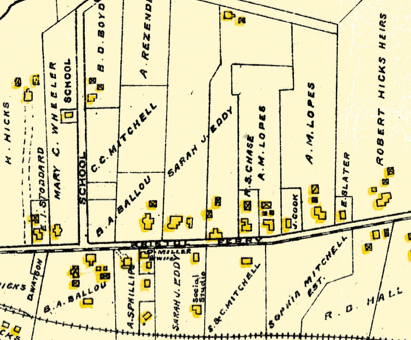
Mitchell land Bristol Ferry Road area 1907

What would you do if your teenage son was kidnapped from a Florida school and conscripted into the Confederate Army? This was the dilemma for the Mitchell family who had strong ties to the Bristol Ferry neighborhood of Portsmouth. The Mitchells had business interests in Florida and their son Colby was in school in Apalachicola. A detachment of Confederate soldiers took young Colby from his school and conscripted him into the Southern army even though he was underage.  The men wouldn’t even let Colby go home to get a change of clothing.  His parents pleaded with the army colonel to release their son, but he was taken to the army camp anyway.  Fortunately the young man had some friends in the camp who took care of him and gave him food as there was “no food for conscripts.”  A few months later Colby was allowed a few days furlough because his health had deteriorated from malaria.  He was forced to go back to camp.

Colby had a severe relapse of his fever, but the kindness of his fellow soldiers pulled him through his illness.  At that time he was able to get another four day furlough to visit his family in Apalachicola.  If the Southern army could kidnap young Colby, his father Thomas Mitchell decided to kidnap him back.  His father took him to a Union vessel that was blockading the harbor and father and son were soon on their way north.  The trip to Rhode Island took several months and father and son had left the rest of the family behind in the south.

Colby and his sisters, May, Cora and Sophie were part of the Bristol Ferry community for many years.  Colby’s story was told in a Newport Mercury article (July 20, 1934) when he was awarded the “Boston Post Cane” – given to the town’s oldest resident.  He must have recovered well from his wartime ill health.  He was described as an eighty-nine year old who was “well and hearty” and living with his niece.

Sold at Auction: Glen Farm Herd

1 Comment

Photo from auction catalog.

A  Newport Mercury  account in 1949 provides the story of the end of the renown Glen Farm herds. The entire herd of 89 cows were dispersed in one auction for over $36,000. The herd, one of the oldest in Rhode Island, had been established in 1889 by H.A.C. Taylor and had been continued by his son Moses. Moses Taylor’s wife, Edith Taylor Nicholson had continued the herd, but she made the decision to sell in 1949.

Glen Farm Guernseys were known for high quality breeding and an outstanding record for being disease free. The original stock came from the Island of Guernsey, but the Taylors continued to selectively breed and improve their herds.

Among the buyers at the auction were Francis Taylor, the grandson of Glen Farm’s founder.  Francis, who is listed as being from Seekonk, bought a cow (Frolic of the Glen) and a calf (Gold of the Glen).  Local buyers were former Governor William H. Vanderbilt who purchased four of the better known cows for his Massachusetts farm, Hugh D. Auchincloss (Jacqueline Kennedy’s stepfather), and Mervin Briggs (who had Fairholm Dairy in Portsmouth). Most of the herd went to Pennsylvania and Delaware.

The week before the cattle auction, Edith Taylor Nicholson disposed of all the Glen Farm sheep  and some years before the bred horses had been dispersed as well.  After the auction there was still cattle on Glen Farm. Sixty head of Angus beef cattle were still being bred in the last years of the farm.

Cundall’s Mills in the Glen

Leave a comment

The landscape of the Glen provides a special place where you can see Portsmouth history.

portsmouthhistorynotes's avatarThe Glen

Painting of early Glen mill found in the attic of the "Durfee Tea House." Painting of early Glen mill found in the attic of the “Durfee Tea House.”

Courier and Ives view of picnicking in the Glen in the 1850’s

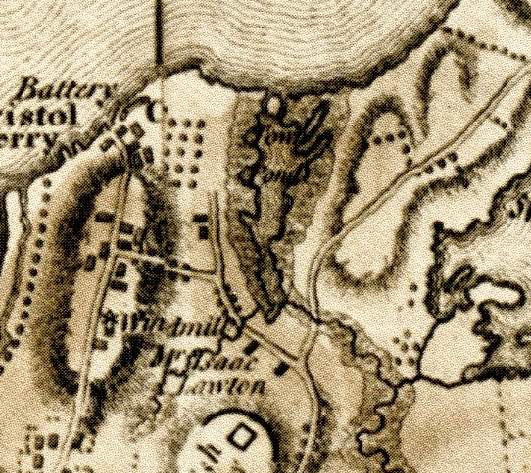
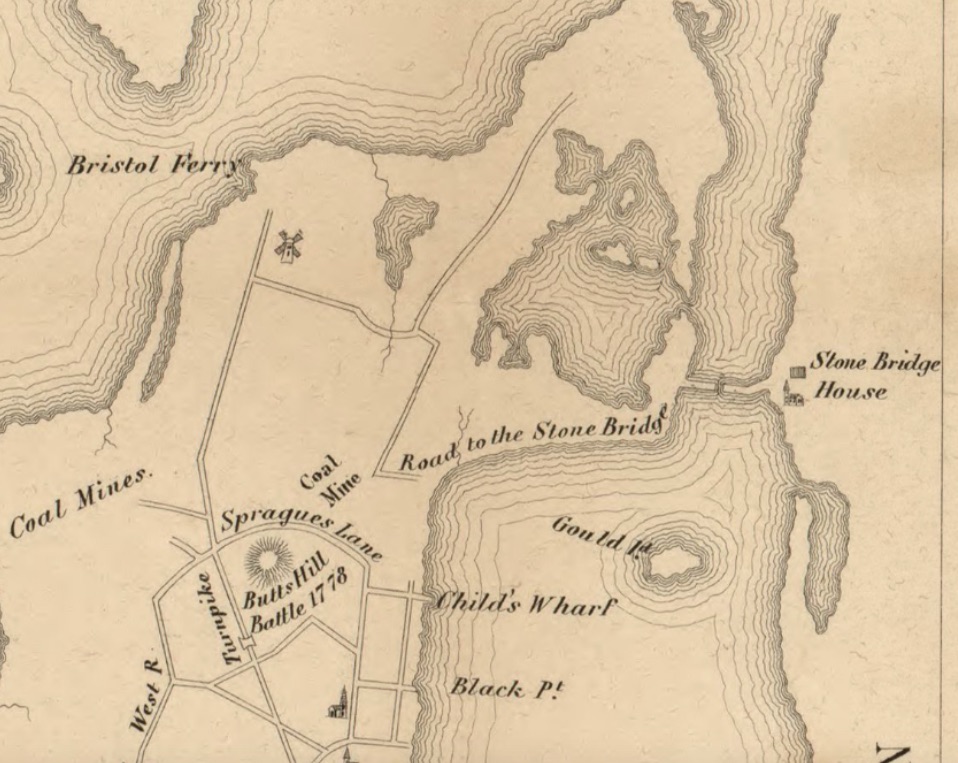
At the historical cemetery, the Cundall family stones led us to uncover another tragedy during what would become the Glen mill days. The Glen’s first settlers, the Cooke family, gradually moved away and sold their land, but many of the Cooke daughters married into local families. It is hard to trace all the ownership of what is now the town owned Glen land, but we did discover information on some of those landowners. In 1720 John Cooke sells a portion of his land to James Sisson. By 1745 Sisson had a water powered grist mill to grind corn on the brook in the Glen. Revolutionary War era maps show the location of that mill as just east of Glen Farm Road and the barn…

View original post 531 more words

Portsmouth Landmarks: Greenvale

Leave a comment

Grapes in the vineyard.

Vintage image of the Barstow house at Greenvale

Greenvale Farm has been in the same family since the 186os. John S. Barstow, a China-trade merchant from Boston, created a “gentleman’s farm” on fifty-three acres of land on the shore of the Sakonnet River. Greenvale was Barstow’s country retreat and he constructed a large main house and stable designed by Boston architect John Sturgis. Barstow followed a pattern for a gentleman’s farm from the agricultural literature of the day (Country Life by Robert Morris Copeland). Retiring to a farm and working with your hands was considered an ideal situation for the gentleman who had already made his fortune.

When Barstow died, his fortune was divided among many brothers and sisters. Sister Catherine was given Greenvale Farm. At her death in 1910 the house had been closed and was considered “a resort for tramps and idlers.” (Providence Journal, 14, June, 1910d).  For decades the property was abandoned. One of Catherine’s nieces – Charlotte Condit Parker and her husband Major General James Parker, took an interest in Greenvale and revived the farm. The property has been in the Parker family since then. Converting the property to a vineyard has been a way to keep the land together in family hands.

A few years ago Elmhurst students interviewed owner Nancy Parker Wilson.
Do you use machines for making wine? Machines do make wine. They press the grapes. You use the same machines to make white and red wine. You have to clean the machines before you make white wine.
What is the grape growing season? May to October
When did the winery get started? Started their own label of wine in the 90’s.
How many people work on the farm? Seven people work full time. Other people help.
Why do you pick a certain bottle for a certain wine? Traditional colors are used. There are different bottle shapes for different wines, too.
What do you do about pests? Birds, beetles, moths and mildew are pests that bother the vines. They put nets on grapes vines to protect them from birds. They use a chemical on a twist tie to protect grapes from moths and other insects. They may use a spray.
What is your biggest selling wine? Chardonnay
What do you do in a drought? A drought does not really affect the grapes. The roots are very far down for older vines, but the younger vines are not so lucky.
How long does it take to make wine? It takes from five days to two weeks.
Where do you make your wine? Now they make their wine at Newport Vineyards.
How did you get started growing grapes? The Parker family got help from grape growers across the river.
What was the farm before it became a vineyard? It started out as a farm raising prize-winning cattle. There were barns and a horse stable.
Have you had any damage from storms? There has been damage from the salt water coming from storms.
Where do you sell your wine? They have a tasting room at Greenvale.
Do you use any machinery to pick grapes? No, the grapes are hand picked. They put them in bins and carry them away.
Have you had any disasters with your crops? No, a hurricane almost came. Some salt water got on the top leaves, but that was about it.

Portsmouth Landmarks: Glen Ridge Farm

Leave a comment

New birth at Glen Ridge

Vintage photo of Glen Ridge Barns

The land in and around Glen Ridge Farm has a history that reflects the history of our town. It was part of an original land grant given to William Brenton and then sold to members of the Cook family who served in town offices from the 1640s on. It was an area that served as a ferry landing for the Fogland Ferry to Tiverton.

The land went through a number of Yankee farm families including that of Captain John Stanton until H.A.C. Taylor bought the land in the 1880s. Taylor was a New York businessman who established Glen Farm to be a model farm dedicated to raising the best livestock. His son Moses Taylor added the stone horse barns you see at Glen Ridge Farm today. The horse barns originally housed the Percheron horses that the Taylors bred, but also were home to the Taylors’ own riding horses. The 1925 barn structures were added to an already existing frame barn structure that is very old and maybe one of the oldest barns in our area. Another building in the compound served as a garage for the Taylor cars and as the headquarters for the Glen Farm Fire Truck (which served at Prudence Island and is being restored today.)

We are fortunate to have parts of Glen Farm in town ownership. Glen Ridge Farm is in private hands, but its owners are keeping the traditional farming use of the land. It is home to an elite herd of colored hucaya alpacas. It is truly a part of our town history that we can see and touch today.

Portsmouth Landmarks: Founder’s Brook

Leave a comment

Founder’s Brook

Portsmouth Compact on the Puddingstone Rock

We call it “Founder’s Brook” because that was what the Portsmouth tercentenary committee called it when they unveiled a monument to Portsmouth’s founders there in 1936. In old records it was known as the “watering place” and later it was called “Stony Brook.” Today it is a place set aside to remember our founders, the Portsmouth Compact and the life of the community in its earliest days.

Although there is debate about whether Founder’s Brook was the original spring where the earlier settlement was centered, this area has traditionally been an important spot to remember the founders.  The bronze tablet with the words of the Portsmouth Compact inscribed was placed on a large “pudding stone” believed to be a spot where the founders made their speeches.  As the small group of settlers prepared to go to Aquidneck Island, they organized themselves into what they called a Bodie Politik or group of citizens. They picked William Coddington as their judge (ruler), William Aspinwall as their Secretary and William Dyre as the Clerk. They formed a government even before they left Boston. What is known as the “Portsmouth Compact” was a pledge to follow God and live by His laws as written in the Bible. These settlers were organized and came to Aquidneck Island with the idea that they agreed with each other to form a government which would follow the laws of God. Other settlements had the structure of church or a patent (agreement from the king) to guide them. These men and their families were developing something new.

As the spring of 1638 came, the little band of settlers began their journey to Aquidneck Island. Some came over the land by way of Providence. Others sailed around Cape Cod. The settled at the North end of the Island around Founder’s Brook and another brook in the area. They had left the security of Boston for tent like homes or dug out caves lined with wood. Just like the Native Americans before them, they hunted and fished for food and they began to prepare the land for planting. There was a new community on Aquidneck Island beginning as the old community had ended. At first this small settlement of English families was known by the Native American name of Pocasset.

Today we come to Founder’s Brook to honor the founders and to get a glimpse of the early roots of Portsmouth life.  Preserving this spot was not easy. The Tercentenary Committee in the 1930’s purchased the adjacent land and gave it to the town to preserve the brook area. In 1960 efforts were made to “save Founder’s Brook” when highway cloverleafs for Route 24 threatened to obliterate the Founders Brook Memorial Grove and the Mello Farm.  The Portsmouth Historical Society, the business community and the State Department of Public Works combined to protect the memorial area.  Improvements to the memorial area were made during Portsmouth’s 375th celebration.

Portsmouth Landmarks: Glen Barns

Leave a comment

portsmouthhistorynotes's avatarThe Glen

Aerial diagram of Glen Farm Barns

1. Pump House: This was home to the equipment that pumped water from the stream to supply the farm with water.

2. Stone Horse Barn: Built in 1911. During World War II the stalls were removed and it was outfitted as a field hospital.

3. Silo: This stone silo is attached to the stone barn with a stone passageway. It was probably built before 1926. There was a wooden silo, too, but it has been removed.

4. Stone Cow Barn: Built in 1907, this barn was for dairy cows. This is where the Glen dairy was located.

5. Stone Bull Barn with Bull Pen: This barn is dated 1910. There was a fire in this barn in 1926, but no animals were injured.

The barns are arranged to provide courtyards of shelter from bad weather.

6. Frame Cow Barn: The is one of the…

View original post 133 more words

Portsmouth Landmarks: Christian Union Church/PHS headquarters

Leave a comment

Church/Museum today

The headquarters of the Portsmouth Historical Society today was a church that was an important part of life in South Portsmouth.  The church was founded in 1810 as the Christian Church of Portsmouth. Members met in private homes until a small meetinghouse was built in 1824 on the site of the present building. At that point they called themselves the Union Society to help unite rather than divide the Christian community. The church was called the Union Meeting House and was financed with the help of a lottery.

The congregation seemed open to a variety of expressions of faith.  William Ellery Channing, a noted Unitarian who lived close by, loved to talk with the church members on Sunday afternoons. Noted social reformer Dorothea Dix began the Sunday School.

The present structure was built in 1865 at a cost of $7,000. At that time they returned to the name of the Christian Church of Portsmouth. The basic principle Rev. Miller was that the Bible is the word of God. Members were sent as delegates to the Rhode Island and Massachusetts Christian and Congregational Conferences.

The construction of the new church was very brief – lasting from August to December 1865. The choir loft was added later. The minister at that time, Rev. William E. Miller was instrumental in overseeing the construction and he also built the church pulpit. A church dedication ceremony was held in early January 1866.

Women were invited to preach. Julia Ward Howe, another neighbor up on Union Street, would come to “supply the pulpit”. Ellen Gustin of Attleboro was active in evangelization at the church and worked with the pastor.

In the 1870s the pastors held open meetings at the Glen and local Methodist pastors and ministers from many denominations were present.  The governing structure of the church revolved around a board which was charged with finding and overseeing pastors and the life of the church. The officers were three Elders (and later a President), two Deacons, treasurer and the clerk. Most of what we know about the church is from the writings of the various clerks in the church records. The activities of the church centered around the official church committee.

The most active of the committees seemed to be Music and Social Life. The church members believed that everyone should have access to a musical education. The church had a singing school and organ lessons were given. The organ you see in the church today was bought from Emmanuel Church from Newport in 1903.

Organ from Emmanuel Church

The social life group coordinated turkey suppers and Christmas festivals at the church. Clambakes, strawberry festivals and oyster suppers were held at the Glen and other sites on the island. Even when there was no pastor and the spiritual side of the congregation was lacking, the social and benevolent parts of the church were active in uniting the group. The church building served the community as a school, lecture hall and social meeting spot.

The church was an active, thriving congregation for the half century between the Civil War and World War I. It then went through a decline from which it never recovered. The last church service was held in the summer of 1937.  In 1940 the fourteen remaining members voted to give the property to the Portsmouth Historical Society. The remaining members recognized the church as a historic landmark in Portsmouth and they wanted the building to be used for educational or historical purposes.

Audience Room

The Portsmouth Historical Society has worked to preserve the Christian Union Church as its headquarters and museum by using grants.

Older Entries Newer Entries