Home

Fortifications (American and British) in Northern Portsmouth

Leave a comment

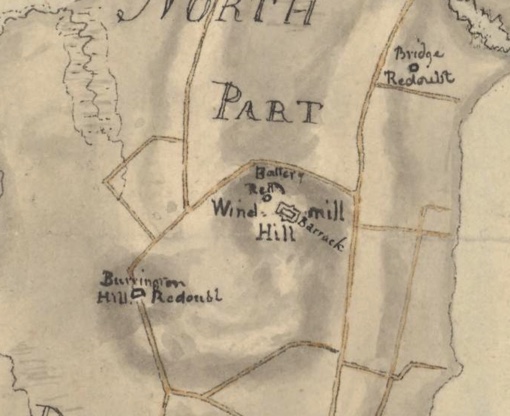
Maps provide a prime source of information on the British fortifications on Aquidneck Island, and the North Portsmouth map from the Huntington Digital Library provides some interesting information. From the notes we get a glimpse of what the American fortifications were before the British Occupation. In some cases the British enlarged what had already existed. In other cases they constructed fortifications to secure their own needs.

Starting at the Bristol Ferry area:

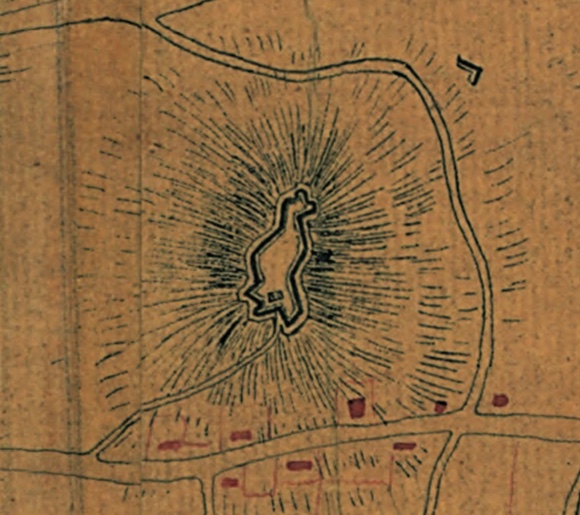
Looking at a modern map the location of this redoubt seems be where the Bristol Landing Condos are today. The note says “Left by the Rebels ___1775 nearly finished.” The diagram in the Henry Clinton Collection of the William Clements Library gives us more details.

A diary entry from a British soldier, Frederick Mackenzie, gives us an idea of the fort changing hands in the initial actions after the occupation.

“Dec 8th 1776 – The Army landed this morning at Weaver’s Cove near Mr. Stoddards House…
The first embarkation under General Prescott, marches as soon as formed to the high road from Newport to Bristol Ferry, a short distance from the landing place, and finding that the few of the Enemy who were on the Island, had retired in haste towards the N. End of it, he pursued them to the ferries, where he took a few prisoners and a 9 lb cannon; and save a great many cattle and sheep which they had not time to Carry off.

The Rebels abandoned a well situated fort at the N. End of the Island yesterday, without attempting to defend it. It in some measure commands the passage to Bristol by the ferry.”

Heading east on the map we see the fortifications heading toward Common Fence Point.

The redoubt by the Lawton house was labeled “made a Redoubt July 1776 now demolished”. That would have been an American fortification. Looking at a map today, it seems to be in the Anthony Road/Boyd’s Lane area to the south of Town Pond. In the direction of Common Fence Point there is a line of “abbatis” which is an obstacle made by cutting down trees, interlacing them and having the sharp points face the enemy. What we call Anthony Road was labeled Common Fence Road on the map.

The map labels a “Common Fence Redoubt” but the modern location is actually closer to East Main Road. There were fortifications toward Howland Ferry. We don’t think of a bridge being on Park Avenue, but early maps show a bridge there. The Bridge Redoubt is listed as September of 1776 which would have made it an American fortification originally.

A map made by Fage in 1778 that is part of the Clinton Collection at the Clements Library helps us to view the fortifications as a whole. One would think that the Common Fence Redoubt would be on Common Fence Point and the Bridge Redoubt would be close to the bridge to the Howland Ferry, but their locations on the map seem to be somewhat puzzling. Perhaps they were guarding the way from Common Fence Point and guarding the way from the bridge. The positions of the redoubts put them closer to established central roads. Howland Ferry was an important location. It is close to where the remains of Stone Bridge are today. It was a narrow spot between Aquidneck Island and the mainland at Tiverton. From Mackenzie’s Diary: Oct. 20, 1777 In order to strengthen the post at Howland’s bridge, an abbatiss of large apple trees from the neighboring Orchards was thrown across the Neck about 200 yards this side of the bridge, which will prevent the enemy from advancing in that part with Cannon or any considerable number of troops without first removing them, which will take u some time and must be done under our fire.”

Oct 21, 1777 – “We have had some convincing proofs of late of the bad construction of Howland Bridge Redoubt.  The 9 pounders place in the right embrasure could not be brought to bear on the ground from which the Rebels fired the night of the …”

Nov. 26, 1777 – “An Abbattis was made this morning from the shore at the Mouth of the town pond for 300 yards o the right along the edge of the pond, which is passable at low water.”

March 16, 1778
“The 43rd regiment having undertaken to supply themselves with the necessary quantity of wood from Commonfence Neck, during the time they continued on duty at the advanced posts,& having employed several carts yesterday in drawing away what had been cut near Hick’s orchard…”

Fage Map 1778

History Happened Here

1 Comment

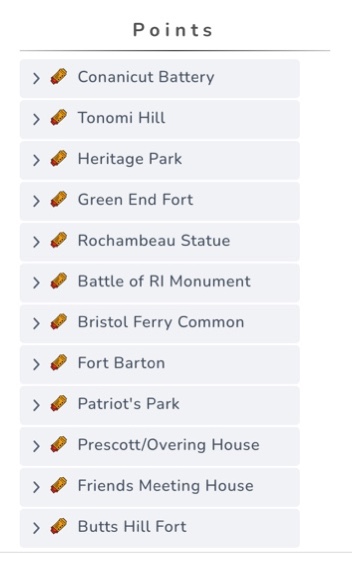
Our community has special locations where we can get in touch with our Revolutionary War history.  Locations in Portsmouth, Middletown, Newport, Jamestown and Tiverton are places where "history happened."  There are monuments to French General Rochambeau, The Rhode Island 1st Regiment and to the Battle of Rhode Island.  In some locations (like Butts Hill Fort), you can actually see the earthen work fortifications. 

Below is a link to an interactive map where you can find out more about the locations in our community.  Be sure to click on the button for more information.  There are links to websites and even videos that help explain the importance of the site.

https://map.proxi.co/r/FEV-As3nU-ELkWnmLKsc

These are the locations you will find on the map.

“The Murder of Peleg Hedly” and “Gunpowder from the British Frigate Lark destroys the Wilcox House”: Notes on a Map

Leave a comment

What was Portsmouth like during the British Occupation? What happened during the Battle of Rhode Island? Who lived in Portsmouth during this time and what happened to their property? These are questions I have been asking as I do research for Butts Hill Fort and the Battle of Rhode Island. Recently I was able to get more answers through poring over an online map recently found by a member of the Butts Hill Fort Restoration Committee. It is part of the map collection of the Huntington Library, but there are some mysteries about it. Usually a map lists a “maker” – the person who drew the map. This map lists no maker, but it is clear that the maker was part of the British occupying forces. The Legend reads:

“Plan of the northern part of Rhode Island in the township of Portsmouth. Shewing the British posts of defence as compleated during the possession of Rhode Island, from the 8th of Dec. 1776 to the 25th of Oct. 1778. When the Siege of Newport was raised after the Attack of the French and Americans in August 1778. The Enemy retreated the 29th and remained two days in possession of Wind-Mill Hill. The Kings Troops pursuing them took the Position upon Quaker Hill as represented in the Plan, till the Enemy totally vacated the Island the 1st of September, 1778.”

The map itself is neatly done, but there are interesting notes here and there. This blog will feature some of the notes about Portsmouth citizens and what happened to them during the Occupation and battle.

“Peleg Headly was murdered by us and his house destroyed on the 29th of August.” was one note that struck me. There was a Peleg Hedly in Portsmouth at the time, but I have not found a death record for him.

This map shows the Bristol Ferry area. The notes provides the location of a Rebel made fortification. The Bristol Redoubt “was left by the Rebels about 1775, nearly finished.” A note to the north of the Bristol Redoubt tells us houses were destroyed and orchards were cut down between Town Pond and the Bristol Ferry landings. Another orchard was cut down off of Bristol Ferry Road to the south of the ferry landings. William Burden (Borden?), Codington (Coddington) and Earl are three of the farmers mentioned. Widow Westgate’s house was made into a barracks for 50 soldiers. Other farms mentioned are those belonging to George Irish, David Anthony, Stephen Brownell and George Hall.

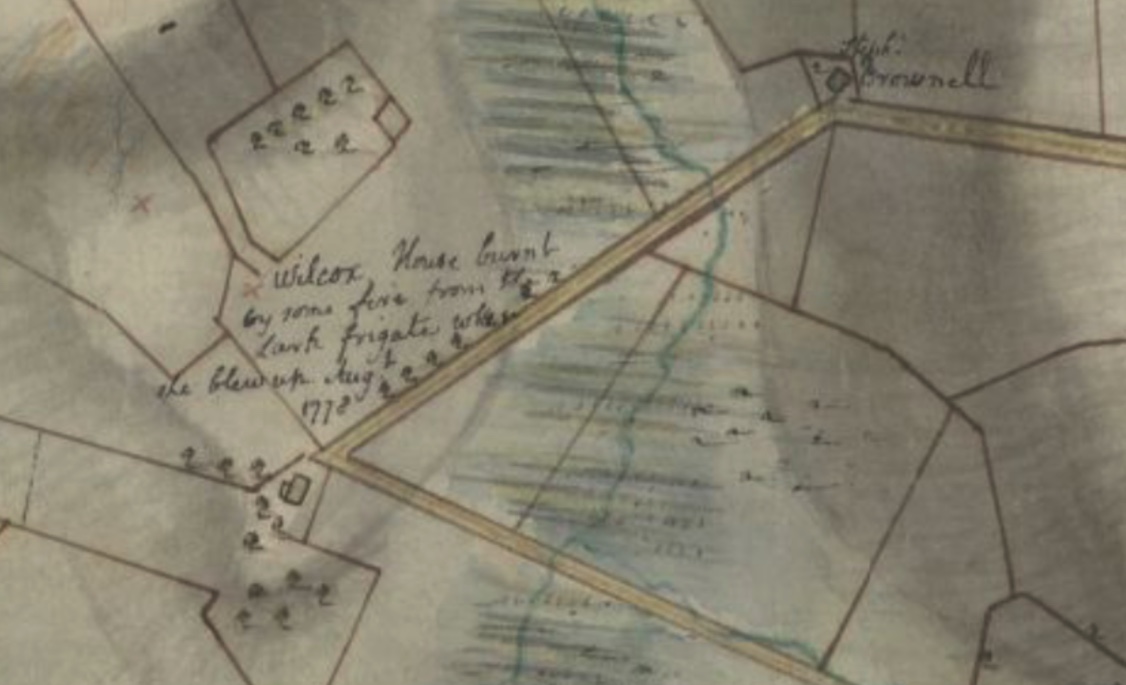
The Wilcox (Cook Wilcox) “house burnt by some fire from the Lark Frigate when she blew up August 1778.”

As the French fleet was arriving in late July of 1778, the British ordered that their ships would be destroyed rather than be taken by the enemy. The frigates Lark, Cerberus, Orpheus and the Juno were no match for the French ships coming in. The Lark’s Captain Smith ran his ship aground and set her on fire. The Lark’s 76 barrels of gunpowder exploded and ignited the Wilcox home. Flaming debris landed as far away as three miles. In his diary, British engineer Frederick Mackenzie wrote: “It was a most mortifying sight to us, who were Spectators of this conflagration, to see so many fine Frigates destroyed in so short a time, without any loss on the part of the Enemy.”

More notes from the map in future blogs.

Preserving the Fort: Honoring “those brave men”

Leave a comment

Tour stop 6 at the Memorial

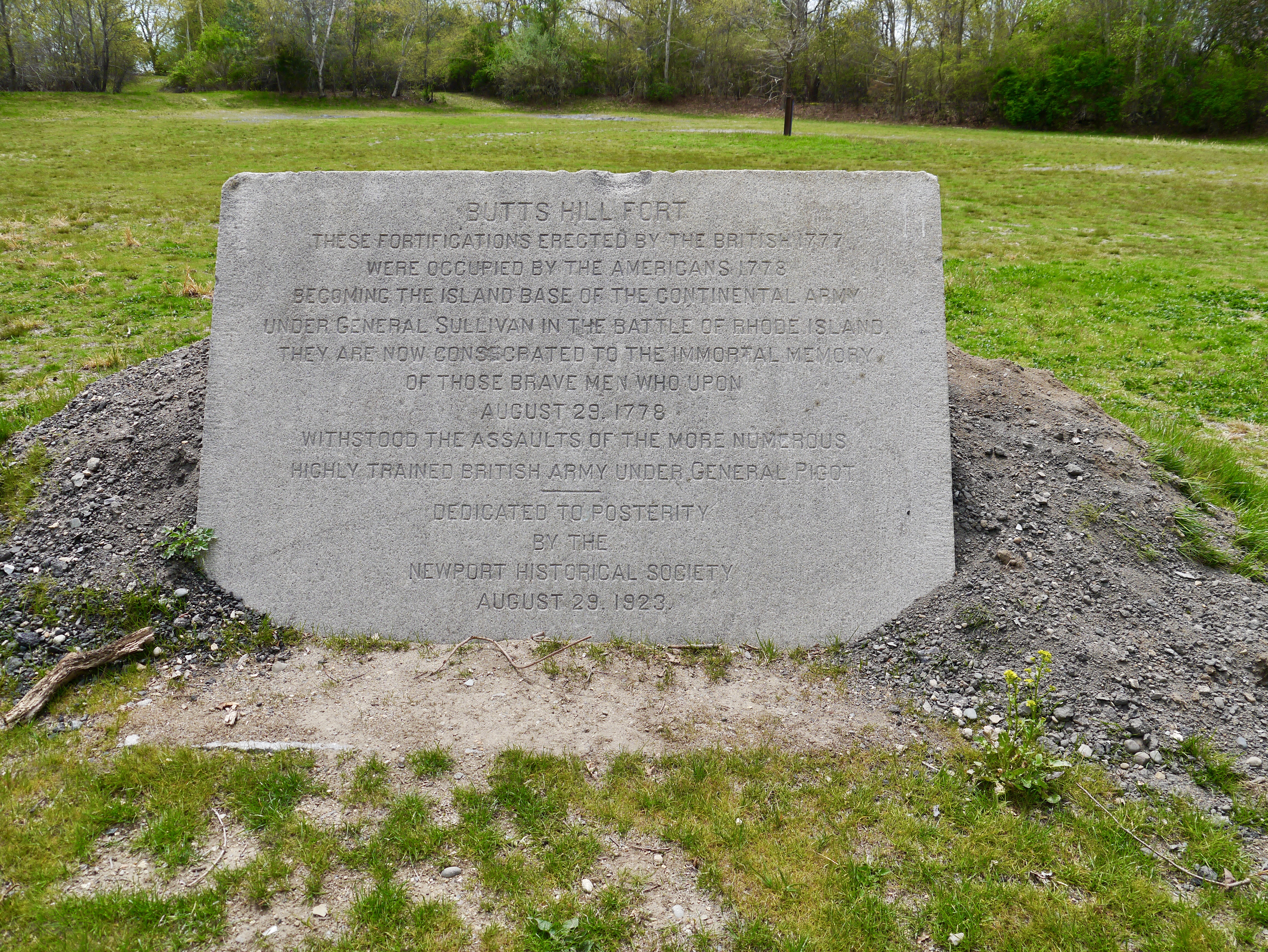
The words of this memorial read:

Butts Hill Fort
These fortifications erected by the British 1777 were occupied by the Americans 1778 becoming the island base of the Continental Army under General Sullivan in the Battle of Rhode Island. They are consecrated to the immortal memory of those brave men who upon August 29, 1778 withstood the assaults of the more numerous highly trained British Army under General Pigot. Dedicated to posterity by the Newport Historical Society, August 29, 1923.

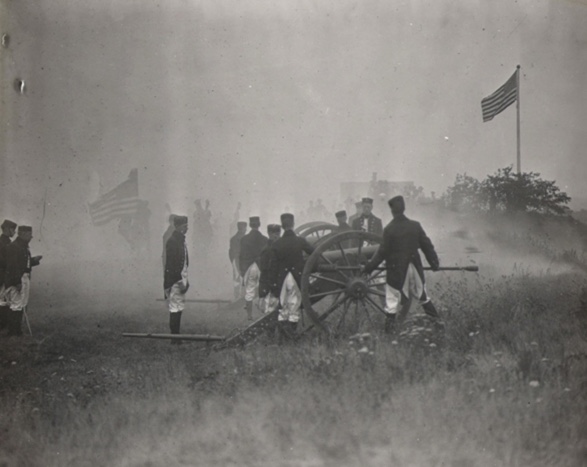
This memorial stone was dedicated with some fanfare. There were speeches and battle reenactments, marching bands and the blast of cannons. This sacred piece of land was saved from being a housing development by the then President of the Newport Historical Society, Rev. Roderick Terry. He personally bought the property (and Fort Barton as well) and gave them to the Society. This gift came with some restrictions:

*The Newport Historical Society and its successors were to forever “preserve, keep and maintain” the property as a monument to those who fought in the Revolutionary War.
*That the property will always keep the name “Butts Hill Fort.”
*That the property should never be used for monetary gain.

Dedication 1923

The Newport Historical Society could not maintain the fort. In 1968 the land was transferred to the State and on to the Town of Portsmouth. Terry’s restrictions on the property remain today as the responsibility of the town of Portsmouth.

The Butts Hill Fort Restoration Committee aims to fulfill Rev. Terry’s mandate to preserve, keep and maintain the property as a monument to those who fought in the Revolutionary War. The Committee is working on a land management plan to restore the fort and create an area of walking trails and informational signage.

As the anniversaries of the American Revolution and Battle of Rhode Island draw near, the task of “preserving” the fort and ensuring that it is a monument to those who fought in the Revolutionary War becomes even more vital.

Camp Butts Hill 1780-1781: French and Americans Complete the Fort

2 Comments

A continuation of a tour of Butts Hill Fort : Stop 5: At the parade grounds

In December of 1779 the British finally departed from Aquidneck Island. The Americans regained possession of Butts Hill. The French arrived on Aquidneck Island on July 11, 1780 and the island was again occupied by troops. In October of 1780 one American militiaman would report in a letter:

“…there are about 7500 Men on the Island at the Several ports, 5000 of which are French, at Newport, 2000 Three Months Men, at this place and 500 Continentals, under Col. Greene of this state.”

The allied French and American forces felt secure, but they continued to prepare to defend the island. On Butts Hill there were American troops assigned to support the work of the French troops in restoring the fortifications. Through the summer and fall of 1780, Butts Hill was actively being enclosed and made into a fort by the Americans and their French allies. This is the fort shape we recognize today.

Rochambeau Map 1780

We get a glimpse of their work through the Orderly Books of Ebenezer Thayer and John Jacobs. An orderly book is a record of the day to day activities of a unit. Thayer recorded the activities of a troop assigned to support the Expedition Pariculiere, the French Expeditionary Army under the command of Rochambeau. Their service was from August 16th to November 28, 1780. Other orderly books and some letters written from the camp give us an idea of life in the camp. That life was not easy.

The September 9th entry by Thayer shows they were assigned six men to a tent with a cook for each group of six. Later entries show that the kitchens had to be moved higher to prevent the smoke from filling the tents. A later entry tells us that the guard consisted of sixty rank and file soldiers. There were also sentinels around the encampment – 2 in front and one in the rear. This is kept up day and night. This day’s entry also includes concern about the filth around the camp that could be detrimental to the soldiers’ health.

They were not equipped well. An entry expresses concerns that there were not enough axes. One of the “fatigue duties” (labor duties that don’t require arms) was gathering wood. The axes would have been essential to chopping wood. Wood on Aquidneck Island was so scarce they had to go to Freetown, Massachusetts to obtain firewood.

Soldiers were hungry and stole from nearby homes and they were disciplines for that. The officers had a hard time securing enough food to last a day so that they might be fit for duty. In a October 10, 1780 letter to friends in Boston, Major May of the Boston Regiment shares his experience.

“We have but 21 days to tarry here, but famine seems to stare us in the face. I could give you particulars, but I never was fond of telling all. It may suffice to say, that we have one day’s rations of Indian meal on hand, no meat, no wood, no sauce etc. Before I go any further I must tell you I have been, even now, sick with a stupefying cold. ..I hope I may be returned to you all again, in health and safety.”

One group that were assured of good provisions were those actively helping the French masons. “There are four men to be detached from the brigade to attend constantly on the French Masons until the stone pillows (pillars?) of the Fort are completed and two masons detached to assist the French Masons until the works are finished and for their service they shall receive half a pint of rum a day when in the store.” Their provisions are ready for them so that they can complete the Fort works in a timely manner.

Fort building was hard work. One entry records that the American wagons are bringing loads of stone to the works at Butts Hill Fort. They are building a “sally port” which is a secure, controlled entry way to an enclosure like a fort. All tools must be returned to the engineer. Members of the Black Regiment continued the “works” at Butts Hill Fort once the Massachusetts militias departed.

The Black Regiment at Butts Hill Fort

1 Comment

We think of the Black Regiment’s valor during the Battle of Rhode Island, but I am discovering more ties between the First Rhode Island Regiment (commanded by Col. Christopher Greene) and the construction of the fort at Butts Hill. This was a time of transition for the soldiers of the Black Regiment and it is not always easy to follow them as they were absorbed into other units and divided for assignments.

First, I need to provide some background. When the British voluntarily left Aquidneck Island in October of 1779, the Americans came back to find the Island decimated. The First Rhode Island Regiment joined the Second Rhode Island Regiment in Newport on November 3, 1779. After the British Occupation, supplies of food and wood were dangerously low in Newport. They were sent to winter in Providence and East Greenwich. In early February of 1780 one report had the regiment at about 143 privates. They had orders to march for New York, but the arrival of the French on Aquidneck Island changed the plans.

On July 10, 1780 the French fleet and army arrived in Newport. General Heath of the American Army acted as Washington’s liaison, but on July 25th he was joined by Major General Lafayette. Five thousand French soldiers set up camp in Newport. Although a small number of the Black Regiment soldiers were sent as guards to Providence, by the end of July the remainder of Col. Christopher Greene’s men and the Rhode Island Six Months Continental Battalion encamped in Portsmouth. They performed guard duty at Butts Hill, Howland’s Ferry, and Bristol Ferry.

The Massachusetts Militia Orderly books show that Greene’s men were transported to East Greenwich to prepare for a march west with the American Army. However, the activity of the Royal Navy caused alarm and American General Heath ordered Greene’s troop to return to the island. Greene was disappointed but made a request in a letter to George Washington. The letter, dated October 14, 1780, gives us a further link between the Black Regiment and Butts Hill Fort.

“When Gen. Heath left this post, the command of the American Troops devolved on me.  The difficulty of getting supplies of provisions has been such that we have been almost entirely without.  This has greatly retarded the completion of the very important work at Butt’s Hill, where the three militia from the Massachusetts State have been employed.  Their time of service expires the first of next month.  I am confident they will not be able to put the fort in a defendable state by that time.  Should your Excellency not call my Regiment to join the Army.  They will undoubtedly be very usefully employed making it so.  I wish to know your Excellency’s pleasure as to our staying here or joining the Army.  If we stay in this state which part of it to  La__ Winter Quarters – as the season is far advanced and the Times of the Six months Service expire the first of January.  Perhaps in the short time they have to serve may be useful here as with the Army, though for my own part I ever wish to be with the Army…”

Letter of Col. Christopher Greene to George Washington – 10/14/1780

According to pension petitions, they helped the French soldiers and masons complete the job of re-enforcing the fortifications at Butts Hill. Fifty of their soldiers were detached to help the French move their artillery. After two calls back to Aquidneck Island, they would later join the American Army on the march south and participated in the final battle at Yorktown.

Resources

“They fought bravely, but were unfortunate.” by Daniel Popek was a valuable resource. Its footnotes led me to many important documents.

Letter of Col. Christopher Greene to George Washington,  Oct. 14, 1780

Letter of Col. Christopher Greene to Governor William Greene, October 27, 1780

A View of the Battle: Butts Hill as Sullivan’s Headquarters

Leave a comment

Part 4 in brainstorming a tour of Butts Hill Fort: Focus on the Battle of Rhode Island. At the SW corner of the Fort.

We pick up our timeline:

August 28th: (From Sullivan’s letter to Congress after the battle):

Sullivan details the positions of his forces on the evening of August 28, 1778.

“One regiment was posted in a redoubt advanced to the right of the __ line. Colonel Henry B. Livingston with a light corp, consisting of Colonel Jackson’s detachment, and a detachment from the army was stationed in the east road: Another light corp, under command of Colonel Laurens, Col. Fleury, and Major Talbot, was posted on the west road. These corps were posted near three miles in front; in the rear of these was the picquet of the army, commanded by Col. Wade.”

“On the evening of the 28th we moved with our stores and baggage, which had not been previously sent forward, and about two in the morning encamped on Butts’s Hill, with our right extending to the west road, and left to the east road; the flanking and covering parties ____further towards the west road on the right and left.”

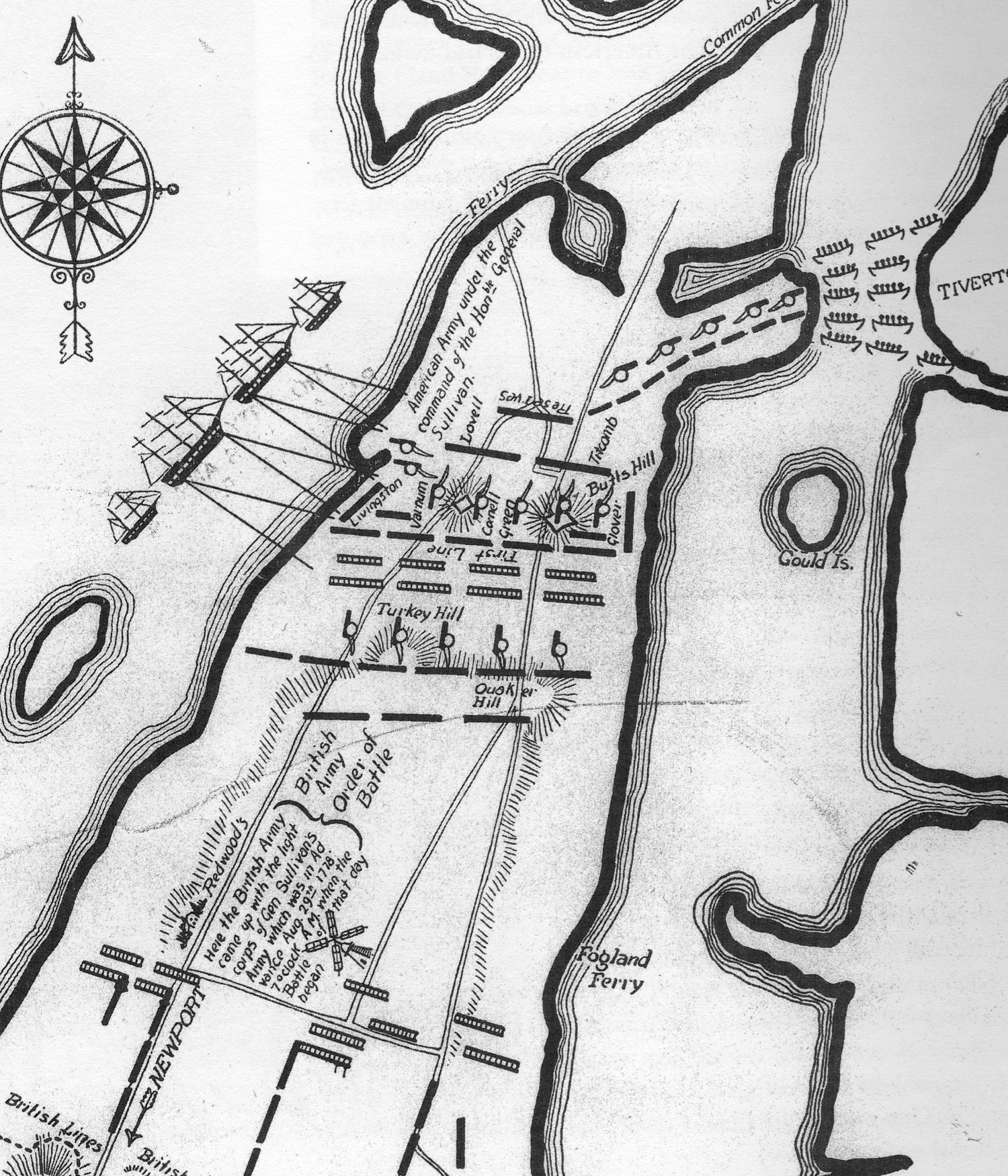
August 29th, 1778: What was going on around Portsmouth during the day of the battle? These engagements are detailed for us by Seth Chiaro. They are culled from The Rhode Island Campaign written by Christian McBurney.

West Main Rd and Union Street Engagement: During the early hours on August 29th around 7:00 AM, Hessian Chasseurs made contact with American forces near the intersection of West Main Rd and Union Street. A small engagement took place from that area and would eventually lead towards the Lawton Valley. The Hessians would eventually break the American line with Artillery. 

East Main Rd and Union Street Engagement: By 8:00 AM the British 54th, 22nd, 43rd, and the 38th Regiments of Foot are ambushed by Col. Nathaniel Wade’s American picket line. The Americans fired two volleys into the British column. The picket line retreated towards Quaker Hill. The 43rd RoF took pursuit down Middle Road while the 54th, 38th, and 43rd  RoF continued down East Main Rd. 

Turkey Hill Engagement: German Captain Von Malburg pursued Col. Laurens Regiment to Turkey Hill. Laurens men took up a strong defensive position on top of Turkey Hill. Col. Laurens sent a request for reinforcements to General Sullivan. Sullivan responded with orders to ‘”fall back to the main line.” General Sullivan sent Webb’s Connecticut Regiment to support Laurens’ retreat. Ameican and Hessian units engaged on Turkey Hill before the Americans fell back. Laurens’ Regiments fell back to General Nathanael Green’s position to the right of Butts Hill. By 8:30 AM the Hessians had secured Turkey Hill. 

Quaker Hill Engagement: The British units that had engaged with American Forces were now engaged on Quaker Hill. The British forces formed a line that extended from East Main Rd to about where Sea Meadow Drive is located. Americans were also formed between the Quaker Meeting House and Hedly St. General Sullivan sent reinforcements to Quaker Hill, giving the Americans the upper hand, but only for a short time. Both sides engaged on the hillside over a poorly defended artillery position. American forces were able to secure the position. The British attacked and poured effective volleys of musket balls into the Americans causing them to retreat. Sullivan ordered the units fighting on Quaker Hill to retreat back to the mainline around Butts Hill Fort. The engagement on Quaker Hill lasted a full hour. The British attempted to attack Butts Hill Fort but the 18 pound cannons from Butts Hill Fort kept the British from advancing. 

Lehigh Hill Engagement (Durfee’s Hill):  General Nathanael Greene held the right flank of the American Army, along the right-wing stood a small artillery redoubt. This was a vital position for both sides. The 1st RI Regiment (Black Regiment)  was under the direct command of Major Samiel Ward who was commanded by Col. Christopher Greene, a distant cousin of Nathanael Greene. German Captain Malsburg was ordered to attack the hardened position. The first attack failed. The 1st RI Regiment held its ground. The Hessians tried multiple times to take the position. The Hessians tried to flank the position, this also failed. On the third attempt, the 2nd RI Regiment supported the 1st RI Regiment. As the 2nd RI Reg. approached the redoubt the Hessians were attempting to climb the walls. All together Greene had about 1,600 soldiers fighting on the Lehigh Hill. Units included 1st RI Regiment, 2nd RI Regiment, Livingston’s 1st Canadian, Sherburne’s, and Webbs Regiments. More than 800 Continentals including Laurens advance guard and Jacksons’ Detachment participated. The American line veered SW at a 45-degree angle from Butts Hill to Durfee’s Hill making the American fire even more effective. Col. Henry Jackson’s men fixed bayonets and charged into the Hessian Line, turning the tide of the battle. The Battle was over at 4 pm. The Hessians retreated to Turkey Hill. Both sides exchanged cannon fire throughout the night. Cannon fire was also exchanged between Turkey Hill and the Butts Hill Fort. 

Commonwealth Land Title Insurance Company map, 1926

August 30, 1778

From Sullivan’s letter: “The morning of the 30th I received a letter from his Excellency General Washington, giving me notice that Lord Howe had again sailed with the fleet, and receiving intelligence at the same time that a fleet was off Block Island and also a letter from Boston, informing me that the Count D’Estaing could not come round so soon as I expected, a council was called, and as we could have no prospect of operating against Newport with success, without the attendance of a fleet, it was unanimously agreed to quit the island until the return of the French squadron.”

The retreat plan in Sullivan’s words:

“To make a retreat in the face of an enemy, equal, if not superior in number, and cross a river without loss, I knew was an arduous task, and seldom accomplished, if attempted. As our sentries were within 200 yards of other, I knew it would require the greatest care and attention. To cover my design from the enemy, I ordered a number of tents to be brought forward and pitched in sight of the enemy, and almost the whole army employed themselves in fortifying the camp. The heavy baggage and stores were falling back and crossing through the day; at dark, the tents were struck, the light baggage and troops passed dawn, and before twelve o’clock the main army had crossed with the stores and baggage.

Resources:

Plan of the Battle of Rhode Island from a Commonwealth Land Title Insurance Company map, 1926

Sullivan’s letter to the Continental Congress which was published in the Providence Gazette, September 26, 1778.

The Role of Butts Hill in the Siege of Newport

Leave a comment

This blog is part three of information that might be provided on a tour of Butts Hill Fort today. We are at the southern fortifications.

The narrative of our tour of Butts Hill Fort has taken us through the British improvements to the fortifications. This part of the story takes us to the three weeks in August of 1778 when the Americans held this high position during the Siege of Newport.

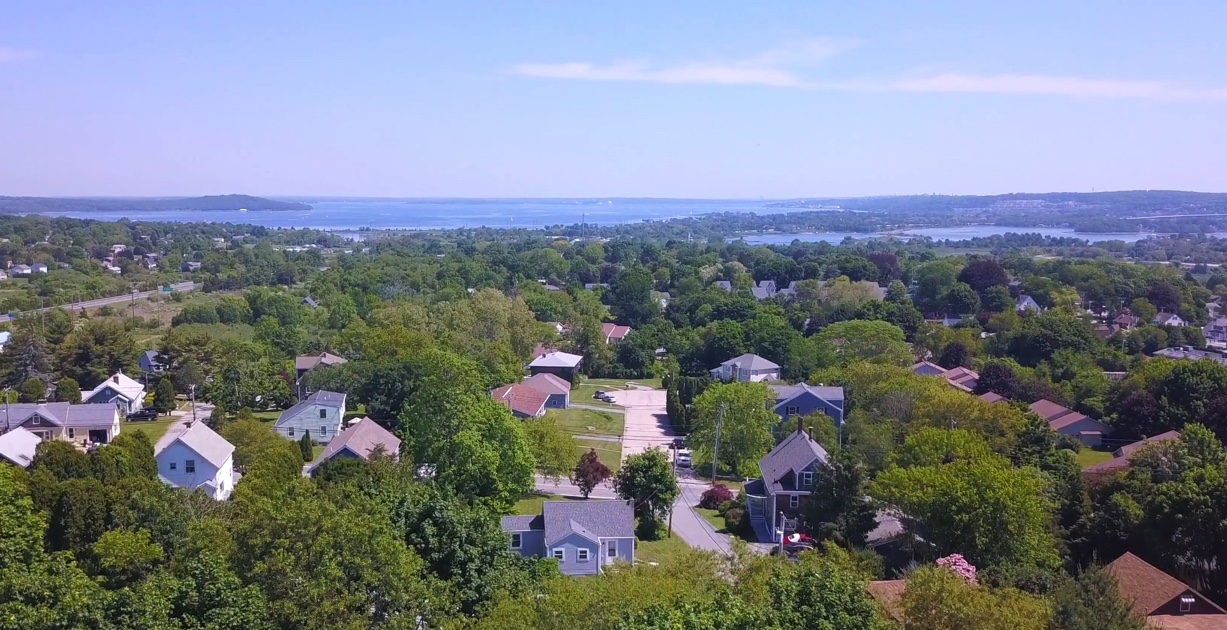
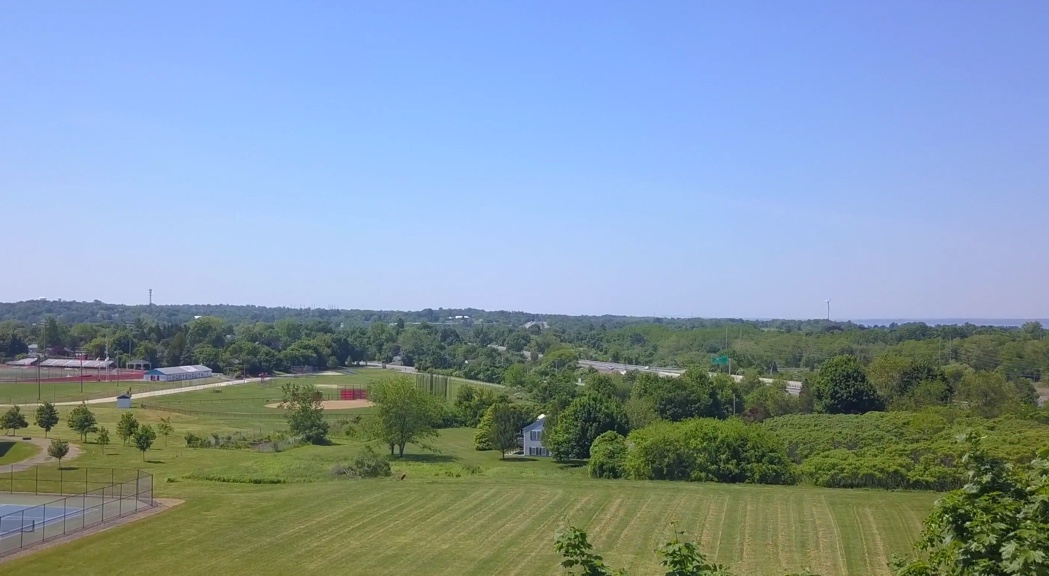
Drone images from Butts Hill illustrate what a commanding view was possible from this location. The British were concerned with the view of possible American invasions from the North from Bristol and Tiverton. For the Americans, however, the view south was essential.

With the French sailing to Newport to help the American forces, Butts Hill became a strategic site.

July 29th: d’Estaing met with American Commanders when he arrived at Point Judith. Plans called for Sullivan’s American forces to cross from Tiverton to Aquidneck Island and advance to the British fortifications at Butts Hill. The French would land on Conanicut Island (Jamestown) before arriving in Newport to cut off the British forces.

August 9th: Fearing an attack, British forces abandoned Butts Hill and General Pigot withdrew his forces to Newport as the French were landing on Conanicut. Sullivan discovered that the British had abandoned Butts Hill, so he crossed over to Aquidneck and occupied the high fortifications. He called for the heavy cannon at Fox Point to be moved to Portsmouth. Sullivan was supposed to wait until August 10.

August 11: Most of the American troops were camped about Butts Hill. The diary of Rev. Manasseh Cutler who served as chaplain for American General Titcomb’s Brigade, provides a few glimpses of what was going on around Butts Hill. He wrote on August 11th that at 4 o’clock the whole army paraded and passed in review by the general officers. “The right wing of the army was commanded by General Greene and the left by the Marquis de Lafayette.”

August 12-13: A hurricane hit that destroyed men, horses, camps and supplies on both the British and American sides. Rhode Island’s governor (William Greene) replaced the ruined powder on the American side.

August 16: As the Americans built earthworks and dug trenches toward Newport, American reserves and the sick who were healthy enough to do garrison work remained at Butts Hill which served as Sullivan’s headquarters.

August 17: Sullivan calls a council of War. All officers recommend holding positions until they could be reinforced.

August 26: Americans now know that the British fleet is coming and that it would be at least three weeks before French would arrive. They begin to send their heavy cannon back to northern locations like Butts Hill. The Council of War again determines to hold American positions until they could be reinforced. General Sullivan began to prepare for a retreat. He knew that enemy reinforcements were coming and his best course was to retreat. Cutler’s entry on Monday, August 24th “As much of the heavy baggage moved off last night as possible. A body of men retreated to strengthen the works at Butts’ Hill. At the lines – heavy fire – army preparing to retreat.” Cutler’s story ends on August 26th when he, like many in the militias, escaped to Tiverton and away from battle.

This was not a hasty retreat. Sullivan ordered increased defenses in the North (especially Butts Hill and fortifications guarding the Bristol Ferry and the ferry to Tiverton). He wanted to get all his weaponry out so it would not fall into enemy hands to use against them another day. In his letter to Congress after the retreat, he makes it clear that this was an “unanimous” decision to first retreat to Portsmouth and hope that the French would return.

Initial positions of Americans

Resources

Providence Gazette on September 26, 1778. “Letter from the Hon. Major General Sullivan to the President of Congress dated headquarters Tiverton, August 31, 1778″.

Cutler’s Diary is found in Edwin Stone’s “Our French Allies.” This is an old book (1884, Providence) but it was a great help. It is available online through Google Books. https://www.google.com/books/edition/Our_French_Allies/YY8LAAAAIAAJ?hl=en&gbpv=1

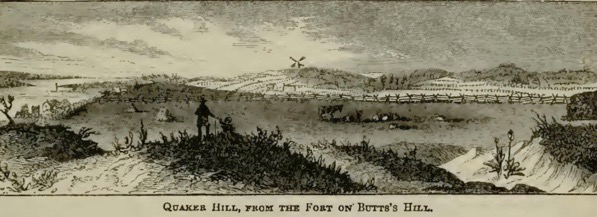
Image of Quaker Hill: Benson John Lossing, ed. Harper’s Encyclopedia of United States History (vol. 7) (New York, NY: Harper and Brothers, 1912)

A map of part of Rhode Island shewing the positions of the American and British armies at the Siege of Newport, and the subsequent action on the 29th of August 1778. [1807]. Original in Boston Public Library Leventhal Map Center.

When Did “Butts Hill” Become a Fort?

Leave a comment

As I try to imagine giving a tour of the Butts Hill Fort, I am coming across military terms that I need to understand. Thankfully, there are others in the Butts Hill Fort Restoration Committee that are willing to share their knowledge with me. I find that I have been using the term “fort” rather loosely.

Stephen Luce reminded me: “The fortifications there were called ‘works’ from 1775/6 to 1780. There was never a ‘Windmill Hill Fort’ because the Fort did not exist until the French combined the separate works in 1780/81 and by that time the hill was called Butts Hill.”

Going back to the revolutionary terminology guides (American Battlefield Trust Glossary) clarified things for me.

Fort: A fully enclosed earthwork; a fortified building, enclosure, or strategic position.
Fortification: Something that makes a defensive position stronger, like high mounds of earth to protect cannon or spiky breastworks to slow an enemy charge. Fortifications may be man-made structures or a part of the natural terrain.  Man-made fortifications could be permanent (mortar or stone) or temporary (wood and soil).  Natural fortifications could include waterways, forests, hills and mountains, swamps and marshes.

The British works at “Windmill Hill” were fortifications. When they arrived on the island they took over an American militia made natural (hill top) defensive position that was a temporary construction of wood and soil. The British sought to make it a more permanent fortification with the building of barracks and a guard house.

Plan of a barrack for 300 men, and officers, erected at Windmill Hill with an abbatis, December 1777 :

Note there is an “Abbatis” around the barracks. Abatis: A line of trees, chopped down and placed with their branches facing the enemy, used to strengthen fortifications.

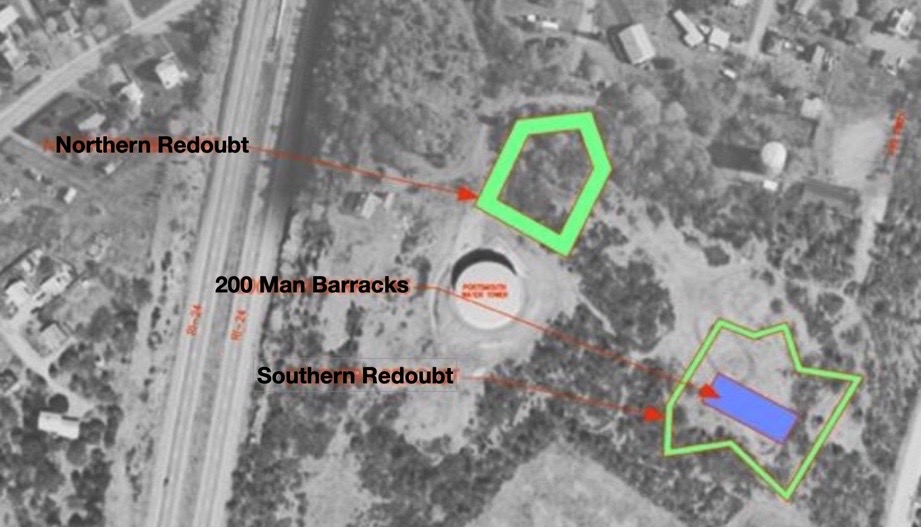
As we look at the military maps of the time, it is clear that the British fortification at Windmill Hill was not enclosed as a fort would be. It was a more permanent fortification because they had built structures such as a guard house and a barracks. It was carefully planned and as Frederick Mackenzie’s diary proves, it was worked on over time to improve the position. The Edward Fage map shows a second redoubt – the Southern Redoubt – was added to the fortifications. This was the condition of the fortifications when the Americans returned to Aquidneck Island in August of 1778.

Resources:

“Plan of a barrack for 300 men, and officers, erected at Windmill Hill with an abbatis, December 1777 : Plan nr 18..” https://quod.lib.umich.edu/w/wcl1ic/x-6053/wcl006127. University of Michigan Library Digital Collections. Accessed: December 19, 2021.

Planning, Preservation and Management Plan for Butts Hill Fort, Portsmouth, RI. A Project of the Rhode Island Marine Archaeology Project.

American Battlefield Trust website.

Fage, Edward, 1777-1779: Manuscript chart of Aquidneck Island and environs. Original in the Clinton Collection, Clements Library, University of Michigan at Ann Arbor. Plan of the adjacent coast to the northern part of Rhode Island, to express the route of a body of troops under the command of Lieut Colonel Campbell of the 22d: Regiment to destroy the enemies batteaux, vessels, galley &c &c &c which was accomplished May 25th 1778 / laid down and drawn by Edwd Fage, lieutt. of artillery.

What was the Fort like before the Battle of Rhode Island?

Leave a comment

Part 2: Brainstorming for a Guided Tour: at the North/East rampart and moat.

If what we see today at Butts Hill Fort is the outline of the modifications made by the French and Americans, what was the fort like just before the Battle of Rhode Island?

If we start the tour with the oldest section – the North ramparts, we could begin to discuss the British improvements to the small fort left behind by the Americans. The diaries of Frederick Mackenzie and blueprints of proposed fort construction can give us a good idea of the fort at what the British called “Windmill Hill.”

North Rampart and Moat

December 8, 1776: as Mackenzie was arriving on the island as part of the British forces, he wrote: “The Rebels abandoned a well situated fort at the N. End of the Island yesterday, without attempting to defend it. It in some measure commands the passage to Bristol by the ferry.”

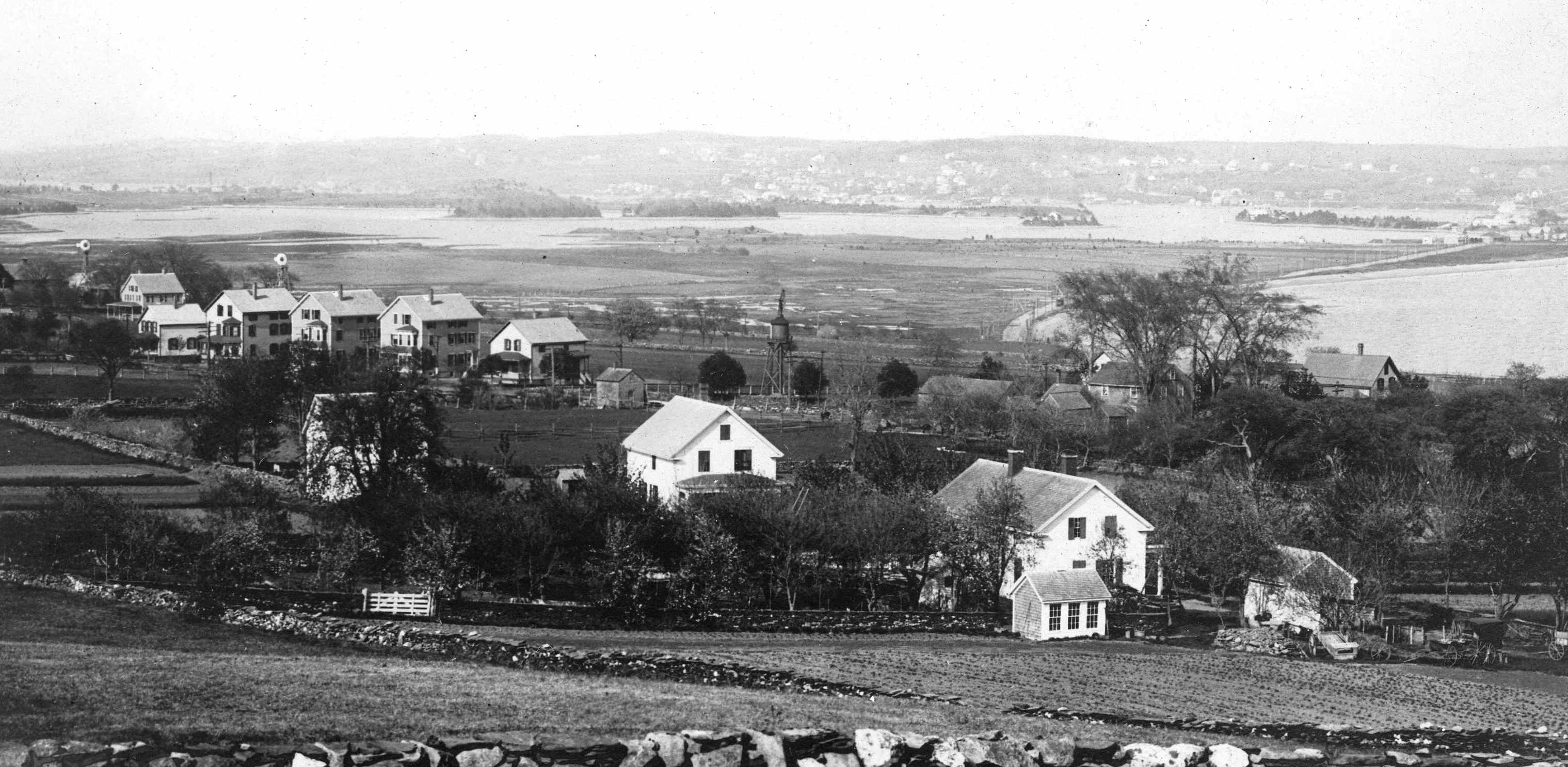
Vintage view of Howland Ferry area from Butts Hill Fort

My guess is that this is a reference to the Butts Hill (or Windmill Hill location as the British called it). The location does overlook the Bristol Ferry landing. One of the reasons this location was so valuable is that it had a commanding view of both the Bristol Ferry and Howland Ferry to Tiverton. While they occupied Aquidneck Island, the British would have expected an American attack to come Bristol or Tiverton.

Dec. 30, 1776: “The redoubt constructed by the Rebels above Bristol Ferry, and abandoned by them, is ordered to be repaired and a guard house to be erected therein for the accommodation of the advanced post. It is a much better situation for the advanced guard than that they are now in, and the troops on duty will not be liable to accidents from the wanton firing of the Rebels on the opposite side.” (From Mackenzie diary).

This again I believe to be a reference to the Butts Hill Fort in the area “above Bristol Ferry.” The Rebels had fortifications across in Bristol and they would often direct fire at the troops stationed by the Aquidneck side of the Bristol Ferry crossing. The order here is to repair the redoubt and build a guard house. The British are beginning construction to enlarge the American fortifications.

Sept 12, 1777: “As the works intended to be made for the defense of the North Part of the Island, require a good many workmen to complete them, and the duty of the Soldiers is rather severe, General Pigot sent a summons this day to the Inhabitants of the township of Portsmouth to assemble on the 15th instant at Windmill Hill in order to assist in carrying them on. They are required to work three days in the week.” (From Mackenzie diary).

Sept 15, 1777: “In consequence of the General’s summons to the Inhabitants of the township of Portsmouth, to assemble in order to be employed to work on the Redouts, 17 only appeared this morning at the place appointed. The Majority of the Inhabitants being Quakers, they informed the General that it was contrary to their principles to assist, in any manner in matters of War, and that therefor they could not appear. They even refuse to be employed in constructing Barracks for the accommodations of the troops.” (From Mackenzie diary).

Portsmouth residents are used as forced labor to construct fortifications for the British.

Sept. 17, 1777: “We are at present very busy in fortifying different posts on the Island; and there are already more works planned and traced out, than can possibly be finished by the end of December. …… A fortified Barrick on Windmill hill for 200 men.” (From Mackenzie diary).

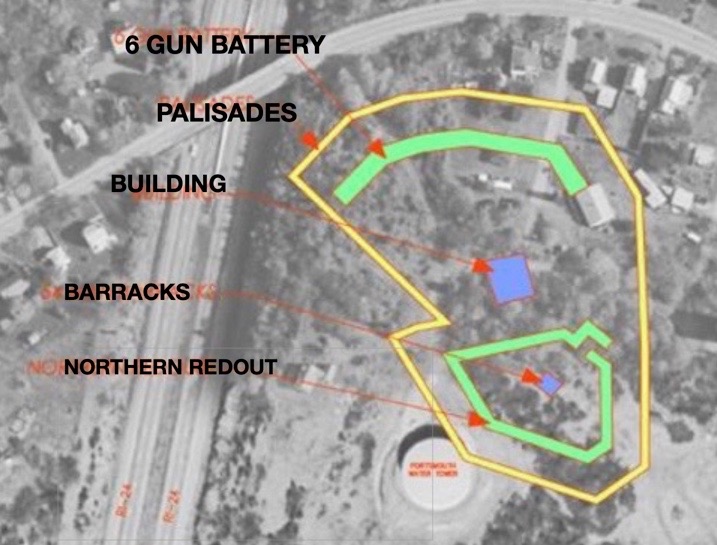
Blueprints of the British fort plans and an overlay done by Dr. Abbass in her plans for Butts Hill Fort help us to visualize what the fort looked like just before the Battle of Rhode Island. Some of the fortifications were in what is a residential area. We need to know two more terms to understand the visuals. (Definitions culled from American Battlefield Trust)

Palisade: Typically, a fence or defensive wall made with wooden stakes or tree trunks, and used as a defensive structure or enclosure. Palisades form the walls of a stockade.

Redoubt: (pronounced rih-dowt) An enclosed field work which had several sides and was used to protect a garrison from attacks from several directions. A redoubt could also extend from a permanent fortress.

The Northeastern part of the fort with its moat, glacis and ramparts remind us of the British fortifications that General Sullivan and the American troops would move into just before the Siege of Newport and the Battle of Rhode Island.

Resources:

Diary of Frederick Mackenzie: Giving a Daily Narrative of His Military Service as an Officer of the Regiment of Royal Welch Fusiliers during the Years 1775-1781 in Massachusetts, Rhode Island, and New York, Volume I & II

Revolutionary War Plans in collection of the William Clements Library: University of Michigan.

Diagram from Planning, Preservation and Management Plan for Butts Hill Fort, Portsmouth, RI
A Project of the Rhode Island Marine Archaeology Project.

Older Entries Newer Entries