Home

Portsmouth Neighborhoods: Bristol Ferry/Commons – Colonial Days

Leave a comment

As the Portsmouth founders moved away from the settlements around the Town Pond, Common Fence and Founder’s Brook, the Bristol Ferry community to the northwest began to develop. In the 1930s, Portsmouth historian Edward West did some remarkable work with land evidence. Among his works are the Land Grant Maps that tell us where the early settlers were given land. How he worked through all the locations with rods as measurements, we will never know. West tells us that upon founding the town “they immediately made laws governing the size and location of the house lots.” They began recording property in a book. There were times when land transferred without records, so the accuracy of the land evidence may be questionable in some cases. West illustrates the grants and town plan with his maps. Some of the first grants given were in the Bristol Ferry area.  As the town was laid out, Sprague Street was the southernmost border.  Land grants were given out in 1657, 1693 and the last lands were given out in 1713.  By 1713 the commons were laid out, highways were straightened and the town was considered finished as laid out from Sprague Street northward. As the Portsmouth population spread to the north and west of Town Pond, the town fathers and surveyors thought they had finished laying out the town.
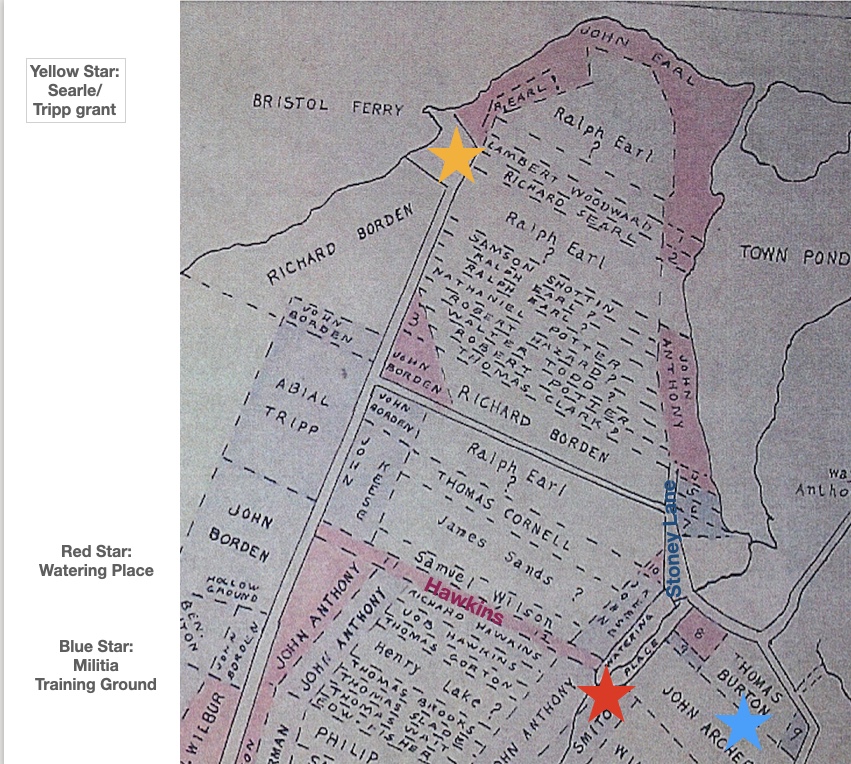
The first street to the right was “Stoney Lane.”  It was a short “driftway” (a path used to drive cattle or sheep) between Richard Borden’s property and that of Mistress Harts.  South of that was a lane that led to a “watering place” now called Founder’s Brook. On the map it is called Hawkins Lane for Richard Hawkins and his wife Jane who was a friend of Anne Hutchinson. This “watering place” was laid out in 1713 as a public place for the washing of sheep and general water uses.  Also in 1713 Thomas Burton received a piece of land that was known as the “Training Place” before that.  That ground may be where the militia had trained.

Waiting for the Ferry

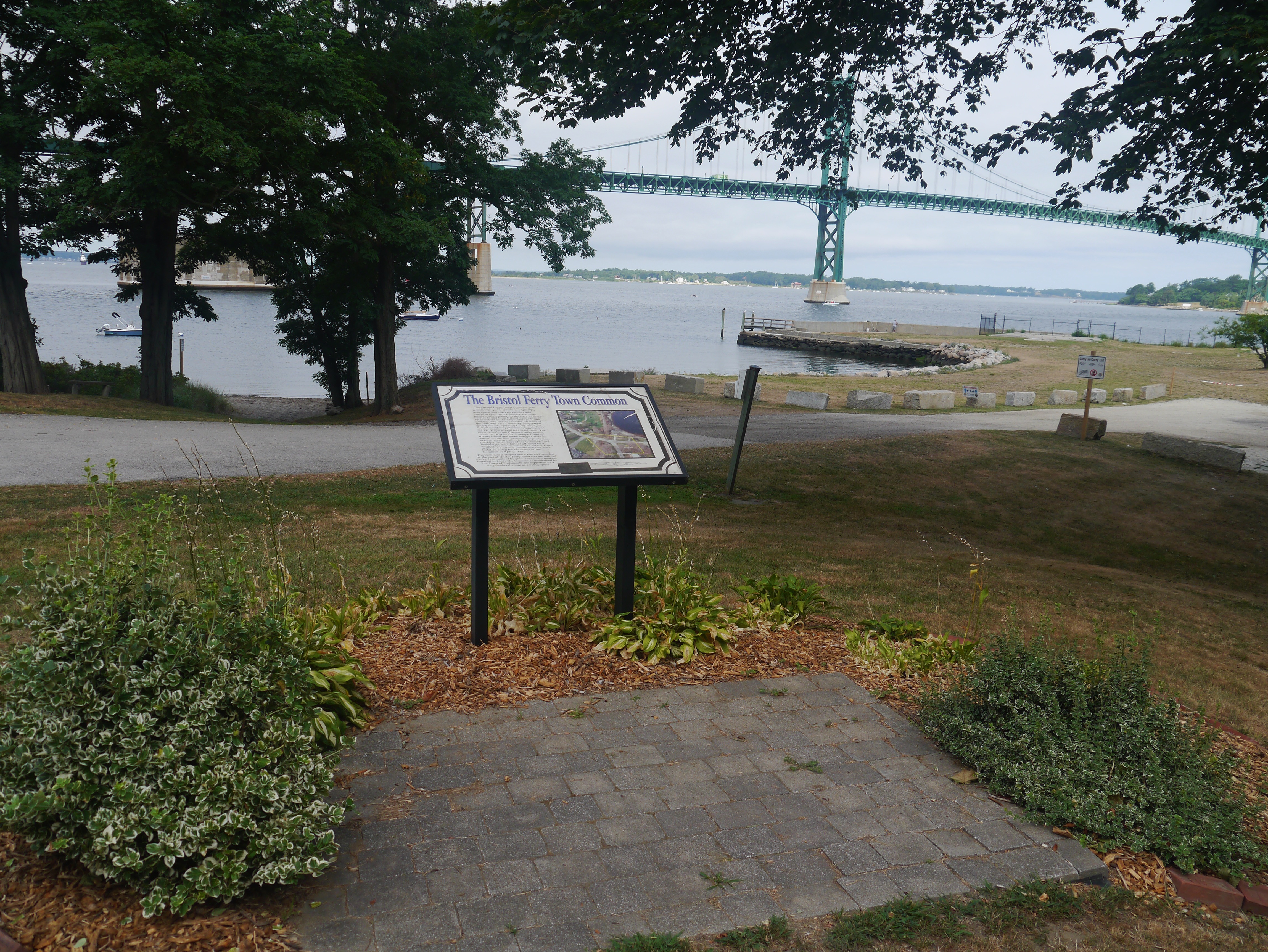
The tip of the Bristol Ferry area developed commercial businesses like taverns and shops that catered to those using the ferry. Ferries were more informal at the beginning. Those with boats provided a service to passengers and goods that needed to be transported to the mainline at Bristol. This is the site of a town common dating back to 1714. Ferry service started here in 1640. This 1.5 acre space was originally used by farmers and others to keep their livestock and other goods while waiting for the ferry to Bristol. The Bristol Ferry area had a British fort during the occupation. This area was the transportation hub for Aquidneck Island (Rhode Island) and there are records of George Washington passing through here after visiting with General Rochambeau in 1781. The French and Americans would make the start of their long journey to victory at Yorktown through Bristol Ferry.

A Bristol Ferry story

Just above the Bristol Ferry is the 3 acre lot that Richard Searle sold to Mary Paine.  Mary was a bar-maid at Baulston’s public house.  Searl exchanged his lot for a pint of wine.  He didn’t give Mary a deed, but the town council ratified the sale on the testimony of a witness in 1666.  Mary later married John Tripp and that piece of land became the site of his ferry house.
Recommended Reading

 West, Edward. Rhode Island Historical Society Journal in July of 1932 (The Lands of Portsmouth, R. I., and a Glimpse of Its People).

Portsmouth Settlers: John Tripp and Mary Paine Tripp

Leave a comment


For a number of years I have been gathering stories of Portsmouth women. Their stories can be forgotten when history is generally written about the men. In presentations I tell the story of Mary Paine Tripp, but John and Mary Tripp’s combined story gives us a glimpse of what was happening in the early days of Portsmouth. It also helps us to focus on what was happening in the Bristol Ferry neighborhood of our town. It was one of the first neighborhoods to be developed.

A story about Mary:

I came across an interesting story from Edward West’s 1932 article in the journal of the Rhode Island Historical Society on the “The Lands of Portsmouth, Rhode Island”.  How much would you give for a glass of wine? Back in 1666 Richard Searl sold a three acre lot just above the Bristol Ferry to Mary Paine. Mary was the barmaid at Baulston’s Tavern and the land was exchanged for a “pint of wine.” Mary later married John Tripp who used the land for a ferry house. Although this deed wasn’t registered, the Town Council accepted the deposition of William Collinge as to how the land was transferred. Mary officially owned the land.

Note Searl Property on Land Grant Map. Marked with star.

John Tripp, early settler

An article by Tripp Family genealogist Janet Tripp Andrews provides us with information about John Tripp, 1611 – 1678, as well as the conditions in Portsmouth for the first settlers. John started life here as an indentured servant – perhaps to a ship’s carpenter. He was admitted as an “inhabitant” at Portsmouth’s founding. That allowed a settler to own land but not to vote or hold office. He must have paid off the indenture because a year later he was admitted as a freeman.

Early Records of the Town of Portsmouth show that the community developed quickly. The first house lots were assigned and an inn, brewery and general store were established with William Baulston in charge. Like all men between the ages of sixteen and fifty, John would have trained with the militia. To keep order a pair of stocks with a whipping post was ordered. To enable easier home construction a water mill was proposed. Meanwhile, that first summer settlers lived in caves or dugouts covered in branches. As wood was processed for construction more permanent one and two room structures with lofts and thatched roofs were considered permanent housing. Regardless of what their occupation had been in Massachusetts, the people of Portsmouth became farmers tending to hogs, goats, sheep and cattle. John Tripp, like the other Portsmouth settlers, would have been fencing property, digging wells, and planting orchards.

Although disagreements led to many residents leaving Portsmouth to establish Newport in 1639, John Tripp was among the thirty who signed the second Portsmouth Compact. He signed his own name. This was about the time that John Tripp married Mary Paine.

John Tripp would later become associated with boats and ferries, but Thomas Gorton was appointed ferryman to the Howland Ferry to Tiverton when it was established in 1640. Cattle were ferried across to graze in the Tiverton grasses. Early records show that in 1650 John had the approved weights to measure as the standard for the town. John took on other positions in town. In 1656 he was appointed to inspect cattle moving on and off the island. Tripp must have been able to read and write to do this job.

Meanwhile the Tripp family was growing. In 1640 their first son (John Jr.) was born. By 1650 their thrid daughter was born. Altogether Mary and John had ten or eleven children.

The process of becoming a “ferryman” was gradual for John. The shoreline around Bristol Ferry was owned by the town, but John Tripp, Ralph Earle and John Borden owned land that could add a pier. In 1658 the town treasurer was ordered to pay “Goodman” Tripp “for going into the Bay.” This could mean that Tripp was using his boat to deliver people and/or items like documents or goods.

In 1670 John Tripp had the honor of serving on the Governor’s Council. In 1673 John served as Town Moderator. With this service to the town and colony, Tripp was also serving as a ferryman. Captain Church’s writings have the first mention of “Tripp’ s Ferry” in 1676. After King Philip’s War Tripp’s son Abiel, William Earl, John Borden, and Joseph Anthony were given permission to build or finish wharfs on public land in 1682. Belore the Revolutionary War, the ferries were known by their owners – (Tripp’s Ferry, Borden’s Ferry). After the war it became know as the “Bristol Ferry” and was one of the most important ferries because it was a direct route from Newport to Providence. Washington, Lafayette, Rochambeau and other notables crossed to Bristol by way of this ferry.

Mary’s story continues

Mary Paine Tripp inherited John’s boats at his death in 1678. At a town meeting April 23, 1679 Widow Tripp was granted a license to sell food and drink to travelers. Perhaps she turned her house into a tavern. That would be full circle to her days at Baulton’s Tavern were she exchanged wine for a land grant.

Sources used:

Andrews, Janet Tripp. John Tripp, 1611-1678, A Glimpse into our Founder’s Life, Nov. 2016. In the collection of the Portsmouth Historical Society.

Augusta, Anna and Chapin, Charles V., “A History of Rhode Island Ferries, 1640-1923” (1925). Public Domain Books. Book 5.https://digitalcommons.uri.edu/pd-books/5

The “Bristol”

Leave a comment

Steamboat ferries operated out of Bristol Ferry Landing

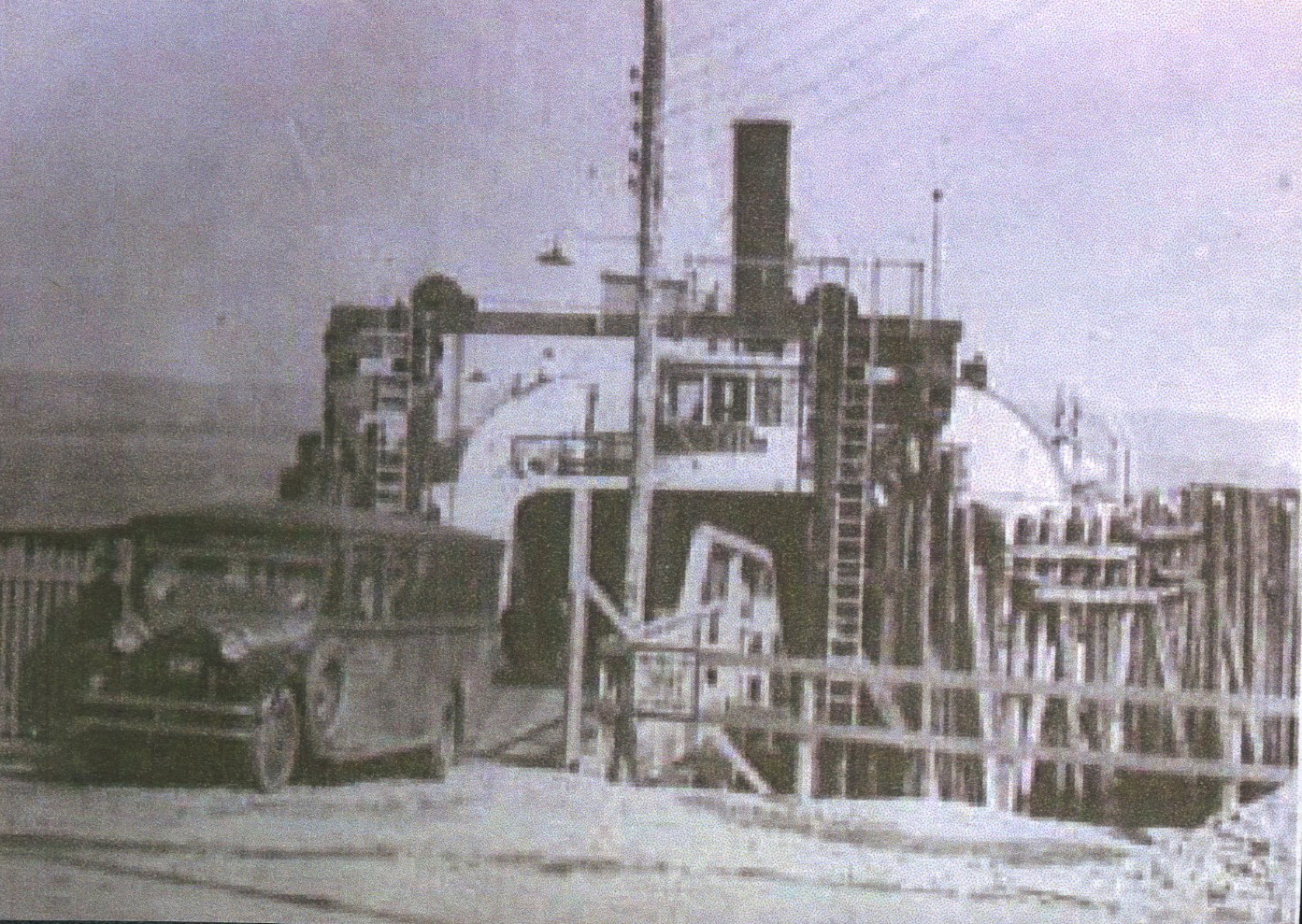
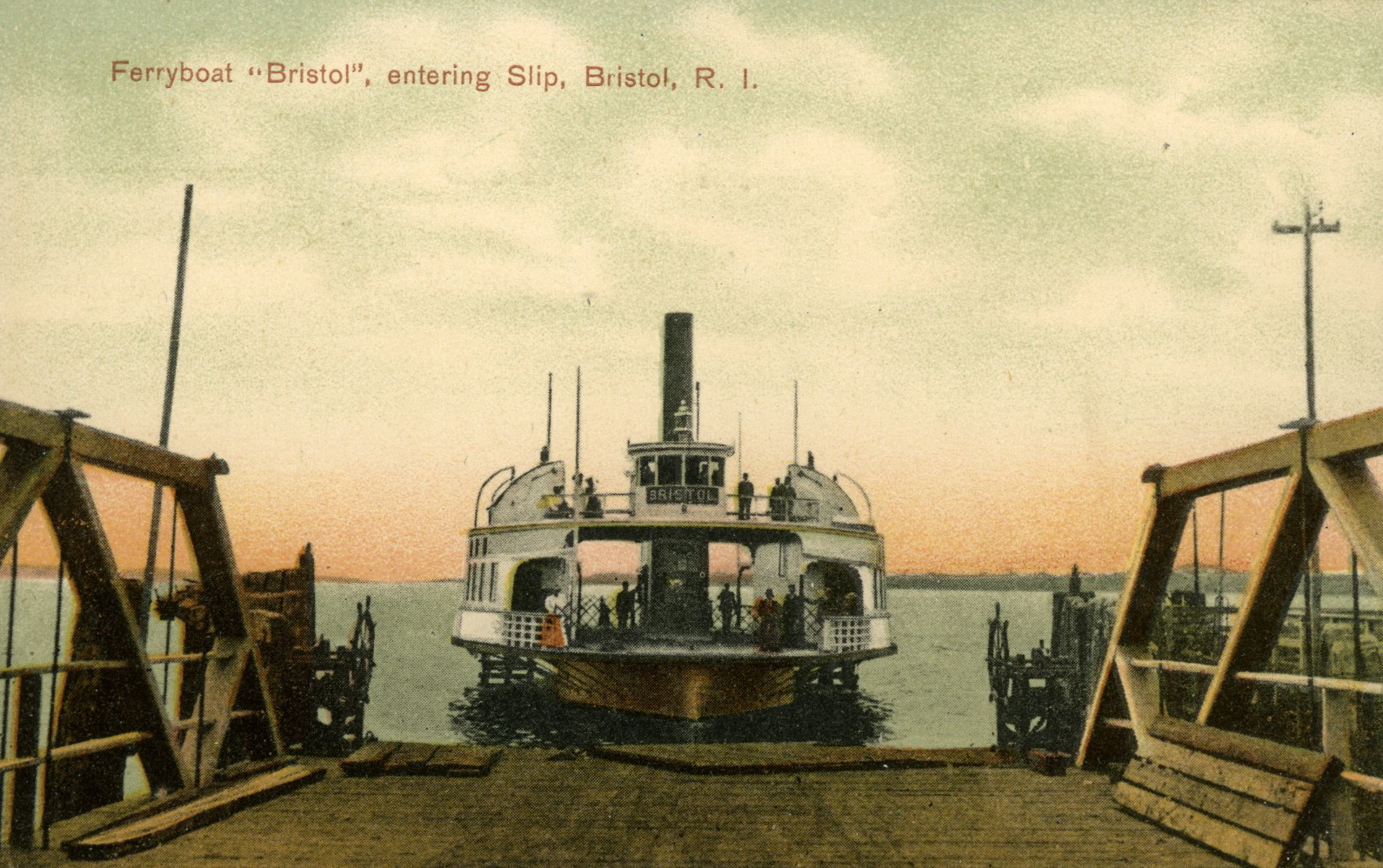
The Bristol was a steam powered ferry that transported automobiles.

from 1905 until the Mount Hope Bridge opened in 1929.  The Bristol was a double ender type ferry that carried automobiles.

Bristol Ferry Landing

Leave a comment

The Bristol Ferry Landing area was a transportation hub for Aquidneck Island travelers. (Image - G. Schmidt)

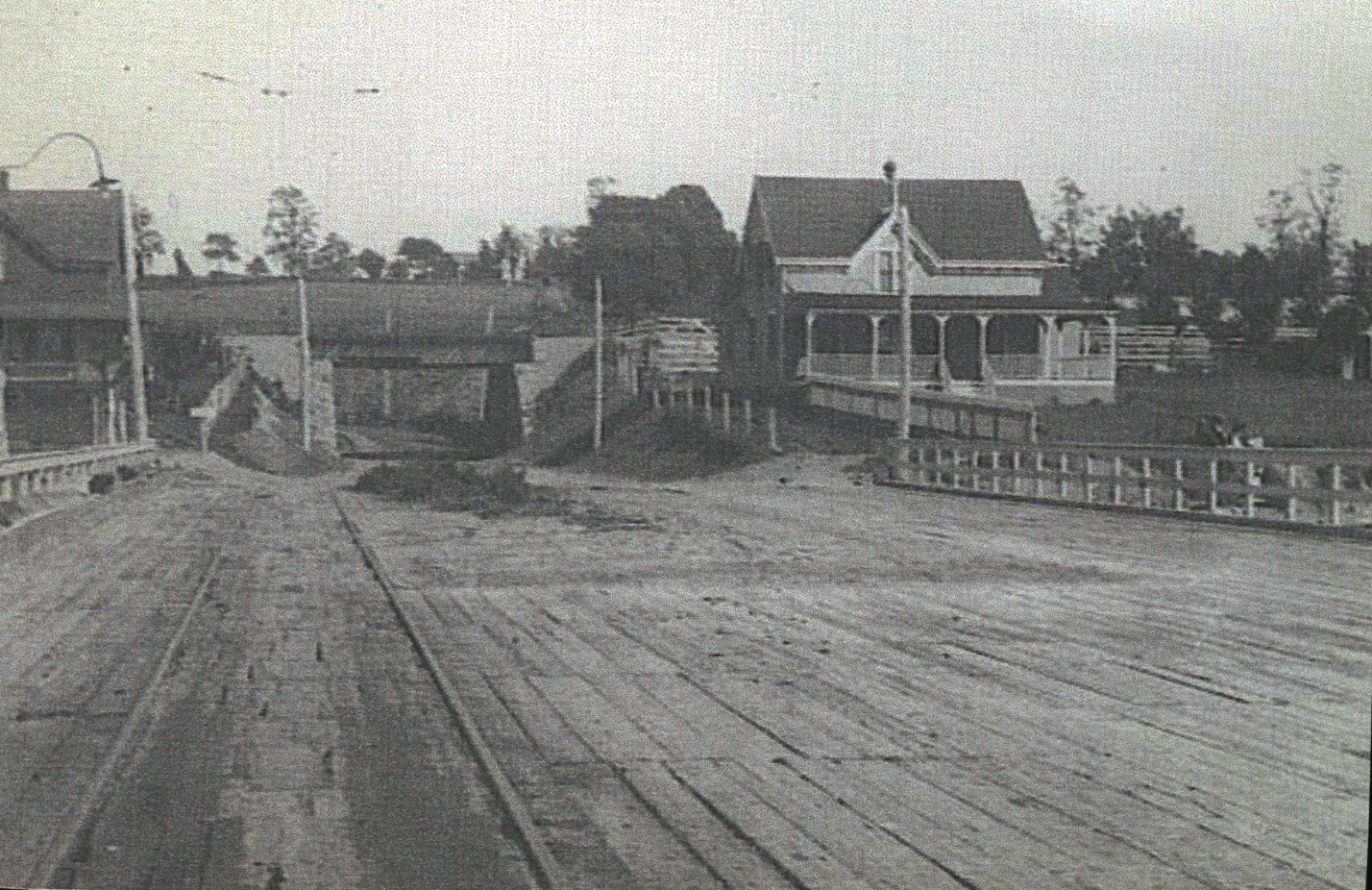
The Bristol Ferry area of Portsmouth was a transportation hub even in colonial times. It was a train station, a ferry landing, a loading dock for animals headed to market, a stage coach stop, a trolley car stop and a landing place for steam boats. To accommodate travelers, the village area at Bristol Ferry included places to eat and spend the night.

The Old Howland Ferry

5 Comments

In colonial times the main roads in Portsmouth led to the ferry landings.  What we call East Main Road was known as the Path to Howland’s Ferry.  Its location was close to where the remains of Stone Bridge are today. This location is one of the narrowest points on the Sakonnet River between Tiverton and Portsmouth. The ferry may date back to 1640.  It was also known as Anthony’s Ferry and Pocasset Ferry. Howland’s Ferry played an important part during the Battle of Rhode Island. American forces used the location to pour onto Aquidneck Island to fight the British who occupied the island. When they were forced to retreat, many of the American forces used that route to make their escape. Howland Ferry was less used once the Bristol Ferry was established.

Howland Ferry area

This ferry, the West Side, was used in the Howland Ferry area when the Stone Bridge was not operating. (Image G. Schmidt)

Bristol Ferry Town Common

Leave a comment

Blaskewitz Map of Bristol Ferry Area

During Revolutionary times there was an active community around the Bristol Ferry landing. Blaskowitz chart.

The way to Bristol Ferry became a bustling community with taverns and shops. By the old ferry landing is the Town Commons.  On March 12, 1714, the common is listed in a list of “Rhodes, Ways and Lanes in Portsmouth.” This document is available in town archives. Regarding the Bristol Ferry Common, it states that,

“… the piece of  land near Abel Trip house adjoining to the ferry against Bristol, is left for the conveniency (sic) of the Public in importing  and transporting of Cattel (sic), Sheep, Horses, wood, rails, etc. and is bounded on the bank against the salt water 12 rods, and against the land of John Earl & John Earl _____ twelve rods and against the land of  John Pool, John Tripp and Abel Tripp, that is, from the Earl ____ his corner to Thomas Borden’s Northeast corner aforesaid, is twenty rods and from Borden’s down to the lege (sic) of the bank next to the salt water is nineteen rods.”

Bristol Ferry

Leave a comment

Tripp, Borden and Gifford Ferries

The Bristol arrives at the ferry landing. (Image: G. Schmidt collection)

West Main Road in colonial times was known as the Path to Bristol Ferry.  Howland Ferry to Tiverton came first in 1640, once the ferry to Bristol was established, it became the primary way off the island to the mainland and Providence.  The ferries on the Portsmouth side were known as the Tripp’s Borden’s and Gifford’s ferries after the owners.  Early records show John Tripp was paid for ferrying the colony’s general assembly across to Bristol.  John’s son Abiel built a wharf around 1680.  In 1698 John Borden had a ferry operation alongside the Tripp ferry.  In 1766 Thomas Tripp sold his wharf and land to Joseph Borden (John’s brother) and after that the ferry was generally known as the Bristol Ferry.  In 1774  Joseph Borden sold the land, ferry house and ferry privileges to David Gifford. All ferries were discontinued during the British occupation of Aquidneck Island during the Revolutionary War.    Gifford’s sons, Gideon and Jeremiah, bought even more land to form “Ferry Farm” to care for the horses that were used to power the new type of ferries.  Horseboats were not all that practical at the Portsmouth ferry, so that ended in 1845.

Fogland Ferry

Leave a comment

Cook Ferry

The Cook family began to ferry their animals to Fogland to graze during the day.

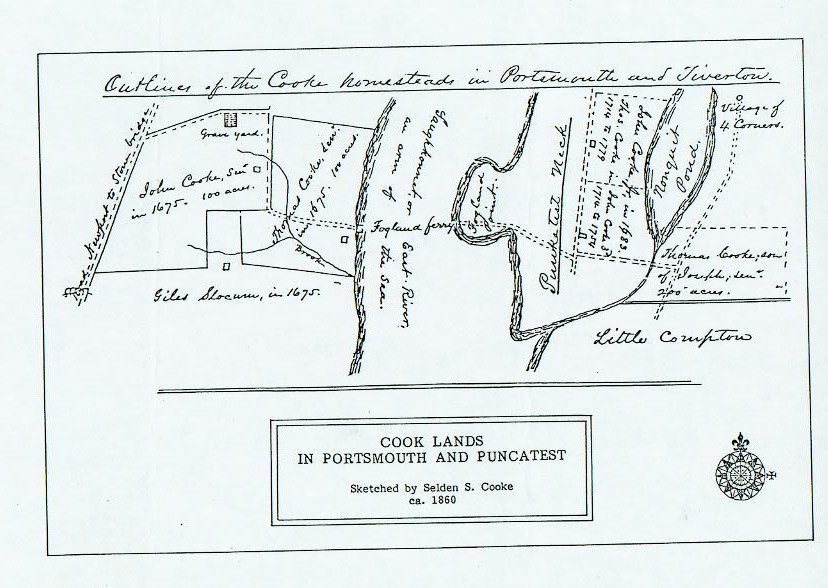
Fogland Ferry (or Cooks Ferry) began when Thomas Cook bought grazing rights to Fogland across the river in what is now Tiverton. Cook lands were located in the Glen area. Thomas Cook’s home was where the Glen Manor House is today. Later on the family seems to have established a public ferry. In 1762 Joseph Cook sold 31 acres of land with wharves, buildings and ferry rights to Christopher Cadman. When he died in 1787, the Cadman Ferry was left to Gideon Cadman, Christopher’s son.