Home

Founding Mothers: A List of Brave Women

Leave a comment

P1040406The founding mothers of Portsmouth and Aquidneck Island were a brave lot.  What conditions did they face when they came to settle here?

It was primitive living.  These women came from well established England to a Boston that just beginning to take shape as a major town. That must have been sobering change.  When they left the buildings, ferries, roads and businesses of Boston to step foot on Aquidneck, they were indeed coming to nothing. Unlike Boston or even Providence, there were no docks or ships bringing in goods.

Shelter was a problem.  They had to live like the Native Americans for a while before their homes were built, crops established and businesses started.  Mary and William Dyer, for example,  followed the Native American example by bending birches into house frames, using mud for walls and weaving twigs to make thatched roof.  Others sought shelter in shallow caves and dug out mud floors until trees could be felled and homes constructed.  Sixty to seventy people lived in pits dug in the ground with floors of planks and dirt walls covered with tree bark.

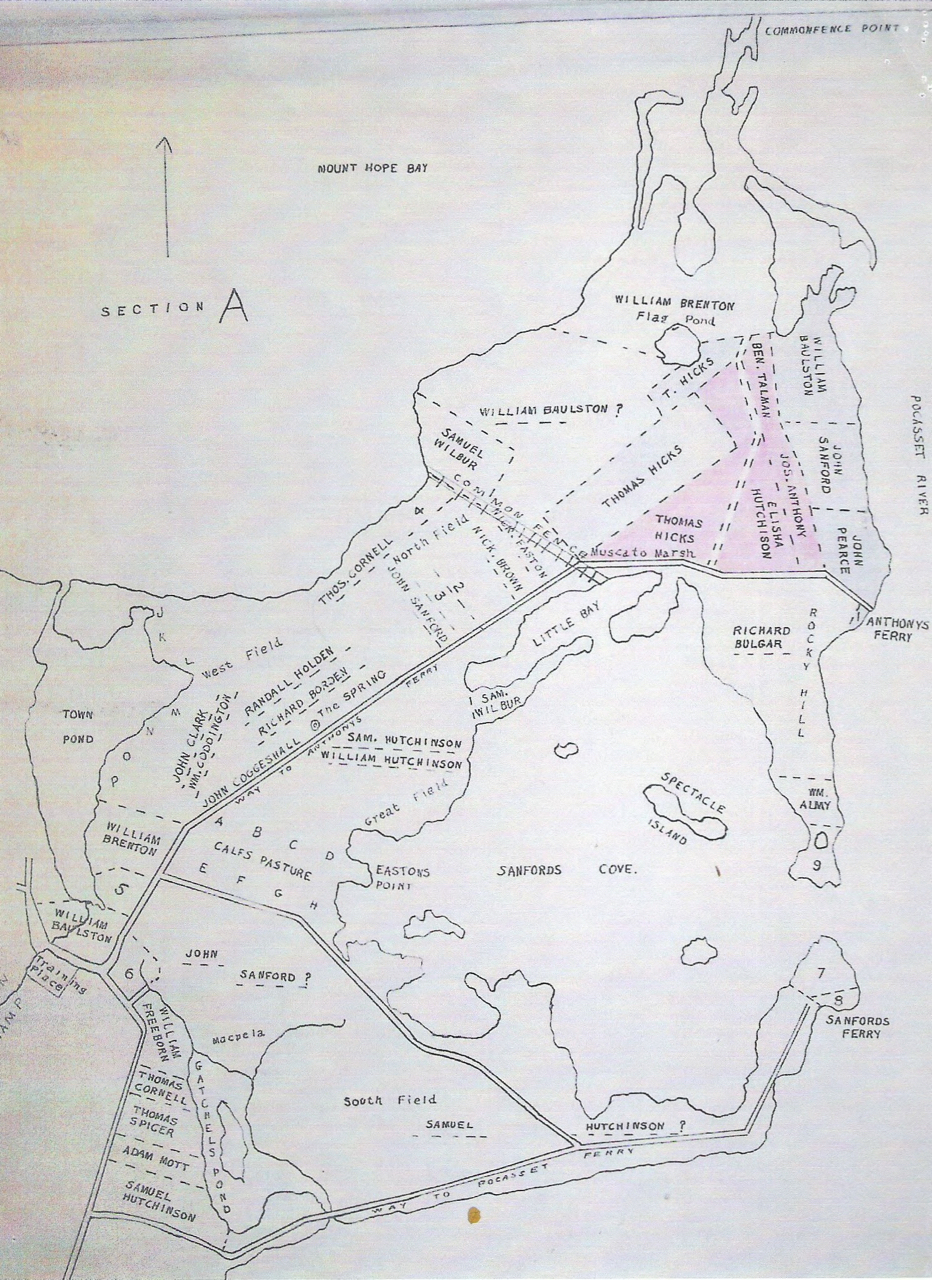
They needed protection from wild animals. Howling wolves greeted the settlers and they had to rely on Native Americans (through the efforts of Roger Williams) to dig out traps in the Common Fence Point area to eliminate some of the wolves.  One of the first decisions they made was to construct a “common fence” to protect their livestock.  Mosquitoes made living around marshes a miserable existence.  Native Americans again came to the rescue by filling in marsh lands near Newport harbor.

Women became isolated.   The founding mothers were used to the company and support of other women.  This was possible when they settled in small house lots clustered around the springs.   The settlers would abandon this village like setting for homes on their larger farm lots.  This was practical for working their farms.  Women were separated by the move of some of their friends to Newport.  When the Dyers chose to uproot and settle in the Newport area, Mary Dyer was separated from Anne Hutchinson and other friends from Boston were no longer at a neighborly distance.

Here is a partial list of some of the women who were in Portsmouth/Aquidneck Island while Anne Hutchinson lives here (1638-1642).

Mary Moseley Coddington 1603-1647
Elizabeth Harris Clarke 1610-1670
Anne Marbury Hutchinson
Mary Gould Coggeshall 1604-1684)
Elizabeth Goodyear Aspinwall- 1606-1650
Ann Bradford Wilbore – 1597-1645
Margaret Odding Porter- 1596-1665
Bridget Hutchinson Sanford – 1618-1698
Katherine Hamby Hutchinson. 1615-1651
Faith Hutchinson Savage 1617-1652
Mary Barrett Dyer 1611-1660.
Mary Wilson Freeborn – 1600-1670
Sarah Odding Shearman – 1610-1681
Katherine Hutchinson Walker 1609-1654
Elizabeth Baulston – 1597-1683
Sarah Hutchinson
Elizabeth Bull
Frances Dungan Holden
Susanna Ring Clarke- 1611-1664
Margery Johnson
Mary Hall 1619-1680
Lucy Brightman
Sarah Lott Mott 1604-1647
Martha Tomson 1610
Susanna Thompson Wilcox 1607
Mary Paine Tripp
Sarah Cornell 1627-1661
Frances Latham Clarke 1609-1677
Martha Clarke 1621-1694
Elizabeth Hazar Layton (Lawton)
Joan Savage Earle – 1609-1699
Elizabeth Leads Browne
Rebecca Marbury Maxson
Martha Potter Hazard

Jane Hawkin

Herodias Long Hicks Gardner Porter
Mary Mayplet Gorton 1607-1677

Susanna Potter Anthony (1619-1674

Joan Fowle Borden – 1604-1688

Eleanor Wait

SaveSave

SaveSave

Founding Mothers: Anne Hutchinson and Portsmouth

Leave a comment

P1040411

Town Pond: Area of early settlement.

Anne Hutchinson only lived in Portsmouth for four years, but her story is pivotal to understanding the founding of our town. Anne was a bold and intelligent woman that the ministers of Boston viewed as a threat to their power and to the community as a whole. Boston was a theocracy where the church and the state were so connected that you had to be a church member to be able to vote. Anne was a critic of the ministers and to stop her influence she was put on trial twice.  Her civil trial was in Fall of 1637 and her church trial was in March of 1638.  Anne’s greatest crime was leading weekly public meetings to discuss scripture, theology and the ministers’ sermons. In 1635  she started with just women, but by 1636 men began to accompany wives. Anne had stepped out of place.

Among her followers were some of our prominent town founders. Many of them were solid citizens in Boston.   William Aspinwall was a notary, court recorder, and surveyor.  William Coddington was the richest man in Boston.  John Coggeshall was a silk merchant.  William Baulston  was an innkeeper.  William Dyer was a milliner.  As Anne was tried in court, her followers were removed from positions in town government, deprived of their weapons and expelled from Boston as well.  John Clarke had not been part of Hutchinson’s followers, but he joined the group leaving with Anne because he was interested in a society where freedom of religion was possible.  The men in Hutchinson’s group wanted to create a settlement with freedom of conscience. Roger Williams, who had been expelled from Boston earlier,  urged them to try Aquidneck Island.  Men packed building supplies in a ship they had hired to sail them around Cape cod.

About March 7,  while in Boston, a group of men signed what is now known as the Portsmouth Compact.  It was an agreement to join together as a “Bodie Politik.” Will and Edward Hutchinson (Anne’s son) traveled to Providence to Roger Williams who arranged a meeting with Narragansett Sachems Miantonomo and Canonicus. On March 24th they gave the sachems “a gratuity” of forty fathoms of white wampum beads, ten coats, and  twenty hoes. Randall Holden represented the Hutchinson group. The men continued south on ships to a new home  Aquidneck Island in Narragansett Bay.  They agreed to make the first settlement on the flat northeastern end which had a natural spring saltwater cove.  Their first homes resembled what the Native Americans used.  They pitched tents and built huts to live in while they cleared land.  The men chose two to three acre house lots between the cove and spring and began framing simple houses.

Anne walked from Boston to Portsmouth.  On April 1, 1638 she began a six day walk. With her were son Edward (24), Bridget (19),  Francis (17), Anne (12), Mary (10), Katherine (8), William (6), Susan (4 and  a half), Zuriel (2).  Anne’s daughter Bridget carried month old son Eliphal. They walked from Wollaston to Quincy, through Braintreee, Brockton, Tauton, Pawtucket.  They slept in wigwams and makeshift shelter along the way to Providence.  Providence had about a hundred settlers at the time and was a maritime center.  The group with Anne traveled  the last sixteen miles by ship to Aquidneck.

Portsmouth was so much more primitive than the Boston they ha left. The first settlement was about sixty to seventy people. They lived in pits dug in the ground with floors of planks and dirt walls covered with tree bark. They had two or three acre house lots between great cove and mount hope bay. The Hutchinson lot was on the western beach of the cove.

A short while after they settled there was an earthquake that shook the community.  Governor Winthrop said was “God’s continued disquietude against the existence of Anne Hutchinson”.

Anne had been pregnant during the trials and journey.  She was delivered of what we know today was a hydatidiform mole or abnormal growth.   Anne bled profusely and was attended to by John Clarke who was a physician.  Somehow word got back to Governor John Winthrop in Boston.  He asked Clarke for details and Clarke provided all the gory details.  Abnormal births were considered judgements from God and women were accused of evil when such a birth occurred.  Anne herself had helped Mary Dyer at the birth of a deformed baby before her trial.

Very little is know about Anne’s life here in Portsmouth.  Did Anne continue to lead her meetings in Portsmouth?  No formal churches were formed on the island at this early settlement time.   John Clarke preached in Portsmouth but no church founded or built.  Settlers were split over whether to gather on Lord’s day so religious services were disorganized at best. With all the problems they had with the Boston theocracy, this loose faith community might have been purposeful.  Anne probably preached and gathered women at meetings.  There was rapidgrowth in the community due to Anne’s influence and Boston’s strict theocracy.

When Anne’s husband William died, the Boston leaders were prepared to intimidate Anne again.  Ministers from Boston came and suggested they would take over Rhode Island.  Without William, Anne was vulnerable.   In the summer of 1642, the fifty one year old widow was packing to move away from Portsmouth to New York.   Her furniture and heavy belongings were sent over land along with horses, cattle, hogs. She hired boats to transport her group of family and friends (sixteen in all)  to a new home. In August of 1643, Anne and most of her family were butchered in an attack.  Only daughter Susan (Susanna) survived and she spent eight or nine years with the Siwanoy tribe.

Although Anne’s stay in Portsmouth was only four years, Portsmouth remains part of her legacy.  We were founded by Anne and her followers and they brought a tradition of religious toleration with them.

Sources include: American Jezebel:  The Uncommon Life of Anne Hutchinson, the Woman who defied the Puritans –  by Eve LaPlante – Harper Collins, 2004

SaveSave

Founding Mothers: Mary Dyer, Faithful til Death

2 Comments

Mary Dyer is known as a martyr for the the Quaker faith, but we should know her story as a founding mother of Aquidneck Island.   Born Marie Barrett in 1611, in 1633 Mary married William Dyer.  Dyer was a milliner, but in the 17th century milliners imported and sold such items as broaches, daggers, swords, gloves and capes.  In 1635 the Dyers made their way to Boston.  Mary became a friend and follower of Anne Hutchinson.  Anne tended Mary when she delivered a badly deformed child in 1637.  Such a birth would be considered punishment for challenging the views of the Governor Endicott, so Anne and minister John Cotton buried the baby in secrecy.  When Anne and some of her followers were tried by the Massachusetts Court and church for opposing the ruling ministers and governor, Mary stood by Anne.  They walked hand in hand out of the church.

Mary’s husband had signed documents supporting Anne’s views, so he was banished as well.  What did Mary find when she came to Aquidneck Island?  The Dyers accompanied the Hutchinson family by land, stopping at Mount Wollaston before going on to Providence.  They followed an Indian trail around Mount Hope.  Aquidneck Island was a wilderness.  Shelter was a big concern.  They crawled into caves around the banks of the cove where they landed.  Mary and William followed Native American example by bending birches into house frames, using mud for walls and weaving twigs to make a thatched roof.  These first settlers were frightened by the sound of the wolves roaming around their camp.  This was a bigger threat because they had unprotected livestocks.  The Dyers had sent their horses, cows, sheep and hogs via ship around Cape Cod.  Through the aid of Roger Williams, Native Americans came and laid traps to kill the wolves.  The settlers decided to make a Common Fence.  Five rails with no more than three inches between each rail was judged sufficient to keep out predators.  The first fence was built around the common pasture for the whole town and we know that today as Common Fence Point.

William Dyer was one of those who surveyed the lands and helped mark out the six acre house lots for all the settlers.  They were given land on the provision that they  must built homes within a year. Dyer drew up property deeds and kept the deeds.  An earthquake in August 1638 generated fear.

Mary and William Dyer were among those who left the northern end of the island to found Newport to the south.  William took the land deeds with him – concealing them in his personal goods. Mary and William Dyer had a farm opposite Coaster’s Island.  It was near a swamp and mosquitos were a problem. The settlers exchanged coats with brass buttons for Native Americans help draining and filling the swamp for house lots.  Mary had women friends but she missed Anne Hutchinson.   The women were separated from each other on big farms instead of clustered in a smaller village.

Mary was mother to Samuel, Mary, Will, Maher (Mahershallaber), Henry, and Charles. When her children were between fifteen years old to infant, Mary left for England.  William was the “single father.” In 1651 Will went to England to bring Mary back.  He was secretary to John Clarke who went with Roger Williams to get a charter for Rhode Island.  Mary would stay there for seven years and she became a Quaker – a follower of George Fox.

When Mary did return she landed in Boston and was jailed.  She was not aware of anti-quaker laws.  Governor Endicott believed that if he permitted Quakers to express their views in the Massachusetts Bay Colony – the whole structure of Church-state partnership might collapse and England would take over.  Mary was finally able to slip a letter out to her husband.  William Dyer demanded his wife’s release and signed a document saying she would not return to Boston.  When she returned to Newport, she found her family had completely changed and Mary felt out of touch.

In October 1658 Boston ruled that banishment upon pain of death was the penalty for Quakers.  Mary went back to Boston to support her quaker friends. Her husband wrote to try to save wife.  Her son, Will, came to her rescue another time.  Mary had the rope around her head before the reprieve was given. The thought was that the near death experience would scare Mary, but it didn’t deter her.

When she got back to Newport, she longed for a quaker community. She left to spend time with friends on Shelter Island in New York.  In April 1660 Mary was incensed that the Boston rulers had spread lies about her.  She was intent on going back to Boston to challenge what the authorities said about her. This time she did not escape the gallows.  She was faithful to her Quaker faith – even to death.

Source:  Mary Dyer:  Biography of a Rebel Quaker by Ruth Plimpton.  1994, Branden Publishing Company, Boston.


Founding Mothers: Herodias Long Hicks Gardiner Porter: “So scandalous a life.”

6 Comments

P1040392

Founder’s Brook

We started our research into our founding mothers with a list compiled by the Friends of Anne Hutchinson.  Last on their list was a “Herodias Long Gardiner” and that name led us to the story of a very interesting woman.  Divorce, domestic abuse, common law marriage, a lashing for expressing religious views – her story has much drama to it.  Life wasn’t always easy for some of these founding mothers.

Herodias was “married” to three of our early Aquidneck settlers – John Hicks, George Gardiner and John Porter.  In researching her story we found her name listed as Horod, Harwood, Harrud, and even Horad.  You wonder why her parents would name her after a biblical queen who was noted as responsible for the beheading of John the Baptist.

What we know about her early life comes from a petition she wrote in 1665.  She was probably born in England around 1623/24.  She married John Hicks in London when she was a young teenager.  They first settled in Weymouth, MA in 1637 and came to Aquidneck Island 1638.  By 1644/45 Herodias accused John of “many grievances & extreme violence” when she petitioned for divorce.  John left for the Dutch colony on Long Island and according to Herodias, he took her inheritance with him.  John had another story when he wrote John Coggeshall.  He believed her unfaithful and sought his own divorce in New Amsterdam.

Left with no money and searching for someone to “maintain” her, Herodias came to live with George Gardiner as his common law wife.  She seemed to have three children by John Hicks and yet another nine with George Gardiner.  Like Mary Dyer, she became a follower of George Fox and the Quaker faith.  In 1658 she walked for sixty miles from Aquidneck Island to Weymouth to protest the treatment of Quakers.  With babe at the breast and another child by her side, Herodias received ten lashes by order of Governor Endicott.  She was then imprisoned for fourteen days for supporting the Quaker faith.  She was never listed as a member of the Quaker faith and didn’t continue her protests after this incident.

By 1664 Herodias petitioned for a separation from Gardiner.  She admitted that they had never been married according to the law.  She asked for some money to keep her in her own house on her land and she wanted the authorities to restrain him from meddling with her.  The authorities judged that both had been “living in a horrible sin of uncleanness … which was a reproach and scandal.”  Both Gardiner and Herodias were fined and told not to lead such a scandalous life.

By 1666 Herodias was married to John Porter after he had settled a court case with his former wife.  After a good long life, Herodias had died by 1705.

Sources:  “Herodias (Long) Hicks-Gardiner-Porter, a Tale of Old Newport by G. Andrews Moriaty – RI History, July 1952, pp 84-92.

rebelpuritan.com – has an extensive section on the historical sources for Herodias’ life story.


SaveSave

Founding Mothers: Mary Paine Tripp and the great land swap.

Leave a comment

P1040392In preparation for a July 23rd celebration of Anne Hutchinson’s birthday at the Portsmouth Historical Society, we have been researching some of the women who were in Portsmouth with Anne.   We are looking at those who came with Anne in that first wave, but also some of those who came shortly after and would have shared the settling experience with her.   Mary Paine Tripp (1605 to 1687) was married to John Tripp.  We came across an interesting story from Edward West’s 1932 article in the journal of the Rhode Island Historical Society on the “The Lands of Portsmouth, Rhode Island”.  How much would you give for a glass of wine? Back in 1666 Richard Searl sold a three acre lot just above the Bristol Ferry to Mary Paine. Mary was the barmaid at Baulston’s Tavern and the land was exchanged for a “pint of wine.” Mary later married John Tripp who used the land for a ferry house. Although this deed wasn’t registered, the Town Council accepted the deposition of William Collinge as to how the land was transferred.

Out of the Attic: Mount Hope Bridge Construction Booklet

Leave a comment

One of the small treasures in the collection of the Portsmouth Historical Society is a small booklet about the construction of the Mt. Hope Bridge.  It was written and illustrated with photos taken by the chief engineer of the project.  It is an incredible chronicle of a project of major importance to our town.  

The Portsmouth Historical Society has items from the opening festivities of the Mt. Hope Bridge in 1929.  Those items include an invitation, guest badge and photographs of the construction and ribbon cutting.  A front page newspaper article from the time helped us to understand how elaborate the ceremonies were.  Senator William H. Vanderbilt presided over the pageant.  Beginning at 10 in the morning a parade began in Bristol – a “tableau”  depicting Roger Williams organized by the Rhode Island Historical Society.  The Newport Historical Society organized a tableau and parade depicting John Clarke and they marched from the Aquidneck Island side.  At 11 AM “Roger Williams” met “John Clarke”  and unfurled flags at the center of the bridge and exchanged greetings. There was an Indian ceremony in which Governor Case and Senator Vanderbilt became members of the Algonquin Council.  Vice President Charles Curtis signaled from Washington, D.C. at noon to begin the dedication of the bridge.  The program lists events such as a christening of the bridge, ribbon cuttings and acceptance of bridge certification.  The ceremony was even broadcast on WEAN at the old Outlet Building in Providence.

Out of the Attic: Mussel Shoal Lighthouse Blueprints.

Leave a comment

Blueprint for last Mussel Shoal Bed Lighthouse

In researching our Civil War Sword, we rediscovered another item in our collection. We have the blueprints of the last Mussel Shoal Lighthouse.  Musselbed Shoals is a dangerous spot for navigation through the channel from Narragansett Bay to Mount Hope Bay. It is even noted  on colonial era maps.  In 1871 a beacon was placed there followed by a new light in 1873.  This structure was damaged by ice floes.  A new structure with built with more protection, but ice floes in 1919 -1920 damaged this one as well.  The light was abandoned in 1938 and the lighthouse was severely damaged by the Hurricane of 1938.  Later the building was torn down and an automatic light was installed that remains today.


Lighthouse with Mt. Hope Bridge in the background.

Out of the Attic: Do we have a Civil War Cavalry Sword?

Leave a comment

P1080090

Possible Civil War Cavalry Sword belonging to a lighthouse keeper.

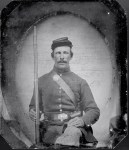
The sword in this picture has been laying on the top of a display case in the Portsmouth Historical Museum.  It has been somewhat out of sight, so it is a good candidate for our Out of the Attic theme this year.  It had an acquisition number written on it which refers to some old museum records. According to the record. It was a:

“Civil War sword (that) belonged to Sheridan Smith, Calvary man. His horse was shot out from under him and for recognition he was made keeper of the Mussel Bed Shoal lighthouse. This is how they came to this section from Norton MA.”

Is this true? How can we determine that?

An on-line search revealed that historical records for the Mussel Bed Shoal lighthouse list a Thomas and Andrew Smith as lighthouse keepers – Not Sheridan Smith. Was Sheridan a middle name?

P1020333

Mussel Shoal Light – near Mt. Hope Bridge area.

The 1880 Federal census lists ”Thomas S. Smith” as a resident of Portsmouth and a “Lighthouse Keeper”.  We learned that his wife’s name was “Roseanne.” Does the “S” stand for Sheridan? We noted that the census lists one of his sons as “Andrew.”

Thomas Smith died in 1881 and it appears that his son Andrew took over the role as lighthouse keeper.

A Veterans Schedule from 1890 lists Roseanne as the wife of Thos. S. Smith (Alias) “Thomas Sheridan.” It also says he was in the Cavalry.

Is this a cavalry sword? It is similar to images we have seen of a typical Civil War Cavalry Sword found online.

It appears that may indeed be a Civil War Calvary Sword that belonged to Thomas Sheridan Smith. Was his horse shot out from under him? That is more difficult to prove.  Maybe someone in Smith’s family has more of the story.

Research by Richard L. Schmidt of the Curator’s Committee

Oscar Miller: Bristol Ferry Artist

Leave a comment

Oscar Miller roses

Oscar Miller painting on sale at Ruby Lane website.

Much due to Sarah J. Eddy’s influence, Bristol Ferry was a cultural and intellectual center. It was also a transportation center that made it easy to take the Fall River Line to New York, ferry to Bristol, take a train to Fall River and north or farmers to ship their produce from the freight dock. It was a perfect place for Oscar Miller and other artists to call home.
Oscar Miller was an artist with a national reputation. He created over 1500 works. Miller exhibited at most of the great American art institutions: The National Academy, painting titled “Girl Reading” at the 1904 World’s Fair. He painted marine seascapes, salon paintings, genre studies, and figure studies. Miller had many studios – New York and Paris as well as Portsmouth. His first Portsmouth studio was in the living room of the cottage he built in 1897-8 for his wife to be and then a purpose built 1904 Gambrel or “Dutch” style studio structure with a huge North window on Bristol Ferry Road which still exists today. A shop shed was added when Oscar returned from Europe just before the First World War.
Sarah Eddy liked Oscar’s paintings in a New Your City exhibition and first invited him up to Bristol Ferry in 1896 to “paint the spring.” In Bristol Ferry, Oscar would dress his subjects in costumes – as did Sarah Eddy and other artists of their day. Eddy taught him photography and his photography was just as good as his painting. His grandson, Gus, has glass plates of his grandfather’s photography work.
While in Portsmouth, Sarah Eddy introduced him to the woman who would become his wife – Clara Brownell May – daughter of Floride Mitchel. When their house was finished and furnished in 1898, they married. Clara believed that if she was to marry an artist, it should be one who could put a roof over her head.
Oscar Miller had married into a Bristol Ferry family. Clara’s aunts were part of the Bristol Ferry Art Colony – Sophie Mitchel (artist) and Cora Mitchel (poet and musician). Miller’s home and studio were built on Mitchel land that had been an asparagus farm. The Family raised and traded cotton in Florida. Mrs. Miller’s uncle Colby Mitchel had even been impressed into the Confederate Army and had to be rescued after he contracted malaria and smuggled back North. The family spent their time between Florida and Bristol Ferry.
Oscar Miller was a great organizer with a business mind. His Family had an art gallery on New York’s Fifth Avenue so he would also buy art as well as produce it. He always painted in a spotless suit because much of his work was painting portraits and he never knew when a client might drop by unannounced and he wanted to be able to shake their hand. Miller painted the portraits of many important New York, Providence and Fall River businessmen and matrons.
During the Spring, Summer and Fall, he would make the rounds of European locales – Holland, Northeast France, Brittany, St. Ives in England, Italy, Austria, Switzerland and Belgium. In the winter he would go back to work in his winter studio in Paris to paint works for the great Paris Salon exhibition. Every other year he would return to Bristol Ferry for a few months to visit family and to paint and exhibit locally.
He exhibited at many American and European institutions including: American Federation of Arts, American Water Color Society, Art Club of Philadelphia, Art Institute of Chicago, Le Salon de la Societe des Artistes Français, Memorial Art Gallery Rochester, Milwaukee Art Museum, Museum of Fine Arts Ghent, National Academy of Design, National Arts Club, Newport Art Association, Pennsylvania Academy of Fine Arts, Providence Art Club, Salmagundi Club, and the Society of American Artists in New York. A posthumous retrospective was held at the Rhode Island School of Design.
When he was in Bristol Ferry he loved to go out to paint at dawn or sunset. He thought the light in Bristol Ferry was like that of Holland or Venice because it was surrounded by water that reflected sunlight upward. More than that, Oscar Bristol Ferry among the most beautiful places in the world.
Bristol Ferry was unique. It had the warmest climate on the island and the surrounding water kept the growing fields moist even in drought. People would come to Bristol Ferry farms as a vacation destination. It was a wonderful area for artists to come for the summer season.
Most of my information on Oscar Miller was from an interview with August “Gus” Miller – Oscar Miller’s grandson. Sept. 12, 2014
The image of Oscar Miller’s painting is from this website:  https://www.rubylane.com/item/230729-JB04415/OSCAR-MILLER-1867-1921-still-life


Out of the Attic: Bristol Ferry Artist Box

Leave a comment

P1060744We received this artist box a number of years ago.  It had belonged to Claire Fay, a longtime board member of the Portsmouth Historical Society.  The paints are relatively new, but the box itself dates from a hundred years ago.  A note said it originally belonged to Bristol Ferry Art Colony member Mariette Letourneau – the great aunt of Claire Fay.  This item raised some questions.  Who was Mariette Letourneau?  Was there an “art colony” at the Bristol Ferry neighborhood of Portsmouth.

Finding Mariette Letourneau was not so easy. Genealogical resources show an aunt for Claire that was named Mariette Letourneau, but the birth date doesn’t match the date given on the card that was left with the box.  Was she an artist at Bristol Ferry?  Perhaps she stayed with the Fay family and they did live on Bristol Ferry Road.

Was there an artist colony?  There were certainly a number of artists that lived in the Bristol Ferry neighborhood.  Many of them were drawn there by Sarah J. Eddy. Sarah was a noted photographer, sculptor and painter.  Her most famous works are portraits of Frederick Douglass and Susan B. Anthony.  Sarah would invite artists to come visit and stay at her home (if they were female) or at Willowbrook,  her guest house.

Among the most famous artists in the neighborhood was Oscar Miller who had international fame.  He married into a family with Bristol Ferry roots and kept a studio there. Miller’s studio is still there under the care of his grandson.

Sophia Mitchell was another artist who had a national following.  She traveled extensively and had studios in Brooklyn as well as Bristol Ferry.  There were as many as six studios along Bristol Ferry Road.

Bristol Ferry had a reputation for having the quality of light that artists love – beautiful morning light and gorgeous sunsets.fullsizeoutput_167


Older Entries Newer Entries