Home

Out of the Attic: Thurston Meal Bag

Leave a comment

Thurston mill copy 2

Thurston Mill Sack

Among the “Attic Treasures” that will be in this year’s Portsmouth Historical Society’s annual display is a paper sack.  Much of what we know about the item is printed right on the bag.  The bag held wheat ground at Thurston Mill at Melville, Rhode Island.  It also tells us that the mill was once owned by D. Almy.  Starting with this information, we began our research into our questions:   Where was Thurston Mill?  When did it operate?   What did it look like? What happened to it?

Where was the mill?  If you are familiar with Portsmouth you might think that it was located on the westside of Portsmouth near the old Melville Navy area.  The Melville post office, however was located on East Main Road by Clearview Avenue.  1907 Map CUCMaps from 1907 give us a clearer answer. It was just down East Main Road from the Christian Union Church which is Portsmouth Historical Society headquarters today.  The Melville Post Office is right next to it.

When did the mill operate?  The sack itself lists D. Almy as a previous owner.  We know from newspaper articles that Almy Mill was operating in 1886.  It seems that Richard Sisson’s horse, “Bootsey Barker” ran into an arm of the mill while it was grinding.  (The horse was unharmed.).   Newspaper articles also tell us that the mill passed from Almy to his niece who was Edward Thurston’s wife.  Mills were a community gathering spot in Portsmouth and farmers from all around would bring their grain to the mill to be ground into flour.  This bag is for wheat flour, but corn meal was commonly ground as well.  The miller was entitled to a portion of the flour he ground.  Thurston (and Almy) would have sold his portion of the flour to make an income.

What did the mill look like?  Fortunately there isThurston Mill copy a postcard of the Thurston Mill.

What happened to the mill?  In April of 1959 Thurston’s Mill was destroyed in a fire.  A newspaper article tells us that it had stopped operating forty years before, so it had been used for storage before the fire.  Among the photographs in the PHS collection is an image of the mill on fire.  Thirston Mill Fire ~1961


Out of the Attic: Glen Farm Ribbons

Leave a comment

Ribbon

Second Place Ribbon from Newport County Fair 1914

The theme of this year’s Portsmouth Historical Society Museum displays is “Out of the Attic:  Items of Interest from our Collection.” Among the items to be featured is a cache of award ribbons from Glen Farm.  These are a recent addition to our collection and they offer an opportunity to highlight the outstanding success of Glen Farm. The Taylor family, like so many of the gentleman farmers in our town, were very proud of what they bred or grew on their farm.  It was a matter of pride and sometimes a point of contention.   A 1910 National Magazine article reports.  ” In most national dairy shows and state expositions, the Glen Farm stock has taken many of the prizes, both for butter fat tests and as breeders. Perhaps the brightest star in all Mr. Taylor’s constellation of prize winners is “Missy of the Glen.”  But another gentleman farmer claimed that Missy’s butter fat content was not as high as claimed.  H.A.C. Taylor, the owner of Glen Farm,  brought that farmer as far as the Supreme Court.  Taylor won after the state college monitored Missy’s butter fat for an entire year.  According to Taylor’s son Reginald, the award given by the court didn’t cover the legal costs, but Missy and the Glen Farm workers were vindicated.Missy of the Glen

Boyd’s Mill

Leave a comment

windmillBenjamin Boyd shared his family’s history with wind mills in a 1942 newspaper article  for the Fall River Herald. Although Boyd’s Mill stood in Portsmouth for many years, it has been moved to Paradise Park in Middletown and has been carefully preserved by the Middletown Historical Society.  The mill stood nearby West Main Road in Portsmouth by Mill Lane.

In the article Boyd states that  John Peterson, a retired ship captain, built the mill in 1810.  Boyd comments that the millers are very much like “sea captains” in the skills they need to manage the mills in bad weather.  The timber came from Wickford across the bay.  The article gives many details about the construction of Boyd’s Mill.  The main shaft is twenty-two inches in diameter and nineteen feet long and is made of hard Georgia pine. The Boyd Mill is unusual in that it has eight arms – each  thirty one feet long.  The arms carries sails twenty-eight feet four inches wide. The Boyds bought it after their Bristol Ferry mill was blown to pieces in the Gale of 1815. Boyd shares how difficult it was for millers when Rhode Island farms switched from growing grain to truck farming. To keep going, the Boyd family promoted the famous Rhode Island Johnny Cake meal. Their meal was shipped as far as South America.

The entire article is well worth reading.  You can find it under the “Collections” section of the Portsmouth Historical Society website:  portsmouthhisrorical.org.  Look for the Scrapbook images.

Bristol Ferry Artists

Leave a comment

sunset-at-bf-glassplate

This image is from a glass plate negative.  Captured in 1910, this was titled “Sunset at Bristol Ferry”.  I don’t know that this image is by Sarah Eddy, but she was a marvelous photographer working around the Bristol Ferry area at that time.  The Bristol Ferry area attracted many artists and photographers.  The quality of the light there was special.  Artists and photographers especially came during the summer season, but many had permanent studios in the area.  I found this small glass plate on Ebay, but I know that other glass plates may be found in Portsmouth attics.  Hopefully we can uncover more about the Bristol Ferry artist colony.

Julia Ward Howe’s Other House

2 Comments

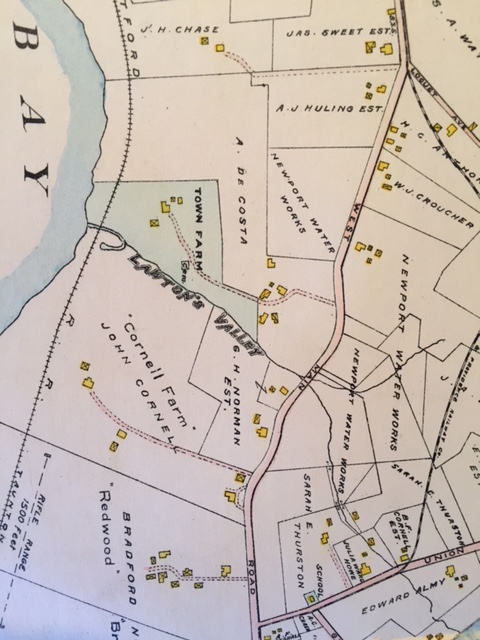
lawtonWe think of Julia Ward Howe at Oak Glen, a house that is still standing.  Julia had a house in Lawton’s Valley before that. 1853 was her first summer in Portsmouth.  Julia lived in Boston, but she had deep Rhode Island roots.  There was a water powered mill near by where the local farmers brought their corn to be ground.  Julia found this place an inspiration.  Her poem, “In My Valley” was her first writing in the new house.  She wrote: “My first writing in the new house, where may God help and bless us all.  May no dark action shade our record in this house, and if possible, no surpassing sorrow.”  Read the poem here:  In my valley-From sunset ridge: poems, old and new

In 1865 Julia’s husband Samuel sold the Lawton Valley house.  By 1870 the bought Oak Glen which was a short way from Lawton’s Valley.  Julia would live at Oak Glen until her death there in 1910.


Whose Home? Green Animals

Leave a comment

P1060542Green Animals: Brayton House c. 1859 Cory’s Lane

In 1877 Thomas Brayton treasurer of the Union Cotton Manufacturing Company (more like principal operating officer today), bought property in Portsmouth to be a summer home for his family. Thomas Brayton hired a Portuguese mill worker, Jose Carriero, to develop and manage the grounds of his Portsmouth estate in 1905. Gardener Joseph Carreiro, superintendent of the property from 1905 to 1945, and his son-in-law, George Mendonca, superintendent until 1985, were responsible for creating the topiaries. There are more than 80 pieces of topiary throughout the gardens, including animals and birds, geometric figures and ornamental designs, sculpted from California privet, yew, and English boxwood.
When Thomas Brayton died at age 96 on May 10, 1939, he this estate to his daughter Alice, age 61 and his son Edward, age 51.  Alice Brayton had re-opened the main house on the Portsmouth estate in 1936 to begin renovations to make it her permanent residence. She moved to the estate in the spring of 1939 naming it Green Animals for the topiary animals in the garden. Miss Brayton left Green Animals to The Preservation Society of Newport County at her death in 1972.

Alice Brayton

  1. During Depression she helped to found a relief program in Fall River to bring milk, food and clothing to the needy.
  2. Founded a nursing association in Fall River.
  3. Published books including contributing to “Gardens of America”
  4. Loved to garden.
  5. Loved to entertain – hosted Jacqueline Bourvier’s coming out party.

Whose Home Is It?

1 Comment

Living in a School House?

Southermost School

Southermost School

Can you imagine a family living in the basement of a school? Two families did live in the “cellar” of the old Southermost School because they fell on hard times. We learn about these families from Portsmouth historian Edward West’s writings. In his 1932 article for the Rhode Island Historical Society on the “Lands of Portsmouth,” West gives a virtual tour of early Portsmouth. “..we come to the site of the Southern School House, where the widow Sarah Strange took up her residence after the death of her husband; for at a Town Meeting in 1746, she and her family were ordered out, so that the school house might be improved in the use for which it was built.”

Sarah’s situation is indeed “strange” because her family forced the move of another family to the cellar of the same school. Schoolmaster James Preston was reported as being sick and helpless in 1727. In the early days it was the families of the school children that were responsible for the room and board of the schoolmaster and his family. In an article on “Relief Problems of Old New England,” West reports on Portsmouth Town Council decisions. “James Strange (Sarah’s husband) refuses to entertain James Preston and his family any longer in his dwelling house it is agreed by this council that said Preston and his family be settled in the Southermost School house in the town for the present, that is in the cellar part thereof…” The Town Council agreed to pay Preston’s wife money weekly to provide for the family. Now the building at that time was twenty-two feet by fourteen feet – not large at all to house a family and the school children.

In 1730 it was ordered “that James Preston and his family be removed out of the School house wherein they now dwell and that Rebecca his wife pay the charges of their removal and house rent out of the weekly allowance.” Rebecca was forced to “bind out her two eldest children otherwise the said council will put out the said Children in order for the lessening the Towns Charges therein.” Soon afterwards James Preston died and the town paid his funeral charges. There is no further mention of the family in town records.

This schoolhouse is on the National Register of Historic Places.

Willow Brook

Connors Funeral Home today

Willow Brook - owned by Sarah Eddy.

Willow Brook – owned by Sarah Eddy.

This home has had some colorful owners and uses through the years. Researching the homes and dating them is always difficult. We think the house may date to around 1850 and it was built for David Anthony. Asa Anthony owned it when he served as Portsmouth Coroner in the 1880’s. Newspaper articles mention that sometimes bodies were brought to Asa’s home before burial. In 1898 after Asa’s death, the home and farm was sold at auction to the Ballou family of Providence who had a home down the road on Bristol Ferry. Newspaper articles state that they probably would not be living there. Perhaps they bought it for artist Sarah Eddy who used it as a place her friends and other artists could come and stay while visiting Portsmouth. 1907 maps show it as her property at that time. The image above was scanned from a glass plate and we suspect that Sarah Eddy – a noted photographer – may have taken this photograph. In 1900 the Rev. Dennis and his sister seemed to run the guest house. Newspaper articles show that Rev. Dennis ran a Sunday School there for children who weren’t members of any particular church. Grand parties were held for the community during the 1920’s including a Christmas party for 164 guests. The house became a “tourist lodge and trailer park” in the 1930’s after it was bought by a Mrs. Hollis. By 1958 we see ads for “Willow Brook Manor Nursing Home” In the 1970’s it seemed to by run by Leo MacAloon. For a while it was a nursery school. Memorial Funeral Home bought it in 1983 and has run it since then as a funeral home. It seems to be appropriate as the home of a former town coroner.

George Manchester House

102 Glen Road

George Manchester House

George Manchester House

George Manchester of Portsmouth, RI was born 1822, the son of John and Lydia (Albro) Manchester of 1105 East Main Rd. His brothers were John Henry Manchester and Daniel Manchester, both of Slate Hill, and his sisters were Susan and Rebecca (Mrs. William H. Gifford). George was a carpenter who helped construct many homes in Newport County. He was a devoted member of the Union Church at the location of today’s Portsmouth Historical Society, and taught Sunday School there. He was a public servant who represented Portsmouth in the RI General Assembly for several terms, as had his father and his grandfather Giles Manchester. At various times George held the offices of Superintendent of Public Schools in Portsmouth, State Railroad Commissioner, State Auditor, Customs Officer, Justice of the Peace, and High Sheriff of Newport County. An avid reader and book collector, he wrote book reviews and articles for magazines such as Harper’s, and for religious publications such as the Herald of Gospel Liberty and the Christian Inquirer. He lived at 102 Glen Rd., and was married to Phebe Taber Coggeshall. They had three children, Alfred (grew up to be a minister in Salem, MA), Charles (owned a store in Newport), and Leonora (wife of George Brawley, a Middletown farmer). George’s wife Phebe died in 1861. In 1873, he married Eliza Maria (Peckham) Rogers, widow of Thomas G. Rogers. George died in 1879 and is buried in St. Mary’s Church cemetery.

Cundall House – Maybe

Glen Farm Road

Cundall House- on land the Cundall's owned

Cundall House- on land the Cundall’s owned

There are no definite dates for this house. 1798 is one date given. If so, than it would have been the home of Joseph Cundall, a notable miller in the area. Other sources note that this was the land of Joseph Cundall, but that the house was built later. This house, however, is known as the “Cundall House” in newspaper articles.

The Glen’s first settlers, the Cooke family, gradually moved away and sold their land, but many of the Cooke daughters married into local families. It is hard to trace all the ownership of what is now the town owned Glen land, but we did discover information on some of those landowners. In 1720 John Cooke sold a portion of his land to James Sisson. By 1745 Sisson had a water powered grist mill on the brook in the Glen to grind corn. Revolutionary War era maps show the location of that mill as just east of Glen Farm Road and the barn complex.

James Sisson then sold his mill and 46 acres around the brook to Joseph Cundall. What we call “the Glen” became commonly known as Cundall’s Mills. In 1706 Joseph Cundall had left his native England to become an indentured servant in America. Becoming an indentured servant was a way for a young person to learn a trade and get an education in exchange for working for seven years or more. Cundall seems to have learned his trade well and was in a good position to buy land as an adult. Water from the stream powered the carding and fulling mills to wash and pull woolen fibers. Joseph Cundall added almost a hundred more acres to his land around the Glen before he died in 1760. Newspaper accounts tell the tragic story of his son Joseph who got lost in a Christmas Eve snowstorm and died on his way home from the mill. Near the Glen barns there is a little burial ground with Slocum and Cundall family headstones. His gravestone is easily read in the old cemetery with a death date of December 24, 1811. If the 1790 date is accurate, this little house would have been home to this Joseph Cundall.

Taylor residence - Glen Manor House

Taylor residence – Glen Manor House

Mrs. Taylor’s Manor House

Frank Coelho Drive
Mrs. Taylor’s Manor House
Even though the Taylor family started Glen Farm in 1882, construction did not begin on their home until around 1920. The Taylors had a Newport summer home, but that preferred the Portsmouth countryside. They hired famed architect John Russell Pope to design their home in the Glen area. During World War I the Taylors lost their son in France. Family stories relate that the French chateau style of the home was designed to remember the place where their son died. The house was completed in 1923.

Architect Pope encouraged the Taylors to hire the Olmsted Brothers Firm to design the landscaping. The gardens were designed to be at their best in July and August when the family would be in residence. Mrs Taylor opened the grounds and gardens to special events. Moses Taylor died in 1928 but Edith continued to spend more time at the Glen. She remarried many years later and became Mrs. G.J. Guthrie Nicholson, but continued to come to the Manor House until her death in 1959.

In 1960 the Manor House and 43 acres around it were sold to the Elmhurst Academy of the Sacred Heart. The house served as a dormitory for boarding students. When Elmhurst Academy closed its doors in 1972, the Town of Portsmouth bought the house and the newly built school buildings that were attached to it.

Portsmouth citizens still own the house and the Glen Manor Authority and the Friends of Glen Manor House constantly strive to restore the house and gardens.

Leonard Brown House

Linden Lane

Leonard Brown House in 1920

Leonard Brown House in 1920

If you are familiar with the Glen, you may know that the Leonard Brown House sits at the end of a drive lined by majestic linden trees. Who’s was Leonard Brown and what does he represent in Portsmouth history. Brown was born in Middletown in 1815. His wife Sarah was the daughter of Revolutionary War militia leader Cook Wilcox. What would become the Brown farm had been part of Wilcox’s land. By the 1880s Brown was considered one of the best farmers in Portsmouth. He raised poultry and pigs and brought them to market in New Bedford. Along with farming, Brown served as a wheelwright and a blacksmith. Leonard Brown represents the Yankee farmers, the descendants of the original English settlers. Brown and the farmers like him were the backbone of Portsmouth. They served in political offices, farmed and were the skilled craftsmen of the town.

Dating the Brown House has been difficult. The diary of George Manchester shows that Brown was on the land in 1851 because a barn was built for him by Albert Coggeshall. 1860 maps show Leonard Brown on the property.

When Leonard Brown died in 1896, the Brown farm was sold to H.A.C. Taylor and became part of the Glen Farm. A 1904 gardening magazine shows that Taylor had the row of linden trees planted as a entryway to the house. The house served as a home for many Glen Farm families over the years. When the Town of Portsmouth bought the land in 1989, the Brown House was in disrepair. Fires, hurricanes and vandalism had damaged the house, but efforts are being made to restore and the use the house once more.

Mrs. Durfee’s Tea House

82 Glen Road

DURFEE Tea House

A 1893 Harper’s Monthly Magazine called Mrs. Durfee the “Goddess of the Glen.” No trip out to the romanic Glen was complete without stopping at the Durfee house for refreshments. Many of the Newport society greats would host dinners and events at the Durfee Tea House. One guest describes a visit in the 1870 timeframe: Miss Durfee, very lame but most hospitable, received her guests and soon the famous tea-house cakes were served. These were meal cakes, made as thin as a wafer, slightly sweetened with a suspicion of nutmeg flavor. Baked on a griddle that covered the whole top of the stove, they were compounded of a milk mixture consisting of ten eggs to a quart of milk, the finest Rhode Island meal, butter, sugar and spice….After supper, the frolic terminated in a Virginia Reel, in which all, young or old took part, and then the resellers returned home by the light of the moon.” (Newport Historical Society Bulletin, April 1926).

This house has had several owners and at least two locations through the years. There are two Mrs. (or Miss) Durfees. Samuel Clerk who took over the Cundall Mills property sold the original lot without a house to Mrs. Mary G. Durfee. in 1836. The house must have been built shortly after the sale. Mary Durfee must have originated the tea house because when the property was sold to Ruth Durfee in 1857 it was already known as “Mrs. Durfee’s Tea House.” Durfee Tea House was a cultural center for Portsmouth. Many activities were held there including the original Sunday School for the Union Meetinghouse which was organized by social reformer Dorothea Dix.
In 1909 the house was moved to the current Glen Road location because H.A.C. Taylor purchased the lot and wanted the house moved off of his farm. Manton Chase bought the house at auction and moved it.

Oak Glen - Julia Ward Howe home today

Oak Glen – Julia Ward Howe home today

Julia Ward Howe’s Oak Glen

745 Union St.
In 1850, Dr. Samuel Howe bought a small cottage on the land around what is now Oak Glen. Howe’s wife, Julia Ward Howe, had Rhode Island roots and this cottage became their summer refuge from Boston. Howe was a pioneer in education of the handicapped and he and Julia were part of the effort to abolish slavery. Julia may be best known for writing the words to the “Battle Hymn of the Republic,” but she also wrote songs, poetry, plays and essays. Henry Wadsworth Longfellow, Oscar Wilde and other literary giants came to visit her at Oak Glen.

The Howes enlarged the home in the 1870’s, but the home was still centered around their growing family of six children. The additions to the home helped it become a gathering spot for local and national literary figures. When Samuel died in 1876, Julia continued to live at Oak Glen until her death there in 1910. Julia was occasionally ask to “supply the pulpit” at the Christian Union Church down the road. She was a noted speaker, writer and advocate for such causes as Women’s Suffrage and the International Peace Association.

Some of her furniture from Oak Glen was donated to the Portsmouth Historical Society and is featured in the Julia Ward Howe Room of the museum.

This home is on the National Register of Historic Places.

Greenvale – Barstow House

Barstow House at Greenvale

Barstow House at Greenvale

In 1863 J.S. Barstow, a China trade merchant, purchased land in Portsmouth to establish a “gentleman’s farm.” Barstow followed a formula for the how much of the land would be in gardens, orchards, livestock, etc. He was inspired by a book called Country Life by Copeland that describes the type of person (like Barstow) who would establish such a farm as a man who craves occupation as well as recreation. “Owners of country seats in America are generally men who have retired from active business… and have something to do and to think about those avoid the evil of mental inactivity.”

Barstow’s “Stick Style” home was designed by Boston architect Sturgess who also designed a stable and barn. At Barstow’s death the house and land passed to relatives and finally to niece Charlotte Parker and her husband Major General James Parker. When the Parkers retired in 1918, the came back to a property that had been neglected and revived the farm. The property is owned by members of the Parker family today and has been re-purposed as a Greenvale Vineyard. Although you can’t tour the Barstow house itself, you can visit the stables that have been restored and redesigned as a Wine Tasting House.

Nichols – Overing House – Prescott Farm

Overing House

Overing House

This house is known not for the importance of its owners, but for a daring deed in the Revolutionary War. It was probably built by Jonathan Nichols before 1750. The Nichols family owned it until 1765 when John Nichol’s widow sold to Peleg Thurston. A “mansion” is listed on the property as part of the land transfer. Both John and Jonathan Nichols served as Deputy Governor of the Colony of Rhode Island. Thurston was merchant who might have been involved in privateering. After Thurston’s death in 1770, his widow sold the property to Henry John Overing. Overing was a “sugar baker” who refined raw sugar into loaves. Overing was loyal to England and when the British invaded Aquidneck Island in 1776, Overing’s farm was a headquarters for General Richard Prescott. In July of 1777, American Col. Barton and his men silently rowed across to Portsmouth from Warwick. They overcame the sentry without a shot and captured General Prescott. Prescott later came back to the island. He was exchanged for a Col Lee – an American held by the British. The whole “caper” raised the spirits of the Americans.

Overing seems to have sailed for England in 1783. Overing’s wife kept the house until 1796. The house was sold to her son-in-law, Thomas Handy. He sold the house to the Briggs family in 1797, but Thomas and Mary Handy lived as tenants on the farm. The Briggs sold to Asher Robbins, and in 1803 it was sold to Benjamin Pages. There were other owners along the way. Bradford Norman picked up the property in 1927 and his daughter, Barbara Norman Cook (aka Kitty Mouse) owned the house until she sold it to the Doris Duke’s Newport Restoration Foundation in 1970.

Common Fence Point

Leave a comment

From Blaskewitz Revolutionary War era map

From Blaskewitz Revolutionary War era map

Birdseye ViewCommon fence001

Gambling for the Good? Lottery Used to Build Union Meetinghouse in 1824

Leave a comment

Union Meetinghouse lottery payout list. (from Newport Historical Society notes 1912).

Union Meetinghouse lottery payout list. (from Newport Historical Society notes 1912).

Meeting at the Southermost School in 1820, a group calling themselves the “Rhode Island Union Society” wanted to built a church where people of all denominations could worship together. They tried to raise money, but the church was left half-built. So in 1824 they petitioned the State of Rhode Island for permission to hold a lottery to raise the sum of $2000 to complete their church.

From Revolutionary times to the 1840s, lotteries played a big role in providing revenue for civic buildings in Rhode Island. Banks were rare and taxes were too low to cover needed civic improvements. In the same year that the Union Meetinghouse lottery was approved, the town of Portsmouth was granted a lottery to pay for Charity Bridge and roads along what we call Park Avenue today. In Newport County lotteries were used for rebuilding Long Wharf, buying books for Redwood Library, building a public school in Newport and even paying for the reconstruction of the 1795 bridge over the Sakonnet River!

“The bridge connecting the island of Rhode Island with the mainland at Howland’s Ferry was first opened for crossing on Thursday, Oct. 15th, 1795; it was washed away in the great gale of September, 1815, and in the October following the Rhode Island Bridge Co., under whose auspices it had been originally built, and subsequently managed, obtained a grant from the Assembly to raise the sum of $25,000 by a lottery, the money so raised “ to be expended in rebuilding the bridge and rendering the same permanent ” (Bulletin of the Newport Historical Society, 1912).

Maybe lotteries were not such a great idea. Lotteries were ended by the state in the 1840s. Many of the lotteries authorized didn’t raise the needed funds. The lottery for the Union Meeting House didn’t quite generate enough money and the church was forced to “sell” pews to members to make up the difference.

By 1865 the little meetinghouse was too small for the congregation and the building was moved to the Sisson lot across East Main Road. A larger church was built on this same site and renamed the “Christian Church.” The Portsmouth Historical Society now has the care for this historic building. Should history repeat itself? Do we hold a lottery to raise funds to repair our building?

Lost to Time: Anthony Seed Farm and Hathaway Orchards

1 Comment

news1 - Version 2

Hathaway Peaches ready for transport.

Anthony jpgPortsmouth is certainly known for its farms and some of our farms were the best in the state.   We have lost many great farms, but this blog will remind us of two very special agricultural businesses:  H.C. Anthony Seed Farm and Hathaway Orchards.

Henry Clay Anthony grew up on his father’s farm and understood farming, but he also had training at Scoffield Commercial College in Providence and that prepared him for business.  Early on Anthony became interested in raising seeds to supply to the local farmers and he perfected his techniques through the years.  By 1920 he was the largest seed grower in all of New England.  His seed was sold through many areas of the United States and Canada.  He had more than 800 acres of land in Rhode Island and rented land in Massachusetts to grow his seed.  Besides working at his business for sixteen hours a day, Anthony devoted time to community service as a State Representative, Portsmouth Town Councilman and active member of countless religious and social groups.

You can see some of the drawers that stored Anthony Seeds at Denise Wilkey’s Pottery Studio on East Main Road.

Hathaway Orchards began in 1926 when Howard W. Hathaway bought one hundred and thirty (plus) acres of land around where Montaup Country Club is today.  The Hathaway fruit packing house is still used by the Portsmouth Public Works Department as a storage location.  Another Hathaway Orchard area was located on Middle Road close to where the Escobar Dairy Farm is today.  Some “Hilltop” area streets have names that reflect the fruits that were grown there.   From 1932 to 1959 Hathaway Orchards produced peaches, apples, pears, currants and gooseberries.

In 1944 Hathaway had the largest peach orchard in the state and  produced 2500 bushels.  The peach tree rows were over a mile long.  The picking season lasted six weeks.  Fifty workers were needed and boys and girls earned two or three dollars a day for their work.

The Hurricane of 1938 severely injured the orchard and it took six years for another good crop to appear.  Hurricane Carol in 1953 was the end of the peach orchards, but the apple orchards hung on until 1959.  The peach orchard was close to the water and the salt spray from the hurricanes ruined the trees.

Like Henry Anthony, the Hathaways were very involved in the community as well as running their agricultural businesses.  Both Howard and Merrill Hathaway (his son) served on the Portsmouth School Committee.  Howard also served on the Town Council and as Town Treasurer.  Hathaway School is named after Howard Hathaway.

In the Portsmouth Historical Society’s “Lost to Time” exhibit you can see clippings from a Providence Journal article on the Hathaway Orchards and an interview Elmhurst students did with Flo Hathaway Olivieira (Merrill Hathaway’s daughter) about growing up on the orchard.    In the display case there are vintage images of Anthony Seed Farm.  The Portsmouth Historical Society Museum is open on Sundays from 2PM to 4PM from Memorial Day weekend to Columbus Day weekend.

Older Entries Newer Entries