I have found more brave Revolutionary Women to add to my list. Local historical societies have been a good source for some unique stories.
Tiverton: Dorcas Seabury Soule.
Her house was located on the northest corner of the intersection at Tiverton Four Corners. She was a busy woman as the mother of eleven children. Her husband Abner was part of the Tiverton militia and he was on guard duty when this event happened. According to a Tiverton Historical Society member, Tiverton men were often called upon to to stand guard at Punkateest Neck to watch for signals about the the activities of the British on Aquidneck Island. The Soule home at the time was only three rooms, but Dorcas had company since two other women were with her. It was common for Tiverton families to encounter strangers escaping to Tiverton from the British Occupation of Aquidneck Island. Tiverton was in Patriot control. When a stranger appeared at her door asking for food because he was hungry, Dorcus agreed to share some food with him. When she asked him his name, the stranger replied “touch me not.” Dorcas became suspicious. Thinking quickly, she seated him at the table with his back to the door. She ran to the barn and returned with horse reins. She and her friends tied him up in the chair. When her husband arrived back home they discovered papers on the stranger that proved him to be a British spy.
In 1889 Dorcas’ granddaughter share her story under oath.
Little Compton: Sarah Snell Tompkins 1759 – 1837
Sarah Snell and Nathaniel Tompkins married in 1781. Nathaniel was a farmer and like most men at that time served as a soldier as well. Sarah and her husband lived on a 12 acre farm on Tompkins Lane that Nathaniel’s father had passed down to him. Life was never easy for Sarah who was the mother of thirteen children. When her husband was away on duty she didn’t have the support of servants or farm workers – she had to manage all by herself.
We have Sarah’s experience in her own words. This was recorded when she made an application for and received a pension many years later as a widow.
“[Nathaniel was] much in the service before as well as after our said marriage…. I had two children born after said marriage and before the close of the war. After our marriage, when my husband was away in the service I had to do, and did, many things, out of doors, that women in this town think they cannot do. We suffered great privation at that time.”
Sarah dictated her testimony and signed her name with an X. The small pension would have helped Sarah who according to her neighbors lived in poverty.
Warren: Nellie Easterbrooks : 1761-1836
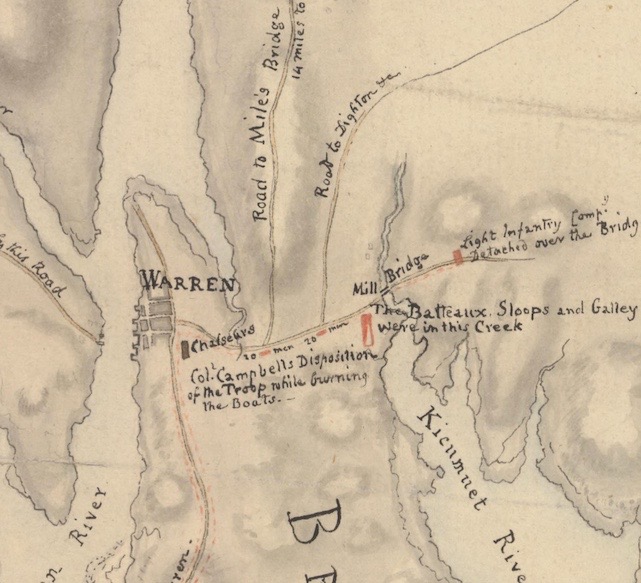
Easterbrooks House on Church Street in Warren was occupied by Nellie Easterbrrook and her mother during the Revolutionary War. The ladies rented a room to John Holland, the Warren school master. The British raid of Warren and Bristol occurred on May 25, 1778. Roughly 500 British and German troops under Lieutenant Colonel Campbell traveled to Warren to destroy American military supplies (especially flat boats) that were being prepared for the The Rhode Island Campaign. Along the way from Warren to Bristol they sacked the towns and burned property. During this raid, Holland’s treachery was found out. “Traitor Holland” had been secretly providing information to General Pigot, the British commander. Holland was thought to be a Patriot, but the town learned of his loyalist sympathies when British troops stopped by the house on their way back to Aquidneck Island. He was cheering for the attacking army and he left town in their company. Nellie and her friends were angry at the damage the British had done toWarren people and property, so as the troops were leaving town they captured a drunken drummer. The Patriot ladies dragged him to a local hotel and locked him into a closet.


Leave a Reply