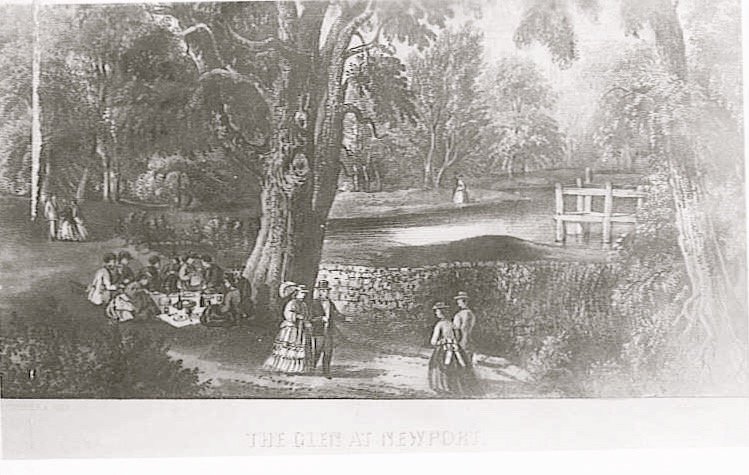
A glen is a deep, narrow, secluded valley. This part of South Portsmouth has been named “the Glen” almost since the founding of Portsmouth. It is the ancient home of water powered grist mills, carding and fulling mills and factories. The mill run leads to the Sakonnet. When the British cut down all the trees in Portsmouth, the Glen was too steep for them to cut. In the mid 1800s the Glen was a favorite picnic spot. People would come to enjoy the shade, write poetry, paint and draw. Currier and Ives pictures the Glen at its best. Unfortunately, the Glen is privately owned and you can no longer walk the carriage paths across the brook. The mill pond is gone, too, after the dam burst around 1979. Walking through Glen Farm Road you can get a since of the Glen of the past.
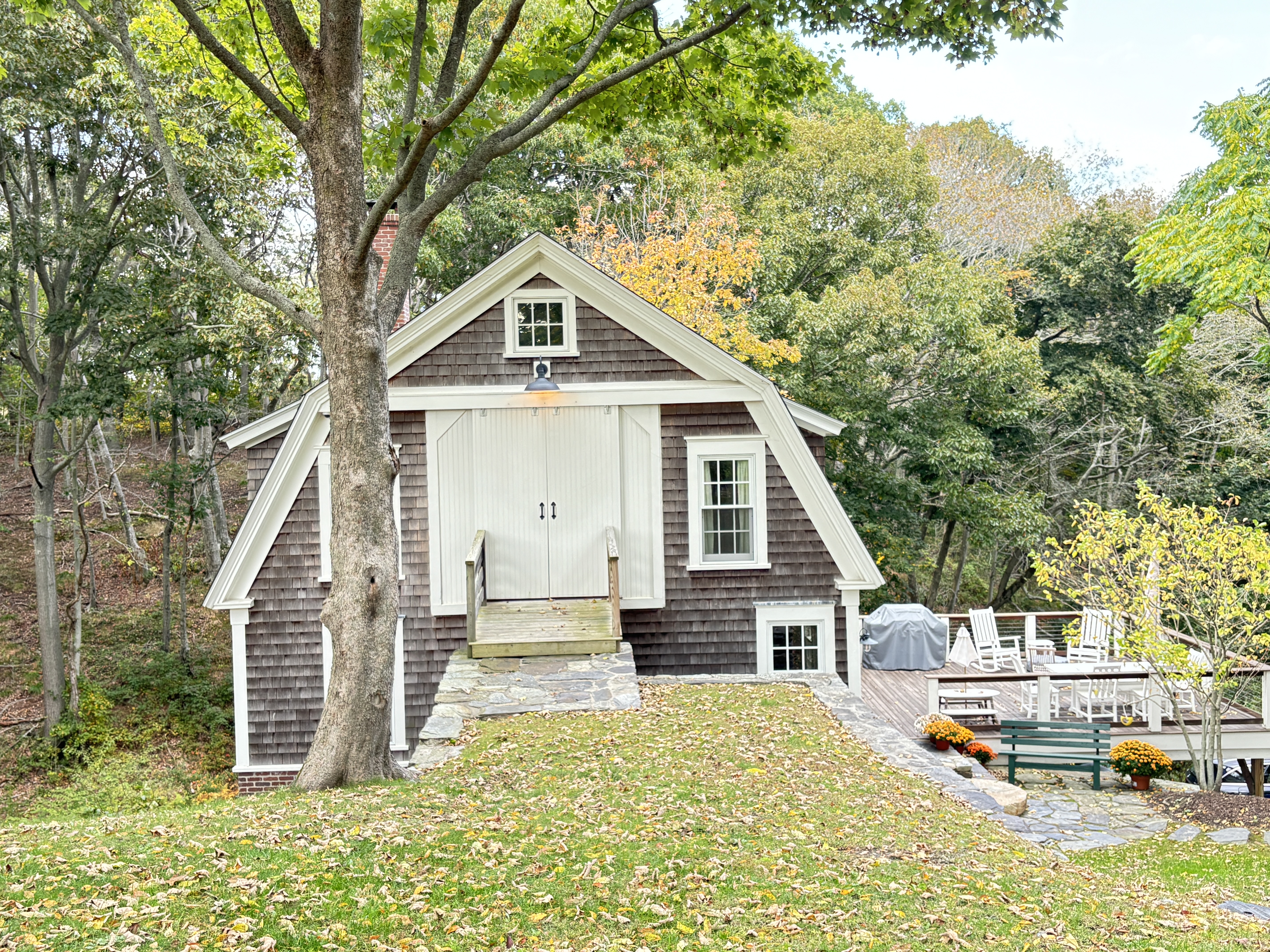
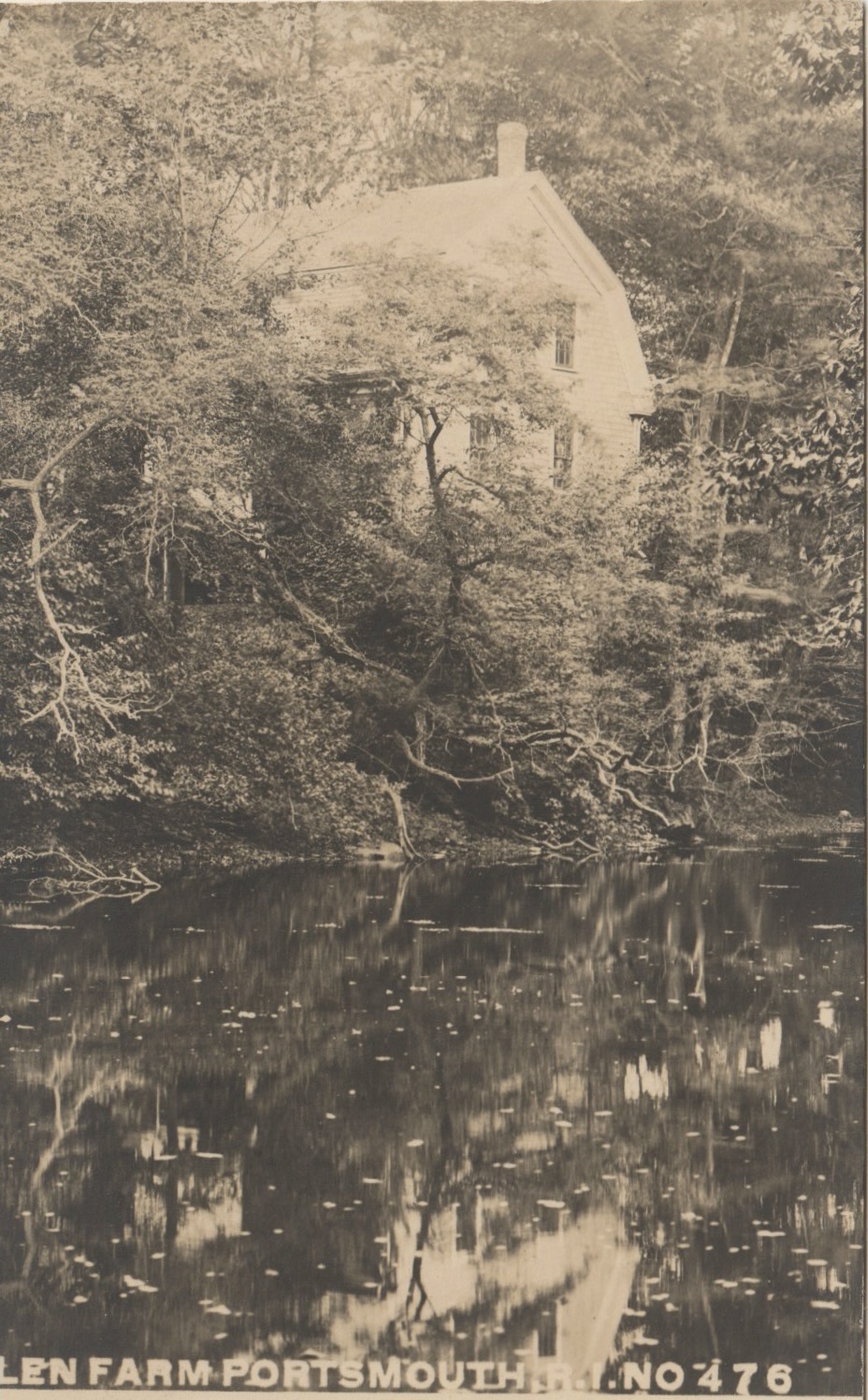
A family has done a beautiful job of restoring a structure that was built on the foundations of an old mill. I can’t get a proper Then and Now shot from the same side, but you get an idea of the mill pond that used to be.
I came across a clipping that was from the Newport Mercury in June of 1933. This was a lette to the editor by Benjamin Boyd describing the history of the Sherman mill that is at Prescott Farm today. He has a nice style of writing, so I transcribed it and am including it in this blog.
Sherman Mill – Benjamin Boyd’s Letter to the Editor Newport Mercury, June 2, 1933.
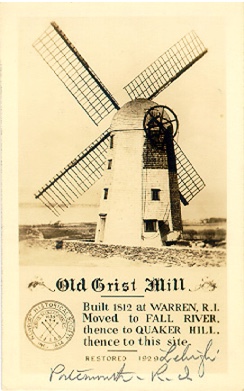
“This mill was built in Warren, RI in 1812 and was connected with a distillery. Later it was moved to Fall River and later to Portsmouth, RI. The dates of these removals I do not know. When I was a boy, of a dozen years old or so, it belonged to Robert Sherman and stood just north of the present Newport County Fair Grounds. Mr. Sherman at that time looked to me like a middle aged man but whether he bought the mill and moved it from Fall River or whether his father or someone else did I do not know. The mill was the largest and most powerful one ever built in this county, so far as my knowledge goes. It described a circle, when running 70 feet in diameter and drove two sets of millstones. It was an unruly bird and was liable to become unmanageable in squally weather. Only the most experienced wind grist mill miller, and men having full knowledge of what the vagaries of changing gale and storms would do to mill arms, with a leverage of 35 feet swinging 15 to 25 Revolutions per minute were capable of handling this mill.
I recall that Mr. Sherman was sick all one winter and hired a man by the name of Almy to run his mill. Mr. Almy had run a water mill which was located in the Glen, now part of the Taylor estate, but his knowledge of wind power was more theoretical than practical. There came a day, when Mr Almy discovered that unlike watermills, wind mills had a way of acting very independent. Mr. Almy found out about these things on one of those typical March days, when the wind will be blowing a light breeze and the sun shining in an innocent kind of way, and in 15 minutes a snow squall will be raging and the wind bowing hard enough to take the hair of one’s head. The old mill was probably turning around but not grinding much, and Mr. Almy was probably sitting on a bag of flour, very likely musing on the wherefore of the which or why this should be thus when it should be otherwise. About this time the snow squall struck and things became otherwise with a vengeance. The old mill immediately went into high gear full speed ahead which certainly meant disaster, and caused Mr Almy to apply the brake to the main shafts so he could stop and shorten sail. An experienced miller would have seen this squall coming in advance and shortened all, but brakes propose and winds dispose, so the old mill did not stop. Then Mr. Almy bethought himself to try the expedient of filling the eye of the mill stone with grain to choke it up and help the brake to stop the mill. He succeeded in stopping all the internal machinery of the mill, but he could not stop the mill arms. They twisted off the 26 inch oak shaft and went over the mill taking most of the top with them.
Later Mr. Almy was asked what he thought of wind grist mills and he said that there were only two things that had ever beat him – red-headed women and windmills. The next day as a boy of 12 or 13 I saw the wreck of this mill and it was certainly some wreck. The mill was fitted again but was soon sold to the late Benjamin Hall Senior and his brother William who ran the Adams House in Boston. These men had the mill moved to a farm they owned on Lehigh Hill on the West Road about one half mile east of the Portsmouth Coal Mines.
____?Sherman, a well known mover of buildings at that date, moved the mill for them down Quaker Hill on the East road through Freeborn Street and up Lehigh Hill.
I remember seeing the mill being moved down Quaker Hill. Mr. Sherman had a large rock chained to the mill, and this rock dragged on the ground behind the mill as a brake. Old people will remember Mr. Sherman as the one who moved a church that stood on Bedforrd Street in Fall River to Rock Street, and then turned it round by putting a large cannon ball under the center of the building placing the planks for the rollers in a circle.
Mr. Sherman bought the mill and farm of the Halls, and ran it for a number of years. After he passed away this property went back into the hands of William Hall, and after to a family by the name of Sowle. Some four or five years ago, the Newport Historical Society bought the mill and about one acre of land. The Mill was repaired and I understand it is open to visitors. There is a signboard at the entrance telling when and where it was built.”
There are a number of Mr. Shermans in the piece and I am not sure who is who.
He ends with an interesting phrase:
The Mills of the Gods grind slowly
But they grind exceeding small
While the wind mills of humanity vanish
And Death takes the Millers as toll.
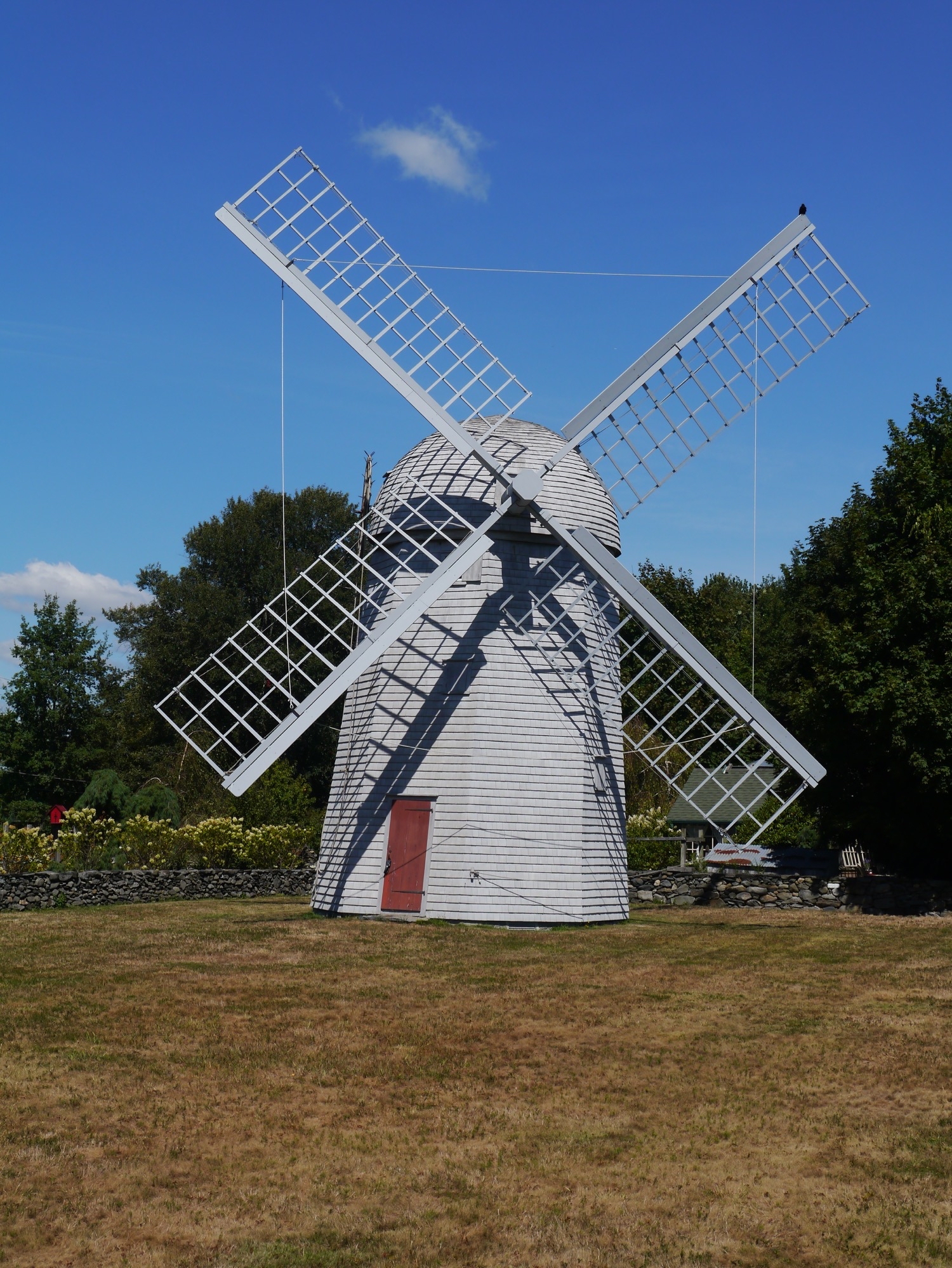
Sherman Mill today at Prescott FarmSherman Mill at Lehigh Hill
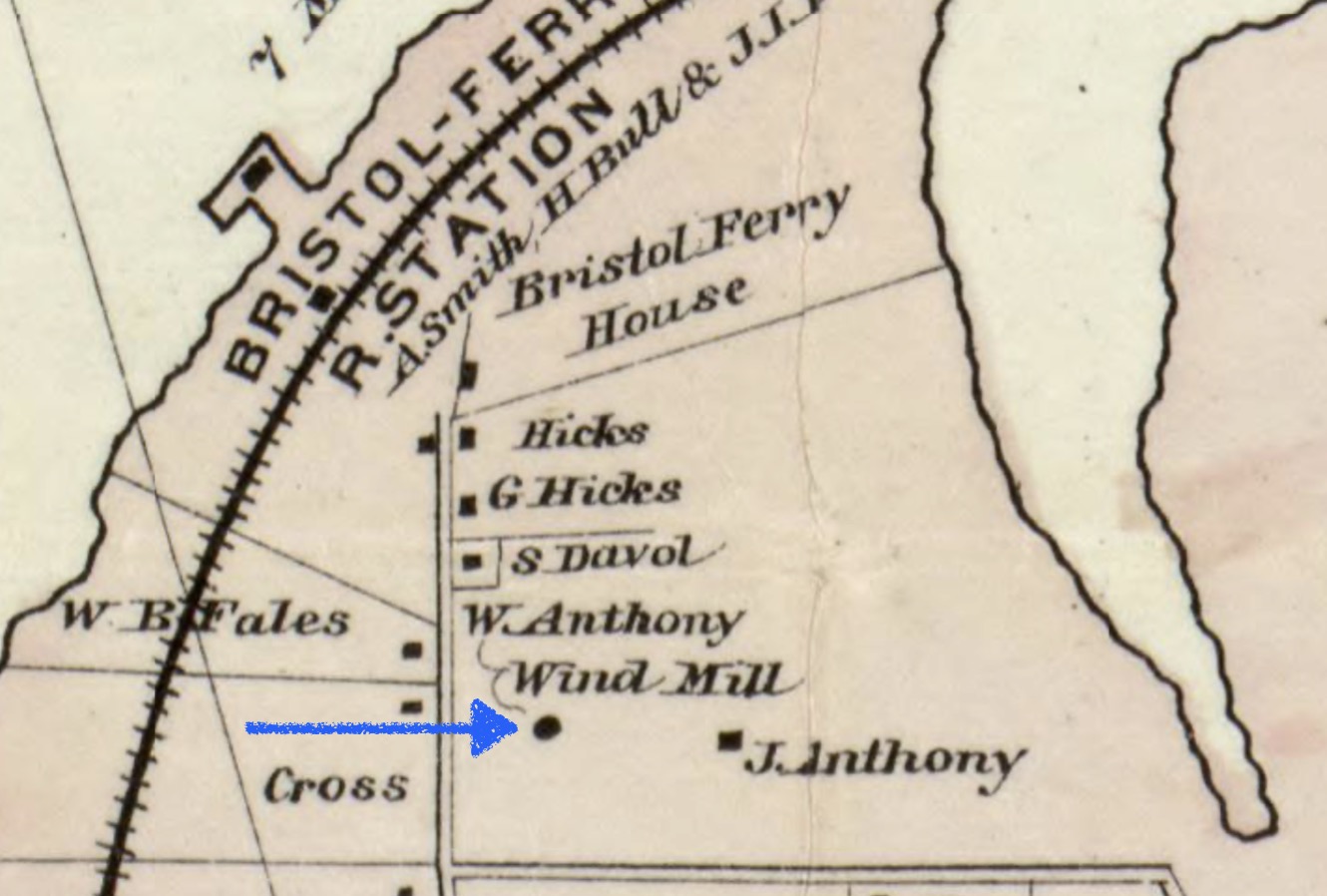
Looking at the Dripps Map created in 1870, mills are noted. Some of them we have seen in the 1850 map. Miller Benjamin Boyd was interviewed in the 1940s and he gives us background on some of the mills. The first mill the Boyd family ran stood by Bristol Ferry. The Great Gale of 1815 destroyed that one, however the 1870 map shows a windmill in that area.
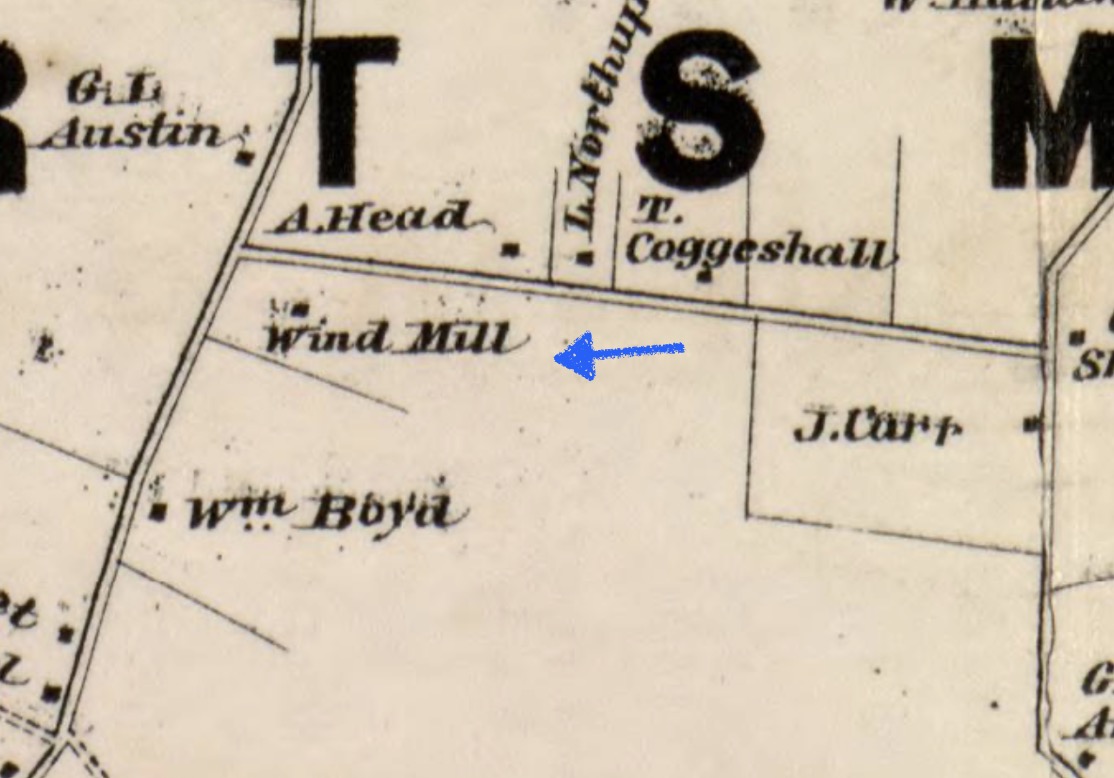
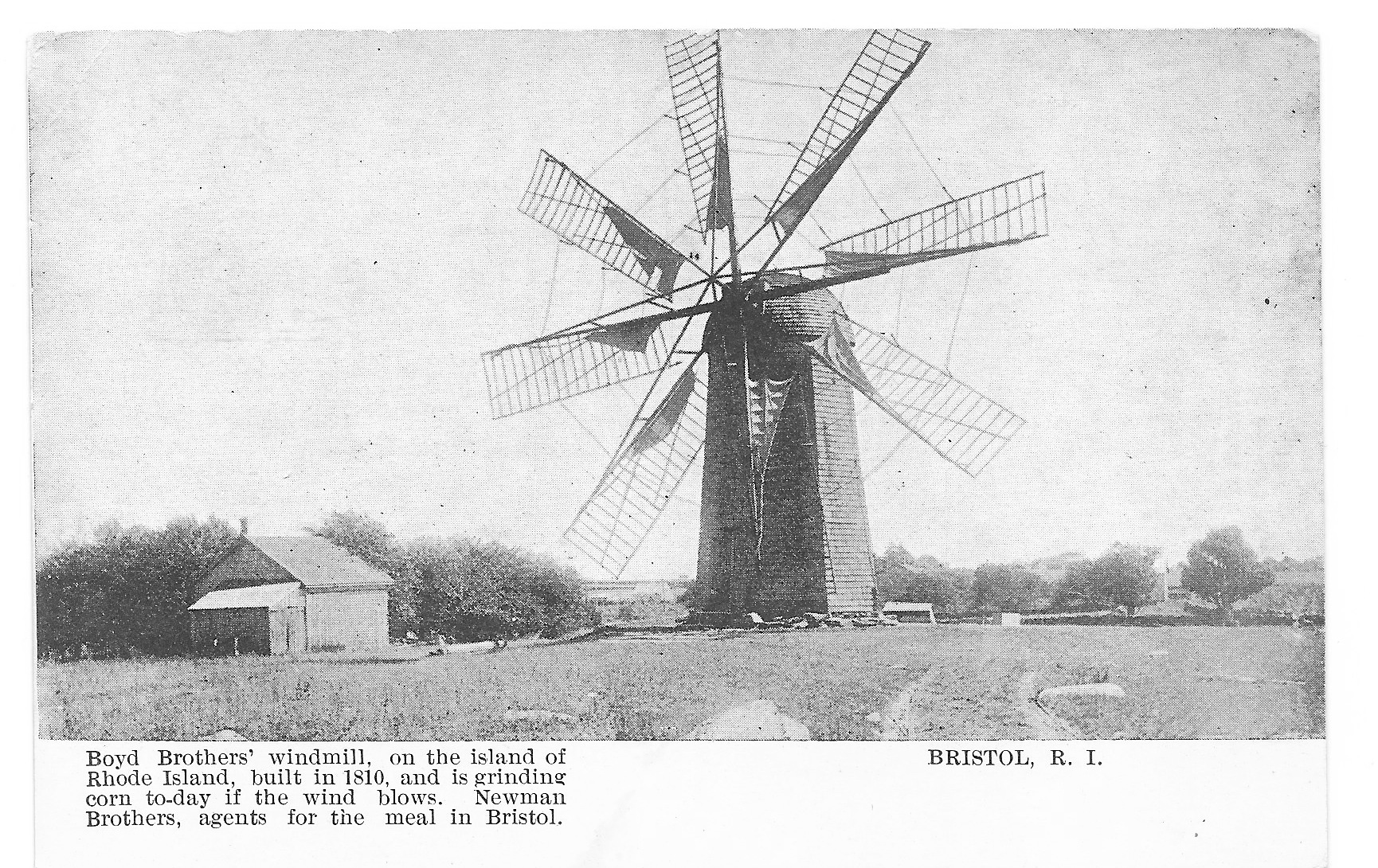
The Boyd family bought the Peterson Mill. It was located by Mill Lane near West Main Road. This mill was built in 1810 to grind grain to feed livestock. Boyd said that in 1901 he converted the Boyd Mill into a eight vaned windmill.
Bristol Ferry WindmillMill Lane and West Main – Boyd’s MillBoyd’s Windmill
The mill stood nearby West Main Road in Portsmouth by Mill Lane. John Peterson, a retired ship captain, built the mill in 1810. Boyd comments that the millers are very much like “sea captains” in the skills they need to manage the mills in bad weather. The timber came from Wickford across the bay. The article gives many details about the construction of Boyd’s Mill. The main shaft is twenty-two inches in diameter and nineteen feet long and is made of hard Georgia pine. Boyd said that in 1901 he converted the Boyd Mill into a eight vaned windmill. Boyd mentioned that cheap grain and meat from the western US made these old methods of farming unprofitable for Rhode Island farmers so they went more into truck farming.
“But there were many people who appreciated the fact that Rhode Island corn, which is of a different shape and color from any other, possessed merits for making meal for family use superior to any other cornmeal.” Boyd was referring to the famous Rhode Island Johnny Cake meal.Boyd commented that all meal up to 1895 was unsifted so that the cook had to sift it. Boyd invented a “power sifter” run by the mill.
By the end of the 19th century there were 6,000 sheep kept on the island and many hogs. November was slaughter time for the hogs that had been grown and fattened by the wind mill ground grain. As the miller, the Boyds received a portion of the ground grain as payment and they fed their hogs with it. Benjamin Boyd said his father took up to 6,000 pounds of pork to sell in New Bedford. The gristmill grain and hay fed cows, oxen, sheep, pigs and poultry.
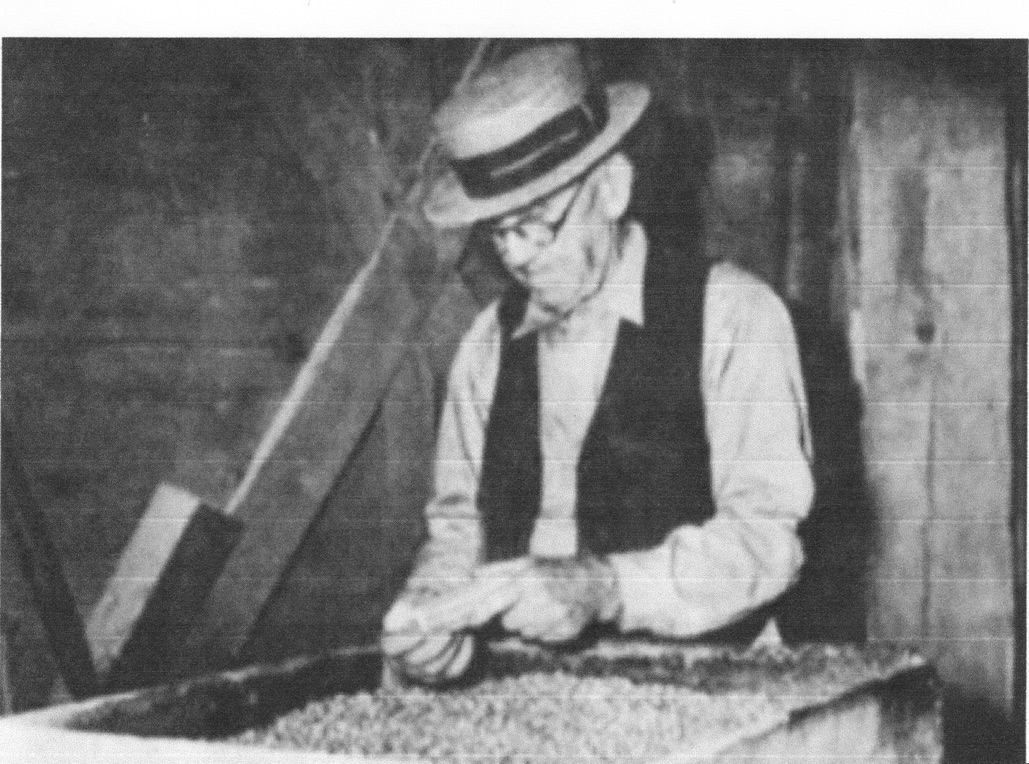
Benjamin Boyd
For Boyd, windmills were part of his heritage. He was a descendent of Nicholas Easton who built the first wind grist mill. “I have farmed all my life and have turned the black dirt of Old Mother Earth into wheat, rye, oats and barley to be ground into feed for livestock, and as I have baked many Johnny Cakes. I have literally turned the black dirt of Old Mother Earth into one of the finest food products known to man, the Famous Rhode Island Johnny Cake; ground by the power of the free air, which is the only thing that is free today.”
The Boyd Mill was taken apart, restored and rebuilt at Paradise Park in Middletown.
Benjamin Boyd shared his family’s history with wind mills in a 1942 newspaper article for the Fall River Herald. The article is in a scrapbook at the Portsmouth Historical Society.
Map: Dripps, M, and Adomiran Judson Ward. Map of Newport & vicinity, or Rhode Island. Newport, R.I.: Revised & published by Wm. Dame, Civil Engineer & A.J. Ward, Bookseller, 1870. Map. https://www.loc.gov/item/2013593287/.
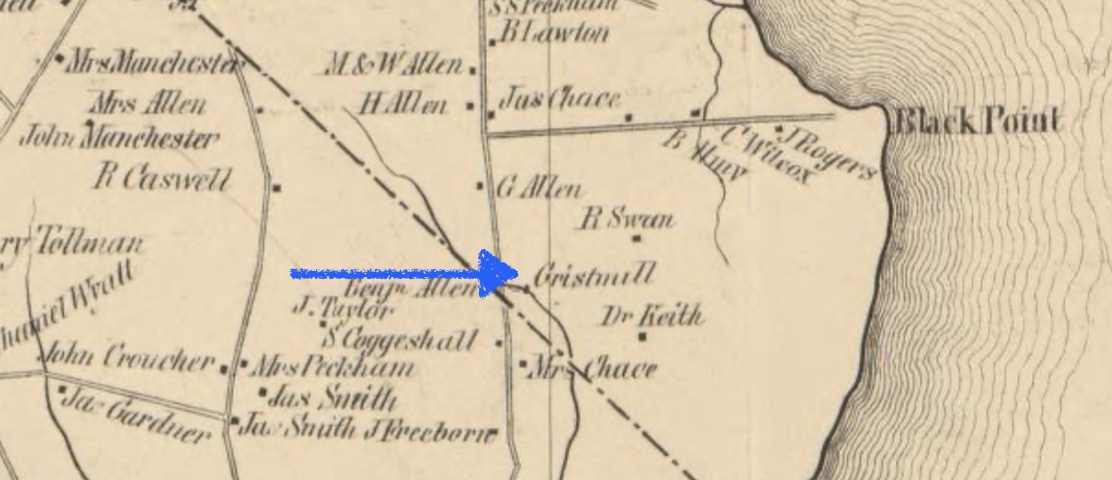
Portsmouth and Aquidneck Island maps are valuable sources of information on who had what property and where important features were located. When I looked for answers to a reference question on the mill that would have been on Old Mill Lane, the 1870 map didn’t show one in the area. When I went to the 1850 Walling Map I was able to locate it on a stream.
1. Gristmill near Old Mill Lane near Middletown Boarder.
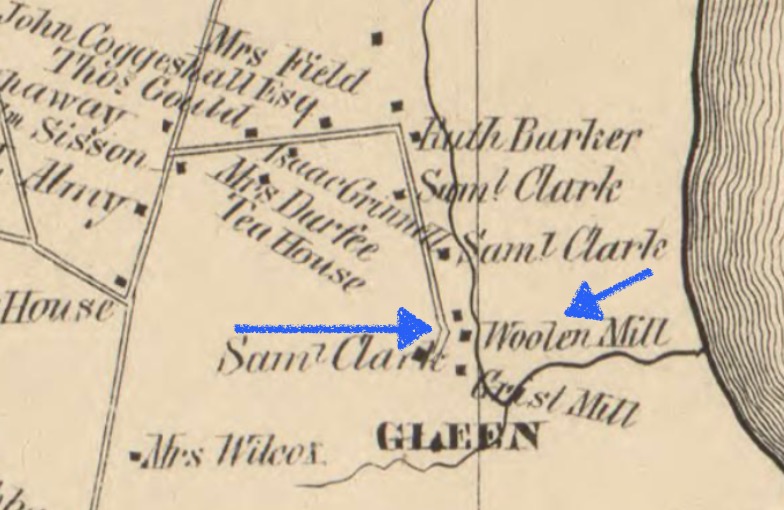
I searched the map for other mills in Portsmouth in 1850. How many more could I find? Heading North toward the Glen (Map calls it Gleen) there was a woolen mill and a gristmill. Those are mills I have come across in my study of the Glen over the years.
The Slocum gristmill from colonial days is sold to James Sisson. James Sisson then sells his mill and 46 acres around the brook to Joseph Cundall. What we call “the Glen” becames commonly known as Cundall’s Mills. In 1706 Joseph Cundall had left his native England to become an indentured servant in America. Becoming an indentured servant was a way a young person could learn a trade and get an education in exchange for working for seven years or more. Cundall seems to have learned his trade well and was in a good position to buy land as an adult. Water from the stream powered the carding and fulling mills to wash and pull woolen fibers. Joseph Cundall added almost a hundred more acres to his land around the Glen before he died in 1760. Old local history books tell the tragic story of his son Joseph who got lost in a Christmas Eve snowstorm and died on his way home from the mill. His gravestone is easily read in the old cemetery with a death date of December 24, 1811.
By 1815 the mills and the land are in the hands of Judge Samual Clarke, whose wife Barbary was a Cundall. The mill was still known as Cundall’s Mills and he advertised that he bought a new carding machine and could dye wool. He advertised that he could manufacture cashmeres, flannels and satinets. The land transfers are hard to follow, but by 1823 the mills were on the auction block and the inventory lists a gristmill and clothier works with looms and spinning machines. We think of Slater and his mills in Pawtucket, but Portsmouth had these too. Factories constructed of stone were located in the Glen until the Civil War but no trace remains. The stone structure in the Glen now is a later Glen Farm building.
Local historian Rev. Edward Petersen wrote in 1853: “Cundall’s Mills is one of the most romantic spots on the island, and has become a general resort of strangers, who visit Newport in summer, to enjoy the salubrity of its climate and its picturesque scenery.” Artists Currier and Ives even illustrated a picnic at the Glen in 1860. Henry Wadsworth Longfellow’s diaries record an 1852 visit: “Then we drove to the Glen, and walked down a lovely little valley, with a brown brook threading it and a silent mill, to the sea shore; a charming secluded nook.” The Glen was a popular spot to enjoy nature, take a walk, paint and even write poetry. Visitors would often enjoy a stop at Mrs. Durfee’s Tea House on the way home.
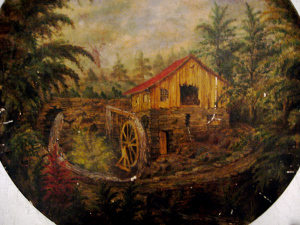
A “mill” building can be seen from Glen Farm Rd opposite the entrance of the barn complex. It has been beautifully restored as a private home. This building was raised on the foundations of an older mill site, but it does not date from mill days. The mill buildings appear on various maps as located on either side of the brook. We have a few images of some of the mill structures and we can imagine the mill pond through drawings and photographs. What is left today is the stonework mill runs that channel the brook down to the river. Unfortunately this beautiful part of the Glen is in private hands now.
Currier and Ives Image of Mill Pond.
Glen Mill Painting in Portsmouth Historical Collection.