Home

Rochambeau’s Orderly Book: A Key to Understanding The French at Camp Butts Hill

Leave a comment

Dr. Robert Selig’s translation of Rochambeau’s Orderly Book gives us an understanding of the French presence at “Camp Butts Hill” in 1780 to 1781. Orderly books contain daily “Morning Reports”, “Garrison orders” and “General Orders”. They don’t give a narration of what happened, but they often give us clues as to who was performing what tasks. We have had access to at least two orderly books from Massachusetts militia units, but Selig’s work brings us a fuller picture from the French side. Selig will be continuing his research and I look forward to adding new information from the engineers who were in charge of the construction at the fort.

In Selig’s article on the French engineers, he provides background to why the French were interested in building a stronger “Butts Hill Fort.” When the French arrived the fort was in poor shape and there was concern that the British may come back and invade Aquidneck Island again. General Rochambeau, Lafayette and others saw the fort as a key communications point if the British returned.

Colonel Jean Nicholas Desandroüins left a description of the fort of December 1780, just as Rochambeau’s engineers began their work. Desandroüin’s observations give us an idea of the condition of the fort when the French began their work.

“It was also necessary to provide the means of being rescued by ensuring communication with the mainland. With this in mind at the far end (northern-most point) […] a fort called Bootshill was built on the height which dominates (overlooking) the space between the two passes or ferry crossings of Bristol and of Howlands. Assistance can assemble under its protection. This good work is of a high elevation, well flanked, preceded by a ditch as wide and deep, dug partly in the rock. It was sufficiently stocked with artillery and could hold 500 men. For its construction, we took advantage of two older, very imperfect, redoubts, whose mutually supporting fronts were shaved off, and which were joined together by two branches with breaks and redans, to make a single piece of good defence and capacity.” (Quoted in Blondet, Jeux de Guerre, p. 239. Blondet dates the letter to 9 December 1780.)
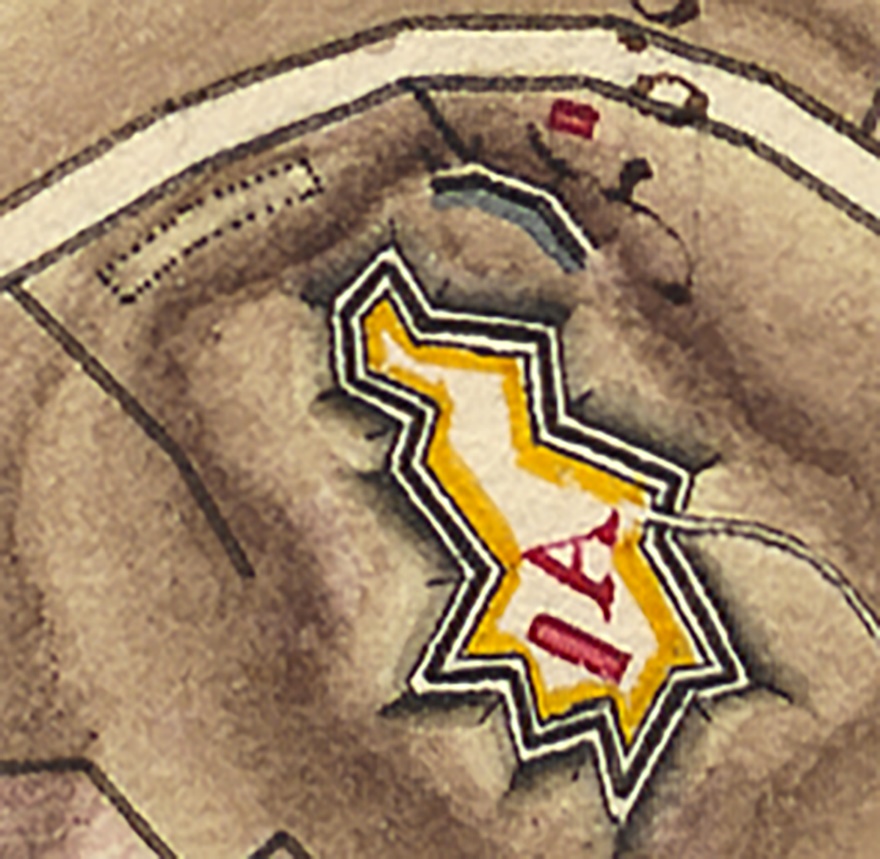
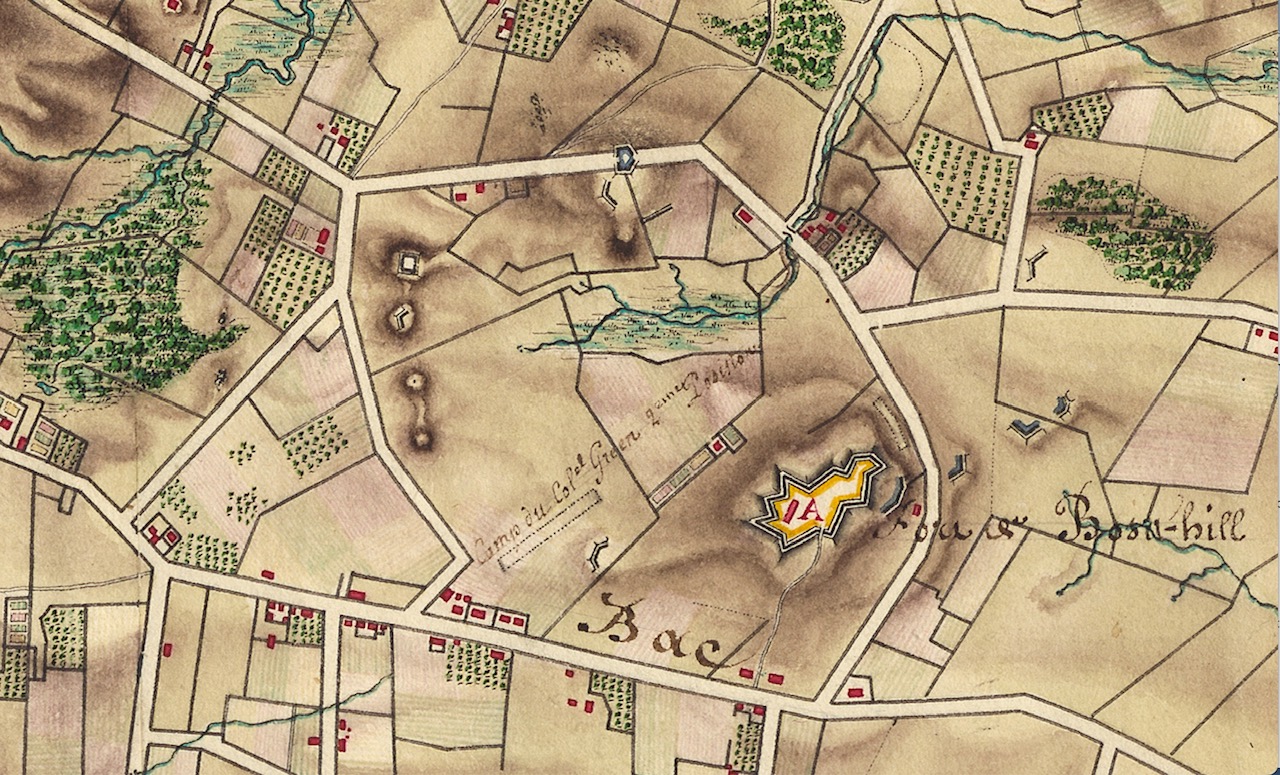
Butts Hill Fort from the Berthier Brothers Map 1780-81

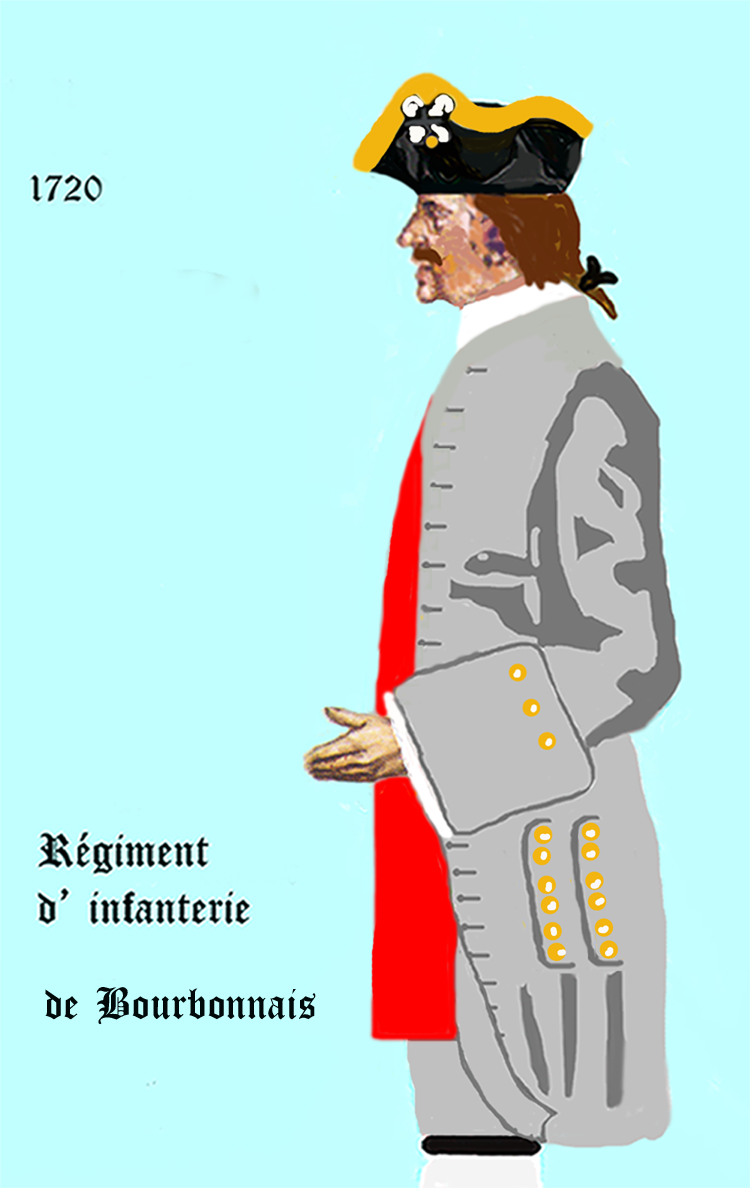
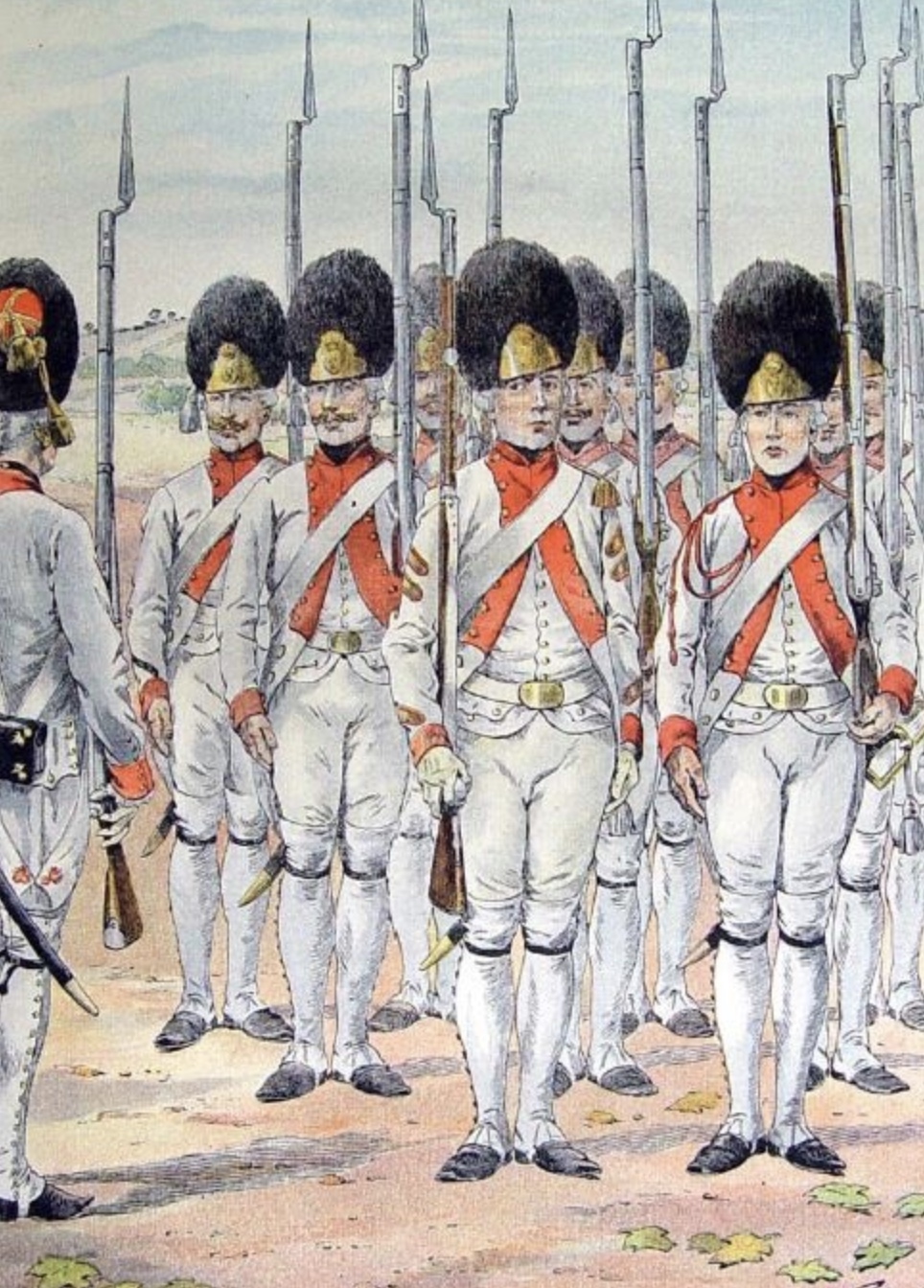
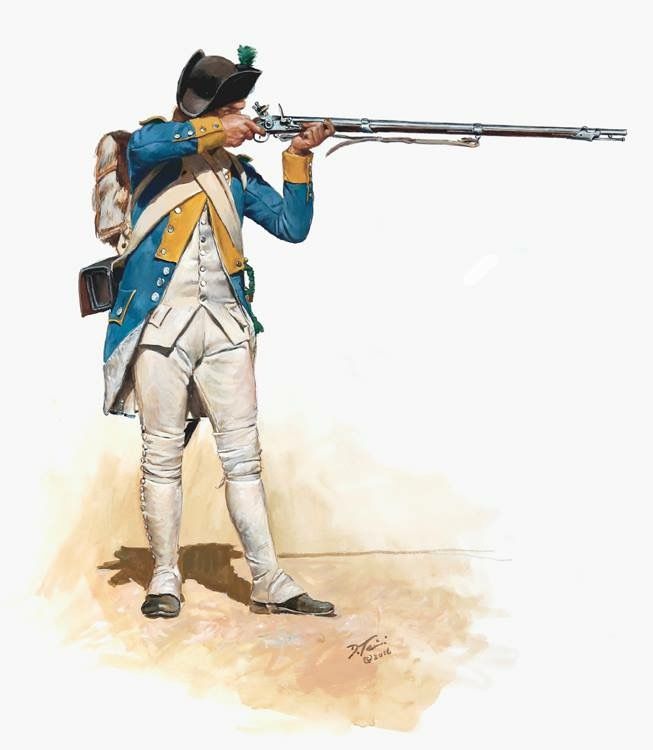
As I read the American Orderly Books from “Camp Butts Hill” (for example Orderly books of Ebenezer Thayer, Jr.) I imagined American militia aiding the French engineers and doing the physical labor at the fort. What I am discovering through Dr. Robert Selig’s work with Rochambeau’s orderly book, is that four French regiments where also present at the construction of the Butts Hill Fort. They included the Soissonnois, Bourbonnois, Royal Deux Ponts, and Santonge Regiments.

Quoting from the Selig’s English version of the orderly books:

Order of 9 December 1780
“Each regiment will furnish two squads [at 12 men each] and a sergeant, the brigade of Soissonnois a lieutenant, and that of Bourbonnois a Capitaine en second who will command the whole, they will assemble at 7 o’clock in the morning near the guardhouse on the Parade Ground. This detachment will march with arms and baggage to Butts Hill Fort near Howland’s Ferry to work there as directed to them by the engineer who will be there, they will take with them cooking pots, mess tins, flasks, and provisions for five days, which each regiment will take care to procure today. The captain who will command the detachment ordered to work at Butts Hill Fort, a mile from Howland’s Ferry, will keep his soldiers in good order and discipline, he will order each day only one corporal and four men as guards, and will not allow more than one cook be employed per regiment in order to keep as few men as possible from the work.”

This entry demonstrates that the French soldiers were actively working at fort construction. Five would work as guards and one as cook, but they wanted to “keep as few men as possible from the work.”

In the table below I have outlined the rotation of French Regiments as detailed in Rochambeau’s Orderly Book.

DateUnitDutyComment
12/23/1780Each regimentDistribute provisions
12/28/178Soissonnois, Santonge, Royal Deux Ponts – Bourbonnais 23 3 regiments return.  Take orders from Palisse, Major of the Royal Corps of EngineersFor the security of the post, the police of the guard, and the preservation of the fort’s works. The detachment will also take orders from Monsieur de Palisse, Major of the Royal Corps of Engineers, and from Monsieur Planchard for the work that can be done. 
Order of 31 December 1780 
SoissonnoisRelieve  previous
1/4/1781SaintongeRelieve previous
1/9/1781Deux PontsRelieve  previousAll the working soldiers employed in repairing the camp effects will be exempt from roll call and will be allowed to work until 8 o’clock in the evening. 
1/14/1781BourbonnaisRelieve  previous
1/16/1781
Rochambeau grantQuarter supplement to the ration of bread per day to the workers at the fort of Butts Hill Fort.
1/19/1781SoissonnoisRelieve  previous
1/24/1781SaintongeRelieve  previous
1/29/1781Royal Deux PontsRelieve  previous
2/2/1781BourbonnaisRelieve  previous
2/7/1781SoissonnoisRelieve  previous
2/13/1781SaintongeRelieve  previous
2/18/1781Royal Deux PontsRelieve  previous
2/23/1781BourbonnaisRelieve  previous
2/28/1781SoissonnoisRelieve  previous
3/5/1781SaintongeRelieve  previousWill be relieved by the first American troop that will establish itself in this fort
3/18/1781SoissonnoisSend to Butts Hill the soldiers named Armand,Corporal and Foucault, soldiers of the company de lay Boyere, fleur Damour of that company of Anselm and Bourdet of the company of Scanty were they will take the order of M. De Turpin, Captain of the EngineersAmericans relieve
4/1/1781Royal Deux PontsOne sergeant and a squad 
4/11/1781SoissonnoisOne corporal and six men
4/16/1781SaintongeOne corporal and eight men
4/21/1781Deux PontsOne sergeant and one corporal and 10 men
4/25/1781BourbonnaisOne sergeant, one corporal and 10 men
4/29/1781SoissonnoisOne sergeant and one corporal and 10 men
5/3/1781SaintongeOne sergeant and one corporal and 10 men
5/8/1781Deux PontsOne Sargent, three corporals and 20 men.
5/18/1781SoissonnoisThree corporals 10 men
5/23/1781SaintongeOne sargeant, three corporals 10 men


5/28/1781Deux PontsOne sargeant, three corporals 10 men


6/2/1781BourbonnaisOne sergeant, three corporals and ten men.
6/7/1781SoissonnoisThree corporals 10 men


The presence of, and the work carried out by, French soldiers at Butts Hill Fort from July 1780 and June 1781 is beyond doubt. The Orderly Book clearly established that within a week of their arrival in Newport, French engineers, most notably Major de Palys, were supervising repairs at the fort. At this point the work was carried out by American militia. It was only in December 1780, that French soldiers began working at Butts Hill Fort, which they did until June 1781, when Rochambeau’s forces deployed to New York. 
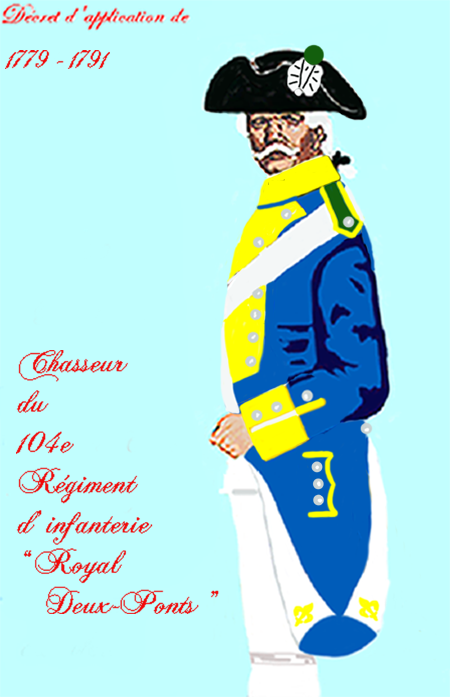
References:Dr. Robert Selig’s research is detailed in a video on Battle of Rhode Island Association website. Rochambeau’s Engineers at Butts Hill.

Illustrations: Par Claude-Antoine Littret de Montigny — Bibliothèque nationale de France, gallica.bnf.fr, Domaine public, https://commons.wikimedia.org/w/index.php?curid=84807137
Digging in: Information from Robert Selig’s work on the French at Butts Hill

Leave a comment

The Battle of Rhode Island Association has sponsored valuable research on the construction of Butts Hill Fort by Robert Selig and John K. Robertson. I am just now getting around to digesting the reports as I work on a timeline of what happened at the fort during the “Camp Butts Hill” period of 1780 to 1781. This is the first in a series of “Digging In” to the research. Today I am doing a close reading of Robert Selig’s article “Rochambeau’s Engineers at Butts Hill Fort July 1780 to June 1781.” The article appears in the Battle of Rhode Island website – battleofrhodeisland.org.

When the French arrived on Aquidneck Island, they found that work was being done on Butts Hill Fort. Selig writes about a diary entry of Ervoil d’Oyré. Describing the defensive works, he found upon arrival in Newport in July 1780:
“Finally, the works built by the Americans on the north of the island were re-established and repaired to assure communication with the continent.”

Selig writes about the French intentions on Aquidneck Island in their early days on the island.

“Prior to the arrival of Rochambeau’s forces in Rhode Island in mid-July 1780, Butts Hill Fort ‘was the only fort active on the north end of the island.’ As Rochambeau set up defenses against the anticipated and feared British attack, he sought to strengthen Butts Hill Fort to block any access from the north. Earthworks had been set up earlier in the war and repairs and additions were made by Massachusetts State troops, but French engineers almost immediately provided the expertise that the Americans lacked.”

Selig goes on to say that on the 9th of July, 21 British ships were seen near Newport Harbor. .

“The next morning Rochambeau accelerated the construction of defensive works, not only around Newport but at Butts Hill Fort as well. An entry in the journal of Major Marius de Palys’s Journal de Campagne, mentions the redoubts at Howlands Ferry and Butts Hill Fort.

” ‘Eight days had elapsed since the commencement of the work, and no thought had yet been given to fortifying the point of the island which should have 1st thought of. This is the point of Howlands Ferry, and Monsieur de La Fayette decided to occupy it better than it was at the time. There were two bad redoubts, which were connected and formed into a respectable fort, which had not been finished, the fort and another in the shape of a star, which protected the ferry together with a battery on the mainland assured communication with the mainland, which was essential for relief or retreat in case of misfortune.'”

Palys’s Journal continued: “Eight days had elapsed since the commencement of the work.”

That would place the date of the beginning of the work to around 28 or 29 July 1780. Selig tells us that La Fayette spent ten days in Newport from the evening of 24 July to late afternoon 3 August 1780. In a letter to General George Washington, dated “Newport july the 26th at seven o’clock P.M.,” he informed Washington that he “could not help advising him [i.e., Rochambeau] very Strongly and very often to erect works and keep a communication oppenn’d with the Continent By Howland’s Ferry or Bristol Point. That matter will I hope be attended to in the Course of the next day.”

When I started researching Butt Hill Fort, I found several orderly books from Massachusetts militias who were at the fort. I imagined a few French engineers supervising the American workers. Reading through Selig’s translation of a French orderly book gives me a different image. There was a constant French presence at the fort with a five day rotation of men from Soissonnois, Santonge, Royal Deux Ponts, and Bourbonnais. Every five days a new detachment would leave Newport at 7 AM. “This detachment will march with arms and baggage to Butts Hill Fort near Howland’s Ferry to work there as directed to them by the engineer who will be there. They will take with them cooking pots, mess tins, asks, and provisions for five days …The captain who will command the detachment order to work at Butts Hill Fort, a mile from Howland’s Ferry, will keep his soldiers in good order and discipline, he will order each day one corporal and four men as guards, and will not allow more than one cook to be employed per regiment in order to keep as few men as possible from the work.” (Order of 9 December 1780).

The orders of December 28, 1780 provide the duties of the French troops -“for the security of the post, the police of the guard, and the preservation of the fort’s works,” The detachment takes orders from Monseur de Palisse, Major of the Royal Corp of Engineers and from Monsieur Planchard.

The French Orderly book lists orders from December 23, 1780 to June 7, 1781. French forces left Aquidneck Island to travel south in June of 1781. The road to Yorktown began with Aquidneck IsIand. On their way to Bristol Ferry the French army would pass nearby the fort they had been working to build.

Recreating Roderick Terry’s Speech

Leave a comment

We know that Roderick Terry saved Butts Hill Fort from being divided into 200 house lots. We know he turned over the property to the Newport Historical Society with restrictions. We know that Terry spoke during the dedication ceremonies on August 29, 1923. What did he tell the crowd that day? I am trying to put together a script for an actor who will be portraying Terry during the October 19th tours of the fort. The only record I have to go from is an article in the Newport Historical Society Journal from November of 1929.

Terry spoke towards the end of the ceremonies. He began by remarking “that in the presence of so many who were descendants of those who had fought on this spot 145 years ago”, it may be hardly proper for him to speak. He was not a native of Rhode Island, but was descended from Connecticut stock. His ancestor was a Colonel of the Connecticut forces in the Revolution. He had tried to prove his ancestor fought in the battle, “but unfortunately it was not so.”

Turning his thoughts to the celebration that day, he said it was the realization of the dream of many years. He had not been alone in the dream, “for several times others had attempted to secure possession of this site, but for one reason or another had been unable.” He felt grateful that “he could be the means of preserving for posterity these fortifications, which I hope would serve to all future generations as a reminder of what our ancestors had done to give us our Independence.” He hoped that “those who would visit this historic spot would find their Patriotism aroused, for in spite of what is the opinion of many today, we believe thoroughly in Patriotism, and that there are few nobler qualities to inspire great deeds”

He was happy to welcome the Artillery companies who make the day more enjoyable and instructive. Their uniforms carry our minds back to the day of the battle when their uniforms were not so clean. “But whether in 1778 or 1923, the wearers of these historic uniforms must be thrilled with the thought of what they represented.”

He closed by expressing the “hope that many in the years to come might visit this interesting spot and find here inspiration ever for better living.

These fortifications were not given to the Newport Historical Society as a personal possession of their own so much as a trust, which they held for the community. The purpose and hopes which lay at the bottom of the gift were listed in the deed given.

That the Newport Historical Society and its successors “shall forever preserve, keep and maintain” these premises “as a memorial or monument to the memory of those who fought in the American Revolutionary War – and as a place where the public may view and study the battlefield on which our soldiers fought to be enlightened in the battles fought in American History. The premises shall always retain the name of “Butts Hill Fort.”

Tracing the Last Days: Butts Hill Fort Ends Its Service

Leave a comment

What happened to Butts Hill Fort after the French left? I am re-exploring the timeline I originally wrote a couple of years ago. When I see references sited, I check them out. It is not that I don’t trust the historian, I do. However I like to see the primary source for myself. I am using a digital version of Rhode Island records. I’d like to thank Steve Luce of the Portsmouth Historical Society for giving me a way of searching the records.

“We, the subscribers, being appointed by the Honorable the General Assembly to point out the best measures for the defence of Rhode Island, do report: That it is necessary to have five platforms laid down at the fort at Easton’s Point; that there be immediately removed from Butts’s Hill, five eighteen-pound cannon, with their carriages, ammunition and apparatus, belonging to the same; and that there be a company, under the command of a captain, stationed in or near the said fort, where a constant and vigilant guard is to be kept.

Newport Artillery Fires Cannon at Butts Hill.

We do further recommend that two field pieces be kept in the fort at Brenton’s Point, with proper ammunition; and a subaltern’s guard, composed of persons that understand the use of cannon, always to be on the ground. These, being supported by the garrison of Butts’s Hill, and occasional suecors from the main land, we doubt not will be able to repel any attack that may be made on Rhode Island in the present situation of the enemy.

We also recommend that the whole militia of the state be kept in readiness to march on the shortest notice; and that a conductor of military stores be appointed, to take charge of all the military stores on Rhode Island, and at Bristol and Tiverton.

All which is submitted by your Honors’ most obedient, humble servants,

JABEZ BOWEN, THOMAS HOLDEN, JOHN COOKE, THOMAS TILLINGHAST.

JOSEPH BROWN,

Newport, August 25, 1781.”

The suggestion was accepted so Rhode Island Records state:

“And the said report being duly considered,

It is voted and resolved, that the quartermaster immediately hire a sufficient number of teams to remove five eighteen-pound cannon, with their carriages, necessary ammunition and apparatus, from Butts’s Hill, to be placed in the fort at Easton’s Point, agreeable to the report of the committee appointed to advise the best measures for the defence of Rhode Island; and that in case he cannot hire, to impress the same. “

The garrison at Butts Hill Fort and the equipment at the fort were being assigned elsewhere as the threat seemed to come more from the South toward Newport than to North Portsmouth.

A Sham Battle in Portsmouth 1780 – a Note to add to John Robertson’s presentation.

Leave a comment

1922: D.A.R. placed tablet “To mark the site of Butts Hill Fort”

Leave a comment

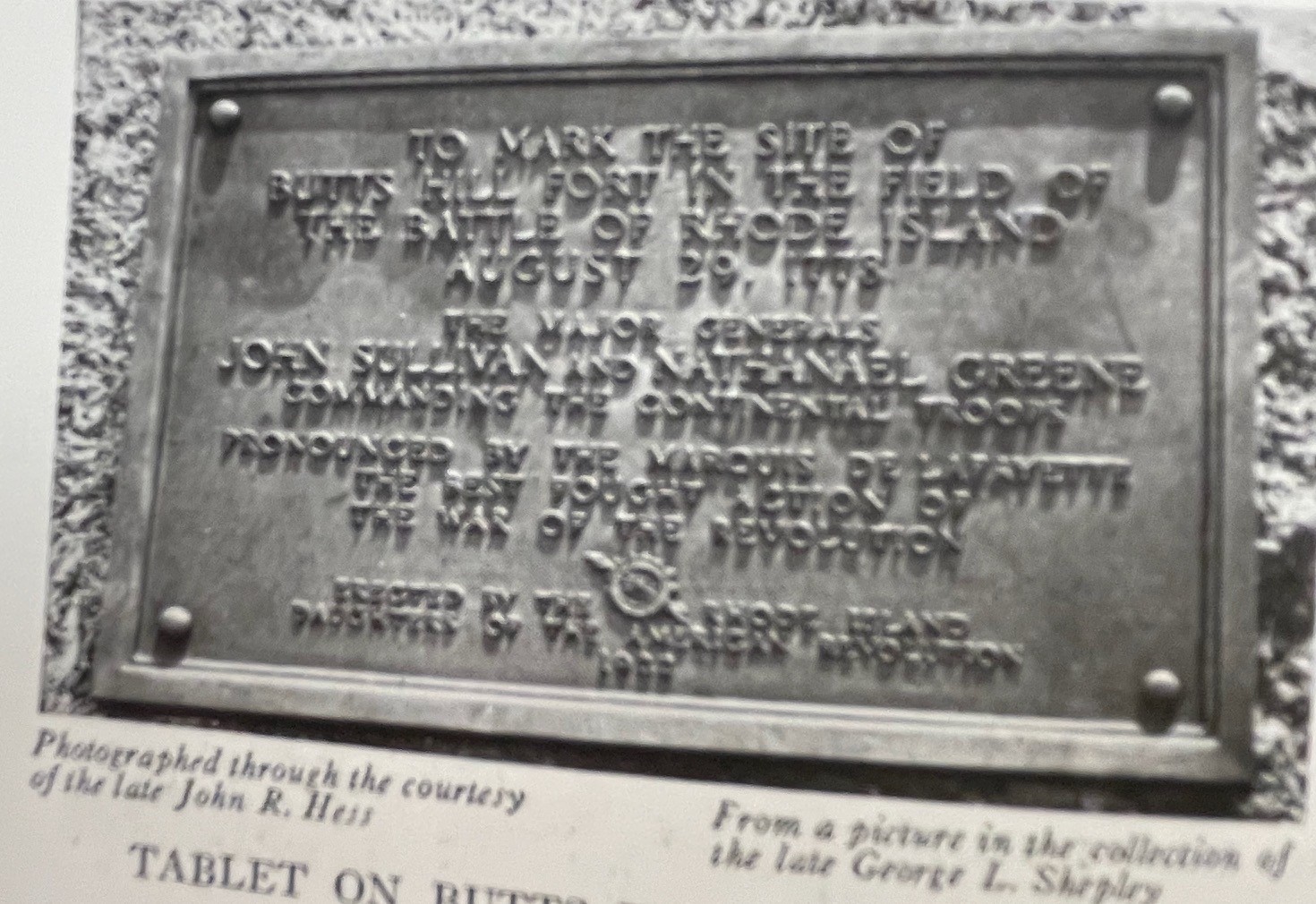
In a corner of Butts Hill Fort there is a boulder that obviously once held a plaque. The Butts Hill Fort Restoration Committee is diligently working on clearing the area around the boulder and there are hopes of restoring the plaque or making a facsimile to restore the memorial to its intended tribute. Today the original memorial is damaged and in the protective custody of the Portsmouth Historical Society. We know what it looked like in its prime.

A 1925 book “France and New England” by Alan Forbes and Paul Cadman, prominently mentioned the plaque and features an image of it. (1)

“Butts Hill Fort, on the east road between Tiverton and Newport and in the township of Portsmouth, on the north end of the island of Rhode Island, has been permanently associated with Lafayette by placing at the southeast corner of the earthworks a native boulder, on the face of which is a bronze tablet, the inscription reading as follows:

To mark the site of

Butts Hill Fort in the Field of the Battle of Rhode Island

August 29, 1778

The Major General

John Sullivan and Nathanael Greene

Commanding the Continental Troops

Pronounced by the Marquis De Lafayette

The Best Fought Action of

The War of the Revolution

Erected by the Rhode Island

Daughters of the American Revolution

1922

Even before Rev. Roderick Terry purchased the land that encompassed Butts Hill Fort, the Daughters of the American Revolution (D.A.R.) were honoring the fort on the one hundred and forty-fourth anniversary of the Battle. Newspaper accounts at the time report that two hundred and fifty people gathered on August 29, 1922 to unveil a tablet that “commemorates the battle on August 29, 1778 when sturdy Americans under Gen. John Sullivan fought the best planned battle of the Revolution.” (2)

The unveiling drew members of the D.A.R. from all “corners of Rhode Island and neighboring states.” (Newport Mercury). Other organizations took part in the ceremonies as well. Portsmouth Girl Scouts gave the bugle call and sang the “Star Spangled Banner.” Invitations were sent to the Sons of the American Revolution, Rhode Island Historical Society, Newport Historical Society, Rhode Island Citizens Historical Society, Bristol Train of Artillery, Sons and Daughters of the Puritans and Quequechan Chapter from Fall River. The public was invited to attend. (3)

After the unveiling, prayers and speeches, the guests were treated to a basket lunch at the Sprague Street home of Mrs. D. Frank Hall. It was the Hall family that owned the fort property before Rev. Terry bought it and put it into the care of the Newport Historical Society.

The Lafayette quote “The best fought action of the War of the Revolution” intrigued me because I have been researching the Marquis’ role in the Rhode Island Campaign. This quotation is widely attributed to Lafayette, but I could not find a confirmation in any of his letters of the time. Lafayette missed most of the action in the Battle of Rhode Island because he was sent to Boston to persuade the French fleet to come back to Newport. He did however, lead the last of the American troops to safety in Tiverton. He greatly admired Sullivan’s skill in executing a well planned retreat.

Sources:

  1. Forbes, Aland and Paul Cadman. The French in New England. Boston, State Street Trust, 1925.
  2. Newport Mercury, Sept.2, 1922.
  3. Fall River Evening Herald, August 25, 1922.

When Did Butts Hill Fort Begin?

Comments Off on When Did Butts Hill Fort Begin?

Subscribe to continue reading

Subscribe to get access to the rest of this post and other subscriber-only content.

Butts Hill Fort 1781: Palisades, Ditches and Ordnances

2 Comments

Letters written by American forces during the 1780-81 time that Americans and French were working on Butts Hill Fort give us some details that enable us to visualize the fort to some extent.

There is a remarkable new book by John Robertson (Revolutionary War Defenses in Rhode Island) that provides more clues to what the fort might have looked like in 1781. Robertson relates information from letters from Major General William Heath and Col Jacobs.

“On 30 August MG Heath requests the Deputy Quarter Master to supply 3,600 palisades ten feet long and from five to eight inches in diameter for use at the fort.” (Robertson p. 75)

With the scarcity of wood for heat and cooking after the brutal British Occupation, I doubt that 3,600 palisades were put up at the fort.

Robertson also gives us information from a letter from Col. Jacobs to Heath on September 5th.

  1. The circumference of the ditch in rods is 111 (about 1,830 feet)
  2. 81 of which are solid stone
  3. 4 rods have been dug to 6 ft, 26 to 5.5 ft. 27 to 5 feet, 38 to 3ft, and 16 to 1.5 ft.
  4. The depth from surface to stone was 18 inches.

It is difficult for me to even imagine this and I hope that someone can take these measurements and draw what it might look like.

What kind of ordnance did they have at Butts Hill Fort?

Robertson found a return of Ordnance document (in and near the fort) on September 26, 1780

Listed are:

  1. 6 iron 18 pounders. (Five are on garrison carriages.)
  2. 2 four pounder brass cannon on field carriages.
  3. The magazine had 643 dozen musket cartridges.
  4. Four spiked cannons,
  5. Four dismounted cannons.

When the French left Aquidneck Island in June of 1781 the fort was complete but the French guns had been removed. The fort was occupied until July of 1782. There was no longer fear of a British attack on Rhode Island (Aquidneck Island). On September 19th, 1782, a Rhode Island resolution passed that authorized Col. Archibald Crary to call on the commanding officer at Newport for help in removing the cannon and stores from Butts Hill and move them to Providence.

In June of 1783, a Rhode Island resolution passed to authorize William Anthony, Jr. “to sell at public venue the gates, timber, etc on Butts’s Hill in Portsmouth” (Bartlett, Records IX, p. 709). There were reports that the wooden barracks building was taken by the Town of Portsmouth to use for a poor house, but it was in rough shape and was quickly broken up. From the French maps we know there was a barracks there, but I don’t have a confirmation of what happened to the building. Perhaps Portsmouth town records may shed some light on that question.

Butts Hill Fort was no longer fortified.

What do the letters and documents tell us about what Butts Hill Fort might have looked like?

  1. It had a gate
  2. It had a barracks
  3. There was timber at the fort – but we have no confirmation palisades were installed
  4. There was a magazine for ammunition
  5. 6 (18 lb) cannons – five on garrison carriages
  6. 2 (4 lb) brass cannons
  7. There was about1830 feet of ditches around the fort (some ditches deeper than others).

Archaeological study-Babit

Butts Hill Fort 1781: French Masons and Sally Ports

2 Comments

We can get clues to what Butts Hill Fort may have looked like in 1781 from the orderly books of the American units who were helping the French reshape the fortifications into a proper fort. One of these orderly books was written by Ebenezer Thayer Jr. It covers August 16 to November 28, 1780. It is available through the Huntington Digital Library. There is another orderly book at the John Hay Library at Brown. It is difficult for me to transcribe the one at Brown. Thayer’s book was less difficult to transcribe and covered a greater period of time, so it was easier for me to draw material from it. Thayer, a Harvard educated minister, was in charge of a three-month regiment of a Massachusetts militia raised to support the Expédition Particulière, the French expeditionary army under the command of Rochambeau. The regiment was placed under the command of William Heath and stationed in Rhode Island at Butts Hill.

Oct 17. 1780 – Thayer’s orderly book. Transcription adapted for understanding.

The wagon masters of the Brigade are directed to attend on the works with their Wagons at the time the Fatigue party (Non Military chores) goes on the works and fetch one Load of Stones each for the purpose of Building the pillows (could that be pillars?) of the Fort every morning until they Receive further Orders from the Commandant. And they will apply to the (Linguister?) at the fort to know where the Stone shall be brought from.

One group that were assured of good provisions were those actively helping the French masons.

October 16th “There are four men to be detached from the brigade to attend constantly on the French Masons until the stone pillows (pillars?) of the Fort are completed and two masons detached to assist the French Masons until the works are finished and for their service they shall receive half a pint of rum a day when in the store.” Their provisions are ready for them so that they can complete the Fort works in a timely manner.”

Fort building was hard work. One entry records that the American wagons are bringing loads of stone to the works at Butts Hill Fort. They are building a “sally port” which is a secure, controlled entry way to an enclosure like a fort. All tools must be returned to the engineer. Members of the Black Regiment continued the “works” at Butts Hill Fort once the Massachusetts militias departed.

October 25, 1780: “The wagoners will attend on the works tomorrow and fetch two load of stones each for the building of the pillows of the sally port”

They are building a “sally port.” All tools must be returned to the engineer. What could a sally port to an earthenware fort look like? We have an example that gives us an idea. Below are examples of sally ports with earthen fortifications. Both images are in the collection of the Library of Congress. The image on the left is of Fort Wayne in Detroit. The image on the right is from Yorktown.

What have we learned about Butts Hill Fort in 1781 from the Orderly Book of Thayer?

  1. In 1780 a sally port was being constructed.
  2. French and American masons worked on the sally port.
  3. Wagon loads of stone were being brought up to the fort.
  4. “Pillows” or could they be pillars, were part of the sally port design.

I would welcome the help of those who understand more about military fortifications to guide me on the meaning of the “pillows.” The wagoner’s were getting guidance from the “Linguister” (Singuister) on where to get the stone. Who in the military could that be?

Butts Hill Fort 1781 – the Shape of It

Leave a comment

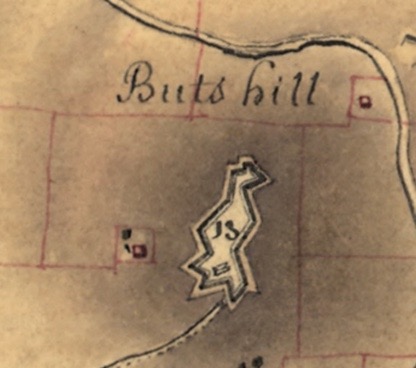
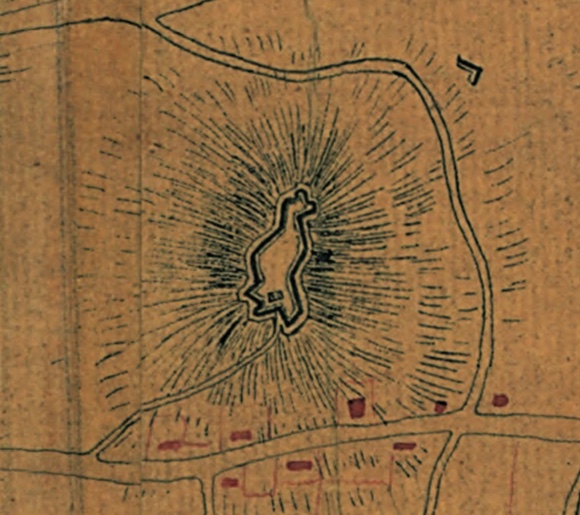
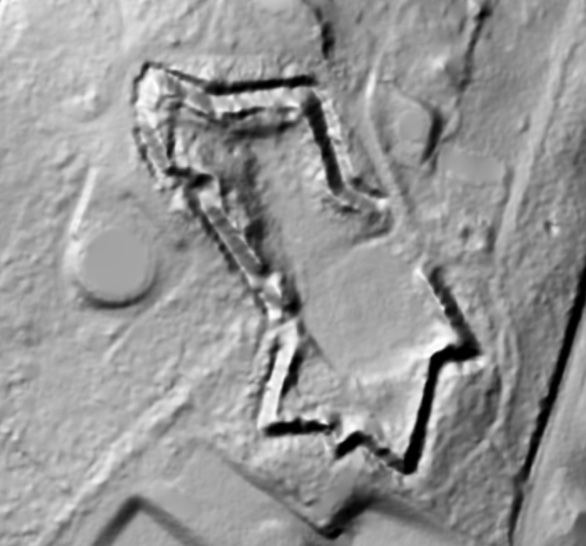
I am continuing to find clues to what Butts Hill Fort looked like in 1781 after the French and Americans had made it into a true fort. In this blog I am gathering images that might help us figure out the shape of the fort.

The first three images are from French made maps. The top two are Rochambeau maps in the Library of Congress. The third map is in the Pierce Collection of the Portsmouth Free Public Library and is also a French map.

What do we learn from the maps?

  1. The entrance was on the Southeast.
  2. There was a road leading from the entrance to East Main Road.
  3. There was a barracks inside the fort.
  4. The last map seems to show some defenses to the northeast – outside of the fort.
  5. The last map shows were Col. Greene’s men were camped while working on the fort with the French.
  6. The triangular defensive (ravelins) positions are most prominent to the south.

The image below is LIDAR- Light Detection and Ranging. It uses light to measure distances and is also known as laser scanning or 3D scanning. It shows us what is under the vegetation on Butts Hill today. We still have the elementary outlines of the fort under the vegetation today.

Older Entries Newer Entries